ACKNOWLEDGEMENTS
My special thanks to Carolina Alvarado Camero, who coordinated the images and wealth of information with intelligence, professionalism and dedication.
My gratitude also goes to my publisher, in particular to Diana Steel and Marco Jellinek, whobelieved in and supported this project from its beginning.
Frontispiece:
Brooch in the shape of Italy
Gianfranco Ferré
Milan, early ’70s
Handworked silvercoloured metal sheet
of inspiration for subjects and themes, but as an example to follow in the area of precision machinery and technology applied to the production of fashion jewellery. Exploiting the potential of the metalcasting technique used widely in the United States, Calestani massproduced large quantities of goodquality ornaments.
The few articles on fashion jewellery published in specialized magazines between the mid1930s and the end of the Second World War make it clear that Giuliano Fratti was the first creator of such items to take advantage of the recently passed dictates of autarky (193640), going on to attain international success as early as 1948 (a few years after the autarky had finished). Fratti used the materials imposed at the time by the Fascist regime (raffia, cork, wood, berries, walnuts and almonds) with such an eccentric creativity that he attracted the attention of French couturiers –including Balmain, Schiaparelli and Fath – and, at the same time, he managed to sell his works to major American department stores. For once, an Italian creator was the one to inspire the French, rather than vice versa – a noteworthy accomplishment.
Another fashion jewellery producer to gain attention in the press was the Genoese manufacturer Alda. A twopage article published in Bellezza in July 1943 praised her fashion jewellery, which had already been displayed at the Milan Triennale in 1940, and above all her use of wooden beads and distinctive sense of colour.
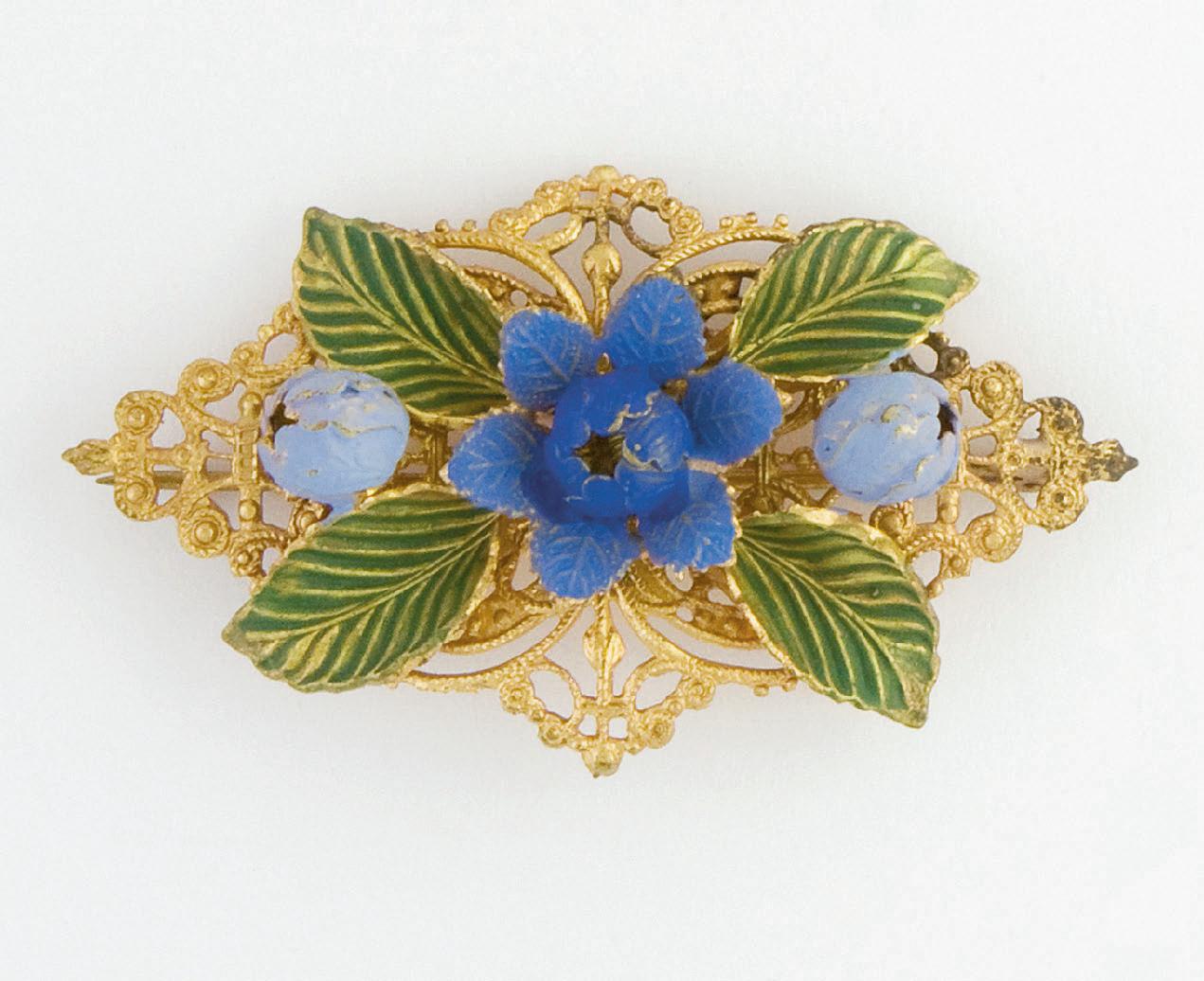
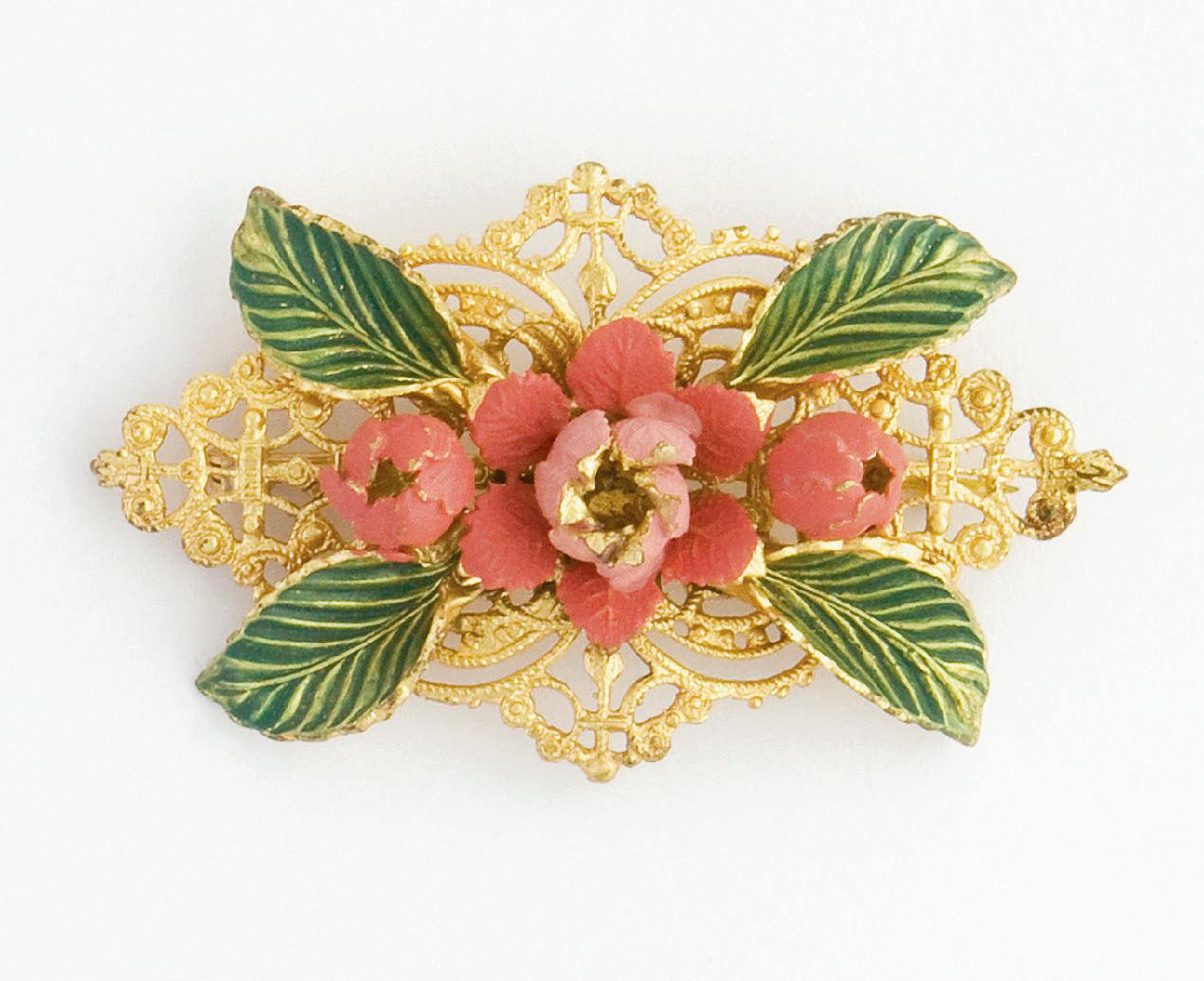
Brooches representing flowers and leaves Fabbriche Riunite Placcato Oro (United factories for goldfilled jewellery) Casalmaggiore, 1950 Gilded stamped metal, partially painted
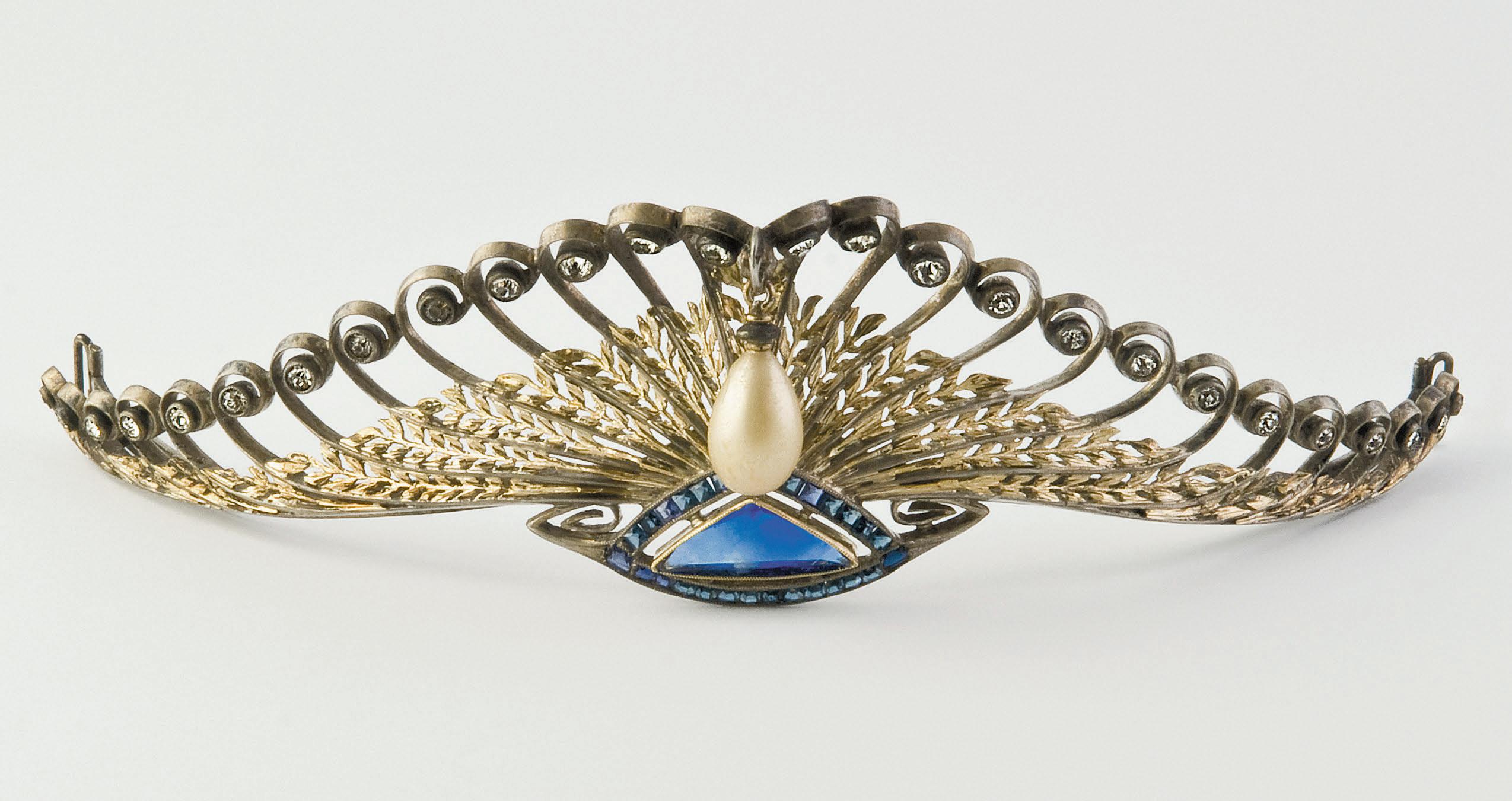
Diadem
Edoardo Saronni, Milan, c. 1910
Silver, rhinestones, drop pearl and glass stones simulating sapphires
Published in Saronni E., Orafo, Gustavo Modiano, Milan, 1927, Table 2 p.102
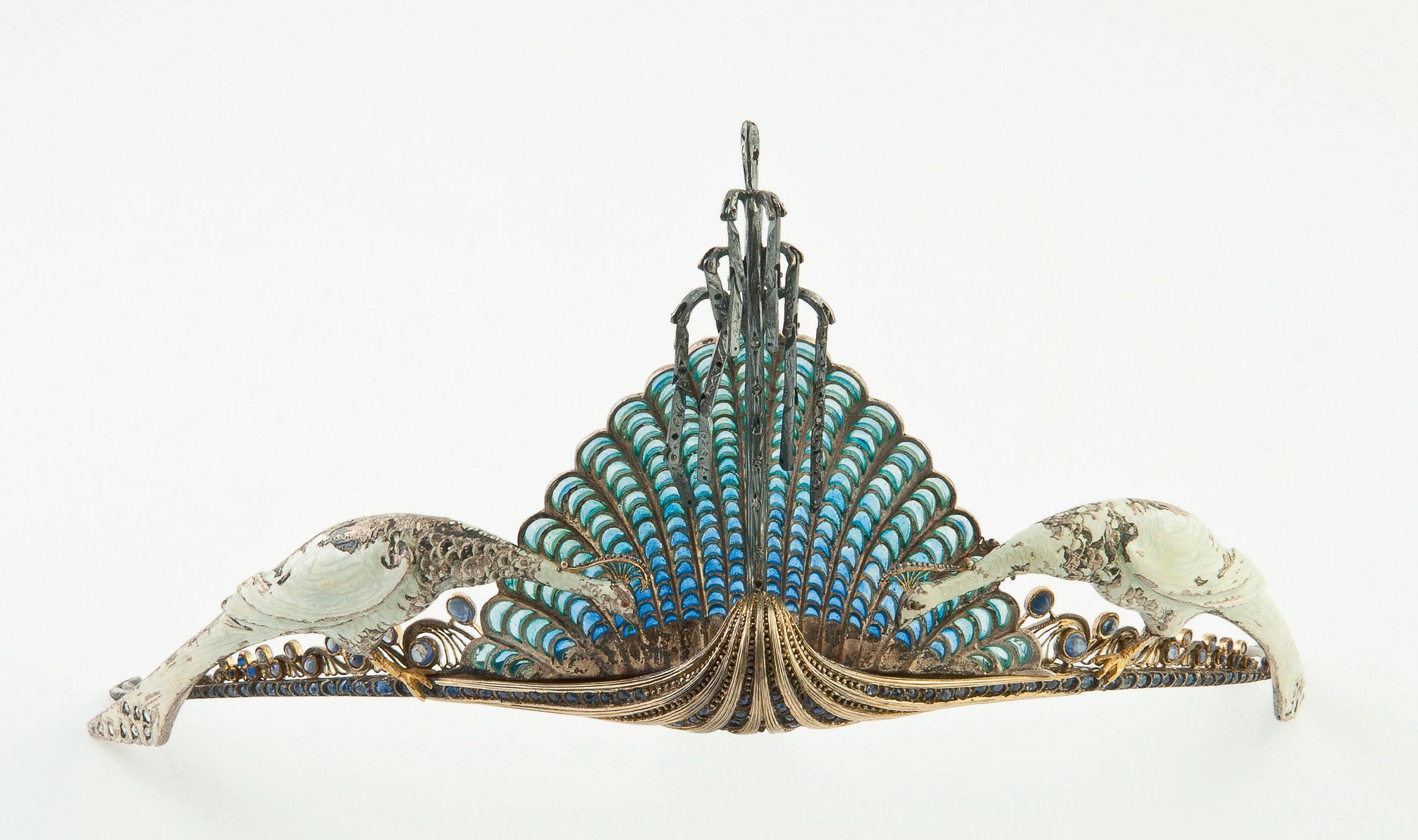
Diadem with peacock motifs
Edoardo Saronni, Milan, c.1905
Silver, plique à jour enamel, enamelled birds, glass stones simulating sapphires
Published in Saronni E., Orafo, Gustavo Modiano, Milan, 1927, Table 4 p.104
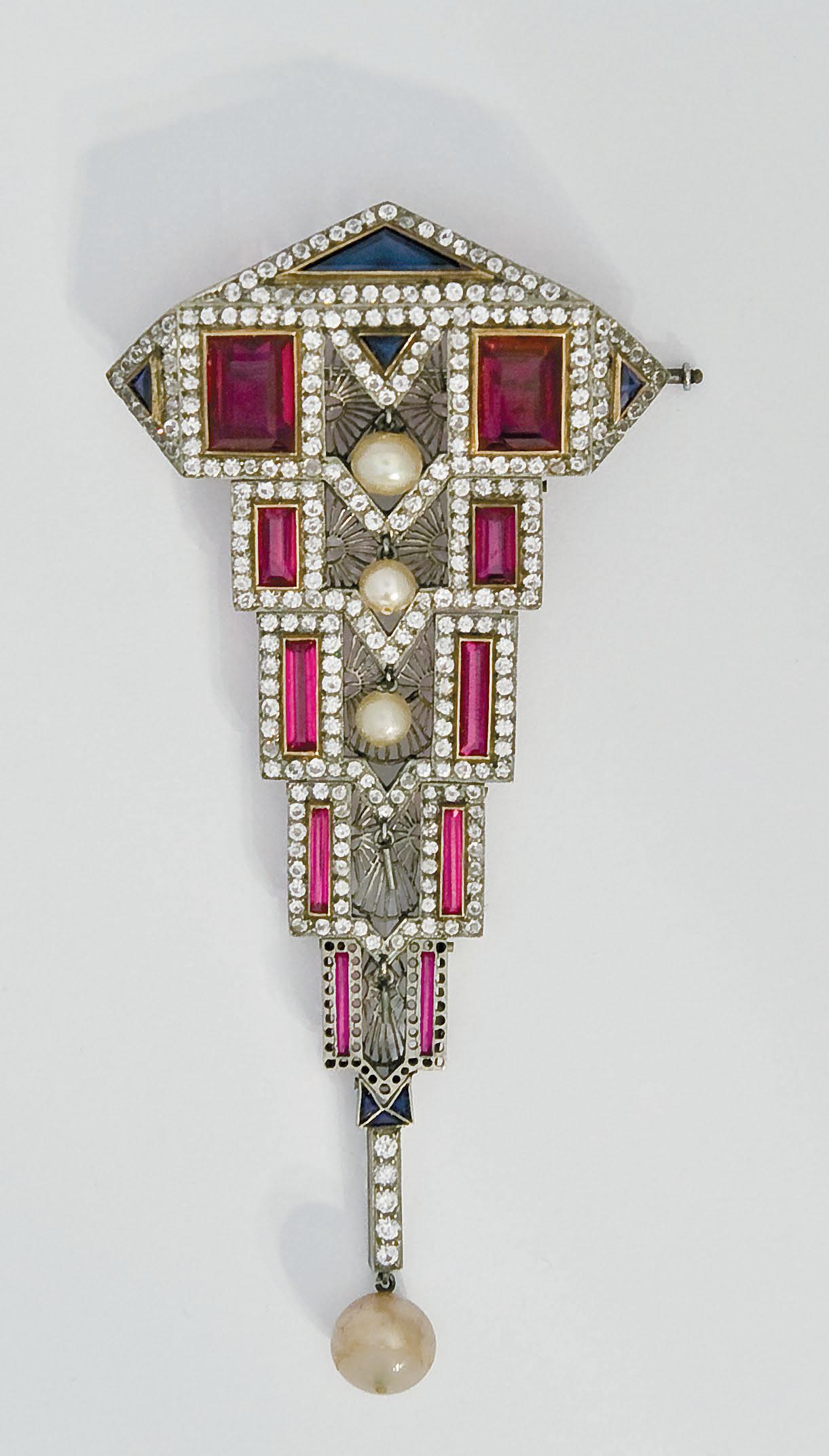
Prototype of a brooch to be made in precious materials and stones
Edoardo Saronni, Milan, c. 1930 Silver, glass stones and simulated pearls, rhinestones
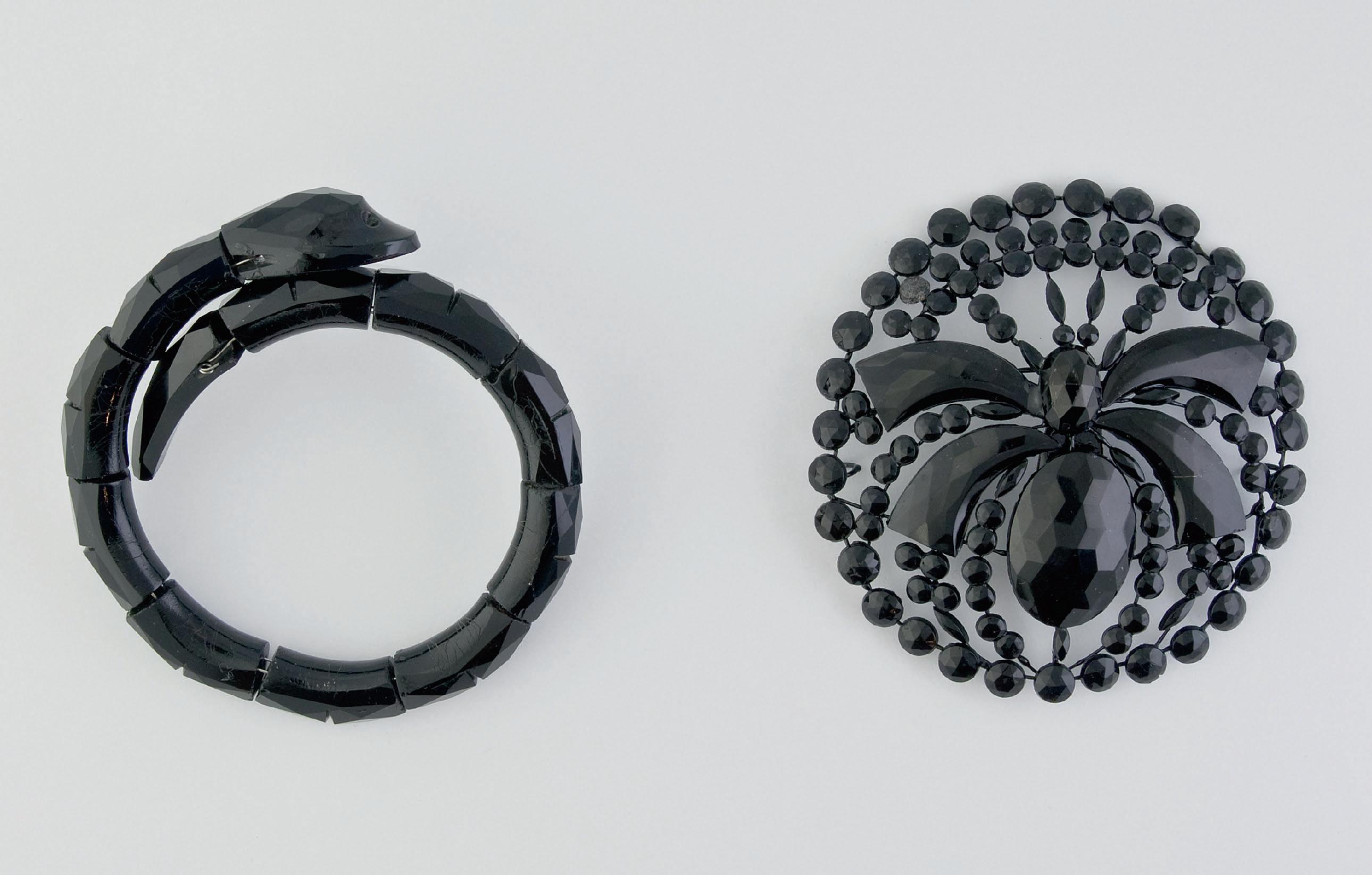
Snake shaped bracelet and insect shaped brooch
Imported from Bohemia by Milan Unger Company, early 1900s
Pierced jet beads strung on memory wire (bracelet) and faceted jais beads mounted on black painted wire (brooch) Unger archives, Milan
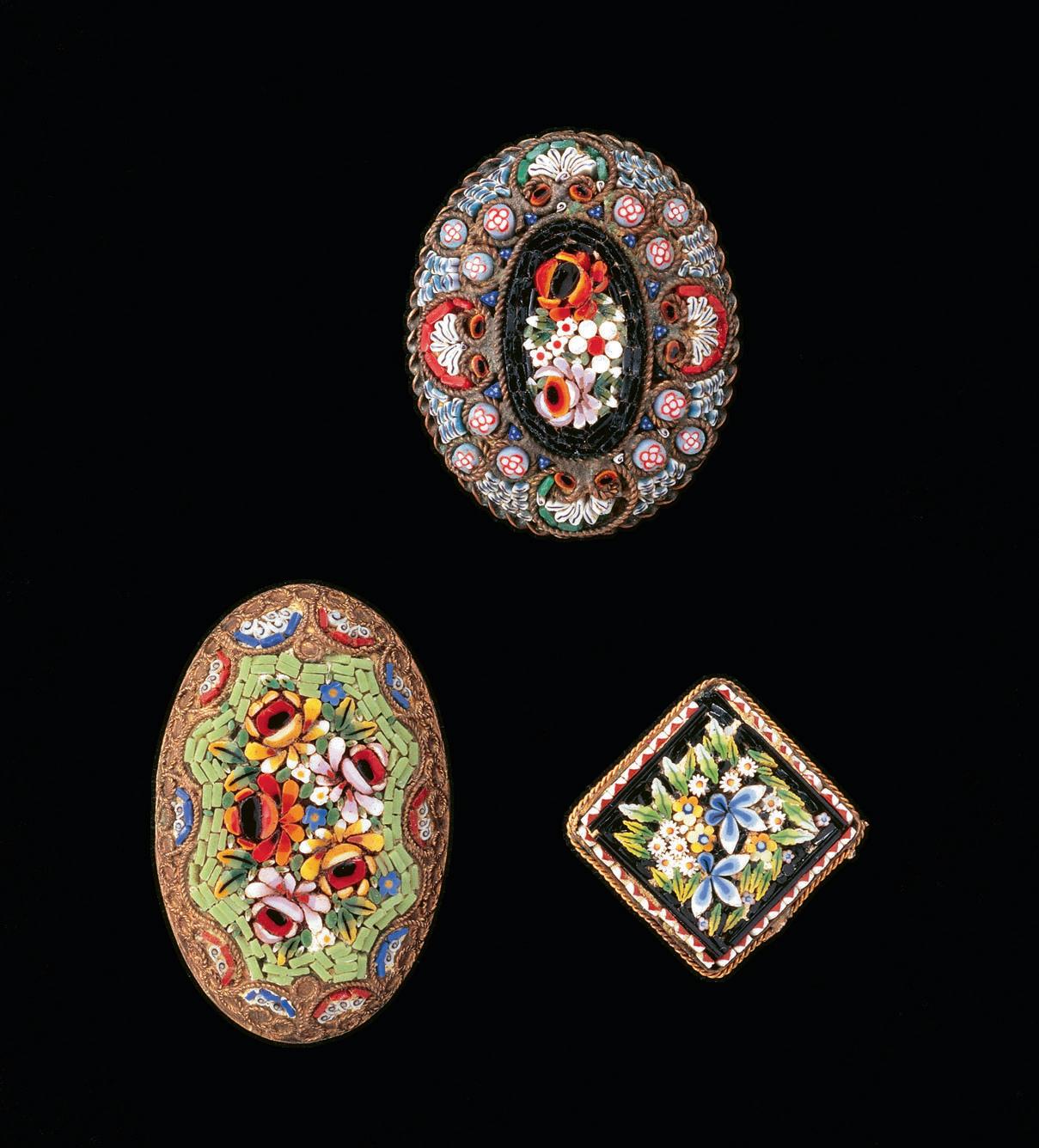
Group of brooches
Manufacturer unknown
Italy, late 19th centuryearly 20th century
Glass tesserae mounted to form micromosaic floral motifs
Example of micromosaic technique, typical of Venice and Rome
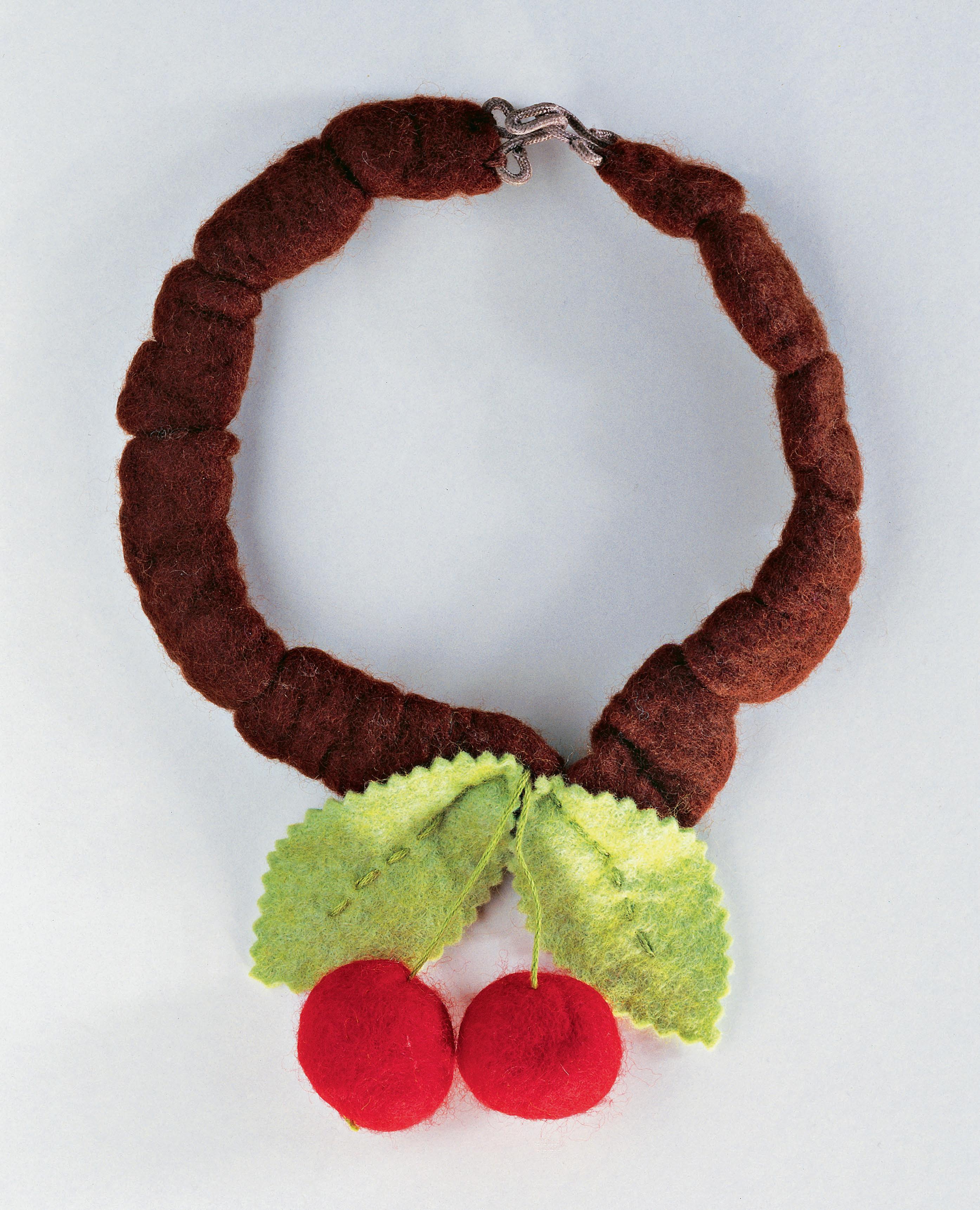
Necklace with pendant in the shape of cherries
Lenci
Turin, c.1940
Wool felt, cut and sewn by hand
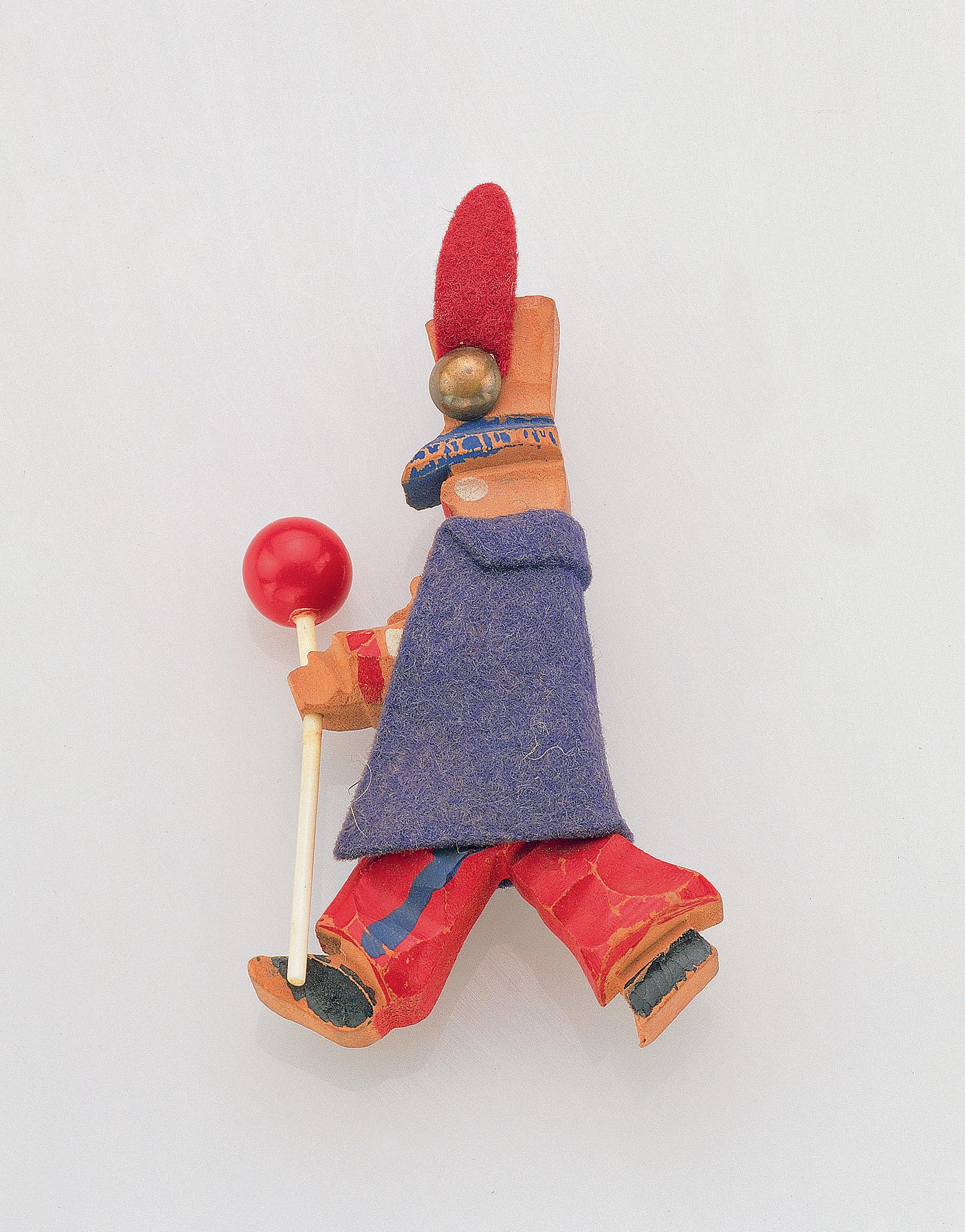
Brooch depicting a carabineer Manufacturer unknown Italy, c.1940
Carved and partially painted wood, felt
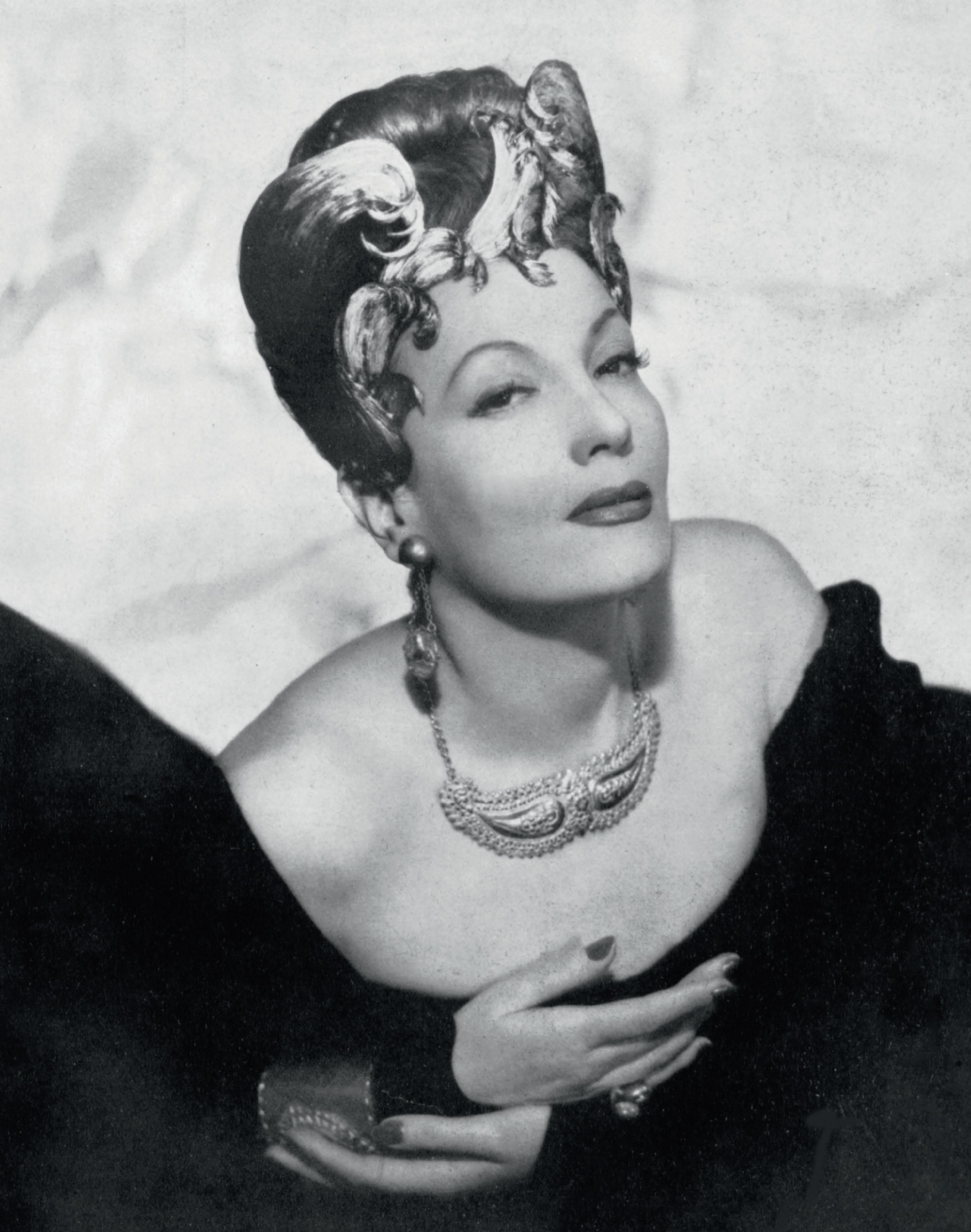
Isa Miranda publicising the movie “The Adventure Starts Tomorrow”. Dress by Pascali; jewellery by Fratti; hair (with gold lacquer) by Antonio, Paris in Bellezza No. 22, September 1947, p.43
Photographer unnamed
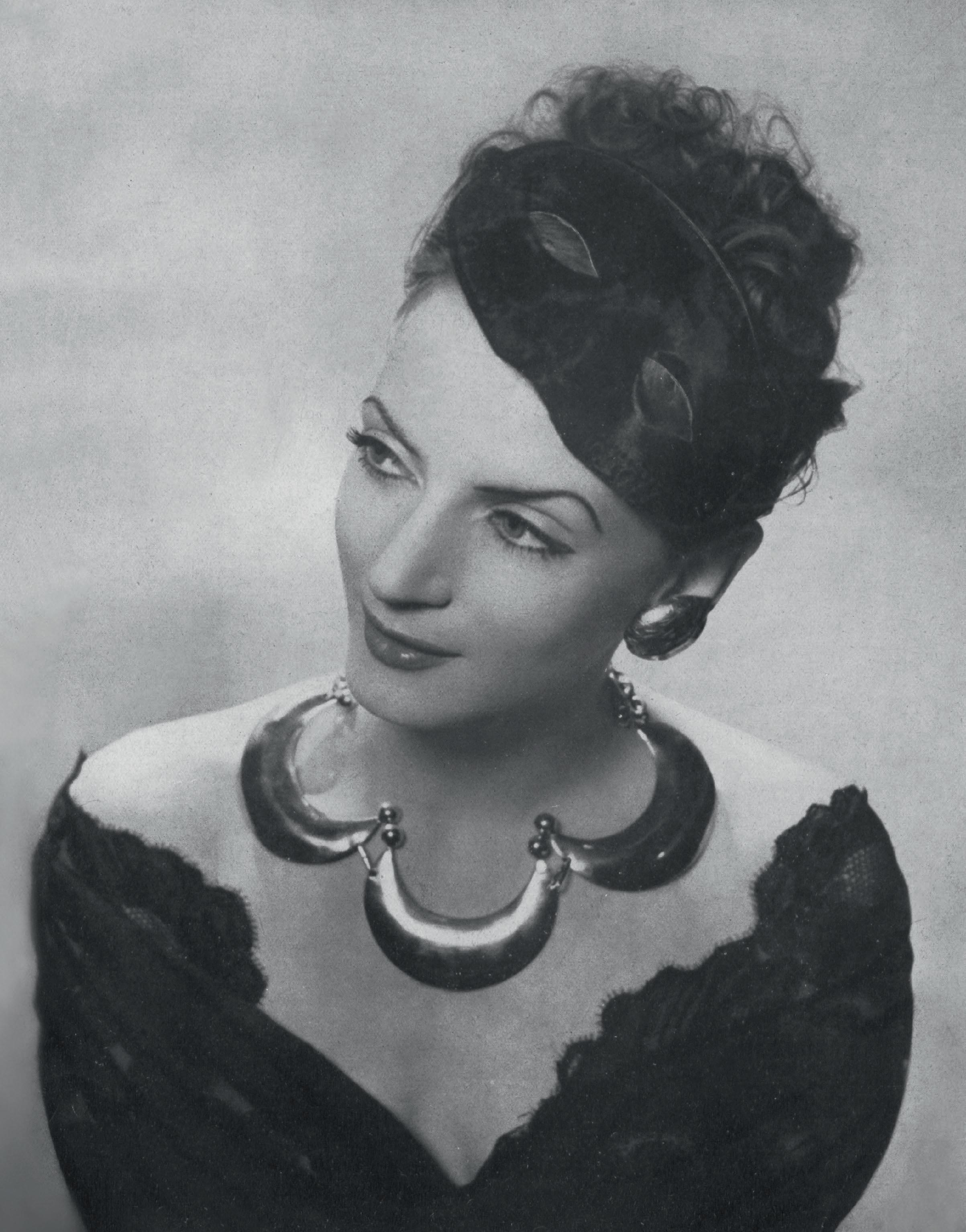
“Luciana baptized ‘Bosforo’, her necklace with three half moons closed with a chain at the back. It is an ornament which demands a full décolleté, as is in fashion at the moment, with bare shoulders or halfcovered by falling sleeves.” in Bellezza No. 1213, December 1946, p.97
Photo: Porta
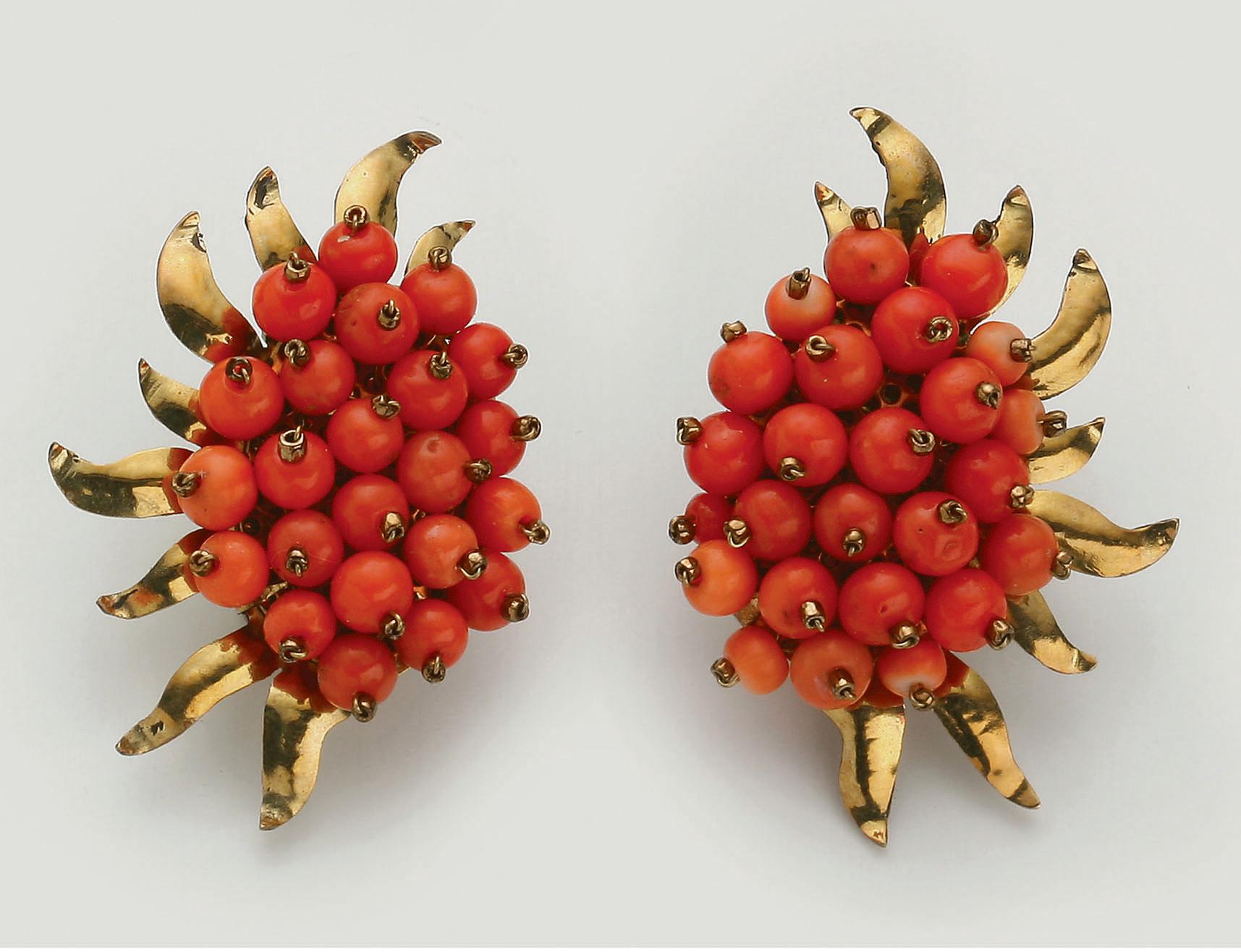
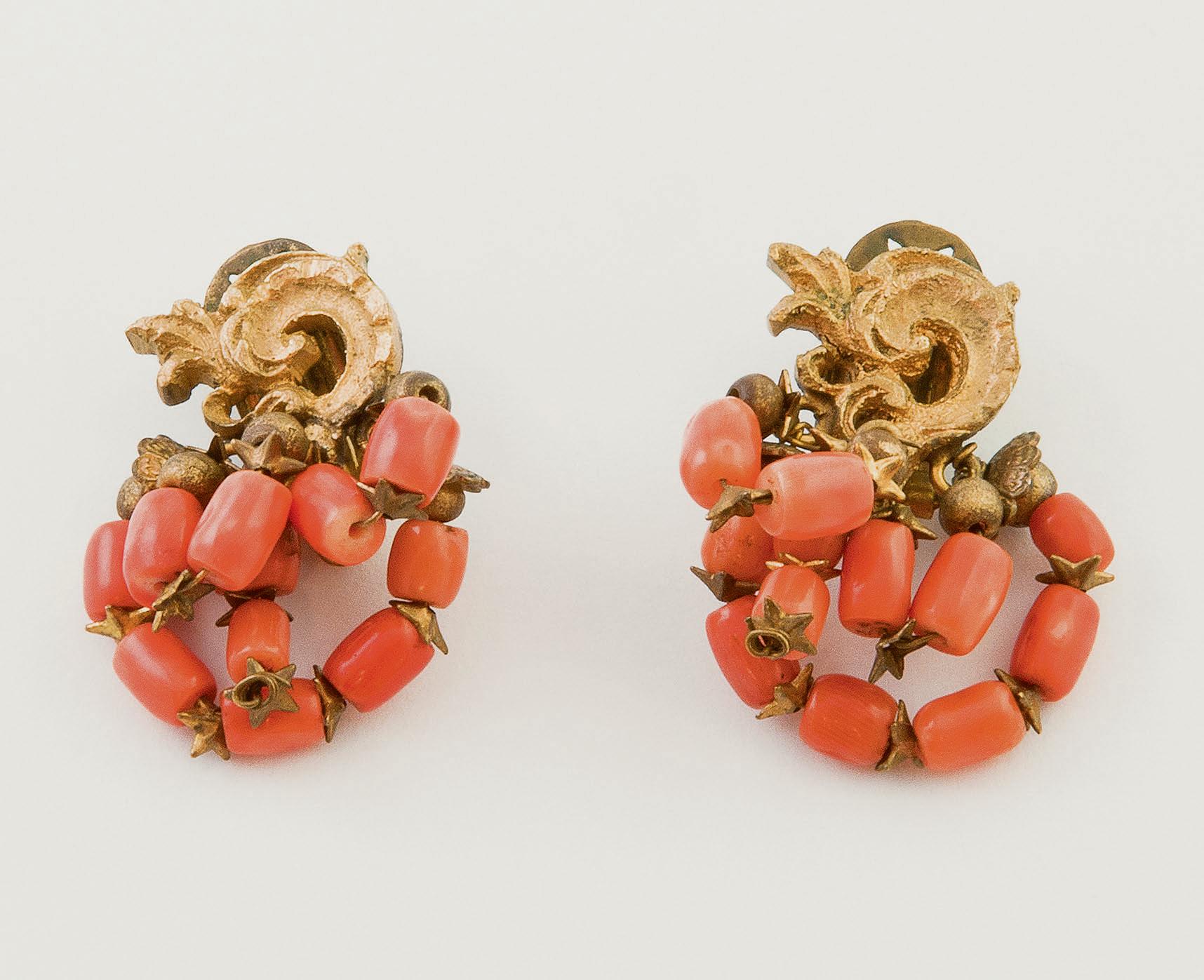
Cluster earrings depicting sunflowers
Lyda Coppola of Coppola e Toppo for Elsa Schiaparelli Milan, c.1949
Pierced coral beads mounted on a metal beading screen supported by a brass sheet
Loop earrings
Lyda Coppola for Coppola e Toppo Milan, c.1948
Elongated coral beads strung on metal wire, gilded metal findings
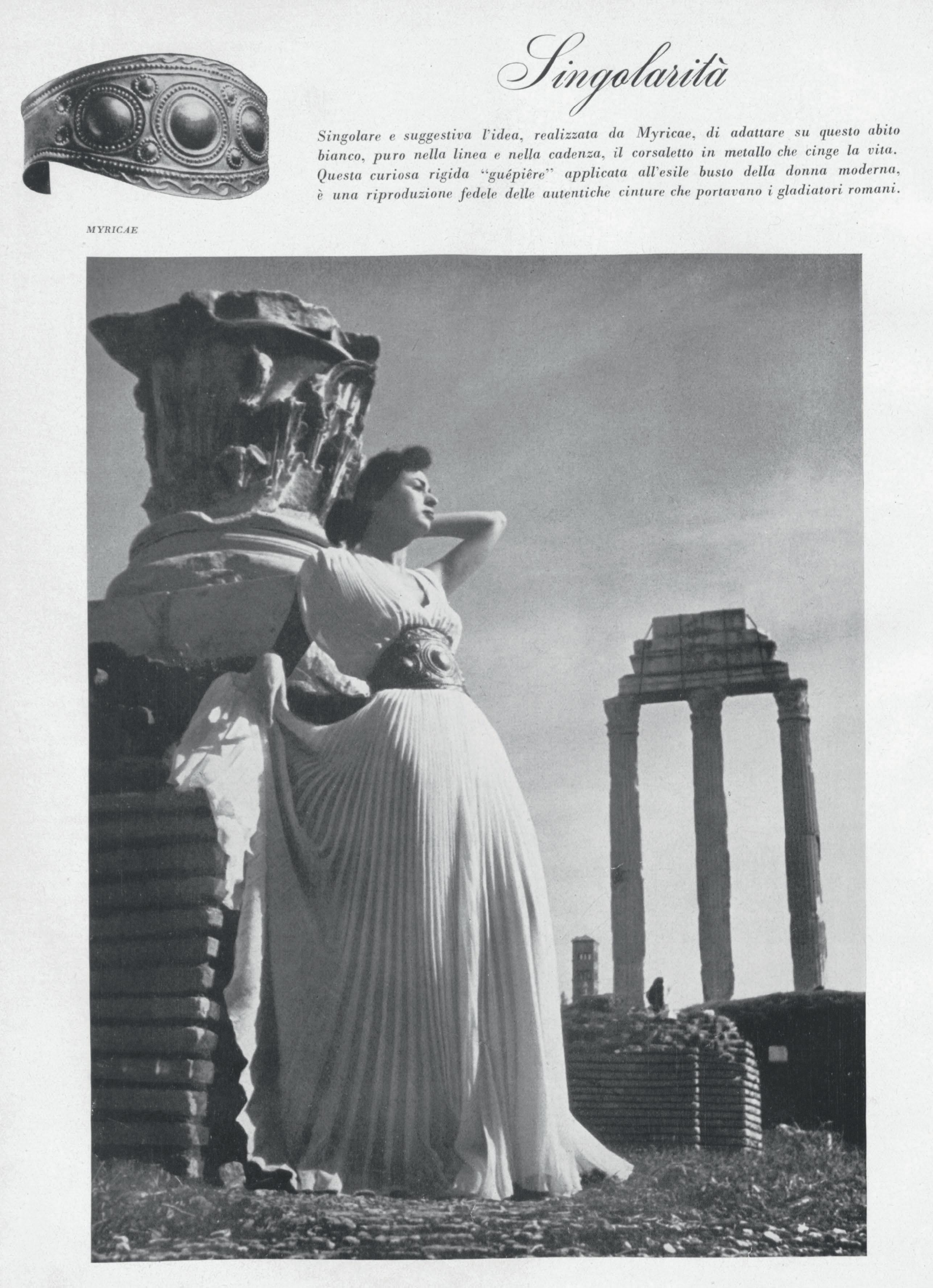
“A singular and fascinating idea, realised by Myricae, to adapt this white dress, simple in line and rhythm, with a metal ‘corset’ cinching in the waist. This curious rigid “corsetry” is applied directly below the bust of the modern woman, and is a faithful reproduction of authentic belts worn by Roman gladiators.” in Bellezza No. 3, March 1949, p.80 Photographer unnamed
As already noted, in Italy throughout the 1950s fashion jewellery continued to be considered an unbecoming substitute for fine jewellery. This widespread bias among women hindered the growth of fashion jewellery from being interpreted specifically as a complement to an outfit rather than a substitute for fine jewellery. Adornments with beads and imitation stones, cut in traditional shapes inspired by French jewellery, prevailed. Canesi in Milan was the most noteworthy producer of these copies, made with the very same workmanship techniques employed for fine jewellery, while only a few producers exploited the “poor” or semiprecious materials belonging to the Italian tradition. Among the latter, the most successful and wellknown brand was unquestionably Coppola e Toppo, to which I dedicated a monograph and furtherly discussed in the foregoing pages. It was the most highly regarded Italian company abroad, particularly in the United States, where it sold direct as well as through the distribution network for the clothing and accessories created by Emilio Pucci, who was the firm’s best customer. Pucci was a worldly, cultured, welltravelled and athletic man who had gone to college in the United States and had already become so famous that he had received the Neiman Marcus Award for fashion in Dallas in 1954. Then there were
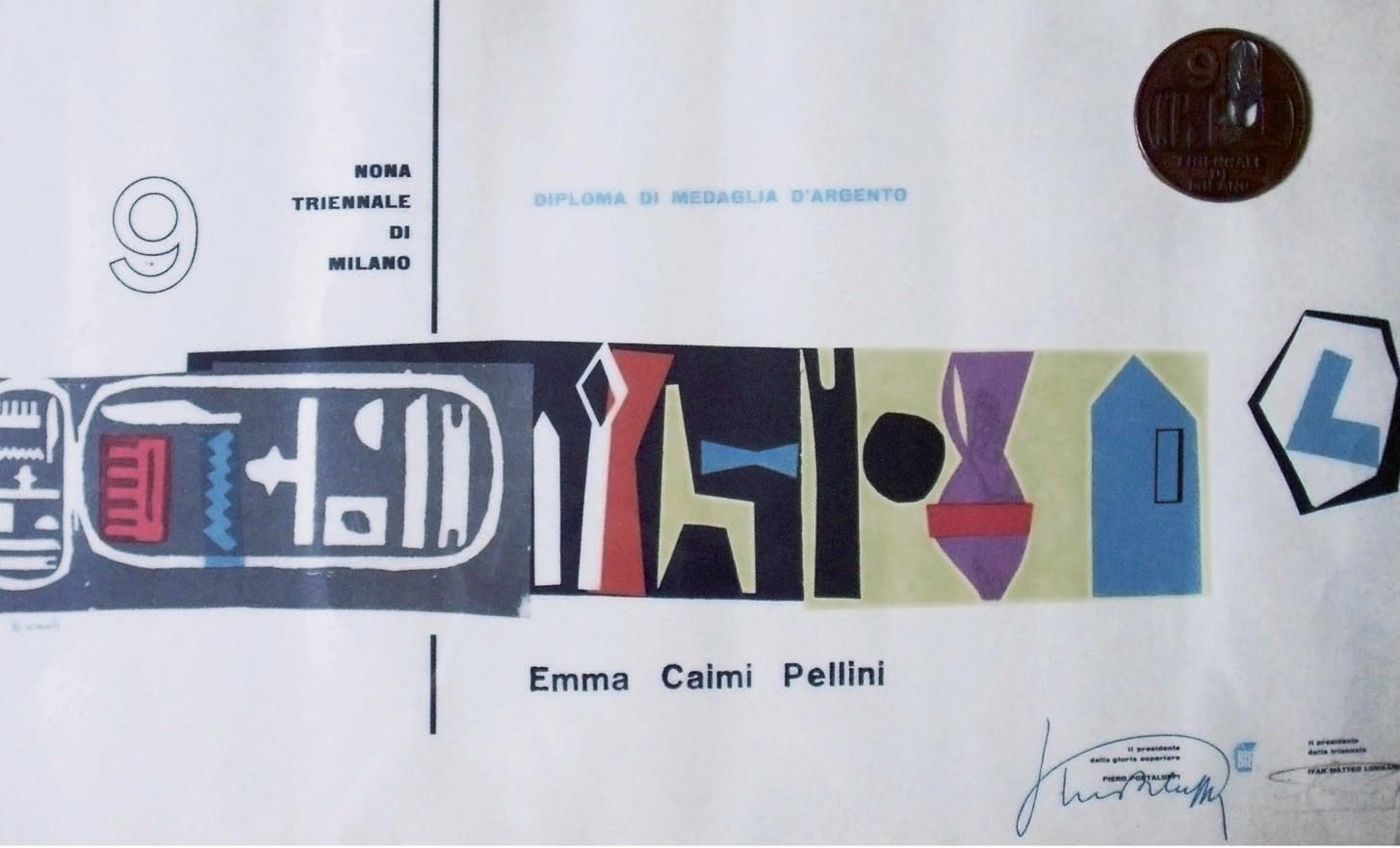
Diploma of the Milan Triennale awarded to Emma Caimi Pellini in 1951
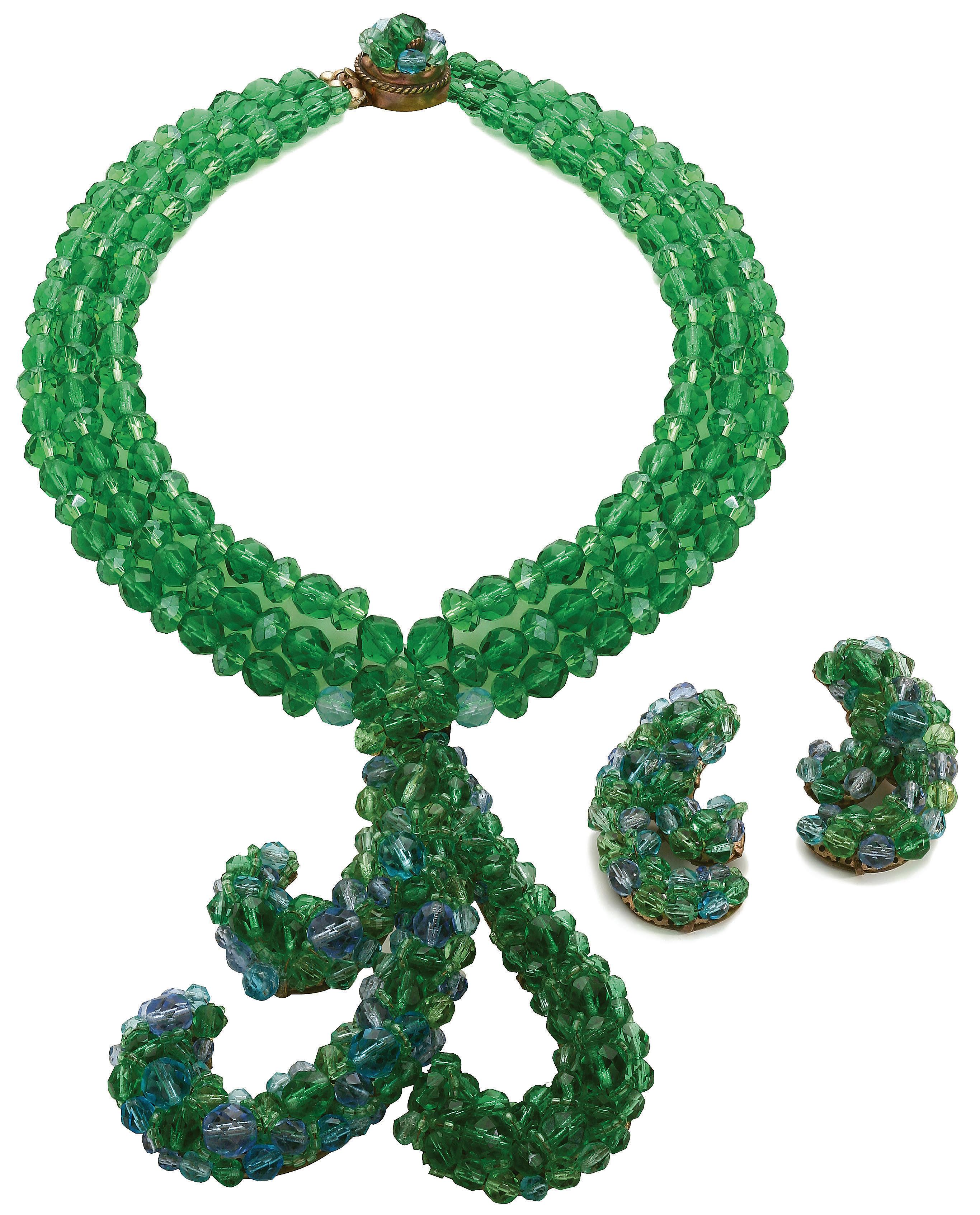
Demi parure comprising necklace and earrings designed by Lyda Coppola of Coppola e Toppo for Elsa Schiaparelli, Milan, 1951
Metal base pavé embroidered with faceted glass beads, strands of firepolished beads alternating with pure crystal beads
Stamped: “Made in Italy by Coppola e Toppo”
This necklace appears in a drawing published in Primavera rivista d’alta moda, Spring 1951, p.71
See: Farneti Cera, D., Fashion Jewels. Coppola e Toppo, Antique Collectors’ Club, 2009, p.34
Giuliano Fratti, Luciana de Reutern, Emma Caimi Pellini, Ornella and Bice Orsi, small companies that produced – directly in their own workshops or by outsourcing the manufacture – fashion jewellery and fashion complements made with typically Italian materials: Venetian glass (Emma Caimi Pellini and Coppola e Toppo, although they often used Bohemian faceted glass beads), raffia (Fratti), ceramic (Ornella), resin (Borbonese) and micromosaic (Bice Orsi), in shapes and themes linked to Italian culture.
In their choice of models Borbonese in Turin and Elfe in Florence wavered between imitation and fashion jewellery; however, in the late 1950s Borbonese succeeded in becoming known for its unique workmanship of a special type of resin, which they had patented and which would distinguish the company’s production in the years to come.
In 1953 a group of couturiers in Rome established the Sindacato Italiano Alta Moda (Italian Union of Haute Couture), which prohibited members from participating in Palazzo Pitti fashion shows in Florence, already renowned for readytowear and thus a competitor of the capital city, which was still closely tied to custommade apparel.
In 1954 Mariuccia Mandelli, known in the industry as Krizia, began to design and sell readytowear in Milan, and in 1955 Ken Scott and Vittorio Fiorazzo opened a studio/shop in Via Sant’Andrea offering accessories and clothing distinguished by the use of printed fabrics with a naturalistic theme in bold colours by Falconetto, a company that Scott had founded with the same partner.
In 1955 the fashion shows at the Palazzo Pitti celebrated a record: 500 foreign buyers, 200 journalists, and exports worth 1.28 billion lire. Roberto
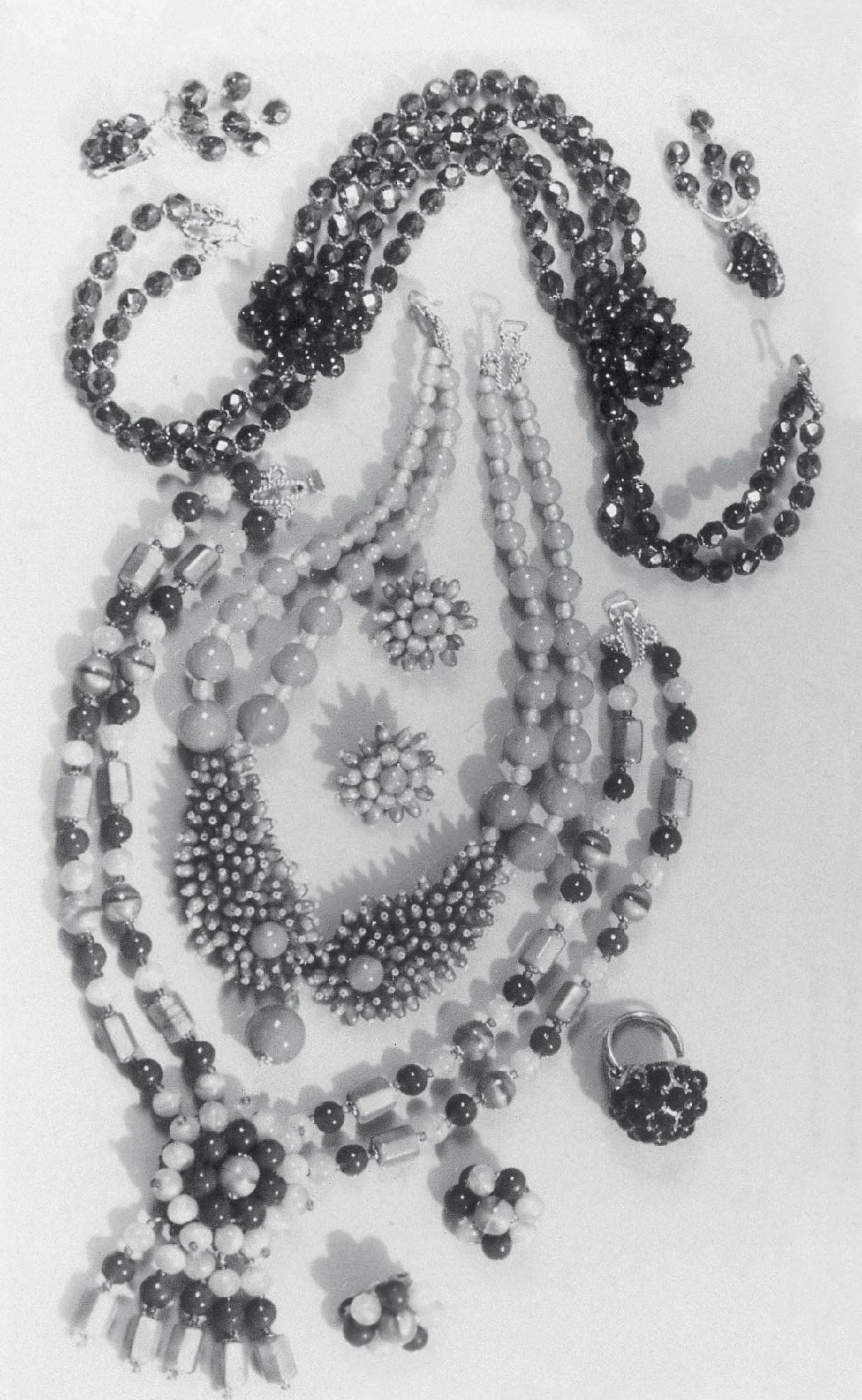
Various necklaces, earrings and a ring
Emma Caimi Pellini
Milan, c.1950
Venetian faceted glass beads
Donatella Pellini archive, Milan
Capucci was named best Italian couturier and was even publicly praised for his talent by Christian Dior. Since Capucci’s outfits are true works of art, only rarely do they bear any additions to their sculptural construction, such as jewel buttons, for example, and only on very few occasions are they associated with fashion jewellery.
1955 was also the year in which the ADI (Association for Industrial Design) was founded in Milan; it united designers, entrepreneurs and critics. Industrial design rapidly became a typically Italian field of excellence. In 1958 two new fashion houses, Mila Schön and Maria Antonelli, entered the Milanese scene and would go on to become famous. Maria Antonelli, a fashion pioneer, was one of the first Italian fashion houses to launch her own readytowear line; her outfits were most often completed by Canesi fashion jewellery. Unlike their Roman competitors, whose regular customers were noblewomen and film stars, the Milanese fashion houses catered to women from the industrial bourgeoisie, who were influenced by Parisian fashion yet capable of expressing their own concept of a simple, classic and sophisticated elegance that was also colourful and fun, but not vulgar.
The Camera Nazionale della Moda Italiana (the National Chamber of Italian Fashion) was founded in Rome in 1958 with the aim of coordinating, protecting and promoting national fashion.
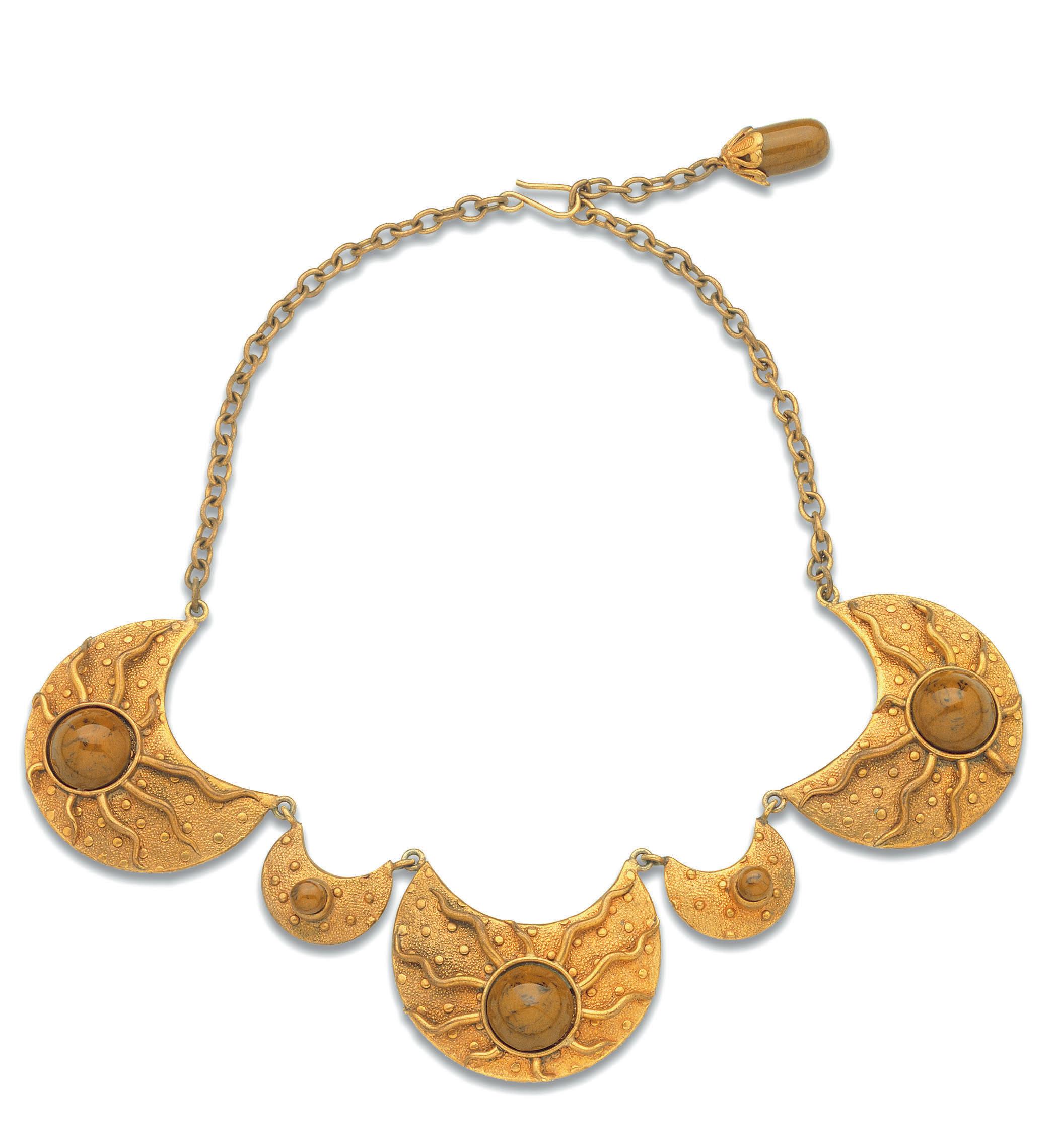
Festoon necklace
Emma Caimi Pellini Milan, c.1950
Gilded metal and bakelite
The matching bracelet is published in Farneti Cera, D. (ed.), Jewels of Fantasy, Harry N. Abrams, New York, 1992, p.263
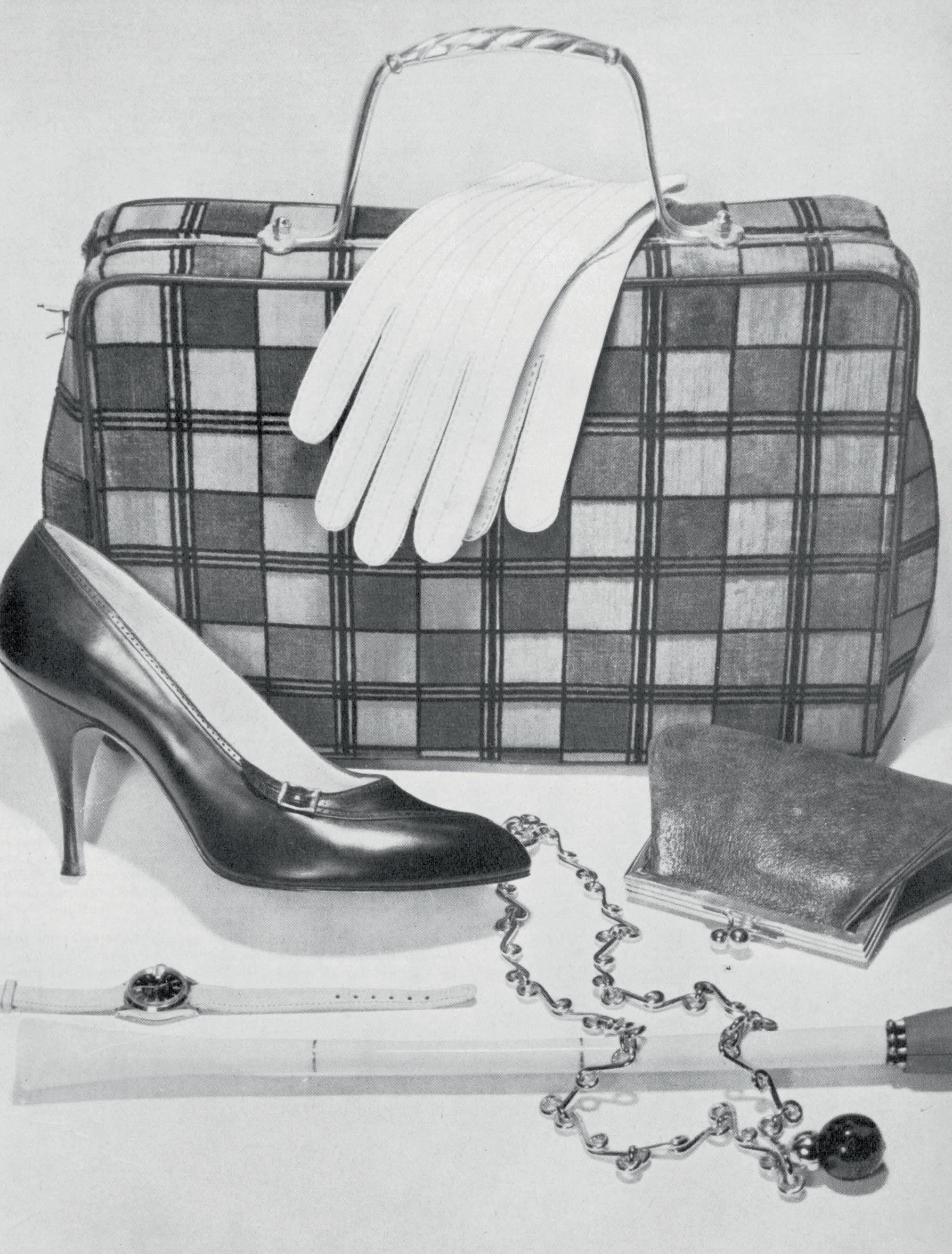
Velvet bag by Roberta; Pair of leather gloves by Scarabeo; Black leather shoes by Ferragamo; Purse in green kangaroo skin and umbrella with ivory handle, Jole Veneziani boutique; Rolex Oyster Perpetual ladydate watch; Chain of aluminium with a coloured stone by “Il Gingillo.” In Novità No. 100, February 1959, p.7
Photo: Piera Frai
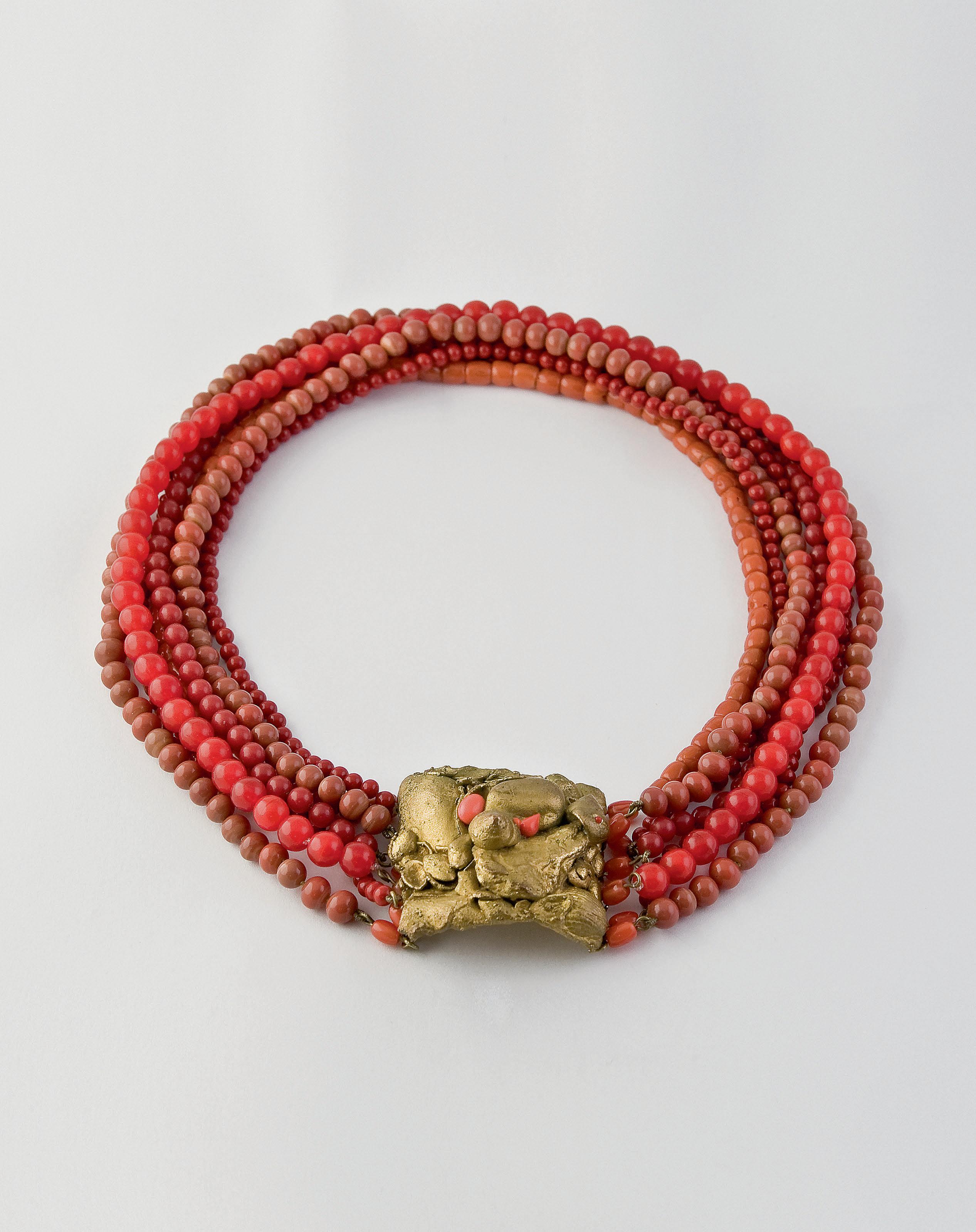
Sevenstrand necklace with gilded clasp Designed by Maria Vittoria Albani for Ornella Milan, late ’50s Imitation coral beads made of glass; clasp consisting of a metal base and elements in gilded ceramic with glass imitation coral stones.
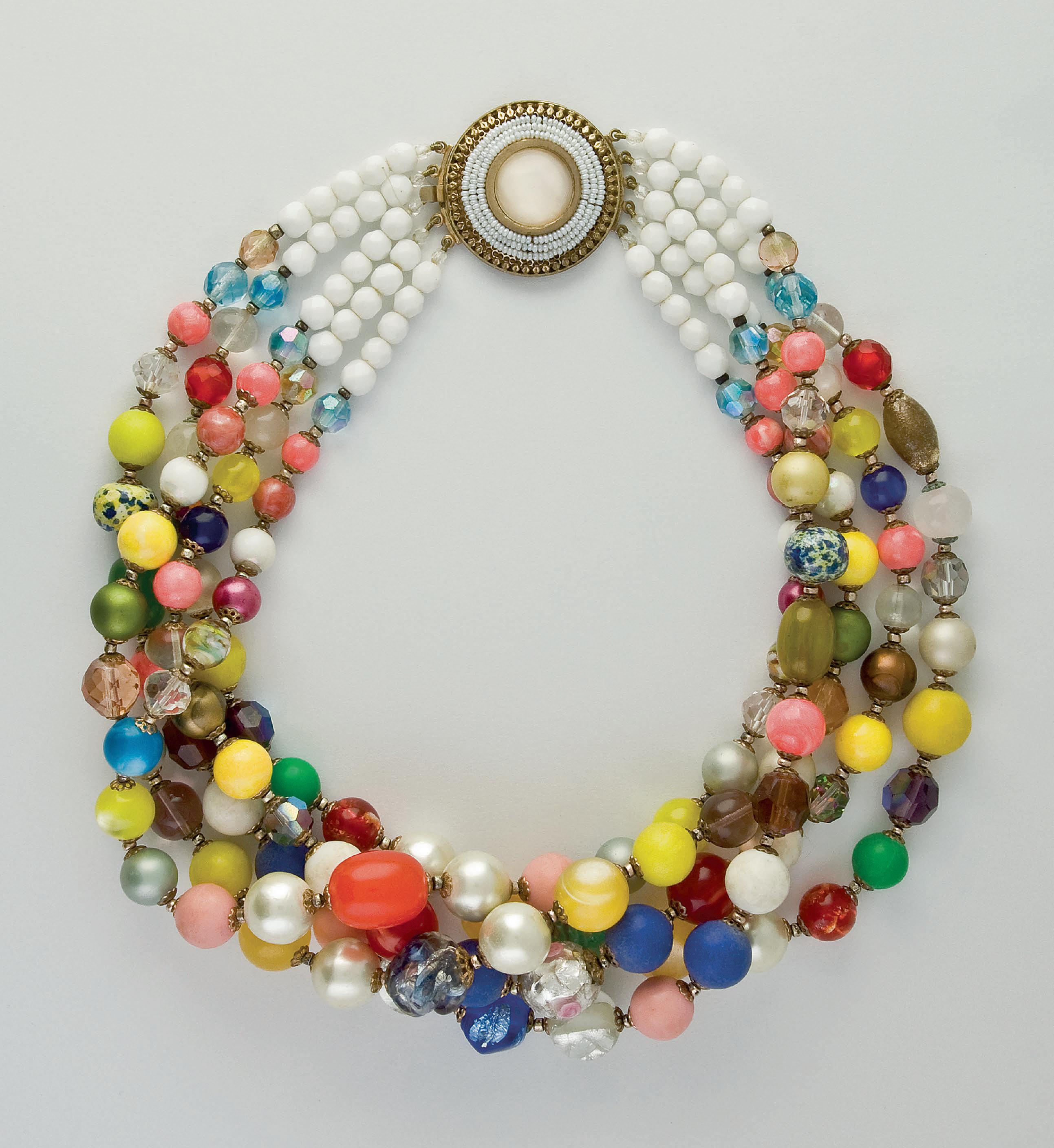
Manufacturer unknown Italy, c.1960
Faceted beads in white, iridescent blue, transparent glass paste and spheres in plastic and glass paste, gilded metal findings Magda and Arianna Ghilardotti Collection, Milan
Fivestrand torchon necklace
Politically aware leftwing students could be recognized by their neutral and anonymous uniform –parka and jeans – while ‘flower children’, pacifists and libertarians, grew their hair long as a way of rebelling against their parents and their middleclass attitudes, and wore clothes and complements recycled from their grandmothers or from Asian and African countries, with new styles and a rich array of colours.
In short, for the first time in the history of twentiethcentury fashion the way one dressed represented a choice of political affinity or beliefs, a way of being recognized not through words but by flaunting a look that expressed an ideology: conservative and rightwing for those who wore fashionable clothes like mum and dad; leftwing, anarchical and pacifistic for those who wore jeans and short jackets, miniskirts and secondhand clothing. Music was the only world shared by young people, politically aware and otherwise. The songs and the dazzling colours of the costumes from Hair, the musical presented on Broadway in 1967 and in San Francisco in 1968, embraced the desire of a new generation for new ideals. The Woodstock Festival in 1969, which attracted hundreds of thousands of young people united by the same free spirit and the desire for a peaceful revolution, became a milestone in the history of those who embraced those new values.
In 1967 Italian fashion designers started to hold fashion shows at their own ateliers again, going to Florence only for the presentation of what was called “Alta Moda Pronta” (readytowear hautecouture), which, precisely because it was readytowear could not be defined as haute couture, and was anyway intended for a broader market. At the same time, young people and their new way of dressing led to
the need to transform the production methods of prêtàporter and the garment industry in general in order to cater to the new need for colour, imagination and to fulfil the desire to look different. This need for change spawned new professions: model makers (creators of patterns to become a future fashion designer), fabric developers, garments sewers and machinists (often as a cottage industry), and distributors (who sold to an extensive network of boutiques). Even the newest women’s magazines, guided by excellent and unforgettable professionals
– Arianna, first published by Mondadori in 1957, relied on Anna Piaggi as fashion editor and Anna Riva as fashion correspondent; Adriana Mulassano was one of the most brilliant collaborators of Amica, founded in 1962 by Franco Sartori, Flavio Lucchini and Enrico Gramigna, and published by Rizzoli – helped circulate a fashion that was not merely a showcase for seasonal models tied each season to a specific theme, but expressed a style. “New” names of brands and fashion designers began to make their way to fame: Krizia, Missoni, Ken Scott, Walter Albini. Albini was particularly active, in 1968 he designed five different collections presented at the Palazzo Pitti: Billy Ballo, Krizia Maglia, Montedoro, Princess Luciana and Trell, although only the first one bore the brand “Billy Ballo by Walter Albini”.
1968 proved to be a critical year for the history of the Western world and values. In the wake of the theories formulated by JeanPaul Sartre in France and Herbert Marcuse in the United States, students – increasingly politically oriented – demonstrated in Paris and Berkeley alike for a society free of violence and exploitation. The occupation of universities took place in all the main Italian cities, from Turin to Padua, Pisa, Florence, Rome and Bologna; these student
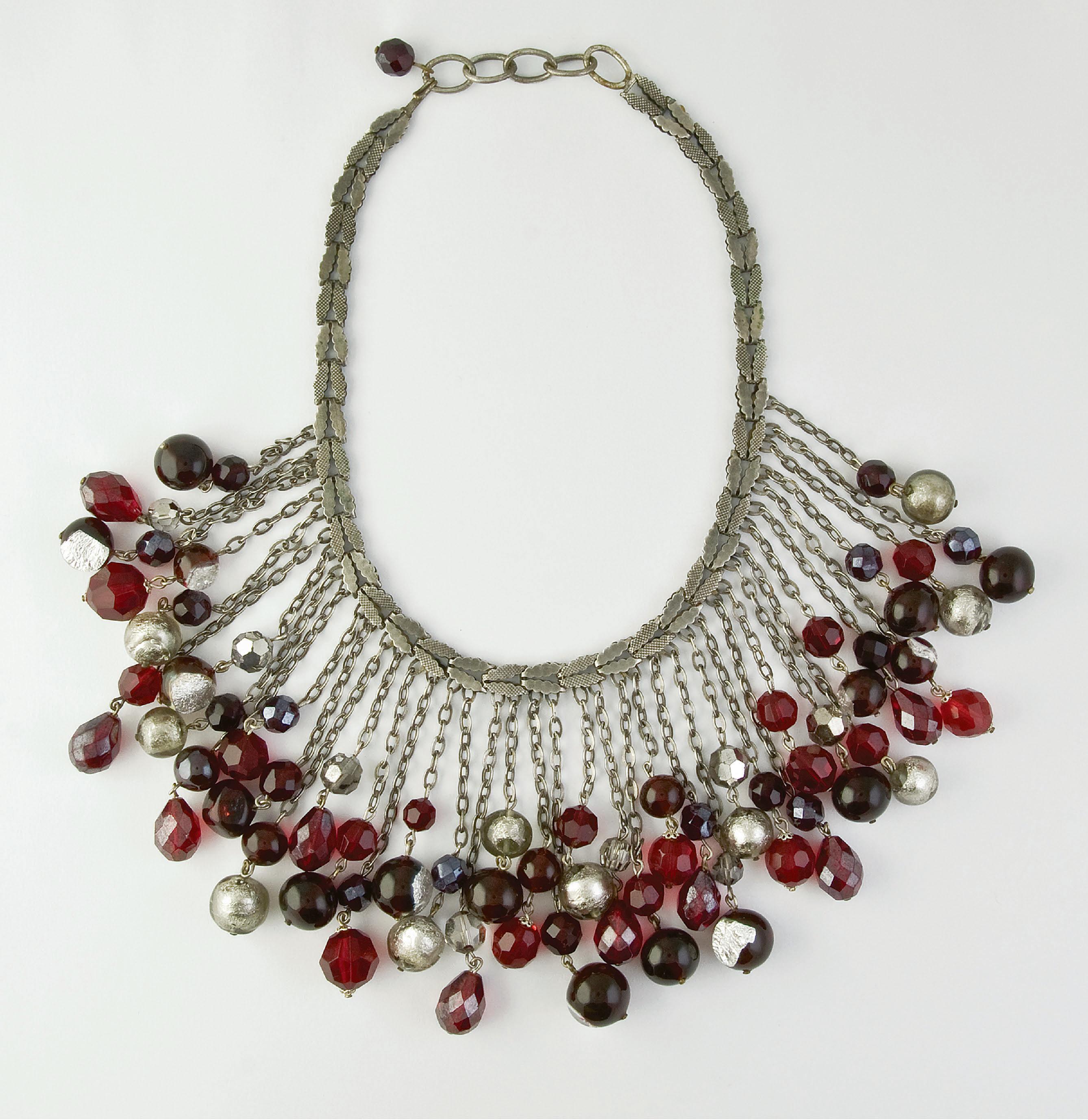
Giuliano Fratti
Milan, c.1965
Burnished metal, glass beads and faceted glass beads with silver leaf inclusions, glass paste spheres
Magda and Arianna Ghilardotti Collection, Milan
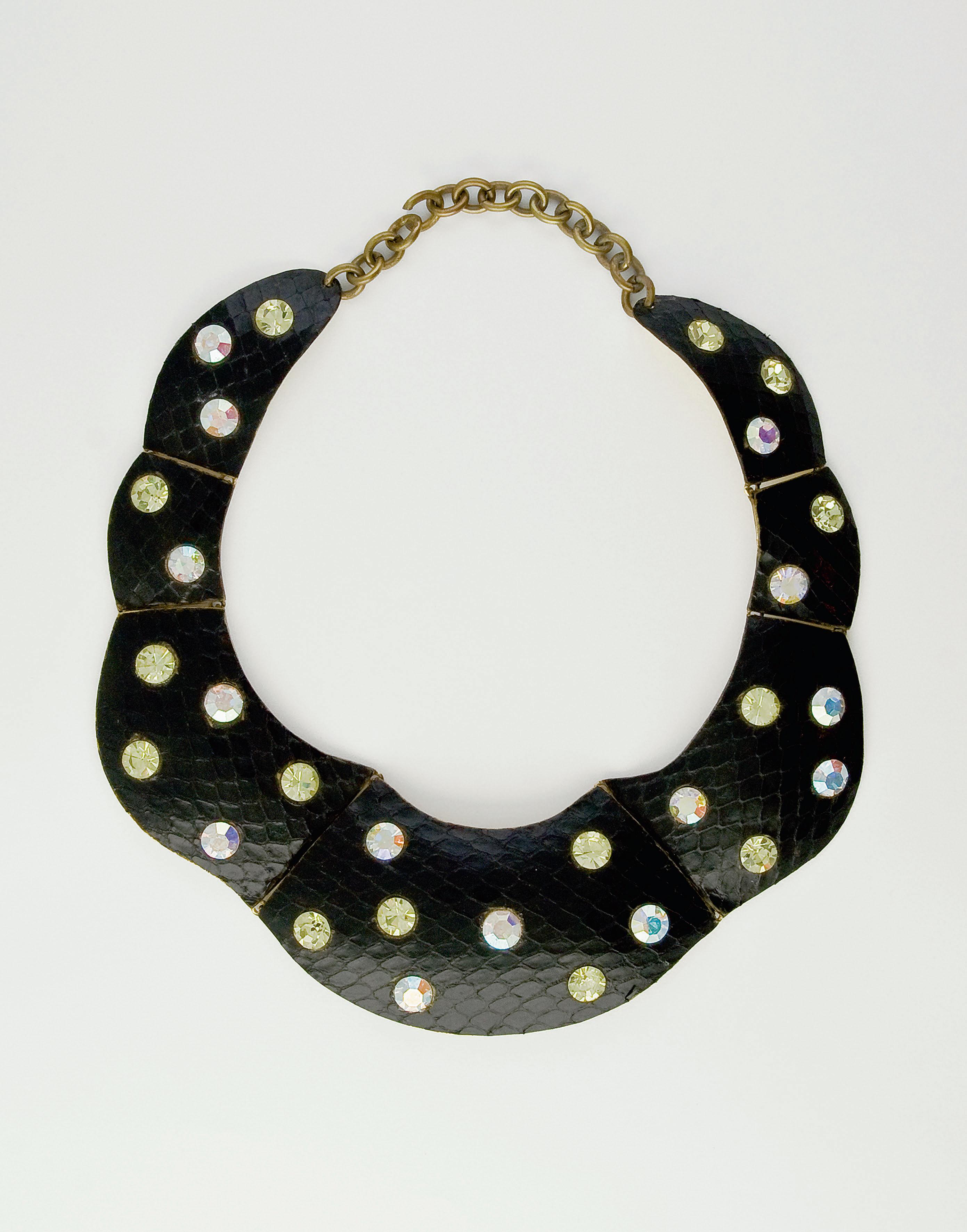
Flexible necklace
Luciana de Reutern Rome, first half of the ’60s Sheet of metal cut and folded by hand and covered with python skin embedded with ‘aurora borealis’ glass stones
Festoon necklace
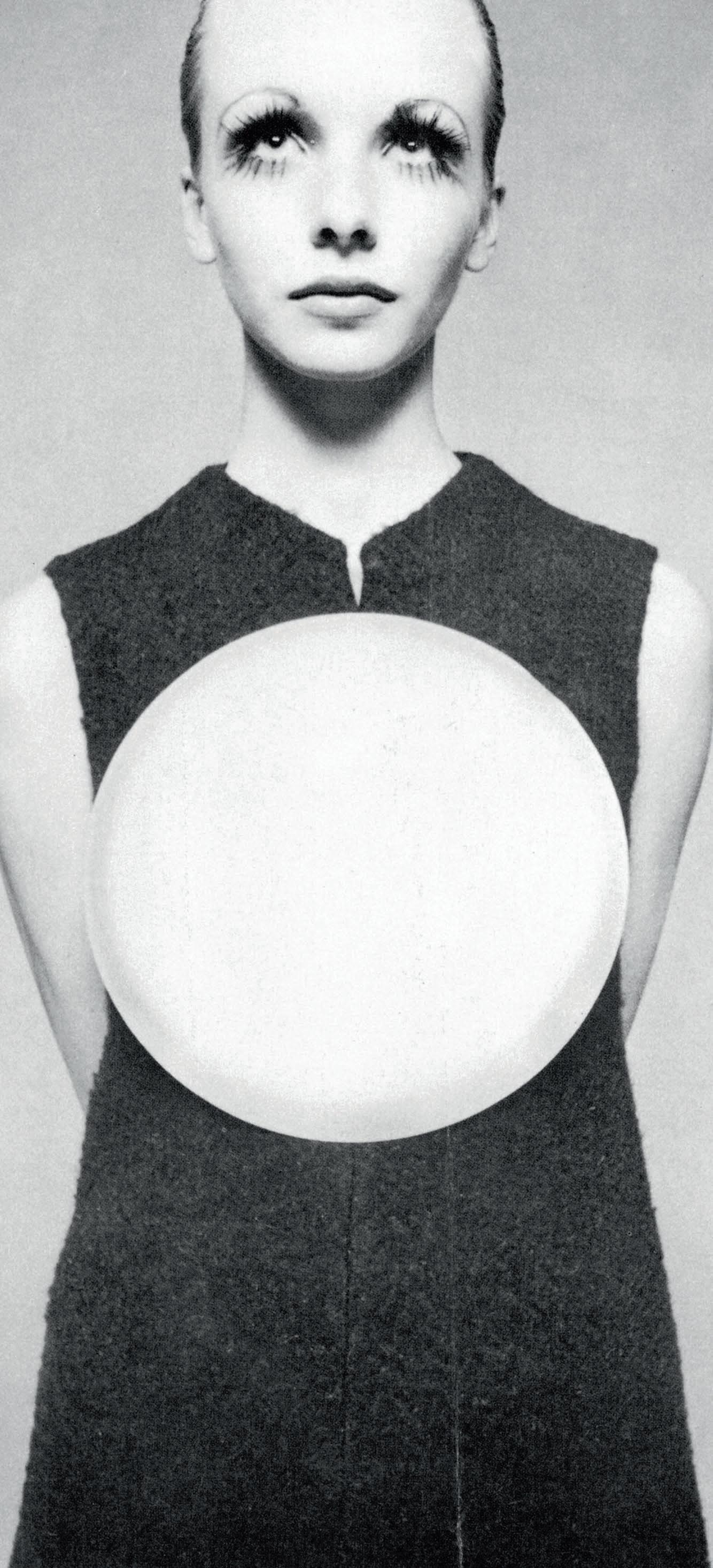
Dress by Marucelli in Loro Piana fabric with aluminium accessory by Getulio Alviani in Linea Italiana, A/W 196869, p.120
Photo: Willy Rizzo
"A barbaric belt: a metallic contrast on the blue coat by Marucelli.
The belt is made from disks of aluminium held together by small rings, by Getulio Alviani. Loro Piana fabric" in Linea Italiana, S/S 1969, p.31
Photo: Mario Santana
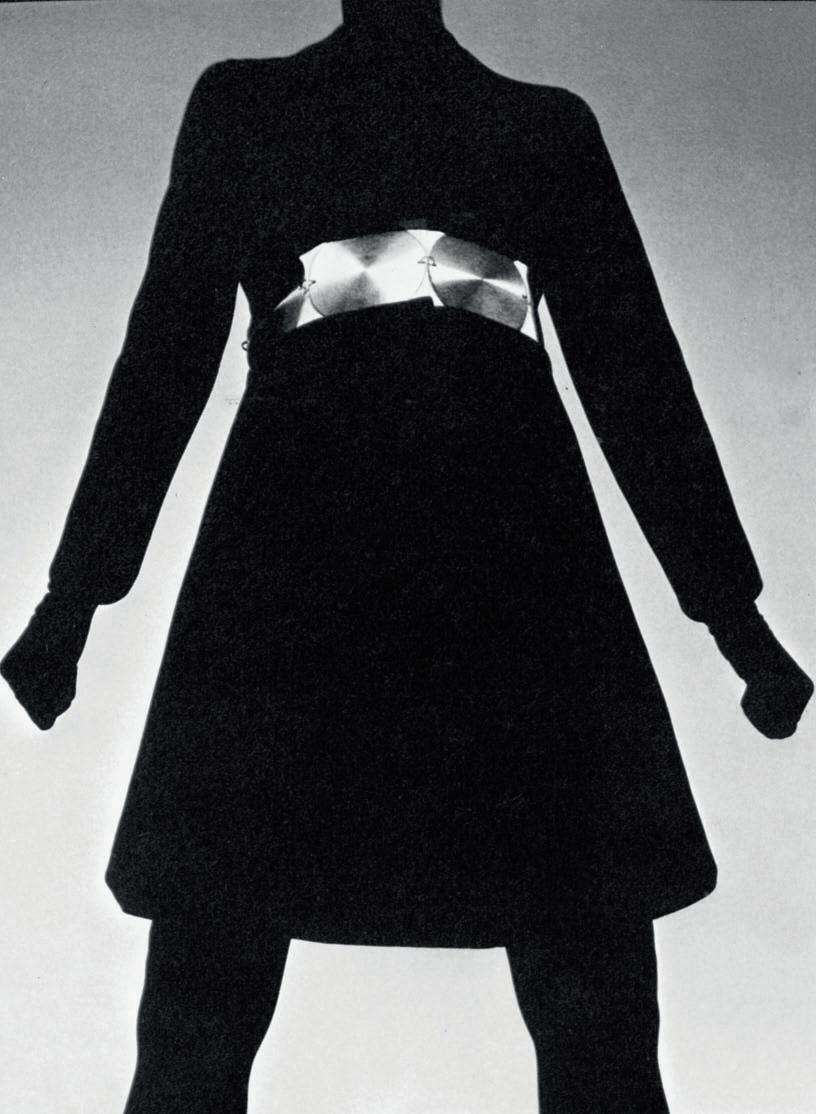
"Dress by Marucelli. The bodice has truly become a piece of armour in aluminium, Getulio Alviani. Loro Piana fabric." in Linea Italiana, A/W 196869, p.121
Photo: Willy Rizzo
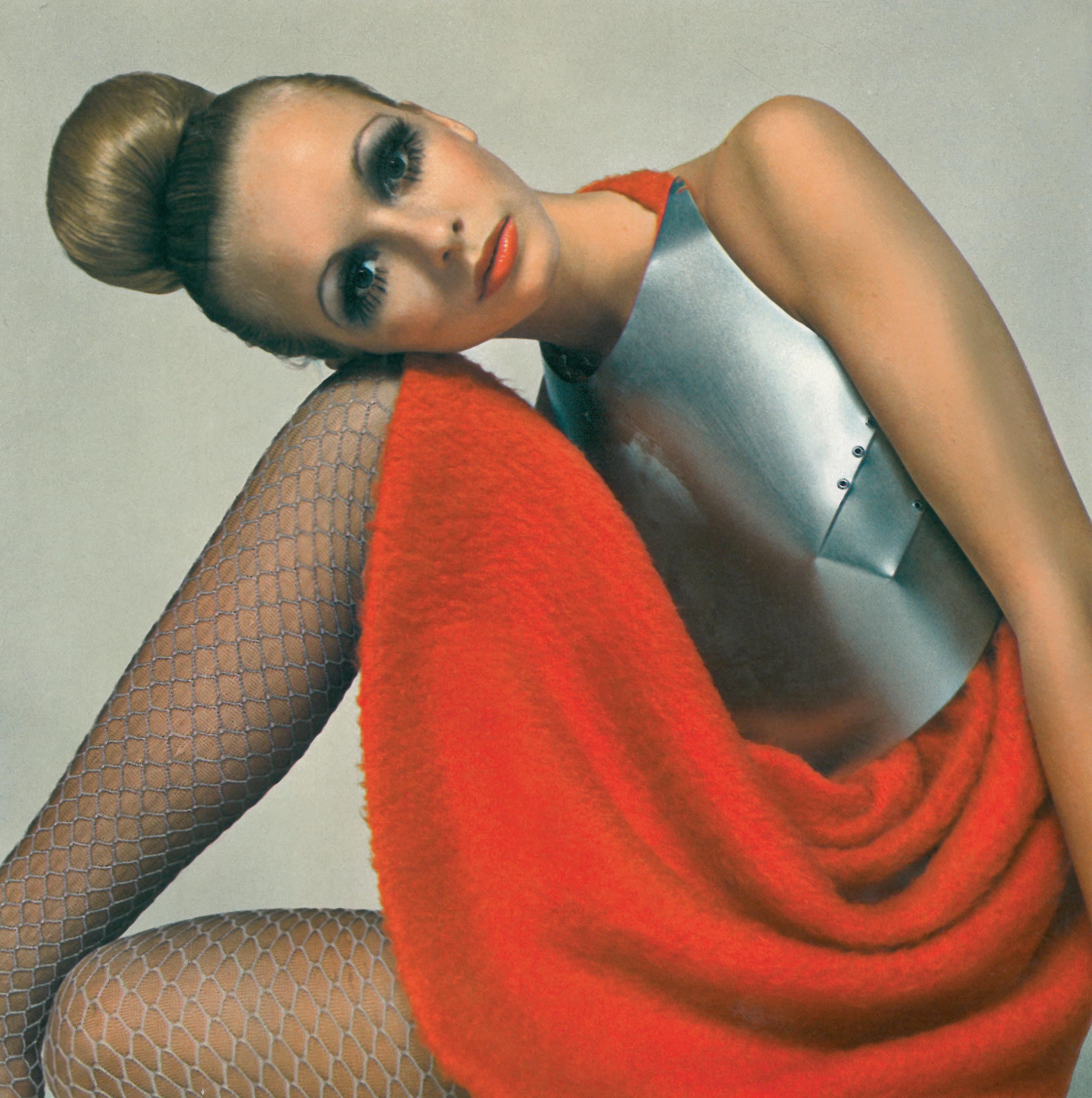
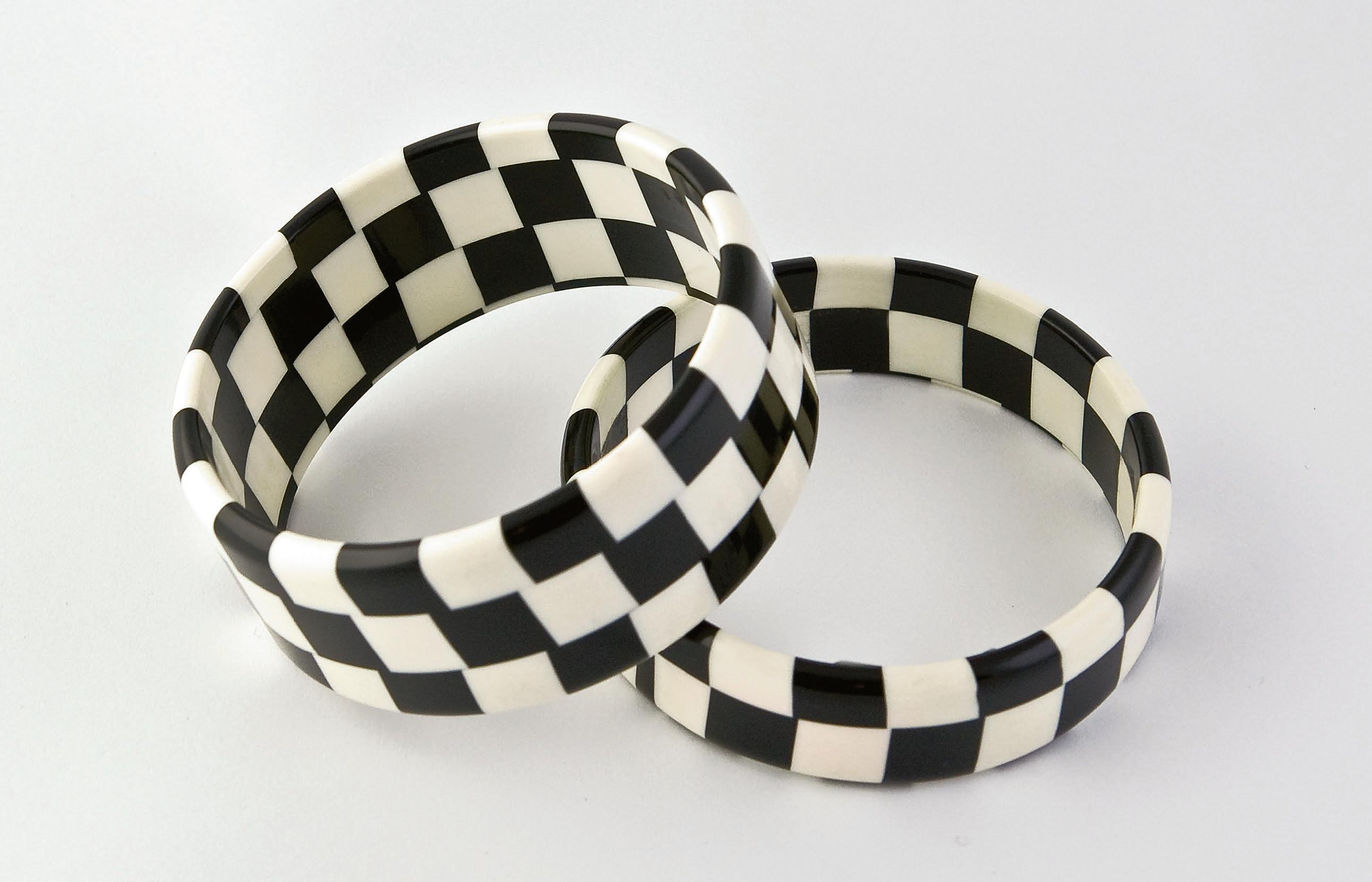
Pair of bracelets in Op Art style
Ugo Correani
Milan, 1971
Black and white acetate
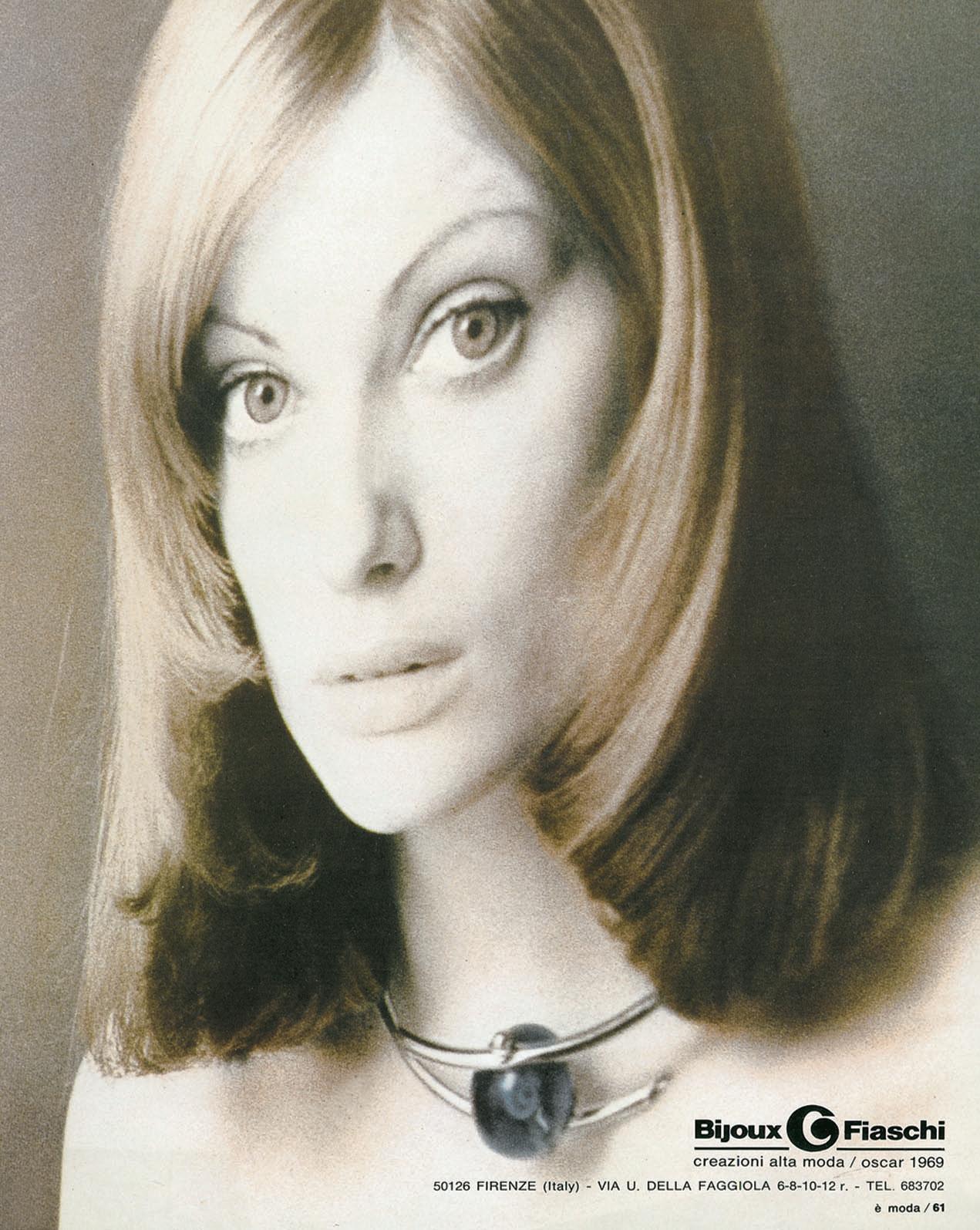
Advertisement for Bijoux Fiaschi
Florence, early ’70s
Photo: Fallai / Strippini
Fiaschi archives, Florence
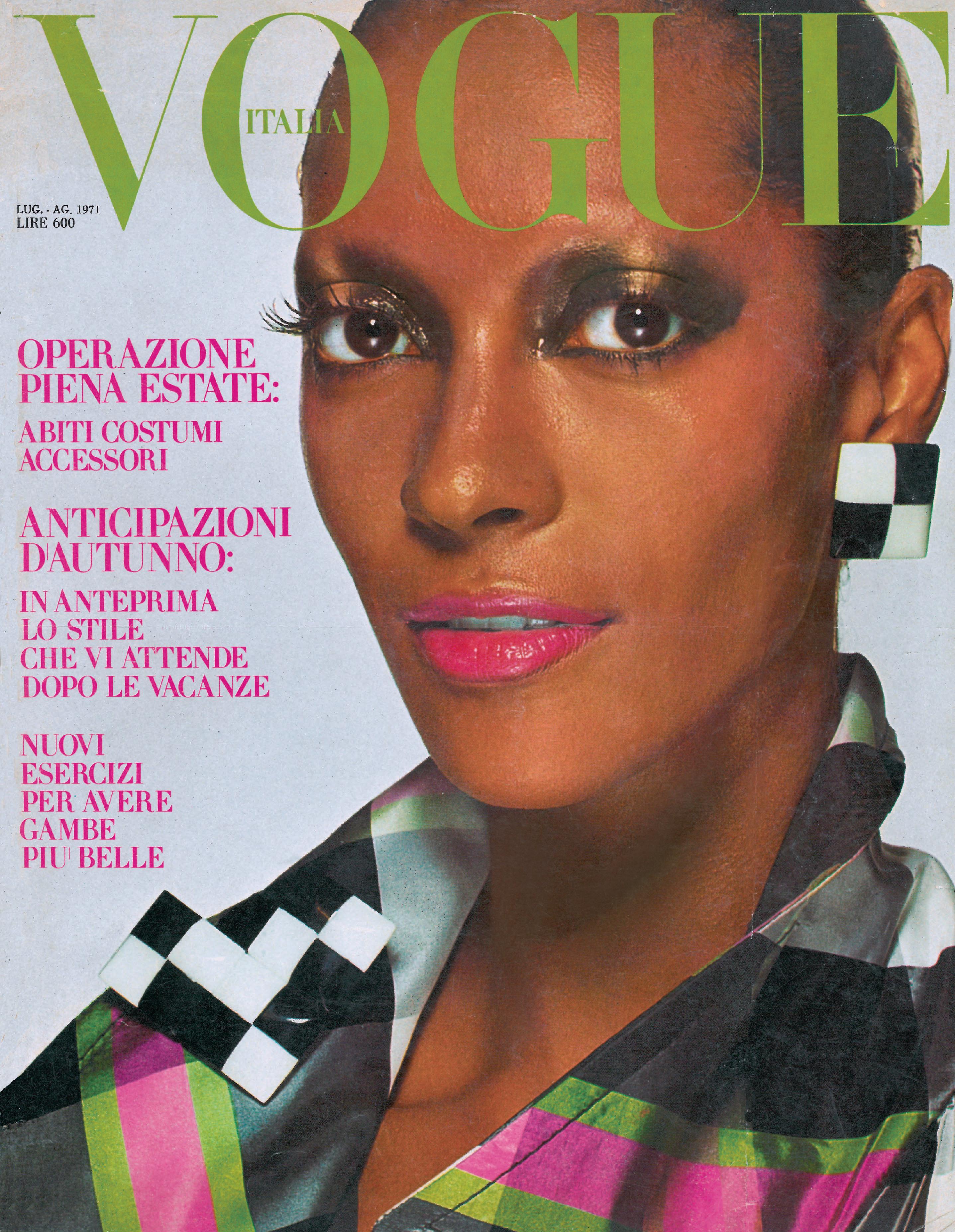
Vogue Italia, cover, JulyAugust 1971
Carole La Brie wearing the Valentino Boutique Madras trench in waterproof silk taffeta by Taroni and geometric jewellery by Correani
Photo: Chris von Wangenheim
THE SEVENTIES and THE BIRTH OF “MADE IN ITALY” FASHION
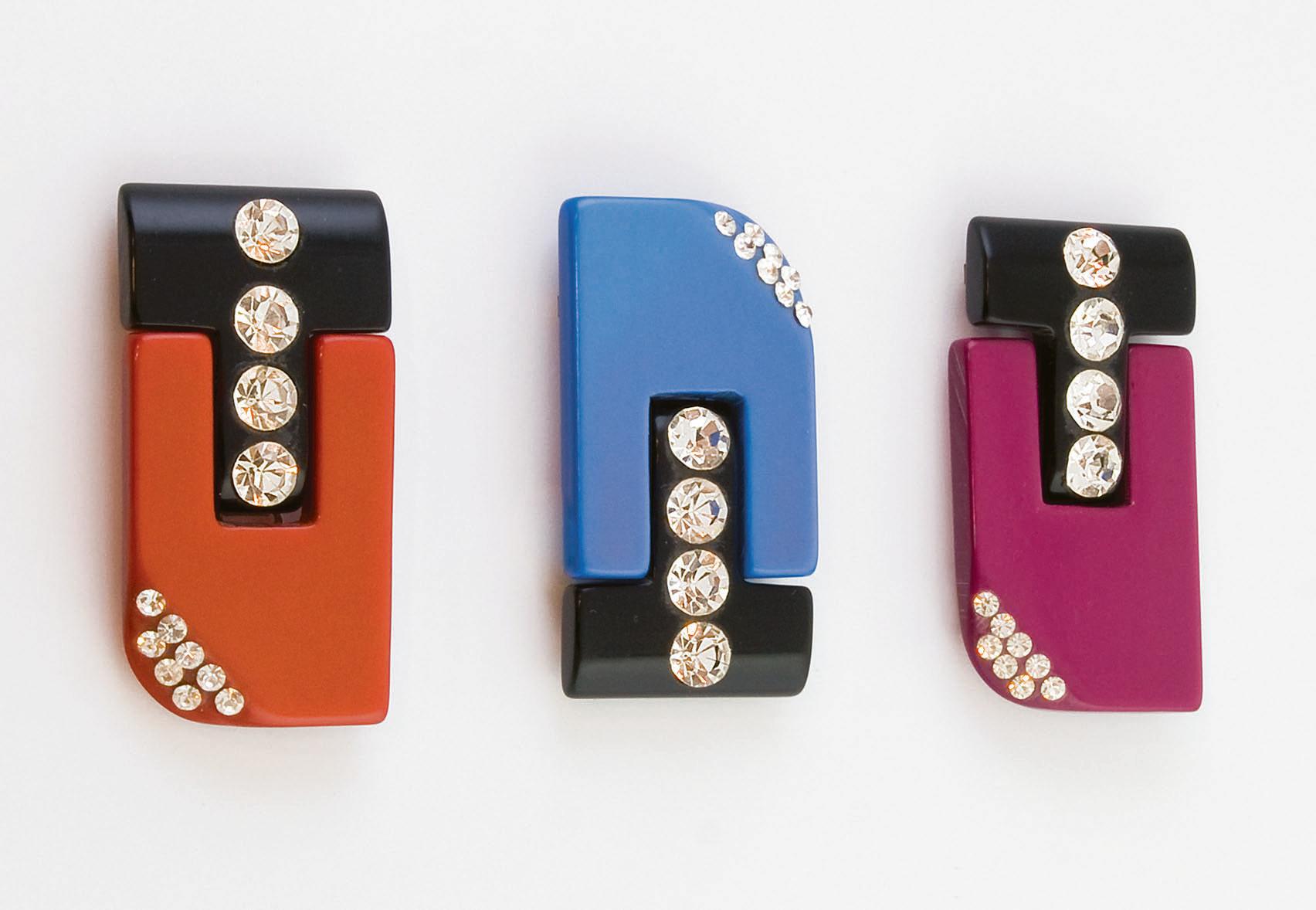
Three geometric dress clips
Designed by Gianfranco Ferré for Walter Albini / Misterfox, A/W 1971–2 collection, Milan
Twotone plastic, rhinestones and gilded metal findings
Marisa Curti Collection, Milan
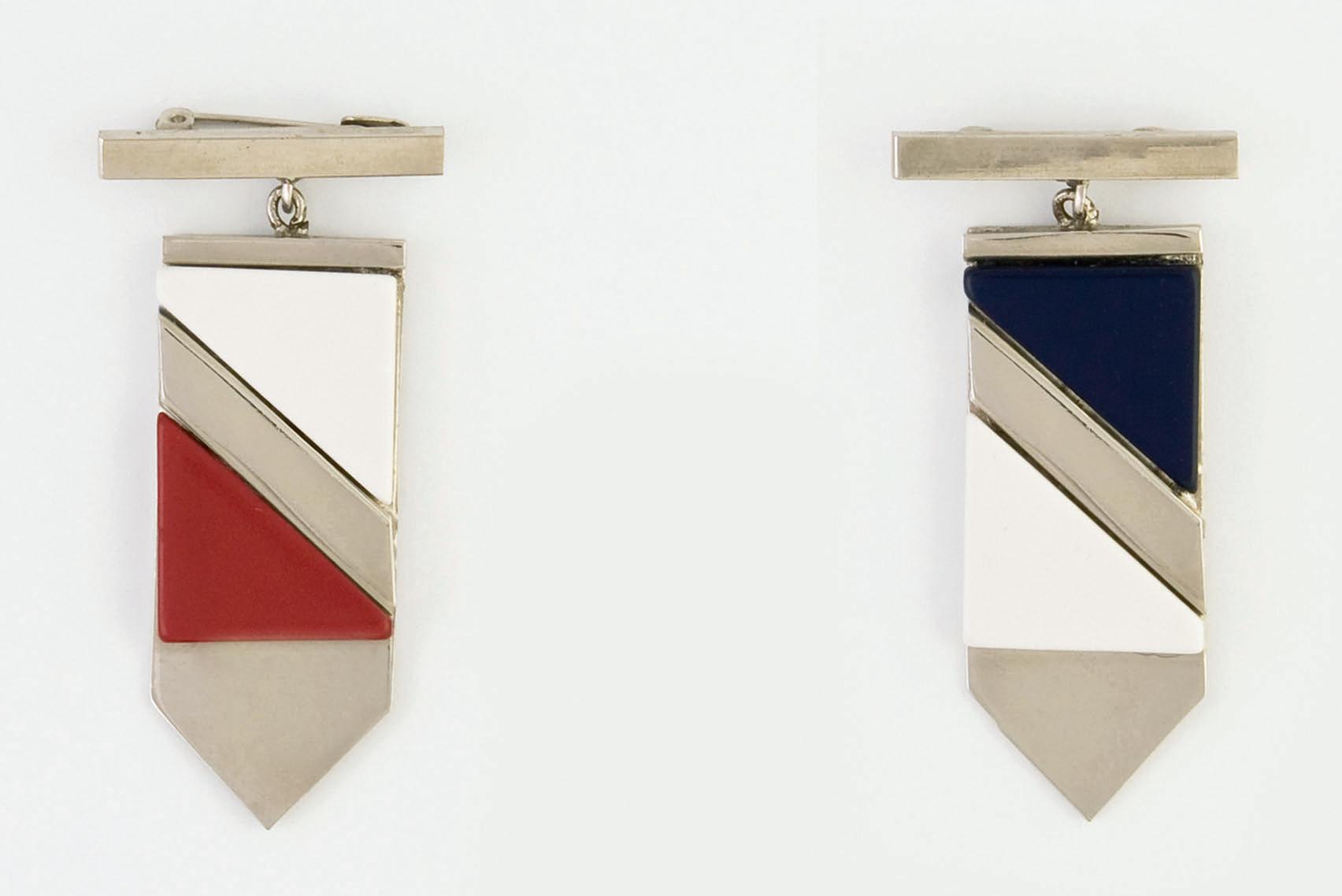
Pair of brooches with pendent banners
Walter Albini for Misterfox, Milan, S/S 1972
Chromiumplated metal and plastic
Marisa Curti Collection, Milan
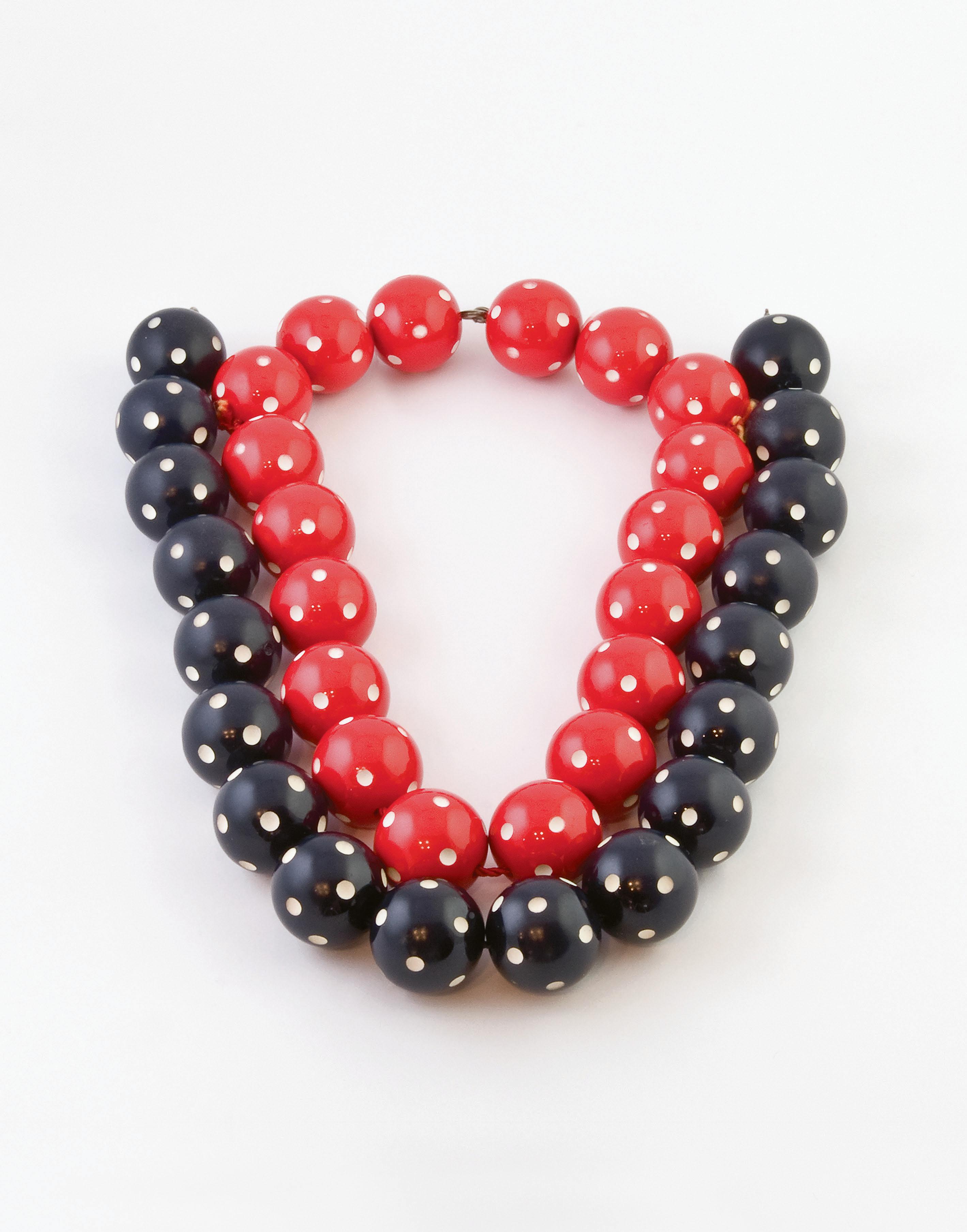
Two bead necklaces
Designed by Walter Albini for Misterfox, S/S 1971 collection
Manufactured by Ugo Correani, Milan
Plastic with engraved dots
Published in Vogue Italia, January 1971, p.25
Marisa Curti Collection, Milan
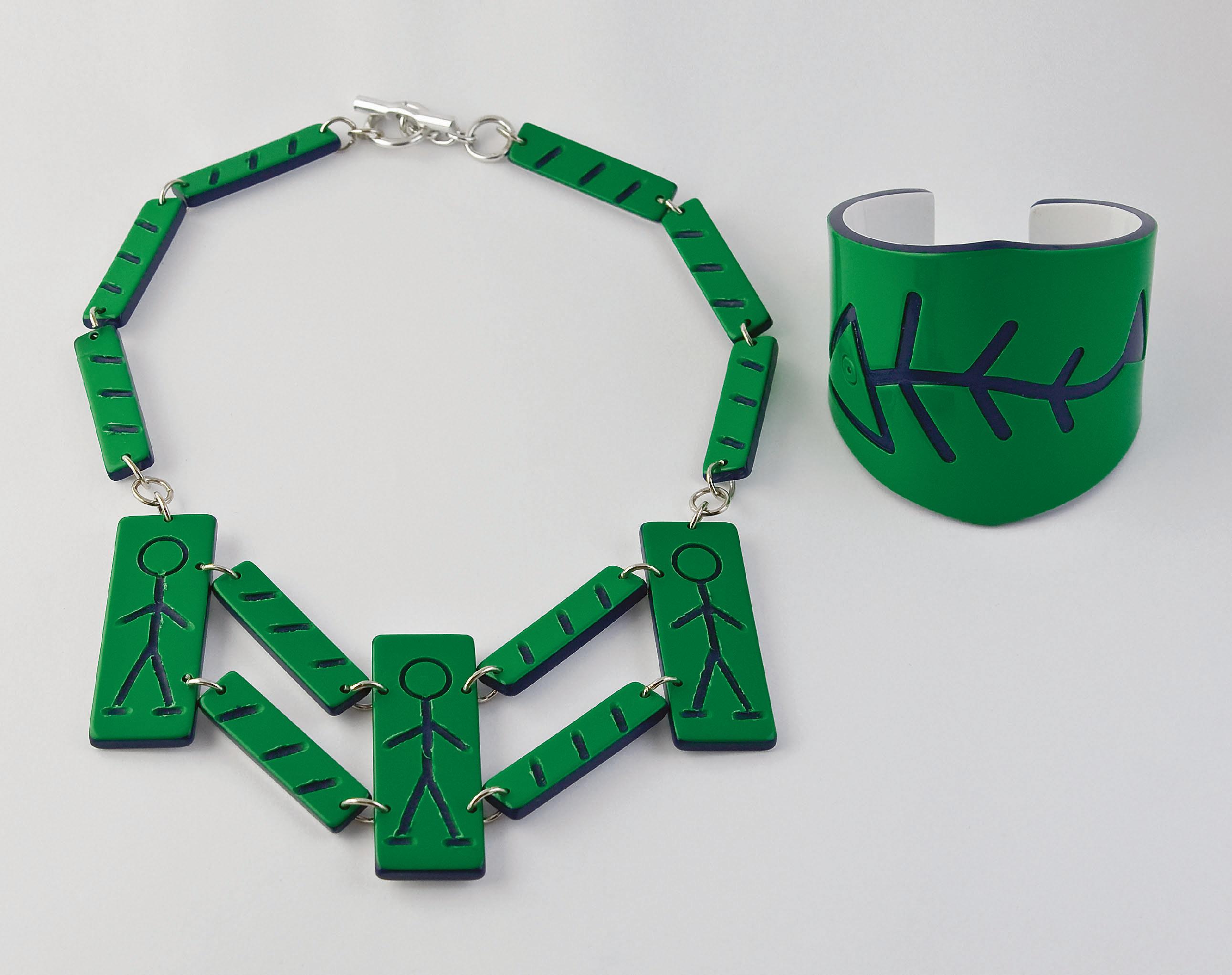
Necklace and bracelet
Elio Fiorucci
Milan, first half of the ’70s
Engraved galalith
Bracelet stamped: “Fiorucci”
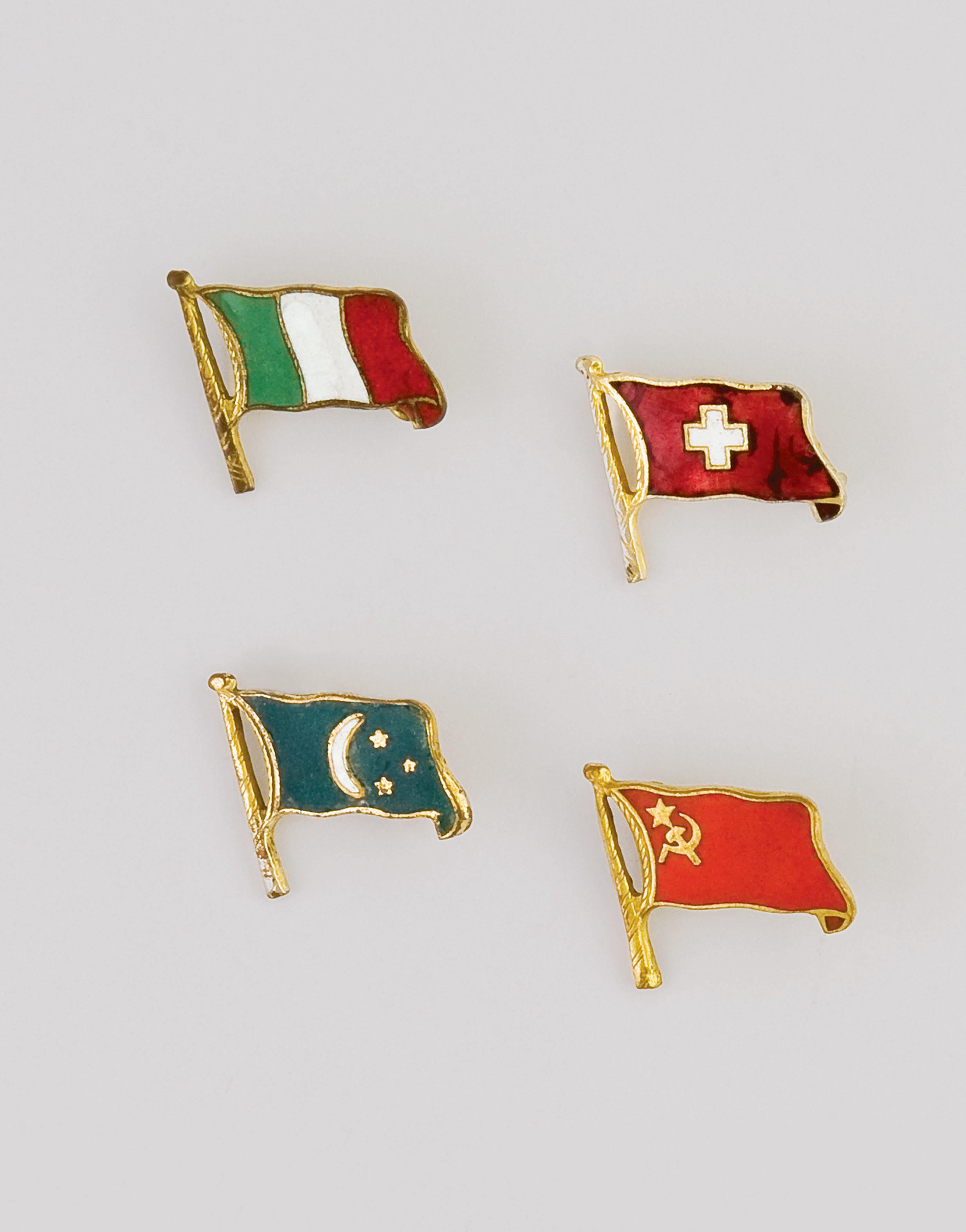
Four flagshaped pins Designed by Walter Albini; manufactured by Ugo Correani Milan, c.1972
Gilded metal, partially enamelled Marisa Curti Collection, Milan
and, at the same time, manufacturers of fine jewellery used them as inspiration for their current production. Tourists passing through Milan in search of “Made in Italy” dresses almost always bought the dress they liked and the vintage brooch that went best with that dress. Questions abounded: “Where does this brooch come from? Who manufactured it? When was it made and for whom? How much would it have cost at the time?”
And so I decided to visit the United States to try to reconstruct the history of American fashion jewellery, first in New York, where the latest fashion trends originated, then Rhode Island, where they were manufactured. Here I found a great willingness on the part of all those involved in the manufacture of fashion jewellery to talk to me; particularly helpful were Alfred M. Weisberg, owner of Technic, a gilding industry, and Peter Di Cristofaro, owner of Providence Machinery Exchange, a company of high precision machines for the manufacturing of fashion jewellery which ten years later would be featured in the The Providence Jewellery Museum.
I was not the only one intrigued by the success of American fashion jewellery in Milan. Ludovica Rizzoli, the wife of the greatest Italian dealer of fine vintage jewellery, Carlo Eleuteri, had a shop right next to Marisa boutique. And it was Ludovica who in 1986 suggested I might organise an exhibition of vintage costume jewellery at the Venice Design Art Gallery. The resulting exhibition, with a catchy title, Gioie di Hollywood, (Joys of Hollywood), was inaugurated on
the same day as the opening of the anthological exhibition dedicated to Arcimboldo, the sixteenthcentury Milanese painter known for his portraits using compositions of fruit and vegetables. The major Italian fashion magazines, newspapers and television channels, local and national, gave Joys of Hollywood a lot of coverage.
Thus began my adventure into the world of vintage fashion jewellery, which culminated in 1991 with the exhibition I gioielli della fantasia (Jewels of Fantasy).
I conceived and organised this exhibition with the sponsorship of the Daniel Swarovski Corporation and valuable contributions from the best international experts of jewellery and fashion history: Vivienne Becker, Nicoletta Bocca, Gerda Buxbaum, Melissa Gabardi for the historical sections related to various cultural areas of European countries; and Rinaldo Albanesi, Vera Maternova, Eduard Schweiger, Alfred M. Weisberg for the technical section. The exhibition then successfully toured the most important museums of the world, from the Victoria & Albert Museum in London to Los Angeles County Museum, from the State Museum of Zurich to the most important museums and locations in the Far East, gathering a great of number of viewers and coverage from specialised press. The exhibition and most of all its catalogue (which was translated from Italian into English, French and German), opened the floodgates for collecting vintage costume jewellery; supported by further publications and exhibitions, which, together, boosted the legitimacy of fashion jewellery as an expression of the applied arts.

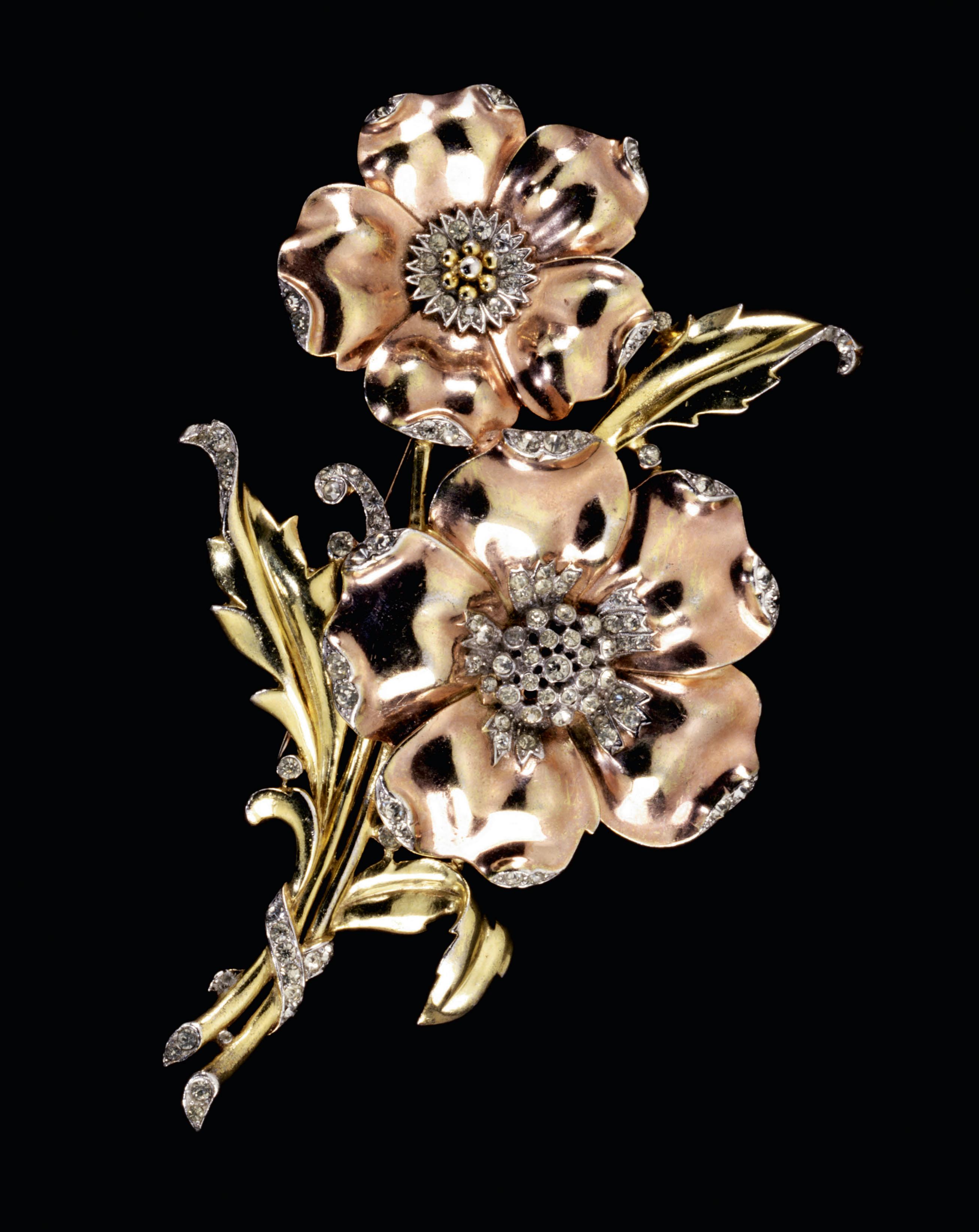
Metal gilded in three colours and rhinestones
Signed: “Trifari”
An example of the kind of brooch that went perfectly with the "Made in Italy" fashion of the Eighties
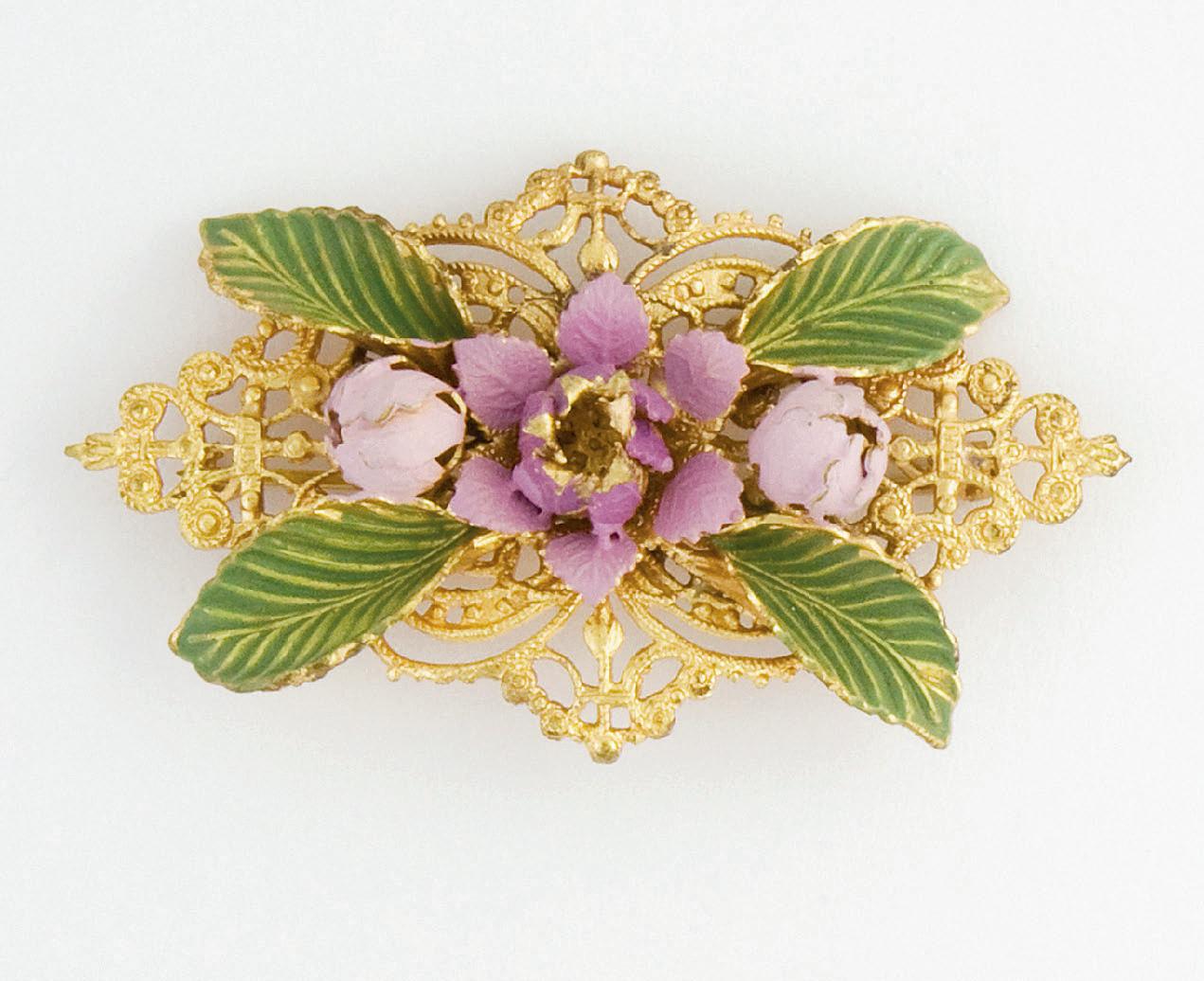
Flowermotif brooch
Designed by Alfred Philippe for Trifari, Krussman & Fishel, USA, c.1941
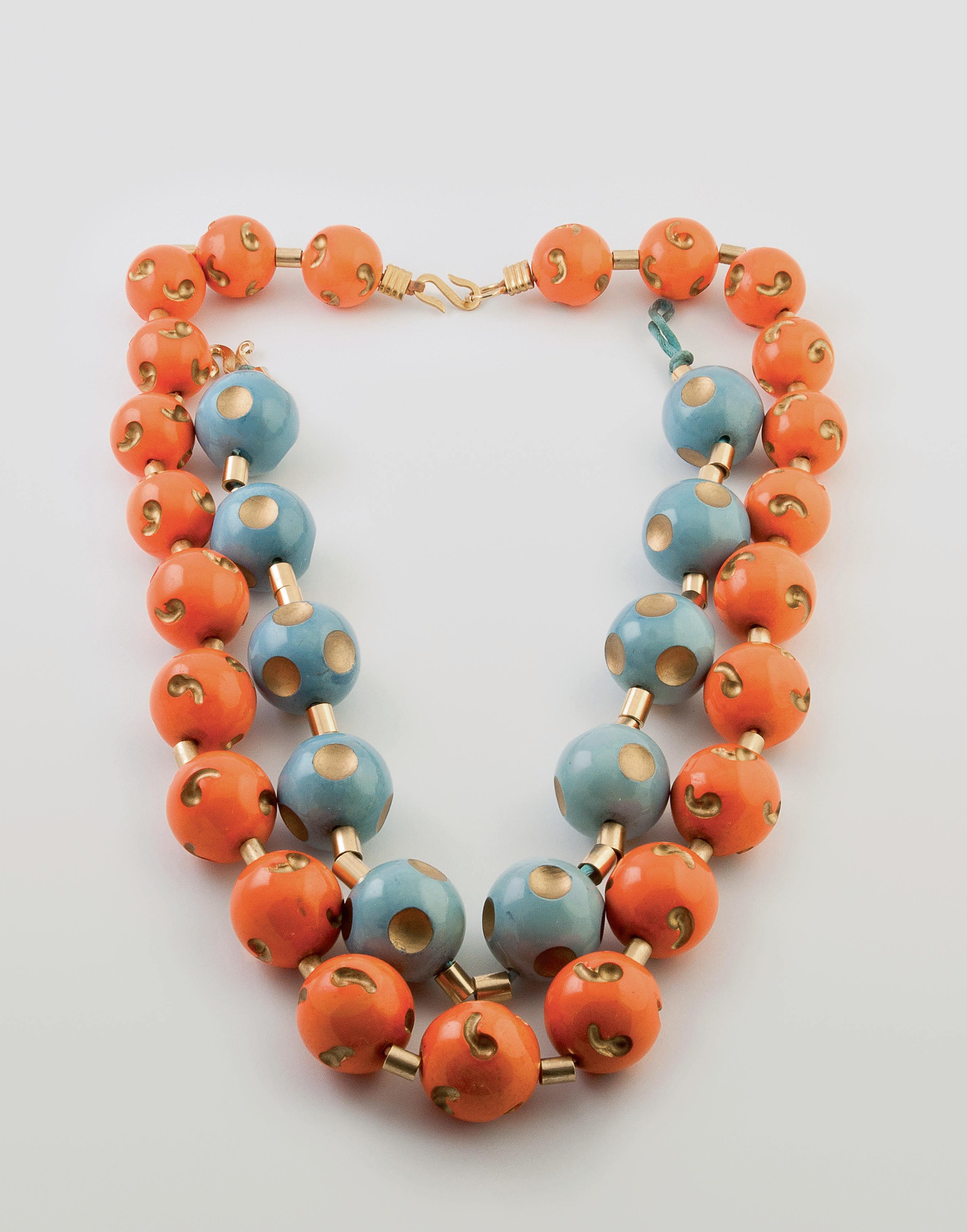
Two necklaces with engraved spherical beads
Sharra Pagano for Enrico Coveri
Milan, early ’80s
Engraved and painted resin, cylindrical gilded brass findings, brass clasp
Sharra Pagano archives, Milan
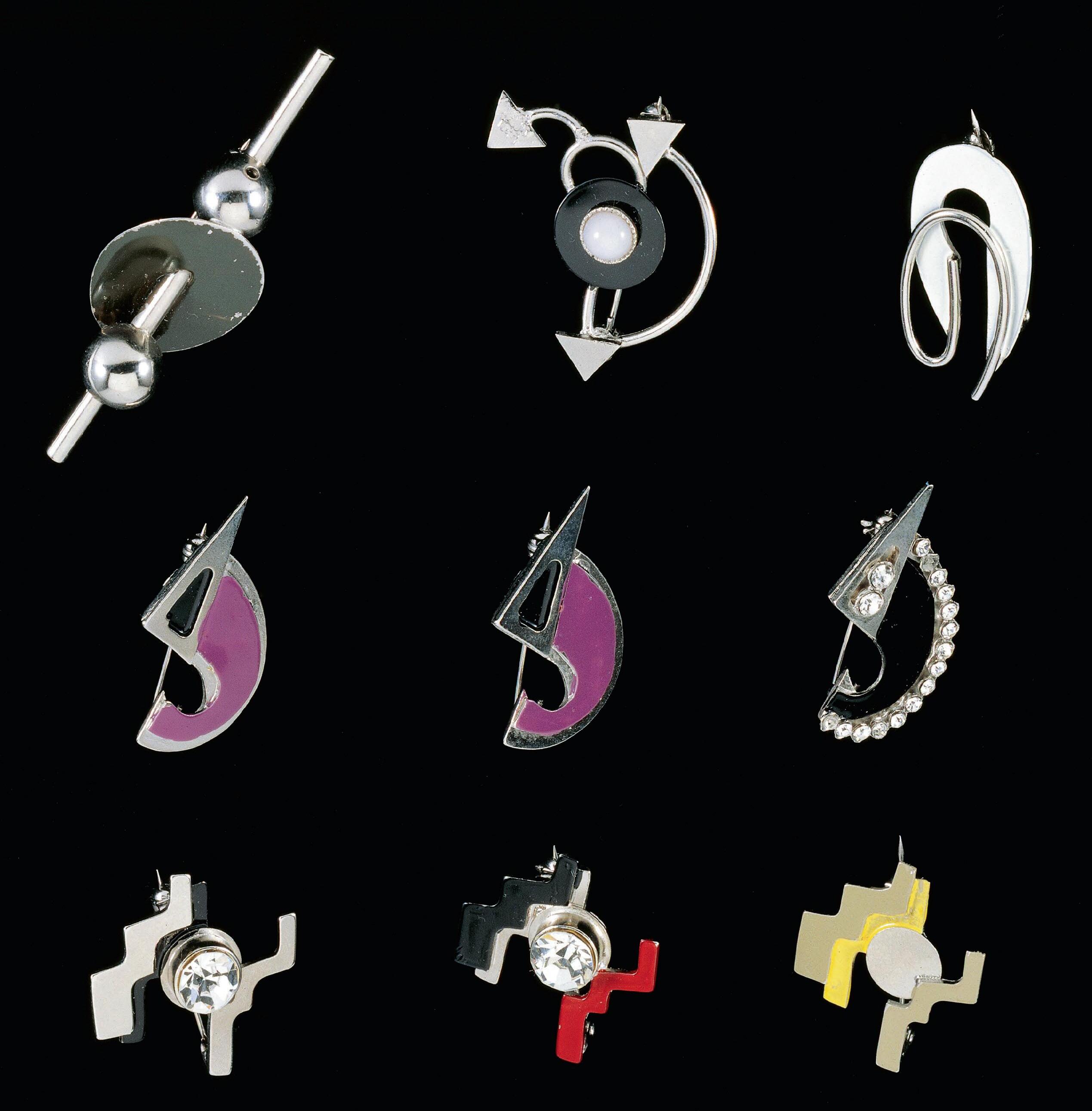
Various geometrical brooches designed by Ugo Correani for Gianni Versace Milan, early ’80s
Rhodiumplated metal, partially painted, rhinestones
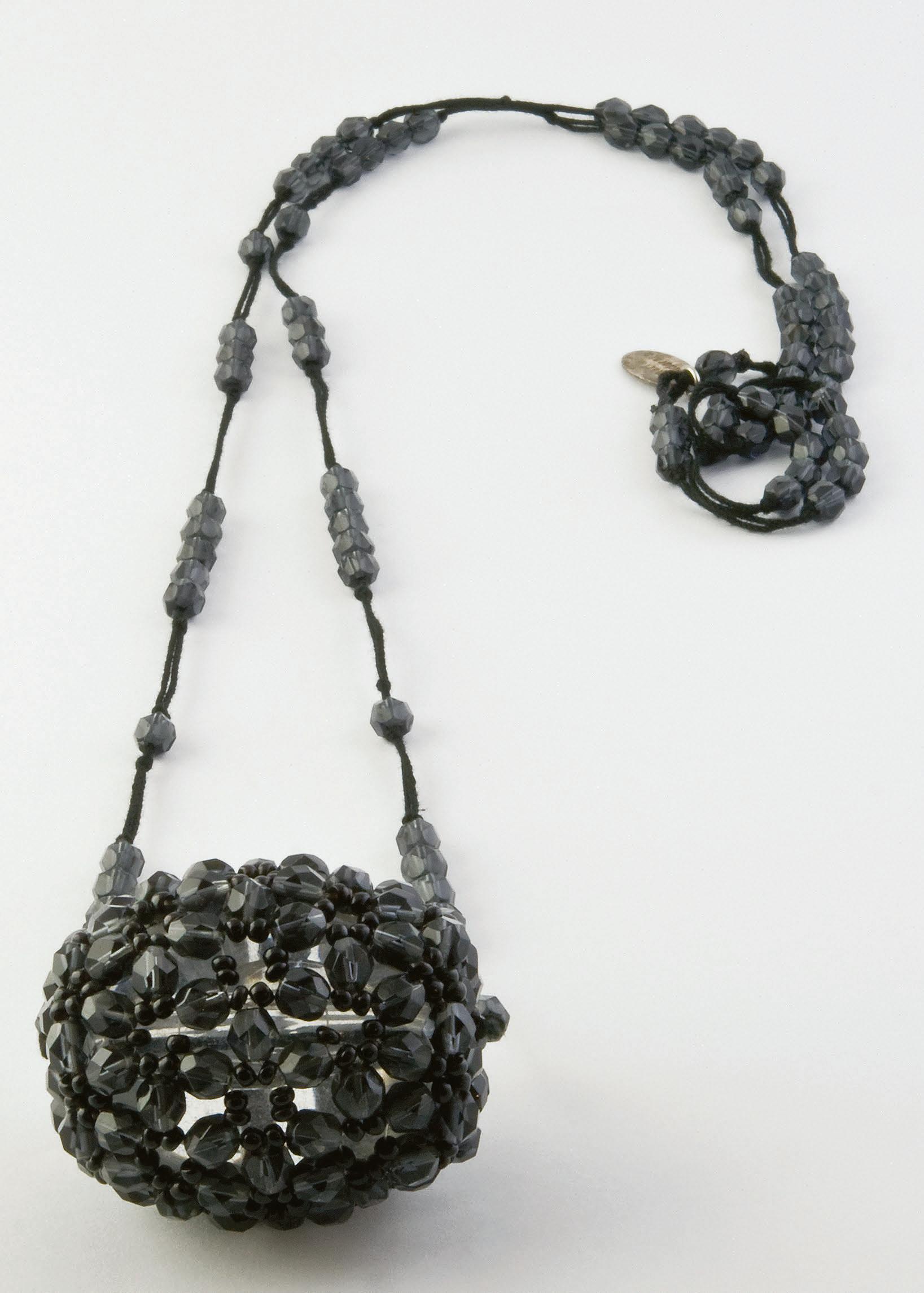
Single strand necklace with heavy beaded oval decoration
Maria Calderara
Milan, 1993
Faceted firepolished glass beads, conterie and silk thread.
Inside of the central pendant made in transparent resin
Metal tag marked: “Maria Calderara”
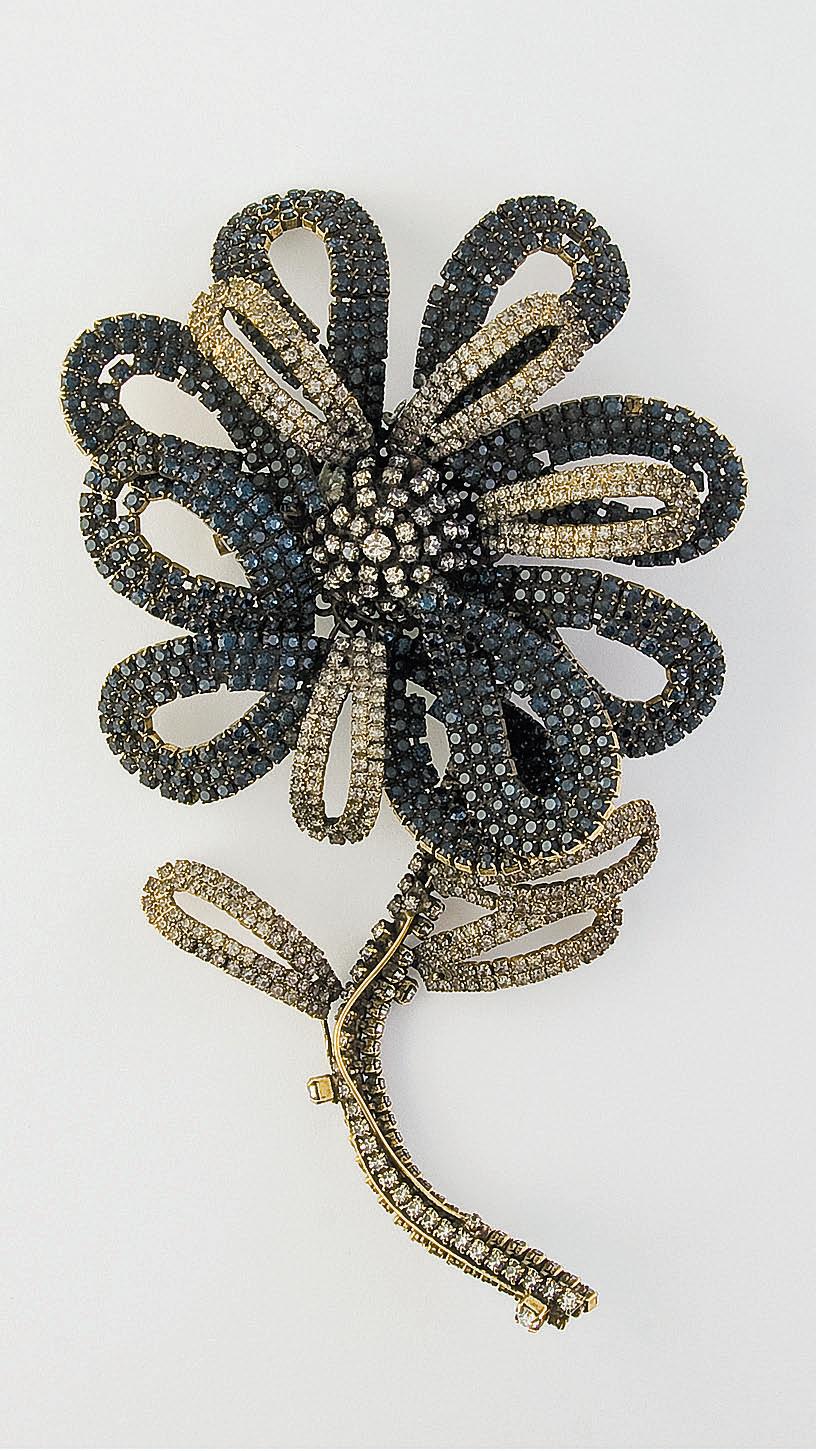
Flowermotif brooch
Angelo Saccone
Bologna, 1999
Rhinestone chain and handworked gilded metal wire
Angelo Saccone Archive, Bologna
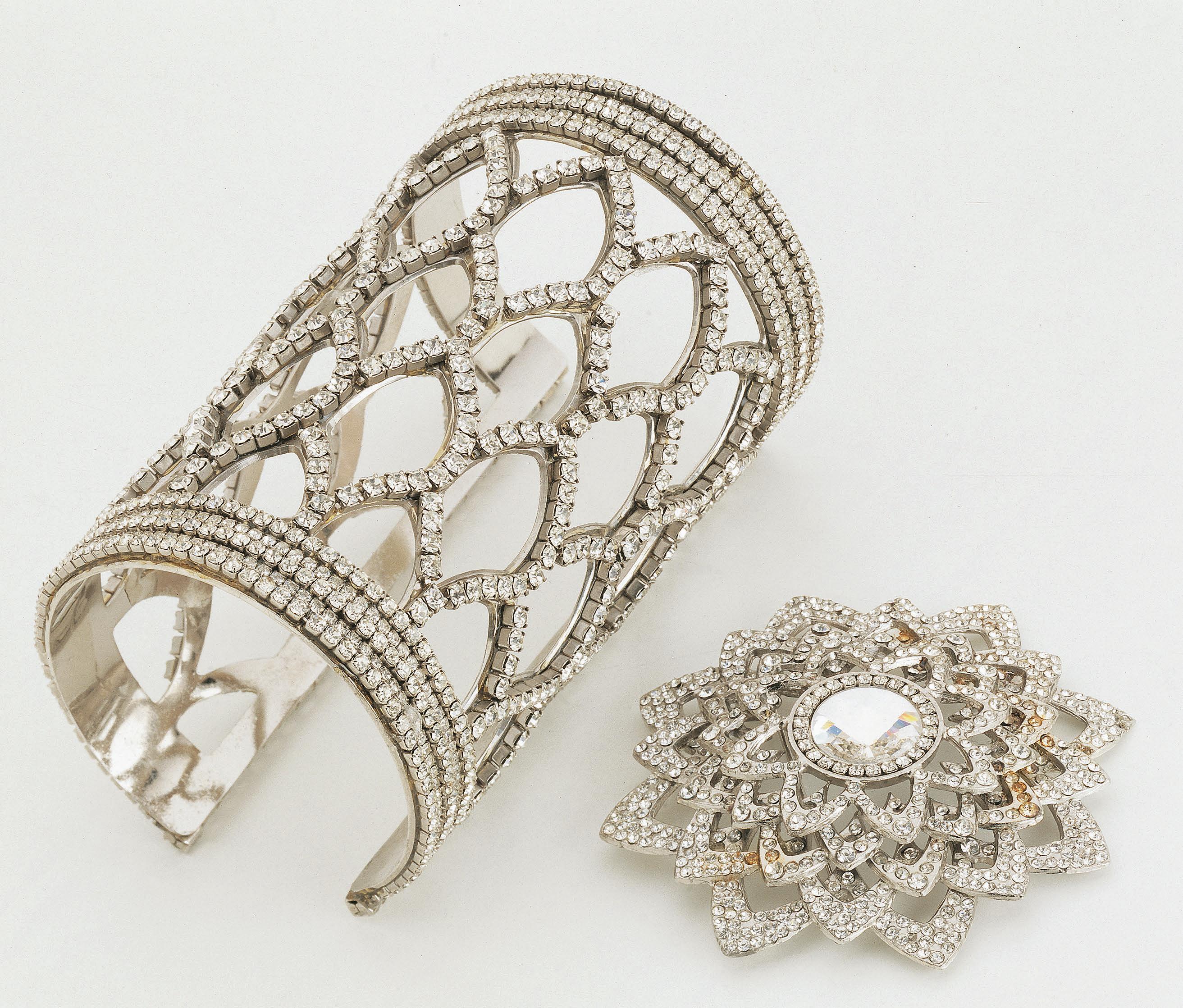
work silvercoloured metal and
Parure comprising brooch and Indian bracelet Mila Schön Milan, c. 1995
Open
rhinestones
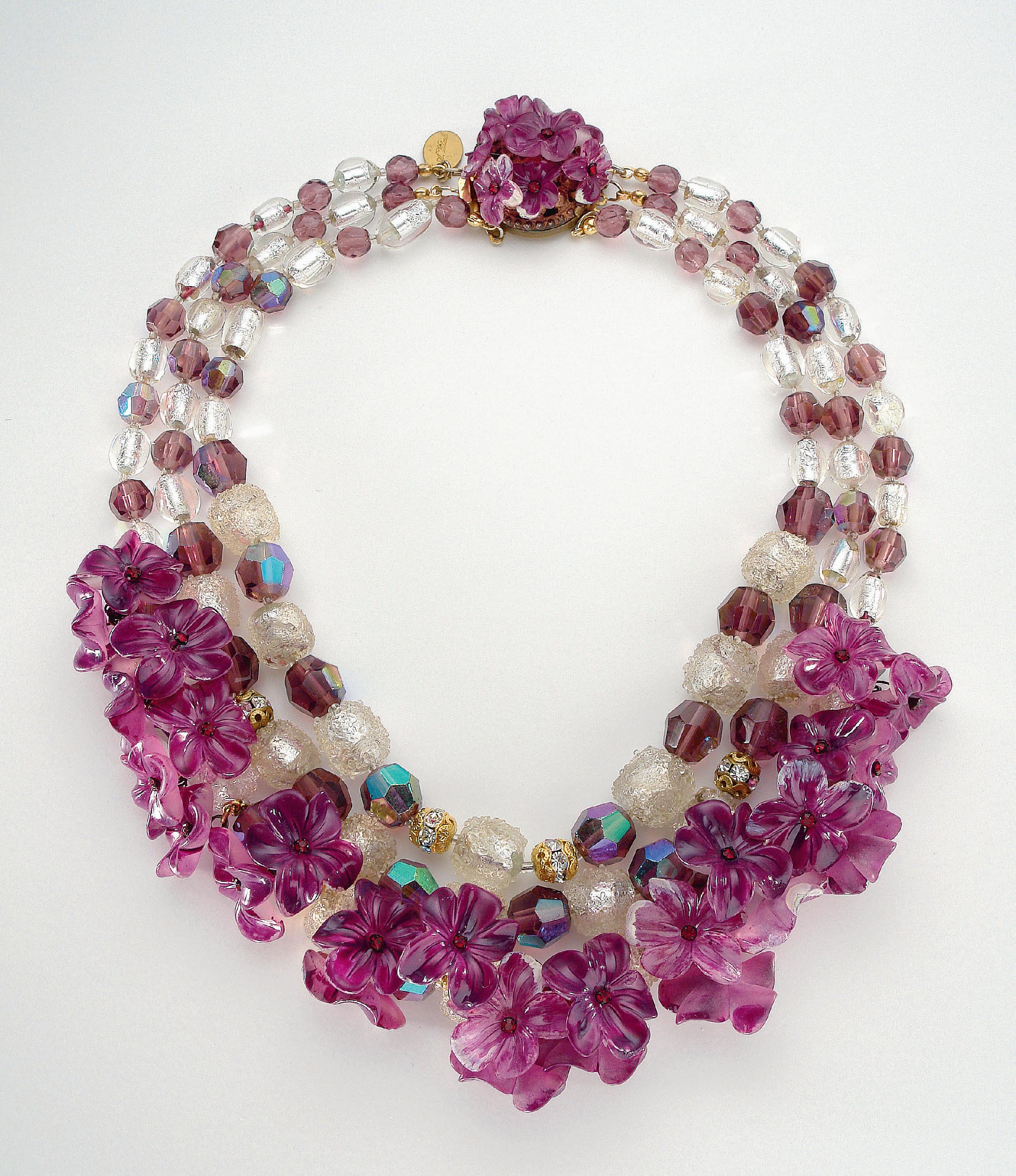
“Attis” necklace
Annarita Vitali
Bologna, 1995
Venetian glass paste beads with inclusions of silver leaf, iridescent violet crystal beads, enamelled violets in plexiglass attached using pins ending with a rhinestone, clasp made of violets mounted on metal beading screen
Private collection
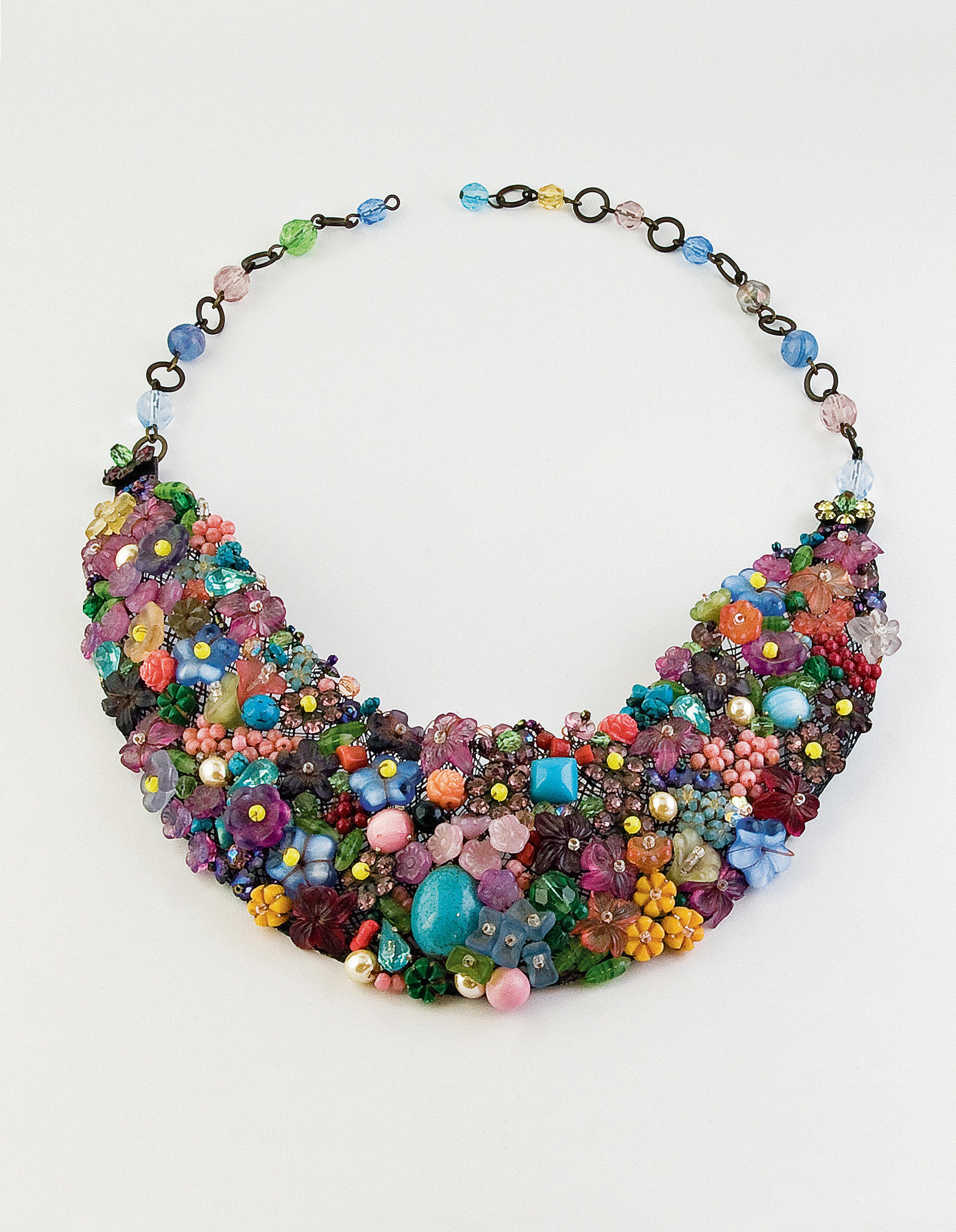
Necklace heavily studded with floralmotif decorations Dora Rossi for Unger’s Clotilde Silver line Milan, 1999
Elements in glass, plastic, simulated pearls, chips of semiprecious stones mounted on a metal mesh
Originally, the Clotilde Silva pieces were sold with a tag marked “Clotilde Silva” Unger Archive, Milan