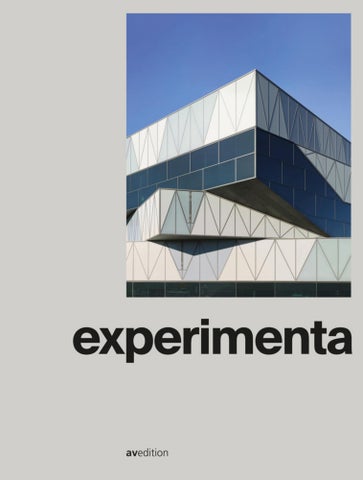
experimenta A Science Center in a New Dimension
Edited by
With contributions from
Wolfgang Hansch
Dieter and Franziska Schwarz Thomas Bochmann Matthias Sauerbruch Wolfgang Hansch Kenan Bromann Bärbel G. Renner Christian Sichau Thomas Wendt
8
When Inquiry leads to Learning-by-doing Dieter and Franziska Schwarz
20
Introduction Wolfgang Hansch
22
The Architecture of the Hagenbucher Oilseed Storehose Thomas Bochmann
42
The Architecture of the New Building Matthias Sauerbruch
66
A Science Center in a New Dimension Wolfgang Hansch
The experimenta Kenan Bromann, Bärbel Renner, Christian Sichau, Thomas Wendt 102
The Research Worlds
116
The Discovery Worlds
138
The Experience Worlds
148
A Ship of Knowledge
152
The experimenta Brand
156
Education is our most important resource Dieter Schwarz Foundation
158
Literature
160
Authors
162
Project Participants
166
Awards/Nominations
167
Acknowledgements
168
Imprint/Picture credits
Thomas Bochmann
The Architecture of the Hagenbucher Oilseed Storehouse
Cradle of Industry and the Construction of the Hagenbucher Storehouse To understand the development of the Heilbronn Kraneninsel with experimenta into a valuable center of knowledge and a place of learning and as an important urban building block in Heilbronn, the history of the site’s industrial past must be taken into account. The former mill quarter located on the river islands near the historic district, specifically the islands Große Bleichinsel and Kleine Bleichinsel, Hefenweiler and Kraneninsel are considered the cradle of Heilbronn’s industrial revolution and were originally densely developed and home to oil and paper factories. With the Neckar Charter of Emperor Louis IV of 1333, the first town grist mills were situated on a dammed and reclaimed section of the Neckar River. This was followed during the early industrial period at the beginning of the nineteenth century by the first factories, which were also powered by water. Up to fifty-five millwheels once turned along the water channels and millraces. Waterwheels also supplied power to the factory owners Rauch, Schaeuffelen, Hauber, and Knorr. One of the last structures built during this industrial age was the “Hagenbucher” oilseed storehouse designed by Hermann Wahl and completed in January 1936—inspired by the New Objectivity architectural style and named for its owner Carl Hagenbucher, one of the largest oil producers in the German Reich. His building complex on Kraneninsel was widely known as the “Oil Baron’s Palace.” Rapeseed, flaxseed, poppy seeds, and other seeds were stored in the imposing six-story-high building with its 3,500 m² of storage space used by the nearby oil mills. Its trapezoidal layout is due to the outer contour of its predecessor, the old mill on the bridge. To support the tremendous loads of bulk seed, the structure was built as a modern reinforced concrete skeletal construction. The distinctive support structure consists of twenty-two interior columns in a grid of around four meters; its concrete slab beamed ceilings rest on a system of main and secondary beams. Each floor of the structure is narrower than the one below. The part of the skeleton structure in the facade is filled in with brick, and the industrial muntin grid windows typical of the time are surrounded with masonry. The “Hagenbucher” oilseed storehouse shortly after its completion in 1936.
23
View from the water’s edge of the historic city center to the Kraneninsel with the new “Hagenbucher,” January 1937
Map of the city of Heilbronn with mill quarter west of the historic city center consisting of the Bleichinseln, Kraneninsel, and the Hefenweiler, 1858
From a Forgotten Ruin in the Mill Quarter to a Science Center While the mill quarter and the historic city center were reduced to rubble and ash just a few years later by bombing during the Second World War, the Hagenbucher storehouse sustained minimal damage. Once the last traces of construction on the Kraneninsel were demolished using controlled demolition in 1957, and the debris dumped into the waterway, the seemingly indestructible building sat enthroned on the island as the last visible relict of the oil industry. After the company Carl Hagenbucher & Söhne closed its doors, the city of Heilbronn acquired the building. Although just a short walk from city hall, the Kraneninsel and the storehouse fell into disuse, only exacerbated by the off-putting expansion of Kranenstrasse on the island as part of the central ring road. It was used as storage space for a time, for example for school props and costumes, and parts of it later served as the municipal art gallery “Art in the Hagenbucher Storehouse.” The storehouse was not listed as a protected historic property and was constantly threatened with demolition, at one time in favor of parking structures and at another to make way for a gymnasium or a hotel. It was not until the Neckarpark concept was launched in the 1990’s that public awareness of the possibilities of the Kraneninsel with its dominant structure revived. As part of a future city park, footbridges were erected to connect the islands and provide access to the historic city center. Various measures were also introduced to improve and revive the adjoining, inner-city neighborhoods along the banks of the Neckar River. A seasonal beer garden was set up in front of the Hagenbucher storehouse as well. At the same time, the idea of using the Hagenbucher storehouse as an offshoot of the City Museum in Deutschhof was considered for the first time, appropriate for a building that was a silent witness to the confident local industry and to the technological, economic, and social history of Heilbronn. Yet it took several years before a feasibility study prepared in 2005–06 and entitled “Science Center in the Hagenbucher” reopened discussions about the use of the partially empty
24
THE ARCHITECTURE OF THE HAGENBUCHER OILSEED STOREHOUSE
The “Strandbeest”—a kinetic work of art made of yellow plastic tubing, zip ties, nylon thread, and adhesive tape by Dutch artist Theo Jansen. Art and bionics create a symbiosis.
Sound installation by German-American artist Gerhard Trimpin. Forty-eight tuned Marimba rods are struck using an electromagnet and the sounds are amplified by the tubes, which act as resonators.
in the scientific and technical progress achieved through the acquisition of knowledge. Today, the acquisition of digital, filtering, media, and problem-solving competence together with ambiguity, socio-economic competence, and the ability to think in processes are in part new competencies based on another type of learning. Add to this mix the applied skills from the 4C model of learning, namely communication, creativity, collaboration, and critical thinking, and an educational goal emerges that did not exist twenty years ago. Andreas Schleicher, Director for Education at the OECD (Organization for Economic Co-operation and Development) describes the learning model as follows: “Rather than just learning to read, twenty-first-century literacy is about reading to learn and developing the capacity and motivation to identify, understand, interpret, create, and communicate knowledge.”90 The 4C model is quite popular in the Anglo-American educational system. It is not without its detractors, but it does identify the fundamental basics of self-directed learning. It dates back to a non-profit organization called the Partnership for Twenty-First-Century Learning founded in 2002. Representatives from all major digital groups are also members. After the turn of the millennium, they raised the question of what educational competence is necessary in the twenty-first century. One representative of these digital groups, Scott Hartley, a Stanford University graduate, describes this in his 2017 book The Fuzzy and the Techie as follows: “Learning to code is not enough. The soft skills— curiosity, communication, and collaboration, along with an understanding of psychology and society’s gravest problems—are central to why technology has value.”43 experimenta attempts to reflect on and critically examine these educational goals and to connect them with its didactic approach of promoting an intrinsic motivation to learn and a self-regulated acquisition of knowledge. Another aspect that expands the experimenta concept beyond the realm of MINT / STEM is art. (STEM stands for Science, Technology, Engineering, Mathematics). There is a trend today to use STEAM, in which case the “A” stands for Arts. The term “STEAM education” is attributed to Georgette Yakman who popularized this link beginning in 2006.104, 105
96
A SCIENCE CENTER IN A NEW DIMENSION
Mondspiegel [Moon Mirror] by realities:united, a group of artists from Berlin. The actual geodata of the surfaces of the moons of Io, Europa, and Titan are virtually mirrored. The dissociation opens up a new aesthetic view of structures that are otherwise almost imperceptible.
Science & Theatre Festival, a cooperation between Theater Heilbronn and experimenta. The picture shows a scene from “Schwarze Schwäne” [Black Swans] by Christina Kettering.
Integrating art in the context of the natural sciences and technology goes back to Oppenheimer (1980): “Art is included, not just to make things pretty, although it often does so, but primarily because artists make different kinds of discoveries about nature than do physicists or biologists …. The art in the Exploratorium is therefore blended with the science as a part of the overall pedagogy.”78, pp. 4–5 Art presents a new and unusual way of looking at things through thinking that is not bound to disciplines, algorithms, and patterns, through surprisingly provocative reckoning. Art can help foster an ethical decision, a decision made using intercultural, socio-emotional competence. Together with the processual interdisciplinary thinking of the modern natural sciences and the creative solution orientation of the technological disciplines, these are competences that will long remain the purview of human intelligence. Educational competences derived from this must also be strengthened and developed in a science center. This is especially true for young people. experimenta attempts to take these connections into account through the use of new formats. One example is the biennial Science & Theatre Festival instituted in 2019. Any consideration of typical human skills in the context of changing the educational landscape cannot avoid artificial intelligence. No subject has shaped the discourse more when it comes to humankind’s future as self-determined beings. Given what we already know about “Artificial Intelligence”—a term introduced in 1956 by American computer scientist John McCarthy (1927–2011)—in the future AI will be superior to human beings in all processes based on algorithms.99 This can be a great advance because it would free people from performing monotonous activities, for example, and perform many processes more efficiently and error-free in virtually all branches. The prerequisite for the use of machine learning, of intelligence in a certain field, would be its global use for the benefit of all. Yet there is another, much more interesting question: Can (should) artificial intelligence gather experiences and thereby be able to learn as well as share what is learned? In his book Künstliche Intelligenz und Sinn des Lebens [Artificial Intelligence
97
The Research Worlds
Getting to know the ways of the world means more than accumulating knowledge. This is why the experimenta Research Worlds focus on guided explorative learning. In the process, visitors grapple with theories, test them using various methods, and in this way find answers to their questions on their own. This facilitates the comprehensive examination of a topic, the grasping of interrelationships, and confidence in one’s own creativity in finding solutions to problems. During explorative learning, students also learn how to learn.
Louis Brüggemann Lab Elisabeth Kalko Lab
Laboratory Facilities for the Secondary School Level p. 108 Level 5
Robert Mayer Lab Wilhelm Maybach Lab
Level 4 Konrad Zuse Lab
Level 3
102
The Student Research Center sfz Nordwürttemberg p. 110 Marie Curie Lab Friedrich von Alberti Lab
Marie Curie Lab Friedrich von Alberti Lab
Level 4
Marie Curie Lab Friedrich von Alberti Lab Level 2
The labs for elementary and middle-school levels Level 2 p. 104
Archimedes Lab
Archimedes Lab Level 2 Archimedes Lab Level 1
Level 1
Level 1
The Carl-Heinrich Knorr Test Kitchen p. 106 Level 1
Level 1
Level 1
The Maker Space p. 112
Ground Level
Ground Level
Ground Level
103
WeltBlick Cold, sober, incomprehensible, and dry: negative words that are often used to describe the natural sciences and technology. The WeltBlick exhibition seeks to prove this wrong. In a playful way, it demonstrates that scientific research and exploration, and technological development are creative, imaginative processes that facilitate fascinating insights and open the door to impressive “spaces of the unrealized.” The exhibition starts with a simple example: the dream of flying. A lot has to happen to make it come true. The process of realizing a dream can be broken down into several steps: observe, represent, calculate, test, and (today) simulate. Precisely these small steps are the focus of the exhibition WeltBlick. What else is typical of this expedition into the world of science and technology? Overall, the exhibition is like an atelier of knowledge. The stations appear to be only on temporary display like the objects in an artist’s atelier.
This is because our knowledge of the world is not solid, but subject to constant change. The design of the exhibition emphasizes this transitory state. Exploration of the atelier of knowledge does not start at some distant point, but rather always with the visitors themselves. At the center of each thematic section is a giant box. The interactive stations there present each section’s topic tangibly, clearly, and as it relates to the individual visitors. The boxes are surrounded by several other stations that use numerous examples to introduce visitors to other branches of science and technology. The focus is purposely placed on the great diversity of scientific visions. This plurality is another feature of the exhibition. Inevitably, artistic visions of our world also emerge, for example, the walking “Strandbeest” of Dutch artist Theo Jansen. A touch of humor and the pleasure of play cannot be omitted from an atelier of knowledge
126
THE DISCOVERY WORLDS
like this. Why does a slice of bread always fall jam side down? The question might sound “childish,” but it leads us directly into the process of the scientific understanding of our world. How large is the slice and what does it weigh? From what height has it dropped? Visitors are not just presented with the final outcome of this kind of experiment, but gain new insight through their own activity! Finally, visitors are playfully drawn deeper into the world of science and technology—now as actively involved participants. What should we actually research and develop in the future? Using examples of selected, actual research projects, visitors now decide themselves—and grapple with the decisions others have made regarding which new visions we want to create for the future.
127
This book about Germany‘s largest science center explains experimenta’s origins in the context of science centers, planetariums, and student labs as institutions of education. It also vividly documents the innovative offerings available as well as its unique didactic concept. The richly illustrated volume is accompanied by remarks on the architectural design concepts of both experimenta buildings: the repurposed historical Hagenbucher storehouse and the spectacular new glass and steel structure designed by Sauerbruch Hutton.