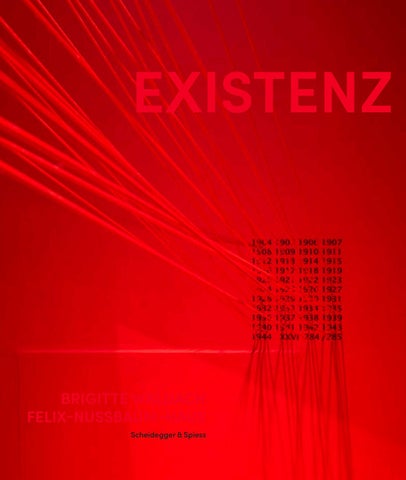
EXISTENZ
BRIGITTE WALDACH FELIX-NUSSBAUM-HAUS Scheidegger & Spiess A
INHALT 4
GRUSSWORT
CONTENTS
5
PREFACE
9
FOREWORD
DANIEL LIBESKIND
11
DANIEL LIBESKIND
EXISTENZ
13
EXISTENZ
49
FROM THE LETTERS OF FELIX NUSSBAUM
53
BRIGITTE WALDACH – EXISTENZ
71
FELIX NUSSBAUM TODAY
87
THE THREAD BETWEEN THE AREAS OF MEMORY
95
ABOUT THE AUTHORS
Prof. Monika Grütters MdB 6
VORWORT Nils-Arne Kässens
11 12
Brigitte Waldach 48
AUS DEN BRIEFEN VON FELIX NUSSBAUM Felix Nussbaum
52
BRIGITTE WALDACH – EXISTENZ Mechthild Achelwilm
70
FELIX NUSSBAUM HEUTE Fritz Backhaus
86
DER FADEN ZWISCHEN DEN AREALEN DER ERINNERUNG Stefan Lüddemann
94
AUTORENBIOGRAFIEN
FOTODOKUMENTATION Gerhard Kassner
PHOTOGRAPHIC DOCUMENTATION
P R O F. M O N I K A G R Ü T T E R S M D B S TA AT S M I N I S T E R I N F Ü R K U LT U R U N D M E D I E N
GRUSSWORT „ Ich hab die Welt, die Welt hat mich betrogen “, heißt es in einem Gedicht der deutsch-jüdischen Lyrikerin Else Lasker-Schüler. Von der Welt um sein Leben betrogen wurde auch der von den Nationalsozialisten verfolgte und in Auschwitz ermordete jüdische Maler Felix Nussbaum. Als Vertreter der von den Nationalsozialisten verfemten Neuen Sachlichkeit war er eine der großen, lange vergessenen künstlerischen Begabungen der Zwischenkriegszeit, ein Vertreter der sogenannten „ Verschollenen Generation “ der zwischen 1890 und 1910 geborenen Künstlerinnen und Künstler. Seine Lebensgeschichte steht für das traurige Schicksal zahlreicher jüdischer Künstlerinnen und Künstler, die ihr Talent nicht zur vollen Entfaltung bringen konnten, weil sie Juden waren. Zum Glück hat sein Werk überlebt, ja es lebt regelrecht auf im Felix-Nussbaum-Haus in Osnabrück, diesem großartigen Museumsbau Daniel Libeskinds, den der Stararchitekt zeitgleich mit seinem weltbekannten Jüdischen Museum in Berlin entworfen hat. Alles andere als bloße Hülle für die umfassendste Sammlung von Werken Nussbaums in einem Museum, ist das Gebäude selbst Raum gewordene Auseinandersetzung eines jüdischen Architekten der Gegenwart mit Leben und Werk eines jüdischen Künstlers, dem die verdiente Anerkennung zu Lebzeiten verwehrt blieb. In einen spannungsgeladenen Dialog mit diesem muse alen Raum tritt die seit Dezember 2018 zu bewundernde Installation der Künstlerin Brigitte Waldach. Sie lädt darin ein auf eine Entdeckungsreise in die geistige Welt Felix Nussbaums, in seine geistige Existenz – so der Titel der Arbeit. Multimedial und mehrdimensional lässt sie Besucherinnen und Besucher in das Schicksal des Künstlers eintauchen und setzt sich dabei auf eindrückliche
4
PREFACE Art und Weise auch mit ihrer eigenen und mit der menschlichen Existenz als solcher auseinander. Zu einem Klangteppich collagierte Textzitate bilden einen Raum im Raum, umgeben von einem Labyrinth aus schwarzen und weißen Fäden, die – miteinander verwoben – Zeit und Raum, Leben und Tod symbolisieren. Ein einsamer roter Faden durchzieht die Installation ; er führt zu einschneidenden Ereignissen, Brüchen und Richtungsänderungen in der Lebensgeschichte des Felix Nussbaum. So wird mit dem Felix-Nussbaum-Haus ein Raum, den Nussbaum nicht gekannt und nicht bewohnt hat, zu einem Ort seiner Existenz. Die Installation, die von Trennung, Schmerz, Isolation, Zweifel, Angst und Vernichtung erzählt, ist auch eine mahnende Erinnerung daran, wohin Diskriminierung und Ausgrenzung führen können und wie wichtig es ist, aufzustehen und die Stimme zu erheben, wo Menschen diskriminiert und ausgegrenzt werden. Nicht zuletzt deshalb wünsche ich dem Felix-NussbaumHaus und der Künstlerin Brigitte Waldach zahlreiche begeisterte Ausstellungsbesucherinnen und -besucher, die sich auf eine Reise in die Welt und geistige Existenz Felix Nussbaums einlassen.
“ I have the world, the world has cheated me ”, the German-Jewish poet and playwright Else Lasker-Schüler wrote in a poem. The world also cheated the Jewish painter Felix Nussbaum of his life, through his persecution by the national socialists and his murder in Auschwitz. As an exponent of the New Objectivity Movement proscribed by the national socialists, he was one of the great, long-forgotten artistic talents of the inter-war years, a representative of the so-called “ lost generation ” of artists born between 1890 and 1910. His life-story represents the sad fate of countless artists whose talents could never reach their full potential because they were Jewish. Fortunately his works have survived and are literally brought to life again in the Felix-Nussbaum-Haus in Osnabrück, Daniel Libeskind’s magnificent museum building, designed by the leading architect at the same time as his world-famous Jewish Museum in Berlin. Housing the most comprehensive collection of Nussbaum’s works in one museum, the building is anything but a mere shell ; it is a spatial confrontation between a Jewish architect of the present-day and the life and work of a Jewish artist who was denied his deserved recognition during his lifetime. From December 2018, the artist Brigitte Waldach’s wonderful installation enters this museum space in a dialogue brimming with excitement. In it, she invites us into Felix Nussbaum’s mindscape on a journey of discovery, into his spiritual and intellectual existence - hence the title of the work, Existenz . Through a multimedia and multidimensional approach, she enables visitors to immerse themselves in the artist’s fate and by so doing, grapples impressively with their own and with human existence as a whole. A soundscape collage of text quotations form a space within a space, surrounded by a labyrinth of black and white threads that – interwoven with one another – symbolise Time and Space, Life and Death. A single red thread runs through the installation ; it leads to the significant events, ruptures and changes of direction throughout Felix Nussbaum’s life-story. Thus, inside the Felix-Nussbaum-Haus, a space that Nussbaum never knew and never lived in becomes a place where he exists. The installation, which tells of separation, pain, isolation, doubt, fear and extermination, is also a warning ; a reminder of where discrimination and marginalisation can lead and of the importance of standing up and raising our voices wherever people are discriminated against and marginalised. Not least, therefore, I hope that the Felix-Nussbaum-Haus and the artist Brigitte Waldach receive a great number of enthusiastic visitors who will embark on a journey into the world, spiritual and intellectual existence of Felix Nussbaum.
5
NILS-ARNE K ÄSSENS DIREKTOR MUSEUMSQUARTIER OSNABRÜCK
VORWORT Die Installation Existenz der Künstlerin Brigitte Waldach setzte 2018 einen Schlusspunkt – und startete zugleich einen Neubeginn : Als letzte Ausstellung des Jahres schloss sie die Feierlichkeiten zum 20-jährigen Jubiläum des Felix-Nussbaum-Hauses ab. Gleichzeitig beginnt mit Existenz eine neue Ausstellungsreihe, die sowohl Felix Nussbaum – seine Werke, sein Leben und relevante Themen – als auch das markante Museumsgebäude selbst in den Mittelpunkt stellt. Daniel Libeskind schuf mit diesem Bau die kongeniale architektonische Umsetzung des künstlerischen Werks von Felix Nussbaum. Die Reihe Gegenwärtig. Zeitgenössische Künstler*innen begegnen Felix Nussbaum lädt in Zukunft jedes Jahr Künstlerinnen und Künstler ein, für das Felix-Nussbaum-Haus eine neue Arbeit zu entwickeln. Brigitte Waldach gelingt mit Existenz ein besonders eindringlicher Start : Ihre Raumzeichnung eröffnet den Besucherinnen und Besuchern auf ungewöhnliche Weise sowohl den Museums- als auch den WahrnehmungsRaum für Nussbaums Werke. Mit der Installation im „ Raum der Gegenwart “ beginnt der Rundgang durch die Nussbaum-Sammlung nun mit einer zeitgenössischen Interpretation von Nussbaums Themen. Die Besucherinnen und Besucher erfahren, wie gegenwärtig Nussbaum gerade heute wieder ist. Die Ausstellung Existenz von Brigitte Waldach ist ein Geschenk – an Felix Nussbaum, der am 11. Dezember 1904 geboren wurde, und an uns alle. Danken möchte ich der Künstlerin, dass sie sich auf das Leben und Werk Felix Nussbaums eingelassen und diese bewegende Raumzeichnung geschaffen hat, die sich eindrücklich mit der Architektur verbindet. Ferner gilt mein Dank dem Partner der Reihe : der Felix-Nussbaum-
6
FOREWORD Gesellschaft, ohne die es das Felix-Nussbaum-Haus nicht geben würde. Ich danke der Kuratorin Frau Dr. Mechthild Achelwilm, die die Konzeption entwickelt und die Umsetzung der Ausstellung betreut hat. Außerdem gilt mein Dank Dorothea Gathmann, Ulrich Deppen, Lara Kolonko, Lukas Attermeier, Stefan Hurdelbrink und Todd Walton, die bei der Realisierung mitgeholfen haben, sowie dem gesamten Besucherservice. Claudia Drecksträter sei für die Öffentlichkeitsarbeit gedankt. Mit der Arbeit aus früheren Installationen vertraut und eine bedeutende Hilfe waren Johannes von Reiswitz und René Moritz sowie Matthias Mühlhoff und Christian Vossiek. Ich freue mich, dass wir die Ausstellung mit dieser Publi kation begleiten können. Mein Dank gilt Staatsministerin Prof. Monika Grütters für ihre einleitenden Worte. Insbesondere danke ich Daniel Libeskind, der mit seinem Kommentar einfühlsam auf Brigitte Waldachs Installation reagierte und eigens für die Publikation zwei Skizzen zum Felix-Nussbaum-Haus bereitstellte. Und ich danke herzlich Dr. Stefan Lüddemann und Fritz Backhaus, die diese Publikation mit ihren Textbeiträgen inhaltlich verdichten sowie dem Verlag Scheidegger & Spiess für die engagierte Unterstützung dieses außergewöhnlichen Buchprojekts.
The installation Existenz by the artist Brigitte Waldach brought 2018 to a close – and at the same time it marked a new beginning : as the final exhibition of the year, it brought the celebrations marking the 20th anniversary of the Felix-Nussbaum-Haus to an end. Simultaneously, Existenz marks the start of a new exhibition series placing Felix Nussbaum’s works, his life and relevant themes – as well as the striking museum building itself - at its centre. With this building, Daniel Libeskind has created a sympathetic architectural realisation of Felix Nussbaum’s artistic works. In the future, the series “ Current contemporary artists encounter Felix Nussbaum ” will be inviting artists to produce a new work for the Felix-Nussbaum-Haus each year. Brigitte Waldach has succeeded in making an emphatic start with Existenz ; her spatial drawing introduces both the museum and the perceptual space for Nussbaum’s works to visitors in singular and unique ways. With the installation in the Raum der Gegenwart , a tour of the Nussbaum collection now commences with a contemporary interpretation of Nussbaum’s themes ; visitors experience the contemporary relevance of Nussbaum again today. The exhibition Existenz is a gift – to Felix Nussbaum, born on 11 December 1904, and to us all. I would like to thank the artist for her engagement with the life and work of Felix Nussbaum and for creating this moving spatial drawing, which combines so impressively with the architecture. I would also like to thank the partner for the series, the Felix Nussbaum Gesellschaft ; the Felix-Nussbaum-Haus would not exist today without them. My thanks to the curator, Dr. Mechthild Achelwilm, who developed the concept and who supervised the exhibition’s launch. Furthermore, I would like to thank Dorothea Gathmann, Ulrich Deppen, Lara Kolonko, Lukas Attermeier, Stefan Hurdelbrink and Todd Walton for their help with both the implementation and the entire visitor services provision, and Claudia Drecksträter for her public relations work. Johannes von Reiswitz and René Moritz were familiar with work on previous installations and provided invaluable help, as did Matthias Mühlhoff and Christian Vossiek. I am delighted that this publication is to accompany the exhibition. I would like to thank Professor Monika Grütters, Minister of State, for her introduction. In particular I would like to thank Daniel Libeskind for his insightful comments on Brigitte Waldach’s installation and particularly for making two drawings of the Felix-Nussbaum-Haus available to this publication. My heartfelt thanks also to Dr. Stefan Lüddemann and Fritz Backhaus for contributing articles to this publication, and to the publishers, Scheidegger & Spiess, for their dedicated support for this remarkable book.
7
DANIEL LIBESKIND
8
9
DANIEL LIBESKIND
8
9
42
43
42
43
44
45
44
45
Text, bringt Zitat und präsente Bildwirkung zusammen. Fäden spannt sie in ihrem Werk nicht nur durch Ausstellungsräume, sondern auch zwischen künstlerischen Gattungen und Arealen persönlicher wie kollektiver Erinnerung. Hitler und Parsifal, Krieg und RAF-Terror – Brigitte Waldach ist kein Thema zu gewichtig, um es in ihre Fadennetze einspinnen zu können. Das Verfahren bewährt sich im Felix-Nussbaum-Haus. Waldachs Fäden reisen wie Lichtbündel durch den kantigen Raum und verklammern ihn. Kuratoren hielten den Saal bislang für kaum bespielbar. Brigitte Waldach verwandelt ihn kurzerhand in eine turbulent bewegte Skulptur. Dabei halten die verspannten Fäden nicht nur den Raum, sondern auch das große Thema Erinnerung zusammen. Waldach macht aus den drei Raumsituationen eine Trias der Lesarten für Nussbaums Schicksal. Sie verweist auf den furchtbaren Tod des Malers, lässt aber auch den Davidstern als Zeichen der Hoffnung triumphal leuchten und über den Tod hinaus in die Zukunft weisen. Dabei geht sie auch der ganz großen Geste nicht aus dem Weg. Wo schwarze und weiße Fäden sich zu zwei Dreiecken teilen, werden auch Untergang und neues Leben hart kontrastiert. Waldach setzt Libeskinds strenger Architektur das pathetische Glanzlicht auf. Auch das muss man können.
90
of light. The black threads disappear into a corner of the space as a sign of a bleak destiny ; the white threads stretch to a side-wall, cross the room and seem to lead through the next wall to the outside – as a sign of departure, which transcends the artist’s death. Brigitte Waldach did not have to invent her concept for the Felix-Nussbaum-Haus from scratch. Threads are her material, spatial installations her medium, history and memory her themes. Waldach combines drawing and text, brings together quotation and present imagery. In her work, she not only stretches threads through exhibition spaces but also between artistic genres and areas of personal as well as collective memory. Hitler and Parsifal, War and Red Army Faction Terrorism – no theme is too weighty for Brigitte Waldach to be able to cocoon in her network of threads. The process is proving itself at the Felix-Nussbaum-Haus. Waldach’s threads travel like light beams through the sharp-angled room and anchor it. Curators had previously regarded the hall as barely workable. Suddenly, Brigitte Waldach has transformed it into a turbulent, moving sculpture. In the process, the taut threads not only hold the space together, but also the important theme of memory. From the three spaces, Waldach makes a triad of interpretations of Nussbaum’s fate. She references the artist’s dreadful death, but also allows the Star of David to shine triumphantly as a sign of hope and to reach beyond Death into the future. In doing so, she does not avoid the grand gesture. Where the black and white threads divide into two triangles, extinction and new life are sharply contrasted. Waldach adds an emotive highlight to Libeskind’s severe architecture. One must be able to do even that.
91
92
93
92
93
Diese Publikation erscheint anlässlich der Ausstellung EXISTENZ von Brigitte Waldach in der Reihe „Gegenwärtig. Zeitgenössische Künstler*innen begegnen Felix Nussbaum“. 14. Dezember 2018 – 10. November 2019 Museumsquartier Osnabrück / Felix-Nussbaum-Haus Die Ausstellungsreihe ist eine Kooperation mit der Felix-Nussbaum-Gesellschaft. AUSSTELLUNG / EXHIBITION Direktion : Nils-Arne Kässens Kuratorin : Mechthild Achelwilm 3D-Modell, Renderings : Johannes von Reiswitz Ausstellungstechnik : Dorothea Gathmann, Ulrich Deppen und Lara Kolonko Aufbauteam : René Moritz, Matthias Mühlhoff, Christian Vossiek, Lukas Attermeier, Stefan Hurdelbrink und Todd Walton Öffentlichkeitsarbeit : Claudia Drecksträter K ATA L O G / C ATA L O G U E Herausgeber : Museumsquartier der Stadt Osnabrück Redaktion : Brigitte Waldach, Mechthild Achelwilm Redaktionelle Mitarbeit : Jonas Schoster Konzept : Brigitte Waldach Gestaltung : frei – büro für gestaltung, Zürich Projektmanagement Scheidegger & Spiess : Giuseppina Leone Lektorat : Karoline Mueller-Stahl Übersetzung : Scriptum Korrektorat : Karin Prätorius / Emily Ligniti
Der Verlag Scheidegger & Spiess wird vom Bundesamt für Kultur mit einem Strukturbeitrag für die Jahre 2016–2020 unterstützt. Alle Rechte vorbehalten ; kein Teil dieses Werks darf in irgendeiner Form ohne vorherige schriftliche Genehmigung des Verlags reproduziert oder unter Verwendung elektronischer Systeme verarbeitet, vervielfältigt oder verbreitet werden. © 2019 Museumsquartier Osnabrück, Brigitte Waldach und Verlag Scheidegger & Spiess AG, Zürich © für die Texte : die Autorinnen und Autoren Fotografien : Gerhard Kassner BILDNACHWEIS / IMAGE CREDITS Nachsatzpapier links Felix Nussbaum, Selbstbildnis mit Judenpass, um 1943 Öl auf Leinwand, 56 × 49 cm Felix-Nussbaum-Haus Osnabrück Leihgabe der Niedersächsischen Sparkassenstiftung Nachsatzpapier rechts Felix Nussbaum, Jaqui auf der Straße, 1944 Öl auf Sperrholz, 70,5 × 49 cm Felix-Nussbaum-Haus Osnabrück Leihgabe der Niedersächsischen Sparkassenstiftung ISBN 978-3-85881-658-0
Verlag Scheidegger & Spiess Niederdorfstrasse 54 8001 Zürich Schweiz / Switzerland www.scheidegger-spiess.ch
96
E