S. 28 | p. 28
Aufbau | Installation
Tag 59 / Day 59
Tag 1 / Day 1
Intervention II Diane edwards S. 32 / p. 32
Tag 30 / Day 30 S. 16 | p. 16
Intervention I Dennis Rudolph S. 20 | p. 20
Vorwort / PREFACE 4/5
Evangelos Papadopoulos – FLOW 8/9 VOICES 80/81
KurzBiografie/ Short biography 94/95
Impressum/Colophon 96
S. 44 | p. 44
Tag 79 / Day 79
Tag 110 / Day 110
Intervention III Banz & Bowinkel S. 50 / p. 50
S. 74 | p. 74
S. 61 | p. 61
Lasse-Marc Riek
Intervention IV
Tag 119 / Day 119 S. 72 | p. 72
Evangelos Papadopoulos – FLOW Wilko Austermann
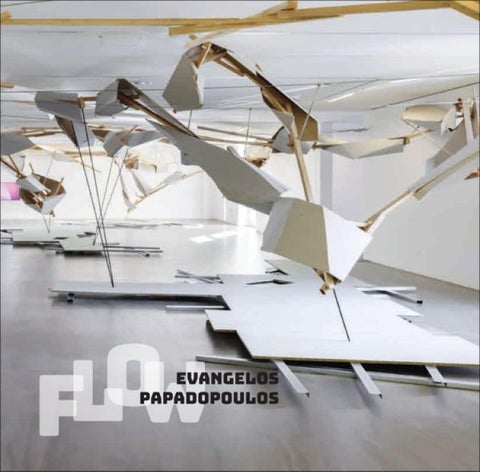
Flowing forms pervade the Museum Ratingen and break up the space. The exhibition FLOW with works by Evangelos Papadopoulos touches on many levels. The title FLOW refers to three essential aspects within the museum show, the processual growth of the sculptural forms, the outward flowing appearance of the objects and the inward concentration manifested within the installation.
8
Evangelos Papadopoulos’s institutional solo exhibition invites us into an idiosyncratic pictorial cosmos that transforms spaces. Flow, the flowing, takes place diversely in the overall project. Visitors have the unique opportunity to accompany the creation of a complex installation. Within four months, the artist transforms the exhibition spaces on the first floor into a flowing course with different materials and forms. FLOW also describes a certain attitude and concentration within the creation of art. The creator acts by means of physical tension and immersion on the environment. He builds, connects, disguises, combines, provokes, eliminates, destroys and creates anew. A sense of tension in flux. He moves and probes states. Gently, the spatial structures dissolve and transform into a plastic drawing in space. These are settings that question classical sculpture. Evangelos Papadopoulos (born 1974 in Athens) studied at the Academy of Fine Arts in Münster, Germany, and is concerned with the development of dynamic forms in space with different materials. Continuously, the sculptor explores ways to dematerialize spaces and reinterpret them. His body and intuition merge in the formulation of the sculptural work. The room is the artist’s image carrier. Drawings in the mind manifest into concrete constellations that sharpen our perception and stimulate imagination. Growth is an essential part of the exhibition. Compare the works of Papadopoulos with nature. Images of veins, root networks, nervous systems, river landscapes, branches and lightning are internalized. Familiar organic structures are visible, appearing in unfamiliar materiality and color. The message, however, does not lie in the banal depiction of nature. They are inspirations, own creations that culminate within complex structures. Space plays a central role in the works of Evangelos Papadopoulos. The artist reacts to the perspective, ground
plan and light situation of the respective exhibition site. He communicates with the existing structure and gives an idiosyncratic response. Carefully he reflects light situations and spatial formations. His work stands out dynamically flowing and can thereby convey a chaotic sense of space. Everything in flow. Forms and materials. He transforms sheetrock, wooden slats, laying boards, hemp ropes, steel cables and metal profiles into vital forms. A close look at the materials clarifies the choice of unusual compositions of sculpture. Sheetrock and wood are elementary building materials in residential construction. They are materials that suggest stability and lose their permanence through the artist’s act. He splits these materials to create expressive forms. Here it is worth looking not only at the surface, but also inside the structure. He breaks layers on top of each other and invites us to look into a hidden interior. What do we discover? It is a play with contrasts. Smooth surfaces establish a dialogue with the brittle. The light sheetrock shines in the combination of the dark shadows within the refractions. On the floor is a disorganized mesh of metallic U-profiles on which lie green rectangular laying tiles. They are part of the overall installation and question the idea of the pedestal. Do they support the hanging elements of the installation? They link all levels of the work together and at the same time convey lightness through the elevation of the metallic U-profiles. At the core of the installation, the wooden slats visualize chaotic lines and the sheetrock gives volume and plasticity. Each area in the middle of the work is composed of different materials that create an all-encompassing image. For the first time the artist presents sculptures made of nickel-plated steel. The durable metal is impulsively deformed and reminiscent of a drapery. Lines cross the volume and form a solid structure within the work. Growth appears here as well. The works unfold as wall objects in the entrance and end areas of the exhibition. Geometric mounts are combined with light planar forms. The reflective light on the surface reveals the graphic treatment of the material. It is observed and makes the traces on the surface visible. These crystallize on close inspection and reveal the particular concentration of the work. Depending on the perspective, new reflections and folds appear in the midst of the sculpture.
Evangelos Papadopoulos – FLOW
Wilko Austermann
Fließende Formen durchziehen das Museum Ratingen und brechen den Raum auf. Die Ausstellung FLOW mit Werken von Evangelos Papadopoulos berührt auf vielschichtigen Ebenen. Der Titel FLOW bezieht sich auf drei wesentliche Aspekte innerhalb der musealen Schau, das prozesshafte Wachsen der plastischen Formen, die äußerliche fließende Erscheinung der Objekte und die innerliche Konzentration, die sich innerhalb der Installation manifestiert. Evangelos Papadopoulos’ institutionelle Einzelausstel lung lädt uns in einen eigenwilligen Bildkosmos ein, der die Räume verwandelt. Flow, das Fließende, vollzieht sich divers im Gesamtprojekt. Die Besucher haben die einzigartige Möglichkeit, die Entstehung einer komplexen Installation zu begleiten. Innerhalb von vier Monaten verwandelt der Künstler die Ausstellungs räume im Erdgeschoss in einen fließenden Parcours mit verschiedenen Materialien und Formen. FLOW beschreibt auch eine gewisse Haltung und Konzentration innerhalb der Kreation von Kunst. Der Schöpfer agiert mittels körperlicher Spannung und Vertiefung auf das Umfeld. Er baut, verbindet, verstellt, kombiniert, provoziert, eliminiert, zerstört und gestaltet aufs Neue. Ein Gefühl von Spannung im Fluss. Er bewegt sich und lotet Zustände aus. Behutsam lösen sich die Raumstrukturen auf und transformieren sich zu einer plastischen Zeichnung im Raum. Es sind Setzungen, die die klassische Bildhauerei hinterfragen. Evangelos Papadopoulos (geboren 1974 in Athen) hat an der Kunstakademie in Münster studiert und beschäftigt sich mit der Entwicklung von dynamischen Formen im Raum mit unterschiedlichen Materialien. Kontinuierlich erforscht der Bildhauer Möglichkeiten, Räume zu entmaterialisieren und diese neu zu deuten. Sein Körper und seine Intuition verschmelzen in der Ausformulierung der plastischen Arbeit. Der Raum ist der Bildträger des Künstlers. Zeichnungen im Kopf manifestieren sich zu konkreten Konstellationen, die unsere Wahrnehmung schärfen und Fantasie anregen. Wachstum ist ein wesentlicher Bestandteil der Aus stellung. Vergleichen Sie die Werke von Papadopoulos mit der Natur. Es verinnerlichen sich Bilder von Adern,
Wurzelgeflechten, Nervensystemen, Flusslandschaften, Ästen und Blitzen. Vertraute organische Strukturen sind sichtbar, die in ungewohnter Materialität und Farbe erscheinen. Die Botschaft liegt dabei allerdings nicht in der banalen Abbildung von Natur. Es sind Inspirationen, eigene Schöpfungen, die innerhalb komplexer Strukturen kulminieren. Der Raum spielt in den Werken von Evangelos Papadopoulos eine zentrale Rolle. Der Künstler reagiert auf die Perspektive, Grundriss und Lichtsituation des jeweiligen Ausstellungsortes. Er kommuniziert mit der vorhandenen Struktur und gibt eine eigenwillige Antwort. Aufmerksam reflektiert er dabei Lichtsituationen und Raumausformungen. Sein Werk hebt sich dynamisch fließend ab und kann dabei ein chaotisches Raumgefühl vermitteln. Alles im Fluss. Formen und Materialien. Rigips, Holzlatten, Verlegeplatten, Hanfseile, Stahlseile und Metallprofile transformiert er zu vitalen Formen. Ein genauer Blick auf die Stoffe verdeutlicht die Auswahl ungewöhnlicher Zusammensetzungen der Bildhauerei. Rigips und Holz sind elementare Baustoffe im Wohnungsbau. Es sind Materialien, die Stabilität suggerieren und durch den Akt des Künstlers ihre Beständigkeit verlieren. Er spaltet diese Materialien, um expressive Formen zu gestalten. Hierbei lohnt nicht nur der Blick auf die Oberfläche, sondern auch ins Innere der Struktur. Er bricht, schichtet übereinander und lädt ein, in ein verdecktes Innere zu schauen. Was entdecken wir? Es ist ein Spiel mit Kontrasten. Glatte Flächen stellen einen Dialog zum Brüchigen her. Die helle Rigipsform leuchtet in der Kombination der dunklen Schatten innerhalb der Brechungen. Auf dem Boden befindet sich ein ungeordnetes Geflecht von metallischen U-Profilen, auf denen grüne rechteckige Verlegeplatten liegen. Sie sind Teil der Gesamtinstallation und hinterfragen die Idee des Sockels. Tragen sie die installativen, hängenden Elemente? Sie verknüpfen alle Ebenen des Werkes miteinander und vermitteln zugleich Leichtigkeit durch die Erhöhung der metallischen U-Profile. Im Kern der Installation visualisieren die Holzlatten eine chaotische Linienführung und die Rigipsplatten verleihen Volumen und Plastizität. Jeder Bereich inmitten des Werkes besteht aus unterschiedlichen Materialien, die ein allumfassendes Bild erzeugen.
9
Videostills ARTIFICIAL_GODS_Eurydike 6
Tag 59 | Day 59
Impressum | COLOPHON
Diese Publikation erscheint anlässlich der Ausstellung | Published on the occasion of the exhibition Evangelos Papadopoulos – FLOW Im Dialog mit | in dialogue with Dennis Rudolph, Diane Edwards, Banz & Bowinkel, Lasse-Marc Riek 27.8. − 5.12.2021
Herausgeberin | Editor Wiebke Siever 96
Kurator | Curator Wilko Austermann Projektleitung | Project management Anne Rodler, Kristina Wotschel Texte | Texts Wilko Austermann Gestaltung | Graphic design Wiebke Muth
Erschienen im | Published by Verlag Kettler, Dortmund www.verlag-kettler.de
Fotografien | Photographs Evangelos Papadopoulos, Kai Werner Schmidt (Cover, 18/19, 22/23, 25, 28–31, 44–49, 56/57, 60, 62-67, 72/73) Ausstellungstechnik | Exhibition technology Michael Lenerz, Hans-Siegert Litfin Verwaltung | Administration Ursula Adelt Gesamtherstellung | Production Druckerei Kettler, Bönen
© Evangelos Papadopoulos, Dennis Rudolph VG Bild-Kunst, Bonn 2021 © Banz & Bowinkel, Diane Edwards, Lasse-Marc Riek 2021 © Museum Ratingen, Verlag Kettler & Autoren | Authors 2021
ISBN: 978-3-86206-955-2 Die Geltendmachung der Ansprüche gem. § 60h UrhG für die Wiedergabe von Abbildungen der Exponate | Bestandswerke erfolgt durch die VG Bild-Kunst.