Like any text that starts out as a dissertation, this book is inevitably imperfect. Not only is the person who starts to write it different from the person who finishes it years later, but it also accommodates, throughout its many versions, input and feedback from a wide variety of individuals whose expertise and diverging interests enact as many pressures on the material at hand. The positive outcome of this extended duration and exposure is, on the other hand, an increased depth and intensity. Such a book also benefits in its origin from the earnestness that characterizes any first research effort, a certain autobiographical urgency that is unavoidable when the author himself is figuring out his place in the world. Some of the ideas elaborated here started to emerge at the Harvard Graduate School of Design, in the studio taught by Adam Caruso and Peter St John, and in the history and theory courses taught among others by Michael Hays, Rafael Moneo, Jeff Kipnis, and Irénée Scalbert. In Cambridge, too, I met Luis Mansilla and Emilio Tuñón, whose office in Madrid I joined for six years, in what I consider was a decisive part of my education. From Luis and Emilio I learned the real meaning of work ethic and much more about architecture and life. I am deeply indebted to them for their trust and encouragement, and I will always consider them my masters. Also in Madrid I met Juan Herreros, another master who became my dissertation adviser and guided the early stages of this project. His intellectual generosity and sharpness strengthened this text tremendously and made me grow as an architect and a writer. I look up to him for his capacity to understand and navigate architecture within the larger context of contemporary life. The bulk of this writing has been done at the Rice School of Architecture, where I have found a supportive atmosphere and a group of brilliant colleagues who have helped me in more ways that I can acknowledge here. In this regard, too, I owe special gratitude to Dean Sarah Whiting for her continued support and guidance, and more precisely for her insightful and intense annotation of an early draft of this text, which was decisive in helping me articulate the different levels of discourse involved in the project. Beyond this book, her example 11
Epics in the Everyday
as an educator and a thinker continue to inspire me to become a more engaged cultural producer. My students at Rice were exposed to this project in the classroom, and their intelligent questions during our seminar meetings helped me think deeper about the contemporary repercussions of the work. Also at Rice, my research assistants, Kohen Hudson and Rose Wilkowski, provided much needed copy editing and support with illustrations, and have been real assets in the last phases of the project. Importantly, several individuals have provided feedback on the different versions of this material during the past five years. The comments of Philip Ursprung, Manolo Laguillo, and Luis Rojo, just to name a few, were important when considering how to transition to a book format, as were the careful readings of colleagues such as Albert Pope, Scott Colman, or Lluis Juan during the last stages of writing this manuscript. Similarly, a mention should be made to all the librarians and archivists that have assisted me during these years, especially Jet Prendeville at Rice Fondren Library and Ines Zalduendo at the Loeb Library at Harvard. I would also like to thank Lisa Schons at Park Books for her invaluable help shepherding this book through publication, as well as Thomas Kramer for his continued support of my writing. It is always a pleasure to work with such a dedicated press. Many of the protagonists of this book are still alive and have been very generous with their time. Stephen Shore, Adam Caruso, and Peter St John were extremely accessible and helpful, as were Denise Scott Brown and Robert Venturi, whose hospitality and warmth made a deep impression on me. Finally, I want to thank my brother Luis Vassallo for his great talent and dedication in producing the graphic design and layout for this volume. He is truly his brother’s keeper.
12
Epics in the Everyday
was put into the emulation of Gans’s study, either by trying to subdivide the potential buyers in New Haven into market categories that tentatively matched his sociological groups, or by trying to identify whether Gans’s sociological taxonomy (upper, middle and lower-middle class and their sub-groups) correlated to differences in home-expansions and ornamental features. The actual proposals, developed in the last three weeks of the course, were also very schematic. Designs were for the most part blown-up single-family house forms, subdivided into smaller units in an attempt to provide a solution for multifamily housing in the suburban landscape.46 The final review was apparently problematic as well. Venturi and Scott Brown recount a bus-load of students from Columbia University attending the review to try to boycott it, for its anti-modernist bias. They also describe Bob Stern and Vincent Scully, who had supported them with their Las Vegas project, leaving the review early and turning their backs on them at that point. Ironically, the review was held in a Victorian house owned by the university, since the Paul Rudolph building housing the School of Architecture had recently suffered a fire as part of larger riots in New Haven during the period.47 Within this climate of exhaustion of their research project, and in a context of growing demands from their practice, Venturi decided to quit teaching in 1971, and both architects focused more heavily on design. While the intended book based on the Levittown studio never happened, Venturi and Scott Brown decided to revisit the project in 1975, when the Smithsonian Institution in Washington, D.C. asked them to design an exhibition about housing. The show, titled Signs of Life: Symbols in the City, was a development of the studio that basically discarded all the sociological, economic, and design preoccupations of the former in order to focus solely on the analysis of the symbolism found in the anonymous built environment. 46. This has become one of a handful of realestate development standards in the United States, where many gated communities and “garden” apartment complexes adopt this model.
150
47. Denise Scott Brown, in discussion with the author, May 2013.
2.
Inclusive Surfaces
Despite the extreme reduction in scope and ambition of the Levittown project in moving from the studio to the exhibition format, the aim of the show still aligned with the fundamental premise enunciated in the 1969 article and the studio brief, that of bringing middle- and lower-middle-class taste and symbolism to the establishment of high culture in order to make it respectable: “The popular environment, sprawl and strip, is drastically in need of a . . . service vis-à-vis the Fine Arts Commissions and Sybil Moholy-Nagy because Pop is unacceptable until it hangs in the academy and only the artist can put it there.”48 This ambition to render suburban symbolism respectable by presenting it in a controlled and domesticated manner within the official institutions of culture was carried out once again through a heavy reliance on photography and graphic communication techniques. The materials in the exhibition included life-size mock-ups of urban and suburban scenes with dialogue bubbles explaining the symbolism of the different elements within (Fig. 11), as well as a series of panels in which some of the themes of the studio were more narrowly and clearly elaborated. Figure 11: Robert Venturi, Denise Scott Brown, and Steven Izenour, life-sized exterior suburban scene from the Signs of Life exhibition, 1976. Based on photographs by Stephen Shore.
48. Denise Scott Brown, “Remedial Housing for Architects Studio,” 57.
151
Epics in the Everyday
Figure 12: Stephen Shore, West Avenue, Great Barrington, Massachusetts, 1974.
The photographs of domestic architecture in the exhibition were primarily in color and favored frontal perspectives (Fig. 12). All life-size photographs and most of the larger images in the panels were taken by Stephen Shore. His photographs were also used as a model for the rest of the documents in the show, produced by the office of the architects in an effort marshalled by Steven Izenour (Fig. 13). For this commission, Stephen Shore took a road trip through the country during the summer of 1975, equipped with a list of themes prepared by the architects, but otherwise free to develop his own approach
152
2.
Inclusive Surfaces
to the subject matter. In addition to the materials used by the architects in the different sections of the exhibition, the show also included a small gallery where twelve of the photographs taken by Shore were showcased as a photographic project in their own right.49 Considering Ed Ruscha’s demonstrated impact on the 1968 Las Vegas studio and the fact that he had been explicitly adopted as the single visual reference for the1969 article that ignited the Levittown project, his total absence from the Levittown show is, to say the least, shocking. The reason behind the switch from Ruscha to Shore as a visual reference can however be explained in the context of a change of public in moving from an architectural monograph directed to professionals, academics, and students of architecture, to an exhibition aimed at the general public. Figure 13: Robert Venturi, Denise Scott Brown, and Steven Izenour, panels from the Signs of Life exhibition, 1976.
49. Stephen Shore in communication with the author, December 2013. Through his personal friendship with Izenour, Shore was also commissioned to photograph a handful of completed projects for the office during that period.
153
Epics in the Everyday
The photographs that Venturi and Scott Brown used for the exhibition at the Smithsonian and subsequent articles belong to Shore’s Uncommon Places project.50 Unlike his earlier work, the images from this period are serene and precise compositions featuring soft and luminous colors and a remarkable sharpness of detail. In Shore’s photographs, the elements found in the built environment seem to voluntarily find their place and organize the frame into geometric forms, an effect achieved through the meticulous alignment of details in perspective. Many of these images also feature an emphasis on centrality and symmetry that lends the humble domestic architecture that they portray a dignity resonant with Walker Evans’s images of vernacular architecture. It was precisely his capacity to exert control over the messy reality of suburbia and to elevate it that interested Venturi and Scott Brown in the work of Shore, as his was a vision able to render acceptable the reality of Levittown in the eyes of the general public. Robert Venturi wrote a short essay for the dust jacket of the original edition of Uncommon Places, where he qualified his particular interest in the work: “Shore’s is the art of the deadpan—rejecting exotic composition, artful editing, or facile simplification. He accepts the threadbare banality of the American scene, the jerry-rigged, down-at-theheels seediness of our rural landscapes and the spatial looseness of our towns, recapturing the overfamiliar, making it poignant, coherent, and almost lovable.”51 Venturi’s characterization of Shore’s photography as “deadpan” in this passage is reminiscent of their previous references to the photography of Ruscha. However, it is worth noting that while the two photographers share a certain dispassionate or emotionless tone, the ultimate effect of their images is not the same. In the case of Shore, for one, it becomes increasingly difficult not to succumb to the sheer beauty of the photographs. In order to illustrate this point, it may be useful to compare Ruscha’s images in his Nine Swimming Pools and a Broken
50. Stephen Shore, Uncommon Places (Millerton, N.Y.: Aperture, 1982).
154
51. Robert Venturi in Stephen Shore, Uncommon Places.
2.
Inclusive Surfaces
Figure 14: Stephen Shore, Ginger Shore, Causeway Inn, Tampa, Florida, 1977.
Glass with Shore’s iconic photographs of bathers in Florida, especially the one depicting his wife Ginger Shore standing in the swimming pool of the Causeway Inn in Tampa (Fig. 14). While both groups of images are strikingly seductive in their own unconventional ways, in Shore’s version of the swimming pools the eerie quality and sense of danger emanating from Ruscha’s photographs is substantially downplayed. While both photographers operate through a certain calculated ambivalence, Shore’s mysterious images cannot help but exude a deep affection for its subject matter, almost a feeling of nostalgia. While Ruscha’s images provoke the viewer openly, Shore’s cool hyperdocumentalism exerts a narcotic effect, deeming it more adequate for the architect’s intended goal of making the reality of American domestic architecture tolerable. It is then surprising to note how, despite the visual and cultural acuity displayed by the architects in their choice of
155
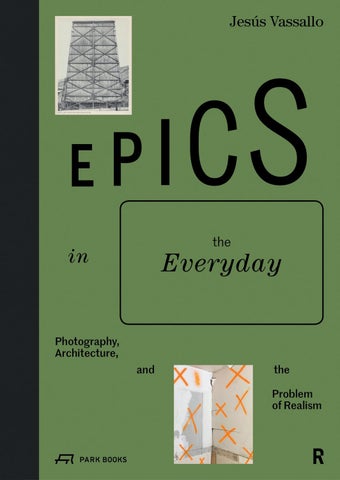
Graphic design: Luis Vassallo, Madrid Copy editing: Kohen Hudson, Houston Proofreading: Colette Forder, Marseille Image rights assistance: Rose Wilkowski, Houston Lithography, printing, and binding: DZA Druckerei zu Altenburg GmbH, Thuringia Paper: Fly white, 130 g/m2 Typefaces: Marr Sans and ITC Century © 2019 Jesús Vassallo and Park Books AG, Zurich © for the text: the author © for the images: see Illustration Credits Front cover: Bernd and Hilla Becher, Anonymous Sculptures, 1970. Daniel Everett, Marker, 2017. Back cover: Light fixture in Robert Venturi’s Vanna Venturi House. Philipp Schaerer, Chicago Series, 2017.
Published by: Park Books AG Niederdorfstrasse 54 8001 Zurich Switzerland www.park-books.com Park Books is being supported by the Swiss Federal Office of Culture with a general subsidy for the years 2016–2020. All rights reserved; no part of this work may be reproduced or edited using electronic systems, copied, or distributed in any form whatsoever without previous written consent from the publisher. ISBN 978-3-03860-162-3
Architecture at Rice is the publication platform of the Rice School of Architecture, an essential medium for sharing projects and ideas developed at the school with audiences worldwide. These publications synthesize a broad spectrum of architectural research into a curated conversation on the current state of the discipline and its engagement with the world. Architecture at Rice Rice University School of Architecture MS-50 6100 Main Street Houston, Texas 77005 www.arch.rice.edu