Preface
Kaat Debo
6
Essays Elisa De Wyngaert 10 Rebecca Arnold 112 Caroline Evans 130 Alistair O’Neill 156 Sonnet Stanfill 180 Elisa De Wyngaert 214 Dana Thomas 246
E/MOTION. Fashion in Transition Fashion, desire, anxiety & Kanye West End times, future visions Juergen Teller New York fashion's first 21st-century crisis Fashion's ambiguous nostalgia Soulful fashion
Interviews Lisi Herrebrugh & Rushemy Botter 98 Simone Rocha 100 Stephen Jones 108 Grace Wales Bonner 110 Marine Serre 148 Supriya Lele 150 Gabriela Hearst 152 Walter Van Beirendonck 154 Helmut Lang 198 Raf Simons 200 Martin Margiela 210 Rick Owens 212 Romeo Gigli 240 Molly Goddard 242 Glenn Martens 244 Christian Lacroix 258 Vivienne Westwood 260 Dries Van Noten 262
End notes Photo credits Colophon
266 268 270
FOREWORD Kaat Debo
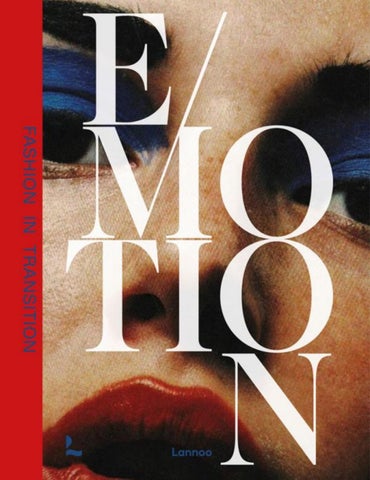
After being closed for a long three years, during which the Fashion Museum Antwerp, or MoMu, was fully renovated and expanded, with a new exhibition space for the presentation of our collection, among other things, MoMu reopens in September 2021 with E/MOTION. Fashion in Transition. With this exhibition and the eponymous book, the museum expressly decided to pause to reflect on the state of fashion today, as well as on the recent historical developments that have led to the challenges facing fashion in the year 2021. The play on words in the title refers to the major systemic changes to which fashion has been subjected in recent years – which, in turn, have been both consciously and unconsciously represented by and in fashion itself. Over the last three decades, we have all born witness to unprecedented globalization, which has had its impact on the creation, production, dissemination, communication and consumption of fashion. More than ever before, it has pushed fashion into the barriers of its own complex system and made it a stage for international political crises, from the Gulf War in the 1990s to terrorist attacks at the start of the new millennium, as well as for financial crises and recessions, the ecological crisis, and such health crises as the AIDS or the current COVID-19 pandemic. Fashion always reflects the prevailing zeitgeist, from social and economic inequality to global social movements, including Black Lives Matter and #MeToo. How have these evolutions impacted the way we see and perceive emotion, success, beauty, creativity, authorship and collaboration? And how has the role of the fashion designer changed? 6
The diverse essays in this book delve more deeply into a number of these evolutions. In addition, E/MOTION. Fashion in Transition presents the voices of the designers themselves, based on eighteen interviews. These are with established names, whether or not they are still active in the world of fashion, through to members of the newest generation of fashion designers. We asked them all about the digital (r)evolution and what impact this has or has had on their creativity. We asked them about the importance of craftsmanship, sustainability, independence and collaboration. And finally, we asked them what triggers them emotionally, and whether, and how, sincere emotion is possible in today’s fashion industry. Last year, we organized video calls with students from eight different fashion schools. Quotations taken from these conversations reflect the concerns, ambitions and hopes of a new generation of aspiring designers and perhaps give insight into how designers of tomorrow see their future. I wish to thank everyone who has contributed to this ambitious project, first and foremost Elisa De Wyngaert, who curated E/MOTION. Fashion in Transition. Also, special thanks to the authors of this book and to the designers and students who, in a very difficult and chaotic year, managed to find the time to reflect on their own design practice, their aspirations, fears, dreams and desires. I am also much indebted to the many lenders and photographers who made their objects and images available for both the exhibition and this book. Finally, I thank the team of scenographers, Jan Versweyveld, Bart Van Merode and Roel Huisman, and graphic designer Jelle Jespers, for their powerful visual presentations of the storylines, reflections and emotions referred to above.
7
Dries Van Noten, Autumn-Winter 1997-98
Dries Van Noten, Autumn-Winter 1997-98
Comme des Garçons’ Spring-Summer 2015 collection, for example, featured roses cascading down fabric ribbons as metaphors of the bloodsoaked news reports following the terrorist attacks in Paris. In her AutumnWinter 2020-21 collection, Simone Rocha looked at the life experiences of women with blood-red ribbons as symbols of death: empowering, yet deadly. In recent years, red fabric or ribbons, flowers and voluminous silhouettes have provided an alternate narrative to an earlier focus on the female body as a vulnerable or precarious place to inhabit.
This look was linked to the Junk Culture of contemporary movies about heroin addicts and addiction, such as Gia (1998) and Trainspotting (1996).8 These films were not well received (especially not in America), as Alona Wartofsky wrote in The Washington Post: ‘If there is one thing Americans don’t want mixed with heroin, it’s ambiguity. And what the filmmakers slap in our faces are both the grim realities of life at the tip of a needle and a freewheeling, pop-music-fuelled glorification of the addicts’ smack-happy existence.’9 The embrace of heroin and unhealthy body images in fashion drew similar vitriol. In a speech in 1997, responding to a new epidemic of heroin addiction in the United States and the sudden death of 20-year-old photographer Davide Sorrenti, President Bill Clinton felt the need to openly denounce Heroin Chic. He reproached the fashion industry for making drug addiction seem ‘glamorous and sexy and cool’.10 In The New York Times, Amy M. Spindler predicted that, ‘The period of denial is over…. Three months after Sorrenti’s death, the magazines that published his work and served as catalysts for the Heroin
28
Versace, Autumn-Winter 1992-93
In its own way, Gianni Versace’s Autumn-Winter 1992-93 Miss S&M collection revealed a dichotomy in body ideals that would prevail in the decades to follow. Versace, famous for presenting his models as seductive, suntanned goddesses, now introduced harder bondage elements for the first time. Supermodels walked the runway as dominatrices, ‘sexual’, yet somehow in control, and far removed from the fragile, pale, Heroin Chic look that would define the rest of the 1990s. Against a backdrop of recession, a deflated job market and pessimism about the future among the younger generation, the waif-like ideal body became popular in fashion imagery.6 Rebecca Arnold wrote about how the Heroin Chic look in fashion photography resulted from the internalized violence of a generation. ‘The creation of the perfect fashionable body has been refused, and that body has been wilfully brutalized and destroyed.’7 Fragile models with messy makeup and drugged expressions appeared not only in photography, but also in fashion shows, including those by such designers as Ann Demeulemeester, Vivienne Westwood, Alexander McQueen and Antonio Berardi.
29
Wolfgang Tillmans, 'astro crusto, a', 2012. Courtesy of Galerie Buchholz, Berlin/Cologne
Torbjørn Rødland, 'White Umbrella (2014-2015)'. Courtesy of the artist and rodolphe janssen
Wolfgang Tillmans, 'astro crusto, a', 2012. Courtesy of Galerie Buchholz, Berlin/Cologne
Torbjørn Rødland, 'White Umbrella (2014-2015)'. Courtesy of the artist and rodolphe janssen
LISI HERREBRUGH & RUSHEMY BOTTER
Since the first collection we designed, activism and a strong message have been at the heart of our work. Our collections are like a diary, where we let our feelings speak about the climate and social issues, sometimes very literally and sometimes more hidden or subtly. We are currently very engaged in further developing our vision of the world. However, it is important that this does not just stop at words and an artistic expression, but that we actually contribute to change. For example, we are setting up a coral nursery together with a diving school in Curaçao, helping dying coral to grow back. We have also made 20% of our collection out of fabrics made of plastics retrieved from the ocean. With the proceeds of these garments, we fund the maintenance of our coral nursery. So as a buyer, you are helping to protect nature and the climate.
At Nina Ricci, we work with the legacy of the fashion house, which is an added value, but also a quest. The fashion house had several designers before us, each of whom interpreted Nina Ricci and the history of the house in their own way. For us, this rich history is a way to look to the future: we let go of the past during the design process to make sure our collections are relevant today. Storytelling is the most important thing we do. We may miss the sensationalism of a real fashion show, but the new virtual alternative is more democratic than ever. Everyone can experience the shows in the same way and at the same time. There are new opportunities to communicate directly with customers, to build a bond. We developed an avatar called Aqua Novio, which embodies Botter. In a more intimate online environment, he shows you how our pieces can be endlessly combined. The tactile, sensory experience of our designs remains crucial. Clothes are worn against your skin. They remain an extension of yourself. Fashion can be protective, reassuring, encouraging and motivating. Fashion may not be as essential as health and nutrition, yet it comes very close. We all need hope at this time. Fashion can give us that hope. The positive side to the current crisis is that suddenly the old rules no longer apply. Young designers with new ideas and visions are now in the game. The challenge is to find an emotional connection with your customers and communicate directly with them. This is more important than ever before.
MoMu X BOTTER, campaign image for Fashion 2.021 - Antwerp: Fashion/Conscious
We both grew up with Dutch and Caribbean influences. The Dutch we got through our fathers, the Caribbean through our mothers. This mix of cultures made us look at the world differently from a very young age. It taught us to deal with distance and contrasts. The Caribbean plays an important emotional role in our design process. Curaçao and the Dominican Republic are alive in the colours, the materials, the styling and the stories we tell. In turn, our memories of Holland and our time at the fashion department of the Antwerp Academy influence our love of history, how we conceptualize and present ideas, and how we always want to explore our collections in depth. These different cultures and traditions made us who we are.
We complement each other. We work in a difficult sector, but one of the advantages of our intense collaboration is that we are always honest with each other. We experience a certain synergy, and both at Botter and at Nina Ricci, we discuss everything in detail. Working together makes us more efficient. Although our personal lives and experiences are translated into our collections, we also always maintain enough of a distance. We do not want to project our opinions onto people, but open a dialogue so that people can form their own opinions. We believe that we are only successful when we can touch people.
98
GABRIELA HEARST
The collective creation process is important to me. I believe in Eastern, more than Western philosophy, which is more about the individual. In my team, we all do something together and we need to find a rhythm, like a jazz band. Fashion shows are still important, even if they have disappeared for a time. I think that in most creative processes, you want that instant human replay in your collective work as a team. Obviously, film is an amazing way to connect with your audience, but I think that in a way the fashion show still wants to be there. There is something about a live experience with others. It has been proven scientifically that a collective sharing of emotion changes the way we receive things, so I am all for a fashion show. Sourcing materials is my favourite part of the design process. I first look at the composition and the impact of that composition on the environment. Second come the visual and touch aspects, most importantly touch and then the visual. I use wool from sheep on my own ranch and source high-quality fabrics and materials from authentic producers, who are often women. I grew up in Santa Maria, on my mom’s ranch, and in Santa Isabel, my father’s ranch, in the Paysandú region of Uruguay. Wool farming has been in my family for six generations. I grew up going to different family ranches, and my experience has always been that things were made to last. The biggest lesson for me is to look at sustainability from my own utilitarian point of view. That was the way we lived, having a few things of quality that were meant to last, and were utilitarian. It had nothing to do with the ostentatious aesthetic you see today. Chloé by Gabriela Hearst in collaboration with Sheltersuit, Autumn-Winter 2021-22
The term on everyone’s lips at the moment is regenerative agriculture. But in our region of Uruguay, I grew up in a regenerative agricultural environment, and so had my family for the past 170 years. Truly sustainable production would be going back to the way we used to produce garments and clothing, specifically from the period before the Industrial Revolution. My dream for sustainable production for the future is in fact to look at the past. Right now, being successful in fashion means only one thing: Can a large-scale, creative fashion operation be sustainable, and can we reduce the negative impact? Can we prove that there is a business model that is more in harmony with the environment, one in which we all care for one another? That is my number 1.
152
between fashion and world events, Adrover added, ‘I cannot do a collection based on trends and flowers when in the city, there are bombs.’
The designers of threeASFOUR articulated a similarly ambivalent view of New York as a fashion city. The label, which is still operating, began as a foursome in 1998 and reformed as a trio in 2005, with a work approach that is part art collective, part fashion house. In our 2005 interview, held in their silver-lined Chinatown studio, threeASFOUR designers Gabi Asfour, Angela Donhauser and Adi Gil described working in New York, especially after 11 September 2001, as ‘tough’, with Gabi declaring, ‘We’re always broke. We stay bankrupt. Yesterday was minus $2,000 in the account and we cancelled our runway show. Or we’re thinking of cancelling. We don’t know yet. We’re like this all the time.’18 In the same conversation, Gabi also emphasized New York’s enduring appeal, adding, ‘We came here because we dreamt of being here all our lives. We will not leave. This is the centre of the world. We really want to make it here.’ The designers also signalled particular praise for the capabilities and flexibility of the local factories they work with: ‘We’re lucky. We’re surrounded by local people, super-talented, sophisticated technical factory people who are hardworking, with focus. That’s what makes this whole thing work.’ Like threeASFOUR, the Duckie Brown designers underlined the importance of local partners, especially the flexibility and control that comes from working with New York manufacturers, rather than producing overseas. As we sat in their combined showroom, design studio and flat, they lauded the willingness of New-York-area factories to produce small orders of just a handful of styles, a crucial requirement for smaller fashion labels. ‘People, especially in New York, have been extremely helpful and supportive. The factories have been behind us.’ 19
190
Irving Penn, Rose, Colour Wonder, 1970. Cover image for Vogue US, June/July 2020
Small-scale fashion labels were also challenged. Designer and costumier Christian Joy, who still operates her one-woman design studio, referenced the difficulty of sourcing the money needed to invest up front in order to create a collection. ‘It’s hard to keep up with fashion shows, showrooms, and press if you don’t have a lot of money or someone backing you.’17
191
EXHIBITION CATALOGUE
AUTHORS
COVER
Rebecca Arnold
David Sims for The Face (January 1998). Trunk Archive,
Caroline Evans
Model: Bridget Hall, Makeup: Linda Cantello
Elisa De Wyngaert Alistair O’Neill Sonnet Stanfill
www.lannoo.com
Dana Thomas
Sign up for our newsletter with news about new and forthcoming publications on art, interior design,
WITH SINCERE THANKS TO ALL THE DESIGNERS WHO TOOK TIME
food and travel, photography and fashion as well as
TO GIVE INTERVIEWS: Romeo Gigli | Molly Goddard |
exclusive offers and events.
Gabriela Hearst | Lisi Herrebrugh & Rushemy Botter | Stephen Jones | Christian Lacroix | Helmut Lang | Supriya
If you have any questions or comments about the
Lele | Martin Margiela | Glenn Martens | Rick Owens |
material in this book, please do not hesitate to contact
Simone Rocha | Marine Serre | Raf Simons | Walter Van
our editorial team: art@lannoo.com
Beirendonck | Dries Van Noten | Grace Wales Bonner | Vivienne Westwood
© Lannoo Publishers, Belgium, 2021
ISBN: 9789401476041
WITH GREAT APPRECIATION FOR THE FASHION STUDENTS WHO GAVE INTERVIEWS: Zeid Hijazi | Paula Keilholz | Kanmin
Kim | Mona Lauterbach | Tara Mabiala | Micah McClain | Marvin M’toumo | Sabrina Pfattner | Silvia Rognoni |
www.lannoo.com
All rights reserved. No part of this publication may be reproduced or transmitted in any form or by any means, electronic or mechanical, including photocopy, recording or any other information storage and retrieval system, without prior permission in writing from the publisher.
Every effort has been made to trace copyright holders. If, however, you feel that you have inadvertently been overlooked, please contact the publishers.
Katya Zelentsova | Terrence Zhou. Special thanks to Aya Noël for conducting these interviews with the students. COORDINATION
Viktoria De Cubber Sarah Theerlynck TRANSLATIONS
Dutch to English: Mari Shields English to Dutch: Robrecht Vandemeulebroecke IMAGE RESEARCH
Birgit Ansoms
Elisa De Wyngaert
Egon Parmentier
Tom Matthews
GRAPHIC DESIGN
Jelle Jespers PHOTO ENGRAVING
Johan Bursens
D/2021/45/117 – NUR 452/644