1
CONTENTS
Foreword . . . . . . . . . . . . . . . . . . . . . . . . . . . . . . . . . . Heidi Bale Amundsen
5
SCREAM VARIATIONS . . . . . . . . . . . . . . . . . . . . . . . . . . . .
13
ESSAYS. . . . . . . . . . . . . . . . . . . . . . . . . . . . . . . . . . . . . . . .
77
Art Ventriloquism . . . . . . . . . . . . . . . . . . . . . . . . . . . . Patricia G. Berman
79
Virality and Migration: The Scream in Popular Culture. . . . . . . . . . . . . . . . . . Øyvind Vågnes
107
Have Your Munch and Eat It Too! A Material Ecology of Screams. . . . . . . . . . . . . . . . . . Joanna Iranowska
121
SCREAM MUTATIONS. . . . . . . . . . . . . . . . . . . . . . . . . . . . .
1 41
Authors’ Biographies . . . . . . . . . . . . . . . . . . . . . . . . . 207 Image List and Credits . . . . . . . . . . . . . . . . . . . . . . . . 208
CONTENTS
Foreword . . . . . . . . . . . . . . . . . . . . . . . . . . . . . . . . . . Heidi Bale Amundsen
5
SCREAM VARIATIONS . . . . . . . . . . . . . . . . . . . . . . . . . . . .
13
ESSAYS. . . . . . . . . . . . . . . . . . . . . . . . . . . . . . . . . . . . . . . .
77
Art Ventriloquism . . . . . . . . . . . . . . . . . . . . . . . . . . . . Patricia G. Berman
79
Virality and Migration: The Scream in Popular Culture. . . . . . . . . . . . . . . . . . Øyvind Vågnes
107
Have Your Munch and Eat It Too! A Material Ecology of Screams. . . . . . . . . . . . . . . . . . Joanna Iranowska
121
SCREAM MUTATIONS. . . . . . . . . . . . . . . . . . . . . . . . . . . . .
1 41
Authors’ Biographies . . . . . . . . . . . . . . . . . . . . . . . . . 207 Image List and Credits . . . . . . . . . . . . . . . . . . . . . . . . 208
Foreword
BOOM! STUDIOS
BACKMATTER BY JONATHAN LETHEM
D O A N D R O I D S D R E A M O F E L E C T R I C S H E E P ? # 12
0
Heidi Bale Amundsen
PHILIP K. DICK
0
0
0
PHILIP K. DICK
M
Cover of Philip K. Dick’s Do Androids Dream of Electric Sheep?, designed by Moritat and published by Boom! Studios, Inc., 2010 4
0
0
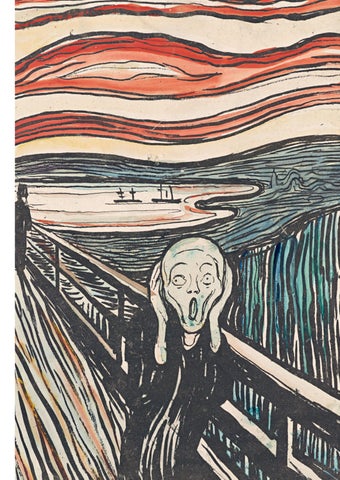
‘A hairless, oppressed creature with a head like an inverted pear, its hands clapped in horror to its ears, its mouth open in a vast, soundless scream.’ These words are taken from Philip K. Dick’s dystopian science fiction novel Do Androids Dream of Electric Sheep? (1968). They describe the deathly, swaying figure depicted in Edvard Munch’s Scream. Dick’s description of the iconic figure with the cranium-like head – ‘contained by its own howl’,1 as he puts it – is one of the many increasing appearances of The Scream all over the arts. Ever since Munch first came up with the motif at the end of the nineteenth century, countless artists, including Andy Warhol and Marina Abramović, have modified it within their own work. In addition, the open-mouthed figure has cropped up in popular cultural productions such as Wes Craven’s Scream film franchise, the poster for the kids’ movie Home Alone, and in scores of satirical cartoons – on everything from Brexit to Donald Trump’s presidency and tax rises – as well as on innumerable political banners and placards, most recently in protests about the climate emergency. In recent years, the Scream image has also taken a prominent place on digital screens in the form of its own emoji and as the basis of countless memes. At the same time, the quantity of souvenirs and other objects decorated with or shaped like Munch’s figure of desperation has increased immeasurably. In short: these days The Scream haunts pretty much every layer of culture. It is without doubt one of the most frequently reproduced images in the history of art, equalled only perhaps by Leonardo da Vinci’s Mona Lisa, and is the originator of a constantly expanding network of analogue and digital mutations. Having said that, ‘originator’ is perhaps not the right word here, since instead of one single original version of The Scream, there is a whole bunch of them. Two of Munch’s originals were created in tempera and oil paint. The first, from 1893, is in Nasjonalmuseet, Oslo, and the other – possibly dating from around 1910 – can be found at Munchmuseet. In addition, there are two versions of The Scream done in crayon and pastel, one from 1893 in Munchmuseet’s collection, the other from 1895 in a private collection. Also in 5
Foreword
BOOM! STUDIOS
BACKMATTER BY JONATHAN LETHEM
D O A N D R O I D S D R E A M O F E L E C T R I C S H E E P ? # 12
0
Heidi Bale Amundsen
PHILIP K. DICK
0
0
0
PHILIP K. DICK
M
Cover of Philip K. Dick’s Do Androids Dream of Electric Sheep?, designed by Moritat and published by Boom! Studios, Inc., 2010 4
0
0
‘A hairless, oppressed creature with a head like an inverted pear, its hands clapped in horror to its ears, its mouth open in a vast, soundless scream.’ These words are taken from Philip K. Dick’s dystopian science fiction novel Do Androids Dream of Electric Sheep? (1968). They describe the deathly, swaying figure depicted in Edvard Munch’s Scream. Dick’s description of the iconic figure with the cranium-like head – ‘contained by its own howl’,1 as he puts it – is one of the many increasing appearances of The Scream all over the arts. Ever since Munch first came up with the motif at the end of the nineteenth century, countless artists, including Andy Warhol and Marina Abramović, have modified it within their own work. In addition, the open-mouthed figure has cropped up in popular cultural productions such as Wes Craven’s Scream film franchise, the poster for the kids’ movie Home Alone, and in scores of satirical cartoons – on everything from Brexit to Donald Trump’s presidency and tax rises – as well as on innumerable political banners and placards, most recently in protests about the climate emergency. In recent years, the Scream image has also taken a prominent place on digital screens in the form of its own emoji and as the basis of countless memes. At the same time, the quantity of souvenirs and other objects decorated with or shaped like Munch’s figure of desperation has increased immeasurably. In short: these days The Scream haunts pretty much every layer of culture. It is without doubt one of the most frequently reproduced images in the history of art, equalled only perhaps by Leonardo da Vinci’s Mona Lisa, and is the originator of a constantly expanding network of analogue and digital mutations. Having said that, ‘originator’ is perhaps not the right word here, since instead of one single original version of The Scream, there is a whole bunch of them. Two of Munch’s originals were created in tempera and oil paint. The first, from 1893, is in Nasjonalmuseet, Oslo, and the other – possibly dating from around 1910 – can be found at Munchmuseet. In addition, there are two versions of The Scream done in crayon and pastel, one from 1893 in Munchmuseet’s collection, the other from 1895 in a private collection. Also in 5
Edvard Munch The Scream, 1895 Pastel on cardboard
52
53
Edvard Munch The Scream, 1895 Pastel on cardboard
52
53
Georg Baselitz Der Brückechor (The Brücke Choir), 1983 Oil on canvas
Jannis Kounellis Homage to Munch II, 2003 Screenprint on brown craft paper 82
the telescoping roadway and activated sky in one of Erich Heckel’s earliest woodcuts, Over the Hill (1903).7 Munch’s motif also seems to have been a source for Heckel’s Man on a Plain (1917), rendered during the Great War. Much like Munch’s open-mouthed creature, the expressive figure in Heckel’s woodcut holds its head between the hands. But rather than Przybyszewski’s image of explosive sexuality, Heckel’s version of the motif (not unlike today’s malleable emoji) offers the sense of overwhelming personal and even political paralysis in light of uncertain societal conditions. In Vienna, the artists of Heckel’s generation likewise created works that echo the liberties that Munch took with human anatomy and the sense of explosive emotion conveyed by The Scream. For that generation, asserting the primacy of sensation over optical empiricism, Munch’s work reverberated as a visual sign of subjectivity. The National Socialists branded such creative license with amplified form and colour as ‘degenerate’ in the 1930s. For postwar Northern European artists, the embrace of spontaneous production, as introduced by Munch and his admirers, enacted a recuperation of that earlier generation. Oslo had been the beneficiary of Munch’s entire collection upon the artist’s death in 1944. After the war ended in 1945, a major retrospective of Munch’s paintings and prints (over 340 of them) opened at Norway’s National Gallery and circulated in Scandinavia, signalling the liberation from the Nazi occupation. A Danish critic commented that Munch’s early motifs such as The Scream were still vital ‘like a fingernail in a bloody sore …’.8 In this way, The Scream was translated as a token of agitation and freedom. After 1945, as travel resumed after the war and Munch’s works began to circulate in exhibitions, artists such as Asger Jorn could again experience the work directly. Jorn viewed Munch as a link in a chain of Nordic – as opposed to German – Expressionists. This was a legacy that Jorn, one of the founders of the Cobra Group, embodied.9 Paintings such as The Eagle’s Share II (1951) pay homage to Munch through the stretched image of a skull that inhabits fantastic creatures and swirling paint layers. In the 1980s, Georg Baselitz mined the legacy of Expressionism in the slipstream of traumatic memory from the war. Baselitz stated that ‘pictures are possible only through models of other pictures’, images to claim and digest.10 Munch has long been an important presence in his thought and work, the subject of several paintings from 1983 (Edvard’s Ghost and Edvard’s Head). Baselitz’s Supper in Dresden is one of the canonical works of the so-called Neo-Expressionist generation (1983). In it, Munch appears among avatars of the Brücke artists – Kirchner, Schmidt-Rottluff and Heckel – in an inverted and enormous pastiche of Nolde’s Last Supper (1909). The 1983 Brücke Choir likewise inserts an openmouthed avatar of Munch into the midst of the Dresden artists’ 83
Georg Baselitz Der Brückechor (The Brücke Choir), 1983 Oil on canvas
Jannis Kounellis Homage to Munch II, 2003 Screenprint on brown craft paper 82
the telescoping roadway and activated sky in one of Erich Heckel’s earliest woodcuts, Over the Hill (1903).7 Munch’s motif also seems to have been a source for Heckel’s Man on a Plain (1917), rendered during the Great War. Much like Munch’s open-mouthed creature, the expressive figure in Heckel’s woodcut holds its head between the hands. But rather than Przybyszewski’s image of explosive sexuality, Heckel’s version of the motif (not unlike today’s malleable emoji) offers the sense of overwhelming personal and even political paralysis in light of uncertain societal conditions. In Vienna, the artists of Heckel’s generation likewise created works that echo the liberties that Munch took with human anatomy and the sense of explosive emotion conveyed by The Scream. For that generation, asserting the primacy of sensation over optical empiricism, Munch’s work reverberated as a visual sign of subjectivity. The National Socialists branded such creative license with amplified form and colour as ‘degenerate’ in the 1930s. For postwar Northern European artists, the embrace of spontaneous production, as introduced by Munch and his admirers, enacted a recuperation of that earlier generation. Oslo had been the beneficiary of Munch’s entire collection upon the artist’s death in 1944. After the war ended in 1945, a major retrospective of Munch’s paintings and prints (over 340 of them) opened at Norway’s National Gallery and circulated in Scandinavia, signalling the liberation from the Nazi occupation. A Danish critic commented that Munch’s early motifs such as The Scream were still vital ‘like a fingernail in a bloody sore …’.8 In this way, The Scream was translated as a token of agitation and freedom. After 1945, as travel resumed after the war and Munch’s works began to circulate in exhibitions, artists such as Asger Jorn could again experience the work directly. Jorn viewed Munch as a link in a chain of Nordic – as opposed to German – Expressionists. This was a legacy that Jorn, one of the founders of the Cobra Group, embodied.9 Paintings such as The Eagle’s Share II (1951) pay homage to Munch through the stretched image of a skull that inhabits fantastic creatures and swirling paint layers. In the 1980s, Georg Baselitz mined the legacy of Expressionism in the slipstream of traumatic memory from the war. Baselitz stated that ‘pictures are possible only through models of other pictures’, images to claim and digest.10 Munch has long been an important presence in his thought and work, the subject of several paintings from 1983 (Edvard’s Ghost and Edvard’s Head). Baselitz’s Supper in Dresden is one of the canonical works of the so-called Neo-Expressionist generation (1983). In it, Munch appears among avatars of the Brücke artists – Kirchner, Schmidt-Rottluff and Heckel – in an inverted and enormous pastiche of Nolde’s Last Supper (1909). The 1983 Brücke Choir likewise inserts an openmouthed avatar of Munch into the midst of the Dresden artists’ 83
Frame from Wes Craven’s film Scream, 1996
Woman screaming on the Potemkin Steps, frame from Sergei Eisenstein’s film Battleship Potemkin, 1925
Greek tragedy, his theories about the potentially cathartic power of theatre have had a significant impact on modern Western culture’s understanding of drama, as well as on the development of more recent forms of entertainment.5 The philosopher believed that the capacity for excess in the narrative arts consisted in its ability to stimulate horror and empathy in an audience, who could then in a sense correlate these feelings with their own experience. By tracing the Scream image’s journey between different contexts, it’s possible to see it as a double expression of unease and angst – about things threatening to the individual, both from within and without. In this way it becomes an effective tool which can be applied to the most elementary or the most complex of visual and narrative forms, no matter how much they are driven by action, character, narrative sequence or psychology. The Scream image contains both a pose and a gesture, which makes it easy to refer to in both still and moving images, so that it always bears traces of its own loaded iconicity. The hands raised to the face are both a static posture and a movement. The figurative is rooted in a layered temporality which makes it possible to recreate it both visually and performatively, so that it can appear equally in a newspaper cartoon or a movie, as a badge or on YouTube. IV
Marina Abramović The Scream, 2013/2015 Video/photograph/permanent sculpture installation, Oslo
114
If virality as trope accelerates the spread, tempo and latency of the Scream image, migration emphasises the extent of intermediality. As well as the tropes, there is their self-reinforcing power, defined by their coexistence. Not for nothing is the idea of ‘life as a journey’ one of the oldest metaphors in the history of culture. In defining the Scream image in the light of stories about virality and migration, they also get blended together in the overlap between different types of discourse. By mapping out the life cycle of the Scream image, you can get a glimpse of how far away these manifestations are from the original picture and the intention behind it, and yet how durable the image is, since it crops up again and again, in what you might call a narrative sequence. As a story, its biography can stake out and identify phases and epochs each with their own characteristics. Perhaps that is why the idea of the image’s life best expresses how fundamental is this separation from an original picture, because it reveals how many ironic meanings it can contain? In a period of history when modernity is being succeeded by postmodernity, the life story of The Scream encompasses both epochs. Its initial birth was as an expressionistic artwork which arrived at the same time as modernism; its rebirth heralded postmodernism’s spirit of appropriation and commodification. As soon as The Scream becomes symbolic, 115
Frame from Wes Craven’s film Scream, 1996
Woman screaming on the Potemkin Steps, frame from Sergei Eisenstein’s film Battleship Potemkin, 1925
Greek tragedy, his theories about the potentially cathartic power of theatre have had a significant impact on modern Western culture’s understanding of drama, as well as on the development of more recent forms of entertainment.5 The philosopher believed that the capacity for excess in the narrative arts consisted in its ability to stimulate horror and empathy in an audience, who could then in a sense correlate these feelings with their own experience. By tracing the Scream image’s journey between different contexts, it’s possible to see it as a double expression of unease and angst – about things threatening to the individual, both from within and without. In this way it becomes an effective tool which can be applied to the most elementary or the most complex of visual and narrative forms, no matter how much they are driven by action, character, narrative sequence or psychology. The Scream image contains both a pose and a gesture, which makes it easy to refer to in both still and moving images, so that it always bears traces of its own loaded iconicity. The hands raised to the face are both a static posture and a movement. The figurative is rooted in a layered temporality which makes it possible to recreate it both visually and performatively, so that it can appear equally in a newspaper cartoon or a movie, as a badge or on YouTube. IV
Marina Abramović The Scream, 2013/2015 Video/photograph/permanent sculpture installation, Oslo
114
If virality as trope accelerates the spread, tempo and latency of the Scream image, migration emphasises the extent of intermediality. As well as the tropes, there is their self-reinforcing power, defined by their coexistence. Not for nothing is the idea of ‘life as a journey’ one of the oldest metaphors in the history of culture. In defining the Scream image in the light of stories about virality and migration, they also get blended together in the overlap between different types of discourse. By mapping out the life cycle of the Scream image, you can get a glimpse of how far away these manifestations are from the original picture and the intention behind it, and yet how durable the image is, since it crops up again and again, in what you might call a narrative sequence. As a story, its biography can stake out and identify phases and epochs each with their own characteristics. Perhaps that is why the idea of the image’s life best expresses how fundamental is this separation from an original picture, because it reveals how many ironic meanings it can contain? In a period of history when modernity is being succeeded by postmodernity, the life story of The Scream encompasses both epochs. Its initial birth was as an expressionistic artwork which arrived at the same time as modernism; its rebirth heralded postmodernism’s spirit of appropriation and commodification. As soon as The Scream becomes symbolic, 115
Andy Warhol The Scream (after Munch), 1984 Screenprint on Lenox Museum Board 118
Andy Warhol The Scream (after Munch), 1984 Screenprint on Lenox Museum Board 118
Fridge magnet by Way NOR
Glass display cabinet with The Scream merchandise at Munchmuseet's research library in Oslo 122
123
Fridge magnet by Way NOR
Glass display cabinet with The Scream merchandise at Munchmuseet's research library in Oslo 122
123
Bicycle seat cover by Museo Thyssen-Bornemisza
Skateboard by Museo Thyssen-Bornemisza
Scream objects including black and white cup by the Royal Academy of Arts Shop, 2005, and vase by Joo Youngeun, Clabo Studio 128
seems to correspond with Mary Miley Theobald’s typology of museum merchandise. Theobald defines four categories: replicas, adaptations, interpretations and creations. A replica duplicates the size, colour and material of an original artwork, whereas an adaptation allows for alterations of these same features. An interpretation, by contrast, uses a version or element of the original in a totally different context, while a creation is something completely new produced for a museum by an artist or a photographer.4 Scream souvenirs can be purchased in museum shops all around the world, and some of them create more buzz than others. Recently, a high-priced interpretation (to use Theobald’s term) of The Scream, a ring fabricated by the Norwegian jeweller Langaard, was sold for 205,000 Norwegian kroner in MUNCH’s gift shop. This provoked discussion around the role of museum shops in social democracies like Norway, which are traditionally based on principles of equality. It seems the main problem with the ring was not a question of aesthetics, but rather its high price. More affordable souvenirs tend to function as identity markers that signify ‘cultural elite’, whereas the costly ring functioned as a signifier of something else: economic status. This did not go down well within the art community. Fashion historian Ragnhild Brochmann was highly critical of the ring, arguing that a museum is an inappropriate retail outlet for this kind of expensive, flashy jewellery. She wrote, however, that she appreciates traditional museum merchandise: ‘I take cheap art items home with me to fill up my mousehole with “high” culture. To have them close. To see them often. To live together.’5 The value of a tiny reminder of a museum visit, Brochmann argues, resembles the value of the items medieval pilgrims used to collect from holy sites. Like the pilgrims, visitors desire material tokens of their visits to different museums, and buying a tiny art reproduction may help them cherish the memory of an exhibition. The merchandise thus enhances and prolongs the museum experience. The material ecology of Screams crosses geographical borders as the image travels around the globe. Scream souvenirs are not only kept in Oslo’s Munchmuseet as a quasi-collection or sold in the museum gift shop, but are also distributed abroad. I recently came across Scream bookmarks and other Scream souvenirs in the Uffizi Galleries in Florence, Italy, even though not a single work by Munch was exhibited. How amused I was, when after spending long hours looking at Renaissance masterpieces by Titian, Michelangelo and Raphael, the first thing I saw in the museum shop was a Scream postcard. It was a witty one, with stickers such as ‘I scream, you scream, we all scream for ice-cream’ and ‘I’m often silent when I’m screaming inside’, and simply ‘Nooooooo’. 129
Bicycle seat cover by Museo Thyssen-Bornemisza
Skateboard by Museo Thyssen-Bornemisza
Scream objects including black and white cup by the Royal Academy of Arts Shop, 2005, and vase by Joo Youngeun, Clabo Studio 128
seems to correspond with Mary Miley Theobald’s typology of museum merchandise. Theobald defines four categories: replicas, adaptations, interpretations and creations. A replica duplicates the size, colour and material of an original artwork, whereas an adaptation allows for alterations of these same features. An interpretation, by contrast, uses a version or element of the original in a totally different context, while a creation is something completely new produced for a museum by an artist or a photographer.4 Scream souvenirs can be purchased in museum shops all around the world, and some of them create more buzz than others. Recently, a high-priced interpretation (to use Theobald’s term) of The Scream, a ring fabricated by the Norwegian jeweller Langaard, was sold for 205,000 Norwegian kroner in MUNCH’s gift shop. This provoked discussion around the role of museum shops in social democracies like Norway, which are traditionally based on principles of equality. It seems the main problem with the ring was not a question of aesthetics, but rather its high price. More affordable souvenirs tend to function as identity markers that signify ‘cultural elite’, whereas the costly ring functioned as a signifier of something else: economic status. This did not go down well within the art community. Fashion historian Ragnhild Brochmann was highly critical of the ring, arguing that a museum is an inappropriate retail outlet for this kind of expensive, flashy jewellery. She wrote, however, that she appreciates traditional museum merchandise: ‘I take cheap art items home with me to fill up my mousehole with “high” culture. To have them close. To see them often. To live together.’5 The value of a tiny reminder of a museum visit, Brochmann argues, resembles the value of the items medieval pilgrims used to collect from holy sites. Like the pilgrims, visitors desire material tokens of their visits to different museums, and buying a tiny art reproduction may help them cherish the memory of an exhibition. The merchandise thus enhances and prolongs the museum experience. The material ecology of Screams crosses geographical borders as the image travels around the globe. Scream souvenirs are not only kept in Oslo’s Munchmuseet as a quasi-collection or sold in the museum gift shop, but are also distributed abroad. I recently came across Scream bookmarks and other Scream souvenirs in the Uffizi Galleries in Florence, Italy, even though not a single work by Munch was exhibited. How amused I was, when after spending long hours looking at Renaissance masterpieces by Titian, Michelangelo and Raphael, the first thing I saw in the museum shop was a Scream postcard. It was a witty one, with stickers such as ‘I scream, you scream, we all scream for ice-cream’ and ‘I’m often silent when I’m screaming inside’, and simply ‘Nooooooo’. 129
Rendition of The Scream by Joseph Teichman in advertisement for the Baker College, Grapevine, bookstore sale, 30 October 1995
The Scream paper napkin
162 163
Rendition of The Scream by Joseph Teichman in advertisement for the Baker College, Grapevine, bookstore sale, 30 October 1995
The Scream paper napkin
162 163
THE SCREAM Head of Publications: Josephine Langebrekke / MUNCH Editor: Heidi Bale Amundsen / MUNCH Editorial Contributor: Karen Elizabeth Lerheim / MUNCH
All rights reserved. This book or parts thereof may not be reproduced in any form without the written permission of the publisher. © Copyright-protected artworks are reproduced according to agreement with BONO (Norwegian Visual Artists Copyright Society) www.bono.no
Translation from Norwegian of Heidi Bale Amundsen’s foreword and Øyvind Vågnes’s essay: Rob Young / MUNCH
Every effort has been made to trace the copyrightholders and to obtain their permission for the reproduction of the artworks and photographs in this publication. We apologise for any errors or omissions and would be grateful to be notified of corrections or additions that should be incorporated in future reprints or editions.
Picture Editor: Deborah Metherell
© 2024 Munchmuseet, Oslo www.munchmuseet.no
Designer: Aslak Gurholt ISBN: 978-82-8462-016-9 Typeface: Store Norske Skrik (Arve Båtevik) Paper: Holmen Book, G-Print, MultiArt Gloss Repro: JK Morris Printing and binding: Livonia Print, Latvia
MUNCH thanks its sponsors and supporters:
217
THE SCREAM Head of Publications: Josephine Langebrekke / MUNCH Editor: Heidi Bale Amundsen / MUNCH Editorial Contributor: Karen Elizabeth Lerheim / MUNCH
All rights reserved. This book or parts thereof may not be reproduced in any form without the written permission of the publisher. © Copyright-protected artworks are reproduced according to agreement with BONO (Norwegian Visual Artists Copyright Society) www.bono.no
Translation from Norwegian of Heidi Bale Amundsen’s foreword and Øyvind Vågnes’s essay: Rob Young / MUNCH
Every effort has been made to trace the copyrightholders and to obtain their permission for the reproduction of the artworks and photographs in this publication. We apologise for any errors or omissions and would be grateful to be notified of corrections or additions that should be incorporated in future reprints or editions.
Picture Editor: Deborah Metherell
© 2024 Munchmuseet, Oslo www.munchmuseet.no
Designer: Aslak Gurholt ISBN: 978-82-8462-016-9 Typeface: Store Norske Skrik (Arve Båtevik) Paper: Holmen Book, G-Print, MultiArt Gloss Repro: JK Morris Printing and binding: Livonia Print, Latvia
MUNCH thanks its sponsors and supporters:
217
218