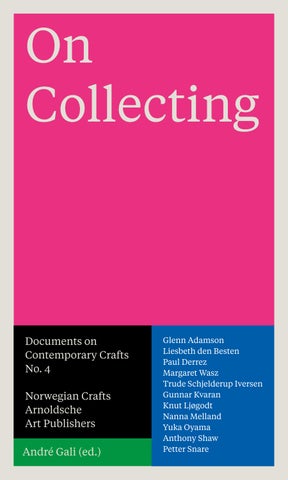
On Collecting
Documents on Contemporary Crafts No. 4 Norwegian Crafts Arnoldsche Art Publishers
André Gali (ed.)
Glenn Adamson Liesbeth den Besten Paul Derrez Margaret Wasz Trude Schjelderup Iversen Gunnar Kvaran Knut Ljøgodt Nanna Melland Yuka Oyama Anthony Shaw Petter Snare
Table of Contents Hege Henriksen: Preface. . . . . . . . . . . . . . . . . . . . . . . . . . . . . . . . . . . . . . . . . . . . . . . . . . . . . . 6 André Gali: On Collecting: From a Public, Private and Personal Perspective. . . . 8 Gunnar B. Kvaran: The Art of Collecting . . . . . . . . . . . . . . . . . . . . . . . . . . . . . . . . . . . . . . . . 17 Margaret Wasz: Why Do We Collect? . . . . . . . . . . . . . . . . . . . . . . . . . . . . . . . . . . . . . . . . . 29 Liesbeth den Besten: The Life of Jewellery Collections in Museums: the Netherlands, a Case Study . . . . . . . . . . . . . . . . . . . . . . . . . . . . . . . . 41 Knut Ljøgodt: Collecting Strategies: Collecting for the Nation – Public Acquisitions and Private Donations . . . . . . . . . . . . . . . . . . . . 57 Yuka Oyama: Collectors . . . . . . . . . . . . . . . . . . . . . . . . . . . . . . . . . . . . . . . . . . . . . . . . . . 75 Trude Schjelderup Iversen: The Becoming of a Public Collection. . . . . . . . . . . . . . . . . . . . . . . . . . . 85 Nanna Melland: A Motivation and Model for Collecting: The Norwegian Craft Acquisition Fund. . . . . . . . . . . . . . . . . . . . . . . . 97 Petter Snare: Turn Your Gaze: About Collecting on the Periphery . . . . . . . . . . . . 105
Table of Contents Hege Henriksen: Preface. . . . . . . . . . . . . . . . . . . . . . . . . . . . . . . . . . . . . . . . . . . . . . . . . . . . . . 6 André Gali: On Collecting: From a Public, Private and Personal Perspective. . . . 8 Gunnar B. Kvaran: The Art of Collecting . . . . . . . . . . . . . . . . . . . . . . . . . . . . . . . . . . . . . . . . 17 Margaret Wasz: Why Do We Collect? . . . . . . . . . . . . . . . . . . . . . . . . . . . . . . . . . . . . . . . . . 29 Liesbeth den Besten: The Life of Jewellery Collections in Museums: the Netherlands, a Case Study . . . . . . . . . . . . . . . . . . . . . . . . . . . . . . . . 41 Knut Ljøgodt: Collecting Strategies: Collecting for the Nation – Public Acquisitions and Private Donations . . . . . . . . . . . . . . . . . . . . 57 Yuka Oyama: Collectors . . . . . . . . . . . . . . . . . . . . . . . . . . . . . . . . . . . . . . . . . . . . . . . . . . 75 Trude Schjelderup Iversen: The Becoming of a Public Collection. . . . . . . . . . . . . . . . . . . . . . . . . . . 85 Nanna Melland: A Motivation and Model for Collecting: The Norwegian Craft Acquisition Fund. . . . . . . . . . . . . . . . . . . . . . . . 97 Petter Snare: Turn Your Gaze: About Collecting on the Periphery . . . . . . . . . . . . 105
The Art of Collecting Gunnar B. Kvaran
Roe Ethridge: Louise Blowing a Bubble. 2011. C-Print. From Erling Kagge’s Collection. Photo: Ina Hagen
16
Since ancient times, art has been part of human existence, playing varying roles in different eras, and taking shape in new forms. Over time, individuals have derived pleasure from beautiful things and striven to acquire lavish personal collections. Art museums in the modern sense have only existed since the eighteenth century. Long before art collecting had started in Europe, the Chinese aristocracy collected works of art, as witnessed by the rich imperial treasures of China. In Europe, the first known cases of individuals setting out to accumulate art collections were in Hellenistic Greece around 2,000 years ago. King Attalus II of Pergamon, who died in 138 BC, is well known for his collection of paintings. In due course, collecting reached Rome, becoming widespread among high-ranking Romans after the conquest of the Greek city of Syracuse in Sicily in 212 BC. The wealthy and high-born of Rome were especially keen to acquire works of Greek art, by whatever means, not caring whether the object was an original or a copy. Roman military leaders were often rewarded for their victories with works of art. Such renowned Romans as the emperors Claudius I, Julius Caesar, Nero and Hadrian, and the military leader Pompey the Great, had magnificent art collections. These were regarded as excessive by many of their contemporaries, who lamented that all these beautiful works of art were hidden away from the public eye in private collections, and proposed that they should be displayed in public squares. In the middle ages, the Church was the leading collector of works of art, which generally related in one way or another to Christianity. Churchmen did not content themselves simply with paintings and sculptures: they also collected manuscripts, precious and semi-precious stones, holy relics and a range of objects from nature. Monasteries and convents served as treasure-houses for collections of unimaginable value, ‘to the glory of God’, in the words of the twelfth-century Abbot Suger of St Denis in France, who sought to justify himself and the Church at a time when its worldly magnificence was under attack.
17
The Art of Collecting Gunnar B. Kvaran
Roe Ethridge: Louise Blowing a Bubble. 2011. C-Print. From Erling Kagge’s Collection. Photo: Ina Hagen
16
Since ancient times, art has been part of human existence, playing varying roles in different eras, and taking shape in new forms. Over time, individuals have derived pleasure from beautiful things and striven to acquire lavish personal collections. Art museums in the modern sense have only existed since the eighteenth century. Long before art collecting had started in Europe, the Chinese aristocracy collected works of art, as witnessed by the rich imperial treasures of China. In Europe, the first known cases of individuals setting out to accumulate art collections were in Hellenistic Greece around 2,000 years ago. King Attalus II of Pergamon, who died in 138 BC, is well known for his collection of paintings. In due course, collecting reached Rome, becoming widespread among high-ranking Romans after the conquest of the Greek city of Syracuse in Sicily in 212 BC. The wealthy and high-born of Rome were especially keen to acquire works of Greek art, by whatever means, not caring whether the object was an original or a copy. Roman military leaders were often rewarded for their victories with works of art. Such renowned Romans as the emperors Claudius I, Julius Caesar, Nero and Hadrian, and the military leader Pompey the Great, had magnificent art collections. These were regarded as excessive by many of their contemporaries, who lamented that all these beautiful works of art were hidden away from the public eye in private collections, and proposed that they should be displayed in public squares. In the middle ages, the Church was the leading collector of works of art, which generally related in one way or another to Christianity. Churchmen did not content themselves simply with paintings and sculptures: they also collected manuscripts, precious and semi-precious stones, holy relics and a range of objects from nature. Monasteries and convents served as treasure-houses for collections of unimaginable value, ‘to the glory of God’, in the words of the twelfth-century Abbot Suger of St Denis in France, who sought to justify himself and the Church at a time when its worldly magnificence was under attack.
17
The Becoming of a Public Collection Trude Schjelderup Iversen
According to the Norwegian art historian Gunnar Danbolt, the art institution is like a lobster trap: it is hard to get into, but impossible to get out of. This metaphor points to the complexity of Norwegian cultural policies, with their various support programmes and grant arrangements on the one hand, and the legal system on the other. It also indicates something about the institutions set up to enforce the contemporary political agenda. The policies, support programmes, grants and legal system form the basis for Norwegian arts funding, which could be describe as art without market (and by that I mean the private art market). I begin this article by reviewing some of the most important historical events that form the background for how Public Art Norway (Kunst i offentlige rom, henceforth referred to as KORO) not only was established but also became one of the most important commissioners of contemporary art in the country. I then discuss KORO’s roles as a collector, caretaker, knowledge producer and facilitator of people’s encounters with art in public spaces. In the final sections, the Hessel Collection in upstate New York serves as an interesting case to compare with KORO. It casts KORO in sharp relief and points to a way forward for reactivating and increasing the cultural value of KORO’s collection.
Billedkunstneren 1/1975. Journal for Norwegian artists.
84
A brief history Traditionally, Norwegian culture policies for artists have had many purposes: to educate, stimulate new artistic production through grants and project funding, honour high achievement, assist elderly artists, improve welfare and living conditions, increase the public use of artworks and provide reasonable compensation for their display. KORO’s support and funding structure rests on two principles: the legal and the political. The legal basis is made up of intellectual property and copyright law. The political basis is the political will to support the arts above and beyond those avenues provided by the legal basis and the art market. The history of this funding structure happens
85
The Becoming of a Public Collection Trude Schjelderup Iversen
According to the Norwegian art historian Gunnar Danbolt, the art institution is like a lobster trap: it is hard to get into, but impossible to get out of. This metaphor points to the complexity of Norwegian cultural policies, with their various support programmes and grant arrangements on the one hand, and the legal system on the other. It also indicates something about the institutions set up to enforce the contemporary political agenda. The policies, support programmes, grants and legal system form the basis for Norwegian arts funding, which could be describe as art without market (and by that I mean the private art market). I begin this article by reviewing some of the most important historical events that form the background for how Public Art Norway (Kunst i offentlige rom, henceforth referred to as KORO) not only was established but also became one of the most important commissioners of contemporary art in the country. I then discuss KORO’s roles as a collector, caretaker, knowledge producer and facilitator of people’s encounters with art in public spaces. In the final sections, the Hessel Collection in upstate New York serves as an interesting case to compare with KORO. It casts KORO in sharp relief and points to a way forward for reactivating and increasing the cultural value of KORO’s collection.
Billedkunstneren 1/1975. Journal for Norwegian artists.
84
A brief history Traditionally, Norwegian culture policies for artists have had many purposes: to educate, stimulate new artistic production through grants and project funding, honour high achievement, assist elderly artists, improve welfare and living conditions, increase the public use of artworks and provide reasonable compensation for their display. KORO’s support and funding structure rests on two principles: the legal and the political. The legal basis is made up of intellectual property and copyright law. The political basis is the political will to support the arts above and beyond those avenues provided by the legal basis and the art market. The history of this funding structure happens
85
A Motivation and Model for Collecting: The Norwegian Craft Acquisition Fund Nanna Melland
The Norwegian Craft Acquisition Fund (Innkjøpsfondet for norsk kunst håndverk, INK) is a unique institution that secures high quality contemporary craft for museum collections. Since its founding in 1990, INK has contributed significantly to increasing the profile and public acceptance of the field of contemporary craft in Norway. The combined efforts of INK’s members raise the quality of the contemporary craft collections at the three museums which specialise in Norwegian craft: KODE Art Museums of Bergen, the National Museum of Art, Architecture and Design in Oslo, and the National Museum of Decorative Arts in Trondheim.1 There is therefore no shadow of doubt that the Fund is one of the most significant institutions for the field of Norwegian craft today. In addition to its immense contribution to the field, it ultimately has an impact on Norwegian heritage and the nation’s cultural value. History INK’s establishment was the result of a congruence of interests between the three museums of decorative art in Norway, on one hand, and the Norwegian Association for Arts and Crafts (Norske Kunsthåndverkere,
1 Hanne Friis: Sirkel, et minne om LB. Wall piece. Textile. 2016. In the Collection of KODE – Art Museums of Bergen.
96
In 1990, when INK was established, the names of the three participating museums were the West Norwegian Museum of Decorative Art (Vestlandsk Kunstindustrimuseum), the Museum of Decorative Arts and Design in Oslo (Kunstindustrimuseet), and the National Museum of Decorative Arts in Trondheim (Nordenfjeldske Kunstindustrimuseum). While all three museums are now part of massive consolidated museums, the National Museum of Decorative Arts in Trondheim, unlike the other two, has kept its individuated name.
97
A Motivation and Model for Collecting: The Norwegian Craft Acquisition Fund Nanna Melland
The Norwegian Craft Acquisition Fund (Innkjøpsfondet for norsk kunst håndverk, INK) is a unique institution that secures high quality contemporary craft for museum collections. Since its founding in 1990, INK has contributed significantly to increasing the profile and public acceptance of the field of contemporary craft in Norway. The combined efforts of INK’s members raise the quality of the contemporary craft collections at the three museums which specialise in Norwegian craft: KODE Art Museums of Bergen, the National Museum of Art, Architecture and Design in Oslo, and the National Museum of Decorative Arts in Trondheim.1 There is therefore no shadow of doubt that the Fund is one of the most significant institutions for the field of Norwegian craft today. In addition to its immense contribution to the field, it ultimately has an impact on Norwegian heritage and the nation’s cultural value. History INK’s establishment was the result of a congruence of interests between the three museums of decorative art in Norway, on one hand, and the Norwegian Association for Arts and Crafts (Norske Kunsthåndverkere,
1 Hanne Friis: Sirkel, et minne om LB. Wall piece. Textile. 2016. In the Collection of KODE – Art Museums of Bergen.
96
In 1990, when INK was established, the names of the three participating museums were the West Norwegian Museum of Decorative Art (Vestlandsk Kunstindustrimuseum), the Museum of Decorative Arts and Design in Oslo (Kunstindustrimuseet), and the National Museum of Decorative Arts in Trondheim (Nordenfjeldske Kunstindustrimuseum). While all three museums are now part of massive consolidated museums, the National Museum of Decorative Arts in Trondheim, unlike the other two, has kept its individuated name.
97
Table of Contents Hege Henriksen: Preface. . . . . . . . . . . . . . . . . . . . . . . . . . . . . . . . . . . . . . . . . . . . . . . . . . . .
4
Knut Astrup Bull and André Gali: Introduction. . . . . . . . . . . . . . . . . . . . . . . . . . . . . . . . . . . . . . . . . . . . . . .
7
Søren Kjørup: Art as the Other? Reflections on Craft’s and Fine Art’s Places in the Aesthetic Field. . . . . . . . . . . . . . . . . . . . . . . .
11
Knut Astrup Bull: You In Between: From Aesthetic Difference to Aesthetic Differing. . . . . . . . . . . . . . . . . . . . . . . . . . . . . . . . . . . . . . . 29 Sarah R. Gilbert: A Widening Chromaticism: Learning Perception in the Collective Craftwork of the Encounter. . . . . . . . . . . . . . . . . . . . . 49 André Gali: From a System of Objects to Speculative Realism. . . . . . . . . . . . . . . 69 Glenn Adamson: Craft and the Allegorical Impulse . . . . . . . . . . . . . . . . . . . . . . . . . . . . 93 Anders Ljungberg: An Emotional Perspective on Everyday Use . . . . . . . . . . . . . . . . . . . 115 Martina Margetts: The Matter In Hand. . . . . . . . . . . . . . . . . . . . . . . . . . . . . . . . . . . . . . . . . 137 Hilde Methi: Paying Attention to Material Responses in Local Ecologies. . . . . . 157 Contributors. . . . . . . . . . . . . . . . . . . . . . . . . . . . . . . . . . . . . . . . . . . . . . . 177
Table of Contents Hege Henriksen: Preface. . . . . . . . . . . . . . . . . . . . . . . . . . . . . . . . . . . . . . . . . . . . . . . . . . . .
4
Knut Astrup Bull and André Gali: Introduction. . . . . . . . . . . . . . . . . . . . . . . . . . . . . . . . . . . . . . . . . . . . . . .
7
Søren Kjørup: Art as the Other? Reflections on Craft’s and Fine Art’s Places in the Aesthetic Field. . . . . . . . . . . . . . . . . . . . . . . .
11
Knut Astrup Bull: You In Between: From Aesthetic Difference to Aesthetic Differing. . . . . . . . . . . . . . . . . . . . . . . . . . . . . . . . . . . . . . . 29 Sarah R. Gilbert: A Widening Chromaticism: Learning Perception in the Collective Craftwork of the Encounter. . . . . . . . . . . . . . . . . . . . . 49 André Gali: From a System of Objects to Speculative Realism. . . . . . . . . . . . . . . 69 Glenn Adamson: Craft and the Allegorical Impulse . . . . . . . . . . . . . . . . . . . . . . . . . . . . 93 Anders Ljungberg: An Emotional Perspective on Everyday Use . . . . . . . . . . . . . . . . . . . 115 Martina Margetts: The Matter In Hand. . . . . . . . . . . . . . . . . . . . . . . . . . . . . . . . . . . . . . . . . 137 Hilde Methi: Paying Attention to Material Responses in Local Ecologies. . . . . . 157 Contributors. . . . . . . . . . . . . . . . . . . . . . . . . . . . . . . . . . . . . . . . . . . . . . . 177
You In Between: From Aesthetic Difference to Aesthetic Differing Knut Astrup Bull
Michael Rowe: Cylindrical Vessel, 1985. In the collection of the National Museum of Art, Architecture and Design, Norway. Photo: the National Museum of Art, Architecture and Design/ Frode Larsen
Sculpture or container? Some time ago, I had a discussion with a curator of contemporary art regarding Michael Rowe’s Cylindrical Vessel from 1985 (Fig. 1). The object reminded the curator of sculptures from the 1960s, the implication being that it represented a bygone stage in art history. Even though there are of course several approaches to reading and experiencing works of contemporary craft, my response was nevertheless to point out that this was not necessarily a sculpture (re-presentation), but a vessel. The artist’s intention was to present, from a formal, aesthetic and historical perspective, a conceptualization of a vessel meant to contain something. Rowe’s vessel, I argued, should therefore not be seen only as a picturing (idea) of a container, or only as a container, but as a conceptual elaboration on the container (a thing) as a meaning- containing and complex object. This discussion reveals a basic principle in the contemporary art discourse, namely, the oppositional relation between artworks, which, in the widest sense, depict or reflect reality, and ordinary things, which are part of the reality the artworks depict or reflect.1 This antithetical conceptual pair, or the duality between art and objects used in everyday life, represents a dominating dogma undergirding and steering our perception and valuing of aesthetic objects, disqualifying some from being considered works of art. It also undergirds the institutional practice of ranking forms of art and positioning contemporary craft as
1
28
Even when artworks do not reflect reality, that is, when they do not act as images of everyday life, they are still seen as autonomous.
29
You In Between: From Aesthetic Difference to Aesthetic Differing Knut Astrup Bull
Michael Rowe: Cylindrical Vessel, 1985. In the collection of the National Museum of Art, Architecture and Design, Norway. Photo: the National Museum of Art, Architecture and Design/ Frode Larsen
Sculpture or container? Some time ago, I had a discussion with a curator of contemporary art regarding Michael Rowe’s Cylindrical Vessel from 1985 (Fig. 1). The object reminded the curator of sculptures from the 1960s, the implication being that it represented a bygone stage in art history. Even though there are of course several approaches to reading and experiencing works of contemporary craft, my response was nevertheless to point out that this was not necessarily a sculpture (re-presentation), but a vessel. The artist’s intention was to present, from a formal, aesthetic and historical perspective, a conceptualization of a vessel meant to contain something. Rowe’s vessel, I argued, should therefore not be seen only as a picturing (idea) of a container, or only as a container, but as a conceptual elaboration on the container (a thing) as a meaning- containing and complex object. This discussion reveals a basic principle in the contemporary art discourse, namely, the oppositional relation between artworks, which, in the widest sense, depict or reflect reality, and ordinary things, which are part of the reality the artworks depict or reflect.1 This antithetical conceptual pair, or the duality between art and objects used in everyday life, represents a dominating dogma undergirding and steering our perception and valuing of aesthetic objects, disqualifying some from being considered works of art. It also undergirds the institutional practice of ranking forms of art and positioning contemporary craft as
1
28
Even when artworks do not reflect reality, that is, when they do not act as images of everyday life, they are still seen as autonomous.
29
Anders Ruhwald: You in Between, 2008. Exhibited at Middelsbrough institute of Modern Art, 2008. In the collection of the National Museum of Art, Architecture and Design, Oslo. Photo: Anders Ruhwald
32
33
Anders Ruhwald: You in Between, 2008. Exhibited at Middelsbrough institute of Modern Art, 2008. In the collection of the National Museum of Art, Architecture and Design, Oslo. Photo: Anders Ruhwald
32
33
From a System of Objects to Speculative Realism André Gali
Artifacts can sometimes grow beyond their intended function. Some objects can demand from us a different set of rules in order to handle them. In some way or another, they take on a form of life within our minds. I thought, if commodities could evoke these various types of emotionality in us and construct fictions, then let them also become agents that help enhance our ability to imagine and dream. – Yuka Oyama, 2017 1
Yuka Oyama: Piano, 2016. From the series Encapsulation Suits. Wearable sculpture made from black polyethylene. Photo: Attila Hartwig
Objects have biographies and ontologies, they come into being at some point in time and live lives of a certain length: maybe one second or 5,000 years. Through their existence, objects take part in shaping the world both physically and emotionally. For makers, creating and shaping objects to be used and/or experienced is the raison-d’étre. The objects may ‘grow beyond their intended function’, as Yuka Oyama describes it in the above quote. Take a domestic object like a ceramic bowl – say one made from stoneware and raku fired in Japan in the Taishō period (1912–1926). Maybe it was fired in Tokyo in 1916 by Bernhard Leach and later brought to the UK where at some point it ended up in a museum collection. For this bowl to come into being at that specific time and place, many conditions had to be in place. Leach had to be in Japan (which he was), which in turn meant that he had to travel by boat from the UK at some point before the firing took place. And for that to happen, a boat needed to exist, and so forth. In addition to the many preconditions enabling Leach to be in Japan at that exact moment, there were other preconditions enabling the clay to exist: for starters, years of 1
68
Yuko Oyama, The Stubborn Life of Objects, Reflection on an artistic project 2012–2017, Oslo National Academy of the Arts, Department of Art and Craft, The Norwegian Artistic Research Fellowship Programme, Oslo (2017), 11.
69
From a System of Objects to Speculative Realism André Gali
Artifacts can sometimes grow beyond their intended function. Some objects can demand from us a different set of rules in order to handle them. In some way or another, they take on a form of life within our minds. I thought, if commodities could evoke these various types of emotionality in us and construct fictions, then let them also become agents that help enhance our ability to imagine and dream. – Yuka Oyama, 2017 1
Yuka Oyama: Piano, 2016. From the series Encapsulation Suits. Wearable sculpture made from black polyethylene. Photo: Attila Hartwig
Objects have biographies and ontologies, they come into being at some point in time and live lives of a certain length: maybe one second or 5,000 years. Through their existence, objects take part in shaping the world both physically and emotionally. For makers, creating and shaping objects to be used and/or experienced is the raison-d’étre. The objects may ‘grow beyond their intended function’, as Yuka Oyama describes it in the above quote. Take a domestic object like a ceramic bowl – say one made from stoneware and raku fired in Japan in the Taishō period (1912–1926). Maybe it was fired in Tokyo in 1916 by Bernhard Leach and later brought to the UK where at some point it ended up in a museum collection. For this bowl to come into being at that specific time and place, many conditions had to be in place. Leach had to be in Japan (which he was), which in turn meant that he had to travel by boat from the UK at some point before the firing took place. And for that to happen, a boat needed to exist, and so forth. In addition to the many preconditions enabling Leach to be in Japan at that exact moment, there were other preconditions enabling the clay to exist: for starters, years of 1
68
Yuko Oyama, The Stubborn Life of Objects, Reflection on an artistic project 2012–2017, Oslo National Academy of the Arts, Department of Art and Craft, The Norwegian Artistic Research Fellowship Programme, Oslo (2017), 11.
69
Craft and the Allegorical Impulse Glenn Adamson
Unknown: Picture – Shepheard Buss, 1570–1600. Embroidered linen in silk, bobbin lace. In the collection of the Victoria and Albert Museum, London. © Victoria and Albert Museum, London.
92
Author’s note I had originally intended, when writing Thinking Through Craft (2007), to include a chapter on Allegory. The book addressed craft’s marginalization within modernity, particularly in relation to fine art. My central argument was that Modern art defined itself, in part, through its dissociation from craft. I had arrived at this position through reading the work of Postcolonial and Feminist theorists. Much as study of the ethnographic Other has served to reinforce Eurocentric views of normalcy, or the feminine has been described negatively in such a way as to assert phallocentric authority, craft has been treated as a margin or ‘horizon’, incompatible with serious artwork. In developing this theme, I looked at a series of interrelated pairings – autonomous/supplemental, optical/ material, institutional/pastoral, professional/amateur. Craft in each case is associated with the latter, unprivileged term. The book also has a fifth, central chapter on ‘skill’, the pivot around which the book was meant to turn, which marks the shift from the formal issues, addressed in the first two chapters, to issues of social context, taken up in the last two. I had expected that the opposition between symbol and allegory would make another of these dialectical chapters. I didn’t quite manage that, though, and ended up shelving the research. Now, ten years on and thanks to the invitation of this volume’s editors, ‘later’ has arrived. So consider the following to be a long-delayed supplement to Thinking Through Craft – sort of like a DVD extra. My treatment of the theme of allegory is necessarily different from how I might have approached it in the 1990s, not least because of the tremendous shifts in craft practice, criticism and scholarship that have occurred since then. Understanding the power plays of Modern art seems less urgent today, when there are so many ongoing questions about craft’s cultural and political efficacy; being able to theorize the enigmatic potency of craft, on its own terms, seems more important. Even so, I invite you to read this text as ‘unfinished business’ – which is, come to think of it, what the allegorical impulse is all about.
93
Craft and the Allegorical Impulse Glenn Adamson
Unknown: Picture – Shepheard Buss, 1570–1600. Embroidered linen in silk, bobbin lace. In the collection of the Victoria and Albert Museum, London. © Victoria and Albert Museum, London.
92
Author’s note I had originally intended, when writing Thinking Through Craft (2007), to include a chapter on Allegory. The book addressed craft’s marginalization within modernity, particularly in relation to fine art. My central argument was that Modern art defined itself, in part, through its dissociation from craft. I had arrived at this position through reading the work of Postcolonial and Feminist theorists. Much as study of the ethnographic Other has served to reinforce Eurocentric views of normalcy, or the feminine has been described negatively in such a way as to assert phallocentric authority, craft has been treated as a margin or ‘horizon’, incompatible with serious artwork. In developing this theme, I looked at a series of interrelated pairings – autonomous/supplemental, optical/ material, institutional/pastoral, professional/amateur. Craft in each case is associated with the latter, unprivileged term. The book also has a fifth, central chapter on ‘skill’, the pivot around which the book was meant to turn, which marks the shift from the formal issues, addressed in the first two chapters, to issues of social context, taken up in the last two. I had expected that the opposition between symbol and allegory would make another of these dialectical chapters. I didn’t quite manage that, though, and ended up shelving the research. Now, ten years on and thanks to the invitation of this volume’s editors, ‘later’ has arrived. So consider the following to be a long-delayed supplement to Thinking Through Craft – sort of like a DVD extra. My treatment of the theme of allegory is necessarily different from how I might have approached it in the 1990s, not least because of the tremendous shifts in craft practice, criticism and scholarship that have occurred since then. Understanding the power plays of Modern art seems less urgent today, when there are so many ongoing questions about craft’s cultural and political efficacy; being able to theorize the enigmatic potency of craft, on its own terms, seems more important. Even so, I invite you to read this text as ‘unfinished business’ – which is, come to think of it, what the allegorical impulse is all about.
93