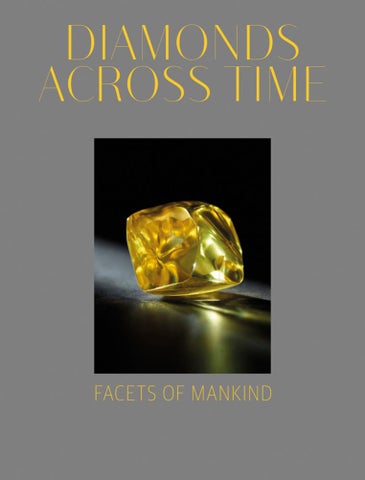
The Alrosa Yellow, rough 34.17 carats, 2016
The Millennium Star, 203.04 carats, 1990
Ring set with an emerald-cut pink diamond, 16.88 carats, with heart-shaped diamond shoulders, 20.90 carats
The Alrosa Yellow, rough 34.17 carats, 2016
The Millennium Star, 203.04 carats, 1990
Ring set with an emerald-cut pink diamond, 16.88 carats, with heart-shaped diamond shoulders, 20.90 carats
facets of mankind
DIAMONDS ACROSS TIME editor usha r. balakrishnan
the world diamond museum
facets of mankind
DIAMONDS ACROSS TIME editor usha r. balakrishnan
the world diamond museum
22
introduction
experience and describes the splendour of the sacred heirlooms that were paraded one by one from the treasure room. He describes the consecration of the ruler, his adornments, and the royal paraphernalia that is integral to the occasion. Ruth Peltason selects a group of twentieth-century women of power, prestige and privilege who have immortalized the diamonds and jewels they wore. Exquisite creations from Van Cleef & Arpels, Cartier, Bvlgari, and others are featured alongside the women who celebrated the jewels. The essay is a paean to the taste and independence of these women and their influence on jewellery design – from Queen Alexandra to the Duchess of Windsor, Marjorie Merriweather Post, Barbara Hutton, Doris Duke, and Elizabeth Taylor. Coloured diamonds are the rarest of the rare, much coveted in the past and the present. They come in shades of blue, pink, yellow, green, and extremely rarely red and even black. The essay by John King explores the magical world of these unusual stones. His essay delves into the science of colour, cutting to bring out the optimal colour that resides deep inside the rough stone, and issues related to grading these gems. It discusses the manifold issues that have contributed to their allure and the fascination they hold as an embodiment of the rare, the unusual, and the magical – an interest that is reflected in the stratospheric prices these rare gems have realised in recent years. Facets of Mankind is richly illustrated with high-quality images of gems and jewels, archival documents, rare drawings, and fabulous photographs. It is our hope that this book will serve as a repository of knowledge about this magical gem that will help us understand diamonds, revel in their beauty, and see exquisite pieces of jewellery celebrating them. The volume places diamonds in the context of the time in which they were discovered, and the political, social and cultural stage on which their histories are etched. In a rapidly changing world, diamonds are
fig. 5  Cartier, Paris. Bird Brooch, special order, 1948 The bird is 20.2 cm long and fashioned from platinum and white gold, set with one square emerald-cut diamond of 2.76 carats, two square-cut diamonds of 2.35 and 1.29 carats, 991 baguette-, brilliant-, and fancy-cut diamonds, for a total weight of 83.89 carats.
fig. 5
22
introduction
experience and describes the splendour of the sacred heirlooms that were paraded one by one from the treasure room. He describes the consecration of the ruler, his adornments, and the royal paraphernalia that is integral to the occasion. Ruth Peltason selects a group of twentieth-century women of power, prestige and privilege who have immortalized the diamonds and jewels they wore. Exquisite creations from Van Cleef & Arpels, Cartier, Bvlgari, and others are featured alongside the women who celebrated the jewels. The essay is a paean to the taste and independence of these women and their influence on jewellery design – from Queen Alexandra to the Duchess of Windsor, Marjorie Merriweather Post, Barbara Hutton, Doris Duke, and Elizabeth Taylor. Coloured diamonds are the rarest of the rare, much coveted in the past and the present. They come in shades of blue, pink, yellow, green, and extremely rarely red and even black. The essay by John King explores the magical world of these unusual stones. His essay delves into the science of colour, cutting to bring out the optimal colour that resides deep inside the rough stone, and issues related to grading these gems. It discusses the manifold issues that have contributed to their allure and the fascination they hold as an embodiment of the rare, the unusual, and the magical – an interest that is reflected in the stratospheric prices these rare gems have realised in recent years. Facets of Mankind is richly illustrated with high-quality images of gems and jewels, archival documents, rare drawings, and fabulous photographs. It is our hope that this book will serve as a repository of knowledge about this magical gem that will help us understand diamonds, revel in their beauty, and see exquisite pieces of jewellery celebrating them. The volume places diamonds in the context of the time in which they were discovered, and the political, social and cultural stage on which their histories are etched. In a rapidly changing world, diamonds are
fig. 5  Cartier, Paris. Bird Brooch, special order, 1948 The bird is 20.2 cm long and fashioned from platinum and white gold, set with one square emerald-cut diamond of 2.76 carats, two square-cut diamonds of 2.35 and 1.29 carats, 991 baguette-, brilliant-, and fancy-cut diamonds, for a total weight of 83.89 carats.
fig. 5
diamonds of the french crown jewels
The Birth of a Taste
Opener Crown of Louis XV (detail), with historical replica of the Sancy diamond on top fig. 1 Crown of Louis XV, 18th century. Gilt silver In 1729 the pearls and precious stones were replaced by paste imitations at the order of Louis XV. Originally, the Regent diamond adorned the flower at the front. The eight quadrangular diamonds that surmounted the flowers were from the set of eighteen Mazarin diamonds. The crown is topped by a fleur–de–lis formed from silver acanthus leaves, originally set with the Sancy diamond. In all, the crown contained 282 diamonds, 16 rubies, 16 sapphires, 16 emeralds, and 237 pearls.
fig. 1
F
ollowing Marco Polo’s return from the Orient, East-West interactions were renewed during the fourteenth century thanks to Venetian control over the Silk Road and the increased demand for luxury items among European monarchs, especially those of the Capetian dynasty that ruled France beginning in 987. At this time, the few diamonds known in Europe were essentially confined to liturgical spheres.1 Gradually, diamonds were introduced as political instruments, particularly by the house of EvreuxNavarre, which attained the secular authority of the French kingdom through an alliance with the Valois, the cadet branch of the Capetians.2 This alliance included Louis of Évreux (1276–1319), Philip VI of France (1293–1350), Jeanne of Valois (c. 1294–1342), Jeanne of Evreux (1310–1371), and Blanche I of Navarre (1331–1398)3 (fig. 4). Amongst the Valois, Philip VI wore one diamond finger ring,4 possibly point cut.5 Amongst those rulers, diamonds constituted symbolic and prestigious collectibles. Between 1350 and 1365 Philip VI’s son King John II ‘the Good’ (1319–1364) was the first to accumulate a significant number of pointed, square, and flat diamonds6 His largest diamonds weighed the equivalent of about fifteen carats.7 Most authors have postulated that those pointed and square diamonds were polished from natural octahedra.8 Typical of the late Middles Ages, these designs were likely acquired during the first half of the fourteenth century, when Venice had become Europe’s first ‘cutting’ centre9 or at least a city that specialized in cutting if not a trading hub. Beyond these unsubstantiated speculations, we know that a diamond market was active in France on the eve of the fourteenth century.10 Fathers and sons. John II bestowed his artistic tastes on his four sons. The first–crowned Charles V of France (1338–1380) – expanded his father’s work of restoring royal authority and commerce. Charles was a scholar with views about culture and education. His accomplishments include a large number of impressive buildings such as the infamous Bastille and an important number of military fortifications around Paris.11
8855
diamonds of the french crown jewels
The Birth of a Taste
Opener Crown of Louis XV (detail), with historical replica of the Sancy diamond on top fig. 1 Crown of Louis XV, 18th century. Gilt silver In 1729 the pearls and precious stones were replaced by paste imitations at the order of Louis XV. Originally, the Regent diamond adorned the flower at the front. The eight quadrangular diamonds that surmounted the flowers were from the set of eighteen Mazarin diamonds. The crown is topped by a fleur–de–lis formed from silver acanthus leaves, originally set with the Sancy diamond. In all, the crown contained 282 diamonds, 16 rubies, 16 sapphires, 16 emeralds, and 237 pearls.
fig. 1
F
ollowing Marco Polo’s return from the Orient, East-West interactions were renewed during the fourteenth century thanks to Venetian control over the Silk Road and the increased demand for luxury items among European monarchs, especially those of the Capetian dynasty that ruled France beginning in 987. At this time, the few diamonds known in Europe were essentially confined to liturgical spheres.1 Gradually, diamonds were introduced as political instruments, particularly by the house of EvreuxNavarre, which attained the secular authority of the French kingdom through an alliance with the Valois, the cadet branch of the Capetians.2 This alliance included Louis of Évreux (1276–1319), Philip VI of France (1293–1350), Jeanne of Valois (c. 1294–1342), Jeanne of Evreux (1310–1371), and Blanche I of Navarre (1331–1398)3 (fig. 4). Amongst the Valois, Philip VI wore one diamond finger ring,4 possibly point cut.5 Amongst those rulers, diamonds constituted symbolic and prestigious collectibles. Between 1350 and 1365 Philip VI’s son King John II ‘the Good’ (1319–1364) was the first to accumulate a significant number of pointed, square, and flat diamonds6 His largest diamonds weighed the equivalent of about fifteen carats.7 Most authors have postulated that those pointed and square diamonds were polished from natural octahedra.8 Typical of the late Middles Ages, these designs were likely acquired during the first half of the fourteenth century, when Venice had become Europe’s first ‘cutting’ centre9 or at least a city that specialized in cutting if not a trading hub. Beyond these unsubstantiated speculations, we know that a diamond market was active in France on the eve of the fourteenth century.10 Fathers and sons. John II bestowed his artistic tastes on his four sons. The first–crowned Charles V of France (1338–1380) – expanded his father’s work of restoring royal authority and commerce. Charles was a scholar with views about culture and education. His accomplishments include a large number of impressive buildings such as the infamous Bastille and an important number of military fortifications around Paris.11
8855
fig. 37
fig. 37  Coronation sword. The RĂŠgent diamond was set on the guard shell. The stones were dismantled in 1812 and replaced with copies.
fig. 37
fig. 37  Coronation sword. The RĂŠgent diamond was set on the guard shell. The stones were dismantled in 1812 and replaced with copies.
164
d e r e k j.   c o n t e n t
The Matan The Kingdom of Matan and the principality of Simpiang were well known for the many large diamonds found there. In 1825 a Major G. Mueller drafted a report for the Government of the Netherlands in which he describes two remarkable gems: There (Kingdom of Matan) are a few diamond mines, but the discovery of diamonds is usually left to chance rather than to systematic exploitation. It is said that two stones of considerable weight and value are in the possession of the ruler of Matan, and that for centuries these two diamonds have passed from father to son. Segima is the name of the larger of the two; the smaller is called Danu Raja.74 Mueller recounts the story of how the Segima was found and how it enabled the humble finder to share a home and the table with the ruler of the kingdom. However, he also offers a second account that claims the diamond was found in Landak province and that a ruler of that country gave it to his daughter. He explains that after various convoluted dynastic efforts to gain control of the gems through marriage, Putri Bunku, the daughter and heir of the king of Landak, married the ruler of Songi and Succadana in 1821 or 1822. And thus the largest and most precious treasure of Landak passed into the possession of Succadana. On that same occasion, the country of Matan spirited away the Danu Raja to Landak. Mueller relates that the Sultan of Matan always wore both diamonds upon his person and that he deliberately spread the rumor that they were entrusted to the care of his wife in order for him not to be murdered and his treasure stolen – perhaps not very considerate toward his wife. In 1849 Heinrich von Gaffron75 compiled another description and history of the Matan diamond:
fig. 18  The Banjarmasin diamond
fig. 18
164
d e r e k j.   c o n t e n t
The Matan The Kingdom of Matan and the principality of Simpiang were well known for the many large diamonds found there. In 1825 a Major G. Mueller drafted a report for the Government of the Netherlands in which he describes two remarkable gems: There (Kingdom of Matan) are a few diamond mines, but the discovery of diamonds is usually left to chance rather than to systematic exploitation. It is said that two stones of considerable weight and value are in the possession of the ruler of Matan, and that for centuries these two diamonds have passed from father to son. Segima is the name of the larger of the two; the smaller is called Danu Raja.74 Mueller recounts the story of how the Segima was found and how it enabled the humble finder to share a home and the table with the ruler of the kingdom. However, he also offers a second account that claims the diamond was found in Landak province and that a ruler of that country gave it to his daughter. He explains that after various convoluted dynastic efforts to gain control of the gems through marriage, Putri Bunku, the daughter and heir of the king of Landak, married the ruler of Songi and Succadana in 1821 or 1822. And thus the largest and most precious treasure of Landak passed into the possession of Succadana. On that same occasion, the country of Matan spirited away the Danu Raja to Landak. Mueller relates that the Sultan of Matan always wore both diamonds upon his person and that he deliberately spread the rumor that they were entrusted to the care of his wife in order for him not to be murdered and his treasure stolen – perhaps not very considerate toward his wife. In 1849 Heinrich von Gaffron75 compiled another description and history of the Matan diamond:
fig. 18  The Banjarmasin diamond
fig. 18
figs. 5
figs. 5
302
d j oi h a nn a k si cn agr i s b r i c k
Charles, future 6th Marquess, married Lady Theresa Chetwynd-Talbot (d. 1919) in 1875. Born in 1856 into one of the oldest and most distinguished families in the kingdom, Lady Chetwynd-Talbot was said to have the brains of a man and the temperament of a woman. Although she was short in stature, her authoritative presence and good looks won many admirers, including Naser al-Din, the Shah of Persia, who proposed buying her during his official visit to London in 1889. The driving force in her marriage, she ably assisted her husband on his appointments in public life as Lord Lieutenant of Ireland 1886 and as President of the Board of Education. From 1884, when he succeeded to the marquessate, she made a great reputation as Marchioness of Londonderry, invariably dressed in either black or white. All the privileges and responsibilities of rank, wealth, and power gave her intense pleasure, whether driving to the state opening of Parliament in the family stage coach, organising shooting parties at Wynyard for the Prince of Wales and his friends, or receiving crowned heads, prime ministers, poets, sculptors, and men of letters at Londonderry House. There the family jewels were put to good use, for as Edward Frederic Benson described, she ‘revelled in personal splendour, and frankly and unmitigatedly enjoyed standing at the head of her stairs when some big party was in progress, with the ‘family fender’ as she called that nice diamond crown gleaming on her most comely head, and hugging the fact that this was her house and that she was a marchioness from top to toe and was playing the part to perfection.’30 A high point was reached when she attended the famous Devonshire House Ball in 1897, celebrating the sixtieth anniversary of the reign of Queen Victoria in 1897. As Maria Theresa, Empress of Austria and Queen of Hungary, dressed in a white satin embroidered with gold thread and seed pearls, blazing with the Londonderry diamonds–stomacher, brooches holding up her train and the ‘family fender’ on her powdered hair–she was greeted by the other guests with a murmur of admiration as she ascended the grand staircase of Devonshire House, as if she owned it.
fig. 14
fig. 15
fig. 14 The Londonderry diamond stomacher, made by R. & S. Garrard & Co., composed of four elements graduated in size reaching from neckline to waist and set with brilliant and rose-cut diamonds mounted in silver and gold, London, 1854
Surrounded as she was by all the great ladies of England not one could compete with this impressive combination of the Londonderry diamonds with her regal bearing (fig. 15). Nor was she forgotten. Thirty years later her stately and voluptuous presence was evoked by V. Sackville West by the character of Lady Roehampton in the novel The Edwardians: ‘What self possession expressed in the set of the magnificent shoulders emerging from the cloud of tulle! How divinely her head was posed under its crown of diamonds! How royally she sat–so calm, languorous and queenly without a care in the world.’ She lived by the advice she gave a shy friend, ‘My dear always enter a room as if the whole place belonged to you’v.31 It was left to Theresa’s daughter-in-law, Edith (d. 1959) (fig.18), to adjust to the new world that followed the end of World War 1 in 1918. Although
fig. 15 Marchioness Theresa attired as the Empress Maria Theresa for the Devonshire House Ball, 1897
302
d j oi h a nn a k si cn agr i s b r i c k
Charles, future 6th Marquess, married Lady Theresa Chetwynd-Talbot (d. 1919) in 1875. Born in 1856 into one of the oldest and most distinguished families in the kingdom, Lady Chetwynd-Talbot was said to have the brains of a man and the temperament of a woman. Although she was short in stature, her authoritative presence and good looks won many admirers, including Naser al-Din, the Shah of Persia, who proposed buying her during his official visit to London in 1889. The driving force in her marriage, she ably assisted her husband on his appointments in public life as Lord Lieutenant of Ireland 1886 and as President of the Board of Education. From 1884, when he succeeded to the marquessate, she made a great reputation as Marchioness of Londonderry, invariably dressed in either black or white. All the privileges and responsibilities of rank, wealth, and power gave her intense pleasure, whether driving to the state opening of Parliament in the family stage coach, organising shooting parties at Wynyard for the Prince of Wales and his friends, or receiving crowned heads, prime ministers, poets, sculptors, and men of letters at Londonderry House. There the family jewels were put to good use, for as Edward Frederic Benson described, she ‘revelled in personal splendour, and frankly and unmitigatedly enjoyed standing at the head of her stairs when some big party was in progress, with the ‘family fender’ as she called that nice diamond crown gleaming on her most comely head, and hugging the fact that this was her house and that she was a marchioness from top to toe and was playing the part to perfection.’30 A high point was reached when she attended the famous Devonshire House Ball in 1897, celebrating the sixtieth anniversary of the reign of Queen Victoria in 1897. As Maria Theresa, Empress of Austria and Queen of Hungary, dressed in a white satin embroidered with gold thread and seed pearls, blazing with the Londonderry diamonds–stomacher, brooches holding up her train and the ‘family fender’ on her powdered hair–she was greeted by the other guests with a murmur of admiration as she ascended the grand staircase of Devonshire House, as if she owned it.
fig. 14
fig. 15
fig. 14 The Londonderry diamond stomacher, made by R. & S. Garrard & Co., composed of four elements graduated in size reaching from neckline to waist and set with brilliant and rose-cut diamonds mounted in silver and gold, London, 1854
Surrounded as she was by all the great ladies of England not one could compete with this impressive combination of the Londonderry diamonds with her regal bearing (fig. 15). Nor was she forgotten. Thirty years later her stately and voluptuous presence was evoked by V. Sackville West by the character of Lady Roehampton in the novel The Edwardians: ‘What self possession expressed in the set of the magnificent shoulders emerging from the cloud of tulle! How divinely her head was posed under its crown of diamonds! How royally she sat–so calm, languorous and queenly without a care in the world.’ She lived by the advice she gave a shy friend, ‘My dear always enter a room as if the whole place belonged to you’v.31 It was left to Theresa’s daughter-in-law, Edith (d. 1959) (fig.18), to adjust to the new world that followed the end of World War 1 in 1918. Although
fig. 15 Marchioness Theresa attired as the Empress Maria Theresa for the Devonshire House Ball, 1897
POWERFUL WOMEN, IMPORTANT DIAMONDS ruth peltason
POWERFUL WOMEN, IMPORTANT DIAMONDS ruth peltason
370
ruth peltason
fig. 20
fig. 20 Cartier New York. Fringe necklace, 1937. Cushion-shaped Burma sapphire, 38.31 carats, calibré-cut and channel-set sapphires, diamonds, and platinum, length: 42.3 cm When Marjorie Merriweather Post’s husband Joseph Davies was appointed ambassador to the Soviet Union, she had Cartier join two bracelets to form this spectacular necklace. The large sapphire in the centre can be detached and worn as a brooch.
fig. 21 Frank O. Salisbury (1874-1962). Marjorie Post Davies, 1946. Oil on canvas, 90.2 × 70.5 cm In addition to the Cartier sapphire and diamond fringe necklace, Mrs. Post has on a sapphire and diamond brooch, ring, and pair of ear clips.
fig. 21
370
ruth peltason
fig. 20
fig. 20 Cartier New York. Fringe necklace, 1937. Cushion-shaped Burma sapphire, 38.31 carats, calibré-cut and channel-set sapphires, diamonds, and platinum, length: 42.3 cm When Marjorie Merriweather Post’s husband Joseph Davies was appointed ambassador to the Soviet Union, she had Cartier join two bracelets to form this spectacular necklace. The large sapphire in the centre can be detached and worn as a brooch.
fig. 21 Frank O. Salisbury (1874-1962). Marjorie Post Davies, 1946. Oil on canvas, 90.2 × 70.5 cm In addition to the Cartier sapphire and diamond fringe necklace, Mrs. Post has on a sapphire and diamond brooch, ring, and pair of ear clips.
fig. 21
powerful women, important diamonds
fig. 39
fig. 39 The Elizabeth Taylor Diamond Ring. Cut-cornered rectangular-cut diamond, with tapered baguettes, and platinum, approx. 33.19 carats The beautiful Asscher-cut diamond is D colour, VS1 clarity, with the exceptional Type IIa designation.
fig. 38
Burmese ruby and diamond necklace, ear clips, and bracelet; the Bvlgari sapphire and diamond sautoir (fig. 41); the Van Cleef & Arpels ruby and diamond ring; the Schlumberger sapphire and diamond brooch; and, of course, the Schlumberger Night of the Iguana Brooch. If collecting jewellery was a race, Dame Elizabeth’s collection would represent a marathon, not a sprint. So much of the collection was built on love. Mike Todd gave her the Cartier ruby and diamond set, whereas the Elizabeth Taylor Diamond Ring, formerly known as the Krupp, was purchased at auction for her by Richard Burton. Between them, Todd and Burton are responsible for most of the very best of Dame Elizabeth’s collection. Did sentiment factor in? Always. Imagine calling a 33.19-carat rectangular-cut D flawless, VS1, Type IIA diamond ‘my baby.’ But that’s how Dame Elizabeth always referred to her eponymous ring, and she meant it. Was something ever too large for the star? Just once, when Richard Burton succeeded in purchasing the Taylor-Burton Diamond ( fig. 40). The diamond came from the same mine where the Cullinan had been found, the Premier Diamond Mine, in South Africa, in 1966. Harry Winston bought the 240.80-carat rough and had part of it cut into a massive
395
powerful women, important diamonds
fig. 39
fig. 39 The Elizabeth Taylor Diamond Ring. Cut-cornered rectangular-cut diamond, with tapered baguettes, and platinum, approx. 33.19 carats The beautiful Asscher-cut diamond is D colour, VS1 clarity, with the exceptional Type IIa designation.
fig. 38
Burmese ruby and diamond necklace, ear clips, and bracelet; the Bvlgari sapphire and diamond sautoir (fig. 41); the Van Cleef & Arpels ruby and diamond ring; the Schlumberger sapphire and diamond brooch; and, of course, the Schlumberger Night of the Iguana Brooch. If collecting jewellery was a race, Dame Elizabeth’s collection would represent a marathon, not a sprint. So much of the collection was built on love. Mike Todd gave her the Cartier ruby and diamond set, whereas the Elizabeth Taylor Diamond Ring, formerly known as the Krupp, was purchased at auction for her by Richard Burton. Between them, Todd and Burton are responsible for most of the very best of Dame Elizabeth’s collection. Did sentiment factor in? Always. Imagine calling a 33.19-carat rectangular-cut D flawless, VS1, Type IIA diamond ‘my baby.’ But that’s how Dame Elizabeth always referred to her eponymous ring, and she meant it. Was something ever too large for the star? Just once, when Richard Burton succeeded in purchasing the Taylor-Burton Diamond ( fig. 40). The diamond came from the same mine where the Cullinan had been found, the Premier Diamond Mine, in South Africa, in 1966. Harry Winston bought the 240.80-carat rough and had part of it cut into a massive
395
402
john king
the world of coloured diamonds
ONE IN TEN THOUSAND: THE UNIQUE WORLD OF COLOURED DIAMONDS John M. King In recent years, the gem and jewellery has used the phrase ‘one in ten thousand’ to indicate the extreme rarity of coloured diamonds. Along with this analogy comes the general assumption that mines typically process a ton of ore to recover just one carat’s worth of rough diamond. This ‘one-in-ten-thousand-stone’ could be of any depth of colour; those with strong, rich colours are rarer still. Even with all these ideas taking hold, widespread understanding of these magical stones has been a slow journey. The Embodiment of Rare Coloured and colourless diamonds have been treasured for centuries, especially large and historic examples such as the pink Agra and the blue Hope. Yet it was probably no more than a generation ago that most industry professionals looked at the buying, selling, and collecting of coloured diamonds as a sideline activity, a passion for a relative few. Some manufacturers at the time sold off the fancy colours in their rough assortments since they did not know what after object, requiring an appreciation for colour itself and its rarity in diamond material. Over the past ten to fifteen years, coloured diamonds have become the focal point of the consumer media and the central activity of many businesses. By now, the story of that transition is well known. Beginning in the late 1970s, a number of developments exposed a broader population of coloured diamonds to the attention of the gem and jewellery industry and, ultimately, the consumer. The story of these developments is in areas as diverse as diamond cutting, mining, major marketing campaigns, auctions, museum exhibitions, and laboratory grading developments. It is the story of how a unique item captured the imagination of the world. Today the significance of coloured diamonds remains the allure and fascination they hold as the embodiment of
fig. 1 The discovery of diamonds has fascinated mankind throughout history. When the rough shows noticeable colour, it is even more unusual. Coloured diamonds are exceedingly rare and have come to define the special and unique in our world.
fig. 1
the unusual, rather than their market share by volume. They do not represent a high percentage of diamond sales or of mining production overall, but they often headline the news when they are offered at auction or worn by media stars to events such as the Academy Awards and the Cannes Film Festival. We have come to appreciate the beautiful range of natural coloured diamonds in general as well as their relative rarity: rare yet just plentiful enough to sustain an active market. Whilst awareness of colour has grown, there continues to be a focus on certain colours like blue, pink, and yellow. The appreciation for the full spectrum of diamond colours continues to develop. Embracing the potential of all diamond colours–few other gemstones occur in the same depths of colour as diamonds–could link these special stones to even more consumers in the years ahead. This effort involves focusing on the effects of colours– not only the price a colour can bring. Diamond may be the only gemstone of which examples with the least colour and the most colour–covering the entire spectrum from colourless to coloured diamonds– carry the highest premium. On this occasion of celebrating the world of diamonds, it is fitting to look back at some of the early developments and how they have shaped today’s landscape. What role do they play today? How will they shape the next fifty years? Manufacturing Coloured Diamonds Historically, the approach toward diamond cutting was consistent: whether coloured or colourless, diamonds were cut to similar proportions and styles or for weight yield only. Cutting experiments in the late 1970s and 1980s begin to change this approach. The initial idea behind those cutting experiments was to improve the look of
403
402
john king
the world of coloured diamonds
ONE IN TEN THOUSAND: THE UNIQUE WORLD OF COLOURED DIAMONDS John M. King In recent years, the gem and jewellery has used the phrase ‘one in ten thousand’ to indicate the extreme rarity of coloured diamonds. Along with this analogy comes the general assumption that mines typically process a ton of ore to recover just one carat’s worth of rough diamond. This ‘one-in-ten-thousand-stone’ could be of any depth of colour; those with strong, rich colours are rarer still. Even with all these ideas taking hold, widespread understanding of these magical stones has been a slow journey. The Embodiment of Rare Coloured and colourless diamonds have been treasured for centuries, especially large and historic examples such as the pink Agra and the blue Hope. Yet it was probably no more than a generation ago that most industry professionals looked at the buying, selling, and collecting of coloured diamonds as a sideline activity, a passion for a relative few. Some manufacturers at the time sold off the fancy colours in their rough assortments since they did not know what after object, requiring an appreciation for colour itself and its rarity in diamond material. Over the past ten to fifteen years, coloured diamonds have become the focal point of the consumer media and the central activity of many businesses. By now, the story of that transition is well known. Beginning in the late 1970s, a number of developments exposed a broader population of coloured diamonds to the attention of the gem and jewellery industry and, ultimately, the consumer. The story of these developments is in areas as diverse as diamond cutting, mining, major marketing campaigns, auctions, museum exhibitions, and laboratory grading developments. It is the story of how a unique item captured the imagination of the world. Today the significance of coloured diamonds remains the allure and fascination they hold as the embodiment of
fig. 1 The discovery of diamonds has fascinated mankind throughout history. When the rough shows noticeable colour, it is even more unusual. Coloured diamonds are exceedingly rare and have come to define the special and unique in our world.
fig. 1
the unusual, rather than their market share by volume. They do not represent a high percentage of diamond sales or of mining production overall, but they often headline the news when they are offered at auction or worn by media stars to events such as the Academy Awards and the Cannes Film Festival. We have come to appreciate the beautiful range of natural coloured diamonds in general as well as their relative rarity: rare yet just plentiful enough to sustain an active market. Whilst awareness of colour has grown, there continues to be a focus on certain colours like blue, pink, and yellow. The appreciation for the full spectrum of diamond colours continues to develop. Embracing the potential of all diamond colours–few other gemstones occur in the same depths of colour as diamonds–could link these special stones to even more consumers in the years ahead. This effort involves focusing on the effects of colours– not only the price a colour can bring. Diamond may be the only gemstone of which examples with the least colour and the most colour–covering the entire spectrum from colourless to coloured diamonds– carry the highest premium. On this occasion of celebrating the world of diamonds, it is fitting to look back at some of the early developments and how they have shaped today’s landscape. What role do they play today? How will they shape the next fifty years? Manufacturing Coloured Diamonds Historically, the approach toward diamond cutting was consistent: whether coloured or colourless, diamonds were cut to similar proportions and styles or for weight yield only. Cutting experiments in the late 1970s and 1980s begin to change this approach. The initial idea behind those cutting experiments was to improve the look of
403