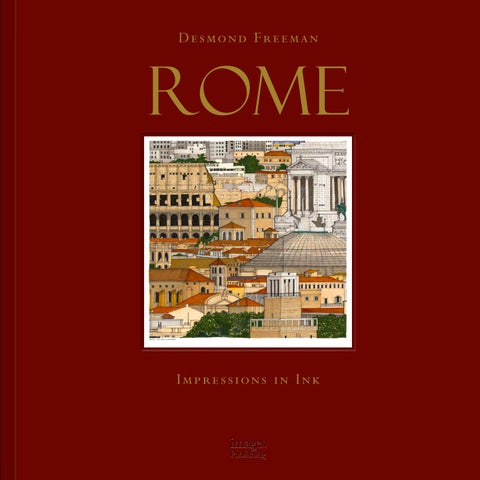
Desmond Freeman
ROME
Impressions in Ink
I
t is generally accepted that Rome was founded in 753 BC by Romulus and that prior to that time it was just one of many settlements on the plain of Latium. Greek and Etruscan traders influenced the development of the settlement, bringing with them urban concepts and religious and military customs. A republican government is thought to have been established in 509 BC. Not without reason did gods and men choose this spot for the site of our city – the salubrious hills, the river to bring us produce from the inland regions, and seaborne commerce from abroad, the sea itself, near enough for convenience yet not so near as to bring danger from foreign fleets, our situation in the very heart of Italy – all these advantages make it of all places in the world the best for a city destined to grow great.
St. Peter’s (see page 56), replaced once-pagan temples and led to the increasing influence of the Christian church and the papacy, not only with new churches being built, but by reorganising the papal estates for the benefit of the poor. Pope Gregory I (AD 540–604), known as Saint Gregory the Great and considered to be the founder of the medieval papacy, initiated further significant changes to the classical centre of Rome that included the conversion of pagan temples, such as the Pantheon in 609 to a church dedicated to the Virgin Mary (see page 35). From the eighth to eleventh centuries power struggles between popes and emperors raged, with the former emerging dominant, as formalised in the Concordat of Worms in 1122.
Subsequent to the papal Schism in 1308 and the move to Avignon (1309–77) the papacy under Martin V returned to Rome in 1420. By this time Titus Livius Patavinus the city was in ruins and it was Pope Martin V (aka Livy, c. 59 BC–AD 17), History of Rome, and his successors who transformed it into the Book V renaissance and baroque masterpiece that has provided so many of the buildings and precincts Rome as we now know it, evolved rapidly depicted in this book. The eighteenth century saw through the early years of the Republic; towards the construction of the Spanish Steps (1723–26), the establishment of the Roman Empire, seeing the Trevi Fountain (1762), along with the Vatican Rome develop as the splendid imperial capital Museum (see pages 58 and 59), and in 1734 with its Old Forum (see pages 14–15) the an institutional museum was set up by Pope Imperial Fora, the Colosseum (see pages 32–33) Clement XII as well as the Capitoline Museums. and building of triumphal arches celebrating military victories, as well as magnificent imperial In 1809 Pope Pius VII was imprisoned by Napoleon and many of Rome’s finest artworks palaces. Barbarian invasions and the merciless were removed to Paris to be returned only after sacking of Rome followed. Rome then saw the emergence of the Christian Emperor Constantine Napoleon’s demise in 1815. The Kingdom of Italy, with Rome as its capital, was proclaimed I (ruler between AD 306 and 337) with his powerful impact on Western architectural history. in 1861. The achievement of Italian unity was celebrated with the opening in 1911 of the The construction of the earliest basilicas, such Vittoriano (see pages 22–23) memorialising as Saint John Lateran (see page 78) and the first
7
Italy’s first king, Vittorio Emanuele II and containing the tomb of Italy’s Unknown Soldier. Clad in a somewhat incongruous white bottincino marble from Brescia, at around 80 metres high the Vittoriano monument dominates the adjacent historic precincts. Fortunately, Rome did not suffer great damage in World War II. Destruction came more from the imperialist fantasies of Mussolini and his desire to create ‘the monumental Rome of the twentieth century’. One manifestation of this obsession was EUR (Esposizione Universale di Roma) begun in 1938 and intended to house the 1942 World Expo, which was cancelled (still incomplete) owing to the war. EUR now houses office buildings (see page 21), museums and ministries. With more than two thousand years of evolution Rome has well earned its title as the ‘Eternal City’. This book can do no more than present forty or so impressions of this multi-layered, multidimensional but exquisitely compelling city, which I have loved since my first visits in the 1970s. I have selected the subjects for the pictures purely on the basis of their appeal to me as an artist and designer, for their distinctive ‘Roman’ character and for their architectural diversity. Not all the pictures are of buildings or even of the urban landscape. Indeed, I became fascinated with Roman mosaics while I was working on this collection and so there are a handful of those that I found most compelling (see pages 9, 18–19, 40, 44–45, 62 and 68–69) along with a drawing of part of a tessellated tiled floor from the Basilica of San Clemente (see page 61). I first admired these floors working on the Venice
collection and could hardly resist the need to keep drawing them to satisfy my deep obsession with pattern, colour, order and complexity. Drawings are modest and intimate … this is no impediment to the breadth of their embrace or range of their creative horizons. Drawings are arguably the most revealing and spontaneous renderings of the human imagination…their immediacy defies the limitations of time … Michelangelo Rome presents the artist with a remarkable opportunity of expression in its diversity, its complex spatial planning, its use of diverse materials and, of course, its rich mix of architectural styles and decorative detail. In many locations it is difficult to fully visualise a completed building or precinct where we see not much more than a ruined carcass. Many of the subjects of my drawings represent centuries of modification, conversion and addition, and often the result is a confusion of style – far from its original intent. For example, from the early seventeenth century until the late nineteenth century the Pantheon had twin bell towers to the rear of the pediment. These in turn had replaced a medieval campanile – certainly never envisaged when the structure was first conceived in 27 BC. Paul the Deacon (c. 720s–AD 799) tells us of the despoliation of the Pantheon by Emperor Constans II in 663: Remaining at Rome twelve days he pulled down everything that in ancient times had been made of metal for the ornament of the city, to such an extent that he even stripped off the roof of the church [of the blessed
Mary], which at one time was called the Pantheon, and had been founded in honour of all the gods and was now by the consent of the former rulers the place of all the martyrs; and he took away from there the bronze tiles and sent them with all the other ornaments to Constantinople. My experience of drawing antique structures and precincts can generate a scepticism in me about what I am looking at in terms of its originality or authenticity. On one visit to Rome I recall taking a photograph of the classical ‘elevated passage’ across Via Campidoglio from Palazzo Senatorio to Palazzo dei Conservatori. Research by friends in Rome eventually led to the discovery that this elegant, enclosed bridge had in fact been built in the 1930s and is known as Il Passetto di Palazzo Senatorio (see page 41). It is fortunate indeed that it was not designed in the Fascist style of the period given the superb views to and from Piazza del Campidoglio! I have been blessed that in almost fifty years of visiting Rome I have been able to develop some small understanding of this multi-layered, complex but intoxicating place. Supplied with a Vatican passport in the late 1990s I led a small team from my design office on a week-long visit to the Vatican, a behind-the-scenes tour that’s never been forgotten. Our design for the Pavilion of the Holy See at World Expo 2000 (in Brisbane) would not have been as rewarding without our time in Rome. Of course, most visits have simply been as a tourist – free to explore at will. The choice of sites and buildings to draw has been agonizing, and if time had permitted I would have continued to produce all the details and vistas I intended at the outset. There is no logic
8
beyond the reasons I mentioned earlier as to what I have included – these are simply some of my impressions in ink of this most special of cities. Right up to the end of the process I was being introduced to new districts of Rome and I am indebted to our friend Dr. Jackie Crisp for sharing her obsession with the architect, sculptor and decorator Gino Coppedè (1866–1927) with his interpretation of the art nouveau style (see page 42). Similarly, our dear friend and resident of Rome, David Robson, with whom I have explored Rome since the early 1970s, has patiently introduced my wife Christine and me to unexplored back streets and little-known quarters. It was with David that I first saw the atrium of the Galleria Sciarra (commissioned in 1888) totally covered with painted decoration by Giuseppe Cellini celebrating the virtues of the women of the time (see page 47). My heartfelt thanks go to Christine yet again for her skill in the text research for the book and her unreserved enthusiasm and encouragement while I worked on the collection. Our collaboration now on three books has been a delight and we are looking forward to the different focus we will both have on the next publication planned for 2022. My thanks must also go to our son, Nicholas, for his graphics advice always so enthusiastically given and to Thomas Eberhart Freeman, our son-in-law, for his undiminished support for the Impressions in Ink project in all its forms. On to New York City! Desmond Freeman Heritage Park, Bowral 2021
9
10
11
Rome!What a scroll of History thine has been! In the first days thy sword republican Ruled the whole world for many an age’s span: Then of thy peoples wert thou royal Queen, Till in thy streets the bearded Goth was seen; And now upon thy walls the breezes fan (Ah, city crowned by God, discrowned by man!) The hated flag of red and white and green. Then was thy glory! when in search for power Thine eagles flew to greet the double sun, And all the nations shuddered at thy rod? Nay, but thy glory tarried for this hour, When pilgrims kneel before the Holy One, The prisoned shepherd of the Church of God. Oscar Wilde (1854–1900) ‘Urbs Sacra Aeterna’, 1881
48
49
On Rome, that brought the world to know the good, once shone two suns that lighted up two ways: the road of this world and the road of God. Dante Alighieri (1265–1321), The Divine Comedy: Purgatory Canto XVI, 106
51
... immediately on going out next day, we hurried off to St. Peter’s. It looked immense in the distance, but distinctly and decidedly small, by comparison, on a near approach.The beauty of the Piazza, on which it stands, with its clusters of exquisite columns and its gushing fountains – so fresh, so broad, and free, and beautiful – nothing can exaggerate.The first burst of the interior, in all its expansive majesty and glory: and, most of all, the looking up into the Dome: is a sensation never to be forgotten. Charles Dickens (1812–1870), Pictures from Italy (1846)
52
53 53
ISBN 9781864708684 ISBN 9781864708684
9 781864 708684 9 781864 708684
54500 54500
$45.00 [USA] £35.00 [GB]