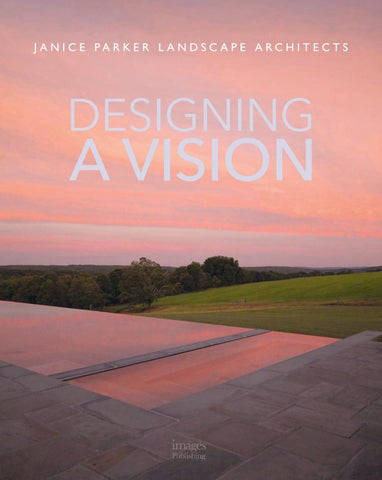
J A N I C E PA R K E R L A N D S C A P E A RC H I T E C T S
DESIGNING
A VISION
J A N I C E PA R K E R L A N D S C A P E A RC H I T E C T S
DESIGNING
A VISION
FOREWORD When I first went to Long Island, I had just read F. Scott Fitzgerald’s Great Gatsby (1926). It is set in an era of unprecedented prosperity in the United States, accompanied inevitably by social excess, decadent parties, and the wild jazz music of the 1920s. Well, frankly, I was disappointed when I first went there in the 1970s—those houses were vast and tedious, and the gardens didn’t sparkle the way they did in Fitzgerald’s text.
But that was before Janice Parker got going on their gardens. In this beautiful book, she shows the scope of her work—from country elegance to formal sophistication to modern chic. Janice’s creativity, attention to detail, and vision comes through in each photograph. Janice seamlessly connects her designs to the natural world surrounding them, and, as important, connects her work to her clients. She clearly has a sense of whom she is designing for, their needs, and their sense of style, all the while maintaining an eye to the culture and history of the community in which her gardens reside. John Brookes, MBE Denmans, West Sussex, England
7
8
FOREWORD
INTRODUCTION I have spent my creative life in pursuit of craft, quality, innovation and art. I was drawn to the natural world, although I grew up in New York City. I knew every tree on my street and to this day my favorite landscapes are along the Hudson River. My very first memory is of a flower. As a garden designer and landscape architect, I have learned many lessons, large and small, all of them important. When I first see a property, I concentrate on, and draw from, everything I have learned. I close my eyes and search for the “genius” of the land. What does it say to me? What is the history, the emotion and the energy of the land? The Earth is alive and the natural aspects of it, the music of the land, are constantly changing, they are not static. This is a sacred process for me. I muster my senses and experience, and the visions start to come. If they come quickly, I know I have a sweetheart job ahead—the land has shown me what it is, can be and that it will work with me. Often, however, this is not the case. If visions do not
come quickly, there can be many reasons for this. The story of the land may be so hidden that it has lost its identity, and complex study is required to find it. We may be changing its identity and form— and therefore its energy—by the developments we are going to make. But I have heard the warning. Now it’s crucial to be detached and gather all the information possible. I cherish this exciting and vital introductory visit with the land. The character of the land may be just a wilderness of sounds, beautiful but incoherent. My goal and focus is to create a symphony—and the first listen may be melodious or jarring. I trust I will discover the harmonies of the land. Daily, I ask myself questions about the design of landscapes and gardens. How do we have the vision and the process to design our gardens authentically? How do we continue to weave the cultural and design heritage in and why does it matter? Do we need to be visionary or pragmatic? Create the historic or modern? Or both—break them up, blend them together and have the vision to make it work? 11
I endeavor to express the current intellectual and cultural design I am charged with, without sacrificing the heritage. I look for the magic—the comfortable, exhilarating and yet relaxed landscape— that will create the harmony of a great garden. I work to go up, down and sideways with the design of the land, with the goal of tapping the creative energy so I can design with purpose and clarity while creating a beautiful landscape. Residential landscape architecture and garden design is a subtle art. The design sensibility, collaboration, needs and goals of my clients, combined with the talent, vision and aesthetic sensitivity of the architect and interior designer, creates the best play date. When you add to this collaboration the dedication, craftsmanship and skill of a master builder, the process deepens. The varied skills and experience brought by each member is vital to the process. In the endeavor of landscape design, I add to this collaboration the role of being a guardian of the land. Which design layout and planting will add the most value, both now and in the future? This is only one
12
INTRODUCTION
consideration for the landscape designer to understand and balance. During our initial analysis and development of each project, I use checklists and questionnaires to gather precise information from all the team members. The use of this information gathering is most crucial in regard to the clients. What are their design vision, preferences and desires? What do they wish for? The domestic home is a cornerstone of life—a place of growth and refuge and I want to help them articulate these desires. Years ago, I designed a rooftop terrace for a renowned New York City music producer. A few days after the garden was finished, he told me he was happier on his terrace than anywhere else in the world. This was the beginning of my love affair with residential design. I look for this reaction from every one of my clients, asking them where they were the happiest, most comfortable and most excited by their environment. I listen carefully to what may seem like sentimental nostalgia at first—“My grandmother’s yard,” for example—but it is much more than that. It’s not a romantic longing for the past, but a longing for the sense of being at home in nature, the basic primal comfort that many of us feel in the natural world.
I have included finished landscape projects to further illustrate the design process and share the inner workings of the business of creating gardens and landscapes, where collaboration and communication are so important. I have learned that if you respect and pay attention to the natural world, you will be repaid in bountiful ways. Give nature reverence and a chance to repair itself, and you have remarkable results. My greatest influence has been Mother Nature. I have had the pleasure and honor of working on gardens by Ellen Biddle Shipman, Annette Hoyt Flanders and Rose Standish Nichols and take true inspiration from the long line of creative and hardworking American female landscape architects. There is a quote by Mary Bronson Hartt about women who entered the demanding and difficult profession of landscape architecture in the early 20th century—“Not for one instant will all this daunt a woman to whom landscape design is a master passion…She exults in the demands upon every power of
mind and body. In other words, she is an artist, and, in so far as her art is concerned, a willful fanatic” (Women and the Art of Landscape Gardening, 1908). I love that! It has been rewarding to spend my life in the pursuit of creation and I am grateful for the chance to show and describe the experiences of garden-making. The time spent with clients who share their vision with me is precious. The long relationships built, with nursery owner (or grower), craftspeople, masons and artisans, has been a source of friendship, support and joy. The time working with design professionals in all disciplines has taught me everything I know.
INTRODUCTION
15
16
INTRODUCTION
Opposite top: Detail drawing of a fieldstone path. Opposite bottom: Fieldstone path. Left: The finished garden. Above: The concept rendering for the Kips Bay Show House 2015.
THE DISCIPLINE OF ART AND CRAFT This chapter asks the important question: How do we proceed with the design process so that we can turn the creative and custom design into a reality? The Greek word techne means craftsmanship, craft and art. As a term in philosophy, it differs from the knowledge of principles or understanding—it is the making or the doing. It is well established that there is a separation of practice from the fine arts—between concepts and ideas, and the thinking or making of things. Landscape design is based on both of these concepts by expressing creativity and art. In my practice I have found that design is a circular business. The quality, exactness and discipline of your design execution come to light in your details and ability to communicate your ideas. It is through this practice that one can innovate and find ways to allow new and revised ways to express traditional design details and methods.
The methodology and process of the design vision and implementation is the embodiment of art and craft. The creation of the drawings and visual materials necessary to build, fabricate and install the garden is, in itself, an art. It is where you must come up with the best and alternate approaches for the construction, while using your composition and engineering training to balance the materials, methods and long-term viability of your design. Each one of these is crucial—some of the best moments and details of outdoor elements can be easily destroyed by time and inclement weather. I love this discipline. Landscape details are intended for the outdoors and as such are affected by all types of weather and changes in climate. This changes the way designers think about fabrication and installation methods, and there is close attention paid to the smallest of conditions. In my office we have spent days discussing the bottom inch of a fence board, how it will slope with the grade, and how to 19
Above: We sketched many urn styles before choosing one (left); the finished installation (right).
protect it from water, mowers, string trimmers and moisture. How do we run the fence so it will bring grace to the sloping grades, not coarseness? How do we best fasten the fence members together, to withstand the sun, ice and rain, and still be able to re-paint as the fence ages? We consider much more than the form and the beauty of the landscape, we consider the durability, the maintenance and the long-term life as well as the expression and function. Craft is a very satisfying way to spend your life. It is not the pursuit of perfection; it is the pursuit of quality. It is based in curiosity and determination. This is where we learn what scale and proportions are, and find out if our visions will work and take their place in the real world. Every designer I know is deeply involved in this process of circular thinking. This is where each design holds meaning and where you start to love the work that you do.
20
THE DISCIPLINE OFÂ ART AND CRAF T
As we pursue an endeavor that holds meaning, we start the process of trueness—to our own inner voice, needs and inspiration. We hone our talent, skills and awareness of ourselves. Once our toolkit is up to par we can draw on the power that comes from the training and study. We start to develop the art of excellence. Again, this is not the pursuit of perfection. That would ruin everything. This is the pursuit of virtue in craft: excellence. A pursuit in which we train ourselves, not disappoint ourselves. Once we attain high standards of work and creativity, we know the difference between a good day and a bad day and we know that, even if our design work is good, it could always be better. We learn to give things more time and energy to get it right, and that this is a process that can’t be cramped by the time allotted for design work or the budget allotted for exploration. If more time is needed, so be it. I make this call every day. Excellence must rule the process.
The “Pool Room” pergola anchors the seating areas and frames the central urn in the “Urn Room” beyond.
84
T R E E FA R M
T R E E FA R M
85
122 O N T H E WAT E R
O N T H E WAT E R 123
136 H U D S O N R I V E R VA L L E Y
Sunflowers add humor to the vegetable garden and frame the house beyond. Overleaf: Fall flower gardens spread out from the house into the landscape.
H U D S O N R I V E R VA L L E Y 137
WITH THE TIDE
W I T H T H E T I D E 175
176 W I T H T H E T I D E
214 C O N T E M P O R A R Y L A N D S C A P E
C O N T E M P O R A R Y L A N D S C A P E 215
MY DEEPEST INFLUENCES: FAMILY, FLOWERS AND ART My personal history is enmeshed in art and flowers. As a member of the Parker family every day was an art education. The renowned artists Robert Andrew Parker and Christopher Andrew Parker taught me how to observe what was in front of me through their prodigious output and curious, incisive vision. From the discipline of painting the same garden at many different times of day, I was taught how to truly perceive color. I learned to look for the quality of the light, and look for the quality of the color. Much is said about the art of composition in landscape design, and less about these underlying values of art. I learned to think about nature in terms of light and color, how the same scene can be perceived thousands of ways—always changing and transforming. I learned to think about what the garden would look like in the evenings and at high noon and how the light would change all year. I trained myself to think about these
values as I started to work with land and nature. A painting is two dimensional, but the landscape is really four—the dimensions the movement and change that the wind and the weather bring. When and from where will the views and landscape be seen? What will the sunrise and sunset do to the perception of the landscape and sky? What color palette will best express my emotional response to a site? What are the plant palettes, with tones of blue, purple or red that communicate what I want to say, and can I make them a theme in my work? Once I thoroughly understood the different color palettes, the real work began. Playing, mixing, editing, improvising—all of this becomes very potent once you know your paint box. The Parker family artists showed me that great painters do this, and learning it takes time. My family has created meaningful paintings, murals and artworks that have filled my senses, infused my work and imbued my life with meaning. 247
As a floral designer first and a landscape architect second, I learned early on that there are no rules about flowers and color that can’t be broken. I believe “Go big or go home!” is applicable to the use of color and style in the garden. Be bold! My first year in the back room of a busy and stylish florist shop in New York City taught me that all the color rules I had learned were meant to be bent, if not completely broken. As I learned to manipulate the natural flowers, branches and plants in the art of floral display, I began a long relationship with the essence of the plant material. One thing to remember is we should strive to think as big as possible about our landscapes—moving out of decorative display and flower borders into the realm of landscape, not ornamental horticulture.
248 M Y D E E P E S T I N F L U E N C E S : FA M I LY , F L O W E R S A N D A R T
If you are looking for an all-white or green garden, I am not the designer to come to. I have and will do them, but I believe that nature did not put all the fabulous plants and flowers on this Earth and then expect us to connect with just a few—or just the ones that are local. Nature is a giant paint box and it is not right to resist. Nature gives us a good reason to relax and loosen up about color. Blasts and pops of color can be exciting focal points, and will bring us emotional responses and connections. Great gardens and landscapes are far more diluted than a true color wheel, they become soft and artistically blurred in the different times of day and seasons.
Every effort has been made to trace the original source of copyright material contained in this book. The publishers would be pleased to hear from copyright holders to rectify any errors or omissions. The information and illustrations in this publication have been prepared and supplied by Janice Parker Landscape Architects. While all reasonable efforts have been made to ensure accuracy, the publishers do not, under any circumstances, accept responsibility for errors, omissions and representations express or implied.
262
Under her guidance, the firm has been honored with multiple awards, including the 2012 National Palladio Award for Landscape Architecture and the 2015 Professional Merit Award from the American Society of Landscape Architects. Her firm’s work has been featured in The New York Times, Architectural Digest, Veranda, The Washington Post Online, HGTV.com, Equestrian Quarterly, Period Homes, Robb Report, New Old House, The New York Observer Online, Curbed NY, Style Beat, Metropolitan Home, Interior Design, Vogue, and Luxe Interiors + Design—to name a few.
Designing A Vision is a captivating and inspiring close-up of Janice Parker’s practice, namely her creative process and prodigious output of incredible works spanning more than three decades. “Janice Parker has put her spectacular talents to work on behalf of all New Yorkers through her service to the city’s community gardens and Million Trees NYC program. Now, with this book, her extraordinary eye for beauty is on display for all the world to see. Her reverence for the art of nature is equaled only by her passion for the creativity of design, and the combination is both amazing and inspiring.” Michael R. Bloomberg, founder of Bloomberg LP and mayor of New York City, 2002–2013
“I know Janice Parker as the dedicated and determined landscape architect who helped The New York Restoration Project launch Million Trees NYC by designing The Cherry Tree Project, the beautiful installation that transformed Harlem River Drive in New York City.” “After reading this book, you too will be ready to go out and plant trees—with a greater understanding of the process and creative spirit that guides innovative and extraordinary landscapes. The passion and love Janice has for the natural world and design comes through on every page, with a unique blend of stunning photographs, art, design and most important, the clear-eyed principles that help produce great landscape and gardens.”
J A N I C E PA R K E R L A N D S C A P E A RC H I T E C T S
Janice’s notable career has embodied the essence of mentoring, teaching, and volunteering. She chose the unique journey of gaining her landscape architecture license through independent training, practical experience and mentorship from other respected professionals in the field of design.
DESIGNING A VISION
Since creating Janice Parker Landscape Architects in 1984, Janice has cultivated the firm to one of national prominence. Janice Parker Landscape Architects has conceptualized and directed innovative landscape architecture for national private and public clients across the United States. The firm has established a reputation for conceiving, planning, and installing thoughtful landscapes, and is dedicated to excellent design, full documentation, and project coordination.
J A N I C E PA R K E R L A N D S C A P E A RC H I T E C T S
DESIGNING
A VISION
In her well-rounded career as a landscape architect, horticultural specialist, garden consultant, teacher, floral designer and speaker, Janice Parker has distinguished herself by rethinking accepted landscape practices and developing inventive, personal solutions for difficult problems. Janice has extensive hands-on experience in every facet of landscape and design— so she intimately understands how it all works. As a result, the work depicted in Designing A Vision is realistic, and inspiring. Containing first-hand accounts of Janice’s experience and practice, this beautiful volume is replete with case studies, anecdotes and insights. Verdant photography augments an incredible number of color renderings, watercolors, inspiring artworks, illustrations and plans.
“This book will inspire all who seek to understand how a highly accomplished landscape architect incorporates nature’s revelations into the design process, based on technical principles but distinguished by her deep understanding and love of nature’s beauty.” Donald J. Leopold, Distinguished Teaching Professor and Chair, Department of Environmental and Forest Biology, SUNY-ESF, Syracuse, New York
“In the magnificent combinations of color and form Janice Parker has created through her transformative garden designs is abundant “habitat” for many wild creatures, especially those that most need it today, insect pollinators and songbirds. Through this work biodiversity is being brought explicitly back into landscape design.” James P. Gibbs, Ph.D., Director, Roosevelt Wild Life Station, Syracuse, New York
Bette Midler
For further information on IMAGES’ books, please visit www.imagespublishing.com
**Designing a Vision_JPL_Jacket.indd 2-3,5-6
Jacket photography Neil Landino, Jr.—front cover, back cover: main image; small left; small right; front and back flaps Eric Striffler—back cover: small middle left; spine Durston Saylor—back cover: small middle right
11.10.16 22:33