GOFF BOOKS Published by Goff Books. An Imprint of ORO Editions Gordon Goff: Publisher www.goffbooks.com info@goffbooks.com Copyright © 2021 Anthony Poon. All rights reserved. No part of this book may be reproduced, stored in a retrieval system, or transmitted in any form or by any means, including electronic, mechanical, photocopying of microfilming, recording, or otherwise (except that copying permitted by Sections 107 and 108 of the U.S. Copyright Law and except by reviewers for the public press) without written permission from the publisher. You must not circulate this book in any other binding or cover and you must impose this same condition on any acquirer.
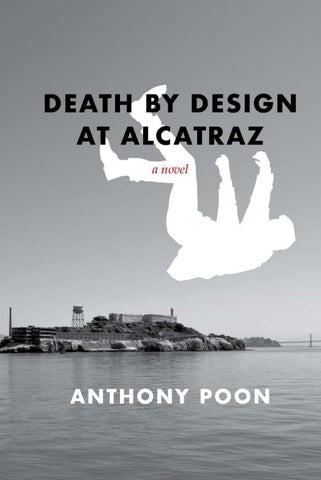
Text, drawings, and jacket design by Anthony Poon Book design by Pablo Mandel Proofread by Kirby Anderson Managing Editor: Jake Anderson Photos of Alcatraz Island by Anthony Poon Author photo by Mikel Healey Silhouette of falling man inspired by Pexels photo, Pixabay 10 9 8 7 6 5 4 3 2 1 First Edition ISBN: 9 7 8 - 1 - 9 5 4 0 8 1 - 2 8 - 4 Color Separations and Printing: ORO Group Ltd. Printed in China.
Goff Books makes a continuous effort to minimize the overall carbon footprint of its publications. As part of this goal, Goff Books, in association with Global ReLeaf, arranges to plant trees to replace those used in the manufacturing of the paper produced for its books. Global ReLeaf is an international campaign run by American Forests, one of the world’s oldest nonprofit conservation organizations. Global ReLeaf is American Forests’ education and action program that helps individuals, organizations, agencies, and corporations improve the local and global environment by planting and caring for trees.
Table of Contents
p ro lo g u e
The Architect Who Couldn’t Fly 13
c h a p t e r 1
The Puppet Master: Magnar Jones 19
c h a p t e r 2
Museums: Vessels of Life or Death 27
c h a p t e r 3
Meet the Competitors 33
c h a p t e r 4
Sizing Up 39
ch a p t e r 5
Sign Here and Enter to Win 47
c h a p t e r 6
The Local Hero: Parker A. Rand 55
c h a p t e r 7
Master of the Universe 61
c h a p t e r 8
Alcatraz Island: Battle Ground 67
c h a p t e r 9
Day One of Four: The East Coast Power Couple:
Ling Liang and Chip Tooney 75
c h a p t e r 10
Banter on a Glass Bridge 81
c h a p t e r 11
Downward Spiral 89
7
ch a p t er 12
The Corporate Man: Johnny Furnsby 95
c h a p t er 13
Blank Canvases Await 101
c h a p t er 14
Ignition 111
c h a p t er 15
The Peacock: Maxwell Brand 117
ch a p t er 16
Drinking Three Cups of Coffee 123
ch a p t er 17
Confession and Concession 131
c h a p t er 18
Day Two of Four: Stomping the Rock 137
c h a p t er 19
The Mover and Shaker: Margo Hunters 147
c h a p t er 20
Karma and Dogma 153
c h a p t er 21
What is a Design Parti? 159
ch a p t er 22
The Theater of Architecture 165
c h a p t er 23
Day Three of Four: I’ll Take Two 171
ch a p t er 24
Capture and Release 177
c h a p t er 25
Architects Grueling at Work 183
c h a p t er 26
Roundtable of Design and Ego 193
c h a p t er 27
An Outcropping 203
ch a p t er 28
Day Four of Four: Flirting with Misfortune 211
8
Death by Design at Alcatraz
ch a p t e r 29
Any Last Words? 219
c h a p t e r 30
Tick Tock Goes the Clock 227
ch a p t e r 31
Fall from Grace 235
c h a p t e r 32
Celadonna’s Dalliance 243
c h a p t e r 33
Design is Everywhere, People! 251
c h a p t e r 34
W T F? 259
c h a p t e r 35
Hunting Ground: Shards of Glass 267
c h a p t e r 36
ChipLing: Machine for Art 275
c h a p t e r 37
PAR Designs: Keep It Simple, Stupid 283
c h a p t e r 38
Judge and Jury 293
ch a p t e r 39
Apprehension in the Lobby 301
c h a p t e r 40
If You Build It, They Will Come 309
c h a p t e r 41
End of the Line 317
c h a p t e r 42
“Honey, I’m Home” 325
e p i lo gu e Glory and Grief 333
Table of Contents
9
10
Death by Design at Alcatraz
p r o lo gu e
The Architect Who Couldn’t Fly
S
ix a.m. and delivered from a red-eye flight, the Dutch architect eyes his construction site blanketed in the cold veil of San Francisco’s coastal fog. Here and there through openings in the swirling heavy mist, Lars von Meester glimpses his latest architectural design in progress on a cliff overlooking the Pacific Ocean. Forties, tall and thin, he is either handsome or lanky and bald, depending on who you ask. It is unknown if he is balding due to genetics or simply making a fashion statement with a close-to-the-scalp haircut, as Lars mimics his older colleagues in Rotterdam and Paris. Like many architects, Lars von Meester is tightly groomed, welldressed, and put together in a hyperconscious manner. He prides himself on his standard black uniform, predictable as it is cliché, stylish as it is practical. He arrives in a black turtleneck, black jeans, and black boots that are as hip as they are protective, at a site of concrete and steel. His three-quarter-length black-wool coat is noticeably trimmed with a hand-stitched blue thread. His loose, gray scarf aims to present a touch of blasé, but the apparent indifference is well-rehearsed. Out of competitiveness or perhaps disdain, Lars’s design colleagues often wonder how such a young architect has already bested those twenty years older in landing numerous prized commissions. On top of that, how does this influencer get his outrageous ideas built, ideas that some architects accuse of being lifted from the images of comic books and graphic novels? Many architects and design students alike
11
have fantastical design visions in their heads, from cities hovering in the clouds to stadiums wrapped in roller coasters. But it is the rare few architects that have the courage, opportunity, and presence to convince a client to fund and build such wild and whimsical structures. The industry of architecture suggests, unfortunately, that one’s career doesn’t launch until age 50 at least, unlike the twenty- and thirty-somethings who abound in tech, banking, law—and pretty much any field that isn’t architecture. It takes a while for architectural talent to season and for relationships to forge before an architect can be considered for a significant project. But Lars has risen to the top with his boyish face, clever salesman turns-of-phrases, and majestic plans for his clients. He has already completed projects of enviable substance, from massive housing projects to twisting skyscrapers, from sculptural cathedrals to mega-hotels with ski slopes descending off the roof. Lars von Meester is known as “the Flying Dutchman,” and although he does not like this nickname, it is apt because his international projects require him to rarely port for long. Today, he arrives in the almost-too-perfect hilly city by the bay to inspect progress on the construction of his latest project. Lars has been hired to re-envision and reconstruct the famous Sutro Baths designed by Colley and Lemme in 1896. Then, a cavernous, five-story-high steel and glass shell magnificently enclosed a public complex of seven saltwater swimming pools. But over the past century, the Baths, situated on the edge of the ocean, had fallen into complete disrepair, appearing like ancient ruins at best, forgotten body parts at worst. Lars’s redesign of the unique and historic property is an ambitious project for San Francisco, a town often accused of fetishizing nostalgia. The nearby Cliff House restaurant, still in operation for locals and tourists, having been reconstructed four times over the span of 140 years, stands tall in the distance. It would be a welcome plan if the project was just to rebuild the Baths, but as with some clients who are developers-for-profit, there is a grander commercial agenda. Adjacent to the Sutro Baths, the client of the Flying Dutchman has also hired him to design what the developer is marketing in glossy PR material as a “new city Mecca” and a “hillside
12
Death by Design at Alcatraz
lifestyle center”—in plain English, yet another shopping mall. With no small amount of controversy, opponents have so far failed to halt the construction of the mall adjacent to the Baths. The disputed project has already desecrated a small portion of Lands End, the beloved grounds of Point Lobos. This vista-embracing western boundary of the Golden Gate Recreational Area ends in cliffs a few hundred feet above heroic ocean waves. The ego of the developer is matched by the ambition of the Dutchman. For better or for worse, most architects want to change the face of cities; and desire and arrogance begets enemies. Lars is expecting a call to confirm a breakfast meeting with a local architect, before they both head over to a press conference. Billionaire art collector Magnar Jones, the developer of these projects, is to soon announce an elite design competition for a career-capping project: the redesign of Alcatraz Island, the historic federal prison, into a new museum of art. Yet another project that will doubtless beget enemies. The cloak of fog has not burned off quite yet, leaving Lars von Meester to discern construction progress as best he can. He stumbles a bit around piles of debris, stacks of steel beams, and coils of electrical wires. Any clear view of half-completed structures at Lands End only alludes to the haunting and skeletal quality of a building shell being erected, awaiting a soul to come. Despite years of comfortably gliding through construction sites, from balancing on the I-beams of office towers to navigating machinery and underground labyrinths, Lars finds himself hesitant as the morning light fails to earn its way through the haze. He feels the menace of the ghostly white pea soup and, having read the news on the plane, also feels the unwelcome of the community for his “lifestyle center.” Local residents were calling it yet another project of consumerism and poor tastes captured in brick and mortar. Lars’s arms are full. One hand is attempting to take photographs documenting the field work, which is a valiant but wasteful effort in these murky conditions. Under the other arm are several rolls of
The Architect Who Couldn’t Fly
13
drawings—blueprints as they were once called for the chemical process using a blue ferric ferrocyanide compound resulting in the trademark and romanticized prints of the past. The Dutch architect sees the shapes of a few first-arriving construction workers gathering at a coffee wagon in the distance beyond the arms and legs of copper pipes, galvanized ductwork, and rebar. For balance in taking photographs, Lars places the rolls of drawings against the construction site fencing running intermittently across the rock boundary of the site near the cliff. A fresh breeze comes up and satisfied with his photographs, he reaches for his drawings. They aren’t there at first grasp. He reaches out farther and farther, like a blind man desperately looking for a cane that has fallen to the ground. He gets on one knee, his three-quarter black jacket tails grazing debris and rock. He finds one roll and feels around for the other, which can’t be far. His cell phone buzzes. Perturbed and disoriented, he stands up to reach for his pocket while he takes a few steps in the gloom peering for the other roll. At the same time, a voice calls out, asking if he needs help. Lars’s bulky black boot meets a flat but slick rock, and his practiced balance and vanity is gone. He stumbles a bit, and moments later, realizes this Dutchman doesn’t know how to fly. Lars von Meester falls twenty stories to his death at the base of the rocky cliffs, where he is united with the rolls of drawings he was so anxious to retrieve. The city’s signature fog has finally lifted. The construction pace is in full force as concrete foundations are being poured, as trusses are being lifted in place, as welders weld. The sounds of construction reach a harmonic vibration resonating with the rhythm of progress. Work goes on.
14
Death by Design at Alcatraz
c hap te r 2
Museums: Vessels of Life or Death
N
o t far from sfmoma, the children feed the ducks, tossing scraps from their morning bread towards yearning beaks. Parents’ watchful eyes monitor the kids as they negotiate the distance between land, lagoon, and quacks at the Palace of Fine Arts. This is the venue for Magnar Jones’s public announcement. From the global short list of “starchitects,” Magnar Jones had hand-picked six architects to participate in his fantasy game of art and design. Seven, actually—one company is comprised of a husband-wife team. The formal announcement is due today, another beautiful Northern California morning. Celadonna has chosen a beloved jewel of San Francisco as the backdrop for Magnar to publicize his scheme to transform the ramshackle Alcatraz Island into a world-class arts institution. As the grand presenter, he is eager to also unveil his list of the candidates who will vie for his project. The Palace of Fine Arts, architect Bernard Maybeck’s “temporary” monumental jewel of the 1915 World’s Fair, still stands today, a century later, as a nostalgic icon of the city. Architects revel in how a fictional ruin expresses an enduring melancholy of lost civilizations. After the conclusion of the fair, the Panama-Pacific Exposition, the heroic palatial structure remained. Rebuilt in 1965 and again in 2009, the beloved Palace of Fine Arts is a popular venue for weddings and photo shoots, ranking high in the long list of tourist attractions.
25
Maybeck refuted the Modernists’ grand idioms, “less is more,” and “form follows function.” This architect had more in keeping with the counter phrase from Postmodernist architect, Robert Venturi, “less is a bore.” Quite the opposite from Magnar’s slick contemporary art, the Palace of Fine Arts presents an abundance of Corinthian columns and pilasters. Lots of history. This doesn’t bother Magnar. Few things derail him. Magnar aims to draw the highest attendance for his performance, and where better than the beloved city monument with its foreground of a large reflecting pond—a location nestled amongst the affluent and elite, and the scenic Presidio? Celadonna likes the mix of the past and the future, as well as cloaking her boss and lover in the backdrop of great architecture. Much better than a hotel ballroom or convention center lobby. A podium has been centered in the majestic rotunda standing over 100 feet high. Massive clusters of speakers are wired to Magnar’s podium, also wired to his ego. He relishes this type of publicity event where he is the center of attention, where he can pontificate, exude influence and superiority. He is after all, a manipulator of his surroundings. This includes people. For this press conference, his charcoal suit is paired with a bolo tie, as well as one of his favorite accents of panache: dark green western boots with inverted flame stitching in white. Against the backdrop of the typically sophisticated city dwellers, Magnar looks like either an out-of-place, self-absorbed individual or a western-themed clown. He steps up to the podium, his podium. Over the past hour, a crowd has gathered—curious members of the general public who read online teasers, and the press stationed on the sidelines held back by taut red ropes between brass stanchions. There are also government officials, some who enjoy the political alliance to this developer, and others who hold only disdain for an arrogant son-of-a-bitch. Several hundred have gathered and counting—a growing crowd of onlookers who happen to come across this press conference turned social media spectacle.
26
Death by Design at Alcatraz
36
Death by Design at Alcatraz
44
Death by Design at Alcatraz
52
Death by Design at Alcatraz
58
Death by Design at Alcatraz