Introduction Art is a private discourse that the artist has with himself and, consequently, with the world around him. The role of a work of art is to isolate a problem, allowing us to see irritation, fascination and maladjustment from a certain distance. It is for this reason that modern art is so egocentric and critical of bourgeois values. Such criticisms are not formulated openly, however, because creativity is an intuitive process. This is the first hurdle in understanding a work of art. Another is that every artist creates his own visual language that is not negotiated with anyone else. In this respect artists have a great deal of freedom, because modern art offers much inspiration through the use of different media and accepts all forms of innovation. Thus, the artist speaks about the most private matters. He addresses himself first and foremost, expressing his truths, grievances and anger in a language whose lexicon is kept secret. The message is difficult to fathom, but one can easily believe in its sincerity. The world in which we live demands unceasing commentary and criticism. This is done by intellectuals, politicians, journalists, writers and artists. Criticism through art is the most mysterious and confusing of all, but it is also the most trenchant. The artist can expose the lies that exist within society in a way that is impossible for someone who is dispassionate and rational in their thinking. Perhaps this is why art – the most private of human activities – is surrounded by such an expensive and complex mechanism of observation and interpretation. In culture, huge amounts of public money are allocated to display, describe and interpret art. The purpose of this is to bring the very best artistic commentary into the public consciousness. MOCAK Museum of Contemporary Art in Krakow participates in this culture game. Our role is important because we are the first modern art museum to have been created in Poland since the Second World War.
4
|
MOCA K M u s e u m o f C o n t e m p o r a r y A r t i n K r a k o w
Our strategy focuses on familiarising the viewer with the meaning of art and its critical interpretation of the modern world. In order to achieve this we need to undermine the bourgeois conceit that art is an easy source of aesthetic pleasure, and to show our viewers that it is quite the opposite: a critical tool used to challenge the tired and convenient untruths that pervade civilisation. The Museum’s collection of modern art is an important part of this mission. First, it is diverse both visually and in terms of the media used. Second, it represents the views of people from all over the world. And third, it highlights the pressing problems of modern civilisation. For these reasons, it offers an informed commentary. These are the precepts that have guided the creation of the MOCAK collection. In that process we have focused not on famous names, but on ideas. We place the emphasis on beautifully constructed concepts that give insight into, and broaden our understanding of, the world. Currently – in 2018 – the collection comprises nearly 5,000 works by 300 or so artists from around the globe. It was begun when I donated 1,000 works from my private collection, amassed between 1973 and 2010. MOCAK is a municipal institution that opened in 2011. It is housed in the former Schindler factory, which has been thoroughly renovated and remodelled according to a design by Claudio Nardi. The museum complex consists of several buildings connected by a walkway and green space. The MOCAK collection has its own exhibition floor, and the display is changed once a year. Drawing on the collection, we put on monographic exhibitions as well as exhibitions devoted to particular themes. As part of our efforts to further knowledge about the artists whose works we hold, we also organise individual shows. To date, we have hosted solo exhibitions by Julian Opie, Marek Chlanda, Omer Fast, Piotr Lutyński and Daniel Spoerri. This year we are planning retrospective exhibitions of the Muntean/Rosenblum group and Krzysztof M. Bednarski.
introduction
|
5
Mirosław Bałka
BlueGasEyes 2004 Video installation, 10 × 361 × 127.5 cm, 3 min 37 s (looped)
The Holocaust awakens a sense of responsibility among many artists. This is not about paying homage to the victims, since that is consummately achieved by various institutions. Artists care about the future. They check that memory is functioning correctly and that the imagination is not merely ‘playing safe’ in order to avoid images that might prove painful. They condemn people’s propensity for hypocritical inculpability. Behind all this lies an extremely important historical intuition. Today, in the post-Holocaust era, it is imperative for culture – but also religion and politics – to warn against a repeat of the Holocaust nightmare, and to do so in a way that overcomes the propensity for forgetting. Mirosław Bałka takes this problem on board in many of his works. He refrains from being explicit, instead dropping numerous hints. His message arises out of a combination of symbols used in very economical, almost abstract interplay. Bałka’s art can best be described as poignant abstraction. The work reproduced here is a good example of this strategy; it contrasts the schematic image of a gas burner with a backdrop of piles of salt. Here the salt represents values, but also tragic annihilation. The burner is a cumulative symbol of the gas chamber and crematorium. In this work there is no obvious reference to the Holocaust, but there are powerful and suggestive symbols. Artists have been quick to discover that realistic depictions of the Holocaust very easily transcend the limits of pathos and as a result lose impact. Bałka is peerless in the way he subtly plays with symbols. The messages he creates are moving and effective because they appeal not to people’s memory but to their sensitivity. Bałka gives us the tools that he initially used in relation to himself. The symbolic eyes of the gas burners become an open view onto what lies beyond.
16
|
MOCA K M u s e u m o f C o n t e m p o r a r y A r t i n K r a k o w
Mirosław Bałka (b. 1958, Poland) studied at the Faculty of Sculpture at the Academy of Fine Arts in Warsaw (1980–85). Selected solo exhibitions: Silesian Museum, Katowice; Freud Museum, London; White Cube, London; Akademie der Künste, Berlin; Museo Reina Sofia, Madrid; Staatliche Kunsthalle, Karlsruhe; Municipal Museum of Contemporary Art (SMAK), Ghent; Tate Modern, London; Museu de Arte Moderna, Rio de Janeiro; Gladstone Gallery, New York; Zachęta, Warsaw; National Museum of Art, Osaka; Van Abbemuseum, Eindhoven; 45th Biennale di Venezia, Venice. Selected group exhibitions: MOCAK, Krakow; Martin-Gropius-Bau, Berlin; Neue Galerie Graz; Documenta IX, Kassel; Museu Serralves, Porto; 24th Bienal Internacional de Arte, São Paulo; 15th Biennale of Sydney; 55th Biennale di Venezia, Venice; Muzej Suvremene Umjetnosti-Novi, Zagreb.
Bl u e G a s E y e s
|
17
Guido Casaretto
Michael-4 / Roman Centurion Texture, David-3 / Street Vendor2 Texture 2015 Sculpture, 50 × 64 × 31 cm, 49 × 63.5 × 36 cm
For centuries the only reality was the world that surrounded us. Things created in its image were therefore seen as artificial. But recently a virtual world has emerged, full of events, people, connections and emotions. In a sense it is even more artificial than anything previously considered as such. But it has quickly acquired the rights of a real environment that some have actually moved into. The real and the virtual – both already having the status of reality – created a bridge over art and placed it in a new situation. As art was more real than the virtual world, it declared its own right to be a reality. Guido Casaretto’s art makes this declaration in a singular way. The objects he creates are hyperrealistic, but they are not part of the reality whose elements they resemble. They do not build continuity and do not pretend or simulate anything. They are quotations taken from the physical world. Their role is special. They invite – or positively compel – imagination. They are so intrusive in their realistic loneliness that we supplement their world with events and images. The material of the imagination makes them real. The world of the imagination legitimizes itself as another reality. And this is the new, post-virtual reality of art. Michael-4 / Roman Centurion Texture, David-3 / Street Vendor2 Texture is a mysterious work. It gives the impression that to link the representation with the title requires a complicated feat of imagination. We see busts of two ordinary, very similar men. The clothes they wear are modern. They differ slightly in the expressiveness of their poses. There is no indication of social status in the representation, yet this balance is undermined by the title. It turns out that we are looking at a Roman centurion and a – probably contemporary – street vendor. Why does the artist not notice the difference between history and the present? Why does he not highlight the different status of the two men? We trust the author, so we treat these ‘oversights’ as important guidelines. We
22
|
MOCA K M u s e u m o f C o n t e m p o r a r y A r t i n K r a k o w
ourselves have to bridge the gap indicated in the title. We build visions of worlds that fit the protagonists, and the sculpted figures immediately move apart from one another. Our imagination thus abandons the literal path and focuses on synthesis. The only correct approach is to treat the title as a perverse suggestion – that we should both remember and forget who the protagonists are. The conclusion is that their contextless humanity is all that counts. On the surface Casaretto’s work seems facile, captivating us with the perfection of shape and psychological mood. However, to place it within the context of other works requires complex interpretative tools. Guido Casaretto (b. 1981, Turkey) studied at the Faculty of Painting at the Academy of Fine Arts in Bologna (1999–2001), and then at the Faculty of Painting at the Mimar Sinan Fine Arts University in Istanbul (2002–07). Selected solo exhibitions: Zilberman Gallery, Istanbul; Volta New York; Sanatorium, Istanbul; Mac Art Gallery, Istanbul; Galeri Artist, Istanbul. Selected group exhibitions: MOCAK, Krakow; CerModern, Ankara; Lahd Gallery, London.
Michael-4 / Roman Centurion Texture, David-3 / Street Vendor2 Texture
|
23
Edward Dwurnik
Hunting a Dangerous Villain 1982 Oil on canvas, 250 × 410 cm
Martial law was one of the darker moments in Polish history after the Second World War. Without warning, the regime introduced military laws, a curfew and restrictions on travel around the country. It was a form of internal occupation. At the same time, throughout Poland, the hunt for opposition activists began; many were detained and then interned in camps. The year 1982 became a particular symbol of political repression. Edward Dwurnik’s painting is executed in a style typical of the artist: a bird’s eye view, with a panorama of the cityscape and a focus on the geometrical order of the buildings. At first glance the city is peaceful. However, upon closer inspection it transpires that there are tanks and military patrols on the streets. In fact, the city is paralysed by fear. The whole purpose is to arrest freedom fighters – for the sake of a clear conscience referred to as ‘villains’. Dwurnik’s composition can be compared to Bruegel the Elder’s Landscape with the Fall of Icarus. In both paintings the action takes place on a stage that suppresses the drama with its apparent tranquillity. Edward Dwurnik (b. 1943, Poland) studied at the Faculty of Painting and Graphic Arts at the Academy of Fine Arts in Warsaw, and for three years at the Academy’s Faculty of Sculpture (1963–70). Selected solo exhibitions: National Museum in Krakow; Wawel Castle, Krakow; Bunkier Sztuki, Krakow; Arsenał Municipal Gallery, Poznań; Galeria Biała, Lublin; Zachęta, Warsaw; Upper Silesian Museum in Bytom; Kunstverein, Stuttgart; Centre for Contemporary Art, Ujazdowski Castle, Warsaw; Leon Wyczółkowski Regional Museum in Bydgoszcz; National Museum in Wrocław; Gallery 72, Chełm. Selected group exhibitions: MAXXI, Rome; MOCAK, Krakow; Museum Ludwig, Cologne; Zachęta, Warsaw; 19th Bienal Internacional de Arte, São Paulo; Museum Moderner Kunst, Vienna; 5th Biennale of Sydney; Documenta VII, Kassel.
28
|
MOCA K M u s e u m o f C o n t e m p o r a r y A r t i n K r a k o w
H u n t i n g a D a n g e r o u s v i ll a i n
|
29
Marcin Maciejowski
We, Young Artists... 2014 Oil on canvas, 180 × 140 cm
Artists often use art for anthropological observation. By spying on others they look for a special mirror in which to view themselves. Marcin Maciejowski is a keen observer of others. The painting We, Young Artists... presents two such anthropological analyses. It depicts young people visiting the National Museum in Krakow to see an exhibition of nineteenth-century Polish art. The female viewer represents the full spectrum of responses to art. The male viewer has been asked to engage in a dialogue with the history of art. He stands before Władysław Podkowiński’s 1894 work, Frenzy, which symbolises female – and also male – orgasm. The work caused a major scandal at the time, but one of the poets who defended the painting wrote: ‘We, young artists, welcome Podkowiński’s work with the greatest joy.’ However, the painter suffered a nervous breakdown caused by all the public attacks and eventually destroyed the work. Today the restored painting, which is on permanent display, inspires no great emotion and is seen by primary school children. The provocative aspect of the work has passed into history. Marcin Maciejowski (b. 1974, Poland) studied in Krakow, first at the Faculty of Architecture at the University of Technology (1994–97) and then at the Faculty of Graphic Art at the Academy of Fine Arts (1997–2001). Selected solo exhibitions: Galeria Bielska BWA, Bielsko-Biała; Baltic Centre for Contemporary Art, Gateshead; National Museum in Krakow; Wilkinson Gallery, London; Marc Foxx Gallery, Los Angeles; Leo König Gallery, New York; Galerie Thaddeus Ropac, Paris; Salzburger Kunstverein, Salzburg; State Art Gallery, Sopot; Zachęta, Warsaw; Galerie Meyer Kainer, Vienna. Selected group exhibitions: Galeria Arsenał, Białystok; Bunkier Sztuki, Krakow; MOCAK, Krakow; MAXXI, Rome; Centre for Contemporary Art, Ujazdowski Castle, Warsaw; Museum Moderner Kunst, Vienna; Contemporary Art Centre (CAC), Vilnius.
48
|
MOCA K M u s e u m o f C o n t e m p o r a r y A r t i n K r a k o w
We, Young Artists...
|
49
Ai Weiwei
Oil Spills 2006 Installation, 3 × 43 × 48 cm, 3 × 43 × 49 cm, 8 × 78 × 87 cm, 8 × 80 × 90 cm, 8 × 83 × 90 cm, 8 × 94 × 82 cm
One of the important achievements of twentieth century art was the initiation of a reactive stance. This creative strategy originates from the artist commenting directly on phenomena that he comes into contact with, or, to which he is condemned. It is a model of reverse creation – the artist creates a work that becomes a tool for the transformation of his personality. This relationship is true of art in general, but in this case it is conspicuous. It leads to the creation of a vigilant personality that listens carefully to every suggested meaning. The artist becomes a detective of civilisation. He can detect lies, artifice, exaggeration, deceit and criminal manipulation. Ai Weiwei is undoubtedly one such artist. His creative potential has an excellent basis. He is an extraordinary observer who feels both the past and the present. Political persecution, which he has experienced at various periods in his life, has influenced his uncompromising attitude. His art is infused with Chinese tradition and Chinese multiplicity, present in everyday life and throughout its history. This is why his installations contain multiple identical objects, sometimes hundreds of thousands of them. Oil Spills is part of a work consisting of 25 elements. Each puddle has a different shape. The artist has divided the original work into four independent arrangements, and the manner in which they are displayed depends on the collector. The work is made of the highest quality porcelain, which is covered with a black glaze. It gives the illusion of an oil droplet, hugely monumentalised. The combination of traditional material, illusory shape and absurd magnification creates a complex symbolic package. It is dialectically balanced. The oil droplet is both a treasure and a contaminant. Provocation with judgement withheld is a strategy typical of Ai Weiwei.
76
|
MOCA K M u s e u m o f C o n t e m p o r a r y A r t i n K r a k o w
Ai Weiwei (b. 1957, China / Germany) studied animation at the Beijing Film Academy (he started in 1978, but did not graduate), and then at the Parsons School of Design in New York (from 1981, but did not graduate). Selected solo exhibitions: PROA, Buenos Aires; Sakıp Sabancı Museum, Istanbul; 21er Haus, Vienna; Lisson Gallery, New York; Museum of Cycladic Art, Athens; National Gallery in Prague; Portland Art Museum, Portland; Royal Academy, London; Martin-Gropius-Bau, Berlin. Selected group exhibitions: 21st Biennale of Sydney; Haifa Museum of Art, Haifa; Imperial War Museum, London; Louvre Abu Dhabi; MOCAK, Krakow; Whitechapel Art Gallery, London; Documenta XII, Kassel; Guggenheim Museum, New York; Asian Art Museum, San Francisco.
O i l S p i ll s
|
77
This edition © Scala Arts & Heritage Publishers Ltd, 2018 Text and photography © MOCAK Museum of Contemporary Art in Krakow, 2018 First published in 2018 by Scala Arts & Heritage Publishers Ltd 10 Lion Yard, Tremadoc Road London SW4 7NQ UK www.scalapublishers.com In association with MOCAK Museum of Contemporary Art in Krakow ul. Lipowa 4 30-702 Krakow Poland https://en.mocak.pl ISBN 978-1-78551-187-5 Edited by Laura Fox Translation by Jasper Tilbury in association with First Edition Translations Ltd, Cambridge, UK Photography by Rafał Sosin Designed by Nigel Soper Printed in Turkey 10 9 8 7 6 5 4 3 2 1 All rights reserved. No part of this book may be reproduced, stored in a retrieval system or transmitted in any form or by any means electronic, mechanical, photocopying, recording or otherwise, without the written permission of the MOCAK Museum of Contemporary Art in Krakow and Scala Arts & Heritage Publishers Ltd. Every effort has been made to acknowledge correct copyright of images where applicable. Any errors or omissions are unintentional and should be notified to the Publisher, who will arrange for corrections to appear in any reprints.
80
|
MOCA K M u s e u m o f C o n t e m p o r a r y A r t i n K r a k o w
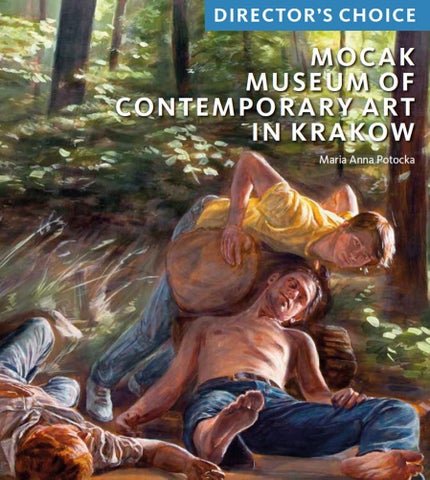
The purchase of the works reproduced on pp. 7, 9, 11, 13, 17, 21, 23, 25, 29, 31, 33, 35, 37, 39, 43, 45, 47, 49, 51, 55, 59, 61, 63, 67, 69, 73, 77 was part-funded by the Minister of Culture and National Heritage of the Republic of Poland. Front cover: Muntean / Rosenblum, Untitled [They realized that their capacity...], 2011 (detail) (see pp. 54–55) Back cover: Guido Casaretto, Michael-4 / Roman Centurion Texture, David-3 / Street Vendor2 Texture, 2015 (detail) (see pp. 22–23) Frontispiece: Maya Gold, Maritime (27), 2008 (see pp. 32–33)