Pierre-Auguste Renoir (Limoges 1841–1919 Cagnes-sur-Mer)
Portrait of a Young Girl (Elisabeth Maître), 1879 Pastel on Ingres paper, 53 × 44.5 cm The Albertina Museum, Vienna. The Batliner Collection Inv. No. DL535
The representation of human beings is of overriding importance in the work of Renoir. He treats the portrait with the same freedom of technical execution as his Impressionist friends Monet, Pissarro and Sisley do in their representation of nature. In the late 1870s he rose to become one of the most famous and sought-after portraitists of Parisian society. This fresh, spontaneous portrait of a child shows six-year-old Elisabeth (1873–1960), the niece of Renoir’s friend Edmond Maître, who was an art collector. Renoir portrays her naturally, in an informal pose. Seated leaning forwards and embraced by the backrest of an armchair, she is positioned at the bottom edge of the picture against a neutral background and in colours which contrast with the intense blue of her dress. These distinctly painterly qualities and the close-up viewpoint give the portrait its strong presence and intensify the direct connection to the viewer. Renoir returns to this medium for his picture, consciously drawing on the eighteenth-century French tradition of using pastels particularly in the field of portraiture. However, in contrast to the detailed, painstakingly crafted style of Rococo pastels, his Impressionist works are characterised by open, visible and rapid strokes.
PORTRAIT OF A YOUNG GIRL (ELISABETH MAÎTRE)
|
7
Georges Braque (Argenteuil-sur-Seine 1882–1963 Paris)
The Bay of Antwerp, 1906 Oil on canvas, 50 × 60 cm The Albertina Museum, Vienna. The Batliner Collection Inv. No. GE17DL
A year after the famous exhibition which established Fauvism as an art movement, the 23-year-old Braque turned his hand to the free brush technique and intuitive, unnatural colours of the new style which had impressed him. He destroyed his Impressionistic paintings and sought out new experiences working with light and colour in the bay at Antwerp. A hazy evening sky over the dunes covers the River Scheldt landscape in amorphous yellow, orange and green dashes of colour, which are refracted in violet tones on the water’s surface, making it clear that this is a warm summer day. Any differentiation between the sky, the outlines of the riverbank and the water’s surface is toned down to allow the material, colour and surfaces to assert themselves. With the whole emphasis placed on autonomy, the violet appears there for its own sake. The bay at Antwerp is represented, but the artist’s ego is in the foreground. Braque’s involvement with Fauvism lasted for only a brief period, and today he is regarded as one of the key exponents of Cubism; Cézanne would play a decisive role in his journey to this new style.
20
|
THE ALBERTINA MUSEUM
Edvard Munch (Løten near Hamar 1863–1944 Ekely)
Winter Landscape, 1915 Oil on canvas, 100 × 150 cm The Albertina Museum, Vienna. The Batliner Collection Inv. No. GE89DL
Munch was much interested in the subject of the winter landscape, especially in the region around Kragerø, a town on the south-east coast of Norway. This painting, created in 1915, is among several executed with broad, vigorous brushstrokes in a new, monumental style. The direct connection with his native landscape led to a greater interest in harmony and classical principles of composition. The panorama of the rugged, sparse fiord landscape is diametrically opposed to his ‘landscapes of the soul’ at the turn of the century. The large snowfields are enhanced by colourful nuances, contrasting with the rocks or strips of meadow; the colour palette is bright and the pastose brushwork shapes the amorphous landscape elements into a changing scene, in which individual colour forms merge together. In his journals from this year Munch writes about the anthropomorphic quality of the landscape: ‘… boulders protruded from the water mysterious as sea creatures […] the dark blue violet sea rose and fell – sighed in between the boulders’.
26
|
THE ALBERTINA MUSEUM
WINTER LANDSCAPE
|
27
Joan Miró (Barcelona 1893–1983 Palma de Mallorca)
Birds and Insects, 1938 Oil on canvas, 114 × 88 cm The Albertina Museum, Vienna. The Batliner Collection Inv. No. GE83DL
The Surrealist movement, dating from 1921 in Paris and led by the French writer and critic André Breton, explored the subconscious to understand what it means to be human and used ecstatic and dream experiences as the source for artistic inspiration. After Breton the most Surrealist artist of all was Joan Miró, who lived in Paris from 1936 to 1940 following the outbreak of the Spanish Civil War. Miró’s preparatory work for his paintings involved a variety of engraved sketches and meticulous drafts. At the same time, no other works of this period seem as quickly produced, spontaneous and unconscious as the cloudy, playful, almost mobile paintings he created from the 1920s onwards, particularly influenced by Breton’s ideas about the influence of things that cannot be influenced. In Birds and Insects the artist deals with the theme of threat, attack and oppression. It was created in response to Franco’s reign of terror in Spain. Like Picasso, Miró also wanted his art to be a call for resistance against fascism. The choice of motif – the fierce resistance put up by the bird against the insects – was possibly inspired by medieval images and could be interpreted as the artist’s perception that freedom was not yet lost in Spain.
36
|
THE ALBERTINA MUSEUM
BIRDS AND INSECTS
|
37
Albrecht Dürer (Nuremberg 1471–1528 Nuremberg)
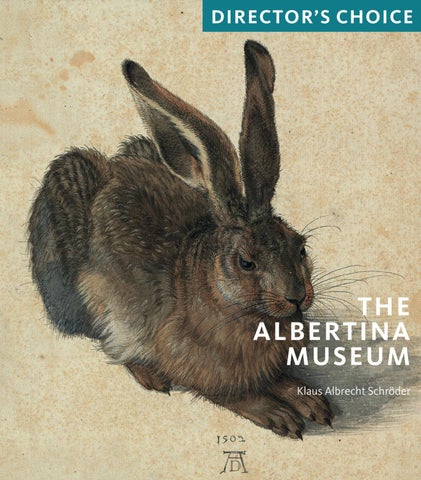
Hare, 1502 Watercolour and body colour, heightened with opaque white, 25 × 22.5 cm The Albertina Museum, Vienna Inv. No. 3073
Arguably the most famous of Dürer’s nature studies, Hare is without doubt one of the first highlights in the observation of nature in Western art. Using nuanced brushstrokes in watercolour and body colour, Dürer captured the soft, longer coat of hair on the belly and thighs as well as the short hair on the animal’s back. He then highlighted individual hairs using opaque white, and used his brush to bring out the light and dark areas of the distinctively coloured fur. Beyond the external appearance, we can detect a transitory moment in the animal’s basic nature, oscillating between the maintenance of a still pose and a readiness to leap up and flee, as signalled by its watchful eyes and alert ears. This also begs the question of whether Dürer drew the animal from a living model or whether he studied the fur markings, ears, paws and other details from a hunting scene and inferred the hare’s squatting position from the example of a tame rabbit. Dürer was the first artist to capture minor, unprepossessing creatures and plants in art, rendering them meticulously and with almost photographic precision, and thus elevating stand-alone animal and plant studies to the highest level.
HARE
|
63
Paul Klee (Münchenbuchsee, Bern 1879 –1940 Muralto, Locarno)
Blue Coat, 1940 Oil and pigmented wax on paper and cardboard, 22.5 × 27.6 cm The Albertina Museum, Vienna Inv. No. 47391
A strange-looking creature trots across an empty background, looking at the viewer. A dog’s coat of a sort covers its body, leaving its legs free. An animal wearing boots like the one in Blue Coat appears in Storm-Animal-Spirits of 1933, a metaphor for the attacks of Nazi storm troopers. This theme is central to Klee’s critique of Hitler’s seizure of power, which he dealt with in the cycle of ‘revolutionary drawings’. Klee was summarily dismissed by the Düsseldorf Academy in 1933 and moved to Switzerland, seeking refuge from his own demise as an artist, a process he repeated in 1940 when facing up to his incurable illness through drawing. The wide-open, owl-like eyes in Blue Coat embody something frightening which is itself fearful. The apparent simplicity of form and the application of paint in coarse lines are based on Klee’s experimentation since the early 1930s with the material effect of unusual pictorial supports, thickly painted backgrounds, and painting media such as glue and pigmented wax. During this period the interaction of often disconcerting effects with surprisingly simple lines and forms replaced the ambiguity of form which had defined all of Klee’s previous work.
78
|
THE ALBERTINA MUSEUM
B LU E COAT
|
79
This edition © Scala Arts & Heritage Publishers Ltd, 2017 Text © The Albertina Museum, Vienna, and Klaus Albrecht Schröder First published in 2017 by Scala Arts & Heritage Publishers Ltd 10 Lion Yard Tremadoc Road London SW4 7NQ, UK www.scalapublishers.com In collaboration with the Albertina Museum, Vienna www.albertina.at ISBN: 978 1 78551 117 2 Coordination and editing for the Albertina Museum: Sandra Maria Rust and Maria-Christina Metzler Coordination and editing for the publisher: Laura Lappin and Ingrid Price-Gschlössl in association with First Edition Translations Ltd, Cambridge, UK Translation into English: Ann Drummond in association with First Edition Translations Ltd, Cambridge, UK Design: Nigel Soper Printed in Turkey
Copyright credits: For reproduced works by: Max Beckmann, Georges Braque, Max Ernst, Erich Heckel, Alex Katz, Maurice de Vlaminck: Bildrecht, Vienna, 2017; Karel Appel: © Karel Appel Foundation / Bildrecht, Vienna, 2017; Francis Bacon: © The Estate of Francis Bacon, All rights reserved / Bildrecht, Vienna, 2017; Georg Baselitz: © Georg Baselitz, 2017; Anselm Kiefer: with the artist; Maria Lassnig: © 2017 Maria Lassnig Foundation; Henri Matisse: © Succession Henri Matisse / Bildrecht, Vienna, 2017; Joan Miró: © Successió Miró / Bildrecht, Vienna, 2017; Emil Nolde: © Nolde Stiftung Seebüll; Pablo Picasso: © Succession Picasso / Bildrecht, Vienna, 2017. Photo credits: Front inside flap: © Alexander Ch. Wulz p. 4: © Andreas Hofer p. 5: © Georg Molterer p. 61: © Jochen Littkemann, Berlin All other photos: The Albertina Museum, Vienna (Peter Ertl and Olga Pohankova)
10 9 8 7 6 5 4 3 2 1 All rights reserved. No part of the contents of this book may be reproduced, stored in a retrieval system, or transmitted in any form or by any means, electronic, mechanical, photocopying, recording, or otherwise, without the written permission of the Albertina Museum, the author and Scala Arts & Heritage Publishers Ltd. Every effort has been made to state the correct copyright of images. The publisher should be notified of any errors or omissions, which are unintentional, in order to ensure that the appropriate corrections can be made in reprints.
Front cover: Albrecht Dürer Hare, 1502 (see pp. 62–3) Front inside flap: The new entrance to the Albertina Museum with its 64-metre long, wing-shaped roof by Hans Hollein. Frontispiece: Michelangelo Buonarroti Male Nude Seen from the Back, c. 1504 (see pp. 66–7) Back cover: Claude Monet The Water Lily Pond, c. 1917–1919 (see pp. 10–11)
80
|
THE ALBERTINA MUSEUM