CZECH ART IN THE 1920s AND 1930s
The Czech art of the 1920s and 1930s, which we present in this publication, is referred to as ‘interwar modernism’. It falls within a relatively closed period, framed between the two greatest catastrophes of the twentieth century. ‘Modernism’ is not a term that describes a specific artistic style; it encompasses various contemporary movements that strove for ‘modern artistic expression’. The lack of uniformity is not only due to the absence of a single, comprehensive direction, but also to the dynamic nature of this 20-year period. While the ‘Roaring Twenties’ were full of optimistic hopes and dominated by a favourable creative atmosphere, the 1930s ended in a politically complex situation full of contradictions that led to another global war.
The period under review begins with the pivotal year of 1918, widely regarded as the start of modern European history. This period also saw fundamental political change in the Czech lands, as the collapse of Austria-Hungary resulted in the formation of an independent Czechoslovak Republic based on the post-war remapping of Europe. This new reality brought with it challenges in politics, economics and the arts. Public spaces in the new republic were dominated by architecture in the decorative ‘national style’ – Rondocubism, as well as the return to classical forms. Free creativity, on the other hand, flourished in many different directions. Concurrent and subsequent trends created space for mutual dialogue, or defined themselves in opposition to each other. The former included works that developed tendencies from the early twentieth century (e.g. Expressionism and Cubism) in a unique way, or works that transformed the classical style of representation, thus maintaining continuity with tradition (e.g. Václav Rabas, Karel Holan and František Janoušek). In contrast, there were manifestations associated with the avant-garde movement that revised the traditional concept of art. Individualistic and unclassifiable approaches remained on the sidelines (Svatopluk Máchal, František Tichý). None of these tendencies was significantly dominant, as we know from pre-war Cubism, for example, except perhaps for a shortlived inclination towards Surrealism in the second half of the 1930s.
At the beginning of the 1920s, the art world was still strongly influenced by the recent war. The pre-war idealistic notion of artists as the
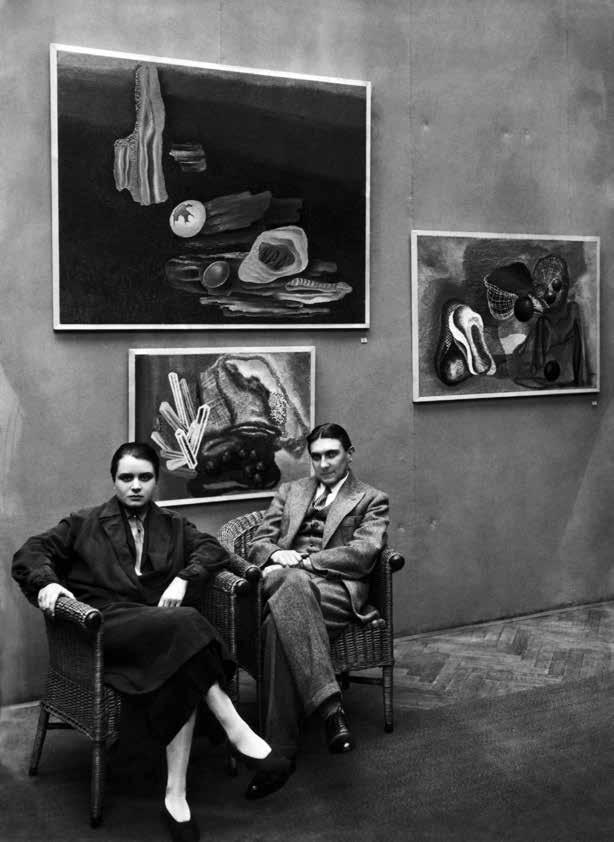
Marie Čermínová (Toyen) and Jindřich Štyrský at a joint exhibition at the Aventinská Mansarda, March 1930.
Photo: ČTK
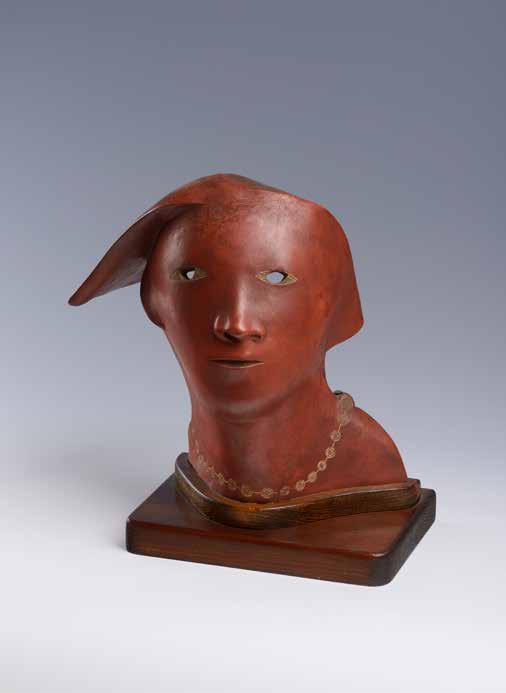
Otto Gutfreund
(Dvůr Králové nad Labem 1889–1927 Prague)
Mask with a Necklace (1920)
Baked clay, 35 × 33 × 24 cm
Signed on the inner side: O Gutfreund, Paní Ale Štechové k vánocům (to Ms. Ala Štechová for Christmas) 1921
Inv. No. P 0148
Purchased in 1968
Otto Gutfreund chose coloured baked clay as the material for a series of sculptures he created in the early 1920s. He produced the first sculpture in this series in 1919 while he was still in Paris, and it came as a great surprise to everyone in Prague who was familiar with his work from before the war. On his return from France, he brought back a naïve, almost caricature-like Vlastní podobizna (Self-Portrait) with rounded, unstructured shapes, in which he replaced the absence of modelling with a painterly approach – colour. Gutfreund continued to use this unusual technique, and SelfPortrait was followed by other coloured sculptures, such as the 1923 Obchod (Trade) and Průmysl (Industry), which inspired similar works by other sculptors in the 1920s.
Maska s náhrdelníkem (Mask with a Necklace) is somewhat different from the rest of the series; it is simply a stylised head made of baked clay, which is not coloured this time, only tinted. Its rounded, simplified form is disrupted only by the protruding shape of the flowing hair. The smooth face is accentuated by an engraved mouth and cut-out eyes, which gave the sculpture its name. Gutfreund subsequently used the motif of cut-out eyes several more times; the aforementioned sculpture is most similar to Dívčí hlava (s rozevlátými vlasy) (Girl’s Head [with Flowing Hair]) from 1925.
Mask with a Necklace was considered to be Gutfreund’s pivotal post-war work, and it was often also exhibited. It was first displayed at the third exhibition of the Tvrdošíjní a hosté (Headstrong Ones and Guests), alongside two other baked-clay sculptures and three drawings. At the Exposition de l’art moderne tchécoslovaque (Exhibition of Modern Czechoslovak Art) at the John Levy Galleries in Paris in February 1924, it occupied a prestigious place alongside SelfPortrait, Sewing Woman, and the sculpture Děvče se psem (Girl with a Dog). The Mask with a Necklace is reproduced in the catalogue, which includes a foreword by the renowned French art critic Maurice Raynal. AP
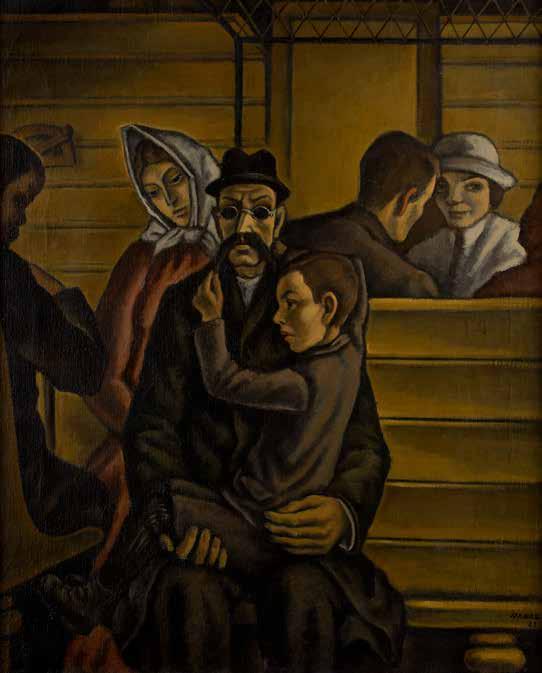
Václav Rabas
(Krušovice 1885–1954 Prague)
By Third Class from Kladno (1923)
Oil on canvas, 99.5 × 79.5 cm
Signed bottom right: RABAS 23
Inv. No. O 0609
Purchased in 1965
Although Václav Rabas is best known as a landscape painter, he created several works addressing social themes during the early 1920s. The striking 1923 painting Třetí třídou z Kladna (By Third Class from Kladno) stands out among them, as the artist turns to a motif drawn from mundane, everyday life. Set in the austere surroundings of a plain carriage, the painting depicts several male and female figures seated on hard wooden benches, representing different social classes. The central figure is a man with a thick moustache wearing a dark coat and hat, who appears to be looking at the viewer; this impression, however, is disrupted by the black round glasses worn by blind people at the time. He is likely a war invalid, while the boy sitting on his lap may be understood as his companion and source of support. The social dimension of Rabas’s painting is also enhanced by its title: the town of Kladno, located west of Prague, was predominantly working-class, and third-class train travel evokes the social marginalisation of the poor working classes. This theme was widely popularised by Honoré Daumier in his 1862–64 work Le Wagon de troisième classe (The Third-Class Carriage), which exists in several variations. Daumier’s painting undoubtedly influenced the entire European art scene. Moreover, in the same year that Rabas’s work was created, the French artist held a solo exhibition at the Salon Topič in Prague, although The ThirdClass Carriage was not displayed there. Evidence of Daumier’s influence can be observed in the Czech art scene as early as the beginning of the twentieth century, for example in Bohumil Kubišta’s 1908 painting Cestující třetí třídou (Third-Class Passengers). Unlike Kubišta, whose relaxed painting in a Fauvist colour palette also reveals the influence of Edvard Munch’s works, Rabas’s monumental work is inspired more by Social Civilism and the German Neue Sachlichkeit (New Objectivity). This movement was at its peak at the time and appealed to Rabas and his contemporaries (Miloslav Holý, Karel Holan, Pravoslav Kotík and Karel Kotrba), partly because it aligned with their social beliefs. RM
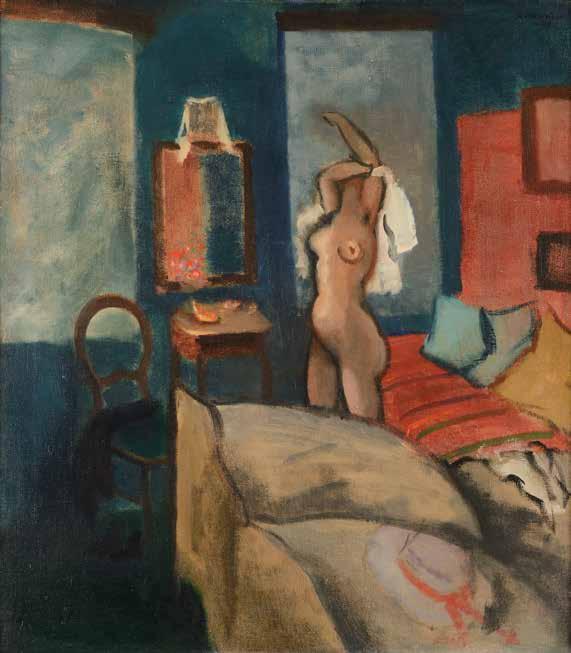
Rudolf Kremlička
(Kolín 1886–1932 Prague)
Interior (1926)
Oil on canvas, 80 × 60 cm
Signed top right: R Kremlička 1926
Inv. No. O 1049
Purchased in 1980
In the 1920s, Rudolf Kremlička was one of the most famous and highly regarded contemporary artists. He is best known for his Neoclassical nudes, although he also painted portraits and landscapes. He was not influenced by Cubism and represented the type of modern painter unaffected by avant-garde art. In his book Malířské konfese (A Painter’s Confessions), published in 1925, he described his journey to his own style, which he had pursued since his studies at the Academy of Fine Arts in Prague, and how he came to terms with the art of the Old Masters, Ingres and contemporary French art.
Around 1917, the artist began to focus systematically on female nudes, creating a distinctive style in which the entire canvas is filled with softly modelled female figures with rounded shapes. In the early days of his work with nudes, Kremlička painted from a model, while, later, he painted from memory. He mainly developed the motif of women dressing – his subjects comb their hair, wash, dry themselves, and so on. The same props are repeated in his paintings: an armchair or a chair, a dressing table, a washbasin, a mirror, red drapery and a white towel. From 1918 to 1923, he exhibited his most important works with the Tvrdošíjní (Headstrong Ones) group.
Kremlička exhibited his painting Interiér (Interior) at the 134th exhibition of the Mánes Association of Fine Artists at the Municipal House in Prague in 1927. It represents a new and rather different concept of the female nude. Unlike previous works, great attention is paid to the setting in which the scene takes place. The room clearly recalls similar works by Henri Matisse, with whom Kremlička had much in common. The nude is no longer the centre of attention, but almost lost in a flood of subtly arranged warm and cool tones of blue and red. The blue walls and curtains contrast with the colourful cushions and striped covers. There is also a dressing table, a chair, a mirror and a discarded hat. The painting has a relaxed feel, capturing an immediate experience – a glimpse into a room where a naked woman is drying herself with a towel. IS
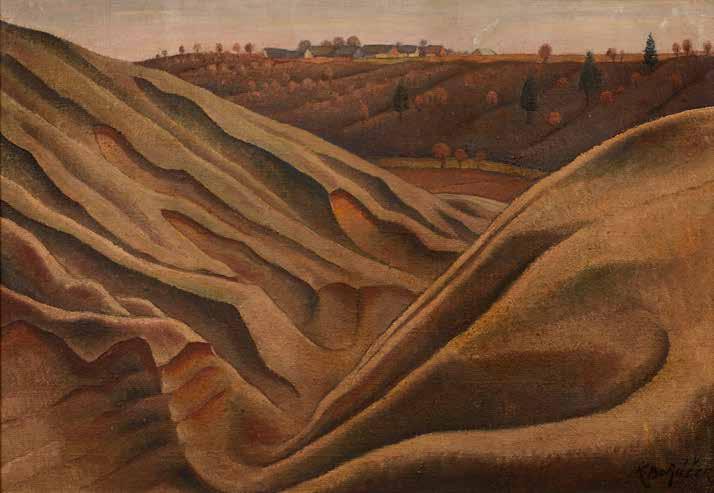
Karel Boháček
(Zamachy 1886–1928 Prague)
Cottages near Zamachy (undated; probably around 1925)
Oil on pasteboard, 50.3 × 72.2 cm
Signed bottom right: K. Boháček
Inv. No. O 1083
Purchased 1982
Karel Boháček’s œuvre is a prime example of Czech landscape painting, focusing on capturing the essence of home and its real and symbolic significance. This trend in landscape painting emerged in Bohemia during the interwar period through the Umělecká beseda (Artists’ Guild) association. Boháček joined this traditional Czech association as a student in 1909 and participated in its activities until his death. Together with Václav Rabas and Václav Rada, he became a leading figure in Czech interwar landscape painting, drawing inspiration from the immediate surroundings of his workplace and birthplace. The typical features of the local landscape – the undulating fields, network of roads and high horizon without any dominant features – draw the viewer’s gaze to the landscape as it is experienced throughout the agricultural year. Like Rabas, Boháček was also a farmer and landowner as well as a painter, and his landscapes are authentic and familiar. Their work not only revived the Cézannesque tradition of painting and conception of the subject, but also emphasised the materiality of the earth and soil. Karel Boháček’s Chaloupky u Zamach (Cottages near Zamachy) is a clear reflection of this tendency and is widely regarded as his magnum opus. Rather than focusing on the characteristics of the village and its buildings, the emphasis is placed on the fields of clay and their earthiness, as well as the changing relief. Thanks to erosion, the slopes have a softly undulating surface. When viewed objectively, the landscapes have a melancholic poetry. They offer a glimpse into the inner life of an ordinary landscape. Karel Boháček inspired a number of artists, including Jan Zrzavý, who regularly exhibited with the Umělecká beseda. At that time, Zrzavý was intensely focused on themes of the Czech countryside. In 1928, the Umělecká beseda organised a posthumous monographic exhibition for Boháček, highlighting his legacy. EB
Jindřich Štyrský
(Dolní Čermná u Kyšperka 1899–1942 Prague)
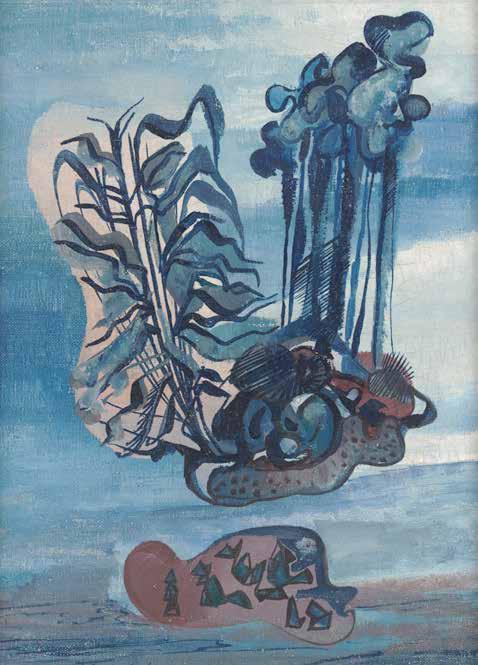
Blue Painting (1930)
Oil on canvas, 40 × 29 cm
Signed bottom right: Štyrský 1930
Inv. No. O 0690
Purchased in 1967
In 1967, Štyrský’s Modrý obraz (Blue Painting) was purchased for the Gallery of West Bohemia in Pilsen alongside the painting Obraz (Painting) from his creative partner Toyen. Both works represented interwar artificialism and Surrealism, styles until then not represented in the gallery’s collections.
The small picture painted using a glazing technique gives the impression of a watercolour. Several delicate horizontal lines in a light blue-violet haze, which blend imperceptibly into the sky, create the impression of land in the foreground. Above this floats an indistinct brown shape containing shard-like visual symbols (perhaps vegetation?), with an island with tall reeds and aquatic plants levitating over it near the shore of a body of water.
In this painting, as in other works from the early 1930s, Štyrský drew on the Apokalypsa (Apocalypse) and Po potopě (After the Flood) series of drawings that he had created the previous year. The first drawing in the Apocalypse series depicts a reed-covered shore with a skull and an organic formation containing shard-like fragments, similar to the one described above. In 1930, Štyrský revisited the theme of bones and plants in his watercolour Skelet v rákosí (Skeleton in the Reeds). The dreamlike atmosphere of the Blue Painting thus stems from the theme of extinction; this time, however, the motif of death is not expressed iconographically.
The combination of visual elements – a flat land motif with aquatic plants levitating on a blue background and a hint of the shore receding into indistinct depths – creates an ambivalent pictorial space that is both pure surface and infinite depth. This is suggested by a light-blue tone that evokes both the element of water and the unconscious. When creating the Pilsen work, Štyrský was exploring the possibilities of flat and spatial solutions for images, with a direct connection to the visual semantics of poetic language. PJ
Josef Šíma
(Jaroměř 1891–1971 Paris)
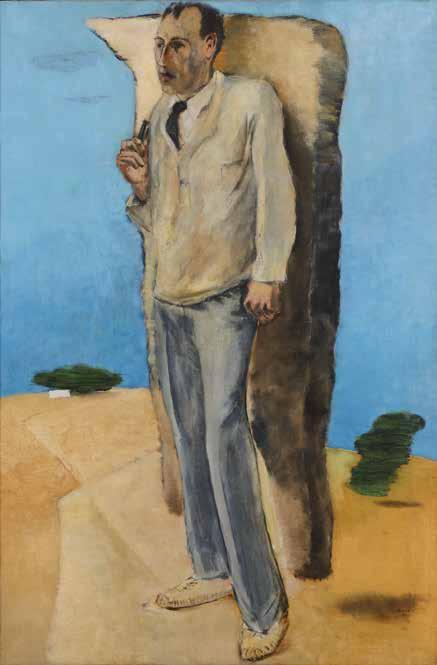
Portrait of Bedřich Stefan (1932)
Oil on canvas, 145 × 95 cm
Signed bottom left: Šíma 1932
Inv. No. O 0944
Purchased in 1975
Bedřich Stefan (1896–1982) was a Prague avant-garde sculptor and, like Šíma, a member of the Devětsil (Butterbur) association. He graduated from the Prague Academy of Fine Arts, where he studied in Jan Štursa’s studio, after which he briefly collaborated with and assisted Otto Gutfreund. In 1925, Stefan came to Paris, where Šíma had been living since the early 1920s, to stay there for two years. During this time Stefan received a one-year scholarship from the French government and returned there annually during the 1930s. This portrait, which differs somewhat from Šíma’s others, was produced during one of these visits. Unlike the other portraits, the subject is depicted full length in his everyday home attire and holding a pipe. This emphasis on civilian life contrasts with the imaginary landscape in which the portrait is set; it is the only one in the series with such a setting, while the others have a neutral, dark background. It is a typical ‘Šíma-esque’ landscape, a motif that began to appear in his work during this period. Another striking motif is the flat stone forming the background of the figure, as if it were part of the landscape itself. Šíma combines the illusory materiality and weight of solid matter with a surreal quality: its shape resembles a human silhouette, and, more importantly, it appears to levitate slightly above the ground. This levitation is indicated in the sun-drenched landscape by a shadow cast by the stone in a similar way to the other depicted objects, albeit one that seems completely unreal. Both the landscape and the strange stone are direct references to Šíma’s slightly older painting Man of the Earth (1929). The painting is a poetic transcription of an experience captured in his wife’s memories: during a walk through a hot summer landscape, a peasant on a bicycle with a torn shirt suddenly appeared behind them. Stefan’s connection with sculpture probably inspired the secondary use of this motif, as it resembles a figure that seems to have just begun to emerge from a block of stone in a sculptor’s studio. MF
Josef Čapek
(Hronov 1887–1945 Bergen-Belsen concentration camp)
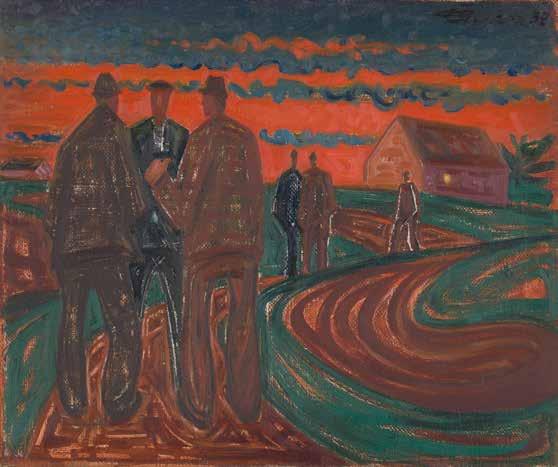
Hardship (1937)
Oil on canvas, 62 × 72 cm
Signed top right: Čapek 37
Inv. No. O 0578
Purchased in 1964
The late period of Čapek’s painting career has not been widely discussed in literature yet, and the 1930s have received almost no special interpretation. His work from this period is characterised by a return to traditional values and styles, particularly a Munch-like Expressionism. This is seen as a typical reaction to political developments. However, less attention has been paid to the meaning, which is generally perceived in the symbolism of the characters. Nevertheless, it is the message and its conveyance that are essential to Čapek’s work at this time.
A year before he painted this work, in 1936, Čapek published his prose piece Kulhavý poutník (Co jsem na světě uviděl) [The Limping Wayfarer (What I Have Seen in the World]), a summary of his life experiences to date, expressing the artist’s intellectual creed in essay form. Through philosophical reflection, the author gradually reveals his views on the essence of humanity, life and death, a person’s place in the world and the meaning of life. These ideas also permeate his paintings. A specific and often cited parallel to the wayfarer’s journey from the essay is the motif of a winding road, which also appears in the painting Těžko (Hardship). The road is a visually structuring element of the landscape, adding a concrete human dimension to it. It was in the 1930s that Čapek began to depict landscapes as an extension of the human dimension. Some excerpts from The Limping Wayfarer seem to directly evoke Čapek’s pictorial compositions.
The painting is symbolic, both in terms of its title and the image itself. Although the road leads home, there are ominous red clouds on the horizon. Čapek was clearly adding dark tones to paintings from the late 1930s, intensifying the drama. Initially used only to emphasise contours, the lines now become independent, creating dynamic flows that follow the example set by Edvard Munch’s expressive, symbolic paintings. Everything conveys the sense of an anticipated catastrophe. With his series Oheň (Fire, 1938), Čapek attempts to confront the growing threat still more openly, making a clear political statement. He was arrested in September 1939 for his anti-war views and was murdered in a concentration camp in spring 1945, at the very end of the war. AP
Toyen (Marie Čermínová)
(Prague 1902–1980 Paris)
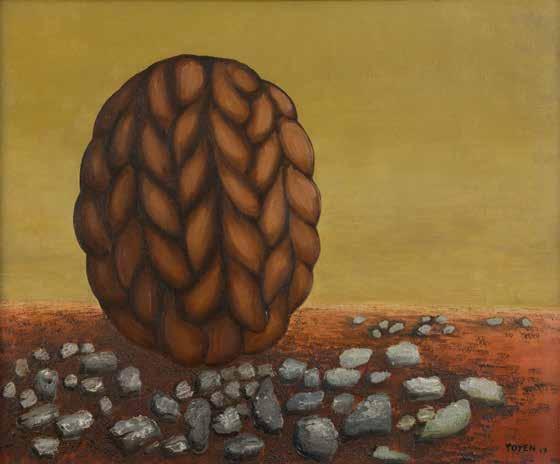
Evening Pebbles (1937)
Oil on canvas, 50 × 60 cm
Signed bottom right: TOYEN 37
Inv. No. O 1330
Purchased in 1996
The canvas Oblázky večera (Evening Pebbles), purchased from a private collection in 1996, is one of the two works by Toyen from the 1930s in the collection of the Gallery of West Bohemia in Pilsen, alongside the painting Obraz (Image). When she created the painting, Toyen was already a member of the Surrealist Group in Czechoslovakia, which she had co-founded in 1934. While Image, produced five years earlier, is an expression of the programme defined by Jindřich Štyrský and Toyen in their manifesto Artificielisme, with its ‘abstract awareness of reality’ and interest ‘focused on POETRY’, Evening Pebbles presents enigmatic, yet real forms in a ghostly yet physically real space. This demonstrates the artist’s shift towards Surrealism.
A large, brown, oval formation of densely plaited structure rises vertically from a barren, stony desert shore. Behind it lies a yellowish body of what is possibly water – Finis Terrae, as another painting from 1937 is titled. The motif, scenery and layout of elements are loosely related to a work from the same year, Objektfantom (Phantom Object), which features a large spherical cocoon-like object from which an eye stares. However, the formation in Evening Pebbles is a hidden female figure, represented by a fragment (the head seen from behind), in keeping with the approach the artist used during this period (as seen in the corset, dress, hair, etc.).
Unlike the canvas Phantom Object, the viewer’s gaze is fixed on the horizon, similar to the figures in Caspar David Friedrich’s paintings. Here, however, the hidden human figure is encrypted so deeply within the inert, oval formation of densely intertwined matter that it forms a tightly closed enigma. Toyen exhibited this work alongside 12 other paintings from the same year at the second exhibition of the Surrealist Group in Czechoslovakia in 1938, shortly before the group’s dissolution. PJ
This edition © Kulturalis Ltd, 2026
Text and photographs © The Gallery of West Bohemia in Pilsen, 2026
First published in 2026 by Kulturalis Ltd 14 Old Queen Street, London SW1H 9HP United Kingdom www.kulturalis.com
In association with the Gallery of West Bohemia in Pilsen Pražská 13
301 00 Pilsen, Czech Republic www.zpc-galerie.cz
ISBN: 978-1-83636-046-9
Project managers: Katerina Siegl (Kulturalis) and Tomáš Hausner (GWB)
Editor: Roman Musil
The authors of the respective entries are marked by their initials at the end of each entry: Eva Bendová (EB), Marcel Fišer (MF), Petr Jindra (PJ), Roman Musil (RM), Helena Musilová (HM), Alena Pomajzlová (AP), Ivana Skálová (IS)
Translation: Tomáš Hausner
Language editing: First Edition Translations Ltd, Cambridge, UK
Graphic design: Bušek & Dienstbier
Photographs and reproductions: © The Gallery of West Bohemia in Pilsen, © ČTK (Czech News Agency), © National Gallery in Prague, © Institute of Art History of the Czech Academy of Sciences
Reproduction by Opero, Verona
Printed and bound in the Czech Republic by PB Tisk, Příbram
10 9 8 7 6 5 4 3 2 1
All rights reserved. No part of this book may be reproduced, stored in a retrieval system or transmitted in any form or by any means, electronic, mechanical, photocopying, recording or otherwise, without the written permission of the author and publisher.
Every effort has been made to acknowledge correct copyright of images where applicable. Any errors or omissions are unintentional and should be notified to the publisher, who will arrange for corrections to appear in any future editions.
The authors have asserted their rights under the Copyright, Designs and Patents Act, 1988, to be identified as authors of this work.
British Library Cataloguing in Publication Data.
A catalogue record for this book is available from the British Library.
EU GPSR Authorised Representative: EASY ACCESS SYSTEM EUROPE OÜ
Mustamäe tee 50 10621, TALLINN, Estonia email: info@easproject.org
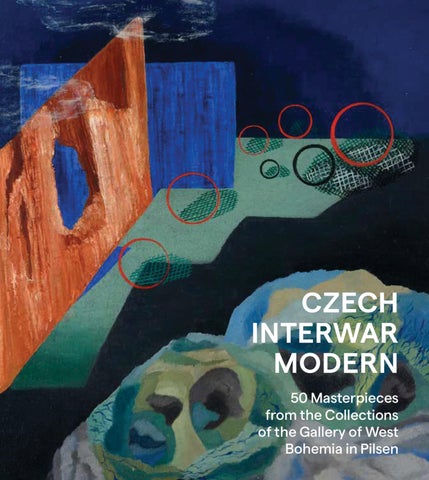
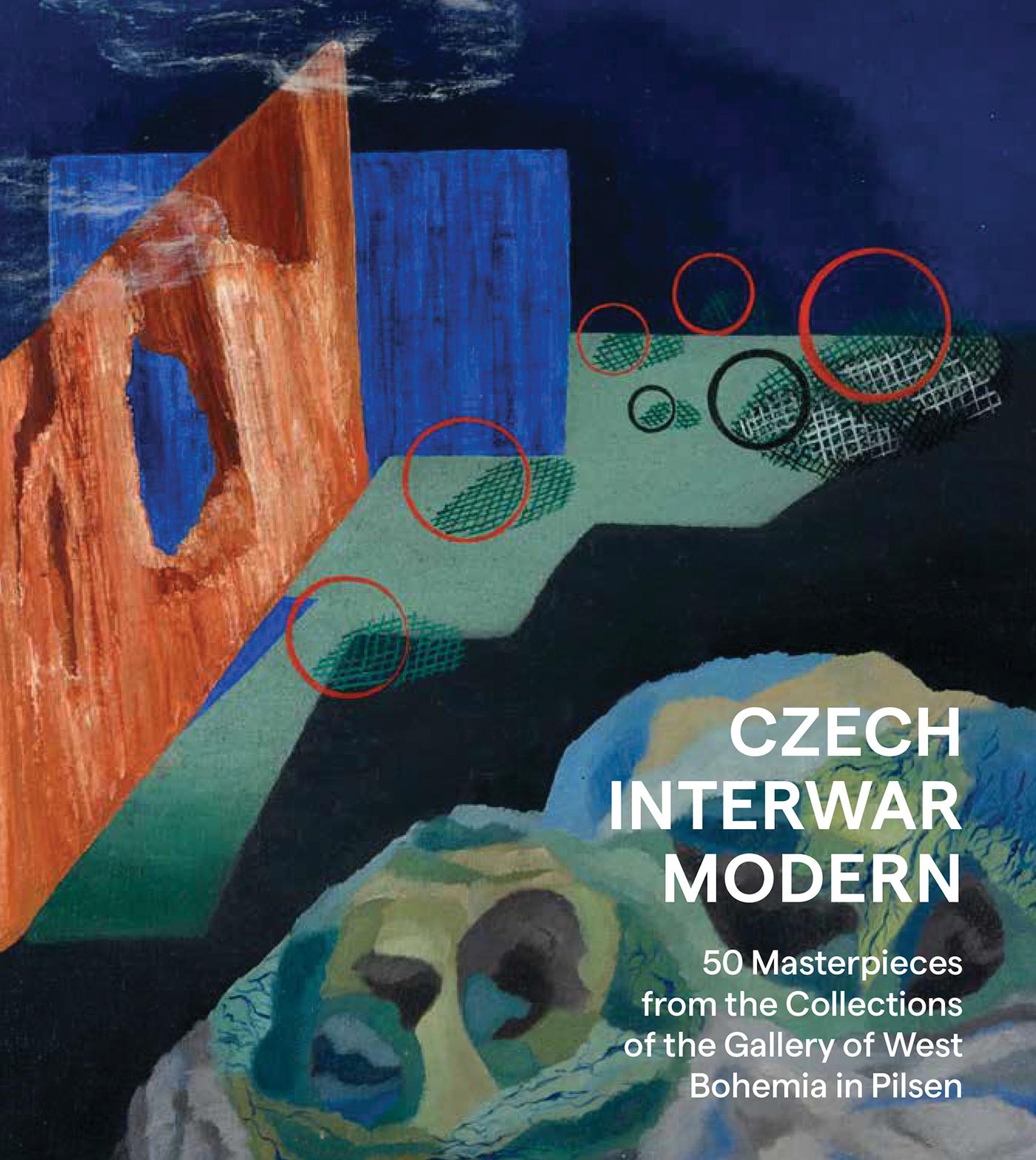
Front cover: Toyen (Marie Čermínová), Image, 1932
pp. 2–3: František Muzika, Site of a Fire, 1927
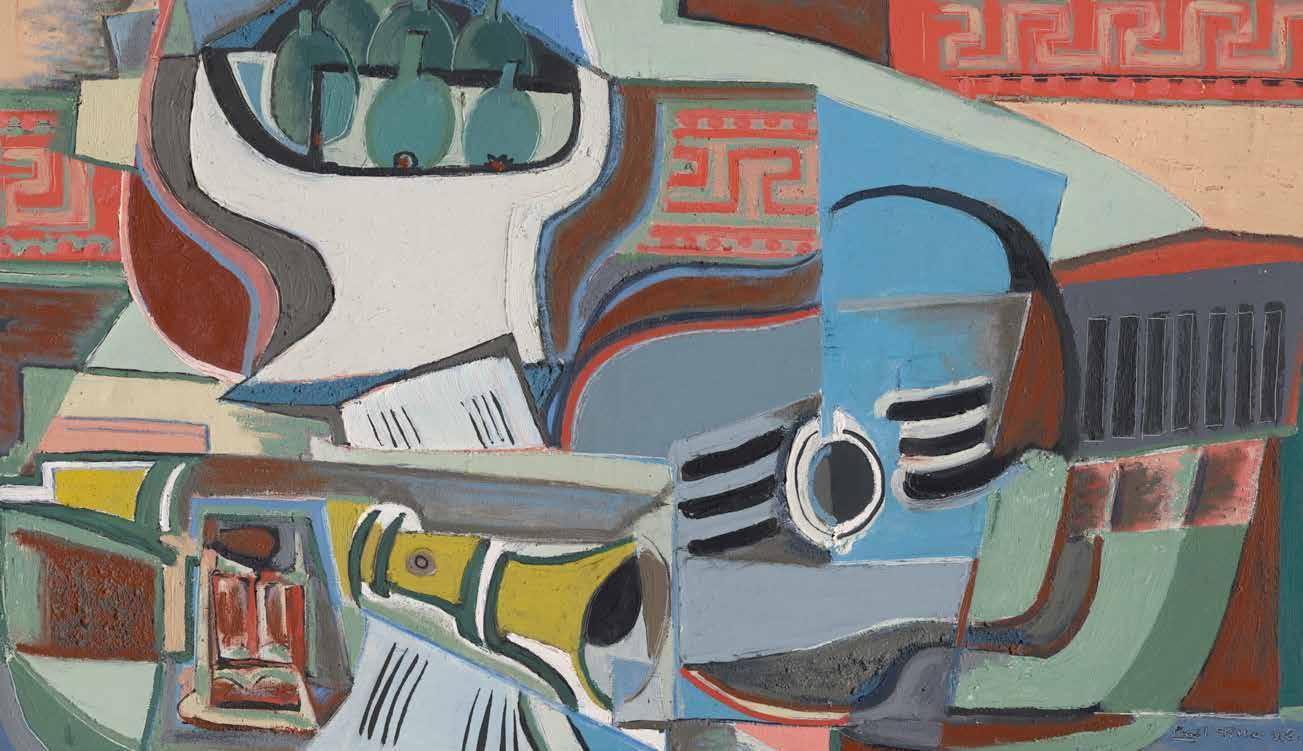
pp. 18–19: Emil Filla, Still Life, 1926
Back cover: Karel Holan, Night Company, 1919