TABLE OF CONTENTS Foreword
8
Introduction
12
Part 1 STORYTELLING & REPRESENTATION
Memoir
Of the Distant Past
20
Essay
Zoomorphism, or What Architectural Creatures Look Like
26
All Eyes on Architecture
58
Response
Stewart Hicks & Allison Newmeyer
Part 2
Part 3
REPRESENTATION & CITIZENSHIP
CITIZENSHIP & SYMBIOSIS
Of the Present
72
Of the Near Future
124
Animism, or How Architectural Creatures Locomote
78
Solidarity, or How Architectural Creatures Love
132
Toward a Charismatic Architecture
112
With Not For
168
Joyce Hwang
Frederick Scharmen
Afterword
176
Regner Ramos Biographies
180
Acknowledgments
182
8
FOREWORD WORLD OF RELATIVES
A critical component of Indigenous ontology is the notion of relationality—that is, the concept that all living things are related. That relation is familial, and we have responsibility to foster and be good stewards of those relationships. I believe we should be thinking about architecture as our relations. Buildings are characters and actors within the living world. They breathe, sweat, and produce waste. I am trying to expand the notion of how architecture can be thought of as living actors in our world. To me, this includes the modalities we use to represent our designed relatives. —Chris T. Cornelius (Oneida), designer and educator, Milwaukee WORLD OF WINDOW SHOPPING
I’m walking with my feet dipped in the river, the water caressing my toes. From my height, I feel like the female Goliath. I’m on the hunt for a dress. Chicago is the best department store to find one, carrying fashionable pieces from Sullivan and Lloyd Wright to Mies and Goldberg. I am immediately drawn to the Marina City towers. I put my legs in, pulling the marina up and squeezing myself to fit. The concrete softens on my body, turning the tower into a silk dress. It is tailored perfectly—a custom garment embroidered with sequined balconies. I’m beaming like a lighthouse above the city and lake, my hands resting on my hips. With the CNA Building lipstick and the Stock Exchange arch necklace, my outfit is complete. Chicago is my wardrobe, my playground, and my intimate inspiration. —Nelly Agassi, artist and educator, Chicago WORLD OF WORDS
I sit cross-legged and eyes closed, still. It’s in this quiet space where many of my worlds agreed to meet. My first true friends were words. Words and worlds, first cousins, maybe even siblings, or lovers, come together to create. In such a vast ecosystem, I’m so blessed that words chose me as a companion. —Roy Kinsey, rapper and librarian, Chicago
9
WORLD OF MEMES
Imagine a world where solidarity between humans is the best it has ever been. Imagine a world where we people loved other human beings more than our pets. Imagine if we cared about abolition in the same way we care about any funny animals on the internet. Cat memes are cute and all, but isn’t emancipation truly hot? We often skip over this possibility when we contemplate creating kinship with animals, plants, or inanimate objects. Sometimes it’s easier to sustain a conceptual relationship with a creature than it is to build a relationship based on respect with other humans, which is kinda fucked up. Still, we trust in the belief that any attempt to locate agency in nonhuman actors will help expand human consciousness or inspire such advances. As an architectural meme hive mind—a model of collective consciousness drawn from eusocial creatures, like bees or ants—building connectivity is the core of what we do. Memes are not an escape, but an amplification of what is here, now. We’ve found that dank memes really hit the cheetah spot, so we welcome all creatures in our blunt rotation. Go off, Kings! —Dank Lloyd Wright, emerging theorist WORLD OF TRANSFORMED AMBITION
“Shit,” I winced as the ragged fingernail on my left pointer finger tore painfully back to the quick, caught on the stiff netting that protects the kale (the only green that grows without excessive effort). It’s times like these I miss sidewalks and zippers—they made great emory boards. I gnaw away the remaining nail flap, enjoying the momentary patch of shade cast by an orbital behemoth drifting in front of the sun. I don’t miss noise. I don’t think anyone does. Later, while warm rain spatters thick leaves and soaks the naked ground, we’ll spend hours laughing again at what once passed for ambition. It never gets old. —Trudy Watt, architect and educator, Milwaukee
10
WORLD OF RELATIONABILITY
The Anthropocene bounds us to a history of capitalists, positivists, and settler colonialists who extract, spill, pillage, ravage, erode, capture, predate. In the Plantatiocene, Chthulucene, or Utopiacene, poetics of relation render us opaque. We are kin to the rebellious and the revolutionary. The exterminator builds architecture to wipe out our relationability: to the sky, to the earth, to the nonhuman, to the nonliving. Against this utilitarian, functionalist, progressivist gospel, we dream of radical ecologies of laziness, listening to the song of birds, to the sound of the future, and the cliquetis of the wind through the cornfields. —WAI Think Tank, educators and designers, planetary WORLD OF CRTRS
new SNNN know very well: BRRD heavens be WRRM hells side SNKK wind from far road, RB’BT hide dark down hole one PR’SN too tall grow, WNND and RNNN soon cease flow fly N’SCT, but nest gone, PLNT root seek water long plenty LNDD left, shrink small, FR’RR burn, destroy all; old MNNN soul see and know: as above, so below. —Andres L. Hernandez, artist, designer, and educator, Chicago
11
WORLD OF DOORS
Door. Ajar and awake, deftly out of the way, so much hinges on this, our familiar exchange. Politely, it states, “after you, after you,“ and checks to make sure that we’ve all made it through. It returns to its jambs, where it patiently waits for its next chance to swing, to be flung, like a gate. When it speaks, it says things like, “come in,” or “goodbye,” or “please, I assure you, no need to be shy.” It surprises me how much I simply adore, our give and our take, our lasting rapport. —Julia McMorrough, architect and educator, Ann Arbor WORLD OF ABOLITION
The world I want to live in is achieved through abolition and is one where maximal pleasure is available to all marginalized people and stripped away from those who currently have it. That world necessitates many more of us to engage in this abolitionism—of capitalism, of prisons, of homophobia, of white supremacy, of settler colonialism, of transphobia, of ableism, of animal consumption, of so much else I can only name in name, from my privileged perch. I want abolition and the forthcoming revolution to be simple as a choice to make individually and collectively. I want an intersectional current to make this wave swell toward socialism or anarchism and away from what is available to us, given to us by our white status quo plutocrats. I want to include all the marginalized and center them for the rest of my life, maybe for the rest of human existence, however long that is. I want you to see yourself in me and this work. Will you be my accomplice? —Andrew Santa Lucia, designer and educator, Portland, OR WORLD WITH(OUT) US
A world before us. A world after us. A world through us. A world beyond us. Forever in flux. Revolving. Evolving. Orbiting. Breathing. Living. Dying. Shapeshifting. A world beneath us. A world around us. A world within us. A world without us. —SANTIAGO X, artist, Chicago
12
Introduction: How to Be Friends with Architecture The land grew and grew as she danced her thanks, from the dab of mud on Turtle’s back until the whole earth was made. Not by Skywoman alone, but from the alchemy of all the animals’ gifts coupled with her deep gratitude. Together they formed what we know today as Turtle Island, our home. —Robin Wall Kimmerer
In what ways can an ethos of friendship catapult us beyond categories and distinctions, where notions of subjectivity and space are given permission to play themselves out in nonhuman-centric and nonnormative ways? —Shun Yin Kiang
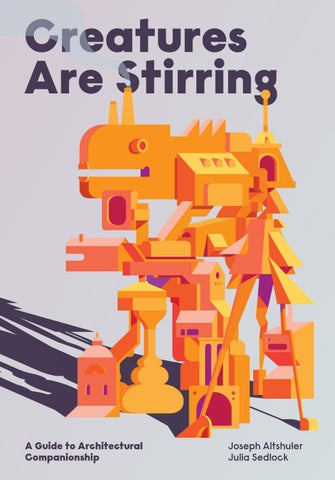
Making friends with various forms of nonhumans offers an opportunity to escape undesirable conditions of the existing human world and enter, even if temporarily, another world with different vantage points, sensations, and codes of conduct. J. R. Ackerley’s 1956 memoir My Dog Tulip makes indirect reference to the difficulties of life as a single gay man in London after the Second World War, while focusing on his relationship to a female Alsatian companion, Tulip. In an analysis of the memoir, the literary scholar Shun Yin Kiang highlights Ackerley’s observation of and curiosity about Tulip’s urinating routines as a form of communication to illustrate the role that nonhuman companionship can play in breaking down human-centered perspectives on the world. Kiang writes, “To see Tulip’s urine as something more than just urine, to fancy a world in which dogs sniff and men follow after them, is to reimagine the world in which we live. Ackerley’s investment in cross-species friendship, in other words, helps resist and revise conventional notions of self and space.”1 While temporary inhabitation of a nonhuman, or more-than-human, world may be pleasurable in and of itself, it also provides an opportunity to practice or rehearse more desirable ways of relating to other humans. When you return to the human-foregrounded world, you might find your own human personhood in an altered state and relate to other humans according to shifted rules. The experience of expanding awareness to include another being’s perspective may also expand your capacity for solidarity with other human beings. In this book, we hope to expand your capacity for friendship and solidarity to include buildings as companionable creatures as we explore the ways that architectural design can enhance, and be enhanced by, such creaturely camaraderie. When we speak of creatures, we cast an intentionally wide net. A quick internet search yields the following definitions: “1. An animal, as distinct from a human being”; “1.1. An animal or person”; “1.2. A fictional or imaginary being, typically a frightening one.”2 This net is already pretty wide: a creature can be human or nonhuman, real or imaginary. Yet a little extra scrolling expands the net even 1 2
Shun Yin Kiang, “Friendship; Or, Representing More-Than-Human Subjectivities and Space in J. R. Ackerley’s My Dog Tulip,” in Creatural Fictions: Human-Animal Relationships in Twentieth- and Twenty-First-Century Literature, ed. David Harman (London: Palgrave McMillan, 2016): 132. Oxford University Press, Lexico.com, s.v. “creature,” accessed March 21, 2021, https://www.lexico.com/ en/definition/creature.
13
When you talk about making friends, you are usually talking about connecting with another human—but not always. Sometimes you are referring to a relationship with another animal, perhaps a dog, cat, guinea pig, or horse. Sometimes you may be lucky enough to make friends with a fictional character in a book or a film. You may have even crossed paths with someone who is friends with their car, or their musical instrument.
14 INTRODUCTION
further. The etymology of the word reveals its root in the Latin creaer, meaning “to create,” and its medieval meaning, circa 1300, is “‘anything created,’ hence ‘a thing’ in general, animate or not...from Old French creature ‘created being; all creation’ (Modern French créature), from Late Latin creatura ‘a thing created; the creation; a creature,’ from creatus, past participle of Latin ‘to make, bring forth, produce, beget.’”3 With this simple step backward in time we extract our justification for including architecture in the cauldron of creatureliness, into which all things animate and abiotic may be stirred. In the Judeo-Christian context, the emphasis on creation refers to God’s acts during a seven-day master class in manifesting the contents of “his” imagination— heaven, earth, and animals, including humans, who are conveniently set apart by their likeness to “him.” This likeness was accompanied by humans’ own preternatural skills of manifesting the tools and technologies that set us apart from the “nature” of Eden, and established an ecological hierarchy that kept us distinct and apart from the other creatures. Yet Indigenous creation myths such as Turtle Island offer alternative frameworks for conceiving of our relationships to nonhumans. As recounted by Robin Wall Kimmerer, when Skywoman falls from Skyworld into the dark water, the geese catch her fall, the turtle offers his back as her home, and the other animals gather mud to spread on his back to create the earth. Skywoman expresses her gratitude by planting fruits and seeds to feed them all.4 The reciprocity embedded in this myth of building home helps us to decontextualize the act of creation from the influence of the theological hierarchy established in the myth of Genesis, and replace it with a condition of relational co-creation, reintegrating humans (and architecture) back into the big melting pot of creaturely inclusion. We are indebted to the work of Donna Haraway, who has theorized, from the Western perspective, the ways that “significant other” forms of being as varied as cyborgs and companion species, such as dogs, challenge the definition of human that is derived from the Judeo-Christian creation myth in order to tell “a story of co-habitation, co-evolution, and embodied cross-species sociality.”5 While Haraway favors the word critter over creature, presumably to avoid association with the latter's creationist roots, we choose to stick with creature as a deliberate act of reappropriation, and to willfully acknowledge the active role that all creatures play in constructing each other’s respective existence and reality. The traditional anthropocentric approach of Western architecture tends to see architecture as an instrument of “civilized” culture. In this understanding, architecture is 3 4 5
Online Etymology Dictionary, s.v. “creature (n.),” accessed March 21, 2021, https://www.etymonline. com/word/creature. Adapted from oral tradition, Robin Wall Kimmerer, Braiding Sweetgrass: Indigenous Wisdom, Scientific Knowledge, and the Teaching of Plants (Minneapolis: Milkweed Editions, 2013). Donna Haraway, The Companion Species Manifesto (Chicago: Prickly Paradigm Press, 2003), 4.
We find an analogous reciprocity in the relationships between humans and horses. While the European paradigm casts horses as objects of value and power, civilizing tools of agriculture, transportation, and war, Indigenous cultures of North America revere horses as sacred companions who “help to heal the wounds that cause the mind, body, and soul to shift out of alignment,” in the words of the scholar and journalist Yvette Running Horse Collin.6 Running Horse Collin’s work challenges the narrative, common in Western academia, that native horses died off in the Ice Age—a narrative that credits Spanish colonists with their reintroduction to the continent, erasing a deep, millennia-long interspecies connection and redefining horses as an implement of white culture. Her dissertation draws on fossil records and anthropological studies to show that the intimate relationship between Indigenous humans and horses has been maintained continuously for thousands of years.7 Brianna Noble, a horse trainer who rehabilitates rescued horses at her Bay Area ranch, describes the companionship that horses have to offer: “As fight or flight creatures, a horse’s very survival relies on their ability to read the emotions and body language of its herd around itself. …Mimicking our emotions, they put up a mirror that allows us to evaluate ourselves in an ever forgiving, nonjudgmental way.” In this book, we attempt to replace the horse with architecture as the subject of this statement: What if architecture “put up a mirror that allows us to evaluate ourselves in an ever forgiving, nonjudgmental way,” and what if we actually looked at what the mirror showed us and responded to it in a way that would help us address some of the crises facing humanity at this moment in time? We ask this question with the ambition of building space for cultural imagination to envision a world on the other side of struggle, yet this process starts with the way our individual imaginations conceive of the relationships we enact on a daily basis. This is not a utopian ideal that we imagine, but rather an aspirational, intersectional response to the conditions that some refer to as the Anthropocene— the geological era that marks the start of irreversible human impact on the earth and its ecology, and whose root causes align with the same social, cultural, and 6 7
Shoshi Parks, “The Shared History of Wild Horses and Indigenous People,” YES!, April 27, 2020, https:// www.yesmagazine.org/environment/2020/04/27/native-horses-indigenous-history/. Yvette Running Horse Collin, “The Relationship Between the Indigenous Peoples of the Americas and the Horse: Deconstructing A Eurocentric Myth” (PhD diss., University of Alaska, Fairbanks, 2017).
15
a tool that addresses either environmental directives (provide shelter, deliver utilities, heat and cool occupants) or cultural ones (communicate an idea, support activities, establish collective lifestyle norms). Regardless of the problem, the logic it uses to rationalize a solution often follows a one-way arrow of cause and effect. Architecture is an object that does a thing in the service of its human occupants. We can’t help but wonder, what if the arrow went both ways? What if our architecture was not a tool but a friend, a subject with its own experience of the world and its own set of needs?
16 INTRODUCTION
economic factors that have prompted many ongoing struggles for social justice. There is a balance to be struck between our efforts to halt the continued harm we are doing to our planet and our ability to adapt to the inevitable changes that our impact has already set into motion. Both will require a sustained, collaborative effort to reconceive and restructure the way that we think about our relationships to each other, to other species of animals, and to our environment. We are architects, so architecture is the language that we speak; it is a language well-suited to worldmaking and storytelling, so we hope that these questions start to paint a picture of a different reality in which the causes of today’s crises are less domineering, and to hypothesize a way that architecture may contribute to that future reality. We acknowledge that the practice of architecture can make significant, concrete contributions in areas such as resource consumption, land use, and housing, but we strongly believe that those efforts must be accompanied by radical cultural, social, and emotional transformations in how we all relate to the rest of the world. We identify capacity to do this in a combination of conditions and ways of being that already exist in our shared reality and our imaginations, in culture at large, and in the culture of architecture. Collecting references and case studies from a range of sources, we use the following pages to position a possible way of seeing and being in the world that might actually already exist in the nooks and crannies of art, literature, internet memes, and our everyday lives. Something is stirring in our midst. We think that seeing both our human selves and our architectural environments as parts of an interconnected creaturely ecology may help us understand what that something might be. The book is divided into three thematically distinct yet overlapping parts: Storytelling & Representation, Representation & Citizenship, and Citizenship & Symbiosis. Each of these parts consists of three components: an illustrated memoir recounted from architecture’s vantage point, an essay, and a response. These three sets of chapters make a case for both architectural creatures and creaturely architectures. Parts 1 and 2 define architectural creatures as buildings or structures that look and operate like discrete actors and animate beings. Architectural creatures elevate the subjecthood and relationability of built matter alongside our own human personhood as peers, co-conspirators, and friends. Zoomorphism and animism help humans suspend the Western disbelief that abiotic entities (e.g., piles of bricks) can exhibit lively, sentient, and agential qualities—if a building looks like or behaves like an animal, it is easier to acknowledge it as companion. Parts 2 and 3 explore creaturely architecture as a broader quality of relationability that diffuses hierarchy and mixes up the identities of ourselves and our nonhuman companions. Creatureliness, as opposed to a discrete creature, no longer requires overt zoomorphism or animism to suggest its animate agency.
In Part 2, Representation & Citizenship, we explore a range of architectural strategies beyond formalism that support our expanded definition of creatureliness. Contemporary interpretations of animism provide a way of seeing the world that justifies our inclusion of both human and architecture in the broad category of creature, and allows all types of creatures to reconstruct their identities within that radically inclusive umbrella of animate beings. Case studies of contemporary architecture practices illustrate the different roles that an animist architecture might play in redefining our sense of locomotion, belonging, and citizenship in the Anthropocene. Respondent Joyce Hwang expands the definition of nonhuman charisma to unpack its potential superpower for both fauna and architectural matter. In Part 3, Citizenship & Symbiosis, we shift from the redefinition of individual identities and our expansion of belonging to explore the implications of those relational moves as we discover new collectives and forms of solidarity. With help from popular culture, we invent new languages of architectural love that promote our ability to live bonded, interdependent lives with other creatures with whom we share the world. Frederick Scharmen responds from the retrospective vantage of the year 2045, analyzing his archive of literary examples of humanarchitectural companionships in relation to the planetary strife and reconciliation of the decades to come. The story of this co-creative symbiotic relationship can be told in many different ways, from many different starting points. We organized the parts of this book described above so that they may be read in a cohesive arc from cover to cover, but you may also choose to open to any of these parts and read it as a stand-alone piece. We offer you agency to choose your own reading adventure, and welcome you to organize an experience based on your interests and interpretations. l
17
In Part 1, Storytelling & Representation, we look at the ways that architecture’s formal language can mimic the shapes of things and beings in order to create narrative structures that inform our definitions of and relationships to self and others. In developing our case for architectural creatures, we explore the role of anthropomorphism, zoomorphism, and other morphisms in architectural history and contemporary architecture and speculate on the impact of formal resemblance in cultivating our capacity to relate to, interact with, and ultimately befriend architectural companions. Respondents Stewart Hicks & Allison Newmeyer take animate qualities of humans and animals (both formal and behavioral) and translate them into architectural and geometric strategies for space-making and interaction. Their contribution to this book reflects on the discipline’s resistance to see faces or other animal likenesses in serious architecture, and they initiate conversations with a fiction writer and a facade consultant to liberate new associations among literary description and architecture’s “facial” articulations.
74
MEMOIR | OF THE PRESENT
75
REPRESENTATION & CITIZENSHIP
128
ESSAY | ANIMISM
129
CITIZENSHIP & SYMBIOSIS