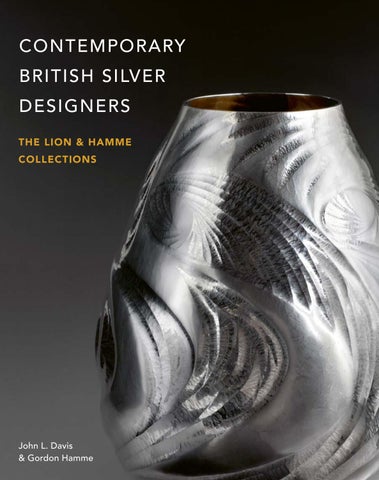
CONTEMPORARY BRITISH SILVER DESIGNERS THE LION & HAMME COLLECTIONS
John L. Davis & Gordon Hamme
CONTENTS
ACKNOWLEDGEMENTS
Having this book about Contemporary British Designer Silversmiths published has been my wish for quite some time. However, this would not have been possible without the efforts and support of several people. Therefore, I would like to express my sincere thanks to them. When I approached him with the idea, James Smith, CEO and Publisher of ACC Art Books, immediately expressed his support. I am very grateful for his ‘starting push’. Catherine Bankhurst, the editor-designer, has been a great help and an ultimate professional. It has been a pleasure to work with her. In the background, Susannah Hecht, the senior editor, made sure that everything went smoothly. Her contribution has been very helpful. Jasmijn Tolk has produced very professional images. The quality of her work, thanks to her skilful handling of camera and computer, can be witnessed on every page.
Alastair Dickenson has been my ‘collecting mentor’, sounding board and friend for more than twenty years. The fact that he was willing to write the Foreword means a lot to me. John Andrew, who has at least the same passion for modern silver as I have, did not need much persuasion when I asked him to write the Introduction. I am very pleased that he has enriched the book with his input. I would like to thank Gordon Hamme, who immediately jumped on the idea of developing a joint production. His relaxed attitude has been a good antidote to my passionate impatience. Finally, and most importantly, I hope that this book will provide a joyful experience to many readers and also will contribute to the appreciation of Contemporary British Silver and its designer silversmiths. John L. Davis
Foreword Introduction
6 8
THE LION COLLECTION A Collector’s Story 12 Interviews with Silversmiths 16 Catalogue Holloware 27 Caddy Spoons 143 Napkin Rings 199 THE HAMME COLLECTION The Hamme Story Three Senior Silversmiths Catalogue
216 218 221
Word of thanks
255
INTRODUCTION John Andrew
This is certainly a most welcome and much-needed book as it showcases modern and contemporary British designer silver. After 1945 the UK’s craft of designer silver went through a great Renaissance which began to manifest itself in the 1960s. This resulted in objects, the likes of which had not been seen before in the world of silversmithing. The step change did not stop there, but progressed to the present day. Quietly Britain established an international reputation for both craftsmanship and the design of silver. Today silversmiths from Asia and elsewhere choose the UK as their preferred place of study with the Royal College of Art as the apogee of their ambition. The centuries-old techniques of using a hammer and stakes to hand-raise forms from sheets of silver remain. Innovations included polished surfaces being replaced by texturing or satin finishes, but usually with some small but stunning contrasting polished surfaces. Mixed metals were introduced and the virtually lost art of enamelling was resurrected to great acclaim. Needless to say, modern technology is also embraced by the larger enterprises which can design by computer using CAD/CAM1 software, However, silversmithing in the UK is fundamentally a handicraft, a trade requiring skill of hand, heart and eye. Despite the Renaissance, or rebirth of silver, it remains one of Britain’s best kept secrets. Stop a person in a typical UK high street and ask them to name a couple of modern British silversmiths, they would struggle to name one. Travel overseas and show a cross section of modern and contemporary British silver and the general response is, ‘We had no idea that you Brits could create such amazing silver.’ A good alternative title for this book would therefore be View Some of Britain’s Best Kept Secrets. Thankfully there are collectors who have stumbled upon the output of modern silversmiths, but compared to followers of other crafts their numbers are low. This book is fascinating for several reasons. It is not unusual for volumes to be occasionally published dedicated to an individual’s collection of antique British silver. However, this is the first book to feature collections of modern and contemporary British silver. One is formed by a married man, the other by a married couple. The largest of the two, The Lion Collection, was put together
8
by John L Davis. He was born a collector, progressing from a young age through stamps to first edition comics and then antique British silver. His penchant was for the ‘golden age’ of antique boxes created in the reigns from Charles I to the early years of Queen Victoria’s, which he started collecting in the mid-1990s. Early into the second decade of the 21st century he felt his collection of antique boxes was complete. He commissioned John Culme, a specialist in English silver and respected writer on the subject, to write-up the spectacular collection. The result was British Silver Boxes 1640–1840: The Lion Collection. Subsequently, he started a collection of primarily 21st-century British silver. This most recent collection is featured in this volume. The Hamme Collection was formed by husband and wife team, Gordon and Angela. It dates from the late 1980s to the present day. Their interest in modern silver grew from running a business they had established in Hatton Garden. Like John, they derive pleasure from contact with the makers. However, the approaches to forming the Lion and Hamme collections are completely different. John knows exactly what he wants and can form a collection at almost break-neck speed, whereas Angela and Gordon collect at a sedate pace. A piece may be acquired to mark their significant anniversaries or occasions and will carefully be considered against all that is available on the market. They have largely abandoned commissioning, whereas John thrives upon this, especially to satisfy his penchant for lions, the King of Beasts. Objets d’art formed by individuals rarely get public airings. Known fellow collectors may receive a private viewing, but generally they remain behind closed doors at undisclosed locations. Of course modern and contemporary British silver has been promoted over the years. Indeed, the Worshipful Company of Goldsmiths, more commonly known at the Goldsmiths’ Company (the Company), staged its first exhibition of modern British silver in 1938 (which attracted 37,000 visitors in 11 days) and after World War II, periodically from 1951 onwards. To coincide with the Festival of Britain it staged both an historic exhibition and a modern one (the visitors were 27,500 and 12,500 visitors respectively). The
modern exhibition was curated by Graham Hughes, who continued to tirelessly promote contemporary British silver in the UK and overseas until he resigned in 1981. It was a great loss. By 1970 the Company had effectively abandoned the hope of persuading the traditional silver trade to stock modern British silver and was concentrating on the designer-craftsman. Trading conditions were not good in the early 1970s and the Company explored having selling exhibitions at Goldsmiths’ Hall (the Hall). So, let us briefly look at how silver was promoted over the years in the UK. The Company’s trigger was the 1973 oil crisis,2 which saw the world’s stock markets plummet in 1973–4.3 However, with the inflation of the period, people were very keen to purchase tangible items such as antiques, collectables and bullion. Having confirmed that a selling event would not affect the Company’s charitable status, it launched its first selling exhibition, Loot, in 1975. Prices were capped at £50 (around £530 at early 2022 prices). This upper limit was later scrapped. Two thousand carefully selected pieces of silver and jewellery made by 310 designers (many of whom were relatively unknown) were offered. However, there was no interaction between the buying public and the men and women who created the pieces. The goods were displayed in cases at the Hall and those wishing to make a purchase went to a counter to complete the transaction with a member of the Company’s staff. The buyer would either collect the piece from the maker or have it mailed after the exhibition. The first Loot attracted 15,000 visitors and sales/orders totalled £250,000 (just over £2.6 million at 2022 prices). The last Loot was held at the Hall in 1981, with the 1978 event being staged in Minneapolis, USA. Loot was a great success, but it was not until 1983 that a replacement was launched – Goldsmiths’ Craft Fair (though later the word craft was dropped). The event adopted the traditional trade fair layout with individual stands staffed by the makers of the items offered for sale. This engagement appealed to visitors and the concept to exhibitors, who not only benefitted from the camaraderie but also through networking and the sharing of ideas and skills. Over the years the visitor numbers have been increasing, and more recently the silver to jewellery exhibitor’s ratio has declined, though since 2015 this has been steady at 25% silversmiths and 75% goldsmiths. Because of its popularity the event has been extended from one week to two with different makers exhibiting in each week and around 130 makers exhibiting in total over the fortnight. It takes place annually at the end of September and the beginning of October. A prestigious vetting panel considers each application from both gold
and silversmiths and selects the exhibitors. Applicants have to meet the criteria of the Fair, which is essentially a showcase for the UK’s designer-makers. Silversmiths who have been regular exhibitors note that they saw the same people at the fair every year, but did not mention newcomers. There was no actual Fair in 2020 due to Covid-19. Over 40% of the attendees of the 2021 Fair were new visitors, but the footfall was down over 40% to just under 5000 because of the pandemic. The next step change to promote contemporary British silver was in the late noughties of the 21st century. In 2007 Gordon Hamme had a discussion about promoting designer silversmiths with his friend Brett Payne, a Sheffield-based silversmith. Brett had recently won the major Dutch prize associated with National Silver Day 4 in the Netherlands. From this concept, British Silver Week was born, though the two are still arguing about who came up with the UK equivalent. Gordon outlined the format of the proposed British Silver Week in 2008 to the Company’s then Promotions Director, Paul Dyson, and there was an immediate offer of support. The Company became the event’s lead patron. The press launch for the event was at Goldsmiths’ Hall in January 2008 with a private view at the Hall on 9th June for press, event holders, sponsors and selected guests. At this event 30 signature pieces of silver by 30 silversmiths were displayed. British Silver Week commenced the following day with the work of these smiths and a further 64, making 94 in total being exhibited at 23 selling events over the length and breadth of the UK. In 2009 the same format was adopted, but there were two differences. More younger silversmiths were encouraged to participate in the event and there was a major exhibition at Chatsworth House in Derbyshire, home of the Duke of Devonshire. This was a ‘House Trail’ of a dozen vintage items from The Pearson Silver Collection through Chatsworth’s impressive State Rooms, culminating in the Great Dining Room with a display of a dozen pieces of silver by 12 of the country’s leading silversmiths as well as a group of silver sculptures by leading sculptors that had been commissioned by the art gallery Pangolin London. By 2012 the number of regional events had considerably diminished, but there was a week-long selling event at the newly opened Goldsmiths’ Centre (the Centre) called Festival of Silver, with the mix of participants changing daily. The Centre was a visionary project of Stuart Devlin, a leading post World War II silversmith while he was Prime Warden of the Company from 1996–7. At the time Robin Buchanan-Dunlop CBE was Clerk5 of the Company. At Devlin’s Memorial Service he recalled a lunch they shared while Devlin was Prime Warden: ‘We were still there long after everyone else had
9
Malcolm Appleby Malcolm Appleby was born in 1946 and decided while still a teenager to become a designer. He developed an interest in gun engraving design and learnt the skills of intricate engraving on metal as a gun engraver. He has also developed new techniques for engraving. He visited Scotland in 1964 for the first time and was inspired by its natural beauty. Consequently, he moved to Scotland in 1970 where he remains to this day. His work can be found at 10 Downing Street and many major museums, and he is considered among the finest craftsmen working today. He was awarded the MBE in the 2014 New Year Honours for his engraving skills. Public collections include: Aberdeen Art Gallery and Museums; The Ashmolean Museum, Oxford; British Museum; Bute House Millennium Collection, Edinburgh; The Fitzwilliam Museum, Cambridge; The Goldsmiths’ Company; National Museum of Scotland, Edinburgh; Perth Museum and Art Gallery; The Pearson Silver Collection; Royal Armouries, Tower of London and The Victoria and Albert Museum.
1. Malcolm Appleby, ‘Tricorn-Esque Bowl’. Britannia silver, heavy gauge. Hand raised and hand engraved. Gilded and also engraved inside. Edinburgh, 2011 L. 22 cm H. 13 cm W. 12 cm
28
2. Malcolm Appleby, large tapered ‘Asymmetric Beaker’. Britannia silver, hand raised. It is made from heavy gauge silver and is gilded inside to approximately 3 cm below the top rim. The gilding together with the hammered pattern to the inside of the beaker creates a wonderful ‘radiance’. The Beaker is very heavy and hand hammered. The interior gilding is very unusual with the top 20 mm inside left in polished silver, and the hammer work on the inside different from the outside. Edinburgh, 2007 H. 12 cm Dia. (top) 9 cm
3. Malcolm Appleby, ‘Fish and Bird Bowl’. Sterling silver, engraved and pierced. The outside has been fully gilded. Edinburgh, 2008 H. 5 cm Dia. 17 cm
29
Musa Butt Musa Butt is a talented silversmith who won The Goldsmiths’ Company ‘Young Designer and Silversmith’ Award in 2008. He returned to South Africa shortly after 2011 and is currently working there as a designer and jeweller, producing one-off commissions for private clients and working in production for designers.
24. Musa Butt, pair of ‘Gilded Beakers’. Slender shape and chased with leaf decoration. Fine silver. London, 2009 H. 9.6 cm Dia. 5.5 cm
Ian Calvert Ian Calvert was born in 1938. He began his craft education at an early age. In 1954 silversmith Robert Edgar Stone offered Ian a four-year apprenticeship. After National Service, Ian worked for Wakely and Wheeler before setting up the Silver Workshops Ltd. in 1964. Ian left the Silver Workshops in 1972 to pursue his own business. His work has been acquired by The Pearson Silver Collection.
25. Ian Calvert, miniature ‘Mobius Curve’ (a unique example). Sterling silver. London, 2011 L. 9 cm W. 7.5 cm
42
26. Ian Calvert, heavy ‘Sail Jug’. The jug is likened to a billowing sail, hence the name. Shown in the 2010 Goldsmiths’ Company Craft Council Awards. Ian made only three of these jugs, and was 73/74 when he made them. One of these jugs is in the Goldsmiths’ Modern Collection, another example is in The Pearson Collection. The jug won numerous awards in the 2010 Goldsmiths’ Craft & Design Council Competition, principally for its design and perfect fabrication. This jug is the original made in 2010, which won the awards; the other two were made in 2011. Sterling silver. London, 2010 H. 25 cm W. (spout) 14 cm (mid) 9 cm (bottom) 11 cm
43
Rauni Higson Rauni Higson’s workshop is in the mountains of Snowdonia. Her work is inspired by the natural world, particularly the mountains and coastline of North Wales. She is fascinated with capturing movement, growth, fluidity and flow in the seemingly rigid medium of metal, with her contemporary interpretation of traditional skills. Her work is highly sculptural, but always designed for function; the fluid forms come alive when used as intended. Movement and flow are characteristic in her designs, as she strives to capture something of the beauty of nature without directly imitating it. Her contemporary designs are created using traditional silversmithing techniques, principally by forging and hammerforming sheet silver. She also applies the technique of fold-forming. Her work is in public and private collections around the world: The Goldsmiths’ Company; HMS Prince of Wales; Liverpool Metropolitan Cathedral; the Margo Grant Walsh Collection; National Museum Wales, Cardiff; The Pearson Silver Collection; The Worshipful Company of Clothworkers; The Worshipful Company of Weavers and The Worshipful Society of Apothecaries.
69. Rauni Higson, ‘Mini Persephone Vase’. ‘The myth of Persephone’s abduction by Hades represents her function as the personification of vegetation which shoots forth in spring and withdraws into the earth after harvest’. This vase was the prototype of a large version (height 54.5 cm) which was exhibited at the National Museum of Scotland in 2015–2016. Probably a unique piece. Britannia Silver. London, 2014 H. 16 cm Dia. 5.5 cm
66
70. Rauni Higson, tall ‘Rivulet Beaker’. Britannia silver, gilded interior. Engraved: ‘I’ underneath. Special commission. With engraved signature. London, 2014 H. 9 cm Dia. 7.5 cm
71. Rauni Higson, pair of ‘Rivulet Beakers’. Britannia silver, gilded interior. One engraved: ‘XX’ underneath. London, 2014 H. 7.5 cm Dia. 7.5 cm
67
Pamela Rawnsley
Jane Short
Sadly, Pamela Rawnsley died in 2014 at the age of 52. Landscape was central to Pamela’s life and oeuvre. In 1996 she moved to the beautiful Brecon Beacons in Mid Wales where mountain walks in all weathers inspired the meanings, forms and delicate surfaces of her exceptional pieces. Exploration was also key to her three-decade-long practice. Through material manipulation, print and drawing she pushed boundaries. She did not replicate her surroundings, rather she used the palette of her landscape as her touchstone – for inspiration and her own interpretation. Pamela’s work is internationally acclaimed and can be found in many public and private collections including Aberdeen Art Gallery and Museums; The Goldsmiths’ Company; Ulster Museum, Belfast; National Museum Wales, Cardiff; The Pearson Silver Collection and The Victoria and Albert Museum.
Jane Short is a well-established maker producing items of enamelled silverware, often made to commission. The focus of her work is that of a constant dialogue and inquiry into the richness and subtlety of colour that the technique of enamelling can offer. Colour, pattern and closely observed nuances of detail are expressed through engraving and champlevé enamel on both larger and smaller items of silverware, most often made to commission. Her work is represented in several museums and collections: The Ashmolean Museum, Oxford; Crafts Council UK; The Fitzwilliam Museum, Cambridge; The Goldsmiths’ Company; Hove Museum and Art Gallery; Lichfield Cathedral; National Museum of Scotland, Edinburgh; The Pearson Silver Collection; Shipley Art Gallery, Gateshead and The Victoria and Albert Museum. She won the Jacques Cartier Award in 2008, has received an MBE for services to the craft of enamelling and was presented with the Goldsmiths’ Craft & Design Council Lifetime Achievement Award in 2021.
161 (left). Pamela Rawnsley, ‘Midwinter Vessel’. Sterling silver with oxidised silver interior. London, 2013 H. 8 cm (highest point), 6.5 cm (lowest point) 162 (right). Pamela Rawnsley, ‘Midwinter Vessel’ with ‘whirly’ decoration. Sterling silver with oxidised silver interior. London, 2012 H. 8 cm (highest point), 6.5 cm (lowest point)
Jen Ricketts Jen Ricketts has perfected the silversmithing technique of hand saw piercing. She uses the finest of saw blades to hand cut her designs. Her current work concentrates on making bespoke functional silverware of intricate city skylines and intriguing silhouettes of countryside scenes. Each piece is exquisitely detailed and can be tailor-made to commission, featuring images of special or memorable places. Jen always begins a commission with a drawing of the design. These drawings then form the template with which Jen hand cuts the design from silver, creating a unique piece of contemporary silverware. Jen received the bronze award for 3D Design Smallworkers at the Goldsmiths’ Craft & Design Council Craftsmanship & Design Awards 2016. She won the Young Silversmith prize awarded by The Silver Society at Inspired Exhibition, Goldsmiths’ Centre London, May 2015, and the Malcolm Appleby Award in 2013. Her work also features in The Pearson Silver Collection.
116
163. Jen Ricketts, ‘Countryside Beaker’. With a hand pierced countryside scene around. Sterling silver. Special Commission. Sheffield, 2021 H. 8 cm Dia. 7.5 cm
164. Jane Short, small ‘Bird Silhouette Beaker’. Dark blue enamelled. Sterling silver, engraved and carved. London, 2012 H. 6.4 cm Dia. 4.4 cm
165. Jane Short, small ‘Mallard Beaker’. Barrel-shaped. Sterling silver, engraved and enamelled with mandarin duck feathers. London, 2019 H. 6.4 cm Dia. 4.4 cm
166. Jane Short, small ‘Fish Scale Beaker’. Small tub-shaped, and enamelled with overlapping fish scale decoration. Sterling silver. Jane’s mark ‘JS’ overstriking Clive Burr’s mark ‘CB’. London, 2009 H. 6.4 cm Dia. 4.6 cm
117
Zoë Watts Zoë Watts is an award-winning silversmith and jeweller working with traditional techniques to create beautiful, tangible pieces that express her fascination with elemental beauty. She is intrigued by the juxtaposition of interesting form and texture. The process of watching relief, shape and form being born and continuously evolving from flat metal sheet by means of hammering and chasing is particularly inspiring to her. Her specialist techniques include the ancient art of hand-raising, chasing, repoussé and snarling. These age-old techniques are a key element to her silversmithing pieces. Zoë has won numerous awards and commendations, amongst which a silver award for Silver Chaser at the Goldsmiths’ Craft & Design Awards 2019 and a scholarship from the Queen Elizabeth Trust (QEST) in 2018. Her work is included in The Pearson Silver Collection.
202. Zoë Watts, ‘Sunrise Moonshine Beaker’. Britannia silver with 24 ct gold plate interior and exterior gold detail. Hand snarled and chased detail. Special commission. With engraved signature. Sheffield, 2017 H. 9 cm Dia. 8 cm
200. Zoë Watts, circular ‘Fused Box’. Sterling silver, gilt interior. Sheffield, 2013 H. 3.6 cm Dia. 3.2 cm
201. Zoë Watts, ‘Galaxy Bowl’. The whirling and swirling chasing on the ‘Galaxy bowl’ pays homage to an everexpanding universe. Britannia silver, with fused base detail. Sheffield, 2017 H. c. 6 cm Dia. 12 cm
136
203. Zoë Watts, ‘Lion Beaker’. With the image of a ‘chilled out’ lion, enjoying a breeze through his luscious locks. Sterling silver, chased with selective 24 ct gold plating; gilded inside. Special commission. With engraved signature underneath. London, 2019 H. 8.8 cm Dia. 7.8 cm
137
347. Alex O’Connor, ‘Caddy Spoon’. With oval shaped and gilded bowl. Sterling silver. London, 2018 L. bowl 8.7 cm
186
348. Sarah Shelton Palmer, ‘Mussel Shell Caddy Spoon’. With finely chased ‘zigzag’ pattern. Sterling silver. London, 2020 L. 10 cm
350. Sarah Parker-Eaton, ‘Caddy Spoon’. With semi-circular finely decorated handle. Sterling silver. Special commission. With engraved signature on reverse of spoon. London, 2016 L. 6.5 cm
349. Clare Pardoe, prototype ‘Caddy Spoon’. Sterling silver. (In 2009 Styles Silver commissioned several caddy spoons and this was a handmade prototype that Clare designed and produced; it is unmarked but identical to several she made for them.) Unmarked, c. 2009 L. 9.5 cm
352. Brett Payne, ‘Swan Caddy Spoon’. Hand forged. Sterling silver, the bowl gilded inside. With 18 ct gold eye. Heavy gauge. Sheffield, 2017 L. 9 cm
351. Brett Payne, ‘Caddy Spoon’. Hand forged. Large circular bowl. Sterling silver. (This caddy spoon has been designed exclusively for Styles Silver who commissioned its design for British Silver Week 2009.) Sheffield, 2010 L. 11.5 cm
187
Malcolm Appleby Born in 1946, Malcolm Appleby is considered one of the most original and highly skilled craftsmen working in Britain today. Known primarily as an engraver, he has been commissioned on many occasions by private companies, public bodies and individuals to produce wonderful pieces of silverware or jewellery. Recent public commissions include: the Royal Medal awarded annually by the Royal Society of Edinburgh, an engraved silver teapot and gold beaded silver bowl for Perth Museum and Art Gallery (2000) and a sculptural table piece for Bute House, the residence of the First Minister for Scotland (1999). The Scottish Gallery commented: ‘The Gallery honoured Malcolm Appleby’s 70th birthday in January 2016, which marked over 50 years of a creative tour de force. Malcolm Appleby has dedicated his artistic practice primarily to engraving and pushing the boundaries of metalwork; constant experimentation has made him a master of his craft and in 2014 he received an MBE for his outstanding contribution to the arts.’ There are commentators who consider Appleby almost a genius. Christina Jansen, Managing Director of The Scottish Gallery, commented: ‘Malcolm Appleby is quite unique and as he is so gifted, he is difficult to be pigeonholed in any way. I’ve got to know Malcolm over the years and he’s exceptional in every area that he works in. His guns (engraving) take him into a level which is close to being a genius, that’s the only way I can describe it. He loves what he does and that transcends into all his work.’ John Andrew in his book Designer British Silver comments that: ‘An unknown journalist of The Illustrated London News writing about the ‘Royal Gold Cup’, engraved by Appleby, said: “The most important and beautiful object in the exhibition, surely destined to become an historic one, is the gold cup. It exhibits the extraordinary skill of this 23-year-old genius.”’
Detail of fig. 488. Fred Rich, ‘The Meadow Vase’.
Winning The Goldsmiths’ Craft & Design Council’s highest award, the Jacques Cartier Memorial Award, is an accolade for any craftsman, but he takes a fairly phlegmatic view: ‘Well, just winning it once is great. It’s nice to win three times, don’t get me wrong. I think it’s a fantastic thing. Again, I don’t make a big deal of it.’ Fred is a trained botanist, and has been questioning his own relationship to enamelling subjects, which have primarily been representations of flora and fauna. He acknowledges the advantage of being viewed as an artist from a business point of view, but has not made the leap away from by-the-hour charging. At 62, he is very worried about the number of working years he has
220
left in him because of problems with his hands. He is also considering his work-life balance, the pressure to meet deadlines and the high risks of making large, very expensive commissions, which can collapse or melt in the kiln at very high temperatures and might be fired 30 or 40 times. ‘I do love my work even though I moan about it a lot. But I overwork [. . .] when you’re up all bloody night working and trying to do deadlines and things. I must be a workaholic sort of type. I can’t think of any other reason why I would do it [. . .] It’s been at the forefront of my mind for some months now, this business about being an artist. That’s why, as I say, you’re striking discordant chords, it is because you’re thinking, well, there’s something that you need to do.’
Malcolm’s work can be found in The Goldsmiths’ Company; The Pearson Silver Collection and various other private and public collections.
444. Malcolm Appleby, ‘Green Man’. Britannia silver. Edinburgh, 1999 H. 6 cm Dia. 30 cm
221
Fred Rich Fred best describes his style of enamelling as a hybrid of cloisonné, basse-taille and champlevé – enamel on an engraved, carved, or etched surface. Each piece results from an incredibly labour intensive process. Fred starts with the form, a vase for example. The enamelled design has to be scribed onto the surface of the vase; 22 carat gold wire is then applied to the vase and soldered on. This ‘draws’ the design onto the vase. However, each piece of gold wire must be cut and bent into shape before being soldered on. This can mean that hundreds of small pieces of gold wire are used in one design. Once the design is in place, the metal is then hand carved in relief. This not only removes the fire stain from the metal, but gives the enamel added life and brilliance through the use of textures. The use of relief carving gives the enamel definition and vitality and Fred regards this as ‘the brush strokes in a painting’. The resulting play with light makes a huge difference to the pictorial effect – transparency gives the whole piece life. Fred’s outstanding work, in which technical perfection combines with creativity and artistry, has won him many accolades, including three times winner of The Jacques Cartier Memorial Award, a Diamonds International Award, and four times winner of the Goldsmiths’ Craft & Design Council Goldsmiths’ Company Award. His work is held in many private collections.
485. Brett Payne, ‘Carafe on Wooden Stand’. Sterling silver. Sheffield, 2017 H. 30 cm W. 11 cm
487. Brett Payne, ‘Cooking Pan’. Britannia silver with wooden handle. Sheffield, 2010 L. 41 cm H. 4 cm Dia. 18 cm
248
486. Brett Payne, ‘Fruit Bowl’. 40th wedding anniversary special commission. Manufactured using an English Wheel – a system often used to make car body parts. Sterling silver. Sheffield, 2021 L. 50 cm H. 3 cm W. 23.5 cm
488. Fred Rich, ‘The Meadow Vase’. 18 ct gold bowl, silver gilt foot and enamel with 22 ct gold cloisons. Winner of The Goldsmiths’ Craft & Design Council ‘Goldsmiths’ Award’ 1998. This was the first vase that Rich had enamelled using 18 ct yellow gold as the base. This presented problems with establishing correct colours after firing. The commissioners requested that particular flowers be represented from their garden, including a snakeshead fritillary featured here. London, 1997 H. 17 cm Dia. 10.5 cm
249
ISBN: 978-1-78884-160-3
9 781788 841603
56500 £45.00/$65.00
www.accartbooks.com