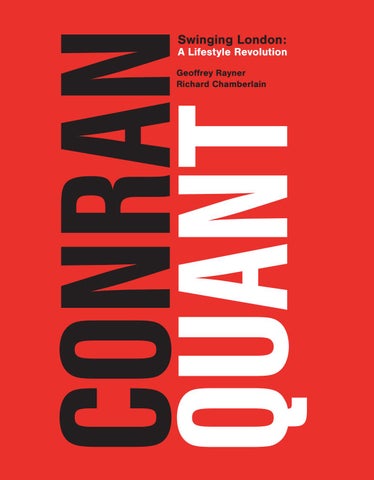
Spanning the period from 1948 - 1972 and presenting everything from ceramics, Cone chairs and stylish cabinets to miniskirts, PVC coats, Sac dresses, textiles and makeup, this book illustrates the vibrancy of the times and the collaborations which intertwined so perfectly. Alongside the designs by Quant and Conran are works by Eduardo Paolozzi, fashions and textiles by Bernard and Laura Ashley and many more.
Swinging London:
A Lifestyle Revolution
Geoffrey Rayner Richard Chamberlain
ISBN: 978-1-78884-011-8
Ă‹xHSLHSIy840118zv;:;:!:!:! ÂŁ40.00/$50.00
www.accartbooks.com
Conran/Quant Cover new.indd 1
CONRAN QUANT
showcases the fashion, design and art of the Chelsea Set; a group of radical young designers and artists who redefined the concept of youth and challenged the established order in 1950s London. At the forefront of this group of young revolutionaries were Mary Quant and Terence Conran.
CONRANQUANT
CONRANQUANT, Swinging London: A Lifestyle Revolution,
Swinging London:
A Lifestyle Revolution
Geoffrey Rayner Richard Chamberlain
04/01/2019 10:52
Table of Contents
7 Introduction 10 Mary Quant: Beginnings © 2019 Geoffrey Rayner and Richard Chamberlain World copyright reserved
12 Enter Alexander Plunket Greene 14 A Landscape of Pleasure: Coffee Bars, Bistros and Brasseries
ISBN: 978 178884 011 8 The rights of Geoffrey Rayner and Richard Chamberlain to be identified as authors of this work have been asserted by them in accordance with the Copyright, Designs and Patents Act 1988
20 Books and Cooks 32 Mary Quant: Bazaar No.1 36 Bazaar No.2. The Conran Connection
All rights reserved. No part of this publication may be reproduced, stored in a retrieval system, or transmitted in any form or by any means electronic, mechanical, photocopying, recording or otherwise, without the prior permission of the publisher
54 Harbingers of Pop
British Library Cataloguing-in-Publication Data A catalogue record for this book is available from the British Library
104 Terence Conran: Early Media Interest
The author and publisher gratefully acknowledge the permission granted to reproduce the copyright material in this book. Every effort has been made to trace copyright holders and to obtain their permission for the use of copyright material. The publisher apologises for any errors or omissions in the text and would be grateful if notified of any corrections that should be incorporated in future reprints or editions of this book.
76 Terence Conran: ‘Meetings with Remarkable Men’ 116 Terence Conran: Early Exhibitions and Initial Recognition 120 Terence Conran: Basketweave and Other Projects 126 Bernard and Laura Ashley: Urban Ruralism 138 Mary Quant: Empire 1961–1970
ENDPAPERS: Textile,‘Plaza,’ screen-printed cotton, designed by the architect John Sayers and printed by Bernard Ashley for Ashley Mountney, c.1955. (© John Sayers)
206 Terence Conran: Habitat 1964–1970
FRONTISPIECE: Advertisement for Long Life Canned Beer, 1960. The first canned beer in Britain, Long Life represented modernity, youth and the new affluent celebrity lifestyle, as epitomised by Mary Quant and her husband Alexander Plunket Greene.
232 Valediction
BACK COVER: (Left) Terence Conran at his first exhibition, 1952. (Photo by Michael Wickham. © Denny Wickham); (Right) Mary Quant outside Bazaar, 1963. (Terence Pepper Collection)
235 Select Bibliography
234 Notes 236 Acknowledgements 237 Image Credits 238 Index
Printed by Graphius Belgium for ACC Art Books Ltd., Woodbridge, Suffolk, England www.accartbooks.com
5
A more indirect but important influence on this nascent Pop culture were the work and theories of the members of the Independent Group, an informal association of young avant-garde artists, architects, intellectuals and critics, who based themselves in London at the then recently formed Institute of Contemporary Arts, the ICA. The sculptor Eduardo Paolozzi, Terence Conran’s great friend and mentor, took, in tandem with his colleague the avant-garde photographer Nigel Henderson, a major part in the Independent Group’s activities. Many of the group’s ideas were more widely disseminated through exhibitions such as Paolozzi’s and Henderson’s ‘Parallel of Life and Art’, organised in collaboration with the Brutalist architects Peter and Alison Smithson at the ICA in 1953. Members of the Group also created the seminally important exhibition ‘This is Tomorrow’, held at the Whitechapel Art Gallery in 1956. Another of the group, the artist Richard Hamilton, famously used the word Pop in his well-known photomontage for the cover of the exhibition’s catalogue. However, it was Paolozzi who first coined the term for his collage of 1947, I Was a Rich Man’s Plaything. Now generally considered the first work of Pop Art, it was originally part of BUNK, the ground-breaking series of collages he presented at the inaugural meeting of the Independent Group in 1952. Within the Group, Paolozzi and Henderson made a considerable contribution to the development of Pop aesthetics and theory. The products of their Hammer Prints workshop, set up in the mid 1950s for the design and production of applied art, gave a foretaste of the often surreal and ironic elevation in Pop design of the mundane and everyday as objects of desire. Throughout the 1950s, an all-pervasive but subtle change was in the air; one which manifested itself not only in the growing phenomenon of the King’s Road and the Chelsea Set, but more significantly in the eruption of coffee bars, bistros, trattorias and other such alien eateries which began to appear on the nation’s high streets at this time. The successful intrusion of these distinctly foreign types of establishments in traditional British street life was, in part, the result of a growing familiarity with continental culture, largely gained through the increasing availability of inexpensive foreign package holidays, the rapid growth of TV ownership and
the impact of movies with exciting European settings and romantic story lines. Outstanding among such films were Audrey Hepburn’s highly acclaimed debut in 1953 in the film Roman Holiday and later, in 1963, Summer Holiday, starring the pop idol Cliff Richard in a teen romance set against the backdrop of Athens and the Parthenon, complete with chart-topping pop songs and the cast decked out in the latest youth fashions. Partly down to these various influences, throughout the later 1950s and early 1960s many young Britons, wanting a more permanent piece of the action on their home turf, began to flirt with such exotic comestibles as spaghetti Bolognese or the drinking of ‘frothy coffee’ in coffee bars from transparent Pyrex cups, invariably accompanied by the somewhat sticky consumption of such delicacies as rum babas or apfelstrudels. Yet, whatever the influence of inexpensive foreign travel or the exciting romantic locations of movies, such as Rome or Athens, without doubt the origins of these somewhat suspect extraneous activities amongst the young in newfangled coffee bars and bistros, also owed something to the widespread success and popularity of the books of the remarkable cookery writer Elizabeth David: A Book of Mediterranean Food and French Country Cooking, published in 1950 and 1951 respectively. By the later 1950s her message was being ably propagated through the advocacy of a coterie of influential cookery writers, either in their columns for leading national newspapers or by the successful co-option in the culinary cause of the then fairly recent medium of television. Referring more generally to the dynamism, energy and enthusiasm generated amongst the young in those early post-war years, the furniture and industrial designer Robin Day wrote:
‘We were dedicated, competitive and filled with evangelical zeal. Living standards were rising dramatically, the austerities and rationing of the war years were lifting and there was a growing feeling of optimism and confidence and anticipation of a bright new world.’ 2
Mary Quant, Knightsbridge, 1961.
8
9
Drawing by Michael Wickham of the young Conran while at Bonneral, France, in 1953. Drawing by Vivien Hislop of the Soup Kitchen’s interior. Published in The Evening News, 1953.
18
19
Drawing by Michael Wickham of the young Conran while at Bonneral, France, in 1953. Drawing by Vivien Hislop of the Soup Kitchen’s interior. Published in The Evening News, 1953.
18
19
The dust jacket of A Book of Mediterranean Food, by Elizabeth David, illustrated by John Minton, 1950. The book is Elizabeth David’s major contribution to the radical change of lifestyle in post-war Britain. 26
The cover of Elizabeth David’s French Country Cooking, illustrated by John Minton. First Penguin edition, 1959. 27
BAZAAR NO.2 THE CONRAN CONNECTION
W
ith the help of Archie McNair’s shrewd business acumen and Plunket Greene’s newly discovered flair for witty publicity and cheeky public relations, Bazaar flourished. So much so, that a little less than two years after its opening in November 1955, a second boutique was opened on Brompton Road in the Knightsbridge area of London. Initially an empty shell in a completely new build, Plunket Greene’s long-term friend Terence Conran was engaged to design both the frontage and interior of the second Bazaar from scratch. The original idea was for Quant, Plunket Greene and McNair to form a joint company with Conran and his second wife Shirley, both of whom were, besides much else, textile designers. Known among themselves as ‘Plunket’s Proposition’, 21 the concept was for the Conrans to design the textiles and Quant the clothes, but, as so often, such enthusiastic youthful plans were to remain unrealized. Quant later recalled that: An invitation to the official opening of Bazaar No. 2 on the 19 November 1958, although the shop had been open for business since late 1957. The invitation is the work of Conran’s long-term friend and professional advisor, the graphic designer Ian Bradbery, a former lecturer at Conran’s alma mater, London’s Central School of Art and Design.
36
‘Terence had a gilded feeling of success about him before anybody else. There used to be page after page written about the Conrans in ‘House & Garden’, in their Regent’s Park Terrace house.
Terence and Shirley never arrived anywhere except on the run.’ 22 Although conran’s design for Bazaar No. 2 was very simple, but extremely elegant in a somewhat austere modernist style, it was also very dramatic. The shop’s frontage, entirely glass from floor to ceiling, was kept clear of any window display, while an open staircase floated down, apparently unsupported, through the centre of the shop from a mezzanine floor. When a fashion show was held, somewhat akin to a 1960s ‘Happening’, it could be seen from the street in its entirety, the models changing in full view on the mezzanine before dancing down the staircase to the sounds of a Modern Jazz combo. When combined with Quant’s radical fashion designs, it’s not difficult to imagine the impact such extraordinary ‘goings on’ had in London in the late 1950s. At one point in the proceedings, in something oddly prescient of Swinging London, an extremely youthful Andrew Loog Oldham – later ‘discoverer’ and highly original, if somewhat controversial, manager of The Rolling Stones – managed to attach himself, after much persistence, to Quant’s entourage in the role of part-time window dresser and selfappointed ‘jack of all trades’, before suddenly ‘swanning’ off – without due notice – to France some nine months later. 23 Plunket Greene and Quant personally celebrated the opening of the second Bazaar by regularising their relationship and getting married that same year; 1957 was an important milestone for them. For the interior of Bazaar No. 2, Conran selected lighting by the sculptor and designer Bernard Schottlander, an associate of Conran’s from his time at the Central School of Art. Schottlander’s lighting designs, some of which rival, and often predate, the best by his French and Italian contemporaries, were among the coolest available in Britain in the late 1950s.24 Somewhat prescient of the future Habitat style, Conran chose for some of the boutique’s seating relatively inexpensive elegant black lacquered chairs with rush seats, which he’d been importing from Italy since at least 1955. Among other accessories in period photos of the interior are what appear to be examples of Fornasetti waste bins, although they may also have been by Conran himself, or even products of Paolozzi and Henderson’s Hammer Prints workshop.
37
Buster jerkin illustrated in J.C. Penney’s Catalogue, 1969.
170
Jerkin in The Beatles’ ‘Sgt Pepper’ style, from Quant’s Buster range, a unisex group of clothing for J.C. Penney, 1969.
171
Buster jerkin illustrated in J.C. Penney’s Catalogue, 1969.
170
Jerkin in The Beatles’ ‘Sgt Pepper’ style, from Quant’s Buster range, a unisex group of clothing for J.C. Penney, 1969.
171
Spanning the period from 1948 - 1972 and presenting everything from ceramics, Cone chairs and stylish cabinets to miniskirts, PVC coats, Sac dresses, textiles and makeup, this book illustrates the vibrancy of the times and the collaborations which intertwined so perfectly. Alongside the designs by Quant and Conran are works by Eduardo Paolozzi, fashions and textiles by Bernard and Laura Ashley and many more.
Swinging London:
A Lifestyle Revolution
Geoffrey Rayner Richard Chamberlain
ISBN: 978-1-78884-011-8
Ă‹xHSLHSIy840118zv;:;:!:!:! ÂŁ40.00/$50.00
www.accartbooks.com
Conran/Quant Cover new.indd 1
CONRAN QUANT
showcases the fashion, design and art of the Chelsea Set; a group of radical young designers and artists who redefined the concept of youth and challenged the established order in 1950s London. At the forefront of this group of young revolutionaries were Mary Quant and Terence Conran.
CONRANQUANT
CONRANQUANT, Swinging London: A Lifestyle Revolution,
Swinging London:
A Lifestyle Revolution
Geoffrey Rayner Richard Chamberlain
04/01/2019 10:52