Foreword Where It All Began
“ ‘All of me is Illustrated. Look.’ He opened his hand. On his palm was a rose, freshly cut, with drops of crystal water among the soft pink petals. I put my hand out to touch it, but it was only an Illustration. “ As for the rest of him, I cannot say how I sat and stared, for he was a riot of rockets and fountains and people, in such intricate detail and color that you could hear the voices murmuring small and muted, from the crowds that inhabited his body.” — THE ILLUSTRATED MAN BY RAY BRADBURY
n my youth, I was a voracious consumer of science fiction and fantasy. Growing up in the ’50s and ’60s, the magical worlds in books, films, comics, and television shows like The Twilight Zone captured my imagination and fueled the creative impulses that would later inform my art. Ray Bradbury was a favorite, and one book in particular stuck with me: his classic collection The Illustrated Man, the central story of which features a roadside encounter with a strange man covered in tattoos. The tale’s narrator gazes in wonder from one tattoo to the next, as they each come alive and reveal their stories. At this time, tattooing was not as mainstream as it has certainly become today and, to the best of my knowledge, none of my friends or family had tattoos. They were associated with people on the fringes of cultured and polite society, individuals with an air of danger. I bought my first SLR film camera as a teenager in the late ’60s. I was working in my local camera store in the Bronx and had visions of becoming a fine art photographer. I enjoyed the process and solitude of darkroom photography, as well as its artistic challenges. More than that, I loved how the medium gave me the opportunity to meet interesting people—my favorite subject matter—and loved the energy of those intimate moments working in the studio with amazing individuals I might never have had the chance to meet otherwise. It wasn’t until I was in my late 20s, a college graduate building a career as an artist, that I had the idea of photographing people with tattoos. However, I had no immediate access to willing and available subjects. At the time, tattooing was illegal in New York City thanks to a ban enacted in
1961, though there was still a thriving underground community. Nevertheless, the desire to undertake this adventure, and the potential visual story I wished to explore and convey, continued to fascinate me and would not go away. I asked friends what they thought of my idea. Some said it sounded interesting. Others said I was asking for trouble— that it would be dangerous to be alone in a studio with the kind of stranger who would have tattoos. I was, admittedly, nervous myself, but I also felt that the camera could be my passport to this exotic and mysterious world. When a friend said they knew someone who might be interested in sitting for me, I decided I had to take a chance. I got her number. Her name was Julie, and she lived and worked as a bartender on the Lower East Side of Manhattan. We set a date. The morning of the session, Julie called to ask if it would be all right if she brought her friend, Angela, along, as she also had tattoos and was interested in sitting for a portrait. When they appeared at the door of my two-room studio apartment in Kew Gardens, Queens, I escorted them into my makeshift photo studio—a living room/kitchen area that I converted by moving my sofa bed, tacking a backdrop on the wall, and setting up my light, umbrella, and tripod. They took several minutes to prepare for the session, and then I individually photographed their portraits. Julie and Angela had compelling tattoo-work and were a sheer delight to work with, and upon seeing those first negatives and chromes, I was hooked. Thrilled and relieved by such a promising start, and with a newfound confidence, I placed an ad in The Village Voice seeking male and female models with interesting tattoos. Soon enough, I started receiving calls. In the
I
Detail of a street map, Brooklyn, New York. Hagstrom Map Company, NY, 1944.
8
9
Foreword Where It All Began
“ ‘All of me is Illustrated. Look.’ He opened his hand. On his palm was a rose, freshly cut, with drops of crystal water among the soft pink petals. I put my hand out to touch it, but it was only an Illustration. “ As for the rest of him, I cannot say how I sat and stared, for he was a riot of rockets and fountains and people, in such intricate detail and color that you could hear the voices murmuring small and muted, from the crowds that inhabited his body.” — THE ILLUSTRATED MAN BY RAY BRADBURY
n my youth, I was a voracious consumer of science fiction and fantasy. Growing up in the ’50s and ’60s, the magical worlds in books, films, comics, and television shows like The Twilight Zone captured my imagination and fueled the creative impulses that would later inform my art. Ray Bradbury was a favorite, and one book in particular stuck with me: his classic collection The Illustrated Man, the central story of which features a roadside encounter with a strange man covered in tattoos. The tale’s narrator gazes in wonder from one tattoo to the next, as they each come alive and reveal their stories. At this time, tattooing was not as mainstream as it has certainly become today and, to the best of my knowledge, none of my friends or family had tattoos. They were associated with people on the fringes of cultured and polite society, individuals with an air of danger. I bought my first SLR film camera as a teenager in the late ’60s. I was working in my local camera store in the Bronx and had visions of becoming a fine art photographer. I enjoyed the process and solitude of darkroom photography, as well as its artistic challenges. More than that, I loved how the medium gave me the opportunity to meet interesting people—my favorite subject matter—and loved the energy of those intimate moments working in the studio with amazing individuals I might never have had the chance to meet otherwise. It wasn’t until I was in my late 20s, a college graduate building a career as an artist, that I had the idea of photographing people with tattoos. However, I had no immediate access to willing and available subjects. At the time, tattooing was illegal in New York City thanks to a ban enacted in
1961, though there was still a thriving underground community. Nevertheless, the desire to undertake this adventure, and the potential visual story I wished to explore and convey, continued to fascinate me and would not go away. I asked friends what they thought of my idea. Some said it sounded interesting. Others said I was asking for trouble— that it would be dangerous to be alone in a studio with the kind of stranger who would have tattoos. I was, admittedly, nervous myself, but I also felt that the camera could be my passport to this exotic and mysterious world. When a friend said they knew someone who might be interested in sitting for me, I decided I had to take a chance. I got her number. Her name was Julie, and she lived and worked as a bartender on the Lower East Side of Manhattan. We set a date. The morning of the session, Julie called to ask if it would be all right if she brought her friend, Angela, along, as she also had tattoos and was interested in sitting for a portrait. When they appeared at the door of my two-room studio apartment in Kew Gardens, Queens, I escorted them into my makeshift photo studio—a living room/kitchen area that I converted by moving my sofa bed, tacking a backdrop on the wall, and setting up my light, umbrella, and tripod. They took several minutes to prepare for the session, and then I individually photographed their portraits. Julie and Angela had compelling tattoo-work and were a sheer delight to work with, and upon seeing those first negatives and chromes, I was hooked. Thrilled and relieved by such a promising start, and with a newfound confidence, I placed an ad in The Village Voice seeking male and female models with interesting tattoos. Soon enough, I started receiving calls. In the
I
Detail of a street map, Brooklyn, New York. Hagstrom Map Company, NY, 1944.
8
9
My Brief Life in Tattoos: The Coney Island Tattoo Festival BY AMY KRAKOW
was hanging around before a board meeting for the Bond Street Theater Coalition, one of the last remaining street theater companies in the nation, a vestige of the ’60s, when I turned to its founders to offer a suggestion. It was 1984, Reagan was in the White House, I was working at The Village Voice, I had a background in festival producing, and I smelled change in the air. Hell, it was all over MTV. “How about a tattoo festival? You should see all the rock ‘n’ rollers with tattoos! I’ll produce it … you’ll make the money. My way of making a contribution to Bond Street.” The founders were speechless. Their expressions spoke volumes. They looked at me as if I were beyond crazy. They tactfully tap-danced around why they thought such an event would not be in keeping with the Mime Festival, Clown College, the Chinese Acrobats, and other respected street theater performances scheduled for that coming summer. And they continued to look at me as if, as if … I were tattooed. Several months later, I broached the subject with Coney Island USA. I was a board member there too. “Let’s put on a tattoo festival,” I said, again. “Coney Island has an amazing history of tattooing, with tattoo shops up and down the Boardwalk before tattooing became illegal in NYC.” “Great idea, Amy,” said Dick Zigun, founder of Coney Island USA and Sideshows by the Seashore, and Board President Costa Mantis. “You know how to do festivals! You put on those great festivals of street performers! Come on. Give us a tattoo festival.” Never one to shirk from a challenge, I agreed. In fact, it was reported that one of the reasons NYC outlawed tattooing in the early 1960s was because of an incident in Coney Island. Paul Ortloff, by then the owner of Shooting Star Tattoos in Fleischmanns, New York, the man who actually organized tattooists well before anyone else, back in the early 1970s, and then staged the first tattoo convention, was the very same person involved in the incident in Coney Island that he claimed made tattooing in NYC a health code violation. He was a young teenager in Brooklyn and got a case of blood poisoning as he called it, but in reality it was Hepatitis B, from his Coney Island tattoo. His father, an attorney, was furious with his independent young son and sought vengeance. He received it in the form of the health
code violation against tattoos. According to Damon Root, writing in the March 8, 2014 Reason.com, “the story of New York City’s tattoo ban presents the classic case of government regulators using a bogus public health pretext to hound an unpopular activity out of existence. Pointing to a non-existent link between tattooing and a minor outbreak of Hepatitis B.” Actually, it wasn’t non-existent. It did happen, and it was because of the very strong political connections of the attorney father that “city officials went on the attack, declaring, ‘the tattoo industry from a public health point of view … [is] not regulatable.’ According to the government, only a total ban would save the citizenry.” And so, in 1961, New York City (and several states) declared it “‘unlawful for any person to tattoo a human being,’ a prohibition that remained on the books for nearly four decades, until the city finally re-legalized the tattoo trade in 1997.” So, a tattoo festival in Coney Island in 1984? Little did I know what I’d be in for. I had no tattoos myself and no idea where to get one. Well, I sort of had an idea. The legendary Spider Webb advertised on the back page of the Voice, and I had visited his studio in the early ’70s to get a tattoo before chickening out. But by 1984, tattooing was relatively underground in NYC. You couldn’t walk into a tattoo shop on St. Mark’s or 23rd Street or in Williamsburg, or anyplace else in the city, for that matter. You had to know who, what, where, have someone vouch for you, and then make an appointment. To thumb his nose … and other body parts … at the authorities and the ban, Spider had tattooed Annie Sprinkle—porn star, performance artist, and founder of the Ecosex Movement—right on the steps of the Metropolitan Museum of Art and received oodles of press. So, I called Spider. I think I left three voicemails: “I’d like to meet with you … I’m planning on producing a tattoo festival in Coney Island.” I was naïve. I know now that there was no way Spider would return a phone call from someone who wasn’t even looking to get a tattoo. But I was and am a woman of my word, and I was determined to do this festival. Coney Island USA needed money, and I really loved the new interest in tattoos that I was seeing on MTV… When I was a little girl, five years old-or-so, I delighted in looking at the flash in the windows of the tattoo shops on Flatbush Avenue near Atlantic—pre-
I
14
15
My Brief Life in Tattoos: The Coney Island Tattoo Festival BY AMY KRAKOW
was hanging around before a board meeting for the Bond Street Theater Coalition, one of the last remaining street theater companies in the nation, a vestige of the ’60s, when I turned to its founders to offer a suggestion. It was 1984, Reagan was in the White House, I was working at The Village Voice, I had a background in festival producing, and I smelled change in the air. Hell, it was all over MTV. “How about a tattoo festival? You should see all the rock ‘n’ rollers with tattoos! I’ll produce it … you’ll make the money. My way of making a contribution to Bond Street.” The founders were speechless. Their expressions spoke volumes. They looked at me as if I were beyond crazy. They tactfully tap-danced around why they thought such an event would not be in keeping with the Mime Festival, Clown College, the Chinese Acrobats, and other respected street theater performances scheduled for that coming summer. And they continued to look at me as if, as if … I were tattooed. Several months later, I broached the subject with Coney Island USA. I was a board member there too. “Let’s put on a tattoo festival,” I said, again. “Coney Island has an amazing history of tattooing, with tattoo shops up and down the Boardwalk before tattooing became illegal in NYC.” “Great idea, Amy,” said Dick Zigun, founder of Coney Island USA and Sideshows by the Seashore, and Board President Costa Mantis. “You know how to do festivals! You put on those great festivals of street performers! Come on. Give us a tattoo festival.” Never one to shirk from a challenge, I agreed. In fact, it was reported that one of the reasons NYC outlawed tattooing in the early 1960s was because of an incident in Coney Island. Paul Ortloff, by then the owner of Shooting Star Tattoos in Fleischmanns, New York, the man who actually organized tattooists well before anyone else, back in the early 1970s, and then staged the first tattoo convention, was the very same person involved in the incident in Coney Island that he claimed made tattooing in NYC a health code violation. He was a young teenager in Brooklyn and got a case of blood poisoning as he called it, but in reality it was Hepatitis B, from his Coney Island tattoo. His father, an attorney, was furious with his independent young son and sought vengeance. He received it in the form of the health
code violation against tattoos. According to Damon Root, writing in the March 8, 2014 Reason.com, “the story of New York City’s tattoo ban presents the classic case of government regulators using a bogus public health pretext to hound an unpopular activity out of existence. Pointing to a non-existent link between tattooing and a minor outbreak of Hepatitis B.” Actually, it wasn’t non-existent. It did happen, and it was because of the very strong political connections of the attorney father that “city officials went on the attack, declaring, ‘the tattoo industry from a public health point of view … [is] not regulatable.’ According to the government, only a total ban would save the citizenry.” And so, in 1961, New York City (and several states) declared it “‘unlawful for any person to tattoo a human being,’ a prohibition that remained on the books for nearly four decades, until the city finally re-legalized the tattoo trade in 1997.” So, a tattoo festival in Coney Island in 1984? Little did I know what I’d be in for. I had no tattoos myself and no idea where to get one. Well, I sort of had an idea. The legendary Spider Webb advertised on the back page of the Voice, and I had visited his studio in the early ’70s to get a tattoo before chickening out. But by 1984, tattooing was relatively underground in NYC. You couldn’t walk into a tattoo shop on St. Mark’s or 23rd Street or in Williamsburg, or anyplace else in the city, for that matter. You had to know who, what, where, have someone vouch for you, and then make an appointment. To thumb his nose … and other body parts … at the authorities and the ban, Spider had tattooed Annie Sprinkle—porn star, performance artist, and founder of the Ecosex Movement—right on the steps of the Metropolitan Museum of Art and received oodles of press. So, I called Spider. I think I left three voicemails: “I’d like to meet with you … I’m planning on producing a tattoo festival in Coney Island.” I was naïve. I know now that there was no way Spider would return a phone call from someone who wasn’t even looking to get a tattoo. But I was and am a woman of my word, and I was determined to do this festival. Coney Island USA needed money, and I really loved the new interest in tattoos that I was seeing on MTV… When I was a little girl, five years old-or-so, I delighted in looking at the flash in the windows of the tattoo shops on Flatbush Avenue near Atlantic—pre-
I
14
15
The Tastes of Misfits: The Joyously Stubborn Persistence of Tattooing at Coney Island BY DR MATT LODDER
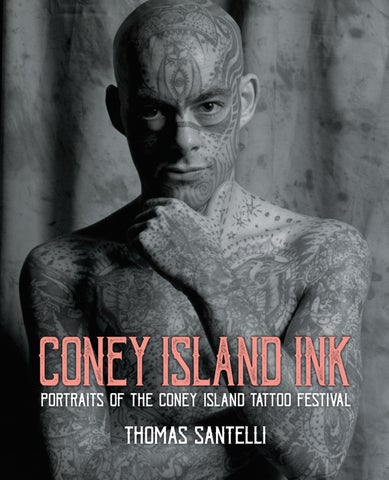
his book collects Thomas Santelli’s empathetic photography of tattooed New Yorkers, all snapped at the Coney Island Tattoo Festival in the late 1980s. It is impossible to understand the true cultural force of the photography compiled here without fully appreciating the historical and social tensions which intersected around them—a defiant, stubborn, joyous celebration of tattooing in a place which had long celebrated and nurtured it, at a time where it had already been illegal for more than 20 years. The New York Board of Health ordered all tattoo studios in the city to close by 1st November, 1961. The ban was ostensibly enacted to help curb a particularly virulent outbreak of hepatitis, with at least 30 cases attributable to tattooing recorded in the preceding two years. In 1959, three 19-year-old teens were hospitalized for several months in cases linked to tattoos acquired at Coney Island that summer, and one ultimately died, leading a health department spokesman to announce for the first time that tattoo shops found to be unsanitary would be forcibly shut down. Though reopening briefly after an initial period of inspection immediately following the Coney Island outbreak, the ban became permanent two years later. The New York Times reported that there were eight working tattoo artists in New York at the time, serving approximately 10,000 customers per year—three in Manhattan, the rest in Coney Island. Sensationalist pulp magazine Vice Squad put the story in rather less pragmatic terms: “From Coney Island to the rat-infested slums of Manhattan, the needle-artists responded to the shutdown by squealing like stuck pigs … The city knew what it was doing. It was the only way to wipe out the sick, dangerous practice.” Indeed, whilst the city’s immediate concerns in banning tattooing were framed in the paternalistic language and mechanisms of public health, this prurient account reveals a broader, more deeply rooted social panic about tattooing and the kind of people whom the moral guardians of New York’s crumbling post-war social order imagined had tattoos. “What the city didn’t mention, and which none of the operators of these disease dens brought up,” the Vice Squad article frothed, “is that tattoo parlors have consistently pandered to the perverted tastes of homosexuals, lesbians, masochists and other sexual misfits!” This was not a novel concern. By 1960, there had been
tattoo shops in New York City for almost exactly a century. German immigrant Martin Hildebrandt, who is widely credited as being the forefather of modern tattooing, opened the first public-facing, listed, professional tattoo studio in the Western world inside a saloon bar on Water Street in Lower Manhattan around 1859. Though the development of the industry stuttered slightly due to the Civil War, by the early 1870s, Hildebrandt was being hailed as the finest tattooer in America when compared to “bungling” competitors in cities such as Boston and Chicago. By the end of the 19th century, New York-based tattooer Samuel O’Reilly had registered the first patent for an electric tattoo machine, firmly cementing the city’s global reputation as a hub for modern tattooing. But throughout these early decades of the professional era of tattooing in New York, as artists boasted of high-class customers drawn from the city’s elite, various arms of the municipal government sought ways to curb their business due to concerns about vice. The New York Society for the Prohibition of Cruelty to Children, for example, drove the prosecution of several tattooers, including O’Reilly himself, for tattooing minor teenagers in 1906 and referred at least two young women to brutal reformatory institutions, ostensibly to cure them of any corruptive desire to get tattooed.
T
A candidly posed double portrait, from the first Coney Island Tattoo Festival in 1986, of legendary tattoo artist, author, actor, and founder of International Tattoo Art magazine Jonathan Shaw, “Tattoo Artist to the Stars.” The founder of Fun City Tattoo in the mid ’70s, which remains Manhattan’s oldest tattoo shop, Jonathan is a revolutionary artist whose innovative old-school and neo-tribal style and iconic legacy have inspired generations of new artists who share his devotion to maintaining tattooing’s sacred traditions.
18
TATTOO HISTORY AT CONEY ISLAND Coney Island, jutting into the sea at the southwestern point of Brooklyn, had been a destination for amusements and leisure since about 1829, when its first resort hotel was constructed. Nevertheless, it is no coincidence that the emergence of professional tattooing in the city of New York during the latter decades of the 19th century mirrors the initial rise in tourism to Coney Island during the same period. During the summer, at its height, hundreds of thousands of travelers took trains and trolleys from across the five boroughs, drawn like moths to the brightly burning electric lights of Coney’s fairgrounds, flophouses, and fortune-tellers, shooting galleries, dance halls, and saloons. Though starting in the wharfs and alleys of Manhattan, by the 1880s, professional tattooing was firmly established as part of the repertoire of bawdy amusements on offer to visitors to Coney Island too, both on the bodies of per-
19
The Tastes of Misfits: The Joyously Stubborn Persistence of Tattooing at Coney Island BY DR MATT LODDER
his book collects Thomas Santelli’s empathetic photography of tattooed New Yorkers, all snapped at the Coney Island Tattoo Festival in the late 1980s. It is impossible to understand the true cultural force of the photography compiled here without fully appreciating the historical and social tensions which intersected around them—a defiant, stubborn, joyous celebration of tattooing in a place which had long celebrated and nurtured it, at a time where it had already been illegal for more than 20 years. The New York Board of Health ordered all tattoo studios in the city to close by 1st November, 1961. The ban was ostensibly enacted to help curb a particularly virulent outbreak of hepatitis, with at least 30 cases attributable to tattooing recorded in the preceding two years. In 1959, three 19-year-old teens were hospitalized for several months in cases linked to tattoos acquired at Coney Island that summer, and one ultimately died, leading a health department spokesman to announce for the first time that tattoo shops found to be unsanitary would be forcibly shut down. Though reopening briefly after an initial period of inspection immediately following the Coney Island outbreak, the ban became permanent two years later. The New York Times reported that there were eight working tattoo artists in New York at the time, serving approximately 10,000 customers per year—three in Manhattan, the rest in Coney Island. Sensationalist pulp magazine Vice Squad put the story in rather less pragmatic terms: “From Coney Island to the rat-infested slums of Manhattan, the needle-artists responded to the shutdown by squealing like stuck pigs … The city knew what it was doing. It was the only way to wipe out the sick, dangerous practice.” Indeed, whilst the city’s immediate concerns in banning tattooing were framed in the paternalistic language and mechanisms of public health, this prurient account reveals a broader, more deeply rooted social panic about tattooing and the kind of people whom the moral guardians of New York’s crumbling post-war social order imagined had tattoos. “What the city didn’t mention, and which none of the operators of these disease dens brought up,” the Vice Squad article frothed, “is that tattoo parlors have consistently pandered to the perverted tastes of homosexuals, lesbians, masochists and other sexual misfits!” This was not a novel concern. By 1960, there had been
tattoo shops in New York City for almost exactly a century. German immigrant Martin Hildebrandt, who is widely credited as being the forefather of modern tattooing, opened the first public-facing, listed, professional tattoo studio in the Western world inside a saloon bar on Water Street in Lower Manhattan around 1859. Though the development of the industry stuttered slightly due to the Civil War, by the early 1870s, Hildebrandt was being hailed as the finest tattooer in America when compared to “bungling” competitors in cities such as Boston and Chicago. By the end of the 19th century, New York-based tattooer Samuel O’Reilly had registered the first patent for an electric tattoo machine, firmly cementing the city’s global reputation as a hub for modern tattooing. But throughout these early decades of the professional era of tattooing in New York, as artists boasted of high-class customers drawn from the city’s elite, various arms of the municipal government sought ways to curb their business due to concerns about vice. The New York Society for the Prohibition of Cruelty to Children, for example, drove the prosecution of several tattooers, including O’Reilly himself, for tattooing minor teenagers in 1906 and referred at least two young women to brutal reformatory institutions, ostensibly to cure them of any corruptive desire to get tattooed.
T
A candidly posed double portrait, from the first Coney Island Tattoo Festival in 1986, of legendary tattoo artist, author, actor, and founder of International Tattoo Art magazine Jonathan Shaw, “Tattoo Artist to the Stars.” The founder of Fun City Tattoo in the mid ’70s, which remains Manhattan’s oldest tattoo shop, Jonathan is a revolutionary artist whose innovative old-school and neo-tribal style and iconic legacy have inspired generations of new artists who share his devotion to maintaining tattooing’s sacred traditions.
18
TATTOO HISTORY AT CONEY ISLAND Coney Island, jutting into the sea at the southwestern point of Brooklyn, had been a destination for amusements and leisure since about 1829, when its first resort hotel was constructed. Nevertheless, it is no coincidence that the emergence of professional tattooing in the city of New York during the latter decades of the 19th century mirrors the initial rise in tourism to Coney Island during the same period. During the summer, at its height, hundreds of thousands of travelers took trains and trolleys from across the five boroughs, drawn like moths to the brightly burning electric lights of Coney’s fairgrounds, flophouses, and fortune-tellers, shooting galleries, dance halls, and saloons. Though starting in the wharfs and alleys of Manhattan, by the 1880s, professional tattooing was firmly established as part of the repertoire of bawdy amusements on offer to visitors to Coney Island too, both on the bodies of per-
19
Here is Coney Island
1
BY AMY SHEARN
“ Hi what’s there to say, I once rode the cyclone for 20 times without getting off,” —POST IN A CONEY ISLAND MEMORIES FACEBOOK GROUP
n any person who desires such prizes, Coney Island will bestow the gift of a spectacle and the gift of the sea. Are these polar opposites or, spiritually, the same? It depends on what mood the tides are in when you happen to visit. Or maybe I mean it depends on what mood you are in. Here’s one thing I know for sure: A trip to Coney Island can never be dull. First, the subway station. Stillwell Avenue, bleats the announcer in a voice you can only understand if you already knew what they were going to say. Maybe you’ve been riding a long way with your swimsuit underneath your clothes. Maybe your heart flips a little: There’s the Cyclone roller coaster cycloning away just beyond the train’s window. The station itself, oddly capacious, with the soaring ceilings and crisscrossing ramps of a European rail hub. On the right sort of day, sunlight streams through the glass brick wall’s mural (My Coney Island Baby, Robert Wilson, 2004), a poor man’s bible of Coney Island culture—here is a carousel, here is a hot dog. It glows like stained glass, and maybe you have entered a church of sorts. The Holy Church of Distilled Weirdness. An odd diorama greets visitors: a life-size lifeguard chair jauntily perched on an artificial dune, presenting a dire sign about sharks and riptides, because welcome to the Atlantic Ocean, babe, you better be ready. Next, the vendor gauntlet. Acclimating to Coney Island means you’ll never be prepared for any other beach day because here one can live in the present, planless; here you don’t need to have brought anything with you. Everything is for sale, usually cheap. Grab a corny beach towel, a sunshade with the structural integrity of a paper cocktail umbrella. Pick up sunscreen, coffee, donut, commemorative T-shirt, blow-up SpongeBob SquarePants, and only now do you exit the subway station into the blaring sun.
Like every place in New York, you’ve had to work to get here. But now, you’re here.
O
1
••• Every sense you have will be assaulted, which depending upon your temperament is either Coney Island’s greatest gift or dreaded downfall. Out on the sidewalk spills every sort of person you’ve ever imagined, like a children’s book about diversity come to life. If you’re bringing your own children, shield their eyes from the hulking candy stores— but keep them in mind as a useful bribe when it’s time to leave. Cross Surf Avenue and head to the Boardwalk, where the sea breeze licks your face, its salty breath somehow disgusting and refreshing at the same time. Now is when you remember that there are two Coney Islands: the Coney Island of the person who stays on the shore and the Coney Island of the person who braves the sea. If you don’t know which you are, you’ll soon find out. What the Boardwalk lacks in terms of the cuteness of a Cape May or a Montauk, it makes up for in sheer Coney Island-ness. The current vibe is smack-dab in between the seedy saloon-like gangsters-and-molls Coney Island of the 19th century and the family-friendly versions that followed. The boards shift beneath your feet, rumbling when a shirtless man bullets by on an unauthorized bike, blasting Biggie Smalls from a boom box. There’s the smell of the sea—saline-forward with a fishy finish—mingled with the greasy tide of corn dogs and french fries. The heat of the sun; the cooling wind rollicking off the Atlantic. The expanse of sand dotted with towels and tents; the glitter of the sea. There’s the guy with the pit bull wearing sunglasses. There’s the woman dressed head-to-toe in lime green. There’s the barker bullying you into singing boardwalk karaoke or—once upon a time—playing Shoot the Freak (RIP to that concatenation
The Coney Island Boardwalk, facing west, late afternoon, summer of 1986.
With thanks/apologies to E. B. White’s Here is New York
118
119
Here is Coney Island
1
BY AMY SHEARN
“ Hi what’s there to say, I once rode the cyclone for 20 times without getting off,” —POST IN A CONEY ISLAND MEMORIES FACEBOOK GROUP
n any person who desires such prizes, Coney Island will bestow the gift of a spectacle and the gift of the sea. Are these polar opposites or, spiritually, the same? It depends on what mood the tides are in when you happen to visit. Or maybe I mean it depends on what mood you are in. Here’s one thing I know for sure: A trip to Coney Island can never be dull. First, the subway station. Stillwell Avenue, bleats the announcer in a voice you can only understand if you already knew what they were going to say. Maybe you’ve been riding a long way with your swimsuit underneath your clothes. Maybe your heart flips a little: There’s the Cyclone roller coaster cycloning away just beyond the train’s window. The station itself, oddly capacious, with the soaring ceilings and crisscrossing ramps of a European rail hub. On the right sort of day, sunlight streams through the glass brick wall’s mural (My Coney Island Baby, Robert Wilson, 2004), a poor man’s bible of Coney Island culture—here is a carousel, here is a hot dog. It glows like stained glass, and maybe you have entered a church of sorts. The Holy Church of Distilled Weirdness. An odd diorama greets visitors: a life-size lifeguard chair jauntily perched on an artificial dune, presenting a dire sign about sharks and riptides, because welcome to the Atlantic Ocean, babe, you better be ready. Next, the vendor gauntlet. Acclimating to Coney Island means you’ll never be prepared for any other beach day because here one can live in the present, planless; here you don’t need to have brought anything with you. Everything is for sale, usually cheap. Grab a corny beach towel, a sunshade with the structural integrity of a paper cocktail umbrella. Pick up sunscreen, coffee, donut, commemorative T-shirt, blow-up SpongeBob SquarePants, and only now do you exit the subway station into the blaring sun.
Like every place in New York, you’ve had to work to get here. But now, you’re here.
O
1
••• Every sense you have will be assaulted, which depending upon your temperament is either Coney Island’s greatest gift or dreaded downfall. Out on the sidewalk spills every sort of person you’ve ever imagined, like a children’s book about diversity come to life. If you’re bringing your own children, shield their eyes from the hulking candy stores— but keep them in mind as a useful bribe when it’s time to leave. Cross Surf Avenue and head to the Boardwalk, where the sea breeze licks your face, its salty breath somehow disgusting and refreshing at the same time. Now is when you remember that there are two Coney Islands: the Coney Island of the person who stays on the shore and the Coney Island of the person who braves the sea. If you don’t know which you are, you’ll soon find out. What the Boardwalk lacks in terms of the cuteness of a Cape May or a Montauk, it makes up for in sheer Coney Island-ness. The current vibe is smack-dab in between the seedy saloon-like gangsters-and-molls Coney Island of the 19th century and the family-friendly versions that followed. The boards shift beneath your feet, rumbling when a shirtless man bullets by on an unauthorized bike, blasting Biggie Smalls from a boom box. There’s the smell of the sea—saline-forward with a fishy finish—mingled with the greasy tide of corn dogs and french fries. The heat of the sun; the cooling wind rollicking off the Atlantic. The expanse of sand dotted with towels and tents; the glitter of the sea. There’s the guy with the pit bull wearing sunglasses. There’s the woman dressed head-to-toe in lime green. There’s the barker bullying you into singing boardwalk karaoke or—once upon a time—playing Shoot the Freak (RIP to that concatenation
The Coney Island Boardwalk, facing west, late afternoon, summer of 1986.
With thanks/apologies to E. B. White’s Here is New York
118
119
46
47
46
47
Internationally renowned painter, actor, writer, co-president of the Tattoo Society of New York, film director, and president of Roussimoff Films Ari Roussimoff was asked to utilize his uniquely individual style and dramatic “over-the-top” stage presence when he followed in Costa’s footsteps as the second moderator of the Coney Island Tattoo Festival.
70
71
Internationally renowned painter, actor, writer, co-president of the Tattoo Society of New York, film director, and president of Roussimoff Films Ari Roussimoff was asked to utilize his uniquely individual style and dramatic “over-the-top” stage presence when he followed in Costa’s footsteps as the second moderator of the Coney Island Tattoo Festival.
70
71
82
83
82
83
94
95
94
95
98
99
98
99