C
O
N
T
E
N
T
S
For Erato
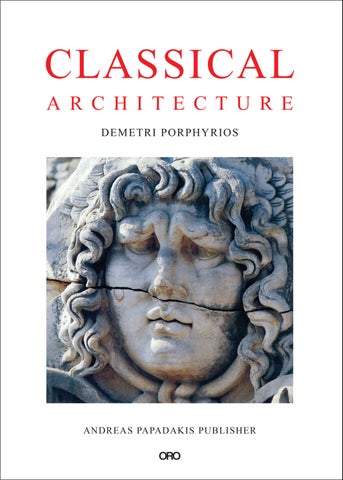
FRONT COVER: Fragment of frieze depicting head of Gorgon, Temple of Apollo at Didyma, c. 2nd century AD BACK COVER: Andronikos of Kyrrhos, Horologion, known as Tower of the Winds, detail, Athens, c. middle 1st century BC
We would like to thank the following copyright holders for permission to reproduce texts in the Appendix: Harvard University Press, Plato, The Republic, HN Hubbell, Cicero in twenty-eight Volumes, Pliny, Natural History, and Vitruvius, On Architecture; Dover Publications, New York, SH Butcher, Aristotle’s Theory of Poetry and Fine Art with a Critical Text and Translation of ‘The Poetics,’ and Eugene-Emmanuel Viollet-le-Duc, Lectures on Architecture; Everyman’s Library, The Complete Works of Horace; Oxford University Press, GWF Hegel, Aesthetics: Lectures on Fine Art; Johns Hopkins University Press, GE Lessing, Laocoön; Cambridge University Press, Gottfried Semper, The Four Elements of Architecture; 9H, Heinrich Tessenow, House-Building and Such Things
All colour images photographed by the author
First paperback edition published in Great Britain in 1998 by Andreas Papadakis Publisher an imprint of Cranbourne Investments International Limited, Kilbees Farm, Hatchet Lane, Windsor, Berks SL4 2EH Copyright © 1998 Demetri Porphyrios All rights reserved No part of this publication may be reproduced or transmitted in any form or by any means, electronic or mechanical, including facsimile, photocopying, recording or any information storage or retrieval system without the written permission of the Publisher. ISBN O 901092 06 2 Printed in Singapore
ABOVE: G Trissino, Villa Trissino, Cricoli, c 1532-38
PREFACE 6 I IMITATION IN ARCHITECTURE 10 II FROM TECHNE TO TECTONICS 28 III THE CLASSICAL ORDER 40 IV CHARACTER AND STYLE 54 V COMMON SENSE 68 VI TRADITION AND THE NEW 84 APPENDIX 102 Plato, The Republic, 104; Aristotle, The Poetics, 106; Horace, The Art of Poetry, 108; Cicero, On Invention, 110; Pliny, Natural History, 114; Vitruvius, On Architecture, 116; Alberti, Ten Books on Architecture, 120; Immanuel Kant, Critique of Judgement, 126; GE Lessing, Laocoön, 130; GWF Hegel, Aesthetics, 134; Quatremère de Quincy, On Imitation, 140; Eugène-Emmanuel Viollet-le-Duc, Lectures on Architecture, 144; Gottfried Semper, The Four Elements of Architecture, 148; Heinrich Tessenow, House-Building and Such Things, 152. INDEX 154
28079_Int.indd 4-5
18/3/2026 3:46 PM
C
O
N
T
E
N
T
S
For Erato
FRONT COVER: Fragment of frieze depicting head of Gorgon, Temple of Apollo at Didyma, c. 2nd century AD BACK COVER: Andronikos of Kyrrhos, Horologion, known as Tower of the Winds, detail, Athens, c. middle 1st century BC
We would like to thank the following copyright holders for permission to reproduce texts in the Appendix: Harvard University Press, Plato, The Republic, HN Hubbell, Cicero in twenty-eight Volumes, Pliny, Natural History, and Vitruvius, On Architecture; Dover Publications, New York, SH Butcher, Aristotle’s Theory of Poetry and Fine Art with a Critical Text and Translation of ‘The Poetics,’ and Eugene-Emmanuel Viollet-le-Duc, Lectures on Architecture; Everyman’s Library, The Complete Works of Horace; Oxford University Press, GWF Hegel, Aesthetics: Lectures on Fine Art; Johns Hopkins University Press, GE Lessing, Laocoön; Cambridge University Press, Gottfried Semper, The Four Elements of Architecture; 9H, Heinrich Tessenow, House-Building and Such Things
All colour images photographed by the author
First paperback edition published in Great Britain in 1998 by Andreas Papadakis Publisher an imprint of Cranbourne Investments International Limited, Kilbees Farm, Hatchet Lane, Windsor, Berks SL4 2EH Copyright © 1998 Demetri Porphyrios All rights reserved No part of this publication may be reproduced or transmitted in any form or by any means, electronic or mechanical, including facsimile, photocopying, recording or any information storage or retrieval system without the written permission of the Publisher. ISBN O 901092 06 2 Printed in Singapore
ABOVE: G Trissino, Villa Trissino, Cricoli, c 1532-38
PREFACE 6 I IMITATION IN ARCHITECTURE 10 II FROM TECHNE TO TECTONICS 28 III THE CLASSICAL ORDER 40 IV CHARACTER AND STYLE 54 V COMMON SENSE 68 VI TRADITION AND THE NEW 84 APPENDIX 102 Plato, The Republic, 104; Aristotle, The Poetics, 106; Horace, The Art of Poetry, 108; Cicero, On Invention, 110; Pliny, Natural History, 114; Vitruvius, On Architecture, 116; Alberti, Ten Books on Architecture, 120; Immanuel Kant, Critique of Judgement, 126; GE Lessing, Laocoön, 130; GWF Hegel, Aesthetics, 134; Quatremère de Quincy, On Imitation, 140; Eugène-Emmanuel Viollet-le-Duc, Lectures on Architecture, 144; Gottfried Semper, The Four Elements of Architecture, 148; Heinrich Tessenow, House-Building and Such Things, 152. INDEX 154
28079_Int.indd 4-5
18/3/2026 3:46 PM
CLASSICAL ARCHITECTURE
CHAPTER I
IMITATION IN ARCHITECTURE
‘The poet [. . .] like a painter or any other artist, must of necessity imitate one of three things: reality past or present; things as they are said or seem to be; or things as they ought to be.’ Aristotle, The Poetics ‘There can be no social development which excludes all mythological relation to nature [. . .] and which accordingly claims from the artist an imagination free of mythology.’ Karl Marx, Introduction to the Critique of Political Economy
W
henever we visit or look at a building, we find our attention moving in two directions at once. One is pragmatic and is concerned with how the building functions. The other has to do with the nature of the building; in other words, we see the building as something that has been made. This is so since in human fabrication, in general, significance lies not in the utility or beauty that may accompany the artefact but in the recognition of ourselves as the makers of that artefact. This recognition is essentially a contemplative experience and when viewed like this the building – though it may be useful – refuses to be used in any way. Architecture begins precisely here; it speaks of the usefulness which produced it in the first place, from which it detaches itself as art and to which it always alludes. We may therefore ask: what is the nature and purpose of this detachment and what are the means by which it is achieved? In other words, in what sense can we say that architecture detaches itself from the contingencies of shelter and construction and, if so, why and how does it do that? The conception of architecture (and art in general) as having a relationship to the world which is not direct but potential can be traced back to Greek antiquity. In his Poetics Aristotle discusses poetry and art as a form of truth liberated from experience: a response awakened in the observer by the transformation of experience and contingent reality into fictitious play. The central principle of Aristotelian aesthetics is that art is the imitation of nature. But what exactly are we to understand by the expression ‘imitation of nature’? The term ‘imitation’ (mimesis, the Greek μίμησις) has been so much used and misused in literary and popular discussions that its early Aristotelian meaning has been virtually lost. By the Hellenistic and Roman periods, the
10
28079_Int.indd 10-11
OPPOSITE: Entry gate of House at Symi, c 1910
11
18/3/2026 3:46 PM
CLASSICAL ARCHITECTURE
CHAPTER I
IMITATION IN ARCHITECTURE
‘The poet [. . .] like a painter or any other artist, must of necessity imitate one of three things: reality past or present; things as they are said or seem to be; or things as they ought to be.’ Aristotle, The Poetics ‘There can be no social development which excludes all mythological relation to nature [. . .] and which accordingly claims from the artist an imagination free of mythology.’ Karl Marx, Introduction to the Critique of Political Economy
W
henever we visit or look at a building, we find our attention moving in two directions at once. One is pragmatic and is concerned with how the building functions. The other has to do with the nature of the building; in other words, we see the building as something that has been made. This is so since in human fabrication, in general, significance lies not in the utility or beauty that may accompany the artefact but in the recognition of ourselves as the makers of that artefact. This recognition is essentially a contemplative experience and when viewed like this the building – though it may be useful – refuses to be used in any way. Architecture begins precisely here; it speaks of the usefulness which produced it in the first place, from which it detaches itself as art and to which it always alludes. We may therefore ask: what is the nature and purpose of this detachment and what are the means by which it is achieved? In other words, in what sense can we say that architecture detaches itself from the contingencies of shelter and construction and, if so, why and how does it do that? The conception of architecture (and art in general) as having a relationship to the world which is not direct but potential can be traced back to Greek antiquity. In his Poetics Aristotle discusses poetry and art as a form of truth liberated from experience: a response awakened in the observer by the transformation of experience and contingent reality into fictitious play. The central principle of Aristotelian aesthetics is that art is the imitation of nature. But what exactly are we to understand by the expression ‘imitation of nature’? The term ‘imitation’ (mimesis, the Greek μίμησις) has been so much used and misused in literary and popular discussions that its early Aristotelian meaning has been virtually lost. By the Hellenistic and Roman periods, the
10
28079_Int.indd 10-11
OPPOSITE: Entry gate of House at Symi, c 1910
11
18/3/2026 3:46 PM
CLASSICAL ARCHITECTURE
ABOVE TOP: Hellenistic statues .from Pergamum Museum, Berlin; ABOVE BOTTOM: P Rubens. Saturn Devouring his Children, Prado Museum, Madrid; OPPOSITE: Lion devouring a horse, from a pagan sarcophagus, Vatican Museum, Rome
16
28079_Int.indd 16-17
IMITATION IN ARCHITECTURE
cal geometricity, sees the tree trunk as a precise cylindrical form. In both cases the artist imitates no physical objects as such but rather ‘things’ in so far as they have an essential significance for him. From one artist to another (or between different historical periods) the significance brought forward might vary and indeed it does: yet all art is imitation in the sense of representing in sensuous form the relevance that some-‘thing’ has for us. It is in this sense that we should understand the Aristotelian concept of imitation. Mimesis (imitation) discloses the way by which the world is true for us. * * * In what fashion does art speak to us? What are the means by which artistic imitation discloses the truth of the world for us? Does the work of art appeal to reason? Does it describe the world with concepts and discursive language? Aristotle reminds us here that a work of art is neither science nor philosophy but a likeness (homoioma/ὁµoίωµα) of some-ʻthing’. Of the issues arising from the notion of artistic likeness a few demand special attention. In the first place, the notion of likeness points out that the work of art is always rendered in a sensuous medium (for example, paint, marble, sound, etc) and therefore speaks to us through the senses and not through the intellect. Art and architecture do not reach us by means of abstract reason but through our senses. Their medium is not discursive thought but sensuous form. The painter, Alberti reminds us, ‘. . . draws with lines and paints in colour . . .ʼ, and though there may be a body of theory and of practical rules which guide the artist, viewing a painting or visiting a building does not demand of us that we follow an intellectual argument or a logical disputation. The opening lines of Alberti’s Della Pittura will remind us that none of this is new wisdom, when he says that: ‘In everything we shall say I wish it to be borne in mind that I speak in these matters not as a mathematician but as a painter.’ I now tum to the second aspect that arises from the notion of artistic likeness. The question here concerns the nature of the medium in which the artefact is made as contrasted to that of its model. Indeed, when we say that a work of art is a likeness of the model we expect that the artistic medium is materially different from that in which its model is fashioned in the first place. A sculpture of a maiden does not use the maiden in flesh, nor does it attempt to render the folds of her dress in real cloth. The emphasis of the Aristotelian notion of likeness here is to extricate the idea of artistic imitation from the Platonic impasse of ‘reduplication’. The image (homoioma) of the world that the work of art fabricates can never be a literal copy for it is always fashioned in a medium that is materially different from that of its model. Instead, the likeness that derives from the organic repetition of nature or from the mechanical repetition of industrial production has nothing to do with the likeness of artistic imitation. That is so, ‘simply because’, writes Quatremère de Quincy, ‘that which constitutes the primary condition of imitation is wanting: namely the image’. Similarly in architecture, a column does not render the bark of the tree with the moss growing on it. This is an obvious point and yet, so often, we
17
18/3/2026 3:46 PM
CLASSICAL ARCHITECTURE
ABOVE TOP: Hellenistic statues .from Pergamum Museum, Berlin; ABOVE BOTTOM: P Rubens. Saturn Devouring his Children, Prado Museum, Madrid; OPPOSITE: Lion devouring a horse, from a pagan sarcophagus, Vatican Museum, Rome
16
28079_Int.indd 16-17
IMITATION IN ARCHITECTURE
cal geometricity, sees the tree trunk as a precise cylindrical form. In both cases the artist imitates no physical objects as such but rather ‘things’ in so far as they have an essential significance for him. From one artist to another (or between different historical periods) the significance brought forward might vary and indeed it does: yet all art is imitation in the sense of representing in sensuous form the relevance that some-‘thing’ has for us. It is in this sense that we should understand the Aristotelian concept of imitation. Mimesis (imitation) discloses the way by which the world is true for us. * * * In what fashion does art speak to us? What are the means by which artistic imitation discloses the truth of the world for us? Does the work of art appeal to reason? Does it describe the world with concepts and discursive language? Aristotle reminds us here that a work of art is neither science nor philosophy but a likeness (homoioma/ὁµoίωµα) of some-ʻthing’. Of the issues arising from the notion of artistic likeness a few demand special attention. In the first place, the notion of likeness points out that the work of art is always rendered in a sensuous medium (for example, paint, marble, sound, etc) and therefore speaks to us through the senses and not through the intellect. Art and architecture do not reach us by means of abstract reason but through our senses. Their medium is not discursive thought but sensuous form. The painter, Alberti reminds us, ‘. . . draws with lines and paints in colour . . .ʼ, and though there may be a body of theory and of practical rules which guide the artist, viewing a painting or visiting a building does not demand of us that we follow an intellectual argument or a logical disputation. The opening lines of Alberti’s Della Pittura will remind us that none of this is new wisdom, when he says that: ‘In everything we shall say I wish it to be borne in mind that I speak in these matters not as a mathematician but as a painter.’ I now tum to the second aspect that arises from the notion of artistic likeness. The question here concerns the nature of the medium in which the artefact is made as contrasted to that of its model. Indeed, when we say that a work of art is a likeness of the model we expect that the artistic medium is materially different from that in which its model is fashioned in the first place. A sculpture of a maiden does not use the maiden in flesh, nor does it attempt to render the folds of her dress in real cloth. The emphasis of the Aristotelian notion of likeness here is to extricate the idea of artistic imitation from the Platonic impasse of ‘reduplication’. The image (homoioma) of the world that the work of art fabricates can never be a literal copy for it is always fashioned in a medium that is materially different from that of its model. Instead, the likeness that derives from the organic repetition of nature or from the mechanical repetition of industrial production has nothing to do with the likeness of artistic imitation. That is so, ‘simply because’, writes Quatremère de Quincy, ‘that which constitutes the primary condition of imitation is wanting: namely the image’. Similarly in architecture, a column does not render the bark of the tree with the moss growing on it. This is an obvious point and yet, so often, we
17
18/3/2026 3:46 PM
CLASSICAL ARCHITECTURE
CHAPTER II
FROM TECHNE TO TECTONICS
‘Tectonics . . . envelop the bare form of construction with a symbolism of order.’ Karl Bötticher, Die Tektonik der Hellenen ‘The roof must no longer support a load but only be supported, and this character of not supporting must be visible on itself: it must be so constructed that it cannot support anything and must therefore terminate at an angle.’ G W F Hegel, Aesthetics
W
e all know from our experience that the craft of making a chair or a table is very different from the fine arts, say, of sculpture or painting. And yet, on closer examination, we find the same procedure in the activity of the cabinet maker and the sculptor or of the weaver and the painter. The making of a utensil or tool and the making of a statue both require craftsmanship. In fact, craftsmen and artists alike have always valued very highly the mastery of their craft. It should not surprise us, therefore, that the Greeks, who gave a lot of attention and thought to their works of art, used the same word for both art and craft, namely techne (τέχvη). Craftsmen and artists alike were all thought of as technites (τεχvίτες), that is men who had a techne and knew how to practice it. And yet, in sharp contrast to Greek practice, our everyday experience tells us that there is a difference between craft and art. In these circumstances we must not hastily dismiss either our everyday experience or that of the ancients but we must rather consider further the meaning of the concept of techne. In Greek, techne refers neither to craft nor to art and it does not have the sense of the technical or of technique as we may otherwise assume. In other words, it does not refer merely to a kind of practical facility in performance or dexterity in execution. Quintilian makes this point clear when he recounts that of all Hellenistic painters, Antiphilos was the most accomplished in ‘ease of execution’, or facilitas, translating in this manner the Greek term hexis (ἕξις), which means a trained skill. But such mere skill in draughtsmanship does not comprise the techne, say, of painting. Instead, the Greek word techne refers to a kind of knowledge. It implies method and consistency and it represents man’s reasoned intelligence put into practice. Techne is an ordered application of knowledge that is intended to produce a specific product, or achieve a predetermined goal. Formerly, the various kinds of work demanding special skill and knowledge were
28
28079_Int.indd 28-29
OPPOSITE: Stoa of Attalas, Athens, c 159-138 BC, reconstructed by J Travlos, 1953-56
29
18/3/2026 3:46 PM
CLASSICAL ARCHITECTURE
CHAPTER II
FROM TECHNE TO TECTONICS
‘Tectonics . . . envelop the bare form of construction with a symbolism of order.’ Karl Bötticher, Die Tektonik der Hellenen ‘The roof must no longer support a load but only be supported, and this character of not supporting must be visible on itself: it must be so constructed that it cannot support anything and must therefore terminate at an angle.’ G W F Hegel, Aesthetics
W
e all know from our experience that the craft of making a chair or a table is very different from the fine arts, say, of sculpture or painting. And yet, on closer examination, we find the same procedure in the activity of the cabinet maker and the sculptor or of the weaver and the painter. The making of a utensil or tool and the making of a statue both require craftsmanship. In fact, craftsmen and artists alike have always valued very highly the mastery of their craft. It should not surprise us, therefore, that the Greeks, who gave a lot of attention and thought to their works of art, used the same word for both art and craft, namely techne (τέχvη). Craftsmen and artists alike were all thought of as technites (τεχvίτες), that is men who had a techne and knew how to practice it. And yet, in sharp contrast to Greek practice, our everyday experience tells us that there is a difference between craft and art. In these circumstances we must not hastily dismiss either our everyday experience or that of the ancients but we must rather consider further the meaning of the concept of techne. In Greek, techne refers neither to craft nor to art and it does not have the sense of the technical or of technique as we may otherwise assume. In other words, it does not refer merely to a kind of practical facility in performance or dexterity in execution. Quintilian makes this point clear when he recounts that of all Hellenistic painters, Antiphilos was the most accomplished in ‘ease of execution’, or facilitas, translating in this manner the Greek term hexis (ἕξις), which means a trained skill. But such mere skill in draughtsmanship does not comprise the techne, say, of painting. Instead, the Greek word techne refers to a kind of knowledge. It implies method and consistency and it represents man’s reasoned intelligence put into practice. Techne is an ordered application of knowledge that is intended to produce a specific product, or achieve a predetermined goal. Formerly, the various kinds of work demanding special skill and knowledge were
28
28079_Int.indd 28-29
OPPOSITE: Stoa of Attalas, Athens, c 159-138 BC, reconstructed by J Travlos, 1953-56
29
18/3/2026 3:46 PM
CLASSICAL ARCHITECTURE
THE CLASSICAL ORDER
us. The various arts are but so many different ‘imitations’ of reality: each one makes its claim to truth with the tools and medium it knows best. Then, I will ask, does this idea of autonomy apply equally to architecture? What are the means of architectural imitation and what is architecture supposed to imitate? Let us return for a moment to that early, pre-architectural stage, when the only thing we had was the craft of building. Repetition and empirical judgement led builders to develop a habit of ‘seeing’ and ‘judging’ the constructional soundness and functional convenience of a particular solution. Over the centuries, a few chosen building solutions acquired a natural authority. Such is the power of habit and consensus that these soon became universal laws, shedding their marks of particularity and stressing their typicality (eg the idea of ‘gable’ as opposed to the gable of my house). In contemplating these select forms, man recognises in them the cumulative knowledge and experience of his building techne and the genius of his species and thereby wishes to commemorate them. At that very moment, these forms lose their use value and assume a symbolic value. The necessities of construction and shelter are commemorated by means of symbolic form: building becomes architecture. ‘It is not for pleasure but out of necessity that our temples have gables’, Cicero wrote. ‘The need for discharging rainwater has suggested their form. And yet, such is the beauty of their form . . . that if one were to build a temple on Mount Olympus – where I am told it never rains – one would still feel obliged to crown it with a pediment.’ Ethnologists have argued that, in the realm of technical achievement, as soon as man invents and employs a tool, he views it not as a mere artefact but as something endowed with powers of its own. The axe and the hammer seem to have attained such mythic significance in the earliest times, but the cult of other implements, such as the fishhook, the spear or the sword, may be found to this day among primitive peoples. Primitive man used image or picture magic with the aim of gaining power over the things and beings represented. Consider the dolls used for bewitching which are spoken of as early as in the ancient Chaldean incantations and survive even among the ‘civilised’ industrial nations of today in the burning of effigies at demonstrations. I am bringing this up only because it could conceivably be argued that the pediment, for example, might have originally been a cult image. But whether the pediment, (or for that matter architectural forms in general), had a mythico-religious rather than commemorative origin does not affect my argument here. Hersey’s claim, in his Lost Meaning of Classical Architecture, that the origins of Classical forms are to be found in an archaic state of terror does not preclude that such cultic symbols may not recur purged of their original dionysian horror. In fact, that was the very achievement of classical Greek culture: images which may have had their origins in archaic terror were now tamed as symbols of order in the idea of tectonics. What is significant in classical architecture is that the techne of construction and shelter is both the subject-matter and the means of its imitation.
44
28079_Int.indd 44-45
ABOVE: Bodley and Gamer, Longwall Quadrangle, Magdalen College, Oxford, c 1880s; OPPOSITE TOP & BOTTOM: Houses in Symi, c 1910
45
18/3/2026 3:46 PM
CLASSICAL ARCHITECTURE
THE CLASSICAL ORDER
us. The various arts are but so many different ‘imitations’ of reality: each one makes its claim to truth with the tools and medium it knows best. Then, I will ask, does this idea of autonomy apply equally to architecture? What are the means of architectural imitation and what is architecture supposed to imitate? Let us return for a moment to that early, pre-architectural stage, when the only thing we had was the craft of building. Repetition and empirical judgement led builders to develop a habit of ‘seeing’ and ‘judging’ the constructional soundness and functional convenience of a particular solution. Over the centuries, a few chosen building solutions acquired a natural authority. Such is the power of habit and consensus that these soon became universal laws, shedding their marks of particularity and stressing their typicality (eg the idea of ‘gable’ as opposed to the gable of my house). In contemplating these select forms, man recognises in them the cumulative knowledge and experience of his building techne and the genius of his species and thereby wishes to commemorate them. At that very moment, these forms lose their use value and assume a symbolic value. The necessities of construction and shelter are commemorated by means of symbolic form: building becomes architecture. ‘It is not for pleasure but out of necessity that our temples have gables’, Cicero wrote. ‘The need for discharging rainwater has suggested their form. And yet, such is the beauty of their form . . . that if one were to build a temple on Mount Olympus – where I am told it never rains – one would still feel obliged to crown it with a pediment.’ Ethnologists have argued that, in the realm of technical achievement, as soon as man invents and employs a tool, he views it not as a mere artefact but as something endowed with powers of its own. The axe and the hammer seem to have attained such mythic significance in the earliest times, but the cult of other implements, such as the fishhook, the spear or the sword, may be found to this day among primitive peoples. Primitive man used image or picture magic with the aim of gaining power over the things and beings represented. Consider the dolls used for bewitching which are spoken of as early as in the ancient Chaldean incantations and survive even among the ‘civilised’ industrial nations of today in the burning of effigies at demonstrations. I am bringing this up only because it could conceivably be argued that the pediment, for example, might have originally been a cult image. But whether the pediment, (or for that matter architectural forms in general), had a mythico-religious rather than commemorative origin does not affect my argument here. Hersey’s claim, in his Lost Meaning of Classical Architecture, that the origins of Classical forms are to be found in an archaic state of terror does not preclude that such cultic symbols may not recur purged of their original dionysian horror. In fact, that was the very achievement of classical Greek culture: images which may have had their origins in archaic terror were now tamed as symbols of order in the idea of tectonics. What is significant in classical architecture is that the techne of construction and shelter is both the subject-matter and the means of its imitation.
44
28079_Int.indd 44-45
ABOVE: Bodley and Gamer, Longwall Quadrangle, Magdalen College, Oxford, c 1880s; OPPOSITE TOP & BOTTOM: Houses in Symi, c 1910
45
18/3/2026 3:46 PM
CLASSICAL ARCHITECTURE
CHAPTER IV
CHARACTER AND STYLE
‘The products of art require the pre-existence of an efficient precedent similar to themselves; as for example with the art of sculpture, which must necessarily precede this specific statue for the latter cannot be produced spontaneously.’ Aristotle, De partibus animalium ‘We are ready for all the joys of exploring our own freedom; infinity is open to us. Yes, but that can induce vertigo!’ Le Corbusier, The Decorative Art of Today
Q
uite often we describe buildings as if they had a personality: they can be elegant or heavy, forthcoming or withdrawn. When such a personality is felt to be the voice of the architect himself, we call it style: le style, c’ est l’ homme. This conception of style as the distinctive signature of the artist is based on the assumption that every artist has his own imagery, his own preoccupations and his own formal conventions. Thus understood, style had its great period in late Victorian times when the primary connection between artistic form and personality was a fundamental artistic value and a principle of criticism. Classical thought, however, has taken a very different view. Plato, who seems to have been fascinated by the visual arts, nevertheless considered artistic production a mere falsification of reality. In an often quoted passage from the Republic, Plato tells us that in contrast to the carpenter who, in constructing a couch, imitates the idea of the couch in the form of a concrete and useful artefact, the painter merely reproduces an illusion of the carpenter’s couch which is twice removed from the ‘truth of the idea’. Art is, in fact, a trivial pursuit since it offers no cognitive value, and artistic invention is but the fanciful conjecture of divine madness built on nothing firm. But while the notion of artistic invention as madness has been previously advanced in order to arrogate a privileged status to the poet, Plato managed to trivialise art by giving it the rather unrespectable sense of an obstacle in the way of true knowledge. Later, in contrast to Plato, Aristotle stressed that artistic production is linked to man’s practical and inventive intelligence. In his Metaphysics, Aristotle distinguishes three aspects of the production process: every object is formed by an ‘agency’; it is formed ‘from something’; and it is formed ‘into something’. Art, therefore, much like medicine or carpentry, is a rational productive activity. Men take a natural pleasure in art since the experience
54
28079_Int.indd 54-55
OPPOSITE: Friedrich von Gärtner, Old Palace, Athens, c 1837-41
55
18/3/2026 3:46 PM
CLASSICAL ARCHITECTURE
CHAPTER IV
CHARACTER AND STYLE
‘The products of art require the pre-existence of an efficient precedent similar to themselves; as for example with the art of sculpture, which must necessarily precede this specific statue for the latter cannot be produced spontaneously.’ Aristotle, De partibus animalium ‘We are ready for all the joys of exploring our own freedom; infinity is open to us. Yes, but that can induce vertigo!’ Le Corbusier, The Decorative Art of Today
Q
uite often we describe buildings as if they had a personality: they can be elegant or heavy, forthcoming or withdrawn. When such a personality is felt to be the voice of the architect himself, we call it style: le style, c’ est l’ homme. This conception of style as the distinctive signature of the artist is based on the assumption that every artist has his own imagery, his own preoccupations and his own formal conventions. Thus understood, style had its great period in late Victorian times when the primary connection between artistic form and personality was a fundamental artistic value and a principle of criticism. Classical thought, however, has taken a very different view. Plato, who seems to have been fascinated by the visual arts, nevertheless considered artistic production a mere falsification of reality. In an often quoted passage from the Republic, Plato tells us that in contrast to the carpenter who, in constructing a couch, imitates the idea of the couch in the form of a concrete and useful artefact, the painter merely reproduces an illusion of the carpenter’s couch which is twice removed from the ‘truth of the idea’. Art is, in fact, a trivial pursuit since it offers no cognitive value, and artistic invention is but the fanciful conjecture of divine madness built on nothing firm. But while the notion of artistic invention as madness has been previously advanced in order to arrogate a privileged status to the poet, Plato managed to trivialise art by giving it the rather unrespectable sense of an obstacle in the way of true knowledge. Later, in contrast to Plato, Aristotle stressed that artistic production is linked to man’s practical and inventive intelligence. In his Metaphysics, Aristotle distinguishes three aspects of the production process: every object is formed by an ‘agency’; it is formed ‘from something’; and it is formed ‘into something’. Art, therefore, much like medicine or carpentry, is a rational productive activity. Men take a natural pleasure in art since the experience
54
28079_Int.indd 54-55
OPPOSITE: Friedrich von Gärtner, Old Palace, Athens, c 1837-41
55
18/3/2026 3:46 PM
CLASSICAL ARCHITECTURE
ABOVE: Giacomo da Vignola and Bartolomeo Ammanati, Villa Giulia, view of portico, c 1551-55; OPPOSITE TOP: A Palladio, Villa Badoer, Fratta Polesine, (Rovigo), c 1557; OPPOSITE BOTTOM: Giovanni and Bartolomeo Buon, Doge’s Palace, view of the court, Venice, c 1309-1424
78
28079_Int.indd 78-79
COMMON SENSE
community at large. Still, it takes two to make the paradigm of the Traditional City credible. Many in the audience, especially those bred in imminent cynicism, applaud the classicists for their zeal but are inclined to find their paradigm unconvincing. Why? The reasons have been as varied as the sophist’s tricks. Some find the paradigm of the Traditional City too sentimental for their proven sense of realism; others find it quasi-socialist and therefore prone to youthful idealism and error; many call it a utopia, for they themselves have given up hope; yet others accuse such a global project of siding dangerously with neo-Fascism. The main reservation of all critics, however, has been that the adoption of the Traditional City as an urban paradigm is a gross setback to the idea of progress. Critics maintain that traditional forms of urbanisation have in the past proven dangerous setbacks to the economic, political and cultural progress of civilisation. Tradition, critics repeat, considers a changeless state of order as the greatest good and, as a result, it fosters an authoritarianism that invariably stifles progress. I shall return to this subject of tradition in my next chapter. Here one must only note that classicists of course know that their adversaries are calling them doctrinaire and authoritarian and they regret the metaphors used to discredit them. To the best of their knowledge, however, they are neither powerful podestàs nor infallible Popes. If they insist on their findings it is simply because the Traditional City has proven to be a working and adaptable model. What is the source that inspires such self-assurance? On a pragmatic level there is the idea that the well-trodden and known forms of the Traditional City have proven successful from the time of the ancients down to the present day. Though the world has changed enormously in the last thousand years or so, the urban structure of the Traditional City has endured. There seems to exist no reason, therefore, for doubting the paradigm’s validity, for there have been no failures. If all available information leads one to believe that the goal of the twentieth-century city – namely the well-being of its citizens – need not be different from that of previous civilisations, then it is good common sense to use a time-tested body of knowledge to cope with present-day exigencies. But Classicism does not simply offer a pragmatic argument in support of its paradigm. The legitimisation of tradition is to be grounded not merely on efficacy. It must stand the scrutiny of argumentation, the criterion for which is neither pragmatism nor historicism nor logical formalism. The ultimate criterion is the public well-being of the city’s inhabitants. Let me now suggest that the apparent banality of the expression ‘public well-being’ shows the inadequacy of contemporary language when confronted with the essential nature of the city. And let me further suggest that the issues that come into prominence in connection with the paradigm of the Traditional City open up an ethical dimension in the debate about the essential nature of the city itself. To grasp the ethical dimension of the expression ‘public well-being’ we should for a moment examine two constitutive ideas of classical thought: those of tradition and reconstruction.
79
18/3/2026 3:46 PM
CLASSICAL ARCHITECTURE
ABOVE: Giacomo da Vignola and Bartolomeo Ammanati, Villa Giulia, view of portico, c 1551-55; OPPOSITE TOP: A Palladio, Villa Badoer, Fratta Polesine, (Rovigo), c 1557; OPPOSITE BOTTOM: Giovanni and Bartolomeo Buon, Doge’s Palace, view of the court, Venice, c 1309-1424
78
28079_Int.indd 78-79
COMMON SENSE
community at large. Still, it takes two to make the paradigm of the Traditional City credible. Many in the audience, especially those bred in imminent cynicism, applaud the classicists for their zeal but are inclined to find their paradigm unconvincing. Why? The reasons have been as varied as the sophist’s tricks. Some find the paradigm of the Traditional City too sentimental for their proven sense of realism; others find it quasi-socialist and therefore prone to youthful idealism and error; many call it a utopia, for they themselves have given up hope; yet others accuse such a global project of siding dangerously with neo-Fascism. The main reservation of all critics, however, has been that the adoption of the Traditional City as an urban paradigm is a gross setback to the idea of progress. Critics maintain that traditional forms of urbanisation have in the past proven dangerous setbacks to the economic, political and cultural progress of civilisation. Tradition, critics repeat, considers a changeless state of order as the greatest good and, as a result, it fosters an authoritarianism that invariably stifles progress. I shall return to this subject of tradition in my next chapter. Here one must only note that classicists of course know that their adversaries are calling them doctrinaire and authoritarian and they regret the metaphors used to discredit them. To the best of their knowledge, however, they are neither powerful podestàs nor infallible Popes. If they insist on their findings it is simply because the Traditional City has proven to be a working and adaptable model. What is the source that inspires such self-assurance? On a pragmatic level there is the idea that the well-trodden and known forms of the Traditional City have proven successful from the time of the ancients down to the present day. Though the world has changed enormously in the last thousand years or so, the urban structure of the Traditional City has endured. There seems to exist no reason, therefore, for doubting the paradigm’s validity, for there have been no failures. If all available information leads one to believe that the goal of the twentieth-century city – namely the well-being of its citizens – need not be different from that of previous civilisations, then it is good common sense to use a time-tested body of knowledge to cope with present-day exigencies. But Classicism does not simply offer a pragmatic argument in support of its paradigm. The legitimisation of tradition is to be grounded not merely on efficacy. It must stand the scrutiny of argumentation, the criterion for which is neither pragmatism nor historicism nor logical formalism. The ultimate criterion is the public well-being of the city’s inhabitants. Let me now suggest that the apparent banality of the expression ‘public well-being’ shows the inadequacy of contemporary language when confronted with the essential nature of the city. And let me further suggest that the issues that come into prominence in connection with the paradigm of the Traditional City open up an ethical dimension in the debate about the essential nature of the city itself. To grasp the ethical dimension of the expression ‘public well-being’ we should for a moment examine two constitutive ideas of classical thought: those of tradition and reconstruction.
79
18/3/2026 3:46 PM
CLASSICAL ARCHITECTURE
ABOVE: D Porphyrios, Paternoster Square Office Building and Central Tower, London, 1991; OPPOSITE: Sir John Vanbrugh, Blenheim Palace, Oxfordshire, 1704-20
98
28079_Int.indd 98-99
TRADITION AND THE NEW
of creation ex nihilo that most of us have been taught today. Historically, of course, we have been told to believe that this ‘fall’ from the grace of tradition was triggered by a profound change in the social role of the artist/architect after the middle of the eighteenth century. With the fall of the Church, the State and the aristocracy that had sustained him for centuries, the artist found himself confronted with an anonymous public. This new client, we are told, he despised. Paradoxically, however, the artist demanded the public’s approval even when it could not understand his art. This nineteenth-century romantic attitude of the genius had much to do with the Modernist slogan ‘down with conventions’ and is still with us today, especially among the Neo-Modernist aesthetes. But it is hardly possible to accept a view which imagines that a creative architect stares at a white board and designs ex nihilo. The empty sheet breeds a horror vacui and never a good idea. Human beings do not create in that way. Architecture may employ technology and it may be implicated with social and economic parameters; architects may read philosophy and novels and some may even be fascinated with fractal geometries and Boolean cubes, all of this is normal and human. But architecture is not made out of these things. Buildings can only be made out of other buildings. Architecture shapes itself. Its forms can no more exist outside architecture than the form of a sonata can exist outside music. Any serious study of architecture (and art in general) soon shows that the real difference between the great and the lesser architect is that the former imitates the principles of a great heritage, unlike the latter who copies the mannerisms of his predecessors or of his contemporaries. That is the true meaning of creativity and tradition. But if creativity is to be understood as production ex nihilo, there would be no place for competence and intelligence. Even more, there would be no place for meaning. It should be evident by now that an artist is said to be original exactly when he takes up the challenge of tradition and makes us see something more than we already know. In that sense artistic creativity elicits a sense of relevance from tradition. The creative artist makes us see the position we occupy within tradition; he raises both the question of the ontology of art and of its historicity. Nowhere is this seen better than in the achievements of classical art and architecture. In fact, since the Hellenistic period, the concept of the classical has had both a normative (ontological) and a historical side. The normative side of the classical refers to the achievements of a particular stage in the development of mankind: namely, Greek Antiquity. What we call classical, in a normative sense, is that which endures the contingencies of a changing political and economic life and of taste and fashion. But insofar as this norm points to the past accomplishments of a specific people and age, the idea of the classical always has a temporal side which gives it a historical dimension. This historical side of the classical is tied up with the awareness of ‘anachronism’: that is, with the awareness of a distance from the norm and a sense of loss. Dionysus of Halicarnassus was perhaps among the first to have felt such an acute sense of loss. His polemics
99
18/3/2026 3:46 PM
CLASSICAL ARCHITECTURE
ABOVE: D Porphyrios, Paternoster Square Office Building and Central Tower, London, 1991; OPPOSITE: Sir John Vanbrugh, Blenheim Palace, Oxfordshire, 1704-20
98
28079_Int.indd 98-99
TRADITION AND THE NEW
of creation ex nihilo that most of us have been taught today. Historically, of course, we have been told to believe that this ‘fall’ from the grace of tradition was triggered by a profound change in the social role of the artist/architect after the middle of the eighteenth century. With the fall of the Church, the State and the aristocracy that had sustained him for centuries, the artist found himself confronted with an anonymous public. This new client, we are told, he despised. Paradoxically, however, the artist demanded the public’s approval even when it could not understand his art. This nineteenth-century romantic attitude of the genius had much to do with the Modernist slogan ‘down with conventions’ and is still with us today, especially among the Neo-Modernist aesthetes. But it is hardly possible to accept a view which imagines that a creative architect stares at a white board and designs ex nihilo. The empty sheet breeds a horror vacui and never a good idea. Human beings do not create in that way. Architecture may employ technology and it may be implicated with social and economic parameters; architects may read philosophy and novels and some may even be fascinated with fractal geometries and Boolean cubes, all of this is normal and human. But architecture is not made out of these things. Buildings can only be made out of other buildings. Architecture shapes itself. Its forms can no more exist outside architecture than the form of a sonata can exist outside music. Any serious study of architecture (and art in general) soon shows that the real difference between the great and the lesser architect is that the former imitates the principles of a great heritage, unlike the latter who copies the mannerisms of his predecessors or of his contemporaries. That is the true meaning of creativity and tradition. But if creativity is to be understood as production ex nihilo, there would be no place for competence and intelligence. Even more, there would be no place for meaning. It should be evident by now that an artist is said to be original exactly when he takes up the challenge of tradition and makes us see something more than we already know. In that sense artistic creativity elicits a sense of relevance from tradition. The creative artist makes us see the position we occupy within tradition; he raises both the question of the ontology of art and of its historicity. Nowhere is this seen better than in the achievements of classical art and architecture. In fact, since the Hellenistic period, the concept of the classical has had both a normative (ontological) and a historical side. The normative side of the classical refers to the achievements of a particular stage in the development of mankind: namely, Greek Antiquity. What we call classical, in a normative sense, is that which endures the contingencies of a changing political and economic life and of taste and fashion. But insofar as this norm points to the past accomplishments of a specific people and age, the idea of the classical always has a temporal side which gives it a historical dimension. This historical side of the classical is tied up with the awareness of ‘anachronism’: that is, with the awareness of a distance from the norm and a sense of loss. Dionysus of Halicarnassus was perhaps among the first to have felt such an acute sense of loss. His polemics
99
18/3/2026 3:46 PM
CLASSICAL ARCHITECTURE
IMMANUEL KANT CRITIQUE OF JUDGEMENT
BOOK I Analytic of the Beautiful. Third Moment The judgement of taste, by which an object is described as beautiful under the condition of a definite concept is not pure. There are two kinds of beauty: free beauty (pulchritudo vaga), or merely dependent beauty (pulchritudo adhaerens). The first presupposes no concept of what the object ought to be; the second does presuppose such a concept and the perfection of the object in accordance therewith. The first is called the beauty of this or that thing; the second, as dependent upon a concept, is ascribed to objects which come under the concept of a particular purpose. Flowers are free natural beauties. Hardly anyone but a botanist knows what sort of a thing a flower ought to be; and even he, though recognising in the flower the reproductive organ of the plant, pays no regard to this natural purpose if he is passing judgment on the flower by taste. There is, then, at the basis of this judgment no perfection of any kind, no internal purposiveness, to which the collection of the manifold is referred. Many birds (such as the parrot, the humming bird, the bird of paradise) and many sea shells are beauties in themselves, which do not belong to any object determined in respect of its purpose by concepts, but please freely and in themselves. So also foliage for borders or wall papers, mean nothing in themselves; they represent nothing – no object under a definite concept – and are free beauties. We can refer to the same class what are called in music phantasies (ie pieces without any theme), and in fact all music without words. In the judging of a free beauty (according to the mere form), the judgment of taste is pure. There is presupposed no concept of any purpose which the manifold of the given object is to serve, and which therefore is to be represented in it. By such a concept the freedom of the imagination which disports itself in the contemplation of the figure would be only limited. But human beauty (ie of a man, a woman, or a child), the beauty of a horse, or a building (be it church, palace, arsenal, or summer house), presupposes a concept of the purpose which determines what the thing is to be, and consequently a concept of its perfection; it is therefore adherent beauty. Now as the combination of the pleasant (in sensation) with beauty, which properly is only concerned with form, is a hindrance to the purity of the judgment of taste, so also is its purity injured by the combination with beauty of the good (viz that manifold which is good for the thing itself in accordance with its purpose). We could add much to a building which would immediately please the eye if only it were not to be a church. We could adorn a figure with all kinds of spirals and light but regular lines, as the New Zealanders do with their tattooing, if only it were not the figure of a human being. And again this could have much finer features and a more pleasing and gentle cast of countenance provided it were not intended to represent a man, much less a warrior. [. . .]
126
28079_Int.indd 126-127
OPPOSITE: WL Bottomley, Garden steps at Milbourne House, Richmond, Virginia, c 1935
127
18/3/2026 3:47 PM
CLASSICAL ARCHITECTURE
IMMANUEL KANT CRITIQUE OF JUDGEMENT
BOOK I Analytic of the Beautiful. Third Moment The judgement of taste, by which an object is described as beautiful under the condition of a definite concept is not pure. There are two kinds of beauty: free beauty (pulchritudo vaga), or merely dependent beauty (pulchritudo adhaerens). The first presupposes no concept of what the object ought to be; the second does presuppose such a concept and the perfection of the object in accordance therewith. The first is called the beauty of this or that thing; the second, as dependent upon a concept, is ascribed to objects which come under the concept of a particular purpose. Flowers are free natural beauties. Hardly anyone but a botanist knows what sort of a thing a flower ought to be; and even he, though recognising in the flower the reproductive organ of the plant, pays no regard to this natural purpose if he is passing judgment on the flower by taste. There is, then, at the basis of this judgment no perfection of any kind, no internal purposiveness, to which the collection of the manifold is referred. Many birds (such as the parrot, the humming bird, the bird of paradise) and many sea shells are beauties in themselves, which do not belong to any object determined in respect of its purpose by concepts, but please freely and in themselves. So also foliage for borders or wall papers, mean nothing in themselves; they represent nothing – no object under a definite concept – and are free beauties. We can refer to the same class what are called in music phantasies (ie pieces without any theme), and in fact all music without words. In the judging of a free beauty (according to the mere form), the judgment of taste is pure. There is presupposed no concept of any purpose which the manifold of the given object is to serve, and which therefore is to be represented in it. By such a concept the freedom of the imagination which disports itself in the contemplation of the figure would be only limited. But human beauty (ie of a man, a woman, or a child), the beauty of a horse, or a building (be it church, palace, arsenal, or summer house), presupposes a concept of the purpose which determines what the thing is to be, and consequently a concept of its perfection; it is therefore adherent beauty. Now as the combination of the pleasant (in sensation) with beauty, which properly is only concerned with form, is a hindrance to the purity of the judgment of taste, so also is its purity injured by the combination with beauty of the good (viz that manifold which is good for the thing itself in accordance with its purpose). We could add much to a building which would immediately please the eye if only it were not to be a church. We could adorn a figure with all kinds of spirals and light but regular lines, as the New Zealanders do with their tattooing, if only it were not the figure of a human being. And again this could have much finer features and a more pleasing and gentle cast of countenance provided it were not intended to represent a man, much less a warrior. [. . .]
126
28079_Int.indd 126-127
OPPOSITE: WL Bottomley, Garden steps at Milbourne House, Richmond, Virginia, c 1935
127
18/3/2026 3:47 PM
CLASSICAL ARCHITECTURE
ABOVE: Corinthian capital from the choragic monument of Lysicrates, after J Durm; OPPOSITE: Birth House (Mammisi) near the Temple of Hathor, Dendera, Greco-Roman period
138
28079_Int.indd 138-139
Hegel
once the question arises about the sort of thing that this final boundary must be. For in this matter a double kind of boundary may occur, a right-angled horizontal one or one inclined at an acute or obtuse angle. If we look at requirements, it appears that southerners who have to suffer very little from rain or stormy winds need protection from the sun only, so that they can be satisfied with a horizontal and right-angled roof for a house. Whereas northerners have to protect themselves from rain which must be allowed to run off, and from snow which should not be allowed to become too heavy a load; consequently they need sloping roofs. Yet architecture as a fine art cannot settle the matter by requirements alone; as an art it has also to satisfy the deeper demands of beauty and attractiveness. What rises upwards from the ground must be presented to us with a base, a foot, on which it stands and which serves as a support; besides, the columns and walls of architecture proper give us materially the vision of load-carrying. Whereas the top, the roof, must no longer support a load but only be supported, and this character of not supporting must be visible on itself, ie it must be so constructed that it cannot now support anything and must therefore terminate at an angle, whether acute or obtuse. Thus the classical temples have no horizontal roof, but roof surfaces meeting at an obtuse angle, and the termination of the building in this way is in conformity with beauty. For horizontal roofs do not give the impression of a completed whole, for a horizontal surface at the top can always carry something else, whereas this is not possible for the line in which sloping roof-sides meet. What satisfies us in this respect is the pyramidal form which is satisfying in painting too, eg, in the grouping of its figures. The final point for our consideration is enclosure, ie walls and partitions. Columns are indeed load-carrying and they do form a boundary, but they do not enclose anything; on the contrary, they are the precise opposite of an interior closed on all sides by walls. Therefore if such a complete enclosure is required, thick and solid walls must be constructed too. This is actually done in the building of temples. About these walls there is nothing further to mention except that they must be set up straight and perpendicular to the ground, because walls rising at acute or obtuse angles give the eye the impression of impending collapse, and they have no once and for all settled direction because it may appear to be a matter of chance that they rise at this or that acute or obtuse angle and no other. Adaptation to a purpose and mathematical regularity alike demand a right-angle here once again. Walls can both enclose and support, while we restricted to columns the proper function of supporting only. Consequently this at once suggests the idea that, when the different needs of enclosure and support are both to be satisfied, columns could be set up and unified into walls by thick partitions, and this is the origin of half- (or embedded-) columns. [. . .] But the real column is essentially round, finished in itself, and expresses precisely by this perfection that it is a contradiction to continue it with a view to making a level surface and therefore a wall, out of it. Consequently, if supports are wanted in walls, they must be level, not round columns but flat things which can be prolonged to form a wall. [. . .] The column must have its foot in front of the wall and come forward independently of it. In modem architecture we do often have the use of pilasters, but these have been regarded as a repeated shadow of earlier columns and have been made not round but flat. Hence it is clear that although walls can also carry, still, since the task of carrying is already borne by columns, they have, on their part, in developed classical architecture, to make enclosure their essential aim.[. . .] Georg Wilhelm Friedrich Hegel, Aesthetics: Lectures on Fine Art, Vol II, translated by TM Knox (Clarendon Press, Oxford, 1975).
139
18/3/2026 3:47 PM
CLASSICAL ARCHITECTURE
ABOVE: Corinthian capital from the choragic monument of Lysicrates, after J Durm; OPPOSITE: Birth House (Mammisi) near the Temple of Hathor, Dendera, Greco-Roman period
138
28079_Int.indd 138-139
Hegel
once the question arises about the sort of thing that this final boundary must be. For in this matter a double kind of boundary may occur, a right-angled horizontal one or one inclined at an acute or obtuse angle. If we look at requirements, it appears that southerners who have to suffer very little from rain or stormy winds need protection from the sun only, so that they can be satisfied with a horizontal and right-angled roof for a house. Whereas northerners have to protect themselves from rain which must be allowed to run off, and from snow which should not be allowed to become too heavy a load; consequently they need sloping roofs. Yet architecture as a fine art cannot settle the matter by requirements alone; as an art it has also to satisfy the deeper demands of beauty and attractiveness. What rises upwards from the ground must be presented to us with a base, a foot, on which it stands and which serves as a support; besides, the columns and walls of architecture proper give us materially the vision of load-carrying. Whereas the top, the roof, must no longer support a load but only be supported, and this character of not supporting must be visible on itself, ie it must be so constructed that it cannot now support anything and must therefore terminate at an angle, whether acute or obtuse. Thus the classical temples have no horizontal roof, but roof surfaces meeting at an obtuse angle, and the termination of the building in this way is in conformity with beauty. For horizontal roofs do not give the impression of a completed whole, for a horizontal surface at the top can always carry something else, whereas this is not possible for the line in which sloping roof-sides meet. What satisfies us in this respect is the pyramidal form which is satisfying in painting too, eg, in the grouping of its figures. The final point for our consideration is enclosure, ie walls and partitions. Columns are indeed load-carrying and they do form a boundary, but they do not enclose anything; on the contrary, they are the precise opposite of an interior closed on all sides by walls. Therefore if such a complete enclosure is required, thick and solid walls must be constructed too. This is actually done in the building of temples. About these walls there is nothing further to mention except that they must be set up straight and perpendicular to the ground, because walls rising at acute or obtuse angles give the eye the impression of impending collapse, and they have no once and for all settled direction because it may appear to be a matter of chance that they rise at this or that acute or obtuse angle and no other. Adaptation to a purpose and mathematical regularity alike demand a right-angle here once again. Walls can both enclose and support, while we restricted to columns the proper function of supporting only. Consequently this at once suggests the idea that, when the different needs of enclosure and support are both to be satisfied, columns could be set up and unified into walls by thick partitions, and this is the origin of half- (or embedded-) columns. [. . .] But the real column is essentially round, finished in itself, and expresses precisely by this perfection that it is a contradiction to continue it with a view to making a level surface and therefore a wall, out of it. Consequently, if supports are wanted in walls, they must be level, not round columns but flat things which can be prolonged to form a wall. [. . .] The column must have its foot in front of the wall and come forward independently of it. In modem architecture we do often have the use of pilasters, but these have been regarded as a repeated shadow of earlier columns and have been made not round but flat. Hence it is clear that although walls can also carry, still, since the task of carrying is already borne by columns, they have, on their part, in developed classical architecture, to make enclosure their essential aim.[. . .] Georg Wilhelm Friedrich Hegel, Aesthetics: Lectures on Fine Art, Vol II, translated by TM Knox (Clarendon Press, Oxford, 1975).
139
18/3/2026 3:47 PM
28079_Int.indd 156
18/3/2026 3:47 PM