ORO Editions
ORO Editions Publishers of Architecture, Art, and Design Gordon Goff: Publisher www.oroeditions.com info@oroeditions.com Published by ORO Editions Copyright © 2022 ORO editions & Tongji University Press. All rights reserved. No part of this book may be reproduced, stored in a retrieval system, or transmitted in any form or by any means, including electronic, mechanical, photocopying or microfilming, recording, or otherwise (except that copying permitted by Sections 107 and 108 of the U.S. Copyright Law and except by reviewers for the public press) without written permission from the publisher. You must not circulate this book in any other binding or cover and you must impose this same condition on any acquirer. Author: Vladimir Belogolovsky Foreword: Iwan Baan Editor: Charles Linn Book Design: Ahankara Art Coordinator: Jialin (Crisie) Yuan Managing Editor: Jake Anderson 10 9 8 7 6 5 4 3 2 1 First Edition ISBN: 978-1-951541-62-0 Color Separations and Printing: ORO Group Ltd. Printed in China. ORO Editions makes a continuous effort to minimize the overall carbon footprint of its publications. As part of this goal, ORO Editions, in association with Global ReLeaf, arranges to plant trees to replace those used in the manufacturing of the paper produced for its books. Global ReLeaf is an international campaign run by American Forests, one of the world’s oldest nonprofit conservation organizations. Global ReLeaf is American Forests’ education and action program that helps individuals, organizations, agencies, and corporations improve the local and global environment by planting and caring for trees.
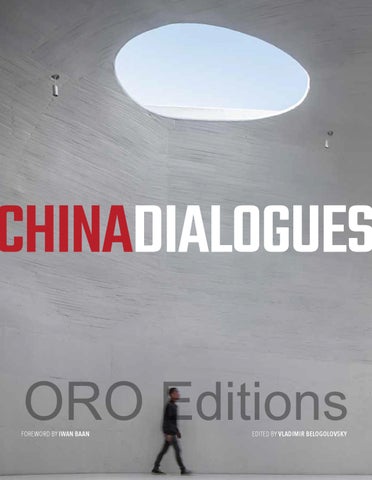
ORO Editions Cover Photo: UCCA Dune Art Museum, Aranya, Qinhuangdao, Hebei Province, 2018. Photo by Wu Qingshan © OPEN Architecture
Foreword by Iwan Baan . . . . . . . . . . . . . . . . . . . 4 Introduction by Vladimir Belogolovsky. . . . . . 16
01 WANG Shu & LU Wenyu. . . . . . . . 40 Amateur Architecture Studio, Hangzhou
02 Philip F. YUAN . . . . . . . . . . . . . . . 52 Archi-Union Architects, Shanghai
03 LIU Yichun & CHEN Yifeng. . . . . . 64 Atelier Deshaus, Shanghai
04 Yung Ho CHANG. . . . . . . . . . . . . . 74 Atelier FCJZ, Beijing
05 LI Xinggang. . . . . . . . . . . . . . . . . 82 Atelier Li Xinggang, Beijing
06 ZHANG Lei . . . . . . . . . . . . . . . . . . 94 AZL Architects, Nanjing
07 Binke Lenhardt & DONG Hao. . . 104 Crossboundaries, Beijing
08 XU Tiantian. . . . . . . . . . . . . . . . . 112 DnA_Design and Architecture, Beijing
09 LIU Jiakun . . . . . . . . . . . . . . . . . 120 Jiakun Architects, Chengdu
10 LI Xiaodong . . . . . . . . . . . . . . . . 130 Li Xiaodong Atelier, Beijing
11 MA Yansong. . . . . . . . . . . . . . . . 140 MAD Architects, Beijing
12 WANG Shuo . . . . . . . . . . . . . . . . 152 META-Project, Beijing
13 Lyndon NERI & Rossana HU. . . . 160 Neri&Hu, Shanghai
14 LI Hu. . . . . . . . . . . . . . . . . . . . . . 172 OPEN Architecture, Beijing
15 ZHU Pei . . . . . . . . . . . . . . . . . . . 180 Studio Zhu-Pei, Beijing
16 HUA Li . . . . . . . . . . . . . . . . . . . . 188 Trace Architecture Office, TAO, Beijing
17 ZHANG Li . . . . . . . . . . . . . . . . . . 196 Atelier TeamMinus, Beijing
18 TONG Ming. . . . . . . . . . . . . . . . . 204 TM Studio, Shanghai
19 WANG Hui . . . . . . . . . . . . . . . . . 214 URBANUS, Beijing, Shenzhen
20 DONG Gong . . . . . . . . . . . . . . . . 228 Vector Architects, Beijing
21 ZHANG Ke. . . . . . . . . . . . . . . . . . 238 ZAO/standardarchitecture, Beijing
Bibliography . . . . . . . . . . . . . . . . . . . . . . . . . 248 Biography of Vladimir Belogolovsky. . . . . . . 249
ORO Editions
Foreword by Iwan Baan
that allows me to step into very different worlds to capture the life within. I am particularly fascinated with people’s adaptability to different circumstances and their endless creativity in creating their own, unique environments. I am interested in documenting a whole spectrum of lifestyles—from within sleek and sophisticated structures and vernacular and humble places. I think the most interesting part starts when the architect has left, and people start to take over and explore the place how they see fit. I like to capture these moments. I like to discover things that are unforeseen and serendipitous.
My introduction to China occurred in 2005, when I first flew to Beijing with Rem Koolhaas to start documenting the construction of his CCTV complex [001]. It was just about to go into construction then, and I proposed to Rem that I would document the whole process from start to finish. I felt that there was an interesting story to tell, which related to how Beijing was changing, how this massive project would impact the city. It was an interesting time for China, and I am glad I was there to record it. My background is in documentary photography and I had only started working documenting Rem’s work in Europe and the U.S. one year before. We have similar interests in cities and public spaces. What I like most is depicting how people live. Photography is an amazing tool
ORO Editions What was particularly striking about building CCTV was the construction site itself, documenting how migrant workers from all over rural China lived
4
001 OMA, CCTV Headquarters, Beijing, 2002-12 © Iwan Baan (2007)
approached Jacques Herzog and Pierre de Meuron to document their Olympic Stadium, the Bird’s Nest [002]. I also met Steven Holl and started working with him on the Linked Hybrid residential complex in Beijing [003] and his other projects in Shenzhen, Nanjing, and Chengdu. I eventually photographed all Zaha Hadid’s buildings in China—in Beijing, Shanghai, and Guangzhou. I was fortunate to experience up close how these Western architects were making a great impact, as I went to China with them on multiple occasions. I always had my own space and time to explore these sites. Critics may complain that some of these buildings were not perfectly executed. But we need to stand back and realize where
right there by the thousands. There were at times 10,000 of them working and living on the site. They were building this grand, technologically advanced building, but the way they did it was largely by hand, using basic materials and techniques. The whole thing felt often so primitive, crude, and somewhat medieval. It was a community of people living on the construction site around the clock—working, resting, eating, conversing, watching TV, working again, and so on. That’s what I was trying to capture. Every six to eight weeks I would go back, and that went on for a few years.
ORO Editions It was an incredible time to be able to experience Chinese cities’ transformation on an epic scale, and because I was going to Beijing so frequently, I
5
ORO Editions 6
ORO Editions 7 002 Herzog & de Meuron, National Olympic Stadium (Bird’s Nest), Beijing, 2003-08 © Iwan Baan
003 Steven Holl Architects, Linked Hybrid Housing, Beijing, 2003-09 © Iwan Baan
they were built, under what circumstances, on what scale, and of what complexity. Given that, I think these buildings were a great success for China. These architects realized their lofty dreams in China. At that time, they could not have done such projects anywhere else in the world on that scale. That in itself is an incredible achievement. On these trips I also started noticing very different kind of projects being built by local architects. They were the works by the very architects that Vladimir Belogolovsky met and interviewed for this book, China Dialogues. First, I met Wang Shu and his wife Lu Wenyu. At the time he did not speak English and we communicated mostly through Wenyu. I was fascinated by his architecture because it was so different from what I was used to see in China. Unlike many of the new construction projects in Chinese cities that follow the same strategy of building from scratch, here was this local architect who resisted that tendency and tried to do his architecture differently.
designed both by architects from China and around the world. They were all brought together by Ai Weiwei. Apart from Wang Shu there were such locals as Liu Jiakun and Xu Tiantian. Throughout my travels in China, I met other architects like Zhu Pei, Zhang Lei of AZL Architects, URBANUS, and Ma Yansong of MAD Architects. I worked with Ma Yansong on many of his projects and I documented the construction of Harbin Opera House [106].
ORO Editions Or, for instance the Jinhua Architecture Park in Jinhua near Hangzhou, a micro city of 17 pavilions scattered along the banks of the river Wu [004]. They were
But working with Wang Shu remains my closest collaboration in China. Over the years, I documented all
8
004 Fernando Romero, Bridging Teahouse, Jinhua Architecture Park, Jinhua, Zhejiang Province, 2014 © Iwan Baan
One of my favorite projects is his Academy of Art, Xiangshan Campus in Hangzhou [005-008], because he has been working there for so many years. These buildings are completely embraced by the students. They are great for working and studying. There is nothing polished or pristine about them. These spaces are sometimes rough and can be beat up by art students, and the whole campus feels like a small city. The buildings are not just singular freestanding structures, but are experienced as a single organism of interconnected creatures. They are intertwined with each other and the landscape all around. Now
his buildings there, and we worked on many publications and his only monograph (Lars Müller, 2017). I find his work incredibly refreshing, particularly the way he combines his knowledge of Chinese culture, building materials, and techniques and incorporates them in very original and contemporary ways. Shu understands the difficulties of building in China. He is very selective about focusing on what he wants to articulate, understanding that certain details or finishes can’t be achieved. He brings a traditional understanding of Chinese architecture to the new era.
ORO Editions 9
005 Xiangshan Campus, China Academy of Art, Hangzhou, Phase II, 2004-07 © Iwan Baan
traditions, culture, topography, and so on. Every place is a discovery. But much of that is now being lost due to the breakneck speed of development. It is the disappearance of such rich culture that gives me pressure to document it as much as I can every time I go to China.
he is working on many projects throughout China and the quality is getting better and better. He is able to push clients into his direction and buildings are becoming more complex. He keeps exploring his idea that every project is a little village where every nook and cranny is completely different. All of his buildings are independent, confident, and surprising.
The historic Tulou Housing in Yongding in Fujian Province [009] is among the most memorable places that I had a chance to visit. This is where the Hakka people live in round multi-family fortress-like buildings that are made of stone, earth, and timber. Some of them were given World Heritage listings. Then there are underground houses in the north that are called yaodong, which means a house cave, an earth
What is especially rewarding about traveling in China is exploring the country’s rich and very diverse history. There is such an incredible variety of vernacular architecture in terms of building materials, methods, and understandings of space. There are many building techniques based on local materials,
ORO Editions 10
006 Xiangshan Campus, China Academy of Art, Hangzhou, Phase II 2004-07 © Iwan Baan
007 Xiangshan Campus, China Academy of Art, Hangzhou, Phase II 2004-07 © Iwan Baan
ORO Editions 008 Wang Shu of Amateur Architecture Studio, Xiangshan Campus, China Academy of Art, Hangzhou, Phases I & II, III 2002–13 © Iwan Baan
11
ORO Editions 12
ORO Editions 13 009 Tulou Housing, Yongding, Fujian Province © Iwan Baan
010 Underground dwellings, Sanmenxia, Henan Province © Iwan Baan
011 Underground dwellings, Sanmenxia, Henan Province © Iwan Baan
shelter dwelling [010-012]. These houses are excavated horizontally from a sunken courtyard in the center. Other buildings I came across on the East Coast of Shandong province are distinguished by high-pitched roofs, all covered in dry plants. They are called seaweed bungalows and are designed to keep the interior warm in winter and cool in summer. Then there are incredible mud houses in Xinjiang province in the west part of the country. Each province presents very different thinking about architecture.
Unfortunately, many of these unique structures are disappearing. Demolition is occurring all over China—from hutongs in Beijing to ancient housing projects on the outskirts of many provincial cities. Structures that are preserved often become tourist hot spots and tend to lose their authentic character. For a long time, I tried to go to Ürümqi, the capital of Xinjiang Uyghur Autonomous Region. There used to be an incredible citadel entirely built out of mud. Finally, when I was able to go there, I discovered that it was entirely razed and parts of it were being rebuilt
ORO Editions 14
012 Underground dwellings, Sanmenxia, Henan Province © Iwan Baan
as a replica. Such demolition is reasoned as the only way to protect these fragile, and therefore unsafe, structures.
built by hand, all from the most local materials, with great knowledge of what you can do with very specific materials right from the site. Nothing is mass-produced, but, of course, these structures need to be repaired by hand, by people who understand the traditional building techniques, something which is vanishing quickly. There is an incredible beauty in these spaces, which is being lost. Naturally, I have a sense of urgency, a mission of sort, to document these unique places as much as possible.
So often these unique buildings are being bulldozed and reconstructed as fake concrete versions. Authenticity is being lost. It is heartbreaking to see that kind of destruction. Very little real history is being preserved. Recently, this attitude is beginning to change, but for so many places it is too late. What’s fascinating about all these buildings is that they are
ORO Editions 15
ORO Editions 170 Holy Fire Lit Place for the Second China National Youth Games 2019, Ruicheng, Shanxi Province, 2019 © Baiqiang Cao; Courtesy of URBANUS
226
171 Holy Fire Lit Place for the Second China National Youth Games 2019, Ruicheng, Shanxi Province, 2019 © Tianpei Zeng; Courtesy of URBANUS
or even replicated by others. And it is important not only to express individual qualities, but also regional ones. If you look at the work in South America, for example, you immediately recognize that. And it is not simply traditional, it is very modern. Yet, it is not placeless. They use the same concrete, but we know that it is their concrete.
Kenzo Tange, Kisho Kurokawa, Arata Isozaki, and the subsequent generations of architects. VB: Kengo Kuma told me that visiting Tange’s Olympic structures sparked his dream of becoming an architect. And similarly, China had its own Olympics and World Expo, right? WH: You are right, but, unfortunately, the most important projects such as the Bird’s Nest, Watercube, or the Capital Airport were all awarded to foreign designers. Nonetheless, it is good to have great examples by the best architects in the world in your hometown. Our design institutes received invaluable experience because all of those projects were drawn by Chinese architects working at the Local Design Institutes. These designers are now much more skilled. So, the most important thing for our architects now is to achieve their own identities. We talked about solving social issues before. Of course, that’s very important. But now we also have to look at the next step: How do we develop diversity and unique architectural languages, rather than finding solutions with generic answers. How do we contribute to the body of knowledge of world architecture? You know, the ultimate goal for any architect is to achieve a place in history. And to do that you need to have a unique language that cannot be imagined
VB: Some of the key venues for the 2022 Beijing Winter Olympics were designed by local architects. And your own pavilion for the 2019 Beijing International Horticultural Expo, also makes a strong case that Chinese architects will have more chances to exercise their visions. WH: Indeed, there are some good signs that our government will trust our own designers in commissioning them prestigious projects that used to be given to foreigners. And in fact, the 2019 Horticultural Expo employed Chinese architects for the design of the master plan and all important pavilions. With the fortune of designing the Botanic Garden Pavilion, I received the experience of a world class challenge. I think similar opportunities will encourage my fellow Chinese architects to jump out of the trap of daily chores to work on elaborating their personal language, while thinking both locally and globally.
ORO Editions 227
183 Niang’ou Boat Terminal, Linzhi County, Tibet, 2013. Photo by Wang Ziling. © ZAO/standardarchitecture
ZK: There are ways to root architecture to its place. Our projects in Tibet are very different from the ones in Beijing. The objective is to find the root, but not be restricted by any form or style. This is where the critical part comes. I don’t deny following regional approach. But I don’t see myself fixed to any particular region. For us being regional means that we search for the roots of the place. But we are very open and would like to build outside of China. We are a very international practice; at one point we had people from 15 countries here. But before building somewhere else I would prefer to live there for a while.
Is it possible? I think by revisiting history we don’t go back; we advance. Researchers find cures for diseases by revisiting old medical books and applying modern knowledge and techniques. Architects can use that as a metaphor. What happened in history does not stay in the past. We are in between, and we are continuously linked with the past to build the future. We can invent the future without forgetting history. VB: This is what the current revolution is about. ZK: Absolutely. And don’t forget the development of the artificial intelligence. Our world is going to get more personalized, individualized, and ultimately, more humane and emotional. While the machine age was intimidating with its mass production, endless repetition, and coldness of the machine, the new revolution will free us even more. That’s the future.
VB: You are an idealist. ZK: That is a good thing about architecture. When I travel to a new place, I never try to see the established landmarks. I need to discover the place first, feel its atmosphere, experience the culture, cuisine, people. If I like the place, I will visit it again to get to know it better. I like continuity in places and that is what I want to highlight in my projects. It is this continuity that is becoming the new avant-garde. Perhaps we had too many drastic revolutions in the 20th century. It is time to put back the pieces. And, of course, without nostalgia, without imitating the past.
VB: Let’s talk about the design process. Where do you derive your inspirations from?
ORO Editions ZK: Really, from places I visit and not so much from architecture itself. I particularly like the anonymous architecture built by people. Because architecture
242
ORO Editions 184 Niyang River Visitor Centre, Linzhi County, Tibet, 2008. Photo by Chen Su. © ZAO/standardarchitecture
243
ORO Editions