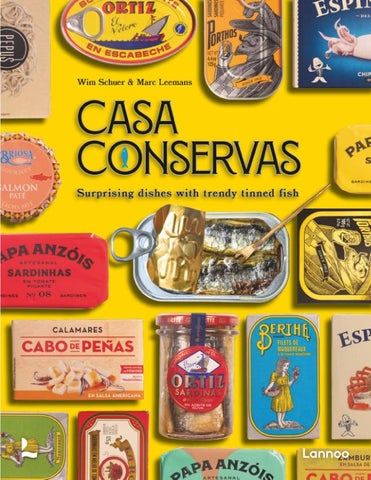
Baila, baila Casa Conservas. Sabor del mar dentro de latas. Canta, canta vida sin prisa. Pescado, sal y alma en la mesa. Vamos, vamos luz del sur. Desde Vigo hasta el cielo azul. Ríe, vive sin control. Hasta Barcelona bajo el sol.
Baila, baila Casa Conservas. Sabor do mar dentro de latas. Canta, canta vida sem pressa. Peixe, sal e alma na mesa. Vamos, vamos luz do sul. Do Porto até ao céu azul. Ri, vive sem controlo. Até Portimão, debaixo do sol.
CONTENT Foreword – Or how a tin opened up a whole world 7
RECIPES BY FISH TYPE
PART I – THE WORLD OF TIN Knowledge, history and context – everything you need to know before you open a tin
11
PART II – TIME TO EAT! Recipes Our passionate chefs Casa Conservas & Raul Pena Vieitez
29 170 173
PART III – THE COASTS Spain Mariscadora Barcelona Espinaler Papa Anzóis Portugal Norte Ramirez
175 177 185 190 195 203 209 213
ANCHOVIES Banderilla with alive and anchovies Aperitivo with conservas, piparra and vermouth Crisps with cabracho pâté, sardine and piparra Tartare of tomato with anchovies Linguine with anchovy Crème of asparagus and anchovy Velvet bite anchovies Butternut-anchovy sensation with black garlic The sea on your plate Grilled sandwich with chicken and anchovy Anchovy canapé from Portimão Sicilian-inspired pasta Tuna and anchovy mousse
39 45 47 49 55 61 79 95 97 119 137 147 163
CABRACHO Crisps with cabracho pâté, sardine and piparra
47
Acknowledgements
216
COCKLES Wolffish with shrimp, cockles, wine and almonds
127
COD/BACALAO Luxurious cod liver on sourdough bread Brioche roll with cod liver Trio of Galician empanadas Hearts of palm and cod liver salad Bacalao in spicy oil with mashed peas Bacalao picante with ajo verde
85 101 103 105 133 159
CRAB Canneloni of avocado with spider crab, ricotta and Royal Belgian caviar Artichoke stuffed with spicy crab
63 81
ELVERS Elvers with garlic
107
MACKEREL & HORSE MACKEREL Hummus with tinned mackerel Creamy fritters of tinned fish Penne with Mackerel Mini-mackerel with Mexican salsa Fish fritters with feta cream Greek roasted mackerel and sardine salad Gratin of mackerel with herb cream Mackerel with orange, fennel and mustard ice cream Guacamole spoon with spicy mackerel Canapé with grilled sardine and smooth lemon cream Tomato with horse mackerel and squid
35 40 59 67 71 73 93 115 125 135 151
MUSSELS Rice with tinned mussels & squid Aperitivo with conservas, piparra and vermouth Trio of Galician empanadas Courgette soup with tinned mussels Rice with mussels Parmentier with mussels Black pasta with mussels
41 45 103 123 131 141 153
SALMON Salmon with Greek pasta and pesto Fish fritters with feta cream Salmon salad Smoked salmon royale
69 71 99 165
SARDINES Canapé of sardines and roasted peppers Creamy fritters of tinned fish Mondadito with sardines, soft cheese and roe Aperitivo with conservas, piparra and vermouth Crisps with cabracho pâté, sardine and piparra Carpaccio of tomato with sardines Sardine pâté Fish fritters with feta cream Greek roasted mackerel and sardine salad Deluxe sardines with garlic and roasted grapes Sardine-avocado toast The sea on your plate
33 37 43 45 47 51 65 71 73 77 91 97
Rustic bread with bone marrow and sardine spread Crunchy pintxo with sardines and pineapple Sardines, red beet and goat cheese Porcello sardinato Roasted noodles with sardines Canapé with grilled sardine and smooth lemon cream Tomato fondue with burrata and sardines Sicilian-inspired pasta Clube Náutico sardine bites Tagliatelle with sardines, lemon and raisins
109 111 113 121 129 135 143 147 155 167
SCALLOPS Velouté with spring vegetables and scallops
149
SQUID/PULPO Rice with tinned mussels & squid Trio of Galician empanadas Tomato with horse mackerel and squid
45 103 151
TUNA Creamy fritters of tinned fish Montadito with ventresca and piquillo Potatoes stuffed with tuna Fish fritters with feta cream Japanese-Mediterranean fusion with tuna on a cracker Pasta with tuna in mushroom cream sauce Ensaladilla rusa Grilled sandwich with tuna and goat cheese Portuguese burger with spicy tuna Giant couscous with saffron sauce and tuna Portuguese tuna with thick-cut potatoes and creamy egg Tuna and anchovy mousse VENUS SHELLS Montadito with smoked Venus shells 31 Saganaki of white clams with surimi in garlic oil
37 53 57 71 83 87 89 117 139 145 157 163
75
ZAMBURIÑAS Zamburiñas with buttery salsa de Vieira and panko 161
Foreword OR HOW A TIN OPENED UP A WHOLE WORLD Sometimes, two people meet and the relationship develops entirely predictably. But that didn’t happen with us. “Us,” Wim and Marc, first met very predictably, crossing paths in our professional, suit-and-tie business circles in Belgium. But from our very first cup of coffee, we discovered that both of us would much rather talk about food than spreadsheets. Within a half-hour we were telling stories of our favourite marketplaces, favourite flavours, and the dishes that had left us speechless with delight. Clearly, we both had a culinary soul. But it was Wim, who one day asked Marc, “So, have you ever tasted really good fish out of a tin?” He hadn’t. And that’s how it started. But if we’re being completely honest, the road to this book began a bit further back than that. And it didn’t happen in Belgium, but on the Portuguese coast, with a glass of Vinho Verde in Wim’s hand, the scent of grilled bread all around him.
ate ventresca de atum – the tender, fatty belly cut of the tuna, packaged like a precious gift. They ate pimentos de padrón and polvo à feira, and drank a chilled Alvarinho, while outside the scents of jasmine and salt lay heavy on the night air.
Because back in what Wim calls his “former life” – his years spent immersed in Antwerp’s lively night life scene – he got to know a guy named Luk. Luk ran a café. He was a man of the world, a bon vivant with a penchant for the good things in life. And about 20 years earlier, that penchant had taken him to Portugal, where he had opened a bed & breakfast. Being a former restaurateur, he took to Portugal’s culinary culture like a fish to water, and when Luk immersed himself in the incredible variety Portuguese cuisine has to offer (as anyone who’s been there can attest to) he was like a kid in a candy store.
Somewhere between the opening of the second and third tins, Wim looked at Luk and said, “Antwerp needs these.” And so Casa Conservas was born. During the Covid lockdowns, when the world stood still and people were longing not just for flavour but human connection, Wim made his move, turning a restaurant space in the Antwerp city centre into a charming tapas bar with the unlikely concept of tinned fish in the starring role. Not a sideshow, not a menu gimmick, but the beating heart of the menu at a casa in the true sense of the word: a home, where guests feel welcome, where they share, where they experience.
Then the day came when Wim was staying at Luk’s place, and Luk took him to a small, unassuming neighbourhood restaurant, Maria do Mar. The sign read, simply: conservas e degustação – in essence, “tinned foods and tastings”. No white tablecloths, no Michelin-star theatrics. Just neat little tins, opened with love, accompanied by crunchy breads, lemon wedges, perfectly ripe tomatoes and a drizzle of azeite – purest olive oil of the finest kind. That evening, Wim and Luk ate sardines from a tin that tasted like the Atlantic. They
Very quickly, it became clear that Wim’s passion project had struck a chord with many in Antwerp. Suddenly, everyone was rediscovering conservas, as the Spanish and Portuguese lovingly refer to tinned fish: foodies, cooking nerds, fans of European food markets, anyone and everyone who sees the appeal of simple, honest and pure products that can help you put an unforgettable dish on the table in minutes. Nowadays, you’ll find Michelin-star –7–
restaurants serving top-quality tinned anchovies plated simply, with bread and lemon. Or TV chefs putting tinned sardines in the spotlight, served on sourdough bread off the grill. And the oil from the tin? The uninitiated might still be tossing it out, but for the rest of us this oil is prized like liquid gold. All around the world, people are starting to understand: you don’t need to hide good conservas. Good conservas must be respected.
has strewn a box of azulejo tiles across the steep, hilly banks of the River Douro. There, in the narrow streets of the Ribeira district, we found many tascas, the unpretentious Portuguese eateries where the menus are on a chalkboard and wine comes in carafes. We ate sardinhas assadas on a terrace overlooking the river as the light of the setting sun turned the water the colour of liquid copper. And we discovered the tiny boutiques glittering like jewellery stores, but here the jewels are the rows upon rows of gleaming, stylistically designed tins of fish, stacked like tiny artworks. In these streets, tinned fish is not sold as a staple food for the pantry – it’s conserva, and it’s presented, as the cultural heritage that it is.
But we wanted to do more than just serve it; we wanted to understand it. So off we went – together. A rental car, a notebook and a suitcase that was half-empty when we left, but was making some suspicious metallic clinking sounds on our return. Our viagem (that is, our journey) began in Galicia, the northwestern corner of Spain, where the rías (the deep, fjord-like bays) hide the richest fisheries in Europe. Standing in the harbour in Vigo one morning, we watched how the fishermen hauled their crates full of gleaming, silver sardines from the boats, the seagulls above them crying out for their share. In a conservera (cannery), we saw women confidently filleting whole tuna with surgical precision, a trade and a craft handed down from mother to daughter. Or, as the forewomen told us: “Esto es arte.” It’s an art. Indeed it is.
Travelling further south, to the Algarve, we arrived where it all began: Portimão, the town that was long the sardine capital of the world. Its canneries are still there, their smokestacks standing along the waterside as silent witnesses to those bygone days. In the museum (yes, there’s a museum dedicated to the sardine, and it’s fantastic), we learned of the thousands of women who once worked here, of the shiploads of tins that made their way from here to every continent, of an industry that shaped a city here. The air in Portimão still smells like smoked fish and the sea. Some things never change.
From Galicia, we headed south to Porto, the city that looks as though some mighty hand
And then, because conserva knows no borders, we crossed back into Spain and made –8–
Luc & Wim
our way to Barcelona, where in the tiny alleyways of the Barri Gòtic, the Catalonian canners still fill their tins with the same pride and dedication as their Portuguese and Galician counterparts. At a counter no wider than an elbow, we drank vermouth and ate mejillones en escabeche, mussels in their traditional spicy, vinegar-rich sauce, straight from the can. Watching us enjoy them, the barman said, with characteristic Catalan candour: “Lo mejor no necesita mucho.” The best doesn’t need much.
tion of the generations of knowledge, care and love inside that tin.
And he was right. In the end, that’s the essence of this whole book.
This book is for you. Whether you’re a seasoned gastronome of world cuisine or someone who until now thought that tinned fish was only something for when you’ve run out of everything else. If you’re one of the latter, this book is especially for you, actually. Because for you it will hold the biggest surprises. Enjoying fish from a tin is not something for when nobody else is looking. It’s not a comida de emergência. It’s a concentrated form of culinary culture: simplicity, honesty and simply irresistible.
In this book we share all the things we discovered along the way. The stories behind the tins. The people who make them. The places they come from. And above all, the surprising, quick, and above all unforgettably tasty recipes that we had in the tiny restaurants and the sun-drenched markets, which you can now experience for yourself at home.
Because what we learned in the canneries, on the markets, in the harbours and in the kitchens, from everyone from the fishermen to the grandmothers, was basically this: the value of a good conserva isn’t in what the chef does with it. It’s in the artistry that goes into it before the tin is sealed. The catch at the right time. The strict selection. The filleting by hand. The patient ageing. The finesse in filling the tin; the care in storing it. The arte y paciencia, as they say in the Spanish conservas industry: the art and the patience. These two words sum it up perfectly.
All you need is a can opener. And, of course, the requisite curiosity. Bom apetite!
And luckily for you, your role in it is deliciously simple. Open a tin. Have good bread at hand. Maybe a lemon, a tomato, a few sprigs of herbs. And then: taste. Really taste. With your full attention. With joy. With a percep-
Wim & Marc
–9–
– 10 –
Part I
The world of tin
– 11 –
Knowledge, history and context – everything you need to know before you open a tin The tin, the sea and everything in-between There’s a moment – maybe you’ve experienced it yourself – when you open that tin and time stands still for an instant. It’s not what you see, it’s what you smell. The immediate sensations: salt, oil, something metallic, and underlying it all, the sea. Dense. Concentrated. As if someone had packed up a piece of the coastline in a tin and sealed it with a lid.
And in fact, that’s actually a pretty good description of what you’re holding in your hand. But how they did it, and why some fish are at their best in a tin, is a story that goes back a long way – back to even before the tin existed.
– 12 –
– 13 –
– 14 –
Before there were tins Ever since we began catching fish, we have been preserving fish. With salt in the Mediterranean region, with smoke in Scandinavia, with sun and wind on the Atlantic coast, with oil where there were olive trees. Every culture that arose on a coastline developed its own way of making the sea last longer than the tide. Most of these were very pragmatic solutions born of necessity, but anyone who’s ever had quality salted anchovies or a slowsmoked herring knows that necessity and flavour sometimes go hand-in-hand.
Nonetheless, all preservation methods have their limits. Salt makes fish hard. Smoke changes the taste. Drying takes time, and you need the sun. And glass, the first material that humankind tried to use to create airtight seals, was heavy, fragile and expensive. There had to be a better way. And like so many things in human history, the innovation came from a war and an empty stomach.
– 15 –
– 30 –
Montadito with smoked Venus shells Quimet del mar This richly topped montadito is inspired by the classic Spanish bar snack: crispy bread, a creamy white base, oozy pepper-tomato compote and plump shellfish straight from the tin. Garnishing with fine deep-fried shoestring potatoes makes the dish festive. Salt of the sea, creaminess, sweetness and a whiff of smoke, all in one bite.
INGREDIENTS (makes 4) 4
slices of firm baguette or
sourdough bread ½
onion, finely chopped
1 clove
garlic, finely chopped
1
red sweet pepper, finely
chopped 1
tomato, finely chopped
1 tsp
tomato purée
100 g
cream cheese, labneh or soft
goat cheese 1 tin (80 g)
almejas (Venus shells)
+ olive oil + black pepper + sea salt + parsley or oregano To serve: deep-fried shoestring potatoes, or fine lemon zest
PREPARATION (20 min.) • Toast the bread until crunchy and let cool. • Gently sauté the onion, garlic, red pepper and tomato in olive oil. • Add the tomato purée and reduce to a smooth, thick compote. • Season with pepper, salt, some pimentón or a few drops of sherry wine vinegar. • Spread a generous layer of cream cheese, labneh or soft goat cheese on the toasted bread. • Top the spread with a spoonful of warm pepper-tomato compote. • Carefully remove the Venus shells from the tin and arrange on top of the compote. • For extra depth, drizzle with a little of the oil from the tin. • Garnish with the fine lemon zest or shoestring potatoes. • Serve immediately, ideally as a small tapa or aperitif snack.
a few drops of oil from the tin Optional: pimentón, chilli flakes, sherry vinegar or balsamic cream – 31 –
– 32 –
Canapé of sardines and roasted peppers Atlântico picante A glorious canapé generously topped with juicy sardines and succulent roasted peppers, sprinkled with fresh herbs for a bright accent. The peppers and onion deliver an earthy warmth, the sardines bring a salty kiss of the sea, and parsley and chives with a drizzle of dark balsamic or reduced jus add a refined finishing touch. Perfect as a first course, part of a tapas plate, or to add a Portuguese flair to your aperitif.
INGREDIENTS (makes 2) 2
slices of firm bread,
sourdough or brioche 1
red sweet pepper
1
yellow sweet pepper
½
onion
1 clove 1 tin (80 g)
garlic, pressed sardines in olive oil
+ olive oil + lemon juice + parsley + chives + black pepper + sea salt Optional: balsamic cream, pimentón, chilli flakes or a few capers
PREPARATION (15 min.) • Toast the bread until browned on the outside but not yet crisp all the way through. • Slice the peppers and onion into thin strips. Sauté them gently in olive oil with a little garlic, pepper and salt. • Cook them thoroughly and slowly, until they become velvety and take on a caramelised sweetness. Season with a few drops of lemon juice and, if desired, a pinch of pimentón or chilli flakes. • Top each slice of toast with a generous spoonful of the pepper-onion mix while still warm. • Carefully arrange one or two sardines from the tin on top of each. • Garnish with the finely chopped parsley and chives. • For extra shine and depth, drizzle with a little balsamic cream or the oil from the tin.
– 33 –
– 34 –
Hummus with tinned mackerel Atlântico cremoso Here, creamy homemade hummus is the base on which you vertically arrange a little fan of silky, flavourful tinned fish. The oil from the tin, along with parsley, chives and a pinch of pimentón give this bite that characteristic Iberian depth: simple, rich, and yet refreshing at the same time. A small plate that works as a tapa, appetiser or component of a Casa Conservas tasting.
INGREDIENTS (makes 12)
PREPARATION (20 min.)
1 tin (400 g)
• Rinse the chickpeas and drain them well. • Blend the chickpeas with the tahini, lemon juice, garlic, olive oil, cumin, pepper and salt until you have a smooth hummus. • For an extra-creamy hummus, add a dash of water while blending. • Put a scoop of hummus on 12 small plates and spread each scoop out slightly. • Carefully remove the fish from the tin and separate into nice-looking pieces. • Stand up a few pieces of fish in the hummus to make a “fan” on each plate. • Drizzle a little olive oil or oil from the tin on top. • Garnish with the pimentón, finely chopped parsley and chives. • Serve with toasted bread or crackers. Serving tip: build the dish in amuse-bouche spoons instead of on plates.
1 tbsp ½
chickpeas tahini lemon, juiced
1 clove
garlic
3 tbsp
olive oil
1 pinch
cumin
1 tin (80 g)
mackerel, sardines or horse
mackerel in olive oil + sea salt + black pepper + pimentón or smoked paprika + parsley + chives Optional: extra olive oil, lemon zest, chilli flakes or a few drops of oil from the tin
– 35 –
Galicia – where the sea comes to land Around the globe, there are many places where you can see the sea. And then there are those places where you feel it. In the air, in the food, in the way people talk about their work. Galicia is one such place. In the far northwestern corner of Spain, where the Atlantic doesn’t politely knock but rather bursts right in through the wide, sheltered estuaries they call rías: the Ría de Vigo, the Ría de Pontevedra, the Ría de Arousa, and the Ría de Muros y Noia. No ordinary bays, these are a network of salty fingers that stretch deep into the green coastlands, leaving life behind wherever they touch: plankton, tides, food, abundance.
The rías make up an extremely fertile piece of the sea, where everything comes together to create life: salt water mixes with fresh, tides push nutrient-rich water inland and then drag it back again, and the sheltered banks create the perfect conditions for a bountiful harvest of sardines, tuna, mackerel, mussels, cockles, clams, scallops, octopus, squid... the list goes on, longer than a Galician Christmas menu (and that is saying something).
– 178 –
– 179 –
The women of the tide But the story of Galician conservas would never have happened without the women who made it possible. In the canneries, it was women’s hands who cleaned the fish, filleted them, sorted them, and placed them in the cans, all with a speed and precision that has to be seen to be believed. But even before the product reached the canneries, women were vital along the sand banks and in the rías itself.
The mariscadoras are one of the most iconic images of Galicia. Literally “women who harvest the shellfish” (marisco), at low tide they waded out into the wet sand, hunched over a rake, basket or bucket, collecting the cockles, razor clams and other shellfish. Their workday was not measured by the clock of the factory, but the rhythm of the tide. As soon as the sea retreated, their work began. For generations, it was a subsistence activity: work that women from coastal families could do alongside caring for the children, keeping house, and sometimes a job in the cannery. But in the second half of the twentieth century, that began to change. The profession became organised into cofradías, permits, zones, quotas and inspections. Gradually, the mariscadoras became not only workers of the tide, but also managers of a vulnerable ecosystem. On Illa de Arousa, the island in the middle of the ría that shares its name, female shellfish gatherers played a critical role in what researchers call the “shellfish revolution”: a shift towards the direct control of the management of the shellfish grounds by these women. Their work is at once both practical and symbolic: practical, because they supply an essential ingredient of Galician gastronomy and the conservas industry; symbolic, because they show that the richness of the rías doesn’t end up in a can by itself. Between sea and plate, there are people: women who know when a sandbank is ready, which shells are big enough, what zone needs to be left to recover, and how to live with a landscape that changes every day.
– 180 –
The tin as ría This also explains why Galician conservas have such a strong and unique character. In many countries, tinned fish means sardines, tuna, mackerel. End of story. But in Galicia, the story goes on: mejillones, berberechos, almejas, navajas, zamburiñas, pulpo, calamares, chipirones, caballa. Here, the tin holds not just fish, but also marisco, the taste of the ría itself. All the species of fish, cephalopods and shellfish we described in the previous chapter you’ll find here, on this narrow strip of coastline. Nowhere else is the sea’s bounty so broad, and nowhere else is the connection between landscape and tin so short.
And that makes Galicia today not only a place of production, but of prestige. The higher-end producers present their tins as gastronomic objects. The seafood is processed at the best possible moment, selected by hand and carefully arranged. The sauce or oil is not a means to an end, it’s a critical element of the product. A good tin is not a place where fresh fish goes to die; it is its own form of culinary expression.
– 181 –