EYES ON FORM VITTORIO SGARBI
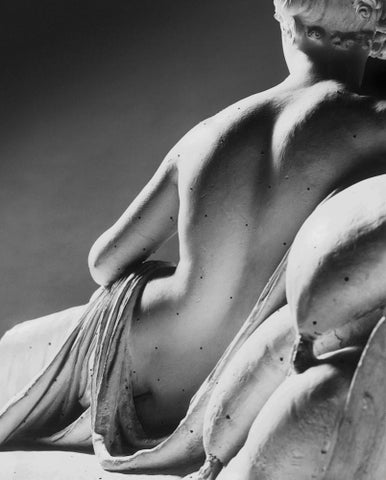
There are not many artists whose spiritual legacy is manifest not only in their works — scattered across churches, palaces, museums, and collections — but in a specific place, in a home, in a studio that epitomizes the efforts of a lifetime. In this sense, Casa Buonarroti in Florence and Casa Vasari in Arezzo are unique. Then there are spiritual shrines, like the home of Morandi in Grizzana along the hills of Bologna, after the senseless dispersion of his studio on Via Fondazza. And identified homes, which today have lost all connection with what they once were, and are limited to a mere plaque, albeit laden with meaning commemorating the past. But no place is like the Gypsotheca, or Cast Gallery of Possagno. There, along with the spirit and legacy of Canova, we also find objects, things. And if this shrine allows us to experience all the grandeur and aesthetic principles found in Canova’s practice, his home conveys the everydayness of his rituals. There was a time, not too far in the past, when numerous works found in Possagno constituted the very heart of important exhibitions, in anticipation of the celebrations for the two-hundred-year anniversary of his death, in 2022. In the meantime, between 2019 and 2020, there were “Canova e l’antico” in Naples, “Canova. Eterna bellezza” in Rome, “Canova e Thorvaldsen” in Milan, along with shows announced for Washington, DC, and Chicago, and everywhere else, with great enthusiasm. Possagno offers such a wealth that it is able to generate various exhibitions without losing its integrity. In the rooms of the Gypsotheca, sculptures can be caressed, and that same feeling is conveyed by Luigi Spina’s black-and-white photographs, unfolding in four tempos, of which this is the first. The collection of hundreds of plaster casts found in the Gypsotheca at Possagno bears witness to the constant and demanding effort Canova dedicated to his work: in fact, his statues are not born from a direct and intuitive crafting of marble, but rather, after methodical and very precise study, from sketches to clay models, from plaster to marble. The plaster model, in particular, was cast in a mold made from an earlier work in clay; applied to the plaster were repères, tiny bronze nails that can still be seen stuck into the statues at Possagno, in which measurements and proportions could be transferred from the plaster onto the marble, using a special pantograph. Spina applied himself with the same effort to the ancient sculptures at the Museo Archeologico Nazionale of Naples, where Canova’s plaster casts were also temporarily on display. Through comparison, the Farnese Collection allowed Canova’s challenge to be measured against his models. It was a unique opportunity to understand, to mirror, a more ancient Canova and a more modern antiquity.
6
7
5 CONTINENTS EDITIONS Art Direction Annarita De Sanctis assisted by Camilla Zuzzi
FONDAZIONE PALLAVICINO, GENOVA President Domenico Antonio Pallavicino
Editorial Coordination Elena Carotti
Vice-Presidents Cristina Marasso, Cesare Bruzzone
Translation Emily Ligniti
Chief Operating Officer Claudio Senzioni
Editing Charles Gute
Artistic Director Vittorio Sgarbi
Color Separation Pixel Studio, Bresso, Italy
IN COLLABORATION WITH
All rights reserved © Fondazione Pallavicino ETS 2020 © For the texts: Domenico Antonio Pallavicino, Vittorio Sgarbi, Luigi Spina © For the images: Luigi Spina For the present edition © 2020 – 5 Continents Editions, Milan
No part of this book may be reproduced or utilized in any form or by any means, electronic or mechanical, including photocopying, recording, or any information storage and retrieval system, without permission in writing from the publisher.
ISBN 978-88-7439-921-5 Distributed by ACC Art Books throughout the world, excluding Italy. Distributed in Italy and Switzerland by Messaggerie Libri S.p.A. www.fivecontinentseditions.com www.luigispina.it Printed and bound in Italy in February 2020 by Conti Tipocolor, Calenzano, Italy, for 5 Continents Editions, Milan
FONDAZIONE ANTONIO CANOVA, POSSAGNO President Vittorio Sgarbi Vice-President Valerio Favero Councilors Silvia Basso, Marcello Cavarzan, Gerardo Santoro, Ivano Zordan