DIRECTOR’S CHOICE
CAMBRIDGE UNIVERSITY BOTANIC GARDEN Beverley Glover
SUBJECT OF SPREAD ENTRY
DC Cambridge Botanic Gardens_OP.indd 3
|
3
29/01/20 15:59
INTRODUCTION Welcome to Cambridge University Botanic Garden (CUBG), and thank you for wanting to find out more about who we are and what we do. As Director, I have the great honour of leading the Garden for a short stretch of years out of its many centuries. The Botanic Garden was founded on this site in 1846, through the vision of Professor John Stevens Henslow, who understood that plants have an enormous amount to teach us about life and how it works. Our plantings them‑ selves, particularly the trees, and the research and learning that they support, will continue to reflect Henslow’s vision for many years to come. This of course means that any Director, or gardener, or visitor, only has a small window of influence over the Garden, and our most important function is to act as stewards, protecting and developing this wonderful place so that future generations can continue to benefit from it. Corydalis bulbosa
4
|
CAMBRIDGE UNIVERSITY BOTANIC GARDEN
DC Cambridge Botanic Gardens_OP.indd 4
29/01/20 15:59
All botanic gardens are special, as organisations that collect and maintain an exciting range of plant species. What sets a botanic garden apart from any other garden is the cataloguing and labelling of plants, with each individual treated as an item in a collection in the same way that specimens in a museum or paintings in an art gal‑ lery would be. But this particular botanic garden is unique in many ways. First, it is of an unusual age. While there are older botanic gardens, reflecting the importance of medicinal plants in early Europe, and younger botanic gardens, designed with modern visi‑ tors in mind, there are very few from the early part of the nineteenth century. This garden was laid out when scientific debate about the nature of species, the meaning of variation and the relation‑ ships between living organisms was at an all-time peak, and those origins are still apparent in the modern Garden. Second, as a Botanic Garden that is part of one of the world’s leading universities, CUBG is unique in the breadth, depth and quality of the living collection it curates. We are home to around 8,000 plant species from all over the world, maintained in a 40-acre landscape. By comparison, there are around 3,000 plant species native to the UK, living in around 60 million acres. Cambridge is clearly a biodiversity hotspot! But perhaps the thing that makes this botanic garden so special is the extent of the integration between our research, education and amenity roles – our visitors can browse research collections that underpin papers in top scientific journals and learn about recent research progress in regular informal lecture series and from our carefully designed interpretation boards, all while enjoying an ice cream and a family walk. This integration benefits all – the research‑ ers who use our collection enjoy sharing their results with a wide audience and are very glad to be conducting research in such a beautiful setting. And our many education visitors, particularly the school groups, immerse themselves in this unique and enriching learning environment. I hope that this guide will give you a taste of the diversity of plantings, activities and historic features that make Cambridge University Botanic Garden so special. It is a pleasure to be able to show you around.
Passiflora garckei
INTRODUCTION
DC Cambridge Botanic Gardens_OP.indd 5
|
5
29/01/20 15:59
Hibiscus trionum
I have always been fascinated by flowers and the ways in which they attract different animals as pollinators. There are around 350,000 species of flowering plants (nobody knows the exact number), and almost as many different ways of attracting animal pollinators. Some flowers release compel‑ ling scents, some have striking colour patterns that direct animals towards their nectar, and oth‑ ers use complex shapes and structures to restrict access to particular shapes and sizes of animals. This Hibiscus trionum flower does something very special, which nobody had noticed before one of my students picked one in Cambridge University Botanic Garden and brought it to me to ask how it worked. The central region of the flower has a dark red pigment, but if you angle the flower towards the light you will see blue light shifting across the red regions. That’s because the petal surface is folded into a series of long ridges, spaced about one thousandth of a millimetre apart, which inter‑ fere with light and cause diffraction. The resulting iridescent effect makes the flower particularly visible to pollinating insects – a clever trick for a flower that only lives for a few hours. When we published this work in 2009 it was the very first report of an iridescent flower, but we’ve since been able to explore the surface structures of the 8,000 species in the Botanic Garden’s living collec‑ tion, and have found that floral iridescence occurs in many different groups of plants.
6
|
above: The blue halo is visible on top of the dark red petal pigment opposite: Hibiscus trionum
CAMBRIDGE UNIVERSITY BOTANIC GARDEN
DC Cambridge Botanic Gardens_OP.indd 6
29/01/20 15:59
DC Cambridge Botanic Gardens_OP.indd 7
29/01/20 15:59
John Stevens Henslow
John Stevens Henslow was a real polymath. He was appointed Professor of Mineralogy at Cambridge University in 1822, and then Professor of Botany in 1825. He was also very persuasive – in 1831 he convinced the University to move its Botanic Garden from a cramped city centre location to the current 40-acre site. The original Botanic Garden was a traditional ‘Physic Garden’, culti‑ vating plants for medical studies. Henslow persuaded the University that for the scientific study of plants themselves, including trees, the Botanic Garden needed a larger site. Planting began in 1846, but the University only gave Henslow funds to develop the western half of the site. This half was designed by the Garden’s first Curator, Andrew Murray, in the ‘gardenesque’ style, combining specimen plants and curated landscapes with horticultural expertise. Within the western half sit the Systematic Beds, created by Murray to serve as a teaching resource to demonstrate the relationships between herbaceous species and families. The trees outside the Garden’s perimeter path were grouped together in their families. This, and the rest of the Garden’s planting, emphasised Henslow’s fascination with plant var‑ iation and diversity. Henslow had assembled a herbarium of British flora which was organised to emphasise variation within each species and to explore the limits to that variation and the boundaries that define species. His interests were reflected in his teaching, where his students were asked to examine and record the different characteristics of plants. This practice was to prove useful to Henslow’s most famous student, Charles Darwin, who Henslow trained and mentored, in due course nominating him as the naturalist on a world-changing voyage to the Galapagos Islands.
8
|
above: Professor John Stevens Henslow, founder of CUBG in its current location opposite: Map of the Garden by Andrew Murray, first Curator of Cambridge University Botanic Garden
CAMBRIDGE UNIVERSITY BOTANIC GARDEN
DC Cambridge Botanic Gardens_OP.indd 8
29/01/20 15:59
Saxifrages
Along with the National Collections of Geranium and Fritillaria mentioned earlier, the Garden holds the National Collection of European Saxifraga species. These plants have been part of a collaborative research project between the Sainsbury Laboratory Cambridge University (SLCU) and our alpine horticultural team. The researchers have discovered a rare mineral in the protective silvery-white crust on the leaves of a number of Saxifraga plants held in the Garden’s collection. This mineral, called vaterite, is a form of calcium carbonate and is rarely found on Earth. Only small amounts of it have been discovered in some sea and fresh‑ water crustaceans, bird eggs, the inner ears of salmon, meteorites and rocks. It is of interest to the pharmaceutical industry as the mineral has special properties which enable sustained and targeted drug release, which might be particu‑ larly useful for anti-cancer medication. It is the first time this mineral has been found in such a large quantity, and the first time it has been found associated with plants. The team came across the discovery while exploring the inner workings of plants held in the Garden using new microscopy tech‑ nologies. Microscopic analysis showed that some saxifrages were exuding vaterite from chalk glands on the margins of their leaves. There is still much to learn, but the collaborative work is revealing fascinating insights into leaf anatomy and biochemistry. The research is an important example of how studying plants in their own right can end up providing help with very human problems.
opposite: Silvery-white dots of vaterite secreted on the leaf margins of Saxifraga scardica above: From left: Simon Wallis (CUBG), Dr Raymond Wightman (SLCU) and Paul Aston (CUBG) examining the Garden’s Saxifraga collection behind the scenes in the Alpine Reserve Yard
SAXIFRAGES
DC Cambridge Botanic Gardens_OP.indd 33
|
33
29/01/20 15:59
Jade Vine
The unmistakable blue-green flowers of the jade vine (Strongylodon macrobotrys) can be found in the Glasshouse Range at the Garden between February and June each year. The jade vine has been in the collection since 1985 and its consistent annual show is well renowned, with visitors marvelling at the bizarre hue of its flowers. Jade is a rare colour within the plant kingdom and is found in very few other plants. Some other examples include the green-flowered Cape cowslip (Lachenalia viridiflora) and the turquoise ixia (Ixia viridiflora). Recent studies have shown that the colour is created by two pigments, malvin and saponarin. Malvin is red-blue and in a class of pigments known as anthocyanins, producing the familiar colours of blueberries and raspberries. Saponarin is yellow and in a group of pigments known as flavones. These pigments are present at a 1:9 ratio of malvin to saponarin, which produces the characteristic jade colour. The science behind the colour is fascinating, but which pollinator has it evolved to attract? The jade vine is native to the tropical forests of the Philippines and it has been suggested that its large pendent flower spikes that hang high in the canopy with their brilliant jade colour entice bats to pollinate them. Conclusive evidence for this is not available, because even in the modern era, with all our available technology, the enormously diverse natural world still has many secrets to reveal. The jade vine at the Garden does produce fruits, and in good years we have had up to 50 of these mango-sized pods. On these occasions a mouse has been spotted moving between flowers and we believe that it may have stepped in for its flying cousins.
34
|
opposite: The jade coloured flowers of Strongylodon macrobotrys
CAMBRIDGE UNIVERSITY BOTANIC GARDEN
DC Cambridge Botanic Gardens_OP.indd 34
29/01/20 15:59
DC Cambridge Botanic Gardens_OP.indd 35
29/01/20 15:59
Quality of the collection
Cambridge University Botanic Garden is one of the largest University-owned botanic gardens in the world. The Garden maintains a living collection of over 14,000 accessions and 8,000 plant species, representing over 141 countries, and distributed across a 40-acre landscape. Over 20% of our collections are sourced directly from the wild, and we hold over 200 species that are threatened with extinction in their native habitats. This diver‑ sity of plants is arranged in discrete displays to represent particular floras and themes including Tropical, Alpine, and Mediterranean floras. We are custodian to nine National Plant Collections – these designations recognise assemblages of exceptional scientific or herit‑ age value. Our Cory Library holds 7,827 volumes with many precious books of rare provenance, some annotated by Charles Darwin, and over 1,200 manuscripts and objects. Our herbarium collection of dried plants totals 16,000 accessions and forms a permanent record of the plants that have been grown at CUBG since its incep‑ tion in 1762. In total, the Garden contains an aston‑ ishingly valuable and high-quality collection, one that we hope brings pleasure and knowledge to our many visitors.
36
|
Lonicera setifera, part of our National Collection of shrubby Lonicera
CAMBRIDGE UNIVERSITY BOTANIC GARDEN
DC Cambridge Botanic Gardens_OP.indd 36
29/01/20 15:59
Upper map shows the areas of the world from which our collection is sourced, with intensity of green corresponding to the number of collections sourced Lower map shows the reach of our collection, with each line representing the transfer of material from our collections to support research, education and conservation
QUALITY OF THE COLLECTION
DC Cambridge Botanic Gardens_OP.indd 37
Â|
37
06/02/20 15:35
DC Cambridge Botanic Gardens_OP.indd 38
29/01/20 15:59
This edition © Scala Arts & Heritage Publishers Ltd, 2020
acknowledgements
Text © Beverley Glover/Cambridge University Botanic Garden
I would like to thank the enthusiastic and
Images © Cambridge University Botanic Garden
knowledgeable staff of Cambridge University Botanic Garden for their help with the
First published in 2020 by
production of this guide, particularly Sam
Scala Arts & Heritage Publishers Ltd
Brockington, Angela Cano, Chantal Helm
10 Lion Yard
and the Learning team, Helen Needham,
Tremadoc Road
Anna Patterson Lee, Sally Petitt, Nicci Steele-
London SW4 7NQ, UK
Williams and Alex Summers, as well as
www.scalapublishers.com
Howard Rice for his help with images.
In association with Cambridge University Botanic Garden
I am particularly grateful to Heloise Toop for
www.botanic.cam.ac.uk
outstanding work coordinating the project.
ISBN: 978 1 78551 285 8
image credits Craig Barrett, Martin Bond, Cambridge
Project editor: Sandra Pisano
University Herbarium, Angela Cano, Richard
Designer: Heather Bowen
Chivers, Mimi Connolly, Peter Corbett, Dom
Printed and bound in Turkey
Cram, Nigel Luckhurst, Wahaj Mahmood, Edwige Moyroud, Sally Petitt, Howard Rice,
10 9 8 7 6 5 4 3 2 1
Alex Summers.
All rights reserved. No part of this book may be reproduced, stored in a retrieval system or transmitted in any form or by any means electronic, mechanical, photocopying, recording or otherwise, without the written permission of Cambridge University Botanic Garden and Scala Arts & Heritage Publishers Ltd. Every effort has been made to acknowledge correct copyright of images where applicable. Any errors or omissions are
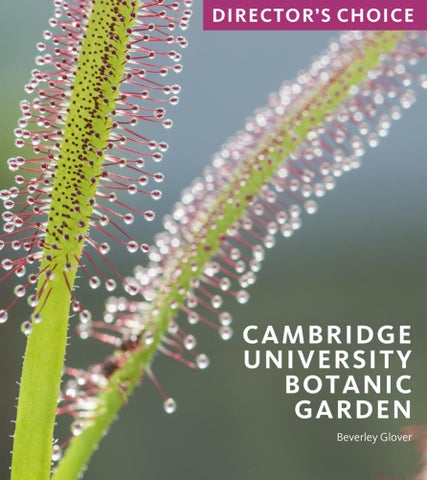
Front cover: Drosera capensis Front flap: Brookside, the Garden’s administrative offices Frontispiece: View across the fountain to the Glasshouses Back cover: The Arid Lands House
unintentional and should be notified to the Publisher, who will arrange for corrections to appear in any reprints. Director’s Choice is a registered trademark of Scala Arts & Heritage Publishers Ltd.
80
|
CAMBRIDGE UNIVERSITY BOTANIC GARDEN
DC Cambridge Botanic Gardens_OP.indd 80
29/01/20 16:00