Diane Burko on Kronebreen Glacier, Svalbard, 2013 Photo: Jack Kohler
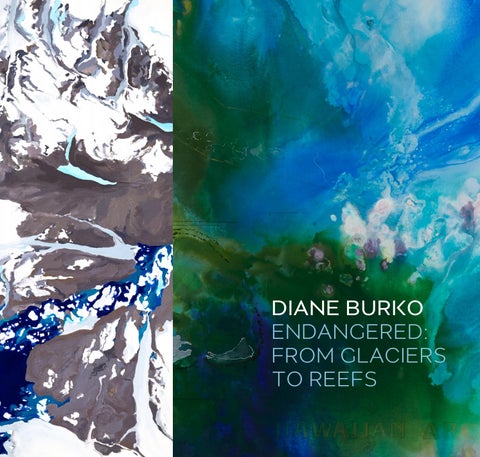
DIANE BURKO E N D A N G E R E D : F R O M G L A C I E R S TO R E E F S
DIANE BURKO ENDANGERED: FROM GLACIERS TO REEFS
Š2019 KMW studio publishing LLC All rights reserved. No part of this book may be reproduced or transmitted in any form or by any means, electronic or mechanical, including photocopying, recording or by any information storage and retrieval system, without permission in writing from the publisher. First Edition, 2019 www.kmwstudio.com For information: contact@kmwstudio.com
A CONVERSATION BETWEEN DIANE BURKO AND BEN ORLOVE
This transcript documents a conversation between the artist Diane Burko and the anthropologist Ben Orlove, the co-director of the Center for Research on Environmental Decisions (CRED) at Columbia University, who teaches in the School of International and Public Affairs, and is the co-director of the Master’s Program in Climate and Society. He is also a Senior Research Scientist at the International Research Institute for Climate and Society. The conversation took place on the occasion of Diane Burko’s exhibition, Endangered: From Glaciers to Reefs at the National Academy of Sciences in Washington, D.C. Ben Orlove: I’m struck by the way this show introduces your new project and includes some of the glacier work which first introduced me to you. Diane, what a change! This Glacier/Reef show is clearly about art and science—two ways of knowledge, two ways of communicating—and both ways are fully present in each of the works and in the show as a whole. With the video and lenticulars, especially, you’re thinking about how we experience the gallery space like a landscape, which is to say that we experience it in multiple ways. There are some things people see from afar, some they see from near, some that they see standing still, some that they see walking. These very basic qualities have been part of our heritage as mammals, the very complicated ways we infer our external world that enters our eyes, while our bodies are stationary or moving. You’re exploring all of these inputs as an artist.
work is truly of this era, when the general public may not have visited glaciers or reefs, but they certainly have knowledge of them. They’ve traveled the world through images; scientific information is presented to them through news, YouTube, magazines, or a television special. And your work is part of that world, drawing on your viewers’ knowledge. DB: Absolutely. It’s very important to me that viewers can relate and learn from the work. I draw from the physical experience of being there. I’m also a photographer, and a lot of my research comes out of making my own images of these places. When we went to the Pacific, we used a drone, and took underwater footage with our GoPro, and all of that is combined in my video piece. It’s important to me that this work is legible, that it uses accessible images, yet can be ambiguous as well, inviting the imagination.
Diane Burko: Yes, I like that! My work comes directly from my experiences of these landscapes that I’ve placed specifically in this gallery space. Page 10 Installation, Corridor Gallery, August 2018 Photo: Kevin Allen Right Installation, Corridor Gallery, August 2018 Photo: Kevin Allen
BO: And those experiences can be difficult; you’re under the water, or in Antarctica. It’s cold, it’s wet, you’re dealing with the realities of these places. So, your approach to painting isn’t just to illustrate science, but to really embody your experience. You incorporate these maps and charts, these images that scientists use as tools for knowing, and you include what you learn from reading. Your
11
00:57:13 02:46:00 04:52:12
06:57:22 08:18:23 09:22:20
10:48:16 11:52:24 12:04:28 Stills from single channel video projection, Ocean/Reef/Paint 12:46, 2018
12
BO: Viewers can certainly admire your work for its distinctiveness, originality, and beauty. I hope they recognize all of those qualities. But it’s important that they don’t see it as something unachievable; the work invites viewers to explore these ideas and relate them to their own world. You’re not just making art for the sake of aesthetic appreciation. I think your work empowers people. If we think about art referring to nature, this work brings up fascinating commonalities between different liquid surfaces, and our ability to see them or comprehend them. We live in a world where there’s a lot of water surfaces, but these tropical oceans are remote. Your work bridges the surfaces of water that are part of our everyday lives, with these much vaster ocean surfaces. DB: I appreciate that. Public engagement is definitely part of my practice. I’m trying to do more than just make beautiful paintings. But I never thought about how they could make people respond through increased awareness of these feelings and multiple ways of seeing, that it can expand their point of view. I like that point. The Blue Marble: Earth as seen from Apollo 17 in 1972
DB: Quite serendipitously. I first began working with Anna Tas, an artist friend who uses this “lenticular” photographic technique in her own practice. I wanted to evoke the movement of water, which we initially decided to do through animation. I mixed tints referencing my on-site coral experience and our visits with the researchers at HIMB and Scripps. We made paint move in small Petri dishes and on some of the 9x12 inch panels you see in the show, and Anna took lots of still photographs from which to choose the animation frames. But as we were doing this, I began making videos of the moving paint, which led me to this video idea—the “Ocean/Coral/Paint” experiment to present a montage of all the information I’ve gathered so far for this project. It includes Richard’s drone footage, our snorkel GoPro footage, as well as video clips from both labs. As you know, Richard, my husband— landscape architect, artist, and photographer—is my collaborator on all my projects. The Gates Lab confocal imagery at HIMB is incredible: seeing live symbionts, polyps in real time has more meaning when contrasted to the Sandin Lab’s 3D digital imagery from their ambitious 100 Island Challenge project. Having the chance to witness the microcosm and macrocosm in the space of a few months was so incredible—and something I wanted to share in my work. I love combining all this factual material with my painting.
14
BO: Don’t you sometimes think that, ultimately, we’re fortunate to have these opportunities like your exhibition at the National Academy of Sciences. There’s so much to do. Let’s just do what we can, do it well, and hope that others join us. DB: Yes, that’s what I’m trying to do. That’s why I only agree to do university shows if they promise to include the community, other departments, for a panel on climate change, or a debate or a conversation between me and a scientist, something that goes beyond art talk....That’s the only way I’ll do it. BO: And the image, painted or photographic, has such a huge effect on the public consciousness about the environment. Images have so much power. You could say one of multiple births of the Anthropocene was the arrival of the blue marble image of the Earth back in the early 1970s. It’s an image of tremendous hope, even as it recognizes the Earth’s fragility. Glaciers in the Himalayas and the Great Barrier Reef are both visible at that distance.
Arctic Melting, July 2016 (after NASA), 2016 Oil and mixed media on canvas, 60 x 84 inches
15
Reef Grid, 27 paintings, 2017-2018, mixed media on panel, 9 x 12 inches each
18
19
28
of all marine ecosystems. Another connection: here I am with the glaciers, and here I am with the reefs. And they seem so different, but they have such synchronicity with each other, because one of the things threatening the reefs is sea-level rise caused by melting glaciers. With higher sea levels, there’s less sunlight reaching the reefs, so there goes the photosynthesis. It’s another contributing factor to their demise. BO: There’s another glacier-reef connection I just thought of. You know, glaciers are a major component of the weathering of mountains. As they scrape away at them, they expose rocks to natural weathering processes. Slowly and steadily, the rain that falls on the rock dissolves some of the minerals. The runoff contains calcium ions, which make their way, with the water, to the ocean...where microscopic coral organisms absorb them, depositing them as calcium carbonate, so they take solid form once again. DB: Well that’s a positive interactive process, but what I learned from some folks at NOAA and the National Park Service in American Samoa is that runoff can be damaging as well because of too much silt moving at once in a storm event, which seems to be happening more often. Instead of being nourished, they suffocate. BO: It’s one piece of it. In my view, to be honest, I see glaciers and reefs both threatened by the same cause. DB: They are, in the end, the same. And it’s clear that glaciers have contributed significantly to sea-level rise in the 20th century. And they’re still a huge threat in the 21st, with Greenland and Antarctica.
UNESCO National Heritage II, 2015 Oil and Flashe paint on canvas 42 x 72 inches
BO: Your work on Greenland definitely talks about the same threat. Glad to see they’ve included paintings of yours about Jakobshavn in this show, by the way. But just to backtrack a second, it’s so great that you use air when you’re making your work. After all, atmosphere is so important to the ocean! It’s immediately fascinating how your colors correspond with their subjects; glaciers are basically affected by just one driver, the warmth that’s due to the increase in the concentration of greenhouse gases. With your focus on a limited range of colors, your glacier paintings aesthetically correspond with that simplicity, they memorialize it. Beyond our deep cultural history of the color of the tropics—Gauguin loved these colors—the use of color in your reef paintings is totally different and complex and makes me think about how complicated coral reefs are. They face multiple threats. With glaciers, typically snow falls in
29
Visions of the Beaufort Sea, 2016, oil and mixed media on canvas, 42 x 42 inches
34
Molokai, 2018, acrylic on canvas, 42 x 42 inches
35
41
Stressed Coral, 1/10, 2018 Still image of back lit Lenticular 13.5 x 13.5 inches Page 43 Top: Alega, American Samoa, 1/10, 2018 Middle: Hanauma Bay, HI, 1/10 2018 Bottom: HIMB, Confocal, 1/10 2018
42
Diane Burko on Kronebreen Glacier, Svalbard, 2013 Photo: Jack Kohler
DIANE BURKO E N D A N G E R E D : F R O M G L A C I E R S TO R E E F S
DIANE BURKO ENDANGERED: FROM GLACIERS TO REEFS
Š2019 KMW studio publishing LLC All rights reserved. No part of this book may be reproduced or transmitted in any form or by any means, electronic or mechanical, including photocopying, recording or by any information storage and retrieval system, without permission in writing from the publisher. First Edition, 2019 www.kmwstudio.com For information: contact@kmwstudio.com