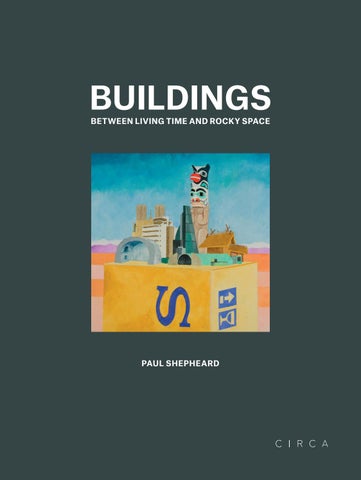
BUILDINGS BETWEEN LIVING TIME AND ROCKY SPACE
PAUL SHEPHEARD
Contents
07
Prologue: Mundane Mansions
13
Structure Traps Paris cathedrals Ronchamp Geneva fountain Rhône Glacier cafe Furka Pass Agip station Bergamo Rome Richelieu Nests Europa
31
Gravity Easington Colliery Tyne Tees flues the sky the horizon gravity solid and superficial geology The Pit Head pub Island of Women Reims Cathedral
49
Interlude: the Labyrinth and the Circus
61
Mimetica Race tracks Monaco Neuschwanstein Holy Sepulchre Temple Dome of the Rock Tashkent Airport Mission San José Marriott hotel Gruene dance hall Silbury Hill The Ise Shrines
79
Money Penthouse London skyline Gherkin, Shard, Walkie Talkie Lorimer St subway Dallas Inca house and Tuscan house Chrysler Building heraldry Temple Church The Square Mile
4
97
Majority Ipswich retail park generic outlets types dungeons prisons Auschwitz-Birkenau Loyola’s chapel the Escorial Plaza Mayor Occupy shanties The Van Nelle Factory
115
Mathematics The stars Stonehenge Moon dynamics the Aubrey Holes country hotel CERN symmetry the weeping apse the Xu field The Large Hadron Collider
133
Making The Pacific Northwest Grand Coulee Dam Longview bridge timber frames shear legs Burj Khalifa Dubai oil storage tanks Nagasaki Warehouse C Totem Poles
151
Military Fort Fraser NORAD Kandahar Airbase HESCOs pontoons Maiden Castle Carreg Cennen Martello towers trenches Trümmerbergen Treptower Park Lossiemouth
167
Epilogue: Survival
174
Index
5
Structure Traps Paris cathedrals Ronchamp Geneva fountain Rhône Glacier cafe Furka Pass Agip station Bergamo Rome Richelieu Nests Europa
Suffolk, England: a gently undulating plain of London clay, terracotta brown, sticky when wet and chisel-hard when dry, carries the first shoots of a crop of spring barley under a dusting of snow. A new year is just starting. The farmer and his dog are on their early morning beat round the edge of the farm, checking rabbit traps. Every night the farmer goes out and lays cage traps, and every morning he goes round and retrieves the terrified rabbits, knocks them dead with a club fashioned out of an axe handle and throws them to the dog. This morning, one of the traps is gone. A fox has taken it. The rope that tethered it has been chewed clean through. A drag trail leads off through the snow towards the middle of the barley field. They track it, dog’s nose to the snow, for three hundred metres. Every so often there are the signs of disturbance and spots of blood. The dog finds the cage first; sticking up in the air, with the rabbit slumped in the bottom, dead. Its left hind leg is missing, torn off, and its ears are gone, ripped clean away, leaving the head denuded of fur, scalped, flayed, bright pink against the snow. You can imagine the scene as the fox tugs furiously on the rope and the cage with the rabbit inside bounces across the ground, landing this way and that, its legs jolted out through the bars and into the jaws of the fox, then tumbled over again until this time its ears flop out and are ripped off by those frantic teeth. Suddenly the dog stops, ears alert and nose quivering; then rushes into the long grass at the side of the field and flushes out the fox. It was watching for a chance to go in again and get another mouthful. ‘Foxy’ is what the farmer calls it when he’s telling me all about it. ‘Foxy’s waiting there to see what happens, then Spider uncovers him and suddenly the two of them are off down the field fast as a
13
rocket until boom! The fox dives into his earth.’ Earths are what fox burrows are called in English, which illustrates the close-to-theground cunning of the animals and at the same time implies the profundity of their existence. But what I want to know is, is the fox’s earth a building? Or do only humans make buildings? And what about that metal cage containing the poor scalped rabbit, that’s human-made. Does that count as a building? The farmer is up to his ears in the day-to-day workings of the world, just like the fox is. He says he wouldn’t know about all that, but what he does know is that nature is cruel. And I’m left wondering about the human intervention into this age-old rabbit and fox debate – who after all, set the trap? – and where the cruelty starts and where it leaves off. MY FOURTEEN-YEAR-OLD SON Oscar suddenly jumped up from the computer screen the other day and announced with an excited look on his face that he was living on planet Earth! And that we were spinning round the Sun! A fact that he had been told over and over had suddenly become actual to him, had become part of his comprehension. The same thing happened to me when I was fourteen. What about you? When did you stop taking for granted the illusions of the steady ground and of the Sun travelling across the sky and of things falling off tables and know for the first time the marvel of the gravitational sphere and its solar orbit and the whole astonishing hurtling-through-space of existence? Knowing creeps up on you. It happens by tiny successive bashes of feeling and intellect, bit by bit, mostly by luck and coincidence, as you thrash your way through the haystack of childhood. That teenage realisation of being on the spinning Earth is when your head breaks out into the open. It is the beginning of being inside structure. When I was nineteen I spent the first half of my gap year between school and college on a sort of twentieth-century grand tour of Europe. It was way back in 1966 when the British finally emerged into the twentieth century and started wearing coats made out of the flag and dancing the hippy shake. I, along with every other youth, had hair down to my rolling stone and trousers as tight as apple peel. I also had a little car called a mini-van, a vehicle that epitomised the swinging ’60s all by itself. Sideways engine. Front-
14
Schweiss, Suisse, Svizzera and Svizra. The CH of the car badges is a fifth: Confederation Helvetica, which was a nineteenth-century post-Napoleon piece of nation building, like I for Italia and, indeed, D for Deutschland The mountain passes were not used regularly until the building technology of the Middle Ages – spun off from those cathedrals? – made the necessary bridges and roads a practical possibility. The huge St Gotthard tunnel, 16 kilometres long, thundered under the Alps a thousand metres beneath my feet, part of the flat earth mentality of contemporary commerce, but I stayed medieval and wound up and up the tortuous roads, the switchbacks and sheer drops going on for so long it started to feel like forever, driving up and up towards the eagles and the ice. And at the top, by the Furka Pass, I came across the colossus of the Rhône Glacier, whose melt waters feed the great river itself. There was a parking lot at the end of the glacier, and next to it a sightseeing platform. I stopped and joined the line of tourists entering the ice cave right inside the glacier itself, where a kiosk and a little café lurked in the gloom dispensing postcards and that Swiss clear fizzy drink made, unbelievably, of milk. It was a strange little building, a building on the move. Apparently, if you sat there long enough, you could hear the grinding of the ice as it descended centimetre by centimetre down the mountain. They said it sounded like the growling of distant bears. I did not stay, and now I fear it is too late to go back. What happened to that place? I imagine global warming pushed the ice back to expose the dingy chairs and tables to the light, whereupon they withered away like a conquered civilisation. But still, it is the Rhône Glacier. The river runs from it. In fact the snaking lines of the great rivers run off from the Alps across Europe in all directions, collecting it up into one huge event, divining difference all the way in the multiple terrains they cross and finally, slowly, spreading their ends as deltas in different seas. The Rhône, the Rhine, the Inn, which becomes the Danube, and the Ticino, which becomes the Po, all spring within 20 kilometres along this same watershed ridge. And then rushing, burbling and meandering for hundreds of kilometres across different landscapes towards their far-flung deltas in the Mediterranean, the North Sea,
20
the Black Sea and the Adriatic. They are a continent-spanning linear structure made of a deep time hydrology, from Pleistocene ice ages to this morning’s rain showers, carved into the landscape by its movement. And poised up there on the Furka Pass among the Alpine rocks and the scattered blocks of ice still clinging to the past winter, I felt the pull of gravity myself as I turned the wheel towards St Gotthard and then plunged down the valley of the Ticino and on to the autostradas of northern Italy. THE YELLOW FLAG WITH THE SIX-LEGGED BLACK DRAGON that flutters over Italian service stations is the flag of Agip, A for Azienda, G for Generale, I for Italiana, P for Petroli. Their product carries the expressive name of Supercortemaggiore, a gasoline named after Cortemaggiore near Piacenza south of Milan, where the first Italian oilfield was discovered in 1949. Italy back then was the land of the car. Of Futurism, Ferrari and Fangio. There was I driving my peculiar little vehicle down the autostrada at a steady one hundred kilometres an hour while huge Maseratis rocketed past me at twice that speed. At one point I pulled off into an Agip station to find a scarlet Ferrari that had passed me half an hour before parked under a bamboo sunshade in the car park, ticking heat off quietly while its driver slept, power napping, with his cream leather seat in full recline. Where had he come from, this glamorous figure? Where was he headed? It seemed that I had left behind me the world of pretty pastures and cowbells and entered the high-octane world of manly men. I saw my first Renaissance buildings in Bergamo, and was charmed by the plain distinction between the old town, with its capelle and palazzi full of the Quattrocento image of a reincarnated ancient Rome, and the new, with its mills and cement works busy with commerce. This was just the beginning – ahead of me I had Verona, where Romeo and Juliet got trapped in love, and Padua, with its massive Palladian plinths, and Pisa, with its famously wonky tower. When you climb the stairs round and round that one, sometimes the stairs are going down and sometimes up, like an Escher drawing. There was Florence too, with its new-age painted cathedral and the beautiful Pazzi Chapel, where the dome of the
21
Reims Cathedral Reims Cathedral is the coronation place of the kings of France. The three west end porches are huge and welcoming, and the east end of the nave takes the width of the transepts into itself, all to accommodate coronation crowds. The cathedral’s time-darkened bulk is richly decorated all over with statues, from eye level on the porch tympana to way up high on the facade arcades, and the wealth of the stone cutting is paralleled by the many rose windows of sumptuously coloured glass. As with the others of the big three, Amiens and Chartres, the stonework seems to crawl with life. All the big Gothic cathedrals have the quality of rewarding you with more detail the closer you get, from the distant 5 kilometre view of hazy bulk through the 3 kilometre view of dark and light masses and the 1 kilometre view of mouldings and ornaments right up to the view from a few centimetres away, with the nostrils on the statues so clear and lively. And at Reims the masonry is so penetrated with tracery that from a couple of hundred metres away you can see right through the place to the sky on the other side. All the big French cathedrals of the Paris corona constellation wear their history in a complex fist of symbolic gestures. In Joris-Karl Huysmans’ grimly devout book about the multivalent Chartres, The Cathedral, you will
44
find a solid mass of words that seems to be excavated from a quarry of meaning as heavy as the stones of the building itself. You will, among three thousand things, find a description of the abbey church at Preuillysur-Claise, in the Touraine, which has a sinuous plan to symbolise Christ’s suffering on the cross, and a weeping apse, canted off axis, to imitate his despairing head. Although there is another explanation for this weeping apse, in that the church itself is built due east to receive the setting sun through the rose window in its west end while the apse itself is oriented at Jerusalem itself. Which is symbolic of the difference between faith and the material world. The building of the big twelfth and thirteen-century cathedrals of northern France took place after the Crusades to the Holy Land – which had attempted to wrest back Jerusalem for Christianity – ended in failure. The religious fervour was transferred to these huge building projects, where the brothers in arms became the secret societies of masons. Their skills in stone cutting, in setting out the complex mathematics of the vaults and in reading the hidden constructional qualities of the stones themselves are lost to us now. All that’s left are the cliché of the masonry guilds’ secret handshakes and private lodges, which in their time were both devices to secure the special skills of the brotherhood, hard won through experience. The Royal status of Reims has brought trouble as well as glory. Right at the start in 1220 the townspeople revolted against the taxes being levied and held up building work for three years. And the revolution of 1789 brought its own censures, though not directed against the building itself. Where English puritans might have attacked the decorated fabric, French revolutionaries went for the symbols of power. The Masonic labyrinth that sat in the floor of the nave was broken up and the Holy Flask that held the oil that anointed new kings was smashed. Pathetically, the replacement flask that resides today in the Bishop’s palace contains nothing but a shard of glass from the original smashed object. In spite of its historic weight, contemporary Reims is somewhat of a caged bear. Son et Lumière games play across the facade on summer nights and the contemporary glass installations are curated like an art gallery. Is this republicanism? There are no descendants of the kings of France left to crown. It turns out there is a great deal more than gravity to Reims. I remember a Structures 101 lecture that told us students of building that there were two
45
Mimetica Race tracks Monaco Neuschwanstein Holy Sepulchre Temple Dome of the Rock Tashkent Airport Mission San José Marriott hotel Gruene dance hall Silbury Hill The Ise Shrines
The horse-racing term ‘steeplechase’ has its origins in a crosscountry event in which competitors raced across the landscape towards a distant church steeple. The random obstacles of ditches and fences and mud and trees that occurred on the shortest, fastest route had all to be negotiated at the last second, as they came up, and this is where the skill lay; a skill picked up hunting foxes. Today’s steeplechase racing with its railings and thick hedges is an imitation of that vibrant idea. A levelled-out imitation. As in the football field, where the sporting metaphor ‘a level playing field’ refers to an artificial landscape that is perfectly flat, the flatness allows the human actions played out upon it to be compared on equal terms, uninfluenced by local conditions. In between those two poles of the as-found landscape of the original steeplechasing and the artificial flatness of the ball park there are some human-made sports grounds where the lie of the land, and a player’s skill in using it, are part of the design equation. Golf is one, and the world is full of golf courses that are similar but not identical. Their formal origins all lie in the sandy hollows and swards of the Scottish lowlands landscape where the game originated, but a golf-course architect today will be mindful of the professionalised dynamics of the game as well as the given ground; and the need for television camera angles to be optimised. A more exaggerated example of designed-indifference can be found in the race tracks on which the Formula One car-racing championship is staged. Race track architects have to work with specific pieces of terrain, but as the rules of the game change in F1’s peculiar arms race between technology and audience satisfaction, each race track deliberately sets out to provoke different aspects of the cars and the drivers. Monza in Italy, one of the first, is fast and straight, while Bahrain in the Persian Gulf, one of the newest,
61
has complex corners with multiple driving lines. Bahrain is a temple to energy consumption. The abstract of asphalt lanes laid on the desert sands is painted over with multicolours, and, because the daytime temperatures mean the race must be held at night, the whole place is lit up like a fairy cake. The slick billboards of the cars’ colour schemes show up on the television cameras like jewellery. The recent Istanbul track imitates Spa, the old Belgian track, which is made of real roads; but there is no tangible archetypal race track as in golf or steeplechasing. Look for the start of it all and you will face a ragout of origins and replicas of tracks and track types. One does stand out, and that is Monaco. It is one of the oldest tracks in F1 and the odd one out of the series: a twisting assemblage of city streets that winds round the roads of a city built on the side of a cliff, like a low-level corniche with the casino of Monte Carlo at its centre. Monte Carlo and Grand Prix racing fit together like a publicist’s dream. Both are toweringly artificial, both are propped up by huge tranches of cash, both are swimming in glamour and hype, yet both are wired to materialism and risk. Sometimes, indeed, they go together like life and death. And over there, relaxing in a deck chair and soaking up the life part of it, sat Billie, that painter of blue skies, sipping a cocktail and taking it all in. The principality of Monaco is like a movie set, with tidy gardens and potted palms and statues that look as if they’ve been mocked up by the props department. In racing week the artificiality of the place accelerates. Bursts of engine fire come from the pits to make the movie’s soundtrack. People crowd the streets like the movie’s extras, gawping at the procession of supercars that crawl along in a supercar traffic jam at one hundredth of their maximum speed. High-octane gasoline and racing oil scent the air. The deck chair Billie was sitting in was on the diving deck of a yacht in the port overlooking the race track at the point that it hugs the bay. The sun shone, the sky was Mediterranean blue and all around her the place was packed with bejewelled people, every one of them tanned to exactly the same shade of Côte d’Azur Brown. They looked sticky with money. Everything in sight was sticky with money. Maybe it’s the money that does the tanning, not the sun.
62
The Ise Shrines The shrines of Ise, Geku and Naiku, are places dedicated to the veneration of the sun goddess Amaterasu Omikami. The central shrines, called shoden, stand in the middle of large rectilinear compounds inside a perimeter fence made up of four closely spaced separate fences, and among a whole family of lesser buildings, all of which have a specific ritual designation. The ritual itself is to safeguard the relics of the goddess. She is supposed to have designated the site herself in a miraculous appearance to the Princess Yamato some time around the birth of Christ, not that he has anything to do with it. Her legend is that she came into conflict with her brother the Moon and went into hiding, bequeathing to planet Earth a terrible darkness. Was that the same darkness that followed the asteroid hit that wiped out the dinosaurs? We can only speculate about the future – everyone knows that – well, it goes for the distant past as well. We might as well accept this story of the sun goddess. It’s not a working hypothesis, because it can’t be tested. But maybe we could call it a working speculation. Amaterasu, the legend continues, was tempted out of hiding when the other gods used a mirror to show her her own reflection. This mirror, or its replica, is the primary sacred object inside the shrine. The shrine is
74
a storehouse, in other words, and is built like a primitive storehouse with a raised floor against rats, but with elaborate and beautiful constructional details not so much steeped in tradition but, with the history of its repeatedly new existences, a plausible originator of that tradition. It’s the past in the present quality of the mimetic, again: and think about the significance of the mirror, mimetics wise! The overriding mimetic of the temple complex at Ise is that it is a replica of itself. Every twenty years the whole thing is reconstructed exactly the same on an adjacent compound and the old one then dismantled, its site becoming the new adjacent compound for the next twenty years. This has been going on since 690 AD, more than thirteen hundred years, with about sixty rebuildings over that time. The only hiatus a gap of 123 years between 1462 and 1585 that the guide book puts down to ‘civil strife’. The buildings and fences of the Ise shrines are all made of unfinished cypress timbers whose exposed ends are dressed with brass, which flashes bright in the sunlight. The frame and ridge elements are strongly expressive, elaborately shaped and carved so that they seem to project force into the sky. The roofs are sumptuously thatched with grass, gently curving towards the eaves. Rope tassels the size of church bells hang over the porches. The compound on which the buildings stand, and the adjacent empty compound on which the next rebuilding will take place, are covered with a gravel made of white marble. The shrines are at the same time modest and apocalyptic. Empty, but bursting with fullness. They are a simulation of nature itself. After rebuilding, the whole thing gradually matures darker, and moss grows in the thatch, and it is this timely however-many-years-sincethe-last-rebuilding palette that presents itself to the throng of tourists that gaze into the compound from the other side of the fence. Politely American, assertively Chinese, formally Japanese, look at them: something about their generational presentation, the old and the middle-aged and the young all travelling together, prompts further thoughts about the character of the rebuildings. Every twenty years, a new generation hatches: and that is why the period chosen for the rebuilding is twenty years as well. It’s a human thing. The rebuilders do it twice in their lives. Once as young people being shown how to do it by old people and once as old people showing young people how to do it.
75
The Van Nelle Factory From the air, Rotterdam, the Netherlands, presents the usual big city forest of towers towards the centre and the usual filter of suburbs away from it. But it is all new. The German bombs that destroyed it in 1940 and the friendly fire that arrived in 1943 left a choice: to rebuild it as it had been, like MĂźnster or Dresden, or to rebuild it new? They chose new, and they have gone on with that, and it is new to this day. The surrounding landscape is below sea level, and consequently brimming full with water, in drainage ditches and canals and rivers and docks, that reflect the blue or grey of the sky. Bright green pastures are part of the picture but there are also huge swaths of glasshouses, growing early fruit and vegetables, which sprawl flatly across the dead flat terrain looking like slabs of ice. Like the glasshouses, most of the buildings down there present their twentieth-century flat roofs to the sky, standing open and ready for the roof gardens that never materialised. Once upon a time the story was that the new technology of flat roofs meant that they could replace the ground their buildings were built on, and would offer sunlit havens, gardens in the sky, for the good health and the wellness of spirit that the twentieth century was to be made of. Nudity, callisthenics and communing with nature was what was going to be going on up there,
110
which frightened some people so much that concern was expressed over the suitability of flat roofs for the new workers’ housing estate going up by the Schie canal, the Justus van Effen complex. But the directors of the Van Nelle coffee, tobacco and tea enterprise were in no doubt. They decided to build a new Van Nelle Factory down by the Schie in the middle of nowhere but close to this new source of labour, close to the harbour and close to the railway. They were adherents of Krishnamurti’s theosophy, a brave new world of mind and spirit unity that permeated the post-war years of the 1920s and 1930s, and so permeated thinking about buildings. The flat roof story comes from that direction. Even the famous inside and outside parity of twentieth-century modernism may not be a perceptual didactic but a direct theosophical analogue of inner and outer health. The new Van Nelle building was to blow away the gloomy hierarchies of the nineteenth century. It was to be closely tailored to the functions of the factory. It was to set new standards in hygiene and the spiritual health of the workforce, using an integrated panoptical surveillance system that would have delighted the reformer Bentham. It used the new technologies of steel and glass and reinforced concrete to open the industrial processes to air and light. It was to be all silver and white, like the new world of machines. The resulting building still stands. It has the heft of an ocean liner, the detail of a cathedral, the confidence of a Picasso painting and the formal excitement of a new world. But it is not what it was. Today the Van Nelle business has been merged and globalised out of existence and the magnificent building that they made is no longer a factory. It was saved from demolition in the 1980s and converted into a host for design studios and hot shops, and now enjoys the museum status of UNESCO World Heritage Site. Like Auschwitz. Almost as a formal opposite to Auschwitz, the regimented functionality of the 1930s and the exotic cosmologies of those times were here put to use for good and not for bad: and it is this quality that gives the idea of function as distinct from form, an idea that has interrupted architectural discussion for a hundred years, a quite different meaning. The original uses of the Van Nelle building have disappeared, along with the social organisation that they enshrined. This extremely functional building is now used for a different purpose! How can that be? It prompts another interpretation of functional design, as a generosity of form, a kind
111
Lossiemouth The Moray Firth in Scotland opens the British Isles out to the North Sea and the Baltic regions like a 30-kilometre wide barn door. Once upon a time, in the NATO vs USSR Cold War days, Soviet Bear bombers used to swing along the Norwegian Coast down the Norwegian Sea and cruise provocatively along the outside edge of international waters, their shining metal flanks glinting in the sky like sabres drawn. They would be met by patrols of NATO fighters scrambled from coastal bases in the UK and fly together in hostile formations eyeballing each other’s credentials for an hour or two before going their separate ways again. Lossiemouth airbase sits right on the edge of the Firth in prime position for such encounters, and though that sort of petty confrontation has subsided and the Royal Air Force is a fraction the size it was, the airbase still survives. It sits spread out over the dour landscape of Moray as full of expedience and ambition as ever, against the day when it might be needed again. The buildings that make up the base are a widely miscellaneous selection of huts and bunkers, revetments and shelters all painted the exact greens of the grass or the trees, or the exact brown of the Earth itself. The water tower sits square on its gantry in the centre, the primary vertical element in this low-lying hunkered-down collection. The control tower is a simple block,
163
like a kid’s toy brick standing on edge. A bright orange windsock ululates like a living thing in the breeze. The sky echoes with the thunder of jets practising take-offs and landings and low passes, and when the coastal wind whips the grass and whistles through the pine trees it sounds just like the jets themselves. The whole assembly is surrounded by a simple 3-metre wire fence while on the horizon the dark green forests and the distant hills and the flat shimmer of the sea bracket the view. On the adjacent fields to the south of the airfield is a pig farm, and to the north the old town of Lossiemouth itself, so that when you stop to examine the place from the road you look across a field of pigsties in the foreground and over the camouflaged presence of the airfield, towards the stone-built town. The corrugated-iron semicircular roofs of the pigsties are the structural doppelgangers of the aircraft hangars, a sort of doll’s farm version. And it might be only in a reverie of material assembly that I can say this, but among the miscellany of types and structures laid out in this view the big pink-fleshed bodies of the pigs themselves are like meat buildings, standing there on the ground. What appears to be an ad hoc collection of this and that strewn lightly across the countryside is in the case of the airbase itself heavily and permanently built. The most purposely strong buildings here are the hardened aircraft shelters, shaped like slices of water melon as are the larger all-purpose hangars, but downsized to fit one fighter plane and its armoury each. They are sophisticated Nissen huts with thick concrete roofs stiff with reinforcement bars and double redundant ventilation systems and huge sliding armoured doors. They are supposedly invulnerable but if the USA ever attacks Britain, they have heavy bombs accurate enough to penetrate the roof in one single precisely targeted blow. When the US Eight Air Force tasked with bombing Germany in the 1940s arrived in England with their heavy bombers and their metre-thick concrete runways, it was agreed that the aerodrome installations would be dismantled after the war. You can imagine the scene as the first squad of men arrives to dig up the concrete and gives up the impossible job on the same day. Those old airfields are still there seventy years on. They will be there forever, like the Great Pyramid, and so will Lossiemouth.
164
Two generations ago, architects had a real job to do, rebuilding
role, which is to rescue a world that is being turned by the media, the money men and the machines into a replica of itself. In this book Paul Shepheard takes a sideways look at this elusive task and finds himself writing an ode to buildings, which asks: what are they, when do they happen, and how are they used? Paul Shepheard is an architect living in London. He is the author of four previous books: What is Architecture? An Essay on Landscapes, Buildings and Machines (1994); The Cultivated Wilderness: Or, What is Landscape? (1997); Artificial Love: A Story of Machines and Architecture (2003) and How to Like Everything: A Utopia (2013). A most impressive aspect of Paul Shepheard’s writing is that it combines a child’s wild-eyed enthusiasm with a philosopher’s serenely detached irony. Architecture is his subject, but Shepheard finds it everywhere from the bowels of the earth to the depths of outer space. — Douglas Murphy This is one of the most extraordinary books on architecture you will ever read. Paul Shepheard’s writing is hard to categorise: it’s not exactly fiction, or criticism, or memoir, although it involves aspects of all three. This book contains a cast of characters that include people, places and architecture and his definition of buildings runs to birds’ nests, totem poles and the Large Hadron Collider. Shepherd doesn’t attempt to corral these things into a priori theory – the usual mode of architectural writing – but describes them as he finds them, in all their dizzying complexity. — Charles Holland
ISBN 978-0-9930721-9-2
9 780993 072192 CIRCAPRESS.NET
£17.95