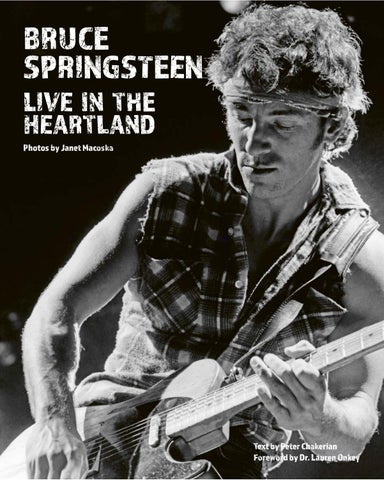
BRUCE SPRINGSTEEN LIVE IN THE HEARTLAND Photos by Janet Macoska
Text by Peter Chakerian Foreword by Dr. Lauren Onkey
FOREWORD BY DR. LAUREN ONKEY
I first saw a Janet Macoska photo of Bruce Springsteen in Rolling Stone magazine’s “Random Notes” section in November of 1980—it’s included here on pages 108-109. I was a senior in high school, and although I’d been a Springsteen fan since I heard Born to Run in 1975, I hadn’t yet seen him live. For five years, I’d read reviews describing the passion and excitement of his live shows. I was finally going to get my chance on The River tour in December of 1980, but in the meantime I was trying to find out everything I could about the tour by scouring the rock press and newspapers from across the country. Janet’s photo felt like an invitation. The photo remains one of my favorite shots of Springsteen in concert. Although you can’t see the audience, they are there: Bruce is looking at the crowd and pointing the mic towards them, as if he’s calling for a response. It’s a shot characteristic of Janet’s work. It captures that passionate moment between musicians and the audience—the physicality, the joy, the work of rock and roll. This book documents a series of very special Springsteen shows in and around Cleveland over four decades. Cleveland was one of the first cities that embraced Springsteen; he was filling bigger theaters and arenas there before he broke out across the country. As a result, there are spectacular photos from very early in Springsteen’s career—early in 1974 opening for Wishbone Ash, his first performance ever in Cleveland, with the five-piece E Street Band. He’s 24 and looking cool. He was back at the Allen two years later, having made a lot of noise with his third album. Those 1976 photos show how far he’d come as a showman. And the 1985 stadium show photos convey the scale of the peak of his success. Springsteen was a perfect subject for Janet. In the 1970s and 1980s, he played and talked about rock and roll like it was the most important thing in the world. And while Bruce has played solo shows and with other bands, these photos capture the development of Springsteen with the mighty E Street Band. You see his relationship with his bandmates, the intensity and drama of the performance, and lots of laughs. The one group of offstage photos here, from the show at the Richfield Coliseum in 1977, get to the heart of the rock and roll matter. Ronnie Spector fronted the E Street Band for
6
four songs that night, including her Ronettes’ classics “Be My Baby” and “Baby I Love You.” Springsteen is just beaming in the photos with Spector backstage. He was at a low point in his career at that time, and Ronnie Spector was trying to find a path back into the music business. But on that night they were reveling in the music. It’s romantic to think that going out and seeing a band could mean so much, that rock and roll could create a sense of community. I had the pleasure of getting to know Janet when I moved to Cleveland in 2008 to work at the Rock and Roll Hall of Fame. She is a rock and roll lifer. When I talk with Janet about the music she loves, she gets a gleam in her eye as she recalls the details of the shows she photographed. She reveres rock history and the people who made it. Her photos have that gleam. They make you want to be in them—you can almost feel the drumbeat in your chest as you look through the book. In 1979, Springsteen recorded a song called “Where The Bands Are” during sessions for The River. Inspired by Cleveland’s own The Raspberries, Springsteen described the song as “a tribute to the beauty and thrills of fandom… Those were the days of good feelings of being a part of something, of a real community of musicians and locals, of folks who when Saturday night rolled around, had someplace to go, somebody to see, something to dedicate yourself to. And music, music, music, music to play, to listen to, to live to.” Crank that song as you look at these photos and see what Janet saw over so many nights capturing the music. “There’s a rocker’s special on tonight/So meet me on down/’neath the neon lights/I wanna be where the bands are.”
Dr. Lauren Onkey is the Senior Director of NPR Music in Washington, DC. Prior to joining NPR, she was the inaugural Dean and Chair of the Jack, Joseph and Morton Mandel Humanities Center at Cuyahoga Community College in Cleveland, Ohio, and served as Vice President of Education and Public Programming at the Rock and Roll Hall of Fame and Museum from 2008-2015.
7
BRUCE SPRINGSTEEN LIVE IN THE HEARTLAND BY PETER CHAKERIAN
When I first heard Bruce Springsteen in the fall of 1979, I’ll admit, I didn’t “get it.”
top-down, literary, panoramic view. There was nothing abstract or cartoonish about any of it.
I mean, on some ethereal, spiritual, super-subliminal level, I did. But probably not the way I was supposed to, or in that way so many others coming of age at the time did immediately.
On one particular visit to my cousin’s, Mark lent me a couple of bootleg cassette tapes that really stayed with me: Pink Floyd: Animals Live in Zurich ’77 and Bruce Springsteen and the E Street Band: Live from the Cleveland Agora ’78. A loaner of the 1977 Led Zeppelin bootleg from Richfield Coliseum (another touchstone) would come on a later visit.
I’m not sure any self-absorbed, suburban kid still reeling from Star Wars and Superman: The Movie could. I was dialed into the divinity of rock ’n’ roll for sure, but not in a disambiguous way. It was from a more sensational, comic book-inspired viewpoint, which stands to reason.
Both titles held equal stature at the time. The former really turned me into a reader and writer, but also dialed me into societal class systems, history and literature. And of course, with its interstellar soundscapes, it sent me down the slippery slope of progressive rock fandom.
None of this awareness landed on me the moment I hit play on that cassette, of course. It planted a seed that would lead to a lifelong, growing awareness of Bruce—one that took many years (and albums and shows) to fully absorb, appreciate, understand.
Every rock star was this sort of otherworldly superhero. My youthful spirit hung on escape, on Buck Rogers in the 25th Century and Battlestar Galactica. Thanksgiving eve was reserved for the Fay Wray, Cooper/Schoedsack version of King Kong. Cleveland Indians rain delays had Space:1999 reruns on WUAB TV-43. Pop culture was assimilated and acquired at the local Lawson’s convenience store at the corner: Topps and Kiss collectors’ cards, Marvel comics, Space Invaders and Asteroids. Any pocket change left went towards the ICEE machine, Bazooka bubblegum or Now and Laters. At home, The Brave and The Bold (November 1977, #138) Daredevil (May 1979, #158), and Uncanny X-Men (October 1970, #126) and Starlog magazines were among the reading materials on my handed-down oak nightstand—furniture anchored by an Arkay bakelite tube-kit radio that my Dad built. Most of the bands I liked way back then were similarly stylized, bordering on caricatured. Not unlike Dad’s Arkay radio, which ironically played them all. It started with Rush, Black Sabbath, Alice Cooper and the Sensational Alex Harvey Band, which I heard in my cousin Mark’s bedroom for the very first time during a visit the next town over. From there, it was on to Queen. Elton John. Kiss. Van Halen. Cheap Trick. All like comic book characters come to life; all essentially over-the-top.
8
The latter was different. Like Floyd, it had been taped directly from a radio simulcast. This one, however, would become legendary—having almost biblical significance—in this once booming industrial town. If you were to believe what fans, insiders and critics were saying much later, this event was tantamount to Bruce saving the city, and vice versa—six million ears intently dialed in, many using their own cassette tapes and decks to capture the magic for future use. And the show! Whoa. Talk about energy and charisma! Springsteen felt like a throwback to a bygone era to these youthful ears. For as rollicking, energetic and big as he and the glorious E Street Band sounded, there was also muscle and a gravitas about him that was just undeniable. He had grit, presence, a real sense of purpose with his writing, and he honored the singer-songwriter aesthetic while making it his own—nodding to everything from folk and Stax-Volt to British invasion; from Sun Records to Motown; gospel to gritty punk rock. It was reaching deep. It was old, it was new, it was bold, and some of it was a profound melancholy blue. It was equal parts third-shift steel mill crew, 19th century Romantic-era idealism, modern sensitive man and sweaty poolhall philosophy.
This wasn’t a frozen Coke or bubblegum from the corner store. More like a stiff cup of coffee with a frenetic caffeine jolt. Or a Boilermaker—shot of Jack and Genny Cream Ale. Maybe both?
How can one begin to outdo all the “Inside Baseball” conversation centered around a cultural iconoclast who seeded heartland rock’s anything-but-inevitable zeitgeist? Or re-tell something that’s been thoroughly analyzed inside and out? It helps when one of your colleagues has some of the quintessential Bruce in her ’folio.
As it did for so many, “Born to Run” stood out to me, largely because it, too, was about escapism—but from a certain point of view I didn’t understand as a youth. A place that felt at once desperately hopeful, drained but rugged-and-ready, urgently imperative.
There is no finessing how important or significant Bruce has been culturally to rock ’n’ roll, and to the United States after all this time. Or how important he was/is to Northeast Ohio, and what it has been like to be here for it. In a lot of ways, you do what Bruce would: you tell the story.
As time went on, “Born to Run” became synonymous with so many of our lives as Clevelanders. The city itself wasn’t doing so hot economically in the late ’70s (something that would continue on and off well into present day). Despite the notion that we were the self-proclaimed “Rock and Roll Capital of the World,” population, jobs and industry were leaving at a frenetic pace.
For an artform so steeped in the aphorism “be here now,” paleographers of rock ’n’ roll have long struggled to do the same.
That song felt like truth to power, like it was written for our city. It would go on to be the Friday afternoon anthem for every weekend on WMMS-FM, discussed further within the book. Today, I can’t hear the song without thinking about this town and its people. The irony is, when superstardom called with Born in the U.S.A., that’s when Bruce would become something of a comic book hero himself. It bugged some fans, people who had been with him from the beginning… maybe it felt like he was slipping away from them, but to me, it felt like he’d been given his cowl and cape. That’s a typical turn of phrase in any fandom. But that fork in the road didn’t last long for most. Bruce kept challenging them all. Successfully.
He sang about coming of age, working class struggles, desperation, longing—real people in difficult situations, making difficult decisions—and he did it all in cinematic scale and with a
considers the Dave Marsh tome Bruce Springsteen: On Tour: 1968-2005 as the indisputable, indispensable and irrefutable final word on The Boss in concert?
How does one even begin to tackle a retrospective photography book on Bruce Springsteen? Especially when one
Ever looking forward, rock critics can come across like extroverted cultural elites you imagine at the “party of the year”—glancing just over your shoulder while in manic conversation, checking to see if someone more important than you came into the room for them to talk to and about. The rush to coronation of another new King, Queen, Godparent or Next Big Thing in rock ’n’ roll has been imminent, repeatedly, from the moment Elvis and pelvis found themselves in the same sentence—if not when “rock” and “roll” were joined in the American cultural lexicon. Artists themselves have long shuddered at such clatter, even if the praise was well-reasoned, insightful, justified and later confirmed. The late Jeff Buckley once told me in a 1994 interview with Cleveland Scene such comparisons were “lazy journalism, lazy culture and a lack of courage to describe originality.” “It’s a cop-out to thinking. Everybody’s been looking for Christ since The Beatles hit America. The kind of art that I make could never take over anything, except somebody’s bedroom. Or maybe their heart,” Buckley said.
9
“If people don’t know what to make of my music, how can it possibly be a revelation? It’s a really treacherous area to interpret something that way that doesn’t really have a language.” Today, his cold-and-broken “Hallelujah” (and accompanying album Grace) are held in the very same legendary esteem as the song’s author, Leonard Cohen. Sometimes, critics aren’t wrong. Such was the case for Springsteen, even if it made the man who would then become the myth and the legend uncomfortable for a part of his career. Twenty years prior, one of the single-most publicized examples of Next Big Thing praise in rock and roll came from the pen and typewriter of Billboard magazine’s Jim Melanson. In February 1973, after the second of six two-show nights by Biff Rose at Max’s Kansas City in New York, Melanson clairvoyantly commented on Rose’s opener: “Will Bruce Springsteen be the [Bob] Dylan heir of the ’70s? Maybe not yet, but the Columbia artist, with his debut LP and his evening’s performance here, shows definite signs of acquiring the mantle.” Melanson set in motion a seven-year itch, whereby crowning the New Jersey singer-songwriter as rock and roll’s inevitable savior became de rigueur. And fifteen months later, in May 1974, Jon Landau of Boston’s The Real Paper would take that hype to a whole other level: “I saw my rock ’n’ roll past flash before my eyes. And I saw something else: I saw rock and roll future and its name is Bruce Springsteen. And on a night when I needed to feel young, he made me feel like I was hearing music for the very first time.”
10
“Landau scooped me,” with a twinkle in her eye. She did bristle a bit at being “beaten to the punch” in print about “The Boss.” But in a world of constant change in rock ’n’ roll, her praise for Bruce never waned. During a career retrospective with her longtime employer, Scott professed (again) her love of Springsteen—dubbing him her favorite artist ever; Born to Run her all-time favorite album. High praise, indeed, from a journalist who introduced Cleveland to The Beatles, Stones and most legends now inducted at the Rock and Roll Hall of Fame and Museum at the end of East Ninth Street. To wit, the pall over Springsteen continued on the annual, with both Time and Newsweek publishing competing cover stories in October 1975. Springsteen himself was said to feel “haunted” by the enormous pressure of the “next Dylan” propaganda at the time. And yet, Landau, himself an originator of that media flurry, was now co-conspirator and co-producer on 1975’s Run and would become Springsteen’s manager. Columbia Records’ own Springsteen promotions would inevitably get called into question, even by Bruce himself, that very next month as he was readying his first E Street Band tour overseas. With both critical acclaim and retail applause rising, it all came to a head when Springsteen scored his first mini-tour of Europe (Stockholm, Amsterdam, and a two-night stand at the Hammersmith Odeon comprised the outing).
Even Cleveland’s groundbreaking rock critic and pop culture icon Jane Scott couldn’t help but weigh in during a 1975 Plain Dealer concert review:
He arrived at the Odeon to posters and lobby cards that said “Finally London is ready for Bruce Springsteen” in the foyer, which he famously removed. Badges printed with “I have seen the future of rock ’n’ roll at the Hammersmith Odeon” were also dispatched, not to be given out as previously intended. The decision to label him the “future of rock was a very big mistake and I would like to strangle the guy who thought that up,” Springsteen said at the time.
“His name is Bruce Springsteen. He will be the next superstar.”
Talk about relentless, insurmountable pressure.
Scott told me in my own Plain Dealer writing days that she had to fight the copy desk to use the term “superstar.” She said,
When it all got to be a bit much, The Boss would bring it back down to earth, to a home-away-from-home: here in Cleveland.
In fact, the city is in many ways the reason why Springsteen endures. It truly would become a getaway of sorts. There are a whole host of reasons for that, anchored in the notion that he likely felt seen, heard and understood here. And not judged. He played his first shows in the area in the winter of 1974, supporting The Wild, The Innocent & The E Street Shuffle album and bands like Wishbone Ash and Black Oak Arkansas. He was the acolyte of the Allen Theatre before the venue knew it needed one. And Cleveland audiences were there for him after a protracted legal battle with his management team made it necessary to reboot his career. Execs at Bruce’s label Columbia Records knew a live broadcast of a concert could be the shot in the arm that Bruce and the band needed to regroup. Famed former program director of WMMS-FM John Gorman insisted that Cleveland would be the perfect location, because fans here were positively wild about Bruce. Add that Steve Popovich, one of the execs, was actually from Cleveland, and there was instant traction behind the idea. The broadcast would be a part of WMMS’s Tenth Anniversary and would be
re-broadcast in several other Bruce-friendly markets: Chicago, Minneapolis, Detroit, St. Louis, Pittsburgh, Columbus, and Cincinnati. There’s a reason three million people were dialed into that August 9, 1978 Cleveland Agora show that night, when only a handful of them could actually attend; why that bootleg-goneofficial of the night was preserved in the moment simultaneously by WMMS, by Columbia, and by The Boss himself. It is one of the most beloved live recordings—not just of Bruce with the legendary E Street Band, but of any live rock ’n’ roll bootleg. There’s little wonder why Bruce eventually released an official version of it in December of 2014. After that 1978 gig, if it hadn’t already been obvious to those beforehand, Springsteen made Cleveland his second home. He has played the city 36 times (as of press time)—both solo and with E Street—as well as landing in various sundry cities positioned around the Great Lakes and Midwest dozens of times over. Calling him “one of the most prolific performers in Northeast Ohio over of the last 40 years” is an understatement.
11
Cleveland’s nickname “Asbury Park West” fits. Bruce’s emblematic anthems and characters and blue-collar ethos cemented that special relationship the city has had with Springsteen. As a city, we were embracing “our story”, as told by Bruce and others who would forge the communal “heartland” rock mythos—Petty, Seger, Mellencamp, Browne, and Raitt, but also Southside Johnny Lyon’s Jukes, Iron City Houserockers, Donnie Iris and the Cruisers, and our very own Michael Stanley Band. People who embraced their respective big-hearted, workhard-play-hard ethos to ultimately become a generation’s own semibiographical soundtrack. That “dialing in” to the voice of a region is why the fabled promoters and radio legends here in town are who they are— and why they got behind Springsteen. And they gave him every opportunity to test out new material and let his hair down here, so to speak, and why he has never forgot the city (or the region) on a tour. It’s a big part of why he came back for presidential rally performances, Vote for Change in 2004 (for John Kerry) and 2008 (Barack Obama) and for a Rock Hall “American Music Masters” performance “Hard Travelin’” honoring Woody Guthrie in 1996. It’s why he kicked and anchored the opening of the Rock and Roll Hall of Fame at the fabled Cleveland Municipal Stadium “Concert for the Hall of Fame” in 1995. And why he delivered three area dates for his Ghost of Tom Joad solo acoustic tour the following year—including namesake “Youngstown” in the itinerary. Even when he accidentally called Cleveland “Pittsburgh” in a 2016 concert on The River redux tour—which drew a range of “laughing boos” partially because of a certain football rivalry—one can’t help but understand that Bruce can do no wrong here. Because he is us. We are him. He speaks to and for us. It’s a perpetual, unbreakable bond. Critics were “always talking about how Springsteen was going to be the ‘next Dylan’ all the time, but you witness him and you know there’s more,” said Janet Macoska, award-winning
12
photojournalist and legendary rock and roll photographer headquartered in Cleveland. “When he’s not in the confession booth with the fans, he is up there, flat-out testifying. There’s a slender thread there to Dylan, but it’s a different spiritual tact in so many ways. And [program director] John Gorman and jocks Denny Sanders and Kid Leo [Lawrence Travagliante] over at the Buzzard [WMMS-FM], and Mike and Jules Belkin at Belkin Productions, they all see it. But perhaps even more importantly, and because of them, Cleveland sees it,” she added. “Cleveland feels it, too,” said Macoska. “They feel seen, and find themselves in Bruce. They see themselves in those songs, those characters, those stories. “The narratives speak to Clevelanders in the heart of economic downturn and struggle; longing for relief and redemption. Bruce is definitely the voice of a generation, and speaks to a quintessentially American experience. “He’s an expert storyteller, hence that Dylan thing, but he’s also the kind of guitar player whose six-string talents get overlooked sometimes because of his stories… Bruce is one of my favorite artists to photograph, and has yielded some of the greatest images of my career.” Macoska should know. Over the course of a five-decade career, she has captured Springsteen on ten different occasions and borne witness to the “E Street Ministry” several more times over, including the famous 1978 Cleveland Agora show. There are no photos of hers from that night, and there’s a story behind that between these covers, but the show itself blew her mind. “That energy, the masterminding, that ebb-and-flow of the show on stage, working that crowd and warming them up to a boil—and that ‘wall of sound’ song construction and band participation? Undeniable. Hits you right in your heart and your guts. That’s something that Bruce has always been able to do.” Capturing that heart and guts has been Macoska’s calling card, often referring to rock and roll as a “soundtrack for life.” Her love affair with popular music began with a pre-teen amour for Ricky Nelson—who she eventually captured on film—but
that love matured in earnest when The Beatles led the British Invasion in America in 1964. At 10 years old, The Fab Four changed her whole world overnight. “They inspired many a hard day’s nights over the years,” Macoska said. “I figured if four lads from Liverpool can do it, why not me here in Cleveland? It’s been quite a ride. I’ve never felt like ‘I’ve been working like a dog.’ Doing what I do is the joy of my life. ‘It makes me feel all right.’” With nary a musical bone in her body, she was determined to stay connected to rock ’n’ roll and bonded with her transistor radio and her parents’ household camera, a Kodak Dualflex II. The former kept her dialed in to all her favorite music; the latter was used to document everything around her—familial, neighborhood activity, still life. Anything to capture the next Life magazine-like moment, a publication she also idolized. The soundtrack to her professional life starts with Sonny and Cher two years later, in 1966. That’s where her fascination with music and photography has something of a head-on collision. A promotional appearance by the singing duo was scheduled at local radio station WKYC before their performance that evening at the Cleveland Music Hall. They were promoting their second album, The Wondrous World of Sonny & Cher. By then, Janet was 12, calling in to WKYC disc jockeys “Jerry G.” ( Jerry Ghan) and “Big Jack” (née WIXY’s “Jack Armstrong,” née John Larsh), requesting her favorite songs and asking to help them out at the station whenever they needed it. “Those guys were very kind to me,” Macoska said. “Quite something for a ‘precocious but semi-responsible’ 12-year-old girl with a camera.” She eventually helmed “Big Jack’s Fan Club,” answering the jock’s abundant fan mail and carrying her sidekick whenever she visited the station. Any chance to capture an image of a visiting pop star was too tempting to pass up.
“I’m sure I drove my parents crazy, and they thought that I was half-crazy,” said Macoska, who said her parents “always dutifully obliged” running her to all of these station opportunities and live events, and “often sat in the car and waited for me to do my thing.” Months later, Macoska’s photo of Sonny & Cher appeared in the monthly periodical Teen Screen magazine. It was 1967, the year of Sgt. Pepper and Are You Experienced. She made a whopping $2 on the deal, but the decades of experiences that were to come were priceless. Since 1974, Macoska has been capturing rock’s greatest on film… and now in pixels (digital). Her works have graced Rolling Stone, People, Vogue, American Photo, Creem, MOJO, The New York Times and The Times, London. Multimedia platforms including VH1, Bravo, A&E, and the BBC all regularly use Macoska’s vast archive in their coverage and in “rockumentaries.” Her work is in the permanent collection of The Rock and Roll Hall of Fame; in The Smithsonian National Museum of American History; in the National Portrait Gallery in London, and in Hard Rock Cafe restaurants, hotels and casinos the world over. David Bowie, Led Zeppelin, The Clash, DEVO, Heart, Hall & Oates, AC/DC and The Kinks are just some of the artists who have used her photos within their own artistic projects, and in 2017, Macoska was inducted into the Cleveland Journalism Hall of Fame. In the pages beyond these, you’ll witness one of her favorite subjects, singer-songwriter and Rock and Roll Hall of Famers Bruce Springsteen and the E Street Band coming to eminence through her lens and her hometown. She reflects on these concerts, her experiences at them, and the circumstances around some of her most legendary shots of “The Boss and The Family.”
When Sonny and Cher arrived, the budding Shutterfly was ready, willing and able for that photo-op—and the thrill of it set her entire career in motion.
13
ALLEN THEATRE, CLEVELAND 1974
ALLEN THEATRE, CLEVELAND 1974
F R I D AY, F E B R U A R Y 1 , 1 9 7 4 A L L E N T H E AT R E CLEVELAND, OHIO
SETLIST: Spirit in the Night Does This Bus Stop at 82nd Street? Walking the Dog Zero and Blind Terry Blinded by the Light Kitty’s Back Thundercrack Rosalita (Come Out Tonight)/Shotgun (Junior Walker cover)
“HE’S VERY EARTHY AND CHARISMATIC—WE AREN’T QUITE TO THE STAGE PERSONA HE’S KNOWN FOR YET; THAT WOULD COME IN ANOTHER YEAR OR SO—BUT I CAN TELL RIGHT AWAY THAT THERE’S SOMETHING ENTIRELY DIFFERENT ABOUT OUR SCRAPPY HERO-TOBE. SPRINGSTEEN LOOKS LIKE HE’S JUST WALKED IN OFF THE STREET… AND THEN THERE’S THE STRIKING PRESENCE OF THE ‘SIXFOOT-SIX BIG MAN’ CLARENCE CLEMONS ALONGSIDE HIM. THEY’RE ON FOR A LITTLE OVER AN HOUR AND I GOTTA TELL YOU, THAT ENERGY IS PALPABLE, Janet Macoska UNDENIABLE.” 16
17
108
108
110
110
114
114
Five decades of blue-jeans down-to-earth rock ’n’ roll. Five decades of poetic, authentic performances, political commentary and worldwide tours. Bruce Springsteen hasn’t just left an impact on the surface of modern music, he helped shape its foundations. Lauded rock photographer Janet Macoska has captured Springsteen’s stage performances from the early beginnings in 1974, to the seminal Born in the USA album and the 2016 River tour, the highest grossing tour of that year. Through Macoska’s lens, we witness his enduring energy on stage. Here is Springsteen at his finest: a down-to-earth superstar, whose powerful performances stand the test of time. “Bruce would rip his heart out and give it to his audience. He put everything into his performance.” Janet Macoska
ISBN: 978-1-78884-119-1
ËxHSLHSIy841191zv&:%:&:+:+
£30.00/$45.00
www.accartbooks.com