Sabina R. Korfmann-Bodenmann (1960) currently lives in Switzerland and has previously had residences in Germany, the USA, and India. She holds a doctoral degree in Business Psychology, and her book The CEO Change and the Effects on the Organization was published in 1999.
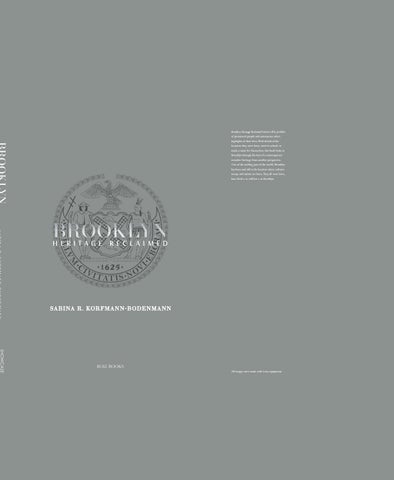
Brooklyn: Heritage Reclaimed features fifty profiles of prominent people and summarizes select highlights of their lives. With details of the locations they were born, went to school, or made a name for themselves, this book looks at Brooklyn through the lens of a contemporary outsider: heritage from another perspective. One of the melting pots of the world, Brooklyn has been and still is the location where cultures merge and talents are born. They all were born, have lived – or still live – in Brooklyn.
Sabina R. Korfmann is the founder of ‘Korfmann Corporate Communications Consulting’, an industry leader for financial media communications in Switzerland. Her book Living Heritage – Centuries in Business was published by Roli Books in 2016.
ISBN: 978-93-5194-134-7
All images were made with Leica equipment.
Brooklyn Cover 24 8 2017.indd 1
24/08/17 2:07 PM
CONTENTS
Foreword
7
Woody Allen 2 Isaac Asimov 3 Madeleine Astor 4 W.H. Auden 5 Lauren Bacall 6 Matthew Barney & Bjรถrk 7 Jean-Michel Basquiat 8 Henry Ward Beecher 9 Lloyd Blankfein 10 Benjamin Britten 11 Mel Brooks 1
12
8 12 16 20 24 28 32 36 40 44 48
52
24 George Gershwin
100
36 Larry King
56 60 64 68 72 76 80 84 88 92 96
25 Ruth Bader Ginsburg
104 108 112 116 120 124 128 132 136 140 144
Sandy Koufax 38 Spike Lee 39 H.P. Lovecraft 40 Norman Mailer 41 Arthur Miller & Marilyn Monroe 42 Henry Miller 43 Steve Rubell
Al Capone
Truman Capote 14 Shirley Chisholm 15 Lady Randolph Churchill 16 Aaron Copland 17 Mos Def 18 Neil Diamond 19 Bobby Fischer 20 Yuri Foreman 21 John Forsythe 22 Milton Friedman 23 David Geffen 13
26 Rudy Giuliani 27 Bob Guccione 28 Anne Hathaway 29 Leona Helmsley 30 Harry Houdini
Wolfman Jack 32 Jay Z 33 Norah Jones 34 Michael Jordan 35 Danny Kaye 31
148 152 156 160 164
37
44 Carl Sagan 45 Bernie Sanders 46 Beverly Sills 47 Barbara Streisand 48 Mike Tyson 49 Mae West
168 172 176
50 Janet Yellen
180 184 188 192 196 200 204
Downtown Brooklyn
28
50 3
Bay Ridge
DYKer Heights
Coney Isl
and
Sunset Park
30
4
20
10
8
Greenwood Heights
Bensonhurst 44
Downtown Brooklyn
31
37
Borough PaRK
Parkville
18
FLATBUSH
45
21
26 41
7
1 25
13
Prospect LefFerts GARDENS
Midwood
Homecrest
43
47
48
Flatlands
14
Crown Heights 19
Brownsville
24
9
2
11
27
42
32
46
Bedfordstuyvesant
49
17
36
35
23
George Town
34
16
Mapleton
Brighton BEACH 29
15
40
Park slope
5
6
Bushwick
22 Highland
Park
East New York
33
38
City Line 39
Brooklyn Outline
12
J
eanette, Lady Randolph Churchill, née Jerome (9 January 1854 – 29 June 1921), was born in Brooklyn. She was an American socialite, the wife of Lord Randolph Churchill and the mother of British Prime Minister Sir Winston Churchill. Her father, Leonard Jerome, was a prominent figure in New York society, whose success on the stock market earned him the nickname ‘The King of Wall Street’. Leonard Jerome was a patron of the arts and an avid sportsman who helped found the American Jockey Club. In 1866, the Jerome Park Racetrack in the Northern Bronx opened. Equipped with a large dining room, magnificent ballroom, and clubhouse accommodations equal to those of the finest hotels, the horse-racing track was a smashing success, and soon became the place to be seen for members of New York society.
Lady Randolph Churchill Mother of British Prime Minister Sir Winston Churchill
Jeanette travelled to Paris with her mother and two sisters, where they mingled with the European upper classes. Jeanette caught the attention of Lord Randolph Churchill (1849–1895), a dashing young English nobleman with strong political ambitions. Long considered one of the most beautiful women of the time, Jeanette was married on 15 April 1874, aged 20, to Lord Randolph Churchill. Although the couple became engaged within three days of their initial meeting in August 1873, the marriage was delayed for months while their parents argued over financial arrangements. After marriage she was henceforth known as Lady Randolph Churchill, and was referred to in conversation as Lady Randolph. The Churchills had two sons. Winston (1874–1965), the future prime minister, was born less than eight months after the marriage. When asked about the circumstances of his birth, Winston would reply: ‘Although present on the occasion, I have no clear recollection of the events leading up to it.’ The biological father of the second son, John (1880–1947), was rumoured to be Evelyn Boscawen, 7th Viscount Falmouth. Lady Randolph is believed to have had numerous lovers during her marriage, including the Prince of Wales (the future King Edward VII), and Herbert von Bismarck. As was the custom of the day in her social class, Lady Randolph played a limited role in her sons’ upbringing, relying largely upon nannies. Winston Churchill worshipped his mother, writing her numerous letters during his time at school and begging her to visit him, which, however, she rarely did. He wrote about her in My Early Life: ‘She shone for me like the evening star. I loved her dearly – but at a distance’. Later in life, they became good friends and strong allies, to the point where Winston Churchill regarded her almost as a political mentor, more as a big sister than as a mother. Lady Randolph was well-respected and influential in the highest British social and political circles. She was an outspoken opponent of women’s right to vote. Consequently, she and her son Winston were often heckled by enraged suffragettes. After Lord Randolph Churchill died in 1895, she occupied herself by editing a short-lived literary magazine and writing several books and plays. Some of the quotes remain famous today, such as ‘There is no such thing as a moral dress – it’s the people who are moral or immoral,’ and ‘Treat your friends as you do your pictures, and place them in their best light.’ Lady Randolph remarried twice and died in 1921.
426 Henry Street, Cobble Hill There is some controversy regarding the time and place of birth of Lady Randolph Churchill. A plaque at 426 Henry Street, gives her year of birth as 1850, not 1854. However, on 9 January in 1854, the Jeromes lived nearby at number 8 Amity Street (since renumbered as 197). It is believed that the Jeromes were temporarily staying at the Henry Street address, which was owned by Leonard’s brother, and that Jeanette was born there during a snowstorm.
. 65 . { Lady Randolph Churchill }
M
ilton Friedman (31 July 1912 – 16 November 2006) was born in Brooklyn. He was an American economist who received the 1976 Nobel Memorial Prize in Economic Sciences for his research on consumption analysis, monetary history and theory and the complexity of stabilization policy.
A talented student, Friedman graduated from Rahway High School in 1928, just before his sixteenth birthday. In 1932, Friedman graduated from Rutgers University, where he specialized in Mathematics and Economics. He was offered two scholarships to do graduate work – one in mathematics at Brown University and the other in economics at the University of Chicago. Friedman chose the latter, thus earning a Master of Arts degree in 1933. In 1946, Friedman accepted an offer to teach economic theory at the University of Chicago, where he would work for the next thirty years, and contribute to the establishment of an intellectual community that produced a number of Nobel Prize winners, known collectively as the Chicago School of Economics.
Milton Friedman Economist
The Great Depression of the thirties was blamed on free markets and brought a vast expansion of government interference with the economy. Anybody who favoured rolling back the power of government inevitably faced the question: ‘What about the Great Depression?’ Without all the laws from that era, it was feared, there would again be high unemployment, chronic monopolies and gross inequality. Friedman did more than anyone else to change thinking on these issues. He gathered massive documentary evidence that the Great Depression occurred primarily because the money supply contracted by one-third between 1929 and 1933, although the U.S. Central Bank (Federal Reserve) had been granted the power to prevent such a catastrophe. The Great Depression was a government failure. Moreover, Friedman showed that ‘inflation is always and everywhere a monetary phenomenon’. He made the case that the government’s ‘fine-tuning’ policy was more likely to backfire: by the time central bankers realize the economy is slipping into a recession or depression, and they inflate the money supply, the effects are likely to be felt after the economy has already recovered, worsening the subsequent inflation. Conversely, by the time central bankers realize inflation is a problem, and they contract the money supply, the effects are likely to be felt after the economy has slowed down, worsening a next recession or depression. The government, Friedman made clear, is the biggest source of instability in the economy. Friedman was an adviser to Republican President Ronald Reagan and conservative British Prime Minister Margaret Thatcher.While champions of liberal economics have generally done well to achieve significant impact on a single area of public policy, Friedman has had an impact on many public policies. He helped usher in an era of free foreign exchange markets. He campaigned for ballot initiatives to limit government spending and taxes. He inspired the movement for educational choice via tuition vouchers which would enable poor people to opt out of government schools. He courageously spoke out against drug prohibition, and was proudest of helping to end military conscription in the United States.
502 Barbey Street, East New York Milton Friedman was born at 502 Barbey Street. He was the fourth child and only son of Jeno Saul Friedman and Sarah Ethel Landau, both of whom were from Beregszasz, Carpatho-Ruthenia, which was part of the Austro-Hungarian empire and is now part of the Ukraine.
. 93 . {Milton Friedman}
All rights reserved. No part of this publication may be transmitted or reproduced in any form or by any means without prior permission from the publisher. SHOWCASE A Roli Books imprint for titles sponsored by individuals or organisations. ISBN: 978-93-5194-134-7 Š Sabina R. Korfmann-Bodenmann, 2017 Š Book concept, layout, and design: Roli Books, 2017 Published in India by Roli Books M-75, Greater Kailash II Market New Delhi-110 048, India. Phone: ++91-11-40682000 Email: info@rolibooks.com Website: www.rolibooks.com Design: Sneha Pamneja Editors: Neelam Narula, Rayman Gill-Rai Layout: Naresh L. Mondal Pre-press: Jyoti Dey Production: Yuvraj Singh Printed and bound in Thomson Press, India