Artist unknown
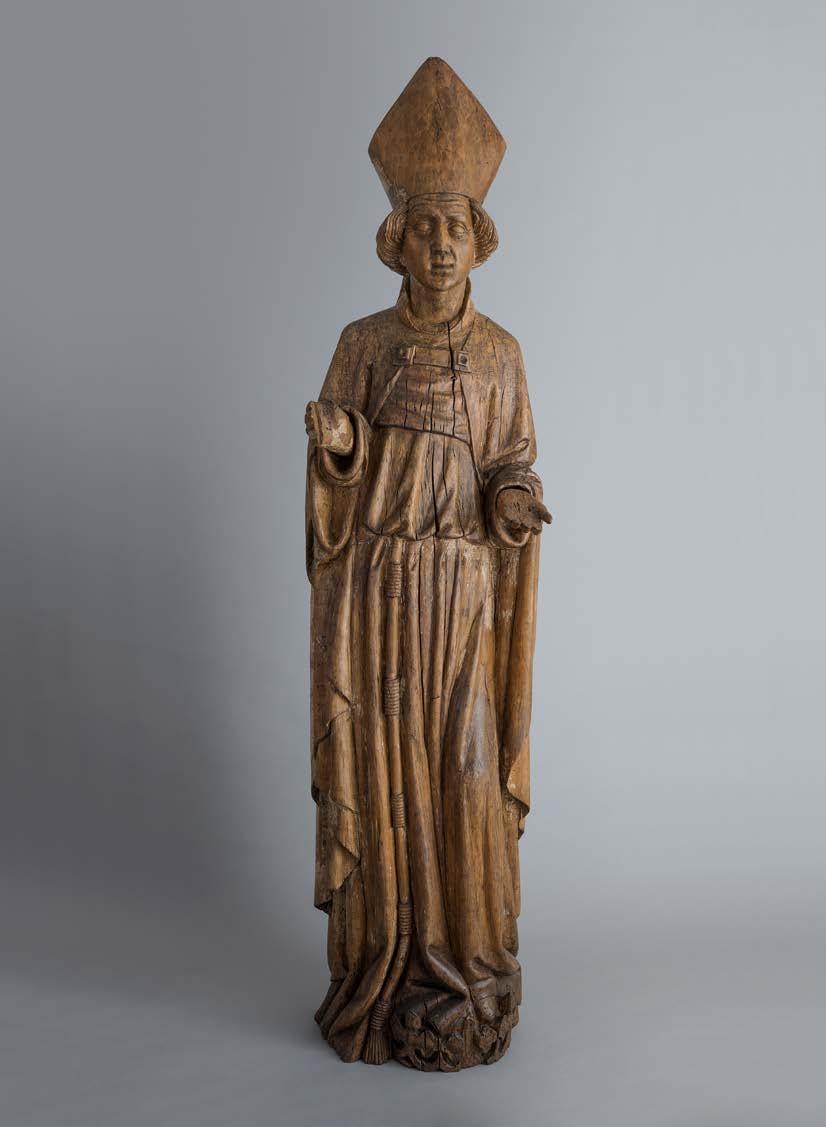
Saint Louis of Toulouse, 1380s carved wood, h. 165 cm inv. no. 54.263
The oldest object in the sub-collection held by Brno City Gallery is the statue of Saint Louis of Toulouse – the only work of art that dates back to the fourteenth century. Old inventory records held by Brno City Museum claim that this statue originated from the Church of St Nicholas on Náměstí Svobody Square, demolished in 1870. Presuming that this information is correct, the statue is the only surviving item from the church’s interior. Its style is consistent with the work of the younger generation of Prague’s St Vitus workshop, headed by Peter Parler. The statue shares similarities with the busts in both triforia of St Vitus Cathedral, as well as the figures that adorn the Old Town Bridge Tower. It lies somewhere between Parler’s classic style and the subsequent ‘beautiful style’.
As Moravia was governed by the younger branch of the Luxembourg dynasty, close ties were formed in the fourteenth century between Moravia and Bohemia. These associations were reflected in the arts; in the 1380s Peter Parler’s nephew, Heinrich Parler, worked at the court of Jobst, Margrave of Moravia, in Brno. However, the hypothesis that the statue of Saint Louis of Toulouse was created by Heinrich Parler himself is unlikely. He is widely believed to be the sculptor of the Pietà at the Church of St Thomas, Brno, and the two works differ somewhat in style. On the other hand, doubt has also been cast on the Pietà being sculpted by Parler, thus invalidating the argument of stylistic differences. Despite the complexities involved in identifying an artist from the Middle Ages, we can say with relative certainty that the statue of Saint Louis of Toulouse was sculpted by someone with ties to the Parler workshop. RJ
Theodor Hörmann (1840 Imst–1895 Graz)
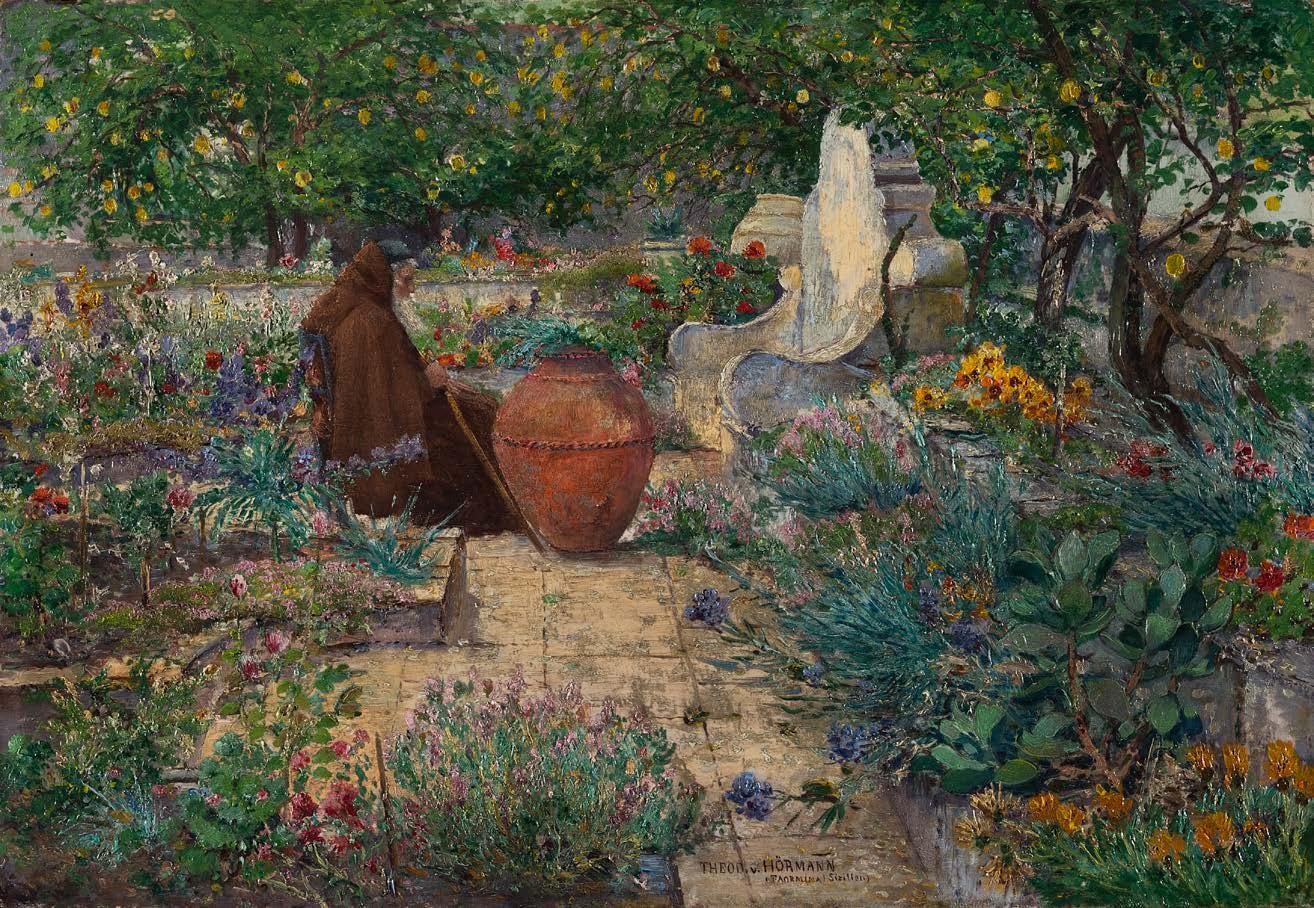
Sicilian Garden (Taormina), 1894 oil on wood, 35 × 50 cm inv. no. 52.511
Theodor Hörmann initially served as a soldier but later studied at the Academy of Fine Arts, Vienna and took up painting professionally. He lived in France for a period and, upon returning to Vienna, became one of the most prominent Austrian Impressionists as a result of his French sojourn. While staying in Munich, Hörmann became acquainted with members of the Munich Secession and advocated for the establishment of a similar organisation in Vienna. However, he did not live to see its founding. Between 1890 and 1893 Hörmann lived in Znojmo. In his paintings he creatively explored this Moravian region, a source of inspiration for Moravian and Austrian painters around the turn of the nineteenth and twentieth centuries.
In 1894 Hörmann visited Taormina in Sicily with Josef Engelhart, who later became a member of the Vienna Secession. The Belvedere Museum in Vienna still possesses a sketch by Engelhart depicting Hörmann painting in a garden in Taormina. The low wall in the foreground and the slender trees could match the garden shown in the Brno painting. From Hörmann’s position, the same angle of view would have opened up as in the Brno composition.
The Vienna Secession regarded Hörmann as an ideological predecessor. Only after 1900 did the group of artists around Gustav Klimt move towards the decorative stylisation that the general public now associates with Viennese Secessionist painting. Around 1900 the inhabitants of Vienna understood ‘Secessionist style’ to be primarily a reference to German and Austrian Impressionism. The painting Sicilian Garden (Taormina) appears as a model example of this ‘Secessionist style’. Hörmann retains flowing lines, but he works with free brushwork and, in places, impasto brushstrokes. He employs intense light and strong, pure colours. The flowerbeds featured here anticipate the Secessionist fondness for paintings based on decorative floral compositions. RJ
František Foltýn (1891 Královské Stachy–1976 Brno)
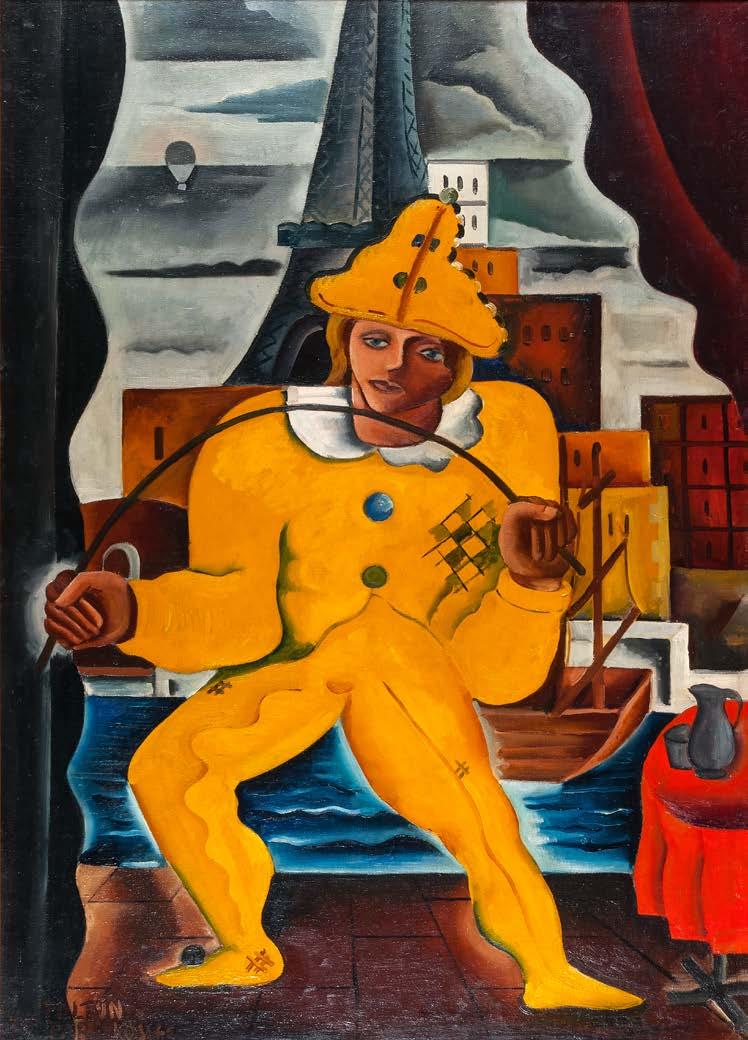
Harlequin, 1925
oil on canvas, 127 × 91 cm
inv. no. 56.622
Foltýn’s artistic style changed several times over the course of his life. He lived in Paris between 1923 and 1934, during which time he first turned his attention to abstract painting. He joined the Cercle et Carré group in 1930 and became a founder-member of the Abstraction-Création group in 1931.
His Harlequin, dating from his early days in Paris, demonstrates that Foltýn was abandoning the previous Cubist-Expressionist phase of his career. Instead he was starting to focus on figure painting influenced by Primitivism. Primitivism was an attempt at artistic creativity liberated from professional training and the trappings of ‘civilisation’. It embraced the art of indigenous peoples, children’s drawings and paintings and the work of Naïve artists – with the most highly regarded Naïve painter in Modernist Paris being Henri Rousseau. While Foltýn’s new artistic style may not have been directly influenced by Rousseau, it does reveal similarities: sharp lines, a two-dimensional concept of shape, the absence of depth perception in the image, a disregard for principles of classical composition, the clumsy stacking of objects onto the canvas, unsophisticated colours and the lack of elaborate shading.
The Parisian panorama on Harlequin is not a view of the actual city, but a theatrical set. The two-dimensional shapes and the way in which they are arranged as a backdrop thus acquire a meaningful justification. The painter evokes the ambience of Paris cabarets in which he places a figure from the classical Italian commedia dell’arte transferred into the modern age, shown by the Eiffel Tower and a hot air balloon in the sky. The Eiffel Tower also appears in other pictures that the artist painted shortly after arriving in Paris; he sees it as embodying not only Paris, but also the modern age itself. Foltýn blended Primitivism with more sophisticated Modernist styles, primarily Cubism, that worked with geometric structures. The buildings painted on the theatre set, and the undulating curtain edges, work by their very nature with the basic geometric shapes. RJ
Jan Willenberg (1571–1613)
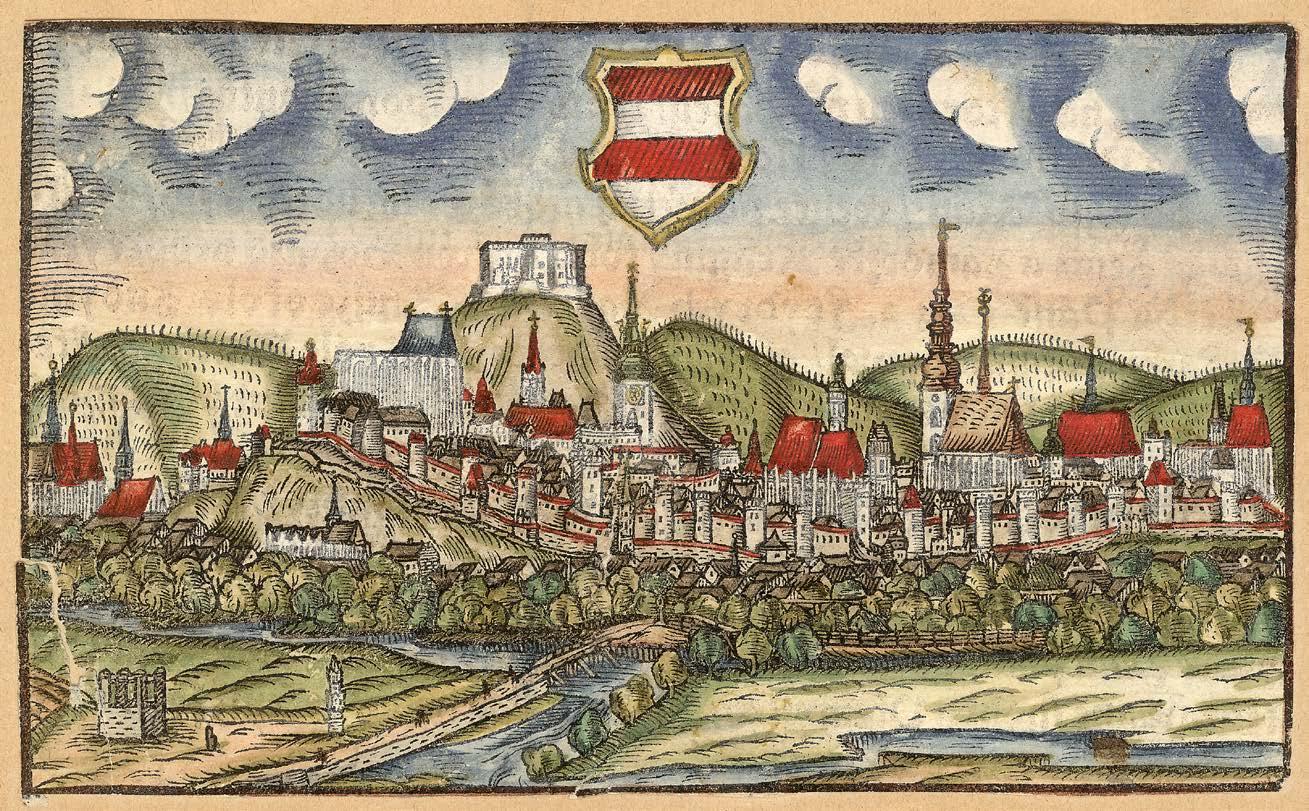
Brno from the South-east, 1593 woodcut with additional colouring, 87 × 145 mm
inv. no. 2289
Historical topographical paintings, drawings and engravings took full advantage of their documentary, evidential, informative and illustrative mission. However, their rapid development into a sui generis artistic form, with its own specific characteristics and symbolic and compositional rules, cannot be overlooked. Such artworks are linked to prevailing artistic currents and did not vanish even with the invention of photography. They lived, and continue to live, in landscape art, of which in their own way they form a part. The first vedutas of Brno were illustrations for books and historical-topographical encyclopaedias. Bartosz Paprocki opens his chapter on Brno in the book Mirror of the Illustrious Moravian Margraviate, in which he describes the city’s history, with this elegant sentence:
Brno is an ancient city, below which flow the Svitava river and another, called the Nigrim by Dubravius, while on the other side the city is surrounded by rugged mountains and is sufficiently fortified against enemies with walls and other measures, with the castle called Špilberk standing on a high hill.
The first-known and oldest view of Brno is preserved in the woodcut by Jan Willenberg, a well-known creator of woodcuts, prints and drawings who illustrated Paprocki’s text. The veduta depicts the city encircled by a wall, with multiple towers and turrets; it features buildings both secular and sacred, though the eye is most drawn to St Peter’s Cathedral. To the cathedral’s right rises the tower of the Old Town Hall and other Brno churches, including those of St James, St Nicholas and St Thomas. Below, left of the cathedral and outside the city wall, the woodcut shows the first-ever image of Staré Brno. The city is surrounded by hills, with Špilberk Castle towering on the highest. This image of Špilberk is the first known depiction of the fortress, now the home of Brno City Museum. JC, LV, FK
Antonín Procházka (1882–1945)
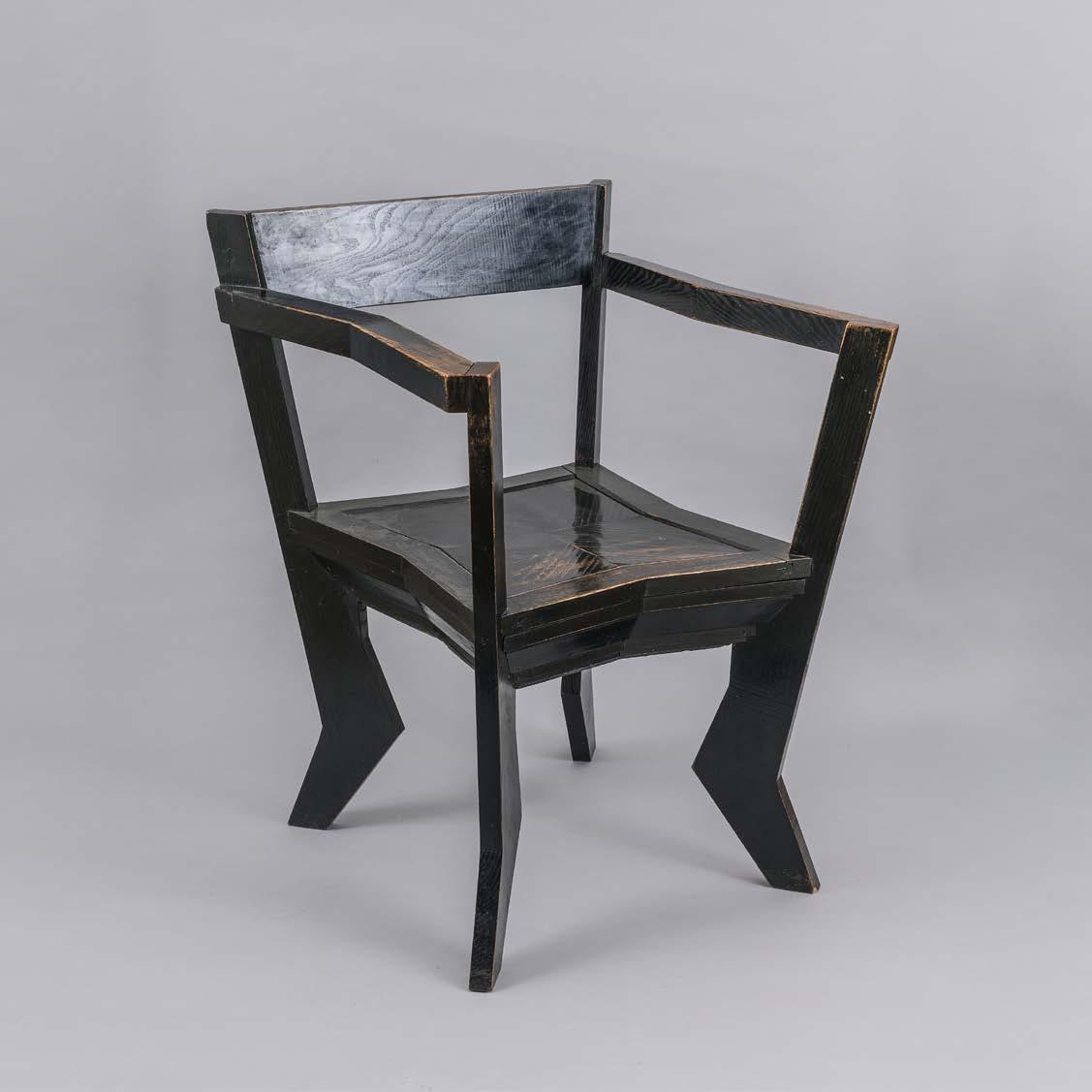
Armchair, probably 1920s wood (oak), stained black, 89 × 65 × 70 cm
obj. no. 25/1986
Antonín Procházka is one of Czech Modernism’s most distinctive painters. A significant proportion of his artistic work consists of designs for furniture, lighting and small handicrafts, as well as architectural studies.
After 1910 Procházka’s intense fascination with colour and expressive composition gave way to a search for new artistic principles, instigated by French Cubism. His individual approach to Cubism, with its distinctive Orphic traits, is one of the most original manifestations in modern Czech painting. In effect Procházka created a specific version of ’Czech’ Cubism, with numerous variations on folk art.
The plastic forms of Procházka’s furniture resemble works of sculpture and represent the ongoing problem of the notional boundary between free and applied art. His masterpiece is an armchair that straddles the interface between architecture and free-standing sculpture. The ‘brutally’ segmented armchair, full of avid disquiet, is today considered one of the most radical furniture artefact designs created in the spirit of Cubism. Several sketches of it have been preserved, providing evidence of gradual changes in its form. This highly impressive piece is aptly characterised by an opinion on the canon of principles applicable to Cubist-period architecture and furniture design, which ‘contrasted the idea of form with structure, purpose, material, entered into an active relationship with matter, bringing it into motion’.2
The date and manufacturer of the piece have yet to be established with any certainty due to the absence of relevant sources and documents. The armchair (two specimens) was acquired by the museum along with an ottoman and bookcase identical in design; both were conceived in the spirit of Rondocubism, a distinctively Czechoslovak artistic style. The set of furniture was originally part of the fixtures and fittings in Antonín and Linka Procházka’s Brno home. Contemporary visitors to their villa describe how one of the armchairs was kept on the ground floor and the other placed in the artist’s atelier. JC, LV, FK
Sergius Ruegenberg (1903–1996) or Ludwig Mies van der Rohe (1886–1969)
Sketch of the upper terrace, Villa Tugendhat, Brno, 1929 (?)
charcoal, 57.5 × 133 cm
obj. no. 10/1992
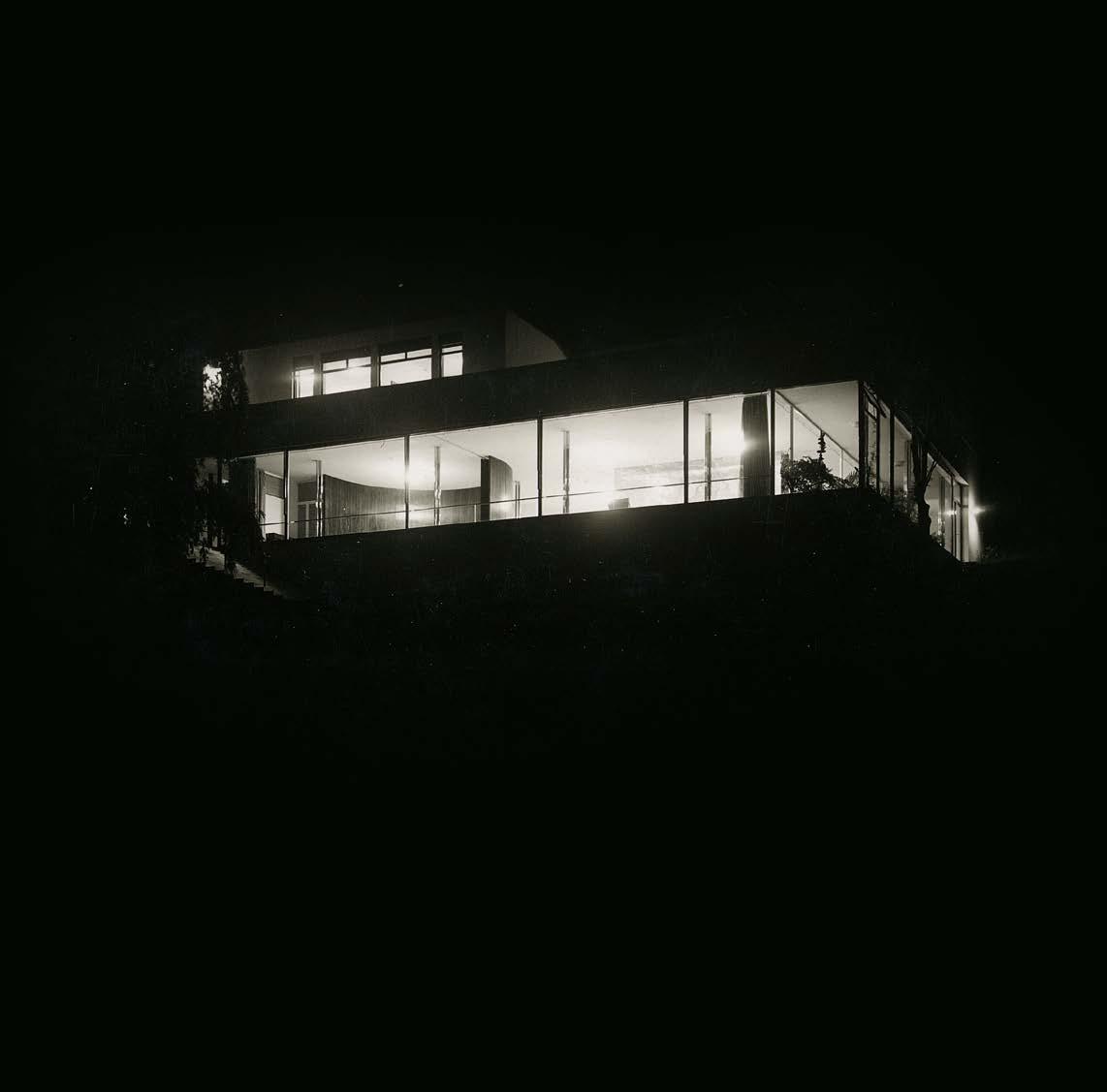
The villa belonging to Greta and Fritz Tugendhat is a unique work of art, in all senses: structure, spatial arrangement, fixtures and fittings, technical facilities (including hot-air heating and cooling, and windows that could be opened electronically), even the way it was integrated into a natural setting. A load-bearing steel frame, fully exposed on the exterior and the interior, both of which were fitted with rare materials, was used in a family home for the first time in the history of architecture.
Sergius Ruegenberg and Lilly Reich (1885–1947)
collaborated with Ludwig Mies van der Rohe to design the building and its interiors. The villa’s garden, in which the Brno landscape architect Markéta RoderováMüllerová (1898–1981) was substantially involved, is literally connected with the building in the sense of architectural interior and exterior uniting into one unique complex. Plants also appear on the facades, where they optically dissolve the substance of the house in greenery. Drawings from Mies’s atelier indicate the importance of this effect, depicting plants on the walls and structures. These drawings include a sketch of the upper terrace, preserved in the collection of Brno City Museum. In harmony with contemporary ideas about a healthy lifestyle, the terrace offered the
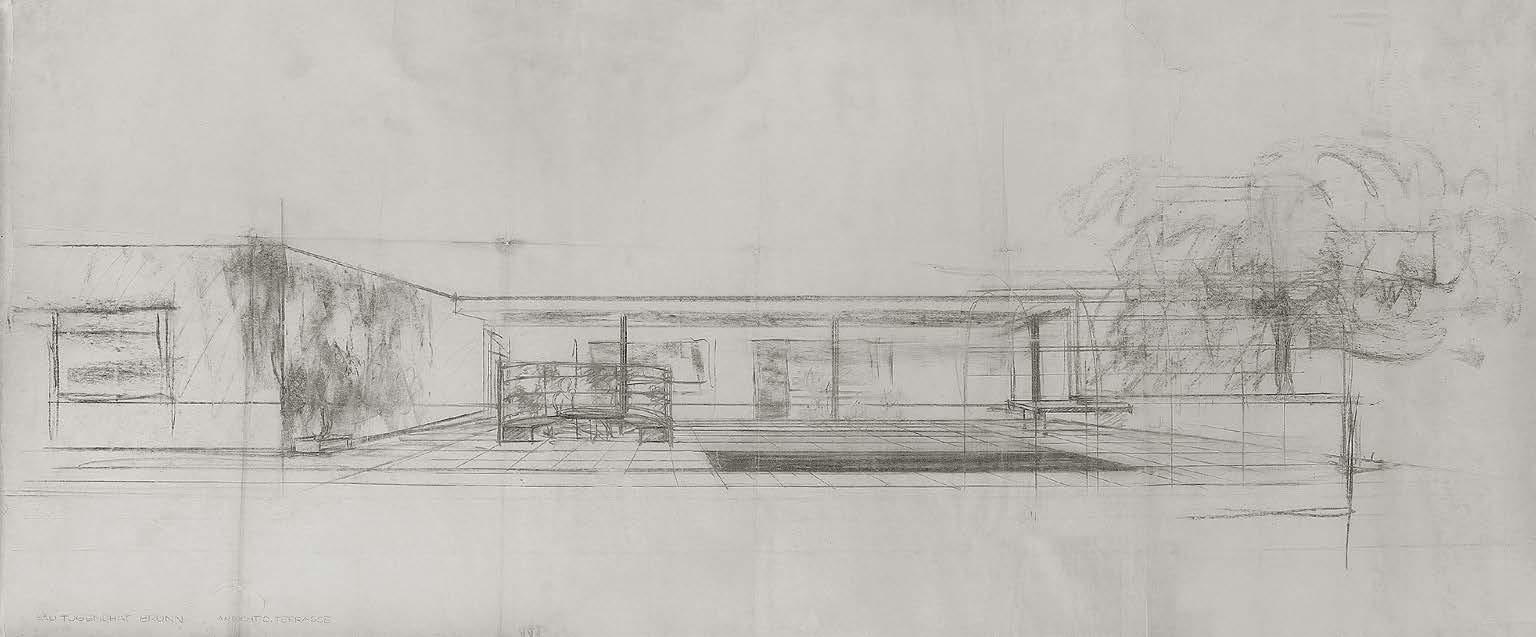
option of spending time in the sun and fresh air directly from the family’s bedrooms. It also made an outdoor play area for the children.
We know from a statement by Sergio Ruegenberg that the curved bench on the upper terrace was designed after Ludwig Mies van der Rohe and Lilly Reich visited the building. The couple were inspired to make the curved bench following a visit to Charlottenhof Palace in Germany. Railings formed the back rest of the bench, which was also surrounded by pots of climbing plants. These can be seen on both the facade and the pergola, and they provide shade for the children’s sandpit. JC, LV, FK
Bohuslav Fuchs (1895–1972)
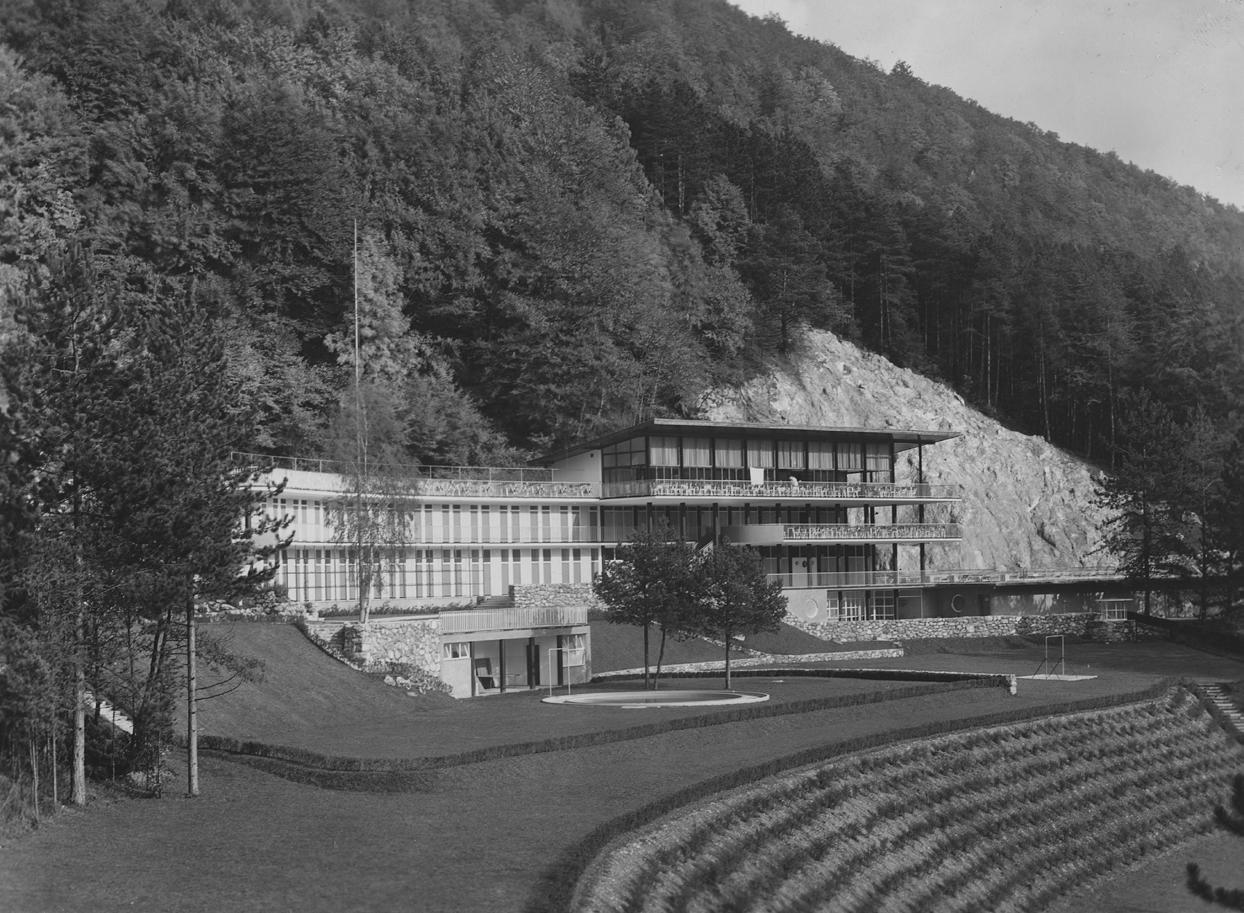
Zelená žaba Summer Lido, Trenčianske Teplice, Slovakia, 1935–37 photograph by studio Orth and Company, after 1937, 17 × 22.5 cm inv. no. 255.606
In 1935 Bohuslav Fuchs designed a new development for the spa centre of Trenčianske Teplice, Slovakia. Of this ambitious plan, only the summer swimming complex was ultimately completed. Fuchs found the ideal location for it in a former quarry with a spring, known locally as Na zelenej žabe (‘On Green Frog’). The building complex comprised an exceptional range of facilities: cleansing baths for between 500 and 800 people, café terraces for bathers, a café for non-bathers, an intimate wine bar, a volleyball area and open-air sports grounds, an archery area, a double bowling alley, an alpine garden with waterfalls and ponds and a children’s area with a pool, playground and showers. The architecture has a pronounced sculptural character that enlivens its strictly defined lines and communicates with the surrounding natural setting. It is distinguished by a wide variety of materials and colours, with yellow, red and blue playing prominent roles alongside ‘classical’ white.
In its time the complex was one of the most significant examples in Europe of organic architecture, in the spirit of the work of Alvar Aalto or Hans Scharoun. Its artistic quality served to transcend both the place and period in which it was created, and Zelená žaba Summer Lido is now regarded as a highlight of Fuchs’s work.
Soon after completion, information about the complex in Trenčianske Teplice was published in the national and international press. It was photographed for this purpose by Jaromír Funke, Atelier de Sandalo and the Orth and Company studio, among others; their photographs are now in the collections of Brno City Museum. Not only does the photograph by Brno’s Orth and Company capture the integration of the building into the landscape on artificial terraces on the southern slopes outside town, but it also illustrates the perfect ‘purity’ of the architecture, symbolising the purity of body and spirit in the modern individual. JC, LV, FK
Artist unknown
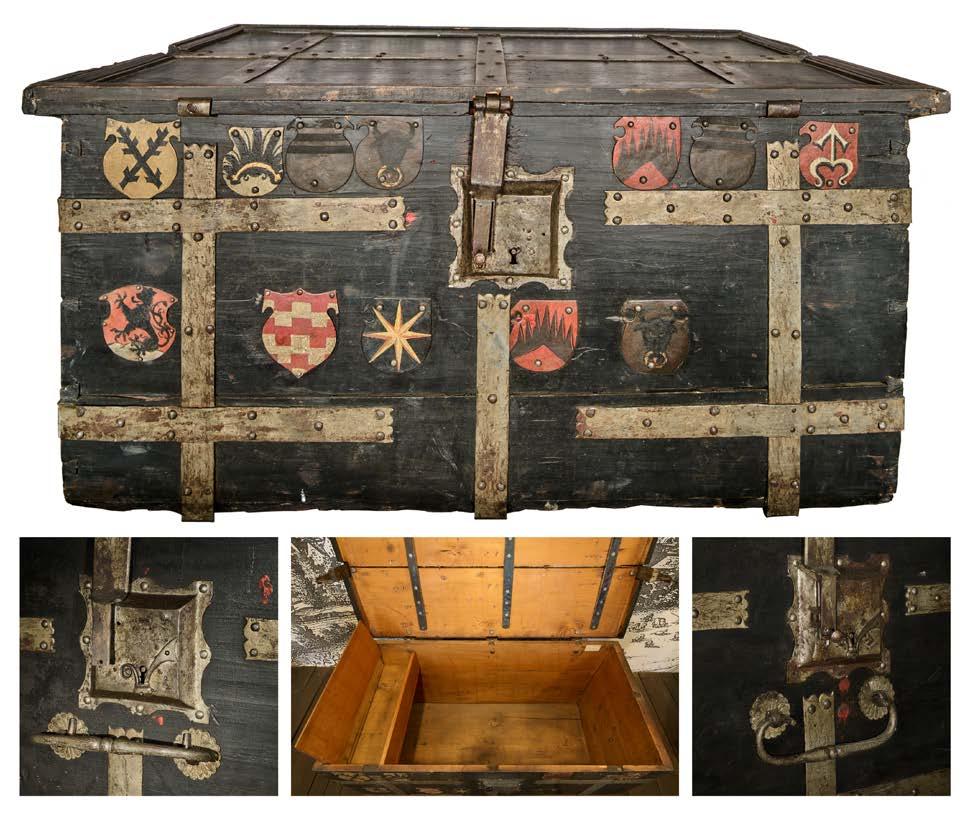
Chest for Moravian Land Registers, early sixteenth century
wood, 117 × 56.5 × 55.5 cm (larger chest)
inv. no. 102.599
The set consists of a pair of solid wooden chests with iron fittings dating back to the sixteenth century. The chests were used for secure storage of the Moravian Land Registers.
In terms of appearance and craftsmanship, the larger of the two chests is of particular interest. This rectangular chest has a flat lid and an upturned stepped edge; it is reinforced with six iron straps secured by rivets. Covered iron locks are placed at the front and on the sides, while oval metal handles are attached to the sides. Inside, a small internal compartment with a lid is set against one side. The front of the chest is decorated with 12 metal plaques that bear coloured coats of arms of Moravian noble families: Lipá, Lomnice, Kunštát, Pernštejn, Boskovice, Kravaře, Žerotín, Cimburk and Šternberk. The coats of arms for Pernštejn, Boskovice and Kunštát appear twice on this chest.
The Moravian Land Registers were for centuries some of the country’s most important legal and administrative institutions. They were the official provincial registers of property and the legal relations of the nobility, church institutions and towns, primarily containing records of land ownership, transfers of estates, inheritances, pledges and judicial decisions. Their importance across Moravia is clear in the observation:
What is entered into a Land Register is regarded as irrevocable law.
The Land Registers formed a cornerstone of provincial law and, at the same time, an instrument of political and social stability. They facilitated control of property relations and the resolution of disputes within the estates system. Documents of such importance required proper protection. They were therefore kept in an iron-bound chest, access to which was granted only to the land clerk, who was appointed for life.
The Moravian Land Registers are the only provincial land registers to have been preserved continuously since they were founded in 1348. TK
Maker unknown
Set of Six Medieval Chess Pieces, fifteenth century
Brno-Komárov
wood, h. 43–60 mm
inv. no. 304.131 – 304.136
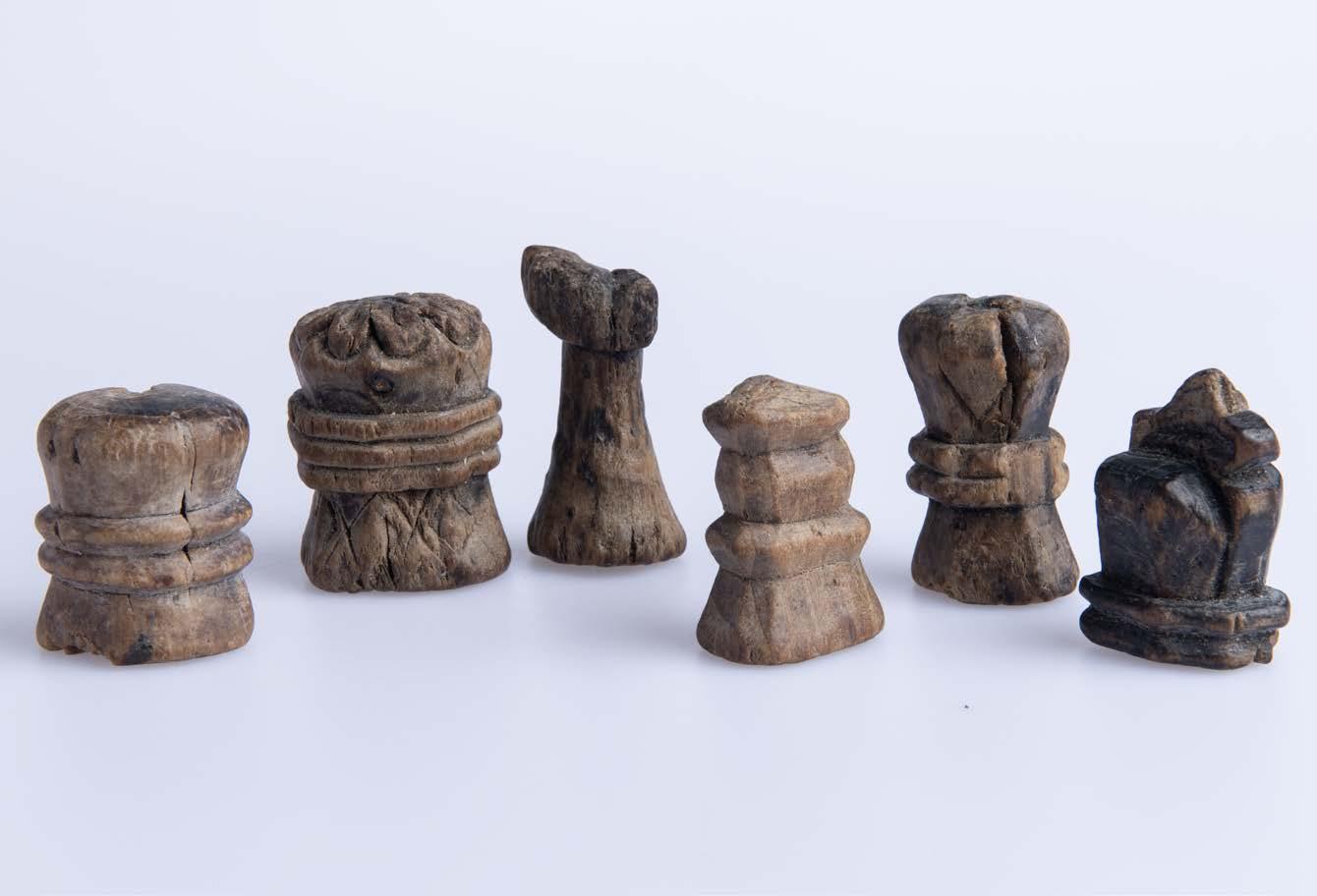
A large component of everyday culture in medieval times very likely consisted of objects made of organic materials such as leather or wood. Although these were originally widely available, very few such artefacts have survived to the present day, as they disintegrate quickly under normal conditions. However, Brno City Museum houses a number of rare wooden findings from the Middle Ages, preserved in the damp environment of medieval sumps. The most interesting include this set of six chess pieces, unparalleled in the Czech Republic.
The six carved wooden chess pieces were found in 1973, during archaeological research conducted by Brno City Museum on the site of the former Benedictine priory in the Brno borough of Komárov. They were discovered, together with other wooden objects, in the backfill of a defunct well, where the damp environment preserved them to this day. The pieces, each of which has a slightly different shape, have been dated to the first half of the fifteenth century, in line with the other items found with them. Identifying the different types of game counters has proved problematic; it is possible that in the Middle Ages the appearance of the pieces was yet to be standardised as they are today. With a little imagination, however, it is possible to make out the figures of a king, queen, bishop, castle, knight and pawn.
Chess was a popular form of entertainment for the nobility in medieval Europe. Chess matches are depicted on a many medieval illuminated manuscripts, while the motif of chessboard squares or chess figures adorned multiple coats-of-arms. Modern chess was not born until the Renaissance; it then continued to develop until the twentieth century. Chess may have appeared in Bohemia as early as the eleventh century, probably imported from Italy by Bohemian merchants. ZH