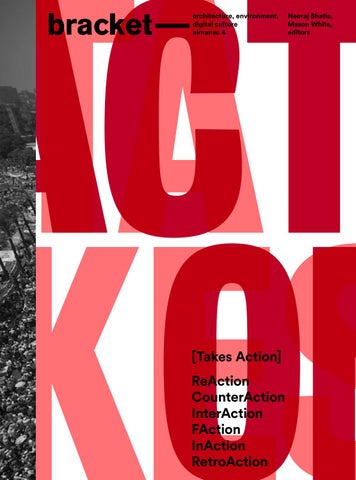
architecture, environment, digital culture almanac 4
[Takes Action] ReAction CounterAction InterAction FAction InAction RetroAction
Neeraj Bhatia, Mason White, editors
4
Call to Action
Mason White and Neeraj Bhatia
158 FACTION 160 Precarity and Power
6 REACTION 8 People Problems: Empowering Forms of Assembly
Mason White
16 Design Activism: Towards Agonistic Pluralism
Kees Lokman
24 #action
Hamed Khosravi
178 Cultivate Collective: Housing for a Contemporary Subject in China
De Peter Yi
190 Spaces of Conflict
Lori A. Brown
Mimi Zeiger
28
A Collective Living Room
198 Delirious Actions: Gender Tactics in Public Space
Matthew Mazzotta
30
Whatever Happened to Action?
Christopher Austin Roach
36
(No) Stop Marconi
206 Hellinikon and the Question of the Large Urban Void
Nahyun Hwang and David Eugin Moon
46 Oh baby let's get political! A Rant
Serafina Amoroso
Aristodimos Komninos
214 Borderlands: An Exploitation of the U.S. Political Geography
Cesar Lopez
Foreign Architects Switzerland (FAS)
50 COUNTERACTION 52 Reflections on Action
222 INACTION 224 Production/Reproduction: How to Live Together
Pier Vittorio Aureli and Martino Tattara (Dogma)
Belinda Tato and Jose Luis Vallejo
58 The Private Space of Collective Resistance
Lindsay Harkema
68 The Space of the Commons: Dheisheh Refugee Camp
236 Post-Squat NL: Reprogrammable City
David Eugin Moon
244 Take Me, I'm Yours: Reclaiming Free Space in the City
Jill Desimini
Alison Hugill and Dan Dorocic
76
The “As If” Society
250 What a Body Can Do: The Political as Generator of a Common Spatiality
Azadeh Zaferani
Lucía Jalón Oyarzun
86 Staging Publics: The Renewal of Place de la République
256 Mobile Loitering: Public Infrastructure for a Highly Gendered Urban Context
TVK Architectes Urbanistes
92
Acting from the Outside
260 Contested Energies
Markus Miessen
96 Insitu uAbureau
100 INTERACTION 102 Commonalities in Architecture
Yoshiharu Tsukamoto
110 Mayhem and Source Code
Albert Pope
118 The Image of the Square: Redefining Citizenship by Design
Samaa Elimam
124 Dialogic Spaces: Cities without Architecture
Claudia Mainardi
132 Exit Spaces: From Koreshan Cults to Wireless Mesh Networks
Tobias Revell
Mariam Kamara Ersela Kripa and Stephen Mueller
268 The Empty City: Building a Nomadic Industrial Complex
Martin Sztyk
272 RETROACTION 274 A Letter to Architects
Vishaan Chakrabarti
278 What is a Tomb for?
Steven Chodoriwsky
284 Cultivating Resilience
Karen Lewis
292 Creating a Nation’s Memory
Jin Young Song
298 Off the Wall
Parker Sutton and Katherine Jenkins
304 Open Museum for Peace
Rafi Segal and David Salazar
138 Shared Grammars, Individual Desires
310 Elastic Commemoration
Gabriel Duarte
146 Within Generic Archetypes and Cross-Subsidies: Productive Housing in Guatemala and Central America
takes action
Neeraj Bhatia
168 Housing Resistant Forms-of-Life: Housing Projects and Social Movements in Tehran, 1941– 53
Posconflicto Laboratory
Guy Königstein
316 Editorial Board 318 On Sharing—Almanac 5 320 Credits
3
CALL TO ACTION Mason White and Neeraj Bhatia
Hannah Arendt’s 1958 treatise The Human Condition cites “action” as one of the three tenants, along with labor and work, of the vita active (active life). Action, she writes, is a necessary catalyst for “the human condition of plurality,”1 which is an expression of both the common public and distinct individuals. This reading of action requires unique and free individuals to act toward a collective project and is therefore simultaneously bottom-up and top-down. In the almost sixty years since Arendt’s claims, the public realm in which action materializes—what Arendt refers to as “the space of appearance”—and the means by which action is expressed, has dramatically transformed. Spatial practice’s role in anticipating, planning, resisting, deflecting, or absorbing action has been broadly challenged by shifts in notions of ownership, social practices, forms of communication, and roles of government. How and where to act today is increasingly uncertain, as it requires different techniques and arrangements that reflect the distinct spatial tendencies of particular factions and their associated values. This is to say, we appear in a multitude of ways today—spatially and non-spatially—and therefore the forms that our actions take also need to be re-examined. The rise of several divisive leaders within contemporary politics, has once again brought action to the foreground. As a new generation assembles to have their voices heard, they are grappling to find effective platforms for action. For instance, the political paralysis many feel in the United States is part of a longer trend that Noam Chomsky has referred to as the “democratic deficit.”2 Chomsky’s deficit manifests when an open society no longer feels that they have the ability to change the systems around them. The feeling of helplessness—the opposite of action—poses a direct threat to participatory politics. Therefore, action is a key indicator on the health and durability of democracy. The most recent yearning to act, and subsequent dilemma on how to act, produced a hybrid of traditional forms of action, such as protests and marches, with contemporary tools, such as social media and GPS. As Albert Pope provokes in his piece, if the street was the “hardware” for action for a previous generation, is it still an effective site for protest today? Despite differing views on the impact of such protests, we can’t deny the power of the aerial images that document the gathering of thousands of voices, from Cairo to Hong Kong to New York. When compared to the gathering of constituents in virtual space, however, these protests are modest aggregations—yet, their powerful imagery, which reveal the spatial dimensions and scale of collectivity, make us consider the formal and enduring role of Arendt’s space of appearance. And, if we understand conflict as native to human assembly, then as Markus Miessen suggests, spatial planning becomes the management of these (spatial) conflicts. Space thereby can be viewed as a political medium that implicates spatial design as a critical factor within this debate. However, the sites and forms of action are not as predetermined today, since we communicate
4
bracket
PEOPLE PROBLEMS: EMPOWERING FORMS OF ASSEMBLY Mason White
“Architecture is too important to be left to architects.”1 —Giancarlo De Carlo “ It is impossible to represent architecture without representing the human.”2 —MOS Introduction
Architecture has a people problem. And by people, I am referring to what is implied when architects cite users, occupants, participants, clients, or what is often oversimplified as “the public.”3 People are an inevitably unpredictable element in any project, and its representation, that alludes to both scale and, more importantly, use. People perform as actors, if only extras, in the spatial theater of architecture. However, many architects consider people, and their actions, to mount a form of resistance to architecture. Arguably, the history of modern architecture is also the history of the struggle for architects to accept people’s “misuse” of architecture. This history has led to a contemporary schism between the passive, obedient figures depicted in archi tectural representation (primarily in images and photographs) and the active, expressive figures that comprise contemporary society. This debate unfolds in the complex portrayal of people, or lack thereof, in the representation of architecture. There are direct correlations between architectural
8
ReAction
representation and the reflection of society through the means of inclusion or exclusion of people and their forms of assembly in both images and photographs of architecture. Today, people are often portrayed as docile and obedient background figures in the representation of architecture, implying accepted behaviors in the completed project. Yet, more often than not, people are an active and disobedient figure disrupting the expected use of a space. This is not necessarily to suggest that people can be predicted or controlled in the design, but to reveal the bias of people serving simply as “entourage,” which is symptomatic of architecture’s current people problem. In particular, the humanist agenda of Team 10 in the 1950s and 1960s recall the dramatic disciplinary shift toward a more profound and complex understanding of people and their active role as spatial practitioners. However, successive waves of formal and technological biases in architecture since then have suppressed and reduced the influence of people—as users and occupants—on design, inciting the current people problem in architecture. Beyond accommodating human needs and program-specific expectations, architects are challenged by how people assemble in unexpected ways in response to a space. But, we might ask if a non-architect can be trusted to know what they need or want spatially? Although, what expertise do architects necessarily possess that make them exclusively knowledgeable about
bracket
Giancarlo De Carlo, University College at Urbino, Italy, 1962 – 82. UNIVERSITÀ IUAV DI VENEZIA, ARCHIVIO PROGETTI, FONDO GIANCARLO DE CARLO, COLLEGI UNIVERSITARI A URBINO, PHOTO CESARE COLOMBO, S.D. (C. 1970).
takes action
People Problems
9
human behavior in response to spaces? People’s forms of assembly in space have assumed even greater complexity since Team 10’s heady 1960s, through increased ubiquity of digital tools, shifts in models of democracy, and new forms of action by splintering cultural groups. These pressures and shifts are not always present in the conceptualization of a work, nor in its presentation (drawn or photographed). However, architects ignore forms of assembly at the risk of the project because these forms embody larger ideals and the will of society. This essay will chart a thread from 1960s humanist architecture through to contemporary political theory of dissensus and agonism, to offer a renewed understanding of how people can be empowered through architecture. De Carlo’s Forms of Assembly
An architect that embodies a profound acceptance of the unpredictability of people is mid-century modern Italian architect Giancarlo De Carlo, also a critical founding member of Team 10. He is best known for his masterwork Urbino University campus, realized between 1962 and 1982, which demonstrates his commitment to an architecture that responds to social and lived experience. In particular, the commissioned photographs by Cesare Colombo, shot in 1968 soon after Urbino’s Collegio del Colle student residences opening, reveal the depth of De Carlo’s interest in an architecture accepting of unpredictable forms
10
ReAction
of assembly. One of these photographs is taken towards the student residences from one of the many concrete stair-walkways that criss-cross campus-wide and down. There is nothing special about the view to the building in the photograph. In fact, the cropping is unflattering, the lighting is too high contrast, and the camera’s downward angle gives an awkward orientation and framing. However, what is significant about it is the presence of people and their prominence. As if caught off-guard, 14 people occupy the stairwalkway. They stand on its landings, on its treads, looking back at the camera, looking forward at the residences and beyond, talking to each other, leaning against the railing, and even one has wandered off into the site. In an instant, each person becomes an empowered independent actor in the spatial theatre of De Carlo’s Urbino. How we assemble generates what kind of society emerges in response to it. De Carlo’s architecture, its representation, and its empowerment of people are synonymous. Architectural photography often communicates space and scale, but the potential to simulta neously convey or suggest forms of assembly, particularly disobedient ones, is overlooked. Colombo’s photographs communicate the spaces and architecture of Urbino, but also the looseness with how they might be occupied. The use of loose space, not necessarily open space, is essential to the project’s empowerment. Loose space can be thought of as space that implies
Giancarlo De Carlo, Colonia Marina Enel, Riccione, Italy, 1963. UNIVERSITÀ IUAV DI VENEZIA, ARCHIVIO PROGETTI, FONDO GIANCARLO DE CARLO, COLONIA SIP A RICCIONE, PHOTO ITALO ZANNIER, (1963).
bracket
# ACTION Mimi Zeiger
Can a tote bag emblazoned with a hashtag spark change? Over the course of the 2014 Venice Biennale in Architecture vernissage, one of the unspoken fundamentals of the Rem Koolhaascurated exposition, as with any trade show, was the swag bag: the free cotton or nylon tote offered as a token of solidarity between viewer and exhibitor. Of the hundreds of bags carried on the beleaguered shoulders of Giardini visitors, from national pavilion to national pavilion, one stood out—a plain muslin tote bag with the words #STAYRADICAL printed in black ink. #STAYRADICAL. Conjunctive and imperative, the tote was handed out on behalf of the three-part conversation series, “Towards a New Avant-Garde” curated by the group Superscript and aligned with the “Monditalia” installation “Radical Peda gogies,” which brought together contemporary architects and thinkers to discuss Italian architec tural impulses of the 1960s and 1970s. “Radical Pedagogies” is a collaborative project of six authors: Beatriz Colomina, Britt Eversole, Ignacio Galan, Evangelos Kotsioris, Anna-Maria Meister, and Federica Vannucchi, with a host of affiliates and contributors drawn from the circle around the PhD program at Princeton University’s School of Architecture. An academic research project manifesting across platforms —exhibitions, online and print publishing, and events—it’s subtitle employs terms keyed into an activist trajectory: action, reaction, inter action. “Radical Pedagogies” chronicles shifting
24
ReAction
educational models and charts the postwar flow of ideas between sites and individuals: Archizoom and Superstudio in Florence, Autogobierno at UNAM in Mexico City, or Metabolist mentor Kenzo Tange’s “Tange Laboratory” at the University of Tokyo. Or as described on the project’s web site, “…a new kind of cartographic network of the contested spaces of pedagogical transformation: spaces of ACTION (the radical questioning and reformulation of the discipline), REACTION (the pedagogical and political friction created by the urgency of these reformulations) and INTERACTION (the constant fluctuation of this information by the movement of ideas and people).”1 The case studies mapped on the “Radical Pedagogies” website underscore a changing global condition leading into and extending from 1968. Each illustrated case study is a snapshot of activist architecture held nimbly in time. Historicizing radical practice fixes radicalism in the rear-view mirror, while the Twitter-friendly tag #STAYRADICAL suggests that the act of staying radical is a progressive action. The phrase, however clever, elicits two uncomfortable queries: Is a Biennale the place for radical, activist, and/or contrarian views? And, given the pervasive desire for and absorption of all things alternative and disruptive, is it even possible for architecture to get radical? On the occasion of the 2012 Venice Biennale in Architecture, activists protested outside the Russian Pavilion during the Golden Lion award
bracket
General view of “Radical Pedagogies” at the Corderie of the 2014 Venice Biennale in Architecture. PHOTO: MIGUEL DE GUZMAN
takes action
ceremony as the Russian team received a special mention for their efforts. Then, a group of women dressed in Pussy Riot-like ensembles—brightly colored dress paired with clashing balaclava—held up a hastily made banner in support for the jailed musicians. It read: “FREEDOM for PUSSY RIOT, and for all activists! #OCCUPYBIENNALE.” Their chants of protests and demands rose up against the polite speeches under the awards tent, a per formance amply photographed by nearby Giardini visitors and news crews. And so action is sublimated into spectacle. Indeed, both retro and contemporary political actions are dependent on the media for the amplification and broadcast of messaging across traditional outlets and social web platforms (if we can even separate the two). In the context of the Biennale, however, the artificial public estab lished by the Venetian setting denatures acts of protest. Any disruption must counter and exceed the somewhat jaundiced eyes of the audience: architects, curators, academics, and media gathered from around the world to laud its own. Action flames and fizzles without a reactive site, leaving a hollow act of acting out, a mimicking of known protest forms and compositions. Should we mourn this conversion of architect ural actions into reenactments of radical acts of yore? No. The grieving period already happened. The mirrors of radicalism were draped in black as radicalism moved from a political to formalist stance. “Radical Pedagogies” includes the 37th Biennale di Venezia (1976) as a case study, citing the debate around the exhibition Europa-America: Centro storico-suburbio (Europe-America: Historical Center-Suburb) sites of pedagogical shift. The show, according to the “Radical Pedagogies” text, “focused on the dialectical pairings between Europe and America, urban centers and periph eries, theory and practice, providing the grounds for experimentation by way of architectural spec ulation, theoretical pronouncement and repre sentational strategies.”2 More important than the dialectic between Europe and America, the show marked a general divide and pitched Team X
practitioners, including affiliates such as Aldo van Eyck, Giancarlo De Carlo, and Alison and Peter Smithson against a younger generation including Manfredo Tafuri, Aldo Rossi, Peter Eisenman, and Robert Stern.3 According to case study author Léa-Catherine Szacka, the debate itself, entitled “Quale Movimento Moderno” and chaired by Joseph Rykwert, is critical in leading to a formal speculative agenda. (A juicy part in the case study text points to a moment within the debate when Van Eyck, on stage, and Tafuri, in the audience, squared off, with van Eyck personally attacking the theorist arguing “…he is trying to persuade architects on something that does not exist.”)4 Still, the romance of political action remains a strong rhetorical device across the discipline. For example, in Austrian architect Wolf Prix’s essay “Exile On Ringstrasse; Excitations on Main Street,” first published in the 2007 exhibition catalog Coop Himmelb(l)au: Beyond the Blue, Jeff Kipnis proposes a chronicle of the birth of the firm—a phoenix-like rising from the actions of 1968: “January 1968: Hollein’s explosive manifesto ‘Alles ist Architekur’ appears in Bau. March ’68: the group Utopie organizes the seminal inflatables exhibition, ‘Structures Gonflables,’ that draws a surreal but compelling equation between inflatable architecture and radical situationist-inspired political action. March 1968: Coop Himmelb(l)au is born from an inflatable uterus, The Cloud, amid the trauma. Vietnam War—the Tet offensive, My Lai massacre, General Nguyen Ngoc Loan shoots a Viet Cong prisoner in the head on the front page of every newspaper in the world. Worldwide antiwar demonstrations. U.S. civil rights riots. May. Red Army Faction. Martin Luther King Jr. and Bobby Kennedy assas sinated, Andy Warhol shot…. The ‘concept album’ kills the 45 rpm single.”5 The tensions produced by this shift from action to form, from the immediacy of the single 45 hit to the artistic indulgences of the concept album also reveal themselves within the radical archi tecture movement in Italy. In 1972, Emilio Ambasz curated the exhibition “Italy: The New Domestic Landscape” at the Museum of Modern Art in New York. Ambasz collected and commissioned works for the show from Superstudio, Ettore Sottsass, Gaetano Pesce, 9999, Archizoom, and others. The “Radical Pedagogies” refers to the exhibition as a catalytic case study that “shifted the center of the discussion from production and technique to symbols and social critique, as was encapsulated in the key-words with which Ambasz chose to define contemporary design: ‘landscape,’ ‘environment,’ ‘media,’ ‘counter design,’ and ‘politics.’”6 It is a note by Ambasz in the influential exhibition’s catalog, however, that best illuminates skepticism of the efficacy of design as tool of action. The architect-curator included a text by designer Enzo Mari, who by 1972 had distanced himself from the designed
#action
25
Cuenca Red, Ecosistema Urbano, Cuenca, Ecuador (2015). Improvement and reactivation of public spaces in Cuenca’s Historical Centre, showing the pilot project Febres Cordero School.
1. EXPLORE: Reality offers an inspiring environment to identify design possibilities. Ordinary life processes provide an incredibly rich and fertile field for experimentation, while at the same time offering the potential to make a genuine difference in society. Designers can, and should, reach toward utopian ideals even with one foot firmly on the ground. 2. RESEARCH: Become an expert on the topic. The research process is open-ended. It is natural for the line of inquiry to evolve, taking on a life of its own and leading in unforeseen directions. 3. NETWORK: Create a network—from citizens to experts; explore connections at both the official and grassroots level. Today’s complex reality requires not just a multidisciplinary approach, but also a transdisciplinary one, and the definition of new instruments, models, and protocols that occur when professions do not work separately. In the early stages of a project, designers are encouraged to establish relationships with a variety of experts and stakeholders. They are asked to build networks of advisors and supporters from academia, the public and private sectors, and potential community members. The progress of a project depends on their ability to elicit the support and cooperation of people
takes action
who often have different agendas. Subsequently, an internally-generated idea becomes a collaborative effort, which instrumentalizes its development. 4. SHARE: Confront and experience ideas outside your own sphere; feedback is a treasure. It is extremely important to listen and engage with people in dialogue throughout the creative process. Incorporating feedback vastly enriches how to analyze an issue, which by extension, ensures that solutions are more relevant and viable. 5. BE OPEN: Start with a detailed plan, but be prepared to revise it in response to new developments. There is an increasing public awareness of the implications of design, allowing designers to acquire new inputs, incorporate feedback mid-process, and make adjustments before the creative process is complete. Designers should be flexible in their approach to a challenge and how they arrive at solutions. The process is often not a linear path, but a dendritic one that follows an unpredictable course. It is valuable for a designer’s development to become comfortable with open-endedness and uncertainty. Reaching out and absorbing reality introduces serendipity into the process, which can increase the possibilities for meaningful connections.
Reflections on Action
53
Voronezh Sea revitalization, Ecosistema Urbano, Voronezh, Russia (2014). Ecological reconfiguration and water-quality improvement of the reservoir. –> Plan CHA, Ecosistema Urbano, Asunción, Paraguay (2014). Masterplan of the historic downtown of Asunción discussed during a participatory meeting with citizens. Dreamhamar, Ecosistema Urbano, Hamar, Norway (2011). Public event during the participatory process for collectively reimagining the Stortorget Square.
54
CounterAction
bracket
THE SPACE OF THE COMMONS: DHEISHEH REFUGEE CAMP Alison Hugill and Dan Dorocic
Hannah Arendt’s essay “Labor, Work, Action,” published in 1958 as part of The Human Condition, produces a definition of action and public space that is connected to a politically democratic tradition, stemming from Greek antiquity. Arendt’s treatise proposes that the actions of individuals—their capacity to begin ever anew within a plurality of beings—is what distinguishes them and reveals the meaning of each human life. Great words and deeds form a part of every person’s individual (thus implicitly social) narrative. Arendt’s depreciation of labor, both productive and reproductive, allows her to privilege action as the main pillar of the human condition, by accepting the “oldest, pre-philosophical hierarchy” of labor-work-action, before Marx and Nietzsche performed what she calls their “theoretical reversals.”1 From a materialist perspective, it is clear that capitalist social relations are deeply entwined with each layer of Arendt’s “human condition.” While they may manifest most transparently in the realm of labor, they are inextricable from individual pursuits in terms of action, and permeate modern notions of both public and private space. In reality, the so-called “public realm”—the space of appearance for Arendt—is not free or independent from state or economic imperatives. On the contrary, the public realm is saturated with these concerns. Rather than returning to the reductionist and exclusive Greek model of politics, wherein the wealthy and educated represent those who cannot speak, we suggest an expanded political understanding based on the idea of the commons, primarily understood via Italian autonomist-Marxists Silvia Federici and Antonio Negri. This essay examines the fraught nature of public space in the Palestinian context, with particular focus on its role in the Dheisheh refugee camp near Bethlehem in the West Bank. Public space and participatory initiatives are observed to understand their relevance and potential in this context. The Arendtian notion of man as “political animal,” vis-a-vis Aristotle, is problematic here. Instead, many refugees living in camps are seeking to actively build common spaces that exist independent of institutional or governmental bodies, individual economic pursuits, or the apparatus of occupation. In particular, a research group within the organization Campus in Camps, an educational and
68
CounterAction
West Bank Refugee Camps and Area Division.
bracket
The 19 Refugee Camps in the West Bank A size comparson of the 19 Camps in the West Bank Far’a Camp
Arroub Camp
Fawwar Camp
Jenin Camp
Ein El Sultan Camp Aqabat Jaber Camp
Tulkarem Camp
Aida Camp
Camp No. 1
Beit Jibreen Camp
Jalazone Camp
Amari Camp
Qalandiya Camp
Shufat Camp
Camp No. 1
Jalazone Camp Amari Camp
Askar Camp
Balata Camp
Deir Ammar Camp
Qalandiya Camp
Deheishe Camp
Jenin Camp
Nur Shams Camp
Tulkarem Camp
Arroub Camp
Fawwar Camp Deheishe Camp
To Bethlehem
Bethlehem
Doha
Central market Ibda’a Al-doha municipality To Hebron
Finiq
Artas
Area A (Palestinain built-up area) Area B (Palestinian civilian area, under joint Palestinian-Israeli military control) Area C (Israeli military Controlled area) Refugee camp Industrial area
source: Camp Development Pilot Research Project
takes action
The Space of the Commons
69
COMMONALITIES IN ARCHITECTURE Yoshiharu Tsukamoto
Recently, people in Japan have expressed how the nation has become affluent and yet people remain unsure of their happiness. This seems to be a sign that they are anxious from being unable to discern where they stand within a society and environment that has rapidly modernized. Archi tecture has been instrumental in this process of modernization, so we should hold it accountable. It is undeniable that the postwar reconstruction of cities and the development of Japan’s territory were fueled by growth in the construction industry. Since 1950, the state and regional governments —the public—advanced the upgrading of social infrastructure at unprecedented scales with new technologies under the banner of protecting the assets and lives of the people. Rivers and roads were treated as quantifiable things and measured in terms of water or traffic volume, with steel and concrete constructions built to control them. As a result, rivers were less likely to flood, but were also more difficult to access, while roads were reduced primarily to a means of transportation. Meanwhile, government policies encouraged the private ownership of property and houses. Regulatory measures to make houses fireproof and earthquake-resistant motivated homeowners— individuals—to tear down old houses that did not conform to this standard. The construction of houses led to the consumption of electrical appliances and furniture, as well as tableware and beddings, with the economic impact of this extending society-wide. This was how the
102
InterAction
industrialization of environmental management and house-building fueled the mass-production of safe, well-serviced neighborhoods and dwellings. In the process, the daily activities of people, a lifestyle that was previously rooted in agrarian landscapes, were transplanted into industrialized trades. Simultaneously, commercial facilities, which took up an increasingly larger share of urban space as the economy developed, grew ever more enormous in order to mobilize customers. These facilities then gave rise to spaces in which citizens, acting as customers, could use clean and safe spaces in exchange for money. In these spaces, there was the appearance that one could gain satisfaction as individuals. The behaviors involving play and pastime that had been enacted by people out in the city were then transplanted into the realm of the service industries. The industrialization that took place propelled the miraculous growth of Japan’s GDP in the late twentieth century. However, this also gave rise to unexpected by-products: people unable to come to terms with nature in the places where they lived, an inability to know what kind of houses to build, as well as confusion on how to activate public spaces. Without these things, people cannot connect with one another. They are consequently separated into individuals, yet grow dependent on the systems endorsed by the state and generated by the market. Effectively, people have been gradually deprived
bracket
of the latitude and opportunities to behave autonomously at their own discretion. If considered from the standpoint of industry, with its primary interest in increasing productivity, it is more convenient that people are oblivious to this. People only need access to a wider range of choices in terms of science, engineering, economics, and design so that they can affirm their individuality. The outcome from shaping the environment and cities in this way, following the war, has resulted in the standardization of the urban landscape as witnessed in Japan today. Its disorderliness and incoherence may be “interesting,” but, at best, it can only be understood as an agglomeration of individual pieces. Unfortunately, these pieces are nothing more than pieces. This is inadequate. What is lacking in this standard landscape are the architectural typologies and human behaviors that have been passed down over generations and that are shared in specific locales by transcending individual differences. This landscape is missing the lively streetscapes and exceptional urban spaces that can be formed through the recurrence of these typologies and behaviors. In order to enable these local typologies and behaviors, we must use design to transcend our generational and individual differences. People will likely develop confidence and pride if they feel that they are a member of a particular collective. Is it not because people lack such feelings that they are uncertain as to whether they are happy? What can be observed from this is that the shortcomings of architecture and urban spaces of our industrialized age are brought to the fore at moments when having a sense of sharedness is important. Certainly, it is true that much has been lost to the destruction caused by earthquakes and wars. However, these are also the vulnerabilities that have repeatedly been reinforced by remaking societal structures in their wake. These structures have the tendency to separate the collective body of the people into distinct individuals. We must be vigilant of the mode of architectural practice grounded on the individual that has been glorified within this tendency, particularly in the late twentieth century. We are suggesting that, if twentieth-century architecture placed too much emphasis on the individual and the state (public), then we must now identify a mode of architectural practice focused on the common. We propose to refer to the realms that unfold through this mode of practice as commonalities of architecture. Commonality is not an everyday term. In Japanese, it holds the meanings of the words kyōyūsei (共有性: the quality of being jointly owned or shared) and kyōdōsei (共同性: the quality of working together or of being united). It is pos sible that is has been adopted in other disciplines, but the term has rarely been used in architecture. Among architects, only Louis Kahn has used the term. According to Kahn, the reason we are moved by ancient constructions is because we are connected to one another by things, or common alities, deep within us that transcend time and place. Notions similar to this can be identified in
takes action
Jørn Utzon’s 1948 manifesto “The Innermost Being of Architecture,” in which the idea that the present is linked to the past by the intelligence of human beings embedded in architecture.1 And also in what Christopher Alexander later describes in his 1979 book The Timeless Way of Building as the possibility of design to possess an “ageless character.”2 These are encouraging expressions that suggest that it is possible for those in the present to link with those who erected the early constructions that seemed to have risen out of the earth. These ideas evoke a return towards an origin. However, one must be careful in returning to origins, because doing so tends to lead to a search for prototypes in a reductive manner through the disregard of time- and place-specific trans formations. Our discussion on commonalities in architecture continues this line of thought. We, too, are focusing on the emergence of intelligence in architecture, but we diverge from it in how we understand human behaviors and architectural types as things that are generated “by chance” through the combination of various conditions. We are doing so because this viewpoint allows us to re-grasp the transformations that behaviors and types undergo over time as things that help us perceive changes in their boundary conditions. We cannot avoid dealing with boundary conditions if we are to create things to be shared, or common alities. We are employing this genealogical approach in an attempt to bring the commonalities in architecture into the context of design. What is now needed are the means for perceiving commonalities. Situations in which commonalities have been given form or have become perceptible include the condition when similar, but slightly different, buildings recur in a particular locale or along a street. Despite different owners, each building participates in shaping the town landscape or urban space with their roofs and facades, forming a collective whole that transcends private ownership. Features observed in buildings regardless of their individual differences are typologies. However, this understanding of typology is through the vantage point of the researcher. With regard to commonalities, we understand that the people living in a place share a common architecture. In other words, the fact that typologies exist signifies that people understand what type of architecture is appropriate for the particular region or community in which they live. Another situation where people are behaving freely is in the urban plaza. However, people in this space will rarely behave in entirely unrelated ways; rather, they converge towards a certain set of behaviors. Behaviors can be seen as types also, and they can be repeated in a particular place by transcending the differences of their subjects. This enables strangers to have common ownership over the same time and place while acknowledging each other’s differences without interference. A person can acquire these behaviors through repetition. They can be learned. These behaviors
Commonalities in Architecture
103
EXIT SPACES: FROM KORESHAN CULTS TO WIRELESS MESH NETWORKS Tobias Revell
Albert O. Hirschman’s 1970 treatise Exit, Voice and Loyalty is a short taxonomy and analysis of possible actions an individual might take against an organization they are unhappy with. Firstly, stop buying products and/or leave the organiza tion: exit. Secondly, express dissatisfaction in some form of protest: voice. The third option is of course loyalty, to remain intractably faithful to the organization despite one’s dissatisfaction.1 The thrust of his argument rests on the relation ship between customers and businesses but, writing at a point in history fractured by political dissent, he acknowledges the space for strong parallels with the political world and the relation ship between citizen and state. This essay ana lyzes ways in which the creation of new types of “exit spaces”—outside the realms of the existing hegemony of the state and corporate power— might provide us with imaginable alternatives with which to articulate our grievances with those structures. This would then allow the creation of an agonist politics, un-stymied by apathy and hopelessness. Examining the significance of contemporary, technologically-driven forms of exit space in seasteading, the Silk Road, and the Athens Wireless Metropolitan Network, this essay will mine these case studies as new forms of public space in the technological realm. The Failure of “Voice”
Hirschman sees exit from an organization as the progressive next-step following the failure
132
InterAction
of voice—defined as the airing of grievances and protesting. In order to understand the interest in exit spaces it’s useful to consider arguments for why voice is failing as a form of inciting change within institutions. In his essay “The Practical Utopian’s Guide to the Coming Collapse,” anthro pologist David Graeber posits that far from being ineffective in their aim of changing the global status quo, the global protest movements of the late sixties had the significant effect of prioritizing domestic appeasement. He suggests that although they often failed in achieving their explicit objectives, they were strategically successful in creating a sense of political empowerment for the previously maligned as well as developing tactics and strategies for functional popular dissent in the framework of the United States’ constitution. As a result of this success he explains that “the creation of that sense of failure, of the complete ineffectiveness of political action against the system” became a leading objective of modern government from which resulted “the imposition of an apparatus of hopelessness, designed to squelch any sense of an alternative future.”2 To this end, states and corporate organizations embarked on extensive strategies to prevent dissent on this scale in the future through acts such as carefully curated media campaigns, public relations, intelligence operations, legal and property levies on space, and the militarizing of the police. Hirschman, writing from the midst of this dissent in the late sixties prefigures this
bracket
Protestors carry identical banners on an all too familiar popular march in Washington DC 2007. PHOTO: RAGESOSS, LICENSED UNDER CREATIVE COMMONS ATTRIBUTION – SHARE ALIKE
internalizing, securitizing strategy as it is used in corporate organizations: [ T]he short-run interest of management in organizations is to increase its own freedom of movement; management will therefore strain to strip the members-customers of the weapons which they can wield, be they exit or voice, and to convert, as it were, what should be feedback into a safety valve. Thus voice can become mere “blowing off steam” as it is emasculated by the institutionalization and domestication of dissent.3 He goes on to describe other innovative tactics employed by organizations for suppressing dis sent. For example how, during the Vietnam War protests, the Johnson administration dealt with government dissenters by giving them the role of “official dissenter,” a position that makes the individual discountable and predictable. Political theorist Chantal Mouffe, in her book Agonistics: Thinking the World Politically, refers to this as the way in which “demands which challenge the hegemonic order are appropriated by the existing system so as to satisfy them in a way which neutralizes their subversive potential.” 4 We could look to the failure of the Stop the War Coalition’s 2003 march—the United Kingdom’s biggest ever demonstration—to achieve its single explicit aim, to prevent the invasion of Iraq as evidence of this disempowerment of popular protest. I have
takes action
previously identified the modern form of popular protest as “flatpacked protest;”5 the protestors organize online, carry identical banners, and pro test under the watchful eye of the police within carefully constructed legal and physical constraints. In this, they behave as a herd, not an active polity. As Hirschman describes, they are easily predictable and discountable, occupying a necessary social niche but having any real agency stripped away through the institutionalization of protest. The Space for “Exit”
Hirschman’s term “exit,” taken at its most literal, is the actual physical departure of a dissenter from the organization they take exception to. Exemplars of this literal form of exit might be the American communes, such as New Harmony, Indiana, and Oneida, that sprung up across the territories of the United States in the nineteenth century. Hirschman himself notes that “exit has been accorded an extraordinarily privileged position in the American tradition. […] The United States owes its very existence and growth to millions of decisions favoring exit over voice.”6 This is exemplified by the number of these communes setup by Europeans emigres looking to escape and challenge European cultural and religious hegemony. The American communes of the nine teenth century are endemic of how, given the desire to form a society under an alternative set of beliefs, the United States at the time was an accommodating location to do it. The Koreshan
Exit Spaces
133
POST-SQUAT NL: REPROGRAMMABLE CITY David Eugin Moon
From 1971 to 2010, the Dutch government mandated an urban experiment in reprogramming its cities. In dealing with the crisis of an over whelming amount of vacant spaces, aging structures, and an incompatible set of needs, the citizens of Holland were legally allowed to squat in buildings that were vacant for more than a year, if a user could enter a space bringing only a bed, desk, and chair.1 The result of this new and unique set of conditions were often bizarre anomalies that contested preconceived notions in architecture and urbanism including programming, prescribed functionalism, form-making, as well as ownership models, and the boundaries of individual rights in the city. Young, middle-class professionals, and recent college graduates were suddenly able to occupy entire floors of empty office buildings; vacant blocks became temporary hotels; new centers of subversive culture spontaneously formed and institutionalized. Many of these occupancies flourished undocumented until 2010, despite strong public demonstrations and student strikes in major cities throughout the Netherlands. This unusual period of collective experimentation poised between the formal and the informal represents the active involvement of many Dutch citizens. Their actions creatively reconceptualized and manipulated the existing urban infrastructure to its needs, partaking in untested modes of spatial organization on a national scale. Select aspects and examples
236
InAction
from this forty-year period will be outlined here, to re-frame a discussion on ownership, design processes, and professional paradigms in the reprogramming of the city. Suggesting the possibilities of spatial organization that mediate the provocative nature of spontaneous occupations and the necessity for the agency of architecture, the Dutch squat and its postsquatted progeny provide a reconsideration for the making and remaking of cities.
Bicycle-in-Office Tower “House,” 2007. PHOTO: INÊS CATARINO CABRITA
House Rights
It was the Dutch Supreme Court’s ruling under the “House Right” in 1971 that established the squatters as legal occupants protected from forceful intrusions.2 A fundamental discussion in the debate was the right to ownership versus the citizen’s basic rights for habitation. At stake was the city’s right to control private property and the responsibility to regulate it. As described by the conservative Bastiaan van ’t Wout in the booklet Black Book of Squatting from 2008, the opponents of squatting continue to argue for the unconditional rights of private owners; as an analogy, they offer the premise of appropriating a neighbor’s vehicle as not defendable in any circumstance, despite its underuse.3 The opposing viewpoint in the subsequent White Book of Squatting (2009) represents the position that squatting advocates have been holding since 1971 and argues for the rights of the individual with a narrative similar to Henri Lefebvre and David
bracket
takes action
Post-Squat NL
237
238
InAction
bracket
Editorial board Pier Vittorio Aureli Neeraj Bhatia Vishaan Chakrabarti Adam Greenfield Belinda Tato Yoshiharu Tsukamoto Mason White Serafina Amoroso Lori A. Brown Steven Chodoriwsky Jill Desimini Dan Dorocic Gabriel Duarte Samaa Elimam Foreign Architects Switzerland (FAS) Lindsay Harkema Alison Hugill Nahyun Hwang Katherine Jenkins Mariam Kamara Hamed Khosravi Aristodimos Komninos Guy Königstein Ersela Kripa Karen Lewis Kees Lokman Cesar Lopez Claudia Mainardi Matthew Mazzotta Markus Miessen David Eugin Moon Stephen Mueller Lucía Jalón Oyarzun Albert Pope Posconflicto Laboratory Tobias Revell Christopher Austin Roach David Salazar Rafi Segal Jin Young Song Parker Sutton Martin Sztyk Martino Tattara TVK Architectes Urbanistes uAbureau Jose Luis Vallejo De Peter Yi Azadeh Zaferani Mimi Zeiger
USD 40.00
ISBN: 978-1-943532-91-9
54000
9 781943 532919