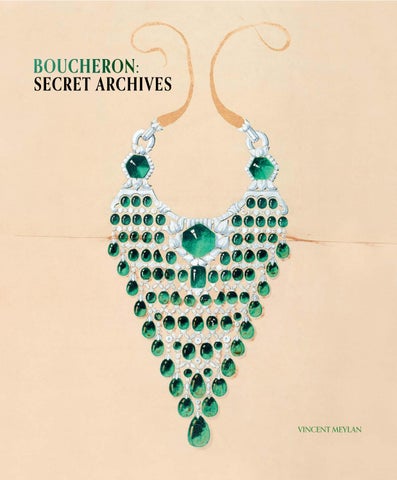
SECRET ARCHIVES
VINCENT MEYLAN
Previous spread: This ruby and diamond necklace was created in 1888 by Frédéric Boucheron for Marie Louise Mackay. It was sold at auction at Sotheby’s New York in December 2025.
CONTENTS INTRODUCTION Fifteen Years of Discoveries about Boucheron CHAPTER 1 — Ladies of Sin The Formidable Object of Desire – La Païva The Century of the Courtesans Frédéric Boucheron’s Ghost – The Countess of Castiglione The Siren Call of Gambling – La Belle Otero CHAPTER 2 — Kings and Queens of the World (The Old and… the New) Married Bliss – Gabrielle Boucheron The Queen of Bulgaria’s Crown The Queen of Vanities – ‘Mrs Astor’ Queen in Exile – Isabella II of Spain The Queen of Nevada – Marie Louise Mackay CHAPTER 3 — The ‘Dollar Princesses’ “We are the dollar princesses” An Heiress on the Verge of a Nervous Breakdown – Consuelo Vanderbilt, Duchess of Marlborough How Vengeance Comes to a Woman – Anna Gould, Countess de Castellane For the Love of a Viceroy of India – Mary Leiter, Lady Curzon
6 8 12 32 36 50
56 60 68 72 80 84 98 100 102 118 126
CHAPTER 4 — The Tour of the Grand Dukes 134 Love until Death – Nicholas and Alexandra 138 A Femme Fatale at the Russian Imperial Court – Katia Dolgorouki 146 The Casanova of the Russian Court – Grand Duke Alexei 148 A ‘Rouble Princess’ – Barbara Kelch 154 The Grand Duchess Vladimir’s Emeralds 160 CHAPTER 5 — Weddings of the Belle Époque The Other Miss Vanderbilt… – Gertrude, Mrs Harry Payne Whitney The Tradition of Wedding Baskets May Goelet, Duchess of Roxburghe The Heiress and the Sex Maniac – Mary Ethel Burns, Lady Harcourt Carats and Philanthropy – Dorothy Pinto, Mrs James de Rothschild The Age of Tiaras
162 166 170 172 176 182 192
CHAPTER 6 — God Save the Kings The Duke of Windsor’s First Love – Freda Dudley Ward The Formidable ‘Frau Coburg’ – Maria, Duchess of Edinburgh The Mountbattens and The Duke of Edinburgh “With My Loving Thoughts” – Mrs Greville and The Queen Mother
198 202 210 214 216
CHAPTER 7 — Ali Baba’s Cave The Stolen Habsburg Diamonds The Reign of Pearls The Most Beautiful Three-strand Pearl Necklaces Prince Youssoupov’s Pearls (and those of his mother-in-law) The Camondo Pearl Necklace
234 238 244 254
CHAPTER 8 — The Whims of the Maharajahs The Casanova of Punjab – Bhupinder Singh, Maharajah of Patiala The Princes of the Salute States Like Mother, Like Daughter – Indira of Cooch Behar and Gayatri Devi of Jaipur
270
256 264
274 284
286
CHAPTER 9 — Hollywood on the Nile The Queen of Hearts – Farida of Egypt The Curse of Princess Shivekiar The ‘Queen’ of Alexandria – Mahivesh Shirine, Princess Toussoun The Treasury of Iran
292 296 304 308 314
CHAPTER 10 — Born to the Stage 324 The Star and the Prince of the East – Rita Hayworth and Aly Khan 326 Rich... as the Aga Khan 330 A Woman Scorned – Sarah Bernhardt 332 Whatever Happened to Joan Crawford? 339 Boucheron Through the Ages
342
A New Era
376
ENDNOTES 378 ACKNOWLEDGEMENTS 381 IMAGE CREDITS 382
Previous spread: This ruby and diamond necklace was created in 1888 by Frédéric Boucheron for Marie Louise Mackay. It was sold at auction at Sotheby’s New York in December 2025.
CONTENTS INTRODUCTION Fifteen Years of Discoveries about Boucheron CHAPTER 1 — Ladies of Sin The Formidable Object of Desire – La Païva The Century of the Courtesans Frédéric Boucheron’s Ghost – The Countess of Castiglione The Siren Call of Gambling – La Belle Otero CHAPTER 2 — Kings and Queens of the World (The Old and… the New) Married Bliss – Gabrielle Boucheron The Queen of Bulgaria’s Crown The Queen of Vanities – ‘Mrs Astor’ Queen in Exile – Isabella II of Spain The Queen of Nevada – Marie Louise Mackay CHAPTER 3 — The ‘Dollar Princesses’ “We are the dollar princesses” An Heiress on the Verge of a Nervous Breakdown – Consuelo Vanderbilt, Duchess of Marlborough How Vengeance Comes to a Woman – Anna Gould, Countess de Castellane For the Love of a Viceroy of India – Mary Leiter, Lady Curzon
6 8 12 32 36 50
56 60 68 72 80 84 98 100 102 118 126
CHAPTER 4 — The Tour of the Grand Dukes 134 Love until Death – Nicholas and Alexandra 138 A Femme Fatale at the Russian Imperial Court – Katia Dolgorouki 146 The Casanova of the Russian Court – Grand Duke Alexei 148 A ‘Rouble Princess’ – Barbara Kelch 154 The Grand Duchess Vladimir’s Emeralds 160 CHAPTER 5 — Weddings of the Belle Époque The Other Miss Vanderbilt… – Gertrude, Mrs Harry Payne Whitney The Tradition of Wedding Baskets May Goelet, Duchess of Roxburghe The Heiress and the Sex Maniac – Mary Ethel Burns, Lady Harcourt Carats and Philanthropy – Dorothy Pinto, Mrs James de Rothschild The Age of Tiaras
162 166 170 172 176 182 192
CHAPTER 6 — God Save the Kings The Duke of Windsor’s First Love – Freda Dudley Ward The Formidable ‘Frau Coburg’ – Maria, Duchess of Edinburgh The Mountbattens and The Duke of Edinburgh “With My Loving Thoughts” – Mrs Greville and The Queen Mother
198 202 210 214 216
CHAPTER 7 — Ali Baba’s Cave The Stolen Habsburg Diamonds The Reign of Pearls The Most Beautiful Three-strand Pearl Necklaces Prince Youssoupov’s Pearls (and those of his mother-in-law) The Camondo Pearl Necklace
234 238 244 254
CHAPTER 8 — The Whims of the Maharajahs The Casanova of Punjab – Bhupinder Singh, Maharajah of Patiala The Princes of the Salute States Like Mother, Like Daughter – Indira of Cooch Behar and Gayatri Devi of Jaipur
270
256 264
274 284
286
CHAPTER 9 — Hollywood on the Nile The Queen of Hearts – Farida of Egypt The Curse of Princess Shivekiar The ‘Queen’ of Alexandria – Mahivesh Shirine, Princess Toussoun The Treasury of Iran
292 296 304 308 314
CHAPTER 10 — Born to the Stage 324 The Star and the Prince of the East – Rita Hayworth and Aly Khan 326 Rich... as the Aga Khan 330 A Woman Scorned – Sarah Bernhardt 332 Whatever Happened to Joan Crawford? 339 Boucheron Through the Ages
342
A New Era
376
ENDNOTES 378 ACKNOWLEDGEMENTS 381 IMAGE CREDITS 382
CHAPTER 1 — Ladies of Sin
CHAPTER 1 — Ladies of Sin
12
13
La Païva, one of Boucheron’s most important customers.
THE FORMIDABLE OBJECT OF DESIRE
LA PAÏVA
Precious stones were her final obsession. She had been collecting them in the depths of her trunks for more than thirty years, not as trinkets, not as fashion accessories worn once or twice before being discarded, but as loved ones to whom she would confide her secrets, her dreams, even her nightmares. Her exchanges with her housemaids were bound by formality, but when evening came, in the privacy of her bedroom – where both bedside tables were in fact safes – ‘La Païva’ would take out her ‘children’ from their padded hiding places. Equipped with her little carat scale, she would expertly weigh them, admire how they played with the candlelight, and affix them to her chest or her ears before gazing at her reflection in the mirror. The sparkling diamonds, milky pearls, mysterious emeralds and blood-red rubies illuminated her face, erasing wrinkles and the ravages of time. At 63 years of age, she no longer sparked desire in the eyes of men, but these jewels provided her with a deep and intimate pleasure. Thanks to them, she could still provoke the jealousy of women. Above all, they were glittering reminders of the great power she had once possessed; of the frenetic energy that had overcome men at the idea of possessing her, and of their will to bend to her desires with abandon, providing her with her most beautiful, intoxicating memories. She had been there for over an hour, sitting across from him at the desk, the red Moroccan leather surface strewn with glimmers of light of all colours: three emeralds as big as almonds; pearls, one of which was the size of a hazelnut; rubies; a 43-carat sapphire... Slowly, she caressed each one,
noting their brightness, purity, and depth, a gleam of desire occasionally flashing in her eyes. These were the moments that Frédéric Boucheron sought to create – those rare instants of weakness in this client, who was a formidable adversary when it came to discussing prices. Each of their encounters would end in a fierce negotiation, and he was never certain he would come out on top. Despite his age of fifty-two, he still found himself starstruck by the most famous courtesan of his time. This was the woman about whom Count Horace de Viel-Castel had said in his memoirs: “her bedchamber conceals mysteries the likes of which are the only possible explanation for the immoral abundance that surrounds her.” The notebook Boucheron used to record his transactions was filled with brief notes on his previous failures: “19 April 1881, the 16-carat yellow diamond: 16,000 francs [80,000 euros], my ruby with a hole in it: 20,000 francs [100,000 euros]. I said I would refuse at 19,500 [97,500 euros]. Twice, she offered me 16,000 [80,000 euros] for both stones.” Or, a few days later: “Absolute white, crystalline, pure diamond, 16 carats. I asked for: 80,000 francs [400,000 euros]. Withdrew at 50,000 francs [250,000 euros]. I sold it at 55,000 francs [275,000 euros].”
CHAPTER 1 — Ladies of Sin
CHAPTER 1 — Ladies of Sin
12
13
La Païva, one of Boucheron’s most important customers.
THE FORMIDABLE OBJECT OF DESIRE
LA PAÏVA
Precious stones were her final obsession. She had been collecting them in the depths of her trunks for more than thirty years, not as trinkets, not as fashion accessories worn once or twice before being discarded, but as loved ones to whom she would confide her secrets, her dreams, even her nightmares. Her exchanges with her housemaids were bound by formality, but when evening came, in the privacy of her bedroom – where both bedside tables were in fact safes – ‘La Païva’ would take out her ‘children’ from their padded hiding places. Equipped with her little carat scale, she would expertly weigh them, admire how they played with the candlelight, and affix them to her chest or her ears before gazing at her reflection in the mirror. The sparkling diamonds, milky pearls, mysterious emeralds and blood-red rubies illuminated her face, erasing wrinkles and the ravages of time. At 63 years of age, she no longer sparked desire in the eyes of men, but these jewels provided her with a deep and intimate pleasure. Thanks to them, she could still provoke the jealousy of women. Above all, they were glittering reminders of the great power she had once possessed; of the frenetic energy that had overcome men at the idea of possessing her, and of their will to bend to her desires with abandon, providing her with her most beautiful, intoxicating memories. She had been there for over an hour, sitting across from him at the desk, the red Moroccan leather surface strewn with glimmers of light of all colours: three emeralds as big as almonds; pearls, one of which was the size of a hazelnut; rubies; a 43-carat sapphire... Slowly, she caressed each one,
noting their brightness, purity, and depth, a gleam of desire occasionally flashing in her eyes. These were the moments that Frédéric Boucheron sought to create – those rare instants of weakness in this client, who was a formidable adversary when it came to discussing prices. Each of their encounters would end in a fierce negotiation, and he was never certain he would come out on top. Despite his age of fifty-two, he still found himself starstruck by the most famous courtesan of his time. This was the woman about whom Count Horace de Viel-Castel had said in his memoirs: “her bedchamber conceals mysteries the likes of which are the only possible explanation for the immoral abundance that surrounds her.” The notebook Boucheron used to record his transactions was filled with brief notes on his previous failures: “19 April 1881, the 16-carat yellow diamond: 16,000 francs [80,000 euros], my ruby with a hole in it: 20,000 francs [100,000 euros]. I said I would refuse at 19,500 [97,500 euros]. Twice, she offered me 16,000 [80,000 euros] for both stones.” Or, a few days later: “Absolute white, crystalline, pure diamond, 16 carats. I asked for: 80,000 francs [400,000 euros]. Withdrew at 50,000 francs [250,000 euros]. I sold it at 55,000 francs [275,000 euros].”
CHAPTER 1 — Ladies of Sin
CHAPTER 1 — Ladies of Sin
28
29
La Païva’s ruby and diamond necklace, which had been slightly altered in size and number of stones, was sold at Sotheby’s in 1980.
“Madame de Païva, who is married to a Prussian, continued to maintain contact with Monsieur Bismarck on matters of politics. She would host huge soirées in her Champs-Élysées townhouse, attended by our embassy attachés whose good faith was elicited and who were forced to speak on our politics, to Prussia’s advantage.” Or worse still: “An eighteen-year-old young English girl was stopped by the vice squad for soliciting on a public highway. She stated that she had been working for Madame de Païva for several months, and that she had had to leave her position despite the profits she had derived from it because the woman, who took a scented bath every day, wanted her to masturbate her while she was in the bathtub. She had yielded to her demands several times, but when she subsequently refused, Madame de Païva had beaten her and so she immediately fled the house.” She did not care. She had become untouchable. Guido’s love, his fortune, and his powerful cousin Chancellor Bismarck offered her steadfast protection. Perhaps the people of Paris hated her, but the authorities did not trouble her. Anyway, she knew it: the end was near. A heart condition now prevented her from riding horses as she had once loved to do, and even from walking too far. The theatre, the opera, all of it bored her. Besides, she was becoming enormous.
Four chambermaids took turns attending to her each day, dressing her, styling her hair and painting her face. But at least she still had her stones; those fragments of eternity that still excited her. No doubt because they represented that final, unattainable treasure: immortality. Spurred on by age and illness, her purchases took on alarming proportions. With expert precision, she expanded and embellished her collection: pearls, diamonds, rubies, sapphires, emeralds and even turquoises. Each piece had to be the most beautiful, the rarest, the most precious. That 27 October, Frédéric Boucheron had just convinced her to purchase the largest pearl in his collection. Round, perfect and exquisitely luminous, it had a weight of 130 grains and a value of over 60,000 francs (300,000 euros). At the last moment, she could not resist the pleasure of adding to her purchase three emeralds of 50 carats each, two rubies, one sapphire and twenty-four smaller pearls. She returned the next day with eleven large rubies weighing 95 carats, which she wished to have set in a rivière with diamonds as spacers. Her final visit would take place on 14 March 1883. This time, she was accompanied by two sturdy footmen who had followed her to the jeweller’s door. Without saying a word, they placed two suitcases on the desk. And before Frédéric Boucheron’s astonished eyes, La Païva unpacked her treasures. Dozens of jewellery cases containing the most beautiful gemstones in the world. Her famous necklaces of emeralds, rubies and pearls, her rivières of large diamonds, her earrings of every stone, her brooches, her bracelets... Lost in contemplation of these pieces worth millions of francs, she waited several long minutes before explaining the purpose of her visit:
CHAPTER 1 — Ladies of Sin
CHAPTER 1 — Ladies of Sin
28
29
La Païva’s ruby and diamond necklace, which had been slightly altered in size and number of stones, was sold at Sotheby’s in 1980.
“Madame de Païva, who is married to a Prussian, continued to maintain contact with Monsieur Bismarck on matters of politics. She would host huge soirées in her Champs-Élysées townhouse, attended by our embassy attachés whose good faith was elicited and who were forced to speak on our politics, to Prussia’s advantage.” Or worse still: “An eighteen-year-old young English girl was stopped by the vice squad for soliciting on a public highway. She stated that she had been working for Madame de Païva for several months, and that she had had to leave her position despite the profits she had derived from it because the woman, who took a scented bath every day, wanted her to masturbate her while she was in the bathtub. She had yielded to her demands several times, but when she subsequently refused, Madame de Païva had beaten her and so she immediately fled the house.” She did not care. She had become untouchable. Guido’s love, his fortune, and his powerful cousin Chancellor Bismarck offered her steadfast protection. Perhaps the people of Paris hated her, but the authorities did not trouble her. Anyway, she knew it: the end was near. A heart condition now prevented her from riding horses as she had once loved to do, and even from walking too far. The theatre, the opera, all of it bored her. Besides, she was becoming enormous.
Four chambermaids took turns attending to her each day, dressing her, styling her hair and painting her face. But at least she still had her stones; those fragments of eternity that still excited her. No doubt because they represented that final, unattainable treasure: immortality. Spurred on by age and illness, her purchases took on alarming proportions. With expert precision, she expanded and embellished her collection: pearls, diamonds, rubies, sapphires, emeralds and even turquoises. Each piece had to be the most beautiful, the rarest, the most precious. That 27 October, Frédéric Boucheron had just convinced her to purchase the largest pearl in his collection. Round, perfect and exquisitely luminous, it had a weight of 130 grains and a value of over 60,000 francs (300,000 euros). At the last moment, she could not resist the pleasure of adding to her purchase three emeralds of 50 carats each, two rubies, one sapphire and twenty-four smaller pearls. She returned the next day with eleven large rubies weighing 95 carats, which she wished to have set in a rivière with diamonds as spacers. Her final visit would take place on 14 March 1883. This time, she was accompanied by two sturdy footmen who had followed her to the jeweller’s door. Without saying a word, they placed two suitcases on the desk. And before Frédéric Boucheron’s astonished eyes, La Païva unpacked her treasures. Dozens of jewellery cases containing the most beautiful gemstones in the world. Her famous necklaces of emeralds, rubies and pearls, her rivières of large diamonds, her earrings of every stone, her brooches, her bracelets... Lost in contemplation of these pieces worth millions of francs, she waited several long minutes before explaining the purpose of her visit:
CHAPTER 1 — Ladies of Sin 51
La Belle Otero liked to collect precious jewels! The strange jewel suspended from her diamond rivière may well be the corsage piece created by Boucheron.
THE SIREN CALL OF GAMBLING
LA BELLE OTERO
Paris, 26 place Vendôme, 3 May 1894
It was a spectacular order, in the number of stones used, the originality of the design and the name of the customer. Slowly, Frédéric Boucheron detailed the contents of the jewellery cases that lay open before him. A few hours earlier, they had been dropped off at the place Vendôme by Mademoiselle Otero. Or rather, Countess Otero, as she demanded to be called, undoubtedly to enrage her colleagues and rivals in her social circle, Liane de Pougy and Émilienne d’Alençon, whose aristocratic airs caused her profound irritation. Under the master’s dictation, a clerk noted in the order book the details of the jewels to be dismantled. The list was dazzling: One diamond snake bracelet, 60 diamonds, 9 carats, 1/8 One bracelet set with a large, 19-carat yellow diamond, One diamond rivière, 36 stones, 50 carats, 1/8... For good measure, ‘Countess’ Otero had even brought with her thirteen loose diamonds and one loose ruby, which she kept in a jewel safe. In total, 584 diamonds, with a weight of 189 carats, twenty-three rubies at 11 carats, nineteen sapphires at 18 carats and 128 small rose-cut diamonds were to be set in this ‘bodice piece’ in the colours of France: “blue, white, red”. A quarter of a century after the defeat at Sedan and Prussia’s annexation of Alsace-Lorraine, the France of the Belle Époque remained fiercely patriotic – even vengeful. That being said, it was not for this reason that ‘La Belle Otero’, who was of Spanish nationality, wished
to commission this tricolour piece. It was simply a matter of conforming to fashion. At the turn of the century, the fashionable elites had rediscovered the habits of the court of Louis XIV. Matching sets, with a necklace, a tiara, a brooch, earrings and sometimes even bracelets, such as those worn by women under the two Empires, had gone out of style. Instead, a woman of taste would now mix her precious stones – diamonds, rubies, sapphires, emeralds – even adding pearls to tie the look together. Geometric shapes had also fallen out of favour: a central pendant flanked by two others, arranged in strict, even tedious, order. Art Nouveau was beginning to emerge across Europe. This new form of artistic expression took inspiration from the sinuous curves of Japanese art and nature, using forgotten materials and techniques such as enamel. Applied to jewellery, enamel could enhance the artistic appearance of a stone, now considered a work of art rather than a simple accessory. And the master of this style was René Lalique. Frédéric Boucheron was no stranger to his creations. For several years, Lalique had been one of his independent designers, and the two men shared the same taste for innovation and originality. Though he had had occasion to work for the courts of Europe, Frédéric had never been a court jeweller. And neither had René Lalique. In any case, these new shapes had won the heart of Mademoiselle Otero. In the world of jewellery, as in many others, the Spanish dancer liked to push originality to its limits, without much concern for the limits of good taste. With her sombre eyes, black hair, and extraordinarily small
CHAPTER 1 — Ladies of Sin 51
La Belle Otero liked to collect precious jewels! The strange jewel suspended from her diamond rivière may well be the corsage piece created by Boucheron.
THE SIREN CALL OF GAMBLING
LA BELLE OTERO
Paris, 26 place Vendôme, 3 May 1894
It was a spectacular order, in the number of stones used, the originality of the design and the name of the customer. Slowly, Frédéric Boucheron detailed the contents of the jewellery cases that lay open before him. A few hours earlier, they had been dropped off at the place Vendôme by Mademoiselle Otero. Or rather, Countess Otero, as she demanded to be called, undoubtedly to enrage her colleagues and rivals in her social circle, Liane de Pougy and Émilienne d’Alençon, whose aristocratic airs caused her profound irritation. Under the master’s dictation, a clerk noted in the order book the details of the jewels to be dismantled. The list was dazzling: One diamond snake bracelet, 60 diamonds, 9 carats, 1/8 One bracelet set with a large, 19-carat yellow diamond, One diamond rivière, 36 stones, 50 carats, 1/8... For good measure, ‘Countess’ Otero had even brought with her thirteen loose diamonds and one loose ruby, which she kept in a jewel safe. In total, 584 diamonds, with a weight of 189 carats, twenty-three rubies at 11 carats, nineteen sapphires at 18 carats and 128 small rose-cut diamonds were to be set in this ‘bodice piece’ in the colours of France: “blue, white, red”. A quarter of a century after the defeat at Sedan and Prussia’s annexation of Alsace-Lorraine, the France of the Belle Époque remained fiercely patriotic – even vengeful. That being said, it was not for this reason that ‘La Belle Otero’, who was of Spanish nationality, wished
to commission this tricolour piece. It was simply a matter of conforming to fashion. At the turn of the century, the fashionable elites had rediscovered the habits of the court of Louis XIV. Matching sets, with a necklace, a tiara, a brooch, earrings and sometimes even bracelets, such as those worn by women under the two Empires, had gone out of style. Instead, a woman of taste would now mix her precious stones – diamonds, rubies, sapphires, emeralds – even adding pearls to tie the look together. Geometric shapes had also fallen out of favour: a central pendant flanked by two others, arranged in strict, even tedious, order. Art Nouveau was beginning to emerge across Europe. This new form of artistic expression took inspiration from the sinuous curves of Japanese art and nature, using forgotten materials and techniques such as enamel. Applied to jewellery, enamel could enhance the artistic appearance of a stone, now considered a work of art rather than a simple accessory. And the master of this style was René Lalique. Frédéric Boucheron was no stranger to his creations. For several years, Lalique had been one of his independent designers, and the two men shared the same taste for innovation and originality. Though he had had occasion to work for the courts of Europe, Frédéric had never been a court jeweller. And neither had René Lalique. In any case, these new shapes had won the heart of Mademoiselle Otero. In the world of jewellery, as in many others, the Spanish dancer liked to push originality to its limits, without much concern for the limits of good taste. With her sombre eyes, black hair, and extraordinarily small
CHAPTER 2 — Kings and Queens of the World 80
Portrait of Queen Isabella II of Spain by Franz Xaver Winterhalter, 1852.
QUEEN IN EXILE
ISABELLA II OF SPAIN
Of the ‘Queen of Spain’s diamonds’, only two gold and silver pear-shaped settings remain. These are stored in a safe alongside the House of Boucheron’s antique jewel collection. To which Queen of Spain did these pendants belong? It is difficult to answer this question accurately. Indeed, in the early 1870s, when Frédéric Boucheron purchased them, Paris had two: Maria Christina (1806–78) and Isabella (1830–1904), mother and daughter. Two strong characters whose excesses, debaucheries and lack of political discernment forced the Spanish monarchy into exile not once but twice. Born in 1806, Maria Christina of the Two Sicilies was the daughter of a Neapolitan king and an Infanta of Spain. Her grandfathers, Ferdinand of Naples and Charles IV of Spain, were brothers, and one of her grandmothers, Maria Luisa, born Princess of Parma, was the daughter of an Infante of Spain, uncle to the same Ferdinand and Charles. Needless to say, her family tree had all the hallmarks of advanced consanguinity. This was further compounded when, in 1829, at the age of twenty-three, Maria Christina married her maternal uncle, King Ferdinand VII of Spain. Given these multiple instances of inbreeding, the degree of relatedness between the married couple was not far from that of father and daughter. Their union gave rise to two daughters: Isabella and Luisa Fernanda. The former became Queen of Spain on her father’s death in 1833. She was just three years old. Maria Christina acted as regent. From 1833 until 1868, the lives of the
two women would be marked by nothing but a long series of coups d’état, diplomatic battles, revolutions, and the toppling of dictators. The two queens were blessed with what was, at the time, discreetly referred to as a ‘strong temperament’. Widowed by King Ferdinand VII, Maria Christina was quick to console herself with a handsome sergeant of the royal guard, Agustín Muñoz. She married him in secret in 1833, and bore him seven children. As for Isabella, she married her first cousin, Francisco de Asís in 1846. However, it is uncertain whether this union served to significantly increase the degree of inbreeding in the Spanish royal family. Nicknamed ‘Paquita’ by the public, Francisco had something in common with his wife and mother-in-law: a distinct taste for handsome guards. Nevertheless, the couple went on to have four children – three daughters and the future King of Spain, Alfonso XII. In 1868, a further coup d’état forced the family to take refuge in France. The queen mother lived in the Château de Malmaison, Empress Josephine’s former residence in Rueil. Queen Isabella settled in Paris, in the Palais de Castille on avenue Kléber. King consort Francisco de Asís took up residence in Épinay. An extravagant spender, Isabella was forced to unburden herself of a large number of her jewels through a series of auctions, which took place at the Hôtel Drouot in July and August 1878. The Queen Mother Maria Christina’s jewellery collection was also sold off at the Hôtel Drouot after her death a year later. The fact that the
CHAPTER 2 — Kings and Queens of the World 80
Portrait of Queen Isabella II of Spain by Franz Xaver Winterhalter, 1852.
QUEEN IN EXILE
ISABELLA II OF SPAIN
Of the ‘Queen of Spain’s diamonds’, only two gold and silver pear-shaped settings remain. These are stored in a safe alongside the House of Boucheron’s antique jewel collection. To which Queen of Spain did these pendants belong? It is difficult to answer this question accurately. Indeed, in the early 1870s, when Frédéric Boucheron purchased them, Paris had two: Maria Christina (1806–78) and Isabella (1830–1904), mother and daughter. Two strong characters whose excesses, debaucheries and lack of political discernment forced the Spanish monarchy into exile not once but twice. Born in 1806, Maria Christina of the Two Sicilies was the daughter of a Neapolitan king and an Infanta of Spain. Her grandfathers, Ferdinand of Naples and Charles IV of Spain, were brothers, and one of her grandmothers, Maria Luisa, born Princess of Parma, was the daughter of an Infante of Spain, uncle to the same Ferdinand and Charles. Needless to say, her family tree had all the hallmarks of advanced consanguinity. This was further compounded when, in 1829, at the age of twenty-three, Maria Christina married her maternal uncle, King Ferdinand VII of Spain. Given these multiple instances of inbreeding, the degree of relatedness between the married couple was not far from that of father and daughter. Their union gave rise to two daughters: Isabella and Luisa Fernanda. The former became Queen of Spain on her father’s death in 1833. She was just three years old. Maria Christina acted as regent. From 1833 until 1868, the lives of the
two women would be marked by nothing but a long series of coups d’état, diplomatic battles, revolutions, and the toppling of dictators. The two queens were blessed with what was, at the time, discreetly referred to as a ‘strong temperament’. Widowed by King Ferdinand VII, Maria Christina was quick to console herself with a handsome sergeant of the royal guard, Agustín Muñoz. She married him in secret in 1833, and bore him seven children. As for Isabella, she married her first cousin, Francisco de Asís in 1846. However, it is uncertain whether this union served to significantly increase the degree of inbreeding in the Spanish royal family. Nicknamed ‘Paquita’ by the public, Francisco had something in common with his wife and mother-in-law: a distinct taste for handsome guards. Nevertheless, the couple went on to have four children – three daughters and the future King of Spain, Alfonso XII. In 1868, a further coup d’état forced the family to take refuge in France. The queen mother lived in the Château de Malmaison, Empress Josephine’s former residence in Rueil. Queen Isabella settled in Paris, in the Palais de Castille on avenue Kléber. King consort Francisco de Asís took up residence in Épinay. An extravagant spender, Isabella was forced to unburden herself of a large number of her jewels through a series of auctions, which took place at the Hôtel Drouot in July and August 1878. The Queen Mother Maria Christina’s jewellery collection was also sold off at the Hôtel Drouot after her death a year later. The fact that the
CHAPTER 4 — The Tour of the Grand Dukes 159
Opposite: The diamond necklace created by Boucheron for Barbara Kelch in 1910. Below: A few of the bracelets bought by Barbara Kelch from Boucheron (from top to bottom): A sapphire and diamond bracelet from 1906; a diamond bracelet with foliage motifs from 1907; a diamond bracelet from 1910; an emerald and diamond bracelet from 1910.
CHAPTER 4 — The Tour of the Grand Dukes 159
Opposite: The diamond necklace created by Boucheron for Barbara Kelch in 1910. Below: A few of the bracelets bought by Barbara Kelch from Boucheron (from top to bottom): A sapphire and diamond bracelet from 1906; a diamond bracelet with foliage motifs from 1907; a diamond bracelet from 1910; an emerald and diamond bracelet from 1910.
CHAPTER 5 — Weddings of the Belle Époque 190
Some of Dolly de Rothschild’s Boucheron jewels are exhibited at Waddesdon Manor. Left: Large rectangular emerald, diamond and pearl brooch created by Boucheron in 1914. Below: Boucheron diamond bandeau created for the Rothschild family in 1913. Opposite: The pearl and diamond tiara originally created by Boucheron for Dorothy Pinto’s wedding basket.
CHAPTER 5 — Weddings of the Belle Époque 190
Some of Dolly de Rothschild’s Boucheron jewels are exhibited at Waddesdon Manor. Left: Large rectangular emerald, diamond and pearl brooch created by Boucheron in 1914. Below: Boucheron diamond bandeau created for the Rothschild family in 1913. Opposite: The pearl and diamond tiara originally created by Boucheron for Dorothy Pinto’s wedding basket.
CHAPTER 7 — Ali Baba’s Cave 265
The Camondo necklace in 1893.
THE CAMONDO PEARL NECKLACE Drancy Internment Camp, 7 March 1944
Béatrice de Camondo had waited for more than three months to be reunited with her husband and their two children, Fanny and Bertrand. Three months spent in the agonising solitude of Drancy, a transit camp where everyone shared a pain similar to her own. Her train, Transport 69, left France on 7 March 1944. On arriving at Auschwitz, she no doubt discovered that Fanny, her twenty-three-year-old daughter, had been gassed shortly after arriving on 31 December 1943. Bertrand, however, was still alive. Whether or not she saw him again is unknown. He died on 15 April 1944, a month before his father, Léon Reinach, who died on 12 May of the same year. Béatrice de Camondo, Madame Léon Reinach, had lived to see her entire family die: her brother Nissim in 1917; their father Moïse in 1935; and now her daughter, son and, finally, her husband. She had no reason left to live, yet she survived another eight months in the hell that was Auschwitz. She died in early January 1945. Auschwitz was liberated by the Red Army only a few weeks later. The Camondos were described as ‘the Rothschilds of the East’ when they arrived in Paris in 1869. It is true that when they landed in the capital, which was still under the rule of the Second Empire, the two Camondo brothers, Nissim (1830–89) and Abraham-Behor (1829–89) deposited the modest sum of 40 million francs (200 million euros) at the Banque de France. And that was just their liquid assets. In Istanbul, the capital of the Ottoman Empire, where the family had lived since the sixteenth century, the Camondos owned around fifty buildings in the Galata district, held a significant
Baroness Elise de Camondo (1840–1910) wearing the Camondo pearl necklace, 1900.
CHAPTER 7 — Ali Baba’s Cave 265
The Camondo necklace in 1893.
THE CAMONDO PEARL NECKLACE Drancy Internment Camp, 7 March 1944
Béatrice de Camondo had waited for more than three months to be reunited with her husband and their two children, Fanny and Bertrand. Three months spent in the agonising solitude of Drancy, a transit camp where everyone shared a pain similar to her own. Her train, Transport 69, left France on 7 March 1944. On arriving at Auschwitz, she no doubt discovered that Fanny, her twenty-three-year-old daughter, had been gassed shortly after arriving on 31 December 1943. Bertrand, however, was still alive. Whether or not she saw him again is unknown. He died on 15 April 1944, a month before his father, Léon Reinach, who died on 12 May of the same year. Béatrice de Camondo, Madame Léon Reinach, had lived to see her entire family die: her brother Nissim in 1917; their father Moïse in 1935; and now her daughter, son and, finally, her husband. She had no reason left to live, yet she survived another eight months in the hell that was Auschwitz. She died in early January 1945. Auschwitz was liberated by the Red Army only a few weeks later. The Camondos were described as ‘the Rothschilds of the East’ when they arrived in Paris in 1869. It is true that when they landed in the capital, which was still under the rule of the Second Empire, the two Camondo brothers, Nissim (1830–89) and Abraham-Behor (1829–89) deposited the modest sum of 40 million francs (200 million euros) at the Banque de France. And that was just their liquid assets. In Istanbul, the capital of the Ottoman Empire, where the family had lived since the sixteenth century, the Camondos owned around fifty buildings in the Galata district, held a significant
Baroness Elise de Camondo (1840–1910) wearing the Camondo pearl necklace, 1900.
CHAPTER 8 — The Whims of the Maharajahs
CHAPTER 8 — The Whims of the Maharajahs
281
280
Opposite: Original design sketches for the Maharajah of Patiala of two bracelets, 1928. Below: Two of the six magnificent emerald and diamond necklaces ordered from Boucheron by the Maharajah of Patiala in 1928.
CHAPTER 8 — The Whims of the Maharajahs
CHAPTER 8 — The Whims of the Maharajahs
281
280
Opposite: Original design sketches for the Maharajah of Patiala of two bracelets, 1928. Below: Two of the six magnificent emerald and diamond necklaces ordered from Boucheron by the Maharajah of Patiala in 1928.
BOUCHERON THROUGH THE AGES
BOUCHERON THROUGH THE AGES
349
348
Gold and lapis lazuli parure, probably by Paul Legrand, c.1871.
Diamond and emerald cabochon parure, 1868.
BOUCHERON THROUGH THE AGES
BOUCHERON THROUGH THE AGES
349
348
Gold and lapis lazuli parure, probably by Paul Legrand, c.1871.
Diamond and emerald cabochon parure, 1868.
Boucheron: Secret Archives
Fifteen years after the first publication of Boucheron: Secret Archives, new documents and photographs discovered in the Boucheron archives and private collections have allowed Vincent Meylan to make more remarkable discoveries about the history of this great Parisian jewellery house. This latest edition has enabled him to dip even further into the fascinating history of the House of Boucheron and its extraordinary, colourful clientèle.
ISBN: 978-1-78884-395-9
9 781788 843959 www.accartbooks.com
59500 £70.00/$95.00