Contents Preface
7
Abdulvohid Bukhoriy
Another Preface
10
A Recipe for a Broken Heart
Ceramics in Uzbekistan: A Very Brief Introduction 16
The Muzafarov Family
Rescuing Shakhrisabz Ceramics The Rakhimov Family
Eclecticism and Experimentation in Ceramic Art
Odilbek Matchanov
46
Numon Oblokulov
64
Mirzabakhrom Abduvahobov
82
Vakhobjon Buvayev
Lone Representative of an Archaic Art
224
94
From Loam to Lagan
236
Ten Ceramic Objects
248
Bibliography
250
Acknowledgements
252
The Creative Team
254
Rustam Usmanov
Art and Enterprise in Balance Ismail Komilov
Mastery of the Classics
168
26
Alisher Nazirov
The Ceramics Workshop as a School of Life
152
The Brilliant Azure of Khorezm Singing Clay and the Lightness of Life An All-Round Craftsman in Andijan
182 194 210
Sharofiddin Yusupov
The Legacy of a Prodigy Bakhtiyor Nazirov
A Floral World in Shades of Blue
108
The Narzullaev Brothers
Guardians of the Gijduvan Tradition
124
Dilnoza Narzullaeva
Women and the Art of Ceramic Toymaking 4
140 5
M A ST E R C E R A M I ST S O F U Z B E K I STA N
C eramic s in U z beki stan
THE MAIN STYLISTIC SCHOOLS OF UZBEK CERAMICS
▲ Fergana, centered on Rishtan, where cool turquoise and cobalt tones on a white background predominate. However, there is great variety in the use of colors in Fergana, including the hazy cyan hues of Gurumsaray and the bright yellows of Andijan. Design-wise, too, the characteristic moviy look is only one of several historically documented styles.
▲ Khorezm, known for its azure tones, intricate floral-geometric designs, cosmograms, and characteristic platters with a high base known as badiya. ◀ Central, including the traditional ceramic centers of Urgut, Gijduvan, and Shakhrisabz, where warm colors take center stage—colors that speak of sunshine and closeness to the earth. ◼ Tashkent, known for its eclectic approach to decorating pottery with colors and motifs borrowed from other regions and combined innovatively.
18
19
M A ST E R C E R A M I ST S O F U Z B E K I STA N
30
T he R akhimov Family
31
M A ST E R C E R A M I ST S O F U Z B E K I STA N
30
T he R akhimov Family
31
M A ST E R C E R A M I ST S O F U Z B E K I STA N
T he R akhimov Family
Shokhrukh working on a giant stoneware sphere. It is part of a set of seven, representing the Seven Ages of Man, each orb featuring a different surface texture and color. The ensemble, titled “Colors of Silence,” was prepared especially for the grand opening of Tashkent’s new Centre for Contemporary Arts in September 2026. Its outdoor placement dictated the choice of stoneware—a durable clay with added silica and feldspar that can be fired at high temperatures—as a medium. A colorful vase by Shokhrukh, part of a collection labelled “A World Created with Dots”. It features stylized bird motifs made up of thousands of individual dots painted in earthy tones.
36
37
M A ST E R C E R A M I ST S O F U Z B E K I STA N
A large water pitcher shaped like a duck, known as aftobaurdak. A cream-colored water basin decorated with a pomegranate motif. In olden times, vessels in this shape were used by women when washing their hair. The large upper basin would catch the water when hair was wrung dry, while the small receptacles below could be used to keep soap or other toiletry items.
54
A li s her N a z irov
Since setting up his own artistic practice in the 1990s, Alisher has resisted the pull of commercial trends, international expansion, and high-volume production. “Art and business must be in balance,” he says. “If a master runs too much after business, his art will suffer. But if he follows his artistic calling, commercial success will follow, too.” In his studio—a traditional Uzbek home turned into a workshop with a courtyard showroom shaded by fruit trees—all the works on display are his own. “There is something inside me that won’t let me rest until I bring my imagination to life in clay,” he explains. “Something is always calling me back to the studio—back to that precious moment of creation.” Thus his day, despite the frequent distractions of visiting tourists, students, fellow artists, and government representatives, invariably begins and ends with time spent on the potter’s wheel or applying confident brushstrokes to the surface of a plate or jug. He lives by a simple motto: If you can find happiness in your daily tasks, you can lead a happy life full of meaning and fulfillment.
55
M A ST E R C E R A M I ST S O F U Z B E K I STA N
68
R u stam U s manov
69
M A ST E R C E R A M I ST S O F U Z B E K I STA N
68
R u stam U s manov
69
M A ST E R C E R A M I ST S O F U Z B E K I STA N
R u stam U s manov
The master posing with his closest collaborators: from left to right, his son Damir, apprentices Husniddin Gofurov and Aziz Hoshimov, and his nephew, Ruslan Shafeev.
76
77
M A ST E R C E R A M I ST S O F U Z B E K I STA N
R u stam U s manov
The master posing with his closest collaborators: from left to right, his son Damir, apprentices Husniddin Gofurov and Aziz Hoshimov, and his nephew, Ruslan Shafeev.
76
77
D ilnoz a N ar z ullaeva
Dilnoza Narzullaeva WO M E N A N D T H E A R T O F C E R A M I C TOY M A K I N G
D
ilnoza Narzullaeva sits in her new workshop—a small but tidy room that opens onto the large courtyard of her house in Tashkent’s Uchtepa district—and studiously shapes a large whistle toy. “You must start with the legs,” she explains. “They need to dry a little before you can add the other parts.”
“Making pottery is personal and physical. Each piece is affected by your mood, as expressed through your hands.” — D I L N O Z A N A R Z U L L A E VA
140
There is a potter’s wheel in the corner of the studio, but it is used mostly by Dilnoza’s father, master Abdullo Narzullaev from Gijduvan, or his senior apprentices when they come to Tashkent; and by Dilnoza’s two sons. To make her whistle toys, Dilnoza uses only her hands, sculpting the clay with calm but resolute movements—a gentle squeeze here, a firm pull there. The clay she is using has been rendered especially malleable through the addition of bentonite, she explains. (Bentonite is a highly plastic, naturally occurring clay composed primarily of minerals that were once volcanic ash. It was first discovered in Fort Benton, Montana.) Her deft manipulation soon yields the main body of the toy—a quadripod making up the torso and legs of the imaginary animal she’s about to whistle life into. While the body dries and becomes more rigid, she fashions the three other components: the head and elongated neck, the tail, and the all-important mouthpiece that will produce a shrill whistling sound. 141
M A ST E R C E R A M I ST S O F U Z B E K I STA N
186
O dilbek M atchanov
187
M A ST E R C E R A M I ST S O F U Z B E K I STA N
186
O dilbek M atchanov
187
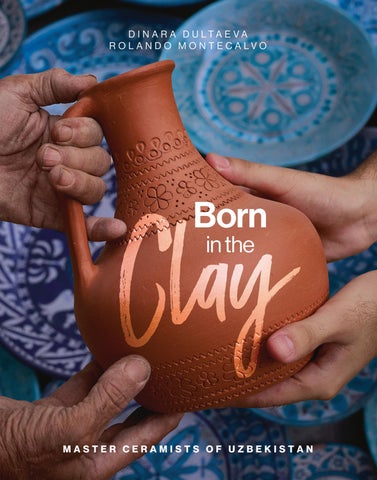
Born in the Clay
M A S T E R C E R A M I S T S O F U Z B E K I S TA N Publisher: Dinara Dultaeva Co-Publisher & Distributor: Kulturalis Ltd, London, UK (www.kulturalis.com) Writers: Dinara Dultaeva, Rolando Montecalvo Photography: Mukhiddin A Lee Designer: Davron Abdullaev Project Coordinators: Sabina Odinaeva, Kamila Serova Text © Dinara Dultaeva & Rolando Montecalvo, 2026 Photography © Mukhiddin A Lee, 2026
All rights reserved. No part of this publication may be reproduced, distributed, stored in a retrieval system, or transmitted in any form or by any means, including electronic, mechanical, photocopying, recording, scanning, or otherwise, without the prior written permission of the publisher, except in the case of brief quotations embodied in critical reviews or scholarly works. The photographs featured in this publication remain the copyright of the photographer and are reproduced with his permission. ISBN: 978-1-83636-097-1 First published in Uzbekistan in 2026 by Dinara&Co. Publishing license: AI No. 317, 26.01.2018 Inquiries: Dinara Media Relations Trilliant Tower, 2 Shakhrisabz Street Tashkent, Uzbekistan Phone: +998 93 390 00 98