Maakha and Rehavam, 1988. Bluestone, 66 x 47 x 45 in. (167.5 x 119.5 x 114.5 cm). Private collection of Rebecca Vaadia and Sara Vaadia.
FIG.4.
The bluestone Shemai’ah is a sturdy male with legs conjoined and arms flush with the sides
of his body. There is a touch of Giacometti in Shemai’ah’s oversized feet, and indeed, Vaadia’s
figurative work makes many allusions to modernism. The figure in Shemai’ah stands at the
end of a pavement of six slabs: actual paving stones that also represent paving stones. This is a
common semiotic pun among modernists, as in Kazimir Malevich’s 1915 painting, Black Circle, where the black circle, in being what it signifies, collapses reality and representation. Similarly,
the wooden pedestals in Vaadia’s slate sculptures echo Constantin Brˆancusi’s carved columns.
They are sections of beams from demolished buildings that Vaadia salvaged from dumpsters, cleaned up, and finished by hand with beeswax.
In 1989, accident provided Vaadia with yet another material. He had just moved into a new
studio in Williamsburg, where a sewer line was under construction on his block. Bulldozers were unearthing dozens of boulders deposited in Brooklyn during the last ice age. Vaadia found the granite monsters thrilling. “As a guy who was raised on a farm in Israel,” he says,
he responded strongly to their “primeval feel.”15 He was told he could have them for free; all he had to do was cart them away. Within hours he had acquired a forklift and was piling up boulders in his studio, although at this point he had no idea what he would do with them.
20
The solution came, predictably, via accident. On a rainy day, Vaadia invited the sewer-line
workmen inside the studio to eat their lunch. There were no chairs, and so they perched, leaned, and lounged against the boulders. Suddenly, Vaadia had a whole new repertoire of
poses as well as a use for the boulders: they would serve as supports. In the past, when a pose had required a figure to be braced, as in Maakha and Rehavam (fig. 4), Vaadia created a bench, throne, or column made of the same stone layers as the figure. But from now on, the glaciers were the sculptors of his supports (with a little assistance from the artist). Yoshiyyahu with Dog
(1989) was the first of many works, such as Gilalay & Ginnetoy (plate 85), in which the irregular
shape of the igneous boulder contrasts with the orderly horizontal strata in the sedimentary bluestone of the figure.
By now, Vaadia was in his 40s, and the days of happy accidents would seem to have been
over. To embark on a life-size figure—let alone a grouping of such figures—he had to plan the
whole work in advance or risk wasting five tons of stone and many months of labor. But one day, as he was putting the finishing touches on Re’uven (fig. 5), a bird flew into the studio, and
his sense of the sculpture changed completely. On the spot, he carved out a birdbath in the base, so that when Re’uven was installed outdoors, birds could continue to vary the composition. In
a similar embrace of accident, Vaadia has been known to leave coins in a sculpture when they fall in, or drops of blood from a cut, a secret signature in DNA.
21
Re’uven, 1991. Bluestone, boulder, and water, 46 x 64 x 52 in. (117 x 162.5 x 132 cm). Collection of The Open Museum, Tefen, Israel.
FIG 5.
27
FIG. 11. Detail of Asaf and Yo’ah, 2001. Bluestone and boulder, 78 x 110 x 80 in. (198.1 x 279.4 x 203.2 cm). Private collection. Permanent installation, Time Warner Center, South Tower, New York, NY.
FIG. 12. Installation at Imago Galleries, Palm Desert, CA, 2003.
as powerful. The columnar limbs and right angles of Asaf and Yo’ah (fig. 11 and pages 2-3) echo
the structural uprights and crossbeams of the Time Warner Building at their back; from the side, the figures look like space aliens basking in the sun against the abstract pattern in the
building’s metal cladding. (A bronze of this subject appears in the current exhibition, plate 92). Indoor settings can also affect the meaning of Vaadia’s figures. The high polish on the floor of Imago Galleries made his portrait busts look like bathers immersed up to their chests in water
(fig. 12); Grounds For Sculpture creates a similar effect with the portrait bust ZAMIR (plate 92). Portraits were a new departure for Vaadia in 2002, after nearly two decades of faceless
figures. The genre had always appealed to him, he says, and he was good at it: after art school, he had been offered a job in a wax museum. He had avoided portraiture because of his layering technique, which is not suited to the rendering of facial detail. But he knew that the tilt
of a person’s head, back, or shoulders could be just as distinctive an identifier, and between 2002 and 2004 he tested out these possibilities in a series of busts of family members, friends,
and passersby. Among them is the self-portrait Boaz (plate 93), complete with striated slate
glasses—quite a departure from The Left Pillar in the Porch of the Temple.
28
Boaz Vaadia: Sculpture Director’s Acknowledgments
THIS VOLUME IS PUBLISHED on the occasion of the exhibition, Boaz Vaadia: Sculpture, an ambi-
tious presentation, spread throughout the 42-acre campus of Grounds For Sculpture. Vaadia’s
work is displayed in two indoor galleries as well as the outdoor sculpture garden, and also includes featured placement in the community. This exhibition provides the unique opportunity to experience an in-depth look at the signature body of work by Israeli-born, New York
artist Boaz Vaadia, which comprises the majority of the work in this exhibition. These works
feature Vaadia’s exploration of figurative compositions created by stacking layers of bluestone or slate, with some of these works later cast in bronze. Although this exhibition is not orga-
nized as a comprehensive retrospective, it contains an entire gallery of Vaadia’s rarely seen early sculptures. These early works display Vaadia’s interest in the effects of gravity and the inherent qualities of material, all of which continue to inform and influence his later work. The exhibition and publication allow us to follow his artistic evolution and see the threads that carry forth.
We are pleased to acknowledge Quaker Bridge Mall, A Simon Mall, as the presenting
sponsor of this exhibition and catalogue. We wish to thank Lynda Benedetto, Christopher Dudley, and the entire Quaker Bridge Mall team for their vision, dedication, and support
of the arts in our community. Their support has enabled Grounds For Sculpture to host and present this ambitious exhibition. Their generous contributions have also allowed us to share this important work with our community in a very intimate manner. With their support, we
have been given the opportunity to place a series of sculptures in the community as part of our Sculpture Along the Way program.
This exhibition and catalogue have been generously supported by The Office of The
Installation at Upper Gallery, Museum Building, Grounds For Sculpture, Hamilton, NJ, 2016.
Consulate General of Israel in New York. I want to give special thanks to Consul General Ido Aharoni, Consul for Cultural Affairs in North America; Aviad Ivri, The Cultural Attaché; as well as Eran Polishuk, Vick Giasov, Renee Schreiber, and Tal Shoham of the Consulate for their assistance in connecting Grounds For Sculpture with the Israeli arts and cultural community.
37
I would also like to recognize and thank the New Jersey State Council on the Arts, the
New Jersey Department of State, the National Endowment for the Arts, the Geraldine R. Dodge
Foundation, the Atlantic Foundation, and the Johnson Art and Education Foundation for their generous support of all of our exhibitions.
Throughout his career, Vaadia has had the benefit of working with a number of supportive
art dealers including Ivan C. Karp at OK Harris early on, during an influential time in his career. It is important to acknowledge that galleries help to build a base of support as well as a trusted space for artists to focus on their creative practice. For this reason, we are pleased to acknowledge all of the galleries that show his work and Baker Sponder Gallery, Imago Galleries, Jim
Kempner Fine Art, and Vered Gallery for their ongoing commitment to Boaz Vaadia and for their generous support of this catalogue.
Without the guidance, expertise, and collaborative partnership of The Artist Book
Foundation, this catalogue would not be possible. We graciously thank Leslie Pell, publisher
and co-founder, for her enthusiasm and steadfast guidance that has resulted in this important publication. Our team at Grounds For Sculpture has greatly benefited from the opportunity to
work with such a well-regarded and accomplished publisher on this project. In addition we are
grateful for the expertise of Wendy Steiner, author of the essay on Boaz Vaadia’s work featured in this catalogue.
Executing exhibitions of this scale could not be possible without the dedication and
close collaboration of the entire staff at Grounds For Sculpture. Our staff has exemplified great leadership and stewardship in shaping this project from an idea to realization. I want
to give great thanks to Tom Moran, chief curator, for his intelligent and sensitive curatorial
process that always elevates the artist’s voice. I want to thank our exhibition team, ably led by Faith McClellan, director of collections & exhibitions management, for the meticulous atten-
tion to detail given to this project to actualize the vision for this exhibition on both Grounds For Sculpture’s campus and in our community. This exhibition marks a new milestone for our organization in terms of garnering fundraising support. As a result, I want to personally thank Rhonda DiMascio, director of development, and Janis Martin Hughes, manager of corporate engagement, for their tireless, patient, and persistent efforts to raise funds for this great
endeavor. Acknowledgment and gratitude go to Coby Green Rifkin, director of marketing communications, who contributed greatly by working to build an audience for this exhibition.
Additionally, a heartfelt thank you goes to Keith Pyatt, manager of technology and digital media, who produced a thoughtful and revealing video interview of the artist that accompanies the exhibition.
38
left to right
Untitled, 1974. Wood, string, leather, human hair, and paper, 81/4 x 81/4 x 1 in. (20.9 x 20.9 x 2.54 cm).
PLATE 12. Untitled,
1974. Wood, string, fur, and paper, 81/4 x 101/2 x 1 in. (21 x 26.7 x 2.54 cm).
PLATE 13.
Untitled, 1974. Wood, string, fur, and paper, 101/2 x 81/4 x 1 in. (26.7 x 20.9 x 2.54 cm).
PLATE 15. Untitled, 1974. Fur and paper, 81/4 x 101/2 x 1 in. (20.9 x 26.7 x 2.54 cm).
PLATE 14.
48
left to right
Untitled, 1974. Wood, string, human hair, and paper, 101/2 x 81/4 x 1 in. (26.7 x 20.9 x 2.54 cm).
PLATE 16. Untitled,
1974. Wood, string, fur, and paper, 81/4 x 81/4 x 1 in. (20.9 x 20.9 x 2.54 cm).
PLATE 17.
Untitled, 1974. Fur and paper, 81/4 x 101/2 x 1 in. (20.9 x 26.7 x 2.54 cm).
PLATE 20.
PLATE 19.
49
Untitled, 1974. Wood, string, nail, copper, feather, and paper, 81/4 x 101/2 x 11/2 in. (20.9 x 26.7 x 3.8 cm).
Untitled, 1974. Wood, string, fur, and paper, 101/2 x 81/4 x 1 in. (26.7 x 20.9 x 2.54 cm).
PLATE 18.
Untitled, 1982. Stone, wood, and leather, 24 x 30 x 7 in. (61 x 76.2 x 17.8 cm).
PLATE 64.
Untitled, 1982. Stone, wood, and leather, 48 x 12 x 71/2 in. (121.9 x 30.5 x 19 cm).
PLATE 65.
64
PLATE 66. Untitled, 1982. Stone, wood, and rope,
PLATE 67. Untitled, 1982. Stone, wood, and leather,
661/2 x 111/2 x13 in. (169.9 x 29.2 x 33 cm).
601/2 x 13 x 13 in. (153.7 x 33 x 33 cm).
65
Ahino’am with Dog, 1990. Slate, boulder, and bluestone, 16 x 23 x 21 in. (40.6 x 58.4 x 53.3 cm). Private collection of Rebecca Vaadia and Sara Vaadia.
PLATE 82.
80
Avimelekh with Dog and 8 Lambs, 1991. Slate and bluestone, 18 x 59 x 24 in. (45.7 x 149.9 x 61 cm). Private collection of Rebecca Vaadia and Sara Vaadia.
PLATE 83.
81
Asa with Dog, 2000. Bronze, boulder, and bluestone, 66 x 84 x 84 in. (167.6 x 213.4 x 213.4 cm). Edition of 5. Private collection of Rebecca Vaadia and Sara Vaadia. PLATE 89.
87
Asa & Yehoshafat, 2000. Bronze, boulder, and bluestone, 86 x 108 x 108 in. (218.4 x 274.3 x 274.3 cm). Edition of 5. Private collection of Rebecca Vaadia and Sara Vaadia. PLATE 90.
opposite
Avdon, 2001. Bronze and bluestone, 72 x 29 x 23 in. (182.9 x 73.7 x 58.4 cm). Edition of 5. Private collection of Rebecca Vaadia and Sara Vaadia.
PLATE 91.
88
Family with Dog, 2009. Bronze, boulder, and bluestone, 76 x 120 x 100 in. (193 x 305 x 254 cm). Edition of 5.
OPPOSITE
PLATE 107.
David, 2010. Bronze and bluestone, 91 x 36 x 36 in. (231.1 x 91.4 x 91.4 cm). Edition of 5.
PLATE 106.
103
114
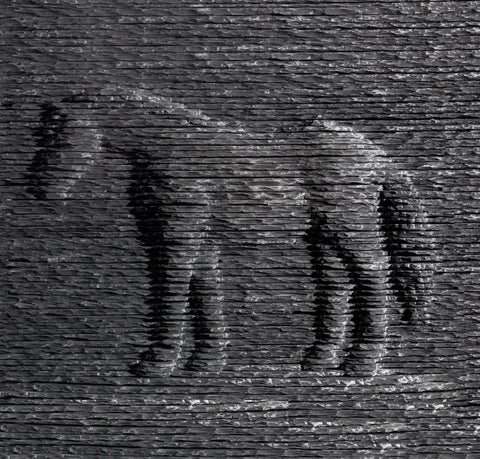
Horse (Relief), 2015. Slate, 14 x 19 x 31/4 in. (35.6 x 48.3 x 8.2 cm). PLATE 117.
opposite
Mother and 2 Children (Column Relief), 2014. Slate, 231/2 x 141/2 x 6 in. (59.7 x 36.8 x 15.2 cm). PLATE 116.
115