BIKELIFE_214X276.indd 6
4/06/20 10:09
BIKELIFE_214X276.indd 7
4/06/20 10:09
‘To put things in a nutshell: we started taking life seriously. You only live once, so it is so important to take control of your decisions. Their outcome will either be an empire or a bucketful of unrealized dreams.’
_8
BIKELIFE_214X276.indd 8
4/06/20 10:09
PROLOGUE THE EMPTY PAGE
S
ometimes we crave a little getaway. All of us have duties, responsibilities, a busy job, a child or three dogs to look after. And all of us simultaneously try to do in life what we like doing. Nowadays life is turbulent and full of distractions: your phone rings and your partner wants to be picked up. Those bills still have to be paid. Your fridge needs filling up, and your boss wants you to work overtime tonight. There’s a climate crisis outside and Instagram is recommending who you should follow next. Where does it end? Well, what if we tell you there is a remedy for the mess above. A temporary one perhaps, but a clean slate and fresh start nonetheless. A way of being alone in the mountains, knowing you have the place all to yourself – being able to contemplate the Milky Way, drinking from a stream so clean, gifted with smiles from passing strangers or experiencing kindness in abundance. A way to get to know yourself and our planet better. To clear our minds of clutter, and encourage us to live simply, in respect of the environment and those who live in it. Something we like to call the empty page, where we take charge of our own lives and start writing a new beginning – or perhaps a side chapter
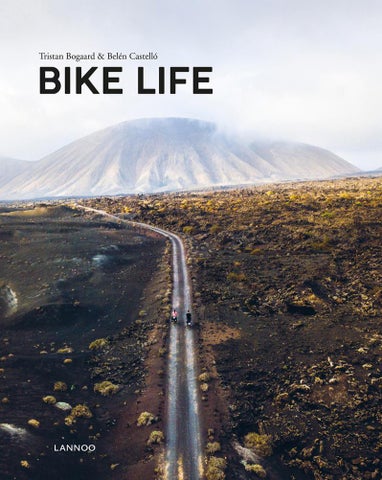
or tangent to an existing story –, nonetheless trying to learn something new and challenging the unknown and seductive path of deepest desires. It’s not always a comfortable remedy and it needs a certain kind of… courage, but anyone can do it: we have seen families with babies, dogs or even cats, but also retired couples, solo women and men with busy jobs or recovering from an injury, and even people fresh out of school, doing what we think is the very best way to discover the world around you. In this book we will be exploring what it means to travel by bicycle. The pros and cons, the healing, life-changing effect it can have on you and how it will contribute to your social sense of being, your visual and mental understanding of the world we live in. On your bike you adopt a different approach to prioritizing what really matters in your life, learning what cannot be taught in any book. We will try our very best to show and tell you all that we love about it.
Welcome to the Bike Life. 9_
BIKELIFE_214X276.indd 9
4/06/20 10:09
_86
BIKELIFE_214X276.indd 86
4/06/20 10:10
ANDALUCÍA
Route of the white villages
CÓRDOBA GRANADA GRANADA
SEVILLA
Loja Teba
Zahara de la Sierra El Bosque Grazalema Sierra de Grazalema
Beanoján
El Chorro Setenil de las Bodegas Ronda
El Burgo
Sierra Nevada
Antequera
MÁLAGA MÁLAGA
Sierra de las Nieves
CÁDIZ
A
ndalucía is probably the closest representation of what people think about when describing Spain: flamenco, street music, tapas, beaches, wine… but what we were about to discover was that it is also a beautiful region full of hills, rivers and magnificent architecture. It’s full of little villages that seem sleepy during the winter months, revealing their true character without the tourists. That said, winter is indeed the best season to cycle in the south of Spain. Hear us out. Our plan was to do our own version of ‘Ruta de los Pueblos Blancos’, the route guiding you through the provinces of Cádiz and Málaga and the characteristic white towns with their whitewashed facades and red-tiled roofs. The route is
famous to anyone who knows the Spanish southern regions and is a fantastic place to spend some time cycling around. Whether it’s on a mountain-bike, touring bike or electric stallion, you’ll be sure to find typical Spanish culture in the midst of its hibernation. Additionally, the south of Spain has so many different regions, each with a slightly different history and tradition. It is hard not to acknowledge that, when you’ve been there once, it’s increasingly worth another trip there to experience more of the same thing. That purely Spanish atmosphere, lifestyle and ease. ¡Vamos! 87_
BIKELIFE_214X276.indd 87
4/06/20 10:10
Cyclists unite! Our friends Agata and Blaz join the ride. The impressive bridge and village of Ronda, Spain
DISCOVERING E-BIKES For this particular trip, we invited two of our friends to join us along the way. We met Blaz and Agata on a hazy afternoon in a stylish Airbnb in the center of Málaga, where not much was going on at that time of year. Our friend Blaz had undergone a stomach operation before flying out to the south and was in full recovery mode – he therefore rented an electric bicycle. Agata was in much better shape and opted for a purely muscle-driven bicycle. So, after a day of getting our things together and catching up over a (rental) home-cooked meal we set out towards the first town on the way: Coín. All of us were pretty loaded, ready for a mixture of wild camping and booking.com apartments on our way. The nearly empty south was now so low in season, four friends could easily have afforded to rent a castle if they’d wanted to.
But as the days went by, we started discovering a flaw in our planning. The ride was, in practice, much harder than what we’d anticipated. Málaga is surrounded by mountains which have to be overcome to get to Andalucía’s more plateau-like flatlands. Blaz flew up every turn and was able to charge his bicycle every night, while the three of us lagged behind. And when a freezing rainstorm caught up with us in the hills just before Ronda, Agata decided to call it a day on her bicycle – she called the shop, they drove over to swap her standard bicycle for an electric one, and before we knew it our Sequoia’s had become ‘abuelitos’ whilst Blaz and Agata flew up the passes, with happy smiles and mountains of motivation. We’d found the remedy to all excuses anyone might have for not going on a bicycle tour and… it is only the beginning. Soon relationships will be mended, cycling
_88
BIKELIFE_214X276.indd 88
4/06/20 10:10
BIKELIFE_214X276.indd 89
4/06/20 10:10
BIKELIFE_214X276.indd 184
4/06/20 10:12
Hiding from the burning midday sun under one of very few trees A glimpse of the northern pass out of Kalaikhum
NORTH, OR SOUTH? If you’ve heard any news coming out of Central Asia recently, you might remember the attack on a group of cyclists near Dhangara, Tajikistan, in the late summer of 2018. A heartbreaking event that shook the touring cyclist community worldwide and still very much echoes among those brave enough to seek out the Pamir Highway for their bicycle tour. We had only just finished our ride and were in the Tajik capital, Dushanbe, when it happened, only about a hundred kilometers south of us on the southern route of two major ways into or out of the Pamir. The group of Dutch, French, Swiss and American cyclists had all been enjoying Tajikistan tremendously and were about to get into Dushanbe to plan their journey further when four young boys in a black car drove straight into them, killing four of the unfortunate cyclists. Even though the attack was claimed by ISIS, the government blamed the opposition, followers of an extremist party banned in Tajikistan in 2015. Yet the country is ruled by a dictator depicted on billboards along the Pamir Highway as a hero of the peoples, and in our opinion this attack was partly an action against him, as a downturn in tourism means less fund being poured into his corrupt governmental castle and rule. Whichever way things are, these unfortunate cyclists took a route known as ‘the southern route’. On leaving Kalaikhum you have the choice to head north or south. The northern route to Dushanbe offers a steep, mainly unpaved 2500meter climb taking you up to an altitude of 3500 meters, and then downwards, while the mostly asphalted and therefore
comfortable southern route is 100 km longer and hillier, has more traffic and is less scenic. Putting it like that, the choice was pretty obvious for us. But because we were so tired from the Panj, we paid a taxi in town $20 to take us up to the top of the 3248-meter Khaburabot Pass. This didn’t go down as smoothly as it might sound, since we spoke to two taxi drivers and went for the one who offered us the best deal, to which the other driver reacted furiously, chasing us down to the gas station and almost getting in a fist fight with our driver who, after his victory, continuously tried to ask us for more money. All this is to say that, when coming to Central Asia, you should be aware of a change in culture that can sometimes feel aggressive and bleak at first encounter. The Tajik, by our experience, were less hospitable than the Kyrgyz, but of course that comes down to our personal situation. These occurrences serve simply as a word of caution, because even in the most special of places hospitality and honesty knows its boundaries. From the pass onwards we spent the next few days enjoying a relatively downward stretch of road along green hills filled with flowers, zooming insects and gorgeous little camp spots. An overall relaxed end to such a turbulent journey before arriving in the capital city of Dushanbe. But then, a couple of hundred kilometers from our end line, something got in our way. 185_
BIKELIFE_214X276.indd 185
4/06/20 10:12
BIKELIFE_214X276.indd 186
4/06/20 10:12
PUPPY RESCUE
An unexpected change of plans
THE FINDING OF LIFE Little did we know what was about to happen a few hundred kilometers away from our end line in Dushanbe, and how it would affect the end of our journey through Central Asia. We were in for quite a whirlwind, and even though in the back of our minds we were expecting something like this to happen, we’d been hoping it wouldn’t be the case. But hey, it did. Pet culture is not a thing in Central Asia. Animals are raised with purposes or jobs in mind. If they are not good enough at their craft or get worn out, they are of no use. Stray dogs are a major issue in this part of the world. The ‘lucky’ ones will have an owner and a flock of sheep to guard, but most of them will be born by the road and die there too, whether from the poison people put in their food, shot by government-issued killing squads, from starvation or hit by a car. We hadn’t really encountered many stray dogs on the way, and the ones we did seemed to have their own routines and didn’t get too attached to us. But everything was about to take a different turn on a very warm afternoon near Obigarm. We had stopped in the shade by the side of the road for a toilet break, and as Belén was holding both bikes while Tristan was out in the bushes, she saw a little brown furry being crossing the road and hiding on the other side. It was so fast she wasn’t really sure what she had seen, but something made her think it was probably a puppy. As if we knew the moment was bound to arrive, she started murmuring ‘Oh, shit. Oh, shit’. We both picked up on this concern and inched forwards, looking down at the ditch by the side of the road. There they were. Two small puppies, one brown, one white, lying next to what we thought to be the corpse of their mother. She’d most likely been hit by a car, pulled herself into the ditch and died there with her puppies besides her.
They were scruffy, weak and full of fleas. The brown one was slightly more scared, the white one numb in his reactions – he’d probably just given up. For a while we tried to communicate with some locals to see if they knew what to do with them, but everyone seemed uninterested. In desperation, Tristan called his mum for advice, as thirty years ago she had also found a puppy on her travels and managed to bring her to Europe. She gave us these wise words; ‘try and feed them, give them water, and if they don’t resist, take them with you and bring them to the nearest city’ which in our case was Dushanbe. Seeing that no one at this roadside cared about these young dogs at all and they looked too weak to survive much longer, we emptied one of our backpacks and plopped them inside. They didn’t protest at all.
DUSHANBE DOGS After a little ride down the road, we found water and a camp spot. We attempted to wash the pups, dried them, managed to get them to drink and even try a little bit of some sloppy noodles we hastily prepared. They needed rest, so we tucked them into a towel and they spent the whole night sleeping by our feet inside the tent, with unbelievable trust. It’s almost impossible for us to understand how, as a forgotten and discarded puppy, you can still find trust in humans taking you off the road. The next day we had two options: to start cycling on towards Dushanbe (which would still take us a good two to three days in temperatures over 40°C) or to try and stop a vehicle that would kindly take us along to the capital. It took a few hours of trying as there was not much traffic, and when there was 187_
BIKELIFE_214X276.indd 187
4/06/20 10:12
it had to be sufficiently empty to fit in two grown-ups and their fully loaded bikes. Eventually a truck driver did stop and we chucked our stuff onto the top of the truck. The puppies were still asleep, suffering from the extreme warmth, and the fleas and ticks we later found on them. By accident, we had come to know a girl called Roxana, who worked at a graphic design studio in Dushanbe. We reached out to her for advice on the dogs and she and her colleagues picked us up upon arriving in the city. Before we knew it, we were being driven to their studio where the puppies could recover in the closed grassy garden until we could figure out what to do next. And as the next few days turned into two weeks, we surfed a wave of cultural, practical, emotional and other mental challenges, culminating in the decision to take the pups home with us. We shared the story on Instagram and, to our surprise, soon received donations from kind strangers all around the world. Thanks to them, we were able to change our plans. Roxana helped us find one of the very few vets in Dushanbe. He got the doggies checked, vaccinated and chipped. In the meantime, we spent a couple of hours a day cleaning them, as their skin was ridden by fleas and their eggs, plus the occasional tick. Slowly they started regaining their health, appetite and even the desire to play. After all the hassle, paper work, and slight rule-bending – Turkish Airlines had to make an exception for us as the dogs were two kilograms overweight –, flights had been booked, our Dushanbe dogs named, chipped, given passports and checked for all that mattered. What now sounds easy was a tough job, but we were ready to leave the country with Moka and Latte at our sides. Easy to guess who is who, right?
owned riviera airbase for millionaires – that is to say, no need for thorough controls. From there we flew to Istanbul and after a transfer spent in a bathroom for the pups to urinate and eat, onto the Netherlands. Finally back home, we immediately had the puppies checked again by the local vet to make sure the Tajik veterinarian hadn’t left anything out and, as we expected, they were as healthy as could be. Once the vet confirmed their blood results looked clean, we looked out for the best possible families to give them a lasting home. Both of them had gone through so much together that separating them felt a bit heartless. Yet we knew that in the long term it’d be for the best as they’d be able to develop their unique personalities and grow close to their loving families. Moka got adopted by a sweet family in the Hague whom we visit a few times a year, and Latte got to be a part of Tristan’s family – to this day his mom has taken care of him, and as he runs through the nearby forests nearly every day his eyes speak immense gratitude.
A NEW HOME
We have shared this story with you as an example of unexpected events whilst traveling, and believe us when we say that they’ll happen, and many of them will probably be related to stray animals. Talk with anyone in the cycling community who has traveled extensively, and they’ll all have a stray-story that makes even the coldest of human hearts feel pity. Simply imagine the dog running behind your bicycle, crying out loud as you out-pedal her greatest effort to seek your guardianship and attention. Quite the memory scar. In our case, we felt like we had to do something about these specific puppies and simply couldn’t leave them to their own rapidly deteriorating destiny. When deep down you know there’s another way than leaving the animal behind, we share this happy story to give you the courage to follow through. Everything is possible, as long as you’re willing to make it your priority.
The team of designers brought us (and our now boxed bikes) to the airport during the dark early hours of our big day. Tajikistan, still under political stress from the attacked cyclist story, made for a check-in process smoother than a family-
For Moka and Latte, everything worked out fine; a nearly undeniable indication of what happens when you persevere. All because of two touring cyclists, an Instagram post and the combined efforts of a group of benevolent strangers.
_188
BIKELIFE_214X276.indd 188
4/06/20 10:12
And now… it’s time to fill in your empty page, start your own adventure, maybe even change your life. We hope you’ve enjoyed our book and got personal value out of it. Are you ready to travel by bicycle? Just in case you don’t know for sure, but would really like to give it a try, you can start by joining us on a guided group tour on: tristanbogaard.com/guidedcycling Sign up for a bicycle tour of your liking, pack up the basics, and ride along with us to learn even more about this way of traveling first hand, as well as improving your photography and video-making skills. It will make you realize the world is at your pedals! See you on the road, Tristan & Belén
This book is published by Éditions Racine. Éditions Racine is part of the Lannoo Publishing Group. All photographs_© Tristan Bogaard & Belén Castelló except p. 6-7_Portrait of Tristan and Belén by Daniel Ernst Texts_Tristan Bogaard & Belén Castelló Review_Richard Lomax Layout_Dominique Hambÿe If you have any questions or comments about the material in this book, please do not hesitate to contact our editorial team: michelle.poskin@racine.be © Éditions Racine, 2020 Tour et Taxis, Entrepôt royal 86C, avenue du Port, BP 104A / B – 1000 Brussel www.racine.be Register for our newsletter to receive information regularly on our publications and activities. All rights reserved. No part of this publication may be reproduced, stored in a retrieval system, or transmitted in any form or by any means, electronic, mechanical, photocopying, recording or otherwise, without the prior permission of the copyright owner. D/2020/6852/6 Legal deposit: August 2020 ISBN 978-2-39025-115-6
_256
BIKELIFE_214X276.indd 256
4/06/20 10:13