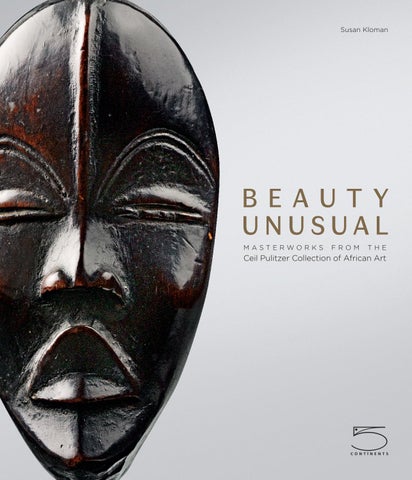
SUSAN KLOMAN
Susan Kloman
BEAUTY UNUSUAL
BEAUT Y UNUSUAL MASTERWORKS
FROM
THE
Ceil Pulitzer Collection of African Art
Masterworks from the Ceil Pulitzer Collection of African Art
Preface
those masks and other objects for a sacred purpose, a magic purpose, as a kind of mediation between themselves and the unknown hostile forces that surrounded them, in order to overcome their fear and horror by giving it a form and an image. At that moment, I realized that this was what painting was all about. Painting isn’t an aesthetic operation; it’s a form of magic designed to be a mediator between this strange, hostile world and us, a way of seizing the power by giving form to our terrors as well as our desires. When I came to that realization, I knew I had found my way.”2
On this Earth of ours, where everything is subject
Almost twenty years later, Henry Moore, awestruck, but less viscerally, went
to the passing of time, one thing only is both subject
to the British Museum to sketch and learn in a more reasoned manner. He
to time and yet victorious over it: the work of art.
encountered works ranging from small stone Cycladic sculptures and monu-
André Malraux in Promenades imaginaires dans Florence, Rome et Fontainebleau, 1976
mental Egyptian and Pre-Columbian artworks to wooden so-called idols, such as the great A’a from Polynesia and Cubistic Mumuye figures from Africa. Moore first became aware of so-called “primitive” art in 1920 when he
Each work of art represented in the Pulitzer Collection is powerfully resonant
read Roger Fry’s Vision and Design (1920) during his last year at the Leeds
with subjects that unite us as humans—visions of prosperity, devotion, power,
School of Art. Certain passages in the chapters “Negro Sculpture” and
fear, and order. Much has been written on the twentieth-century artistic
“Ancient American Art” not only prepared the burgeoning Yorkshire sculptor
reception to African art, and many of the resonances and connections iden-
for the great ethnographic collections of the British Museum, but also shaped
tified there occur in the Pulitzer Collection as well. The inventiveness of
his ideas on two significant concepts: direct carving and the full, three-di-
African societies and of other preliterate peoples has led to an often aston-
mensional realization of form.
ishing artistic multiformity that comprises one of the most important com-
What Picasso, Moore, and myriad other modern artists, from Modigliani and
mon denominators between African and modern art.
Matisse to Brancusi and Giacometti, were reacting to, each in their own way,
Although the focus of this book is Ceil Pulitzer’s African art collection, she
was the supernatural, and the metaphysical concepts relating to this were
has also looked across cultures and mediums. As an artist, and like many of
conveyed through superb craftsmanship and the highest artistic virtue in
her artistic predecessors, she, too, studies antiquities, Pre-Columbian art, Old
works deemed “primitive” in the West. The word “icon” has taken on new
Master paintings, Latin American paintings, Oceanic art, and Native American
connotations today, but originally it meant “image, or reflection in a mirror,”
art—to name just a few of her interests.
from the Greek εἰκών. In a world without written language, the image was
Picasso famously and ironically said, “L’art nègre? Connais pas!”1 knowing
created to portray the intangibles in our universe. How does one portray
well that it was his axis. He later recollected to fellow artist Françoise Gilot in
something not of this world? In La Condition Humaine (1933), Malraux says
1946 his first encounter with African art in 1907 on the cusp of creating Les
that art reminds us of our important nothingness. This, in essence, reflects
Demoiselles d’Avignon: “ . . . When I became interested, forty years ago, in
the worldview in African art that humans are not the center of the universe.
[African] art and I made what they refer to as the [Black] Period in my paint-
It is essential to remember in this context that the fundamental element for
ing, it was because at that time, I was against what was called beauty in the
Sub-Saharan African society, and thereby its art, was its central animist
museums. At that time, for most people [these masks were] ethnographic
belief system. Akin to Shintoism, spirits are everywhere, from traversing the
objects. When I went for the first time, at Derain’s urging, to the Trocadéro
universe to being hosted by a rock. African sculptures are created to appease
museum, the smell of dampness and rot there stuck in my throat. It depressed
the spirits and to give them a favorable seat to assist humans in navigating
me so much I wanted to get out fast, but I stayed and studied. Men had made
the world. So, too, the African artist resolves his problem of representation
8
9
The Pulitzers’ home, 2019
through abstraction. It is not a final result but a means to an existential path. Therefore, it is not the thing itself that is important, but rather its efficacy as a vessel to temporarily house spiritual essence. Understanding and accepting this represents a necessary paradigm shift for modern, especially Western, viewers. The simplest way to summarize it is to think not “art for art’s sake,” to take a phrase the origins of which are rooted in Kantian philosophy, but rather “art is for life’s sake,” as the well-respected African art scholar Roy Sieber noted. The African sculptor is not viewing himself or the empirical human as the center of the universe. On the contrary, he sees everything as liminal, including his own condition and state of being. Ceil Pulitzer has always been moved and awed by the simultaneous immediacy and timelessness this great and beautiful art affords with each encounter. As she rightly surmises: “African art is the most interesting art.”
1 (African art? Don’t know it!). “Opinion sur l’art nègre,” Action, III, April 1920, p. 26.
10
11
2 Flam, J. with Deutch, M. (eds.). Primitivism and Twentieth-Century Art: A Documentary History, Berkeley: UC Press, 2003, p. 425.
the Art Students League. No one I knew was really considering African art.
Ceil Pulitzer in Ethiopia, early 2000s
Before that, I went to convent schools. Cloistered places. But I was a free
CP: I think so, yes. I love seeing any kind of art from any place. But I also must say that the first time I went to Africa, I was there to learn the culture, see the
spirit, so let’s just say I did not enjoy that [laughs]. I was always seeking
animals and the landscape, and hear the music. I loved the people; I loved
new ideas or adventures. One of my favorite parts of the Catholic religion,
everything about it. Still do. I loved learning about the rituals. That was
though, was the ritual of it. Maybe that means something. I haven’t really
important to me. To learn something so different from our day-to-day world.
considered any of this . . .
From these experiences, I also got involved in helping children in Africa . . . I
Ultimately, one of the reasons I collect is that I don’t paint very much any-
haven’t thought about my past for a while. It is such a rich memory.
more. African art can be the most contemporary—timely in its timelessness. So interesting. The most interesting.
SK: Could you tell me more about your phil-
The African wing of The Met has a wonderful curator, Alisa LaGamma. The
anthropic commitments in Africa?
Dapper Museum in Paris is one of my favorite museums. I am incredibly fortunate to live with this art. I have always been interested in so-called
Michael and Ceil Pulitzer, circa 1990s
CP: We established a foundation in Ethiopia
non-Western art because it speaks about people and how they lived, and I
[Play Therapy] to help children recover
have always loved world history.
from the war with Eritrea. It was a terrible,
As for “who” inspired me, well, it was many people—and a chance meeting
terrible war that went on forever. Such a
with Charles Ratton.
frightening impact on children. It isolated so many families: mothers and children. It broke my heart, because I am a
SK: How did you first meet Ratton?
mother, too. It meant something to me personally to witness this pain, the trauma of war. I admired the work that Catherine Hamlin was doing at the
CP: Through a friend who had some African pieces. I went to Ratton’s house,
Addis Ababa Fistula Clinic and what she did to help the women who were
and he had a lot of things from a lot of different cultures and periods. He
suffering with this illness. Also, the important work being done in Uganda
invited me to dinner, but I couldn’t stay, and I regret that. He said to me: “You
[at Soft Power] that was founded by Allan Stone’s daughter, Jessie Stone.1
have a good eye. Why aren’t you interested in African art?” I said: “I am inter-
These are the real heroes. We supported other work in Africa. Dr. Upmanu
ested, but I also have eight children! Perhaps in a next life . . . ”
Lall, for instance, is the director of the Columbia Water Center. He is doing great work. We did projects with him, and they have been highly success-
SK: Were you always a collector? For instance, when you were a child, did
ful in managing and developing systems to get the water where it needs
you collect stamps or go around picking up shells?
to be for people. We did some things in Sierra Leone and supported some of the early HIV-
CP: I don’t know if I ever seriously collected as a child. I studied painting,
testing and treatment work in Kenya.2 I wish I had kept a diary. I don’t really
drawing, and printmaking. I did enjoy collecting paintings and prints from
talk about these experiences, because I was just so busy doing the work and
fellow artists and mentors, like [Oskar] Kokoschka, but it was not substantial.
interacting with a lot of different people. There were many trips, and I was
I considered myself a painter and printmaker first. I wanted to continue paint-
able on a number of occasions to have these experiences with my family, and
ing, but I didn’t, or couldn’t. I had too many other obligations.
those are important and exceptional memories.
SK: Would you say then that your collecting today is more an outgrowth of
SK: What is the greatest lesson you learned that you would impart to future
your artistic nature and interests as opposed to being an inveterate collector
collectors?
to “collect” in and of itself?
14
15
CP: The thing I would really encourage is to find people who can help you.
CP: I would have started earlier and
Go to the best people. Read as much as you can about various works, and
would have selected better people
really learn.
to work with from the start. I learned later that it’s common to buy things
SK: What do you see as the role of museums vis à vis collectors and collecting?
without good advice and, in doing so, you make mistakes.
CP: Education. You can’t get enough. See everything. Really look at every-
thing. It’s important to study maps, and to understand the geography as
Michael Pulitzer: It’s not always so
well, to enhance the experience of learning the history of the art.
terrible. There is a mask in the other room that Ceil has had for years.
SK: Is there anything that you would describe as a “female touch” to
She had it when we first met, and it
collecting?
became part of our story as a family. Our children, thinking it was funny,
CP: I don’t think I even think in those terms [laughs]. I mean, my favorite
would put a pipe in its mouth and
models in life class were female models. I hated it when we had the male
sunglasses on it!
models. So uninteresting. My daughter, Tina, is also an artist, and she feels that way, too. However, in African art, they are different. The male subject is
CP: Yes, that’s right. I kept that mask,
fascinating.
because I still love it. I also loved masks from around the world and have always been fascinated by masks in general.
SK: Why do you think there aren’t more female collectors of African art? SK: It’s courageous that you learned from those mistakes and continued colCP: Well, it’s lack of education. I mean, that’s the essence of it, but there’s
lecting instead of giving up and concluding that the entire field of African art
more to it than that.
is problematic and therefore not worth investigating.
SK: How so?
CP: Well, there is fraud in every field of art. It’s not just African art.
CP: I think people, not just women, often collect what is popular, which comes
SK: African art does suffer from a bad reputation, even though inauthentic
from lack of education and exposure—missing a sense of adventure. I think
works are problematic in any field, but you weren’t deterred.
African art is highly underestimated, because most people aren’t very adventurous. Also, the fact that there’s so much expression in African art. Not
CP: Sometimes it takes the experience of making those mistakes to help you
everyone can handle that. I have a little bit of a rebellious nature, and I love
see and learn and realize how to be more careful.
to look around and see what’s happening. That was probably a big plus with African art.
SK: What object was a turning point in your collection?
SK: If you could go back in time, what would you tell yourself as a starting
CP: Well . . . it would be this work [the Dan maskette formerly in the collection
collector?
of Hubert Goldet, catalogue n. 15]. Incredibly beautiful. This was probably a real turning point, because it’s so contemporary and serene. It’s still one of
16
17
20 | Divination Sculpture Fon artist Republic of Benin Height: 9¼ in. (23.5 cm)
64
65
20 | Divination Sculpture Fon artist Republic of Benin Height: 9¼ in. (23.5 cm)
64
65
66
67
66
67
< 21 | Portrait of a Horse Yoruba artist Ife Kingdom, Nigeria Terracotta Length: 71/8 in. (18 cm) 22 | Commemorative Portrait Edo artist Benin Kingdom, Nigeria Terracotta Height: 9½ in. (24 cm)
68
69
< 21 | Portrait of a Horse Yoruba artist Ife Kingdom, Nigeria Terracotta Length: 71/8 in. (18 cm) 22 | Commemorative Portrait Edo artist Benin Kingdom, Nigeria Terracotta Height: 9½ in. (24 cm)
68
69
< 23 | Figure Representing a Queen Mother Edo artist Kingdom of Benin, Nigeria Copper alloy Height: 13 in. (33 cm) 24 | Scepter Yoruba or Owo artist Nigeria Bone Height: 8½ in. (21.5 cm) > 25 | Staff for a Devotee of the god Shango Yoruba artist Egbado region, possibly Ilaro village, Nigeria Height: 17 in. (43 cm)
72
73
5 Continents Editions Art Direction: Annarita De Sanctis Editorial Coordination: Elena Carotti in collaboration with Lucia Moretti Editing: Emily Ligniti Color Separation: Maurizio Brivio, Italy
All rights reserved – Ceil Pulitzer © 2020 Kloman Art Photo Edward Parrinello © 2020 Succession H. Matisse / Society (ARS), New York For the present edition © 2020 – 5 Continents Editions Srl
With sincere thanks to Ceil and Michael Pulitzer’s gracious family. Sincere thanks as well to Chloé Beauvais, Nathalie Ferneau, Julia Grant, Joy Kloman, Virginia-Lee Webb, Jonathan Fogel, Daniel Gallen, Bruno Claessens, Maxwell Murphy, Edward Parrinello, Philippe Peltier, Costa Petridis, Heinrich Schweizer, Guy Van Rijn, and Titus Van Rijn. Pierre Amrouche, who told me to write. To Wiley and Ryder, my heart.
No part of this book may be reproduced or utilized in any form or by any means, electronic or mechanical, including photocopying, recording, or any information storage and retrieval system, without permission in writing from the publisher.
ISBN 978-88-7439-951-2
Distributed by ACC Art Books throughout the world, excluding Italy. Distributed in Italy and Switzerland by Messaggerie Libri S.p.A.
5 Continents Editions Piazza Caiazzo 1 - 20124 Milan, Italy www.fivecontinentseditions.com
Printed and bound in Italy in October 2020 by Conti Tipocolor – Calenzano, Florence, Italy, for 5 Continents Editions, Milan
Front Cover: Maskette, Dan artist, Liberia / Ivory Coast Back Cover: Maternity Figure, Yombe artist, Democratic Republic of the Congo