Introduction by Kris Provoost
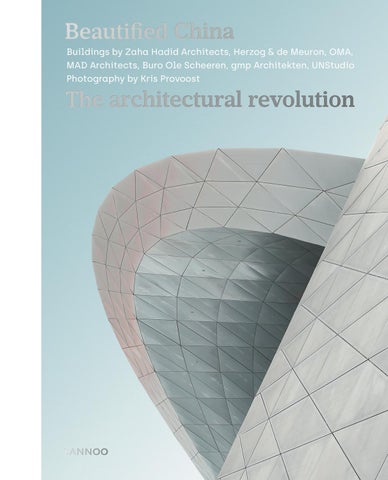
It all started around thirteen years ago. As China was gearing up to host the 2008 Olympics in its capital Beijing, the architecture they were planning to build was just that tiny bit bolder, more daring and more provocative. When the Olympics eventually rolled through in the summer of 2008, I had just completed my Bachelor’s degree in architecture. During the following two years, while completing my Master’s degree, I closely followed the construction of many of those iconic projects. China is a country that uses architecture to transform itself. When 2010 came around and the country held its second big world event, the 2010 Shanghai World Expo, I decided to go see the architecture with my own eyes. Traveling through China for the first time was eyeopening and gives you a good sense of the massive scale in terms of the cities, the vastness of the country and its large number of citizens. Everything is bigger and taller, by a lot. With a good dose of confidence and enthusiasm, I seized the opportunity and looked for a job as an architect. Nine years have passed since then and I am still hanging around China, so it is safe to conclude that my job search was quite successful. Living in Beijing, Shanghai and now Hong Kong, I have experienced architecture as an omnipresent factor in my life. My decision at the time to combine working as an architect with learning photography proved very helpful to understanding my new, ever-changing living context. While living and working across China, I was able to appreciate first-hand what a strong influence architecture can have. Not only on how a city looks, functions or develops, but also on how that city represents itself to the outside world. This is where the iconic architecture represented in this book falls into place. Beautified China is a selection of the most striking modern buildings that have been erected in the country over the past two decades. From arched skyscrapers, infinity loops, and stacked chopsticks to moving tubular curtains, this book offers a glimpse of China’s endless supply of breathtaking architecture. From the wellknown cities (Beijing, Shanghai, Hong Kong) to the lesser-known cities deep inside China’s mainland (Harbin, Changsha, Wuhan ...), this book is guaranteed to offer you a new view of the Middle Kingdom (the literal translation of Zhongguo, the Mandarin name for China). As I approach the end of my first decade in China, I look back on my early days in the country with the same enthusiasm as I do today. As the country keeps developing rapidly, architecture is and will always be at the forefront of it all. As an architect and architectural photographer, there is no place I would rather be than China. Please enjoy the wonders of architecture in Beautified China. •
Lannoo_BeautifiedChina_Binnenwerk_v22.indd 5
7/08/19 11:11
Foreword by Nikolaus Goetze
When I first visited China 20 years ago, it was the largest developing country in the world, characterized by heterogeneous grey urban landscapes against which magnificent buildings in the style of Soviet Classicism (Shanghai Exhibition Centre) stood out, with postmodern skyscrapers shooting up out of the ground like mushrooms. The architectonic quality of these new buildings consisted chiefly in differentiating themselves from their neighbours through extravagant roofing reminiscent of motifs such as lotus, pineapple, or artichoke. The ambitious goal of becoming one of the world’s leading economies within the shortest possible time led to the decision to upgrade large cities through mega-events that boost urban development. Thus, the 2008 Olympic Games reshaped formerly grubby Beijing into the proud capital of an emerging global power. Projects such as the renovated and expanded National Museum (gmp), the Olympic stadium (Herzog & de Meuron), affectionately dubbed the ‘bird’s nest’ by the public, and the provocative new building for the CCTV station (OMA) signalled China’s new architectural ambition. Expo 2010, with its ‘Better City, Better Life’ slogan, transformed Shanghai, which was then already on its way to becoming the financial centre of Asia, into one of the world’s most modern cities. Both mega-events not only changed the urban image of Beijing and Shanghai in record time, but also radiated beyond the city limits into surrounding areas. Cities like Hangzhou, Nanjing, Ningbo, and Suzhou profited from Shanghai’s lustre and have become modern, hightech cities that have shaped the Yangtze River delta into China’s richest region. The southern Chinese city of Shenzhen, meanwhile, underwent a transformation on a scale never before seen in new urban development, turning within a single decade from a small fishing village into a metropolis of millions that, today, is even challenging Hong Kong for economic status. Shenzhen, together with Guangzhou, Macao, and Zhuhai, in the Pearl River delta, form one of the world’s largest high-density urban areas, with over 100 million residents. In order to reinforce the status of Chinese cities, architecture is consciously deployed with a political purpose as an instrument of enhancement. To prevent the erosion of their populations through outmigration to the prospering megacities on China’s east coast, for instance, cities in western China such as Chongqing, Wuhan, or Chengdu acquired outstanding architectural projects of their own within a short time. The general tempo of urban development in China is greatly accelerated by the fact that Chinese cities find themselves in constant competition for prestige. No sooner does one city complete the highest skyscraper in China than ground is broken on the construction of another, even higher building elsewhere. The same goes for opera houses, athletic complexes, and museums. In this way, China has managed not just to join the ranks of the Western economic powers with its ever bolder visions in highly developed cities, but it has even begun to overtake the West, especially given that the pressure of population growth in the ever more attractive megacities will soon lead to the emergence of more satellite cities with populations running into the millions (Lingang New Area, Shanghai – gmp). But such rapid progress has also left its mark. Environmental pollution and its attendant health problems, traffic congestion, and the gradual ageing of the Chinese population are now leading to a radical rethinking of urban planning. The trend leads away from providing the world’s largest source of manufacturing toward becoming a service- and technology-oriented society. New parameters arising out of modern developments, such as the Smart City, artificial intelligence, demands for sustainability, a healthy work-life balance, and the great longing for more green space, will soon decidedly change the image of the Chinese city. And once again, one of the largest countries on the planet is poised on the brink of an urban and architectural revolution as the entire world looks on with anticipation. •
Partner at gmp Architekten von Gerkan, Marg und Partner
Lannoo_BeautifiedChina_Binnenwerk_v22.indd 6
7/08/19 11:11
98
Lannoo_BeautifiedChina_Binnenwerk_v22.indd 98
7/08/19 11:16
99
Lannoo_BeautifiedChina_Binnenwerk_v22.indd 99
7/08/19 11:17
131
Lannoo_BeautifiedChina_Binnenwerk_v22.indd 131
7/08/19 11:21
132
Lannoo_BeautifiedChina_Binnenwerk_v22.indd 132
7/08/19 11:21
www.lannoo.com Go to our website and sign up for our regular newsletter with news about new and forthcoming publications as well as exclusive offers. Authors: Chris Hardie, Peter Rowe, Martijn De Geus, Li Shiqiao Editing: Xavier De Jonge Photography: Kris Provoost Graphic design: Evi Peeters/Mirror Mirror If you have any questions or comments about the material in this book, please do not hesitate to contact our editorial team: redactiestijl@lannoo.com. Every effort has been made to trace copyright holders. If, however, you feel that you have inadvertently been overlooked, please contact the publishers. Š Lannoo Publishers, Belgium, 2019 D/2019/45/271 – NUR 648/652 ISBN: 978 940 1461 696 All rights reserved. No part of this publication may be reproduced or transmitted in any form or by any means, electronic or mechanical, including photocopy, recording or any other information storage and retrieval system, without prior permission in writing from the publisher.
Lannoo_BeautifiedChina_Binnenwerk_v22.indd 192
7/08/19 11:28