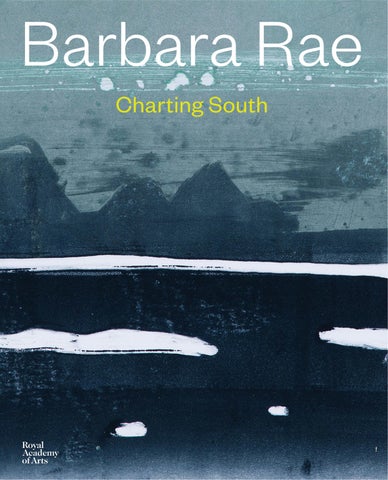
First published on the occasion of the exhibition ‘Barbara Rae, Charting South’ Royal Scottish Academy, Edinburgh 21 November 2026 – 24 January 2027 Supported by Elizabeth Lornie’s Charitable Trust
200 years
The Royal Scottish Academy
Royal Geographical Society, London 5 May – 9 June 2027
Exhibition catalogue
Editorial note
Royal Academy Publications Florence Dassonville, Production and Distribution Co-ordinator Carola Krueger, Production and Distribution Manager Peter Sawbridge, Head of Publishing and Editorial Director
Dimensions of all works of art are given in centimetres, height before width.
Copy-editing and proofreading: Susannah Lawson Design: Myfanwy Vernon-Hunt Colour origination and printing: Gomer Press, Wales Images by Dame Barbara Rae DBE RA copyright © the artist, 2026 Texts by Duncan Macmillan copyright © the author, 2026 Copyright © 2026 Royal Academy of Arts, London Any copy of this book issued by the publisher is sold subject to the condition that it shall not by way of trade or otherwise be lent, re-sold, hired out or otherwise circulated without the publisher’s prior consent in any form of binding or cover other than that in which it is published and without a similar condition including these words being imposed on a subsequent purchaser. All Rights Reserved. No part of this publication may be reproduced or transmitted in any form or by any means, electronic or mechanical, including photocopy, recording or any other information storage and retrieval system, without prior permission in writing from the publisher. Royal Academy of Arts Burlington House Piccadilly London W1J 0BD www.royalacademy.org.uk
Contents
Limited edition A limited edition of 50 copies of this book, signed by the artist, contains the following work: Sea Ice – Gerlache Strait, 2026 Woodcut on paper, 21 × 21 cm Signed and numbered by Barbara Rae Edition of 50
Acknowledgements 10 Foreword The Hon. Alexandra Shackleton 13
Illustrations On the cover: detail of cat. 35 Endpapers: Map of South Georgia, 1958, Directorate of Overseas Surveys Pages 2–3: detail of cat. 81 Pages 6–7: detail of cat. 78 Page 11: detail of cat. 39 Page 12: detail of cat. 29 Page 14: detail of cat. 111 Page 24: detail of cat. 33 Page 32: detail of cat. 12 Pages 40–1: detail of cat. 41 Page 42: detail of cat. 9 Page 68: detail of cat. 32 Pages 70–1: Preparing the James Caird for its voyage, April 1916 Pages 84–5: detail of cat. 40 Page 104: detail of cat. 94 Pages 118–19: The Endurance in full sail, January 1915 Pages 170–1: detail of cat. 82
Symphony in a Minor Key: Painting the Antarctic Duncan Macmillan 15 Ernest Shackleton’s Imperial Trans-Antarctic Expedition Jamie Owen 25 Antarctica: Ecology, Science and Art at the Hub of Our Changing World Nick Lambert 33
EU Authorised Representative EAS Europe, Mustamäe tee 50, 10621 Tallinn, Estonia gpsr.requests@easproject.com British Library Cataloguing-in-Publication Data A catalogue record for this book is available from the British Library ISBN 978-1-915815-33-0 Distributed outside the United States and Canada by ACC Art Books Ltd, Riverside House, Dock Lane, Melton, Woodbridge, IP12 1PE Distributed in the United States and Canada by ACC Art Books, 6 West 18th Street, Suite 4B, New York, NY 10011
Catalogue plates with section introductions by Duncan Macmillan
The Provost James Rae Trust was established to administer the archive of Dame Barbara Rae DBE RA’s paintings and prints. It is named in tribute to the artist’s father, who was at one time Provost of Crieff, Perthshire, where the artist grew up. The Trust is a Scottish charity whose purpose is to raise funds to help further the practice of mature artists whose ventures and travels might not otherwise be possible. Grants are made at the discretion of the Trustees and are available to late-career artists who were born, educated and reside in Scotland.
On Location 43 Monotypes and Editioned Prints 69 In the Studio 105
The Trust’s archive and gallery are based at 28 Anderson Place, Edinburgh EH6 5FR, where visitors can view artworks by appointment.
Biography 172 Recent Exhibitions 174
More information is available at www.provostjamesraetrust.org Contact: info@provostjamesraetrust.org
Further Reading 174 Photographic Acknowledgements 174 Index 175
Barbara Rae_ChartingSouth_FullLayout V8.indd 8
29/09/2026 13:36
Barbara Rae_ChartingSouth_FullLayout V8.indd 9
29/09/2026 13:36
Symphony in a Minor Key: Painting the Antarctic Duncan Macmillan
Barbara Rae’s subject is landscape and indeed she has travelled widely to find landscapes to paint, but she is certainly not just a landscape painter. She does not paint ‘views’ or records of a place. Moreover, although her sketchbooks are landscape in format (cats 1.1–6), her finished works are almost invariably nearly square. This is a way of distancing them from the conventions of landscape painting in which the horizon tends to be dominant. Instead, Rae’s finished work is concerned with the experience she has had in a particular place and that of course brings in much more than the configuration of the hills, or the light of the setting sun, dramatic though these can be. The energy of Rae’s painting and its evident spontaneity ensure that what we see encompasses much more than mere topography. Indeed, her paintings often have an echo of what in the eighteenth century Edmund Burke called ‘the sublime’: a pleasurable frisson of terror inspired by the power and majesty of nature when viewed from a safe and comfortable distance. For us, perhaps, awe might be a better word to describe our feelings when a certain wildness or darkness are allied with beauty. We see this in Rae’s paintings of the Lammermuir Hills near Edinburgh in winter, of the ice floes and dark skies of the Arctic and now, too, in the stark beauty of her paintings and prints of the Antarctic as, for instance, in the towering walls of jagged ice and rock in
her large canvases Deception Island (cat. 111) and Gerlache Strait (cat. 88). J. M. W. Turner was, of course, master of the sublime landscape. At one level Rae’s painting clearly belongs to that tradition. Turner also travelled constantly to find new subject matter. Intriguingly, too, in his late work he moved away from the landscape format to favour square canvases, as Rae has done. The canvases of Turner’s rival, John Constable, however – unless we look at his dark and stormy painting of Hadleigh Castle (1829; Yale Center for British Art, New Haven), its mood perhaps reflecting the recent death of his wife – have apparently little affinity with Rae’s. Nevertheless, Constable was profoundly inspired by the aesthetic philosophy of association formulated by the Edinburgh Episcopalian priest and philosopher the Revd Archibald Alison. For Alison, landscape did not merely derive its power from the gentle familiarity that the lush Suffolk countryside had for Constable. According to Alison, places that we see as beautiful, or that inspire profound feelings in us, can be wild and remote, savage even, and our response to them is shaped not just by their appearance but by our awareness of what has happened there, and thus of their associations. This same idea has a bearing on Rae’s work. We see it powerfully evoked in her paintings of the coast of County Mayo, for instance. The
15
Barbara Rae_ChartingSouth_FullLayout V8.indd 14
29/09/2026 13:36
Barbara Rae_ChartingSouth_FullLayout V8.indd 15
29/09/2026 13:36
Antarctica: Ecology, Science and Art at the Hub of Our Changing World Nick Lambert
I love Antarctica and the sub-Antarctic islands; South Georgia is my favourite place in the world.1 In so many respects this fabulous continent defies even our modern predilection for superlatives. It is a hostile, barren desert, an ice-covered land mass and yet, counter-intuitively, it is surrounded by an abundantly fertile ocean. It is impossibly remote and large, and principally flat, thanks to its four-kilometre-deep icy carapace, but with huge mountain ranges. It is invariably visually stunning. Only seriously bad weather diminishes its beauty, bringing a cold, foggy gloom, wind-driven ice and snowstorms or awe-inspiringly violent seas. These characteristically variable weather conditions may all be experienced in a single day or concurrently a few miles apart, as katabatic winds create tumultuous conditions in clear sight of a peaceful, sunny anchorage. A mystical, almost mythical place that has entranced humans since Captain Cook first sailed its waters in 1773–74, Antarctica is twice the size of Australia, ringed by the stormiest seas on earth, and we now know that it is intricately and deeply connected to the rest of our planet. Its flora and fauna thrive in conditions that would defeat more temperately inclined species. Its landscapes, sculpted by wind, water and ice, seem inviolable, impregnable and timeless (fig. 15). Antarctica is, however, also shaped by human hands: by the whalers who
once hunted its waters, by the scientists who study its secrets, by the artists who interpret and preserve its beauty and by the visitors who arrive each austral summer in search of a glimpse of the sublime. Most importantly, it is the focus of humankind’s understanding of climate change, which is challenging the continent’s apparent impregnability and irrevocably affecting the environment of our entire planet. Even with our modern, technically advanced ships (fig. 13), the voyage to Antarctica remains an operational and logistical challenge. The British Antarctic Survey’s Rothera Base at 67 degrees south in the Antarctic Peninsula is about 12,000 miles from Portsmouth via Madeira, the Falkland Islands, South Georgia and Elephant Island. At an economical 12 knots, each day ticks off approximately 300 miles, such that the overall passage (including various operational tasks en route) takes a couple of months. Other than latitudinal conventions such as the tropics of Cancer and Capricorn and the equator, no visible boundaries, canals or physical obstructions are encountered. The ship sails a continuous ocean all the way, belying the ‘five oceans and seven seas’ of mariners’ lore and highlighting that arguably planet earth is a misnomer: should we instead claim to live on planet ocean (fig. 14)? The ubiquitous Mercator chart projection optimised for navigation in temperate latitudes depicts the southern continent, almost dismissively, as an
33
Barbara Rae_ChartingSouth_FullLayout V8.indd 32
29/09/2026 13:36
Barbara Rae_ChartingSouth_FullLayout V8.indd 33
29/09/2026 13:36
Catalogue plates
Barbara Rae_ChartingSouth_FullLayout V8.indd 40
29/09/2026 13:36
Barbara Rae_ChartingSouth_FullLayout V8.indd 41
29/09/2026 13:36
Catalogue plates
Barbara Rae_ChartingSouth_FullLayout V8.indd 40
29/09/2026 13:36
Barbara Rae_ChartingSouth_FullLayout V8.indd 41
29/09/2026 13:36
12
Gerlache Suite 4, 2023 Mixed media on paper, 21 × 21 cm
13
Gerlache Suite 3, 2023 Mixed media on paper, 21 × 21 cm
58
Barbara Rae_ChartingSouth_FullLayout V8.indd 58
59
29/09/2026 13:36
Barbara Rae_ChartingSouth_FullLayout V8.indd 59
29/09/2026 13:36
12
Gerlache Suite 4, 2023 Mixed media on paper, 21 × 21 cm
13
Gerlache Suite 3, 2023 Mixed media on paper, 21 × 21 cm
58
Barbara Rae_ChartingSouth_FullLayout V8.indd 58
59
29/09/2026 13:36
Barbara Rae_ChartingSouth_FullLayout V8.indd 59
29/09/2026 13:36
‘Difficulties are just things to overcome after all.’ Ernest Shackleton
Barbara Rae_ChartingSouth_FullLayout V8.indd 70
29/09/2026 13:36
Barbara Rae_ChartingSouth_FullLayout V8.indd 71
29/09/2026 13:36
‘Difficulties are just things to overcome after all.’ Ernest Shackleton
Barbara Rae_ChartingSouth_FullLayout V8.indd 70
29/09/2026 13:36
Barbara Rae_ChartingSouth_FullLayout V8.indd 71
29/09/2026 13:36
33
Endurance – October 18 – 1915, 2026 Monotype on paper, 30.5 × 30.5 cm
34
Endurance – Headed to Port, 2026 Monotype on paper, 30.5 × 30.5 cm
78
Barbara Rae_ChartingSouth_FullLayout V8.indd 78
79
29/09/2026 13:37
Barbara Rae_ChartingSouth_FullLayout V8.indd 79
29/09/2026 13:37
33
Endurance – October 18 – 1915, 2026 Monotype on paper, 30.5 × 30.5 cm
34
Endurance – Headed to Port, 2026 Monotype on paper, 30.5 × 30.5 cm
78
Barbara Rae_ChartingSouth_FullLayout V8.indd 78
79
29/09/2026 13:37
Barbara Rae_ChartingSouth_FullLayout V8.indd 79
29/09/2026 13:37
Barbara Rae_ChartingSouth_FullLayout V8.indd 84
29/09/2026 13:37
Barbara Rae_ChartingSouth_FullLayout V8.indd 85
29/09/2026 13:37
Barbara Rae_ChartingSouth_FullLayout V8.indd 84
29/09/2026 13:37
Barbara Rae_ChartingSouth_FullLayout V8.indd 85
29/09/2026 13:37
83
Chinstrap – Dark Bay, 2025 Mixed media on canvas, 76 × 76 cm
84
Penguin – St Andrews Bay, 2025 Mixed media on canvas, 76 × 76 cm
136
Barbara Rae_ChartingSouth_FullLayout V8.indd 136
137
29/09/2026 13:37
Barbara Rae_ChartingSouth_FullLayout V8.indd 137
29/09/2026 13:38
83
Chinstrap – Dark Bay, 2025 Mixed media on canvas, 76 × 76 cm
84
Penguin – St Andrews Bay, 2025 Mixed media on canvas, 76 × 76 cm
136
Barbara Rae_ChartingSouth_FullLayout V8.indd 136
137
29/09/2026 13:37
Barbara Rae_ChartingSouth_FullLayout V8.indd 137
29/09/2026 13:38
Barbara Rae_ChartingSouth_FullLayout V8.indd 170
29/09/2026 13:38
Barbara Rae_ChartingSouth_FullLayout V8.indd 171
29/09/2026 13:38
Barbara Rae_ChartingSouth_FullLayout V8.indd 170
29/09/2026 13:38
Barbara Rae_ChartingSouth_FullLayout V8.indd 171
29/09/2026 13:38
Q Quest (ship) 30 R Rae, Barbara 16, 37, 173 in the Antarctic 16–22, 43, 105 monotypes and editioned prints 69, 105 studios 173 working methods 43 Antarctic Memory 18, 131 Antarctic Passage – January, 2023 21, 116–17 Approaching Charlotte Bay 18, 140–1 Approaching Fortuna Bay 108 At Dusk 67 Beached Water Boat 21, 105, 161 Black Shore 162–3 Bransfield Strait, Antarctic 69, 102–3 Broken Ice – Charlotte Bay 21, 135 Charlotte Bay 21, 132 Charting South 62–3, 66 Chinstrap – Dark Bay 105, 136 Chinstrap Penguin and Ice Field 138 Clear Day 56 Clouds – Bransfield 21, 106 Dark Bergs – Gerlache 86 Dark Passage 82 Dark Passage – Gerlache (mixed media) 107 Dark Passage – Gerlache (monotype) 87 Dark Sea – Passing Gerlache 110–11 Decayed Water Boat – Deception Island 105, 164 Deception Island (carborundum etching) 15, 100 Deception Island (mixed media) 105, 168–9 Deception Island (monotype) 18, 21, 159 Departing Elephant Island 77 Departure – Elephant Island 122–3 Doorway – Deception Island 22, 167 Doorway 2 – Deception Island 166 Doorway 3 – Deception Island 165 Endurance – Headed to Port 21, 79 Endurance – Heeled Over 76 Endurance – October 18, 1915 21, 78 Endurance – Oct 28, 1915 21, 75 Evening Light – Charlotte Bay 133 Five at Grytviken 146–7 Five, Six and Seven at Grytviken 148–9 For Charles, In Memory of Sir James Wordie 72 Gentoo – Gerlache Strait 94 Gerlache – Dark 115 Gerlache Monolith 18, 60 Gerlache Passage 98–9 Gerlache Strait 15, 105, 142–3 Gerlache Suite 50, 52, 54–5, 58–9 Glacier – Gerlache 112 Glacier – Gerlache Passage 125 Glacier Water 88–9 Glaciers – Gerlache 18, 83
Hauling the James Caird (mixed media) 105, 120 Hauling the James Caird (monotype) 21, 72 Icebergs – Near Lockroy 128 Ice Cap 21, 130 Ice Field (2023) 113 Ice Field (2024) 129 Ice Floes 18, 83 Ice Shore 57 James Caird Departing 21, 23 January Night 57 Leaving Deception Island 21, 124 Leaving Elephant Island (2026, monotype) 73 Leaving Elephant Island (2025, monotype) 74 Leaving Elephant Island (mixed media) 121 Light on Gerlache Strait 109 Loose Ice – Gerlache 18, 91 Low Cloud – Gerlache 61, 114 Low Cloud Dark Sea 51 Near Lockroy 18, 81 Oil Tanks – Grytviken 22, 105, 151 Old Machinery, Grytviken 22, 105, 150 Passing Icebergs 64 Penguin – Gold Harbour 139 Penguin – St Andrews Bay 105, 137 Petrel, Grytviken 154 Petrel – Grytviken 17, 105, 156 Petrel Moored at Grytviken 17, 157 Reflections – Charlotte Bay 21, 134 Ruined Hut, Deception 22, 158 Sea Fog, Gerlache 18, 53 Setting Out for S. Georgia 73 Shackleton Gentoo 92 Shed at Port Lockroy 65 Silent Deep 93 Sketchbooks 43, 44–9 Snow Storm – Gerlache 90 South Georgia – Gentoo 95 Storage Tanks, Grytviken 145 Storm – Gerlache Strait 101 Sunset, Antarctic 67 Sunset – Mikkelsen Harbour 18, 20 Through Gerlache Strait 126–7 Trinity – Antarctic 18, 80 Viola – Grytviken 17, 152 Watching Gentoo 96–7 Water Boat – Deception Island 21, 105, 160 Water Boats – Deception Island 21, 105, 161 Whale Oil Tanks 17, 144 Whaling Ship 155 Whaling Ship – Grytviken 17, 19 Whaling Ship – South Georgia 153 White Berg 21, 56 White Glacier – Gerlache 18, 82 Rae, John 16–17 research stations 37 Ross Sea 26, 30
Rothera Base 33 Rouse, Andy Antarctic Peninsula 35 HMS Endurance in Neko Harbour, Antarctic Peninsula 34 Ice cap, Antarctic Peninsula 39 Royal Geographical Society 26, 30 Russia 37 S Salvesen Company 17 Scott, Captain Robert Falcon 17, 25, 26, 28, 37 Shackleton, Sir Ernest 3, 17, 18, 21, 5–30, 26, 71, 119 Shackleton–Rowett Expedition (1921–22) 30 Shackleton’s Final Quest 17 Smith, Revd Spencer 30 Sørlle, Thoralf 30 South Georgia 17, 18, 21–2, 26–8, 29–30, 33, 36, 105 South Pole 25, 26, 37 Southern Ocean 22, 26, 29, 34, 37 Spilhaus projection 34, 36 Stancombe-Wills, Dame Janet 26 Stoney Road Press, Dublin 105 Stromness, South Georgia 17, 18, 26–8, 29–30 ‘the sublime’ 15, 16 Sydenham, London 25 T Terra Nova Expedition (1910–13) 28 Tierra del Fuego 17 The Times 26 Transantarctic Mountains 25 Turner, J. M. W. 15 U Ushuaia, Tierra del Fuego 17 V Vahsel Bay 28 Vega (ship) 16, 17 Vincent, John 29 Viola (whaling ship) 17 W Weddell Sea 18, 21, 26, 28, 29 Whalers’ Bay, Deception Island 21 whaling 17, 18, 21–2, 33, 34, 37, 105 Wild, Ernest 30 Wilde, Oscar 25 wildlife 34–7 Wilson, Edward 25, 37 Wordie, James 26 Worsley, Frank 21, 28, 29 Y Yelcho (tugboat) 30
176
Barbara Rae_ChartingSouth_FullLayout V8.indd 176
29/09/2026 13:38