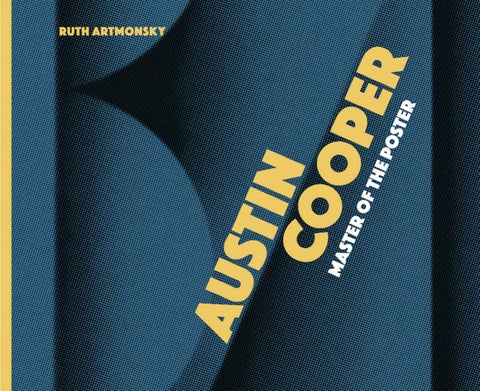
CONTENTS Introduction
8
Clare Austin Cooper: A Life
11
Early Commercial Work
24
Cooper on the Railways
40
Cooper Underground
52
Cooper at the Post Office
64
Teaching
76
Fine Art
86
Epilogue 96 Biography 97 Chronology 98
INTRODUCTION
Above Poster designed by Austin Cooper to publicise an exhibition of posters at the V&A Museum, 1931.
The idea for this book came about because of an omission. I had attended a lecture by the erudite Oliver Green at the London Transport Museum accompanied by my friend and mentor (when it comes to matters of publishing) Mark Eastment. Oliver, one of the most knowledgeable people on Frank Pick and London Transport posters, had omitted to ascribe an artist’s name to one of the most striking posters he had shown. Returning home, Mark, on his laptop, and me, flicking through my many references on London Transport, identified the artist as Austin Cooper. Google proceeded to flood us with many more exciting Cooper poster images, and Mark remarked casually ‘there should be a book on him’. I had already written a little on Cooper in Unashamed Artists – artists who were not demeaned by selling their talents for commercial design, but were actually proud of what they were doing, and delighted in their work. I remembered that it had been something of a research challenge to dredge up even enough morsels on Cooper to cover a few pages, let alone make a book. It was at this point that Chris Mees, the bookseller, who probably knows more about references and sources on advertising and poster art than anyone, came to my rescue. I merely emailed him the name Austin Cooper, and by return I was sent a reference that made a book on Cooper a possibility. It appeared that a Canadian Professor of Art, Timothy Ray, a distant relative of Cooper’s, had spent some thirty years researching him, had persuaded the Art Gallery of Southwestern Manitoba to put on an exhibition of Cooper’s works, and had written a most informative piece on Cooper’s life for the exhibition catalogue (1993). Unfortunately Prof. Ray 8
10
Clare Austin Cooper – a life 11
24
early commercial work 25
42
Above right The great LNER artists meet. London, March 1928. Far left ‘King’s Cross for Scotland’ poster, 1929. Left LNER poster focussed on industrial transport, c. 1930.
B
y the turn of the nineteenth century Railways carrying freight and passengers had mushroomed into a myriad of companies, as for example, the Newcastle & Carlisle Railway and the Stockton & Darlington Railway, each serving its own local area. Gradually these merged into larger groups, as the North Eastern Railway running trains from Yorkshire to Scotland; and then finally came the big five, (a result of further amalgamations), of which, when it came to posters, LNER (the London Northern Eastern) led the field. Railway posters morphed from mere typographical listings of times and fares and conditions of service, to pictorial affairs, where the image took up the bulk of the poster and any hype or information was pushed to the edges. The halcyon days of LNER posters were largely due to the vision of one man, William Teasdale. Teasdale had already tried his hand at publicity as Trade Advertising Agent for the North Eastern Railway, but now, at LNER, his remit was enormous, for he was advertising travel from Essex to Scotland. He was to hold the reins from 1923 to 1929, when he was promoted 43
54
I
f Cooper can be said to have had a highly successful and long relationship with LNER, his work for London Transport spanned an even longer period, for he appears to have had his first commission from them in the year he set up shop in The Strand, 1922, whilst his last commission was in 1944, by which time he had decided to give up poster work – this spanned virtually the whole of his time as a commercial artist in England (to be precise, his first poster was for the then named Underground Electric Railways, but for convenience ‘London Transport’ will be used in this text for the organization taking various titles over the years, running transport in London). London Transport as a patron of artists, designers and architects has been exhaustively recorded in books, articles and exhibitions – the story of the visionary Frank Pick and his acolyte Christian Barman, and, after WWII, Harold Hutchinson is very well-known to those interest in design history. It can be said to have been one of the leaders when it came to fine poster art, both in terms of sheer numbers (at the peak some forty different images a year), and in the progressiveness of the designs, many now considered of iconic status. Harold Hutchinson, in the introduction to his book ‘London Transport Posters’, published in 1963, wrote –
Above Christmas themed poster, 1924. Left A pair of posters from 1924.
Most of the distinguished names in English graphic design have been added to the index of those who thought London Transport worthy of their skill and some of those named have first achieved distinction by posters done for London Transport. Cooper certainly comes with the ‘first achieved’ group for although his first 55
86
FINE ART 87
T
owards the end of WWII, Cooper had an ‘apocalyptic conversion’ as Herbert Read termed it in his introduction to the catalogue for a solo exhibition Cooper was given by the gallery Gimpel Fils. It is not exactly clear when Cooper decided to give up being a ‘poster’ man and become a ‘fine’ artist but it was possibly more gradual than Read would have us think, for Cooper, himself, claimed that he started working on his collages in 1942 and this overlapped with his working on posters until 1944. Although it may not have been apparent to those around him, a diary entry for 1951, quoted by Ray, suggests that Cooper may have always had at the back of his mind that his true vocation was to paint – I was always aware of having had a training with quite other purposes and objectives in view; objectives I abandoned in 1911, when, torn by emotional frustrations and desperately unhappy I turned from the birthright that was mine and sought out other gods other than the God of Art. That his decision was not a simple one, merely of having made a good living out of commercial art he could then afford to turn to developing as a ‘painter’, is suggested in this curious quote from an interview Cooper gave to Time magazine in 1949 –
Left ‘Tal-lee’, 1948, watercolour collage, 14 1/2" x 22".
…during the war my interest in posters faded. I found my hands were functioning without any volition. The first results were doodles, then automatic writing. I thought if my pen is doing this why not my brushes? Much to my astonishment, it picked up a brush and drew on a board. 89
90
100