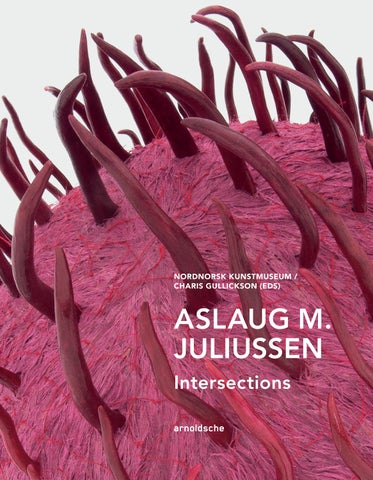
NORDNORSK KUNSTMUSEUM / CHARIS GULLICKSON (EDS)
Juliussen explores materials that speak to culture and tradition in Northern Norway, and the Sámi culture in particular. The publication comprises engaging cross-disciplinary essays that illustrate the multifaceted aspects of Juliussen as an artist. Scholars from such diverse fields as biology, philosophy, gender studies, and art history look at Juliussen’s art from multiple perspectives and thus enable a new dialogue on art in the context of a European indigenous culture.
ASLAUG M. JULIUSSEN
A sphere encrusted with reindeer antler tines, an intricate bone-laden tapestry, and sculptural flora integrating domestic textiles are only three of the many works unveiled in this first ever comprehensive look at tactile works by Norwegian artist Aslaug M. Juliussen. Self-reflections upon her life and everyday experiences with the Arctic landscape shape the imagery in her work, as evidenced by her choice of materials and techniques.
Intersections
Juliussen_cover_FINAL_prn.indd 1
arnoldsche
ISBN 978-3-89790-531-3
NORDNORSK KUNSTMUSEUM / CHARIS GULLICKSON (EDS)
ASLAUG M. JULIUSSEN Intersections arnoldsche
03.09.18 17:03
Juliussen_layout_FINAL_29082018.indd 4
30.08.18 14:28
CONTENTS PREFACE
10
Charis Gullickson AN UNCOMMON THREAD
13
Charis Gullickson TEXTILE-TURNED-HIDE
23
Namita Gupta Wiggers REINDEER – SHOULD PEOPLE HAVE ANTLERS?
35
Bergljot Børresen LIVING MATERIAL: FROM MAMMALS TO ART
41
Sandra Lorentzen REFLECTIONS ON THE TRANSFORMATION OF MATERIALS
61
Anniken Greve TRANSFORMATIONS
67
Harald Gaski SOVEREIGN TRACES
81
Sherry Farrell Racette ABJECTION, EMBODIMENT, AND DIFFERENCE
87
Sigrun Åsebø
Artist Biography Bibliography
101
106
Contributor Biographies
108
Photo Credits 110
Juliussen_layout_FINAL_29082018.indd 5
30.08.18 14:28
Example of a gárdi — fenced corral used to separate free-range reindeer herds
12
Juliussen_layout_FINAL_29082018.indd 12
30.08.18 14:28
AN UNCOMMON THREAD Charis Gullickson
As curator for the exhibition Intersections, I had the opportunity to peek at Aslaug M. Juliussen’s personal photo archive, where I stumbled across a stunning aerial snapshot produced by a drone of a frost-laden, snowy winter landscape in Finnmark, Norway. In the photograph is a woodland terrain with a large clearing at its center. A giant frozen flower, akin to a daisy, occupies the open space. Eight or more petals encircle a small round disk. The individual petals of the flower are separate parts that join together at the center to form a whole. As I scrutinize the photo up close, I discover that the “flower” is in actuality a fenced corral used to separate free-range reindeer herds.1 It is one example of a gárdi — a corral where the Sámi reindeer pastoralist districts, called siida, each have their own partition, their own “flower petal.” Perhaps the corral may be viewed as a junction. The imagery of the corral reminds one of aerial views designating urban landscapes interspersed with interchanging highways, overpasses, and intersections. For me the aerial “flower” with its intricate design — that is, the “corral of many petals” — conjured up thoughts about the intersection or starting point of Juliussen’s artistic practice. When did it begin, and what took place? ⁄ Typically we think of an intersection as a meeting point where two or more roads crisscross. But in this instance, the intersections in the photograph do not follow the standard pattern of conventional geometric straight lines but are rather soft, curvy, and winding lines, much like the rounded, moving, and organic shapes found in Juliussen’s artworks. ⁄ The concept of intersection itself implies many competing yet joining connections. Juliussen harnesses the potential between opposing elements, and her artworks are meticulously layered and saturated with abundant eclectic elements. Abstract narratives are surreptitiously embedded among layers of meaning in her artworks. To truly understand Juliussen’s work, it is necessary to “peel back” piece by piece the many layers of complexity. ⁄ In this essay, I approach Juliussen as a textile artist and discover how life in the North informs her art. I will consider Juliussen’s artistic practice as a “knotscape” in order to create clarity in her creative process. First I will trace and examine Juliussen’s works from her early beginnings in textile. From there I will draw upon philosopher Crispin Sartwell’s knot theory. In doing so, I explore to what extent Juliussen’s art alters our views of the North. 1 This specific corral is located in Sávkadas near Karasjok, Norway. 2 In Norwegian called Statens Håndverksog Kunstindustriskole (SHKS).
FORMATIVE YEARS Aslaug Magdalena Juliussen was born in 1953 in the town of Lødingen in Northern Norway. She moved south to Oslo in 1976 to pursue the study of textiles at The National Academy of Craft and Art Industry.2 Following graduation she apprenticed with artist Synnøve Anker Aurdal at her studio in Oslo from 1980 to 1982. For Juliussen, Anker Aurdal played a vital role during her formative years and shaped her as an artist. Synnøve Anker Aurdal (1908 – 2000) is one of the most respected textile artists in twentieth-century Norwegian art. Anker Aurdal along with like artists Frida Hansen (1855 – 1931) and Hannah Ryggen (1894 – 1970) was a Norwegian groundbreaker who paved the way in establishing textile as an artistic medium for autonomous works. During her apprenticeship, Juliussen along with other emerging female textile artists,
13
Juliussen_layout_FINAL_29082018.indd 13
30.08.18 14:28
Juliussen_layout_FINAL_29082018.indd 30
30.08.18 14:29
SPØRSMÅL — MIN HJERTENS ENGEL [Question — my heart’s angel], 1997, currants technique, embroidery,
silk fabric and paper, 200 × 250 cm, Nordnorsk Kunstmuseum, Tromsø, Norway
31
Juliussen_layout_FINAL_29082018.indd 31
30.08.18 14:29
HORNILD [AntlerFire], 2005, patinated reindeer antler and hair, hide glue, 80 × 75 × 75 cm, RiddoDuottarMuseat, Karasjok, Norway
46
Juliussen_layout_FINAL_29082018.indd 46
30.08.18 14:29
Juliussen_layout_FINAL_29082018.indd 47
30.08.18 14:29
Juliussen_layout_FINAL_29082018.indd 48
30.08.18 14:29
OVDAGIEHDAKUVLA [ForehandBall], 2005, reindeer antler
and hair, hide glue, 80 × 80 × 80 cm
49
Juliussen_layout_FINAL_29082018.indd 49
30.08.18 14:29
Juliussen_layout_FINAL_29082018.indd 56
30.08.18 14:29
HORNKJEDE [AntlerChain], 2006, patinated reindeer antler, bones, and hooves, string, earmarking tags, 200 × 200 (variable height), Nordnorsk Kunstmuseum, Tromsø, Norway, gift of Utenriksdepartmentetet UD
57
Juliussen_layout_FINAL_29082018.indd 57
30.08.18 14:29
MULTIPLE STICHES — SIGHT IN SEWING IV (detail), 2015, linen fabric, embroidery, horsehair, reindeer bone, metal wire, 60 × 60 × 20 cm (length 250 cm)
66
Juliussen_layout_FINAL_29082018.indd 66
30.08.18 14:29
EDITOR’S NOTE
We invited Harald Gaski, who is a professor in Sámi culture
and literature and an expert on Indigenous peoples research, to write an essay about transformations in general within Sámi culture and, moreover, with a view of transformations in Indigenous peoples’ thinking. This essay does not deal with Juliussen’s art as such, but several of the issues touched upon in the essay should still be relevant for the interpretation of her art and her transformative actions — undoing and redoing — in order to create something new.
TRANSFORMATIONS Harald Gaski
Indigenous cultures have always been exposed to transformation, either because of outside pressure to adjust to new conditions caused by environmental changes, or as a result of colonization and forced attempts of assimilation. Over time it developed into specific skills of surviving, or in the words of the Native American scholar and novelist Gerald Vizenor, it became a part of “survivance” — a combination of the terms “survival” and “continuance.”1 As with all other cultures, Indigenous communities too have changed — they have evolved due to internal innovations and improved technology borrowed from outside. It is only in the eyes of the essentialist spectator that Indigenous cultures are expected to stay unaltered and thus represent a gaze into all kinds of bygones that can underpin the view of the conformist. While change is something that happens either coincidentally or as a result of decisions, transformation very often is a sought-after internal quality, a planned and intended alteration of the status quo — change achieved through transformative action. ⁄ It is, however, an inevitable fact that a lot of Indigenous peoples and their languages and cultures over time have become extinct, resulting in an enormous loss of human experiences, worldviews, and expressions. Still 1 Vizenor 2009, pp. 85 – 86.
2 Smith 2009, p. 6.
3 Ibid., p. 6.
a surprisingly high number have survived and still exist despite all kinds of adversities and subjection. Within Sámi culture, we have witnessed a strong determination to keep traditions, languages, and identity alive in spite of the introduction of new livelihoods and ways of life. There must be an intrinsic residue of pride and dignity left within the various Sámi population groups that make people want to stick to their values and worldviews in cultural matters. ⁄ Although primarily concentrating on transformation within the education system, Maori professor Graham Hingangaroa Smith sees a need to “theorise transformation in order to make the intervention potential portable and able to be transferred and applied in many sites.”2 Therefore he wants to move beyond a linear, instrumental notion of transformation and use multiple strategies in order to achieve the goal set. This is a deliberate strategic use of transformation to change things positively — in this case concerning Indigenous peoples’ education and leadership — but even more broadly as an instrument to improve the cultural and political situation of the issues in question. In this struggle, it is also important to be aware of whose interests the applied transformation is serving.3 ⁄ In the Sámi language, one may choose between two terms for transformation: nuppástuvvan and nuppástuhttin, the former describing
67
Juliussen_layout_FINAL_29082018.indd 67
30.08.18 14:29
ČOARVISÁKKIT / HORNPINNER [AntlerSticks], 2003, reindeer antler, cast iron and cast dolomite,
glass, sand, 60 × 5 × 5 cm
78
Juliussen_layout_FINAL_29082018.indd 78
30.08.18 14:29
Juliussen_layout_FINAL_29082018.indd 79
30.08.18 14:29
SV: FROSNE BLOMSTER [Re: Frozen Flowers], 2009, reindeer antler, glass, vintage leather clothing, earmarking tags, metal wire, 60 × 60 × 40 cm, SpareBank 1 Nord-Norge’s Art Foundation, Norway
86
Juliussen_layout_FINAL_29082018.indd 86
30.08.18 14:29
ABJECTION, EMBODIMENT, AND DIFFERENCE Sigrun Åsebø
Aslaug M. Juliussen’s background and her use of textile techniques and “soft” materials immediately seem to put her in a tradition of women. Art forms and techniques such as embroidery, weaving, or sewing have all historically been dominated by women.1 In the Sámi duodji tradition, this was also the case with textiles or soft materials.2 ⁄ The combination of materials, such as bones, antlers, and pelt, and the formal aspects of Juliussen’s art connects her to a long line of women artists from the past fifty years. In craft, hide, antlers, bone, and organic material is common, but when it is used in objects connoting “art,” the material itself is underlined as matter. In my view, it is not the material in itself that creates ambivalence; it is the blurring of boundaries between beauty and the obscene, human and animal. A Minimalist aesthetic highlighting materiality can make us think of artists like Eva Hesse and Louise Bourgeois, who have both worked at the intersection of materiality and symbolism. Jana Sterbak and Magdalena Abakanowicz’s works, which involve meat and other animal or organic materials, could be a reference. Perhaps even more relevant are the works of Kiki Smith, Helen Chadwick, Nicola Costantino, and others who have worked in artistic traditions that question the boundaries separating materiality and conceptualization, mind and body, culture and nature, masculinity and femininity, (hu)man and animal.3 In this article, I will not explore the art of Juliussen as an example of an essentially “feminine” art, nor reveal how Juliussen’s art is “rooted” in a Sámi tradition. What I find interesting about Juliussen’s art is the intertextual space that she creates, where embodiment, femininity, and Sámi tradition are given meaning, without being reduced to any simplistic idea of identity. Blurring boundaries and using signs and references in an ambivalent way, Juliussen is able to subvert ideas of identities and expose them as constructions. 1 There are many interesting books and articles on this topic. For a theoretical discussion of how the concept of femininity is ideologically connected to textile art and crafts’ position as lesser art in the hierarchy of art, see e.g. Parker 2010. For a discussion of Norwegian textile art, see e.g. Lium 2016. 2 Rantala 2013, pp. 102 – 29. 3 Charis Gullickson points towards these artists in her master thesis, Gullickson 2006. 4 For an analysis of this art project and other art projects by Helen Chadwick, see e.g. Sladen 2004 or Betterton 1996.
SYMBOLS AND GENDER DIFFERENCE If we take a closer look at Juliussen’s art, we find symbols or signs that expose and problematize gender difference as a system of meaning. Multiple Stitches (2014 – 17) and Re: Frozen Flowers (2009) made me think of Helen Chadwick’s well-known project Piss Flowers (1991 – 92) and the way she problematizes the meanings attached to men’s and women’s bodies in Western culture.4 Chadwick and her partner, who took turns urinating in the snow, made Piss Flowers. The “sculptures” were casts made from the holes left after the melting snow. Despite the obvious differences between Chadwick and Juliussen, their projects both question gender and embodiment on several levels. Flowers as a symbol connote femininity in several ways. Flowers in Western art and visual culture connote feminine beauty and virtue, but flowers are also a metaphor for the female sexual organ and feminine sexuality. Flowers point to the ambivalence that the female body signals in Western culture: the beautiful flower will fade, and under the surface of beauty lies possible decay. Feminine beauty
87
Juliussen_layout_FINAL_29082018.indd 87
30.08.18 14:29
V Y, I OG II [View, I and II] (detail), 2018, installation (work in progress): silk,
textile, metal wire, wood, variable dimensions, pp. 92 – 99
92
Juliussen_layout_FINAL_29082018.indd 92
30.08.18 14:29
Juliussen_layout_FINAL_29082018.indd 93
30.08.18 14:30