Esecutivo 226x304 (rifilato libro interno 224x297 CMYK pantone 872C
30
Rebecca Bloom is a PhD candidate in Buddhist Studies at the University of Michigan, specializing in Tibetan Buddhism and Himalayan art. She has curated exhibitions at the Rubin Museum of Art in New York, and the Freer|Sackler, the Smithsonian’s museums of Asian art. Most recently, she served as co-curator of Encountering the Buddha: Art and Practice Across Asia, and wrote the Sacred Spaces app, which accompanied the exhibition’s Tibetan Buddhist Shrine Room from the Alice S. Kandell Collection. Her dissertation focuses on the Thirteenth Dalai Lama’s illustrated commentary on the Buddhist monastic code and the series of murals it inspired.
Lo p e z Bloom
Donald S. Lopez, Jr. is the Arthur E. Link Distinguished University Professor of Buddhist and Tibetan Studies at the University of Michigan. He received his PhD in Religious Studies from the University of Virginia in 1982. His publications fall into four areas: Indian and Tibetan Buddhist philosophy, the history of the European encounter with Buddhism, the life and works of the Tibetan writer Gendun Chopel (1903-1951), and anthologies and reference works on Buddhism. His recent books include Buddhism: Norton Anthology of World Religions, The Lotus Sutra: A Biography, Dispelling the Darkness: A Jesuit’s Quest for the Soul of Tibet (with Thupten Jinpa), and Gendun Chopel: Tibet’s Modern Visionary. The Princeton Dictionary of Buddhism (co-authored with Robert Buswell) won the American Library Association’s Dartmouth Medal for best reference work of 2014. He was elected to the American Academy of Arts and Sciences in 2000. John Bigelow Taylor and Dianne Dubler are New York based, still-life photographers, specializing in works of art, antiquities, jewelry, architecture and interiors. Working with the world’s foremost collectors, museums and publishers, they have created the photography for over 250 art books, spanning a vast array of subjects. Currently, they are creating and publishing bespoke, limited edition books on estates and collections for private clients around the world. www.kubaba.com
A s s e m b ly o f t h e e x a lt e d
THE TIBETAN BUDDHIST SHRINE ROOM The Alice S. Kandell Collection at the Arthur M. Sackler Gallery, Smithsonian Institution
www.officinalibraria.net £ 55.00 $ 65.00 € 55,00
D o n a l d S. Lo p e z , J r .
R e b e cc a B lo o m
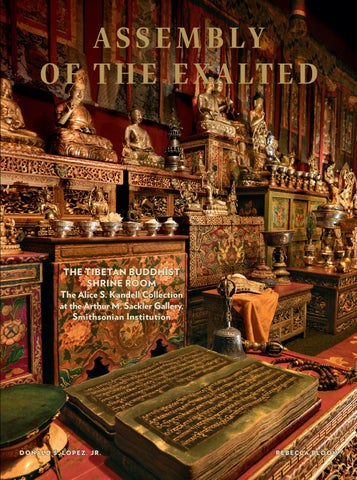
Assembly of the Exalted presents over forty pieces—sculptures, paintings, musical instruments, and ritual objects—from the remarkable collection of Alice S. Kandell. The works, dating from the late 13th century to the early 20th, include great masterpieces and emblematic examples of Tibetan Buddhist art. They are presented here as the constituents of a Tibetan Buddhist shrine. Shrines, both modest and grand, are the primary sites of Tibetan Buddhist practice, whether reciting scriptures, performing rituals, saying prayers, or engaging in meditation. The initial essays thus focus on the evolution of shrines, describing their special role in Tibet, and how the pieces in the Kandell Collection came to be assembled and displayed in shrines at institutions across America, ultimately joining the collection of the Arthur M. Sackler Gallery. Illustrated with vivid photography, forty short essays, each centered on a single work or set of objects, describe the pieces in terms of their importance for the practice of Buddhism, highlighting the many essential functions of Tibetan Buddhist art within the space of a shrine.
A S S E M B LY OF THE EXALTED
A M I TA B H A completed the bodhisattva path and became a buddha. He described his future buddha field in the form of vows, saying, for example, “May I not achieve buddhahood if the beings born in my buddha field cannot remember their past lives, going back billions of eons.” Making forty-eight of these vows, he promised that he would appear at the deathbed of anyone who called on him and would escort them to the Land of Bliss. Shakyamuni explains that Dharmakara went on to become the buddha Amitabha, and that he had created his buddha field, the Land of Bliss. He goes on to describe it in detail as a wondrous heaven where words like “suffering” and “misfortune” are never heard, where no one has to sew or wash their robes, where the trees are made of gold, silver, and all manner of jewels, and where the inhabitants are able to hear whatever teaching they would like to hear. The ground of the Land of Bliss is covered with lotuses made of precious substances, some of which reach ten leagues in diameter. Each lotus emits millions of rays of light, each ray of light emitting millions of buddhas. The Land of Bliss has no mountains or oceans. There is no day or night, although the words “day” and “night” are sometimes used as metaphors. The beings in the pure land never need to eat; they visualize the food they want and their hunger disappears. All of the inhabitants of the Land of Bliss are destined to achieve buddhahood in their next lifetime. Today, we particularly associate the practice with the “pure land” schools of China and Japan, where the faithful recite namu amida butsu, (“Homage to Amitabha Buddha). However,
88|89
In all Buddhist traditions, there are buddhas of the past, present, and future. In Mahayana Buddhism, the form of Buddhism practiced in Tibet, Mongolia, China, Korea, and Japan, in addition to Shakyamuni Buddha, there are a multitude of buddhas in the present, each in his own domain. Of these many buddhas, the most famous is Amitabha whose name means “Infinite Light.” He is also known as Amitayus, “Infinite Life.” He presides over a “buddha field” in the west, called the Land of Bliss (Sukhavati). According to the Mahayana, when a buddha achieves enlightenment, he inhabits his own domain, which will be the setting for his teaching. That domain— including its physical features and its inhabitants—is in some ways a product of his own enlightenment. These buddha fields are often divided into two categories: the impure and the pure. The impure have all six realms of rebirth: gods, demigods, humans, animals, ghosts, and denizens of hell. The pure have only the realms of gods, demigods, and humans. In a Mahayana sutra probably dating from the third century CE called the Discourse on the Land of Bliss (Sukhavativyuha), Shakyamuni Buddha describes the origins of Amitabha and describes his buddha field. Long ago, at the time of another buddha, a monk named Dharmakara asked the buddha Lokeshvararaja to describe to him all the features of all the buddha fields. After receiving this teaching (which took one million years to deliver), Dharmakara retired into meditation, where, for the next five eons, he concentrated all the features of all the buddha fields into one, which he then promised to manifest when he
prayers seeking rebirth in the Land of Bliss appear in Indian Buddhist texts and inscriptions. There is also a strong tradition of devotion to Amitabha in Tibet, where he was revered as the teacher of Avalokiteshvara, the bodhisattva who is the patron and protector of the Tibetan people. The Panchen Lama, originally regarded as the teacher of the Dalai Lama, is said to be the human incarnation of Amitabha. Numerous figures over the history of Tibetan Buddhism composed prayers for rebirth in the Land of Bliss. Just as buddhas of the past, present, and future look alike, buddhas of different buddha fields also look alike, although, unlike Shakyamuni, those from other buddha fields are sometimes depicted wearing crowns and jewels. This beautiful statue of Amitabha, however, dating from the fifteenth century, is physically indistinguishable from Shakyamuni; the inscription carved at the bottom of the base includes the phrase, “this image of the leader, Amitabha.” Like other images of this buddha, his hands are folded in his lap in the posture of meditative equipoise. Sometimes, when he is called Amitayus, those hands hold a vase of the elixir of immortality, reflecting his name, which means “Infinite Life.” In this image,
however, his hands are empty and he is dressed in the robes of a Buddhist monk, their borders beautifully patterned here. As in the image of Shakyamuni, the robes fit tightly over his body, with his navel visible. His head displays the familiar long ear lobes, urna, and crown protrusion. The inscription does more than identify this image as Amitabha, however; it also identifies the reason that this sculpture was commissioned, extolling a power possessed by this buddha, a power beyond his famous promise of rebirth in his buddha field. Seven artists fashioned this Amitabha out of the finest gilded copper. A minister in the Tibetan government had commissioned the sculpture in order that all “frontier wars be averted and all beings attain buddhahood.” There is a long history of Buddhism—through its agents and through its rituals—providing border protection and other aid to rulers throughout Asia. A generous gift such as this was understood to create positive karma that could be dedicated to benefit others and influence events. As long as an image is worshipped, it continues to produce merit and fulfill its donor’s wishes, wishes both worldly and spiritual.
Amitabha Central Tibet, second half of the 15th century Gilt copper repoussé; traces of pigment on hair and face 75 x 53.3 x 38.8 cm (29 ½ x 21 x 15 ¼ in) The Alice S. Kandell Collection Arthur M. Sackler Gallery S2014.20
90|91
Esecutivo 226x304 (rifilato libro interno 224x297 CMYK pantone 872C
30
Rebecca Bloom is a PhD candidate in Buddhist Studies at the University of Michigan, specializing in Tibetan Buddhism and Himalayan art. She has curated exhibitions at the Rubin Museum of Art in New York, and the Freer|Sackler, the Smithsonian’s museums of Asian art. Most recently, she served as co-curator of Encountering the Buddha: Art and Practice Across Asia, and wrote the Sacred Spaces app, which accompanied the exhibition’s Tibetan Buddhist Shrine Room from the Alice S. Kandell Collection. Her dissertation focuses on the Thirteenth Dalai Lama’s illustrated commentary on the Buddhist monastic code and the series of murals it inspired.
Lo p e z Bloom
Donald S. Lopez, Jr. is the Arthur E. Link Distinguished University Professor of Buddhist and Tibetan Studies at the University of Michigan. He received his PhD in Religious Studies from the University of Virginia in 1982. His publications fall into four areas: Indian and Tibetan Buddhist philosophy, the history of the European encounter with Buddhism, the life and works of the Tibetan writer Gendun Chopel (1903-1951), and anthologies and reference works on Buddhism. His recent books include Buddhism: Norton Anthology of World Religions, The Lotus Sutra: A Biography, Dispelling the Darkness: A Jesuit’s Quest for the Soul of Tibet (with Thupten Jinpa), and Gendun Chopel: Tibet’s Modern Visionary. The Princeton Dictionary of Buddhism (co-authored with Robert Buswell) won the American Library Association’s Dartmouth Medal for best reference work of 2014. He was elected to the American Academy of Arts and Sciences in 2000. John Bigelow Taylor and Dianne Dubler are New York based, still-life photographers, specializing in works of art, antiquities, jewelry, architecture and interiors. Working with the world’s foremost collectors, museums and publishers, they have created the photography for over 250 art books, spanning a vast array of subjects. Currently, they are creating and publishing bespoke, limited edition books on estates and collections for private clients around the world. www.kubaba.com
A s s e m b ly o f t h e e x a lt e d
THE TIBETAN BUDDHIST SHRINE ROOM The Alice S. Kandell Collection at the Arthur M. Sackler Gallery, Smithsonian Institution
www.officinalibraria.net £ 55.00 $ 65.00 € 55,00
D o n a l d S. Lo p e z , J r .
R e b e cc a B lo o m
Assembly of the Exalted presents over forty pieces—sculptures, paintings, musical instruments, and ritual objects—from the remarkable collection of Alice S. Kandell. The works, dating from the late 13th century to the early 20th, include great masterpieces and emblematic examples of Tibetan Buddhist art. They are presented here as the constituents of a Tibetan Buddhist shrine. Shrines, both modest and grand, are the primary sites of Tibetan Buddhist practice, whether reciting scriptures, performing rituals, saying prayers, or engaging in meditation. The initial essays thus focus on the evolution of shrines, describing their special role in Tibet, and how the pieces in the Kandell Collection came to be assembled and displayed in shrines at institutions across America, ultimately joining the collection of the Arthur M. Sackler Gallery. Illustrated with vivid photography, forty short essays, each centered on a single work or set of objects, describe the pieces in terms of their importance for the practice of Buddhism, highlighting the many essential functions of Tibetan Buddhist art within the space of a shrine.