INTRODUCTION The Asian Civilisations Museum is Singapore’s National Museum of Asian Antiquities and Decorative Art. The core of our collection, which consists of island Southeast Asian ethnographic objects, dates from the late 1800s to the early 1900s. We have continually expanded our collections to include art from across Asia. From an ethnographic museum presenting the history of Asian civilisations, we have transformed dramatically in the last decade to an art museum displaying objects of great beauty, which represent the best in the craft and aesthetic traditions of cultures across Asia. We have also transitioned from a conventionally geographical approach in presenting our collections, towards espousing grand, pan-Asian, cross-cultural themes in research and display. Four broad themes shape our collecting and exhibition strategy, drawn from Singapore’s essence as one of the last cosmopolitan, multi-faith port cities in Asia – an anchor in the age of trade, travel, and exploration that spanned the fifteenth to the early twentieth century; an age, inevitably, also coloured by the rise of European Imperialism and its associated evils. Maritime Trade is, naturally, our first theme. We specialise in collecting Asian Export Art – luxury goods created in Asia for export to within Asia or elsewhere in the world. The pieces in this book represent cosmopolitan Asian port cities between the ninth and the twentieth century, and present a sweeping historic overview of trade networks in Asia. Faith and Belief is our second theme, with galleries presenting works of art from across Asia, created for the world’s great systems of faith, belief and philosophy. These include the wealth and diversity of animistic traditions in island Southeast Asia. Materials and Design, our third theme, explores Asian decorative art with an emphasis on fashion, textiles, jewellery, and ceramics.
4
|
ASIAN CIVILISATIONS MUSEUM
above: The Peranakan Museum BELOW: The Ancestors and Rituals Gallery at ACM OPPOSITE: The Ancient Religions Gallery at ACM
The examples selected for this book juxtapose courtly traditions with hybrid forms. Finally, Peranakan – our fourth theme – chronicles the material culture of mixed-race communities that emerged in the port cities of Southeast Asia. Our collection of Peranakan objects is large enough to warrant its own branch museum – ACM’s Peranakan Museum – with its own trio of themes, Style, Home, and Origins. The reader will discover that ACM’s mission is not to present the cultures of Asia per se, but rather to delve deep into the connections between cultures – within Asia, and between Asia and the world. In so doing, we hope to remind our visitors that cultures have never existed in isolation, but have always interacted, peacefully or otherwise; and in the process of interaction, mutually enriched each other. This message of connection across cultures is even more important today in a world obsessed with difference rather than with our common humanity.
INTRODUCTION
|
5
INTRODUCTION The Asian Civilisations Museum is Singapore’s National Museum of Asian Antiquities and Decorative Art. The core of our collection, which consists of island Southeast Asian ethnographic objects, dates from the late 1800s to the early 1900s. We have continually expanded our collections to include art from across Asia. From an ethnographic museum presenting the history of Asian civilisations, we have transformed dramatically in the last decade to an art museum displaying objects of great beauty, which represent the best in the craft and aesthetic traditions of cultures across Asia. We have also transitioned from a conventionally geographical approach in presenting our collections, towards espousing grand, pan-Asian, cross-cultural themes in research and display. Four broad themes shape our collecting and exhibition strategy, drawn from Singapore’s essence as one of the last cosmopolitan, multi-faith port cities in Asia – an anchor in the age of trade, travel, and exploration that spanned the fifteenth to the early twentieth century; an age, inevitably, also coloured by the rise of European Imperialism and its associated evils. Maritime Trade is, naturally, our first theme. We specialise in collecting Asian Export Art – luxury goods created in Asia for export to within Asia or elsewhere in the world. The pieces in this book represent cosmopolitan Asian port cities between the ninth and the twentieth century, and present a sweeping historic overview of trade networks in Asia. Faith and Belief is our second theme, with galleries presenting works of art from across Asia, created for the world’s great systems of faith, belief and philosophy. These include the wealth and diversity of animistic traditions in island Southeast Asia. Materials and Design, our third theme, explores Asian decorative art with an emphasis on fashion, textiles, jewellery, and ceramics.
4
|
ASIAN CIVILISATIONS MUSEUM
above: The Peranakan Museum BELOW: The Ancestors and Rituals Gallery at ACM OPPOSITE: The Ancient Religions Gallery at ACM
The examples selected for this book juxtapose courtly traditions with hybrid forms. Finally, Peranakan – our fourth theme – chronicles the material culture of mixed-race communities that emerged in the port cities of Southeast Asia. Our collection of Peranakan objects is large enough to warrant its own branch museum – ACM’s Peranakan Museum – with its own trio of themes, Style, Home, and Origins. The reader will discover that ACM’s mission is not to present the cultures of Asia per se, but rather to delve deep into the connections between cultures – within Asia, and between Asia and the world. In so doing, we hope to remind our visitors that cultures have never existed in isolation, but have always interacted, peacefully or otherwise; and in the process of interaction, mutually enriched each other. This message of connection across cultures is even more important today in a world obsessed with difference rather than with our common humanity.
INTRODUCTION
|
5
Tang Shipwreck Collection, 9th century China Ceramics, gold, silver, other materials The Tang Shipwreck was acquired through the generous donation of the Estate of Khoo Teck Puat.
In the first half of the 9th century, an Arab or Persian ship carrying a precious cargo set sail from the Chinese port city of Canton (today’s Guangzhou) – already a bustling and cosmopolitan centre of trade. It was headed west, across the vast expanse of the Indian Ocean, bound, archaeologists and art historians believe, for the port city of Basra in the lands of the Abbasid Caliphate. Ship and cargo never made it. They sank at tiny Belitung Island, just off the southern coast of Sumatra, in the waters of today’s Indonesia. There they remained for 1,000 years until they were accidentally discovered in 1998. The ACM’s Tang Shipwreck Collection consists of some 55,000 pieces of Chinese-made ceramics, gold, silver, and other objects. The bulk of the collection consists of brown and beige-hued Changsha ǥޝware – so-called because they were fired in the Changsha kilns in China’s Hunan province (48,000 nearly identical tea bowls). Changsha ware was produced primarily for export, and the collection contains the largest trove of this material. There are also rare treasures, including a solid-gold, octagonal cup depicting Central Asian musicians and a dancer, perhaps at the Tang imperial court, a large greensplash, stoneware ewer, and the earliest intact examples of blue-and-white ceramics produced in China. The Collection is significant because it proves that by the Tang dynasty (618–907), there were maritime silk routes that existed alongside the better-known overland silk roads; and that a kind of global trade already existed long before the term ‘globalisation’ was coined.
6
|
ASIAN CIVILISATIONS MUSEUM
TANG SHIPWRECK COLLECTION
|
7
Tang Shipwreck Collection, 9th century China Ceramics, gold, silver, other materials The Tang Shipwreck was acquired through the generous donation of the Estate of Khoo Teck Puat.
In the first half of the 9th century, an Arab or Persian ship carrying a precious cargo set sail from the Chinese port city of Canton (today’s Guangzhou) – already a bustling and cosmopolitan centre of trade. It was headed west, across the vast expanse of the Indian Ocean, bound, archaeologists and art historians believe, for the port city of Basra in the lands of the Abbasid Caliphate. Ship and cargo never made it. They sank at tiny Belitung Island, just off the southern coast of Sumatra, in the waters of today’s Indonesia. There they remained for 1,000 years until they were accidentally discovered in 1998. The ACM’s Tang Shipwreck Collection consists of some 55,000 pieces of Chinese-made ceramics, gold, silver, and other objects. The bulk of the collection consists of brown and beige-hued Changsha ǥޝware – so-called because they were fired in the Changsha kilns in China’s Hunan province (48,000 nearly identical tea bowls). Changsha ware was produced primarily for export, and the collection contains the largest trove of this material. There are also rare treasures, including a solid-gold, octagonal cup depicting Central Asian musicians and a dancer, perhaps at the Tang imperial court, a large greensplash, stoneware ewer, and the earliest intact examples of blue-and-white ceramics produced in China. The Collection is significant because it proves that by the Tang dynasty (618–907), there were maritime silk routes that existed alongside the better-known overland silk roads; and that a kind of global trade already existed long before the term ‘globalisation’ was coined.
6
|
ASIAN CIVILISATIONS MUSEUM
TANG SHIPWRECK COLLECTION
|
7
Tombstone, mid-15th century Malay Peninsula, Malacca Stone, 131 x 45 x 9 cm SB-0008
The fabled Malacca Sultanate (1400–1511) held sway over global trade in spices and other luxury goods. News of its wealth and opulence spread as far as Europe, and the Portuguese explorer Tomé Pires (1465–1540) remarked that ‘whoever was lord of Malacca would have his hand on the throat of Venice’. The Portuguese came to Southeast Asia precisely to conquer Malacca, and wrestle over its monopoly on the spice trade. They succeeded in sacking and occupying the city in 1511, and Malacca’s last sultan fled south to Johor. Material evidence from pre-Portuguese Malacca is scant, which makes this object very rare indeed. The tombstone is inscribed with elegant Arabic script spelling out Quranic verses dedicated to a Gujarati ship captain who died in 1459. Tombstones like this could have been made in Gujarat and shipped from the port of Cambay to Malacca. Soon after the Portuguese sacked the city, they built an encircling wall with its ruins, including this and other tombstones they had removed from a cemetery. In the early 1800s, the British arrived in Malacca and demolished almost the entire fortress wall except for a single gatehouse (Porta de Santiago) that still stands. This tombstone, and a few others like it, were brought to Singapore and added to the collection of the former Raffles Library and Museum (the ethnographic collection of which is now part of ACM). The tombstone stands as a mute but eloquent witness to the violent first contact between Europe and Southeast Asia.
8
|
ASIAN CIVILISATIONS MUSEUM
Tombstone, mid-15th century Malay Peninsula, Malacca Stone, 131 x 45 x 9 cm SB-0008
The fabled Malacca Sultanate (1400–1511) held sway over global trade in spices and other luxury goods. News of its wealth and opulence spread as far as Europe, and the Portuguese explorer Tomé Pires (1465–1540) remarked that ‘whoever was lord of Malacca would have his hand on the throat of Venice’. The Portuguese came to Southeast Asia precisely to conquer Malacca, and wrestle over its monopoly on the spice trade. They succeeded in sacking and occupying the city in 1511, and Malacca’s last sultan fled south to Johor. Material evidence from pre-Portuguese Malacca is scant, which makes this object very rare indeed. The tombstone is inscribed with elegant Arabic script spelling out Quranic verses dedicated to a Gujarati ship captain who died in 1459. Tombstones like this could have been made in Gujarat and shipped from the port of Cambay to Malacca. Soon after the Portuguese sacked the city, they built an encircling wall with its ruins, including this and other tombstones they had removed from a cemetery. In the early 1800s, the British arrived in Malacca and demolished almost the entire fortress wall except for a single gatehouse (Porta de Santiago) that still stands. This tombstone, and a few others like it, were brought to Singapore and added to the collection of the former Raffles Library and Museum (the ethnographic collection of which is now part of ACM). The tombstone stands as a mute but eloquent witness to the violent first contact between Europe and Southeast Asia.
8
|
ASIAN CIVILISATIONS MUSEUM
Matchlock gun, 17th century Japan Brass mechanism, cast-iron barrel with brass and silver inlay; wooden stock, length 70.5 cm Inscribed under the barrel, with the blacksmith’s personal mark: ງȑʐ 疀ێޣɟǟ (Fushimi jū Watanabe Kichiemon jō saku) 2019-00579
The Portuguese dropped anchor on the island of Tanegashima in 1543. Portuguese traders and Jesuits soon established more formal traffic through the port of Nagasaki, and would remain till 1639, when the Tokugawa Shogunate issued an edict for their expulsion and closed the nation to foreigners. For some two hundred years during Japan’s Isolationist (sakoku Ś) period, the Dutch and the Chinese were the only foreign traders allowed. Until 1868, Nagasaki was the only port open to trade, and the sole means of contact between Japan and the world. Trade in the 16th century was a violent affair. Alongside Catholicism, the Portuguese also introduced firearms to Japan. Soon after, local daimyos had their blacksmiths fabricate copies and variations of these European models, often on a large scale. So much so that by the late 16th century, Japan might have been the world’s leading exporter of arms: there are records of some 67,000 matchlock guns being shipped to China in 1583 alone. This matchlock gun, teppo 硔ສ in Japanese, is composed of a cast-iron barrel mounted on a wooden stock with brass mechanism. The barrel is elaborately decorated in brass with silver inlay. The flanks of the barrel feature scrolling vines, while the top features three chrysanthemums and the curious figure of a Portuguese man in a cape, wide trousers, and wide hat. This piece can be regarded as an example of reverse-Japonisme, or perhaps, ‘lusoisme’ – reflecting Japanese fascination with exotic cultures. Incidentally, the Japanese referred to the Portuguese as namban-jin ϒ ୡĉ (‘barbarians from the south’), since that was the way foreign ships approached Japan. Objects decorated like this are now referred to as ‘namban wares’.
10
|
ASIAN CIVILISATIONS MUSEUM
Matchlock gun, 17th century Japan Brass mechanism, cast-iron barrel with brass and silver inlay; wooden stock, length 70.5 cm Inscribed under the barrel, with the blacksmith’s personal mark: ງȑʐ 疀ێޣɟǟ (Fushimi jū Watanabe Kichiemon jō saku) 2019-00579
The Portuguese dropped anchor on the island of Tanegashima in 1543. Portuguese traders and Jesuits soon established more formal traffic through the port of Nagasaki, and would remain till 1639, when the Tokugawa Shogunate issued an edict for their expulsion and closed the nation to foreigners. For some two hundred years during Japan’s Isolationist (sakoku Ś) period, the Dutch and the Chinese were the only foreign traders allowed. Until 1868, Nagasaki was the only port open to trade, and the sole means of contact between Japan and the world. Trade in the 16th century was a violent affair. Alongside Catholicism, the Portuguese also introduced firearms to Japan. Soon after, local daimyos had their blacksmiths fabricate copies and variations of these European models, often on a large scale. So much so that by the late 16th century, Japan might have been the world’s leading exporter of arms: there are records of some 67,000 matchlock guns being shipped to China in 1583 alone. This matchlock gun, teppo 硔ສ in Japanese, is composed of a cast-iron barrel mounted on a wooden stock with brass mechanism. The barrel is elaborately decorated in brass with silver inlay. The flanks of the barrel feature scrolling vines, while the top features three chrysanthemums and the curious figure of a Portuguese man in a cape, wide trousers, and wide hat. This piece can be regarded as an example of reverse-Japonisme, or perhaps, ‘lusoisme’ – reflecting Japanese fascination with exotic cultures. Incidentally, the Japanese referred to the Portuguese as namban-jin ϒ ୡĉ (‘barbarians from the south’), since that was the way foreign ships approached Japan. Objects decorated like this are now referred to as ‘namban wares’.
10
|
ASIAN CIVILISATIONS MUSEUM
Cabinet with the coat of arms of Mexico City, early 17th century Philippines, Manila Exotic woods, bone inlay, silver, 32.5 x 42.2 x 33.6 cm 2019-00743
In 1571, Spanish conquistador Miguel López de Legaspi captured Manila, and established a trading settlement in the name of the Spanish Crown. Through to the 19th century, Manila was a major entrepôt and the western extremity of an epic trans-Pacific trading route. Massive treasure ships known as Manila Galleons – naos de China (‘China ships’) in Latin America – would ply the long, perilous route across the Pacific, bringing porcelain, silks, tea, and other Asian luxury goods to the port of Acapulco, in the Viceroyalty of New Spain (today’s Mexico), and silver bullion from the Americas back to Asia. Manila was administered by New Spain, from its capital, Mexico City. This simple, unassuming fall-front cabinet tells the epic tale of this trade. The form of the cabinet is European, but it was made in the Philippines from exotic woods and decorated with bone inlay and silver fittings. The lions’ heads and paw-shaped feet at the corners, and lion-head drawer pulls suggest Chinese influence, and remind us of the longstanding Chinese presence in Manila. The Cabinet’s most surprising aspect, however, appears when one pulls down its front – there is an inlay decoration depicting the foundation myth of Tenochtitlan, the capital city of the Mexica (Aztecs); that which would become Mexico City during the Spanish Colonial Period. The last thing one would expect to find on Philippine export furniture is Aztec imagery, and so one can only surmise that this would have been a special commission from Mexico City, or a gift for a high-ranking dignitary in Spanish-ruled Mexico.
12
|
ASIAN CIVILISATIONS MUSEUM
Cabinet with the coat of arms of Mexico City, early 17th century Philippines, Manila Exotic woods, bone inlay, silver, 32.5 x 42.2 x 33.6 cm 2019-00743
In 1571, Spanish conquistador Miguel López de Legaspi captured Manila, and established a trading settlement in the name of the Spanish Crown. Through to the 19th century, Manila was a major entrepôt and the western extremity of an epic trans-Pacific trading route. Massive treasure ships known as Manila Galleons – naos de China (‘China ships’) in Latin America – would ply the long, perilous route across the Pacific, bringing porcelain, silks, tea, and other Asian luxury goods to the port of Acapulco, in the Viceroyalty of New Spain (today’s Mexico), and silver bullion from the Americas back to Asia. Manila was administered by New Spain, from its capital, Mexico City. This simple, unassuming fall-front cabinet tells the epic tale of this trade. The form of the cabinet is European, but it was made in the Philippines from exotic woods and decorated with bone inlay and silver fittings. The lions’ heads and paw-shaped feet at the corners, and lion-head drawer pulls suggest Chinese influence, and remind us of the longstanding Chinese presence in Manila. The Cabinet’s most surprising aspect, however, appears when one pulls down its front – there is an inlay decoration depicting the foundation myth of Tenochtitlan, the capital city of the Mexica (Aztecs); that which would become Mexico City during the Spanish Colonial Period. The last thing one would expect to find on Philippine export furniture is Aztec imagery, and so one can only surmise that this would have been a special commission from Mexico City, or a gift for a high-ranking dignitary in Spanish-ruled Mexico.
12
|
ASIAN CIVILISATIONS MUSEUM
Decanter case with bottles, 18th century Case: Java, Batavia, 18th century Wood with silver mounts, velvet lining, 17.8 x 25 x 16.1 cm. Bottles: India, Gujarat, 18th century; Glass, gold paint, each 13.5 x 6.2 cm. 2013-00749
The Dutch United East India Companies (Vereenigde Oost-Indische Compagnie), better known by its moniker, the V.O.C., established its Asian headquarters at Batavia (today’s Jakarta) in 1619. From Batavia, the V.O.C. operated a global trading network linking Nagasaki in Japan, Malacca in Southeast Asia, the Coromandel Coast in India, Cape Town in South Africa, and Amsterdam in the Netherlands. Like Manila, Batavia was an entrepôt. Dutch East Indiamen – the Dutch equivalent of the Manila Galleons – transshipped luxury goods from China, Japan, and Southeast Asia westward to India, the Middle East, and Europe. This decanter case with six accompanying glass bottles was likely commissioned by a V.O.C. officer in Batavia. Cases like this are known to have been presented as gifts to Asian elites to facilitate trade. The case, made from tropical hardwood, was probably made by local craftsmen. The silver mounts on the case have a shape possibly inspired by the cloud-collar motifs in Chinese art – an indication of the long presence of Chinese in the city. Mounts like these were typically placed on betel sets – elaborate boxes containing accoutrements for the chewing of betel nut quids – for the local Dutch in Batavia. The glass decanters, decorated with gold paint, were made in Gujarat, India, where the V.O.C. had also established a trading factory by the 18th century. Three of the decanters have engraved, gilded-silver mounts. These vessels were likely used to store perfumes, medicines, or oils pressed from spices. The quality of workmanship suggests that this case would have been costly and time-consuming to produce.
14
|
ASIAN CIVILISATIONS MUSEUM
DECANTER CASE WITH BOTTLES
|
15
Decanter case with bottles, 18th century Case: Java, Batavia, 18th century Wood with silver mounts, velvet lining, 17.8 x 25 x 16.1 cm. Bottles: India, Gujarat, 18th century; Glass, gold paint, each 13.5 x 6.2 cm. 2013-00749
The Dutch United East India Companies (Vereenigde Oost-Indische Compagnie), better known by its moniker, the V.O.C., established its Asian headquarters at Batavia (today’s Jakarta) in 1619. From Batavia, the V.O.C. operated a global trading network linking Nagasaki in Japan, Malacca in Southeast Asia, the Coromandel Coast in India, Cape Town in South Africa, and Amsterdam in the Netherlands. Like Manila, Batavia was an entrepôt. Dutch East Indiamen – the Dutch equivalent of the Manila Galleons – transshipped luxury goods from China, Japan, and Southeast Asia westward to India, the Middle East, and Europe. This decanter case with six accompanying glass bottles was likely commissioned by a V.O.C. officer in Batavia. Cases like this are known to have been presented as gifts to Asian elites to facilitate trade. The case, made from tropical hardwood, was probably made by local craftsmen. The silver mounts on the case have a shape possibly inspired by the cloud-collar motifs in Chinese art – an indication of the long presence of Chinese in the city. Mounts like these were typically placed on betel sets – elaborate boxes containing accoutrements for the chewing of betel nut quids – for the local Dutch in Batavia. The glass decanters, decorated with gold paint, were made in Gujarat, India, where the V.O.C. had also established a trading factory by the 18th century. Three of the decanters have engraved, gilded-silver mounts. These vessels were likely used to store perfumes, medicines, or oils pressed from spices. The quality of workmanship suggests that this case would have been costly and time-consuming to produce.
14
|
ASIAN CIVILISATIONS MUSEUM
DECANTER CASE WITH BOTTLES
|
15
Whimsical large flowers and cartouches derived from ‘bizarre’ silks, 18th century Coromandel Coast Cotton (drawn and painted, resist and mordant dyed), 170 x 336 cm Ex Hollander Collection, 2009-02142
The Hollander Collection of Indian trade cloths at ACM consists of some 300 pieces of printed cotton textiles produced in Gujarat, the Deccan, and the Coromandel Coast for export primarily to Southeast Asia. The collection includes pieces dating from the 14th to the early 20th century. In Europe, Indian trade cloth was also known as chintz, and regarded as a luxury material used to make bedcovers and high-end clothing. In Southeast Asia, these trade cloths were used for ritual or ceremonial purposes, and as diplomatic gifts and clothing. Indian trade cloth had significant impact on local textile-making traditions in Europe and Southeast Asia. The famous Javanese batiks were probably inspired by Indian trade cloths, for example. This piece was made in India’s southeastern Coromandel Coast – regions of today’s Tamil Nadu and Andhra Pradesh states. The Dutch, British, French, and Danish East India companies were active here at the turn of the 18th century. From their port settlements, they exported textiles in great volumes to the rest of the world – this piece would have been traded by the Dutch V.O.C. The textile is exuberantly designed, featuring large lotus-like blossoms and cartouches at the corners with more flowers within. The style indicates it would have been made for the Indonesian market. In South Sumatra, where it was reportedly found, it is known as a kain leluhur, meaning ancestral or heirloom cloth.
16
|
ASIAN CIVILISATIONS MUSEUM
WHIMSICAL LARGE FLOWERS AND CARTOUCHES DERIVED FROM ‘BIZARRE’ SILKS
|
17
Whimsical large flowers and cartouches derived from ‘bizarre’ silks, 18th century Coromandel Coast Cotton (drawn and painted, resist and mordant dyed), 170 x 336 cm Ex Hollander Collection, 2009-02142
The Hollander Collection of Indian trade cloths at ACM consists of some 300 pieces of printed cotton textiles produced in Gujarat, the Deccan, and the Coromandel Coast for export primarily to Southeast Asia. The collection includes pieces dating from the 14th to the early 20th century. In Europe, Indian trade cloth was also known as chintz, and regarded as a luxury material used to make bedcovers and high-end clothing. In Southeast Asia, these trade cloths were used for ritual or ceremonial purposes, and as diplomatic gifts and clothing. Indian trade cloth had significant impact on local textile-making traditions in Europe and Southeast Asia. The famous Javanese batiks were probably inspired by Indian trade cloths, for example. This piece was made in India’s southeastern Coromandel Coast – regions of today’s Tamil Nadu and Andhra Pradesh states. The Dutch, British, French, and Danish East India companies were active here at the turn of the 18th century. From their port settlements, they exported textiles in great volumes to the rest of the world – this piece would have been traded by the Dutch V.O.C. The textile is exuberantly designed, featuring large lotus-like blossoms and cartouches at the corners with more flowers within. The style indicates it would have been made for the Indonesian market. In South Sumatra, where it was reportedly found, it is known as a kain leluhur, meaning ancestral or heirloom cloth.
16
|
ASIAN CIVILISATIONS MUSEUM
WHIMSICAL LARGE FLOWERS AND CARTOUCHES DERIVED FROM ‘BIZARRE’ SILKS
|
17
Mounted incense burner, mid-18th century Porcelain: China, Jingdezhen, around 1700. Gilded bronze mounts: France, mid-18th century. Lacquer bowls: Japan, 18th century. Porcelain, gilded bronze, lacquered wood, red coral; overall height 26.2 cm 2014-00706
Between 1757 and 1842, Canton (today’s Guangzhou) was, by imperial decree of the Qianlong ٹฅ emperor, the only port in China at which foreigners could trade. From Canton, European trading houses would export millions of pieces of Chinese luxury items such as porcelain, enamels, ivory, silver, lacquer, silk, and tea to the rest of the world. Canton and the China Trade were so important and profitable that the European East India companies established their Southeast Asian trading settlements – Manila, Batavia, Singapore – expressly as halfway-points and entrepôts between China and the West. At the heart of this mounted incense burner is a Chinese porcelain horse, made in the kilns of Jingdezhen during the Kangxi period (1662–1722), and exported by way of Canton. The rest of the object – a fantastical work of European chinoiserie – was assembled in France during the mid-18th century, at the height of the Rococo period. Above the horse are two Edo-period Japanese lacquer bowls set rim to rim; inside is a metal tray to hold burning incense, which would escape through openings in the gilded fitting between the bowls. Crowning the object is a piece of red coral, a popular collectible item in European courts. The gilded bronze fittings that hold everything together were made in France, while – to add ‘icing’ to this global ‘cake’ of an object – the incense contained came from India or the Middle East. I am very fond of this piece because I see it as a metaphor for Singapore – a diminutive port and city-state with a surreal-butbeautiful, hybrid, East-meets-West culture.
18
|
ASIAN CIVILISATIONS MUSEUM
Mounted incense burner, mid-18th century Porcelain: China, Jingdezhen, around 1700. Gilded bronze mounts: France, mid-18th century. Lacquer bowls: Japan, 18th century. Porcelain, gilded bronze, lacquered wood, red coral; overall height 26.2 cm 2014-00706
Between 1757 and 1842, Canton (today’s Guangzhou) was, by imperial decree of the Qianlong ٹฅ emperor, the only port in China at which foreigners could trade. From Canton, European trading houses would export millions of pieces of Chinese luxury items such as porcelain, enamels, ivory, silver, lacquer, silk, and tea to the rest of the world. Canton and the China Trade were so important and profitable that the European East India companies established their Southeast Asian trading settlements – Manila, Batavia, Singapore – expressly as halfway-points and entrepôts between China and the West. At the heart of this mounted incense burner is a Chinese porcelain horse, made in the kilns of Jingdezhen during the Kangxi period (1662–1722), and exported by way of Canton. The rest of the object – a fantastical work of European chinoiserie – was assembled in France during the mid-18th century, at the height of the Rococo period. Above the horse are two Edo-period Japanese lacquer bowls set rim to rim; inside is a metal tray to hold burning incense, which would escape through openings in the gilded fitting between the bowls. Crowning the object is a piece of red coral, a popular collectible item in European courts. The gilded bronze fittings that hold everything together were made in France, while – to add ‘icing’ to this global ‘cake’ of an object – the incense contained came from India or the Middle East. I am very fond of this piece because I see it as a metaphor for Singapore – a diminutive port and city-state with a surreal-butbeautiful, hybrid, East-meets-West culture.
18
|
ASIAN CIVILISATIONS MUSEUM
Portable opium case, 19th century China Lacquered bamboo, bone, wood, silver, glass, 6.5 x 24.5 x 14 cm 2019-00654
There was a dark side to trade in Asia. Piracy and prostitution were rampant in all port cities. Goods of a sinister nature were also traded – slaves, arms, and, that most notorious of commodities, opium. The China Trade was lubricated by silver bullion – the only form of payment China would accept was silver, most of it extracted from mines in South America. As European demand for Chinese luxury goods grew, these silver mines were depleted and the global supply of silver dried out. Faced with a looming trade imbalance with China, the British East India Company decided, in the early 1800s, to introduce opium to China. The Chinese became hooked on the drug so quickly and on such a massive scale that the British began reaping astronomical profits. This finely crafted portable opium case is made for travel, and shows that opium was used by even the highest levels of society in China. The interior of the box is divided into six compartments holding a glass lamp, a silver burner, a silver container with a spout, and a pipe made of lacquered bamboo and bone. The central container holds various ornate silver vessels engraved with chrysanthemum flowers and auspicious Chinese characters, including fu ˟ and gui ۣ (‘prosperity’ and ‘nobility’). The retractable upper part of the oil tank is decorated with the Chinese Gods of Prosperity (Fu ˟), Abundance (Lu ), and Longevity (Shou ). All in all, an exquisite work of art and symbolism, belying the evils of the opium trade and the pervasiveness of opium abuse
20
|
ASIAN CIVILISATIONS MUSEUM
PORTABLE OPIUM CASE
|
21
Portable opium case, 19th century China Lacquered bamboo, bone, wood, silver, glass, 6.5 x 24.5 x 14 cm 2019-00654
There was a dark side to trade in Asia. Piracy and prostitution were rampant in all port cities. Goods of a sinister nature were also traded – slaves, arms, and, that most notorious of commodities, opium. The China Trade was lubricated by silver bullion – the only form of payment China would accept was silver, most of it extracted from mines in South America. As European demand for Chinese luxury goods grew, these silver mines were depleted and the global supply of silver dried out. Faced with a looming trade imbalance with China, the British East India Company decided, in the early 1800s, to introduce opium to China. The Chinese became hooked on the drug so quickly and on such a massive scale that the British began reaping astronomical profits. This finely crafted portable opium case is made for travel, and shows that opium was used by even the highest levels of society in China. The interior of the box is divided into six compartments holding a glass lamp, a silver burner, a silver container with a spout, and a pipe made of lacquered bamboo and bone. The central container holds various ornate silver vessels engraved with chrysanthemum flowers and auspicious Chinese characters, including fu ˟ and gui ۣ (‘prosperity’ and ‘nobility’). The retractable upper part of the oil tank is decorated with the Chinese Gods of Prosperity (Fu ˟), Abundance (Lu ), and Longevity (Shou ). All in all, an exquisite work of art and symbolism, belying the evils of the opium trade and the pervasiveness of opium abuse
20
|
ASIAN CIVILISATIONS MUSEUM
PORTABLE OPIUM CASE
|
21
Painting of Hong Kong Island from the harbour, late 1850s Hong Kong Oil on canvas, 67.2 x 112.3 cm 2016-00351
In 1839, after years of trying to curtail the opium trade, the Qing imperial government took action by having a shipment of opium confiscated and destroyed off the coast of Canton. Britain retaliated, and thus began what is known today as the First Opium War (1839–42). In the aftermath of this trade war, which China lost, it was forced to sign the first in a series of ‘unequal’ treaties that called for the concession of coastal territories to the European powers for the establishment of trading settlements. The Treaty of Nanjing forced five Chinese ‘treaty ports’ open to foreign trade. These were Canton (today’s Guangzhou), Shanghai, Amoy (Xiamen), Foochow (Fuzhou), and Ningpo. It also called for the ceding of Hong Kong Island to Britain in perpetuity. This China Trade Painting of Hong Kong presents one of the earliest views of Hong Kong Harbour, with the Peak looming above the city of Victoria. The artist has painted in well-known landmarks such as St John’s Cathedral and Government House. A great variety of vessels are floating in the harbour – Chinese-style junks, tanka boats operated by Hong Kong’s legendary ‘boat people’, as well as three-masted sailing ships flying the British, French, and American flags. China Trade Paintings were made by mostly anonymous Cantonese artists, some of whom worked out of shared studios. Scenes of major ports, portraits, and still lifes would be mass-produced using Western oil painting techniques in order to appeal to foreign taste. Port views were commissioned by merchants and traders in Canton and Hong Kong as high-end souvenirs.
22
|
ASIAN CIVILISATIONS MUSEUM
PAINTING OF HONG KONG ISLAND FROM THE HARBOUR
|
23
Painting of Hong Kong Island from the harbour, late 1850s Hong Kong Oil on canvas, 67.2 x 112.3 cm 2016-00351
In 1839, after years of trying to curtail the opium trade, the Qing imperial government took action by having a shipment of opium confiscated and destroyed off the coast of Canton. Britain retaliated, and thus began what is known today as the First Opium War (1839–42). In the aftermath of this trade war, which China lost, it was forced to sign the first in a series of ‘unequal’ treaties that called for the concession of coastal territories to the European powers for the establishment of trading settlements. The Treaty of Nanjing forced five Chinese ‘treaty ports’ open to foreign trade. These were Canton (today’s Guangzhou), Shanghai, Amoy (Xiamen), Foochow (Fuzhou), and Ningpo. It also called for the ceding of Hong Kong Island to Britain in perpetuity. This China Trade Painting of Hong Kong presents one of the earliest views of Hong Kong Harbour, with the Peak looming above the city of Victoria. The artist has painted in well-known landmarks such as St John’s Cathedral and Government House. A great variety of vessels are floating in the harbour – Chinese-style junks, tanka boats operated by Hong Kong’s legendary ‘boat people’, as well as three-masted sailing ships flying the British, French, and American flags. China Trade Paintings were made by mostly anonymous Cantonese artists, some of whom worked out of shared studios. Scenes of major ports, portraits, and still lifes would be mass-produced using Western oil painting techniques in order to appeal to foreign taste. Port views were commissioned by merchants and traders in Canton and Hong Kong as high-end souvenirs.
22
|
ASIAN CIVILISATIONS MUSEUM
PAINTING OF HONG KONG ISLAND FROM THE HARBOUR
|
23
This edition © Scala Arts & Heritage Publishers Ltd, 2021 Text and photography © Asian Civilisations Museum With the exception of p. 34, Courtesy of Sotheby’s. First published in 2021 by Scala Arts & Heritage Publishers Ltd Registered address: 27 Old Gloucester Street London WC1N 3AX UK www.scalapublishers.com In association with Asian Civilisations Museum 1 Empress Place Singapore 179555 www.nhb.gov.sg ISBN: 978-1-78551-336-7 Edited by Laura Fox Designed by Heather Bowen Printed and bound in Singapore 10 9 8 7 6 5 4 3 2 1 All rights reserved. No part of this book may be reproduced, stored in a retrieval system or transmitted in any form or by any means electronic, mechanical, photocopying, recording or otherwise, without the written
front cover
permission of Asian Civilisations Museum and Scala Arts & Heritage
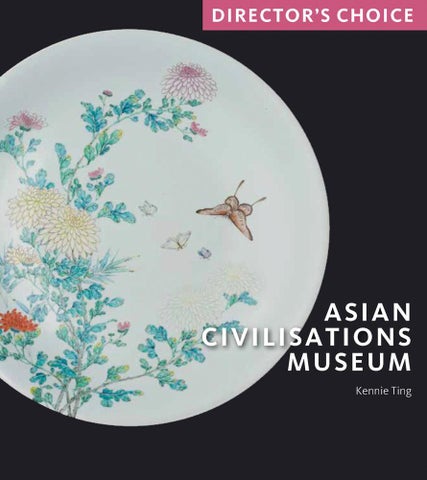
Chrysanthemum dish, 1723–35
Publishers Ltd.
(see pp. 48–49)
Every effort has been made to acknowledge correct copyright of images where
back cover
applicable. Any errors or omissions are unintentional and should be notified
Detail from Indian trade textile,
to the Publisher, who will arrange for corrections to appear in any reprints.
18th century (see pp. 16–17)
Director’s Choice is a registered trademark of Scala Arts & Heritage
frontispiece
Publishers Ltd.
Decanter case with bottles, 18th century (see pp. 14–15)
80
|
ASIAN CIVILISATIONS MUSEUM