Ascension_Layout_FINAL_v2_OP_NEW.indd 6
30/06/20 11:01
The Dean presenting the Precentor to HRH The Duke of Cambridge at the Dedication of Ascension, October 2017
Ascension_Layout_FINAL_v2_OP_NEW.indd 7
30/06/20 11:02
Ascension_Layout_FINAL_v2_OP_NEW.indd 8
30/06/20 11:02
Preface The Very Revd Michael Tavinor Dean of Hereford
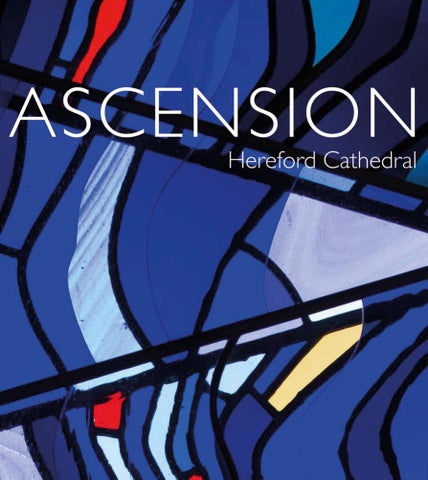
People sometimes ask me what has been my greatest pleasure during my eighteen years as Dean of Hereford. The list is long but one area I have particularly valued is the privilege of adding to the cathedral fabric and developing focuses of pilgrimage and prayer. So, the Tom Denny stained glass of 2007 (commemorating the seventeenth-century priest–poet Thomas Traherne), the St Ethelbert shrine (2007) and the St Thomas Cantilupe shrine (2008) were projects in which architecture, bold colour, history, prayer and pilgrimage became inextricably entwined. They have all helped to bring new life into the cathedral – its gentle sandstone enlivened by flashes of contrast and imagination. In such ways, we have the privilege of adding something to an already rich tradition – of handing on to the next generation a resource for others to use in their Christian experience. In so many ways Ascension continues this trend. Its bold colours and inspirational message are a breathtaking addition to our historic cathedral, and mark the unique link between Hereford and the SAS. Like the Traherne stained glass and the Ethelbert and Cantilupe shrines,
Ascension has become a focal point for worship, thanksgiving and homecomings. Each provides an awe-inspiring space for contemplation and prayer for all visitors to the cathedral. Ascension adds to a sense of Resurrection in this building and gives hope and encouragement to those who come in sadness or bereavement. Ascension is about partnership. It is not the only regimental focus in our city and county. Other churches are greatly valued by the SAS. St Martin’s, in Hereford, has a beautiful memorial window and many come from far and wide to see this, too. Ascension complements this and other memorials, and reminds us that Hereford Cathedral is mother church to a whole diocese and that cathedral, parish churches and Regiment are always working together in partnership for the greater good of our wider community. Above all, Ascension is about deepening experience and my prayer is that today and in generations to come, people will stand before it – and other focuses of prayer in our cathedral – and sense themselves drawn further into the beauty and mystery of God.
PREFACE 9
Ascension_Layout_FINAL_v2_OP_NEW.indd 9
30/06/20 11:02
Ascension_Layout_FINAL_v2_OP_NEW.indd 24
30/06/20 11:02
Ascension: A Place of Hope The Revd Canon Andrew Piper Precentor, Hereford Cathedral
Shortly before seven o’clock each morning, the duty verger unlocks the doors of the cathedral and a new day begins in the life of the Christian community that has worshipped in this sacred space at the heart of the city for over one thousand three hundred years. There is no charge for entry to the cathedral, so among the earliest visitors are homeless people, who gather around the Gurney stoves in the colder months of the year to warm themselves and to shelter from the elements. They are soon followed by those pilgrims who come to pray in silence before the city stirs into life. Some of them attend the first services of the day at seven-thirty and eight o’clock, while others kneel or sit quietly in the nave, or near the shrine of St Thomas of Hereford in the north transept, where they can light a candle and join their prayers with those of the saints and angels. As the day progresses, many other people visit the cathedral to admire the architecture, to enjoy the flower arrangements, to experience the peaceful atmosphere, or to talk to the day chaplain about their particular concerns or uncertainties. This pastoral ministry is a vital part of the cathedral’s service to the community, offering a listening ear to the hopes and fears of people from many walks of life, and assuring them of God’s love and concern for them and their loved ones.
Among those visitors who arrive in need of comfort, encouragement or inspiration are members of the Special Air Service, its veterans, support staff, families and friends. The SAS was first established in Hereford in the 1960s, but, since Stirling Lines moved to its current base just outside the city in 1999, the Regiment has looked increasingly to the cathedral as its spiritual home and the church in which its larger services are conducted, including some of its funerals and memorial services. The military chapel on the base is modest in scale and within the security cordon, which hinders the chaplains in their desire to arrange large services that include family and friends: whereas the cathedral can seat over a thousand people. So our links with the Regiment have grown steadily closer, and the Cathedral Chapter and our congregation have warmly welcomed this development, not least because the Regiment and its wider family is a trusted and valued presence in our county. Hereford Cathedral is unusual, however, in not having a military chapel within its compass, where books of remembrance are kept, battle honours are recorded publicly and standards are laid up. Until Ascension was completed in 2017, the cathedral also lacked any visual expression of our spiritual and pastoral relationship
CONTEXT 25
Ascension_Layout_FINAL_v2_OP_NEW.indd 25
30/06/20 11:02
with the SAS. This deficiency was surprising, especially to some of our visitors, who arrived here (sometimes from countries far across the world) assuming that there would be something relating to the Regiment for them to see, and asking our volunteer welcomers where it might be. The Chapter was pleased, therefore, to receive a proposal from the President of the SAS Regimental Association in June 2014 to commission a permanent artistic installation, designed by John Maine RA, to mark the seventy-fifth anniversary of the Regiment’s formation. It would honour the lives and achievements of those who have served (or are serving) in the Regiment, and create a place that could contribute to the spiritual and pastoral welfare of the whole Special Forces family, as well as assist the Regimental Chaplains in their ministry. Here began the Chapter’s partnership with the Regimental Association and the Regimental Chaplaincy that was timely, and has subsequently proved to be fruitful, enduring and mutually enriching. A small planning group was formed and, from the beginning of our conversations, we were conscious that, in order to honour God and to gain the necessary statutory consents to make a major alteration and addition to a medieval building, the new installation would have to be of the highest quality. It should be considered, by both present and future generations, to be worthy of a permanent place in an ancient house of prayer. It would certainly need to be a dignified and exceptional work of art that was both appropriate to its context and able to fulfil many different functions, including some liturgical ones. Thus this installation was not only to be art for art’s sake, but also art with a mission. In generating for ourselves and for the artist a list of the functions that this new installation would discharge, we identified two overlapping categories – daily functions and occasional functions – that were of equal importance and significance. The list began with our aspiration to create a clear and tangible sign of the SAS presence in Hereford, not least because they are an integral part of our county’s identity. Although this is a well-known fact locally, it is not one that is often mentioned officially.
The Chapter also wanted a visible sign of the cathedral congregation’s regular intercession for the SAS that would encourage visitors and pilgrims to join their prayers for the Regiment with ours. Without wishing to overstate the case, we also desired an unambiguous expression of the county’s pride in the Regiment and of our quiet yet determined support for its members and veterans and their families. It should also serve as a gentle reminder to everyone passing through the cathedral that the Regiment and its wider family need our intercession and deserve our thanks for their particular contribution to our national security. Here we should note a particular pastoral concern affecting the families and friends of the Regiment. They have to bear a burden that is unusual among military families, in that those who serve in the Regiment can disappear quite suddenly, without being able to say where they are going or how long they might be away. During this period of time communication with their family may not be possible. Simply by the nature of some of the Special Forces’ work, their relatives may also worry that their loved one is in harm’s way. These uncertainties can generate an unsettling mix of stress and anxiety, especially among children of the Regiment, who experience the passing of time differently from adults. This is where we felt that the proposed installation could be a real help, as a place of pilgrimage where families of the Regiment could bring their anxieties, offer their prayers for their loved one and light a candle as an expression of their longing for a safe return. Thus, inspiring and nurturing hope would surely be at the heart of the installation’s design. This aspiration also set one of the challenges for John Maine to address: we were asking him to create an installation that would be striking and inspiring for adults, yet also approachable, unintimidating and reassuring for children. He achieved this delicate balance by forming a sculpture that is monumental in style and speaks of strength, but quietly, with humility and an air of understatement, which is characteristic of the Regiment. The sculpture also has a homely quality that invites people to approach it and touch it, which many
26 ASCENSION
Ascension_Layout_FINAL_v2_OP_NEW.indd 26
30/06/20 11:02
(especially children) do, as touch is such a powerful source of comfort. As well as being a focus for private prayer by family and friends, the Chapter also wished the new installation to be a liturgical focus during corporate acts of reflection and thanksgiving, especially on those occasions when members of Regiment are present for worship in the cathedral (although usually not in uniform, for security reasons). It is surely right for us to gather as a community in the cathedral to give thanks to God for the (mostly unseen) work of the SAS in defending us from terrorist threats and in striving to build and uphold peace in this country and abroad. As the mother church of the diocese, the cathedral is also an appropriate and dignified setting for the Regiment’s major occasions. Standing at the centre of the county, the cathedral is surely a fitting place in which to celebrate the Regiment’s achievements, to pray for the injured and the fallen, and to honour
those who have served or are serving in one of its many units. Looking to the future, we could also see that Ascension might well become a place of renewal, where members of the Regiment who have returned safely from a recent campaign might re-dedicate themselves to their continuing service of the Crown. This long list of aspirations made us ponder what kind of installation could deliver all these disparate functions. Right from the outset we turned away from the idea of creating a new regimental chapel. Quite apart from the fact that the cathedral does not have the physical space for such a project, we sensed that such a provision seemed too static for a regiment like the SAS; and so we settled instead on the idea of creating a wayside shrine – a place to pause and reflect, rather than to remain – similar to the ones that are encountered in many European countries. Yet we were also agreed that the principal function of this new installation would not be to serve as a retrospective
CONTEXT 27
Ascension_Layout_FINAL_v2_OP_NEW.indd 27
30/06/20 11:02
This edition © Scala Arts & Heritage Publishers Ltd, 2020 Text © the authors, 2020 First published in 2020 by Scala Arts & Heritage Publishers Ltd 10 Lion Yard Tremadoc Road London SW4 7NQ, UK www.scalapublishers.com In association with The Special Air Service Regimental Association www.marsandminerva.co.uk John Maine RA www.johnmaine.co.uk Hereford Cathedral www.herefordcathedral.org ISBN 978-1-78551-259-9 Edited by Johanna Stephenson Designed by Heather Bowen Printed in Turkey 10 9 8 7 6 5 4 3 2 1 All rights reserved. No part of this book may be reproduced, stored in a retrieval system or transmitted in any form or by any means electronic, mechanical, photocopying, recording or otherwise, without the written permission of Scala Arts & Heritage Publishers Ltd. Every effort has been made to acknowledge correct copyright of images where applicable. Any errors or omissions are unintentional and should be notified to the Publisher, who will arrange for corrections to appear in any reprints. All photography is by John Maine except the following: Gillian Forbes – Stonecarver and Ian Evans-Boiten: pp. 104 (below), 107 © SAS Regimental Association: pp. 14, 19, 22 (above and below) © SAS Regimental Association (courtesy of BM Niven), p. 20 © The Artists Rifles Association: p. 15 © Tom Maine: pp. 2, 6, 10–11, 32–3, 36, 38, 41 (above), 58–9, 64, 67, 70, 71, 76–7, 78–9, 80–1, 82–3, 84–5, 86–7, 92, 93, 96, 97 [all images], 100 [all images], 102–3, 108–9, 114, 120
128 ASCENSION
Ascension_Layout_FINAL_v2_OP_NEW.indd 128
30/06/20 11:06