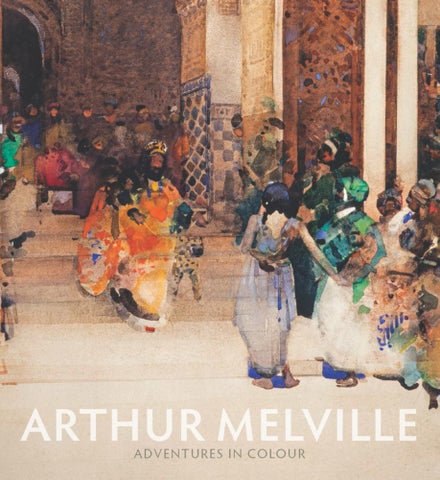
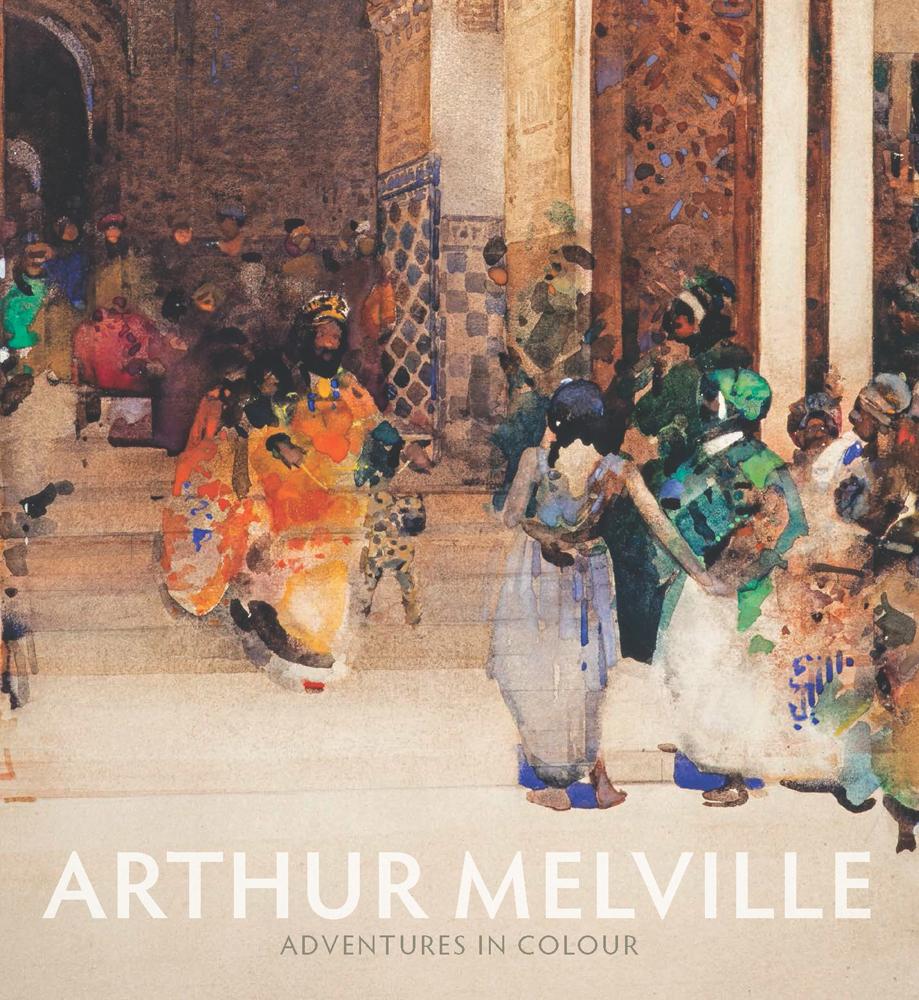
26 · King Cophetua and the Beggar Maid
Watercolour with bodycolour on paper
70.2 x 51 cm
Inscribed: Arthur Melville 98
Exhibited: RI 1906, no.162; GIFA 1907, no.34; Nottingham 1907, no.95; Edinburgh 1908, no.618
Literature: Mackay 1951, no.48; Gale 1996, illus. p.89
Scottish National Gallery, Edinburgh
If he had not already read Alfred, Lord Tennyson’s (1809–1892) poem ‘The Beggar Maid’, Melville would certainly have encountered the legend of the African King Cophetua in Edward Burne-Jones’s (1833–1898) celebrated canvas in 1884 (Tate, London), when it was shown at the Grosvenor Gallery. There, however, the comparison ends, for Melville’s interpretation of the subject is radically different from that of Burne-Jones. Melville elects to show the moment when the hermit king descends from his palace leading a pet leopard and, while scattering coins to the beggars at his gate, falls instantly in love with the beautiful mendicant maid: the central figure with her back to the viewer in the present work. The elaborate blue-tiled archway is probably derived from one of those at the Patio de los Leonnes in the Alhambra Palace.
As he warmed to the theme Melville produced two paintings of the scene. In the alternative, horizontal version (private collection) the King and his Bride stand together on the palace steps, surrounded by courtiers.
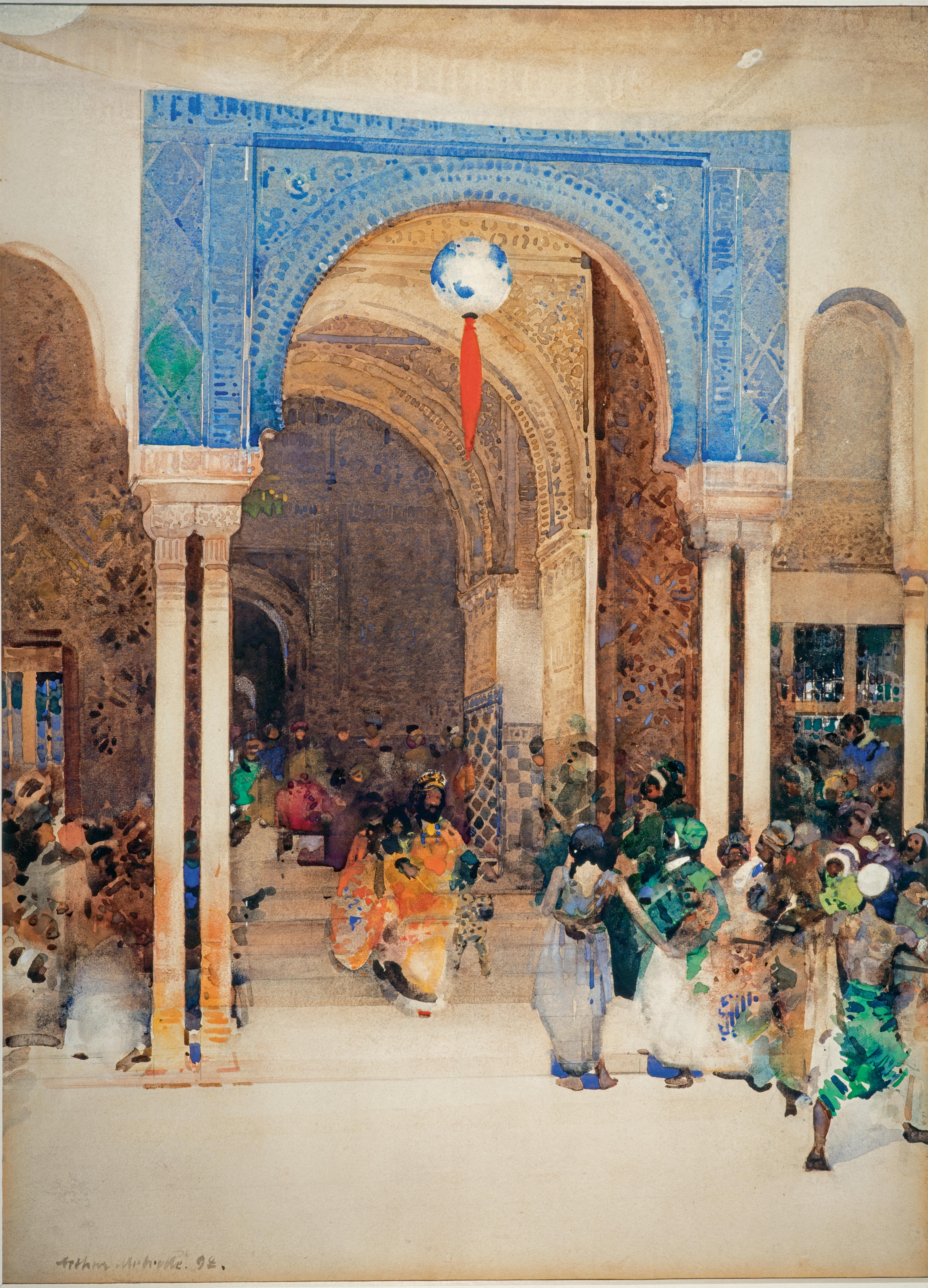
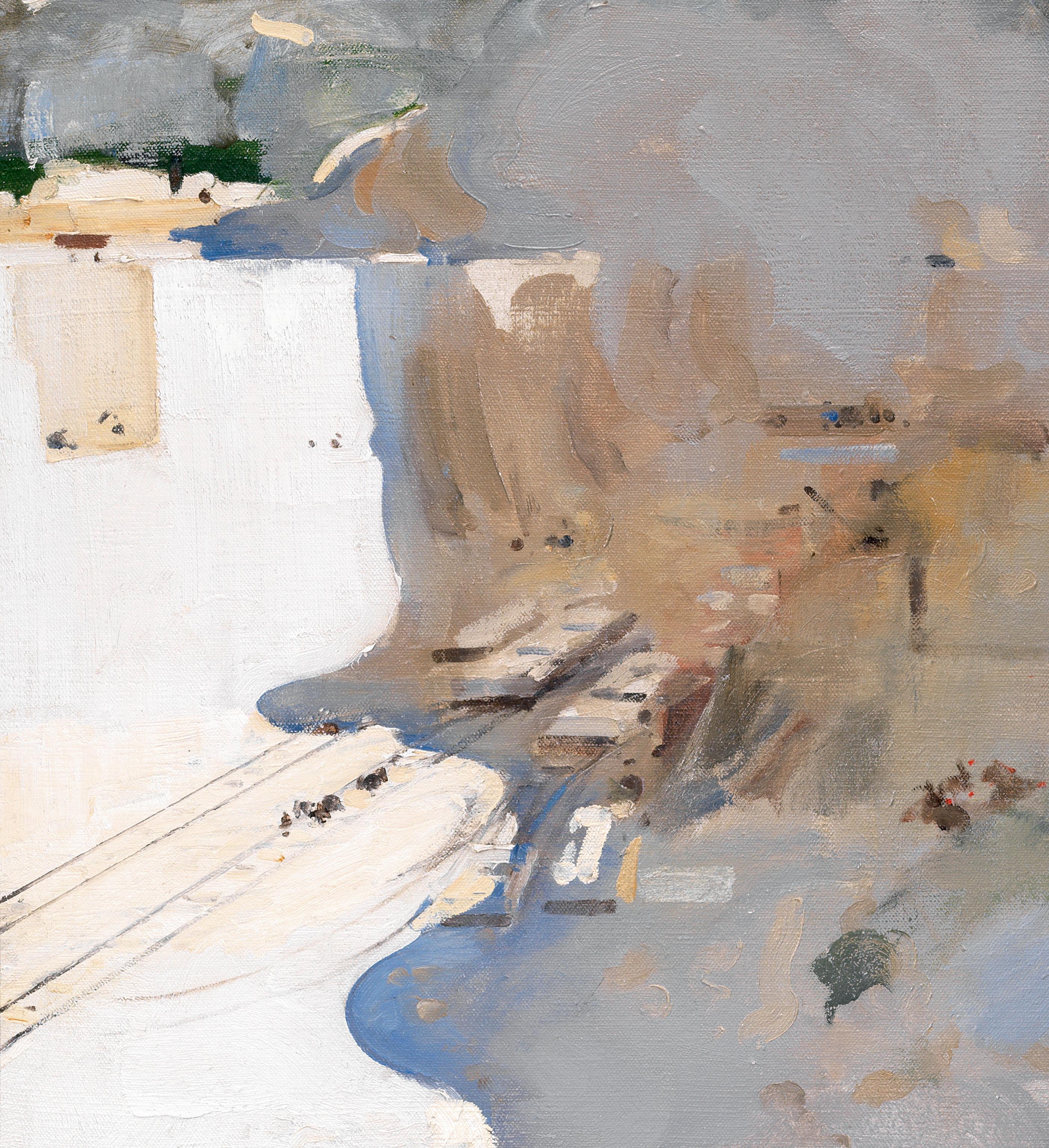
69 · The Chalk Cutting
Oil on canvas · 83.8 x 91.5 cm
Exhibited: RI 1906, no.12; GIFA 1907, no.86; Bourne / FAS 1996, no.68; Bourne / FAS 2013, no.11
Literature: Mackay 1951, no.80
Scottish National Gallery, edinburgh
Purchased with the assistance of the Art Fund and the Patrons of the National Galleries of Scotland 2013
While the press was full of Kitchener’s exploits, Melville also painted the resplendent
The Chalk Cutting, a view into a quarry yet to be identified. It is likely to have been inspired by one of many chalk pits that dotted the Surrey landscape, within easy reach of his new home.
It would be tempting to compare this with similar subjects treated by JeanCharles Cazin (1840–1901), Arthur Lemon (1850–1912) and Sargent, but none quite measures up to Melville’s lyricism; indeed the earlier painters insist on graphic Naturalism. While Sargent would explore the expressive potential of scenes in the Carrara quarries in 1911, he too retreats from the lightness of Melville’s vision. Perhaps Melville’s closest prompt for the present picture was William York MacGregor’s recent paintings of French quarries. One of these, A Rocky Solitude (1896; National Galleries of Scotland) was shown in the New English Art Club (NEAC ) in the spring of 1897.
By 1897 MacGregor was the only Glasgow
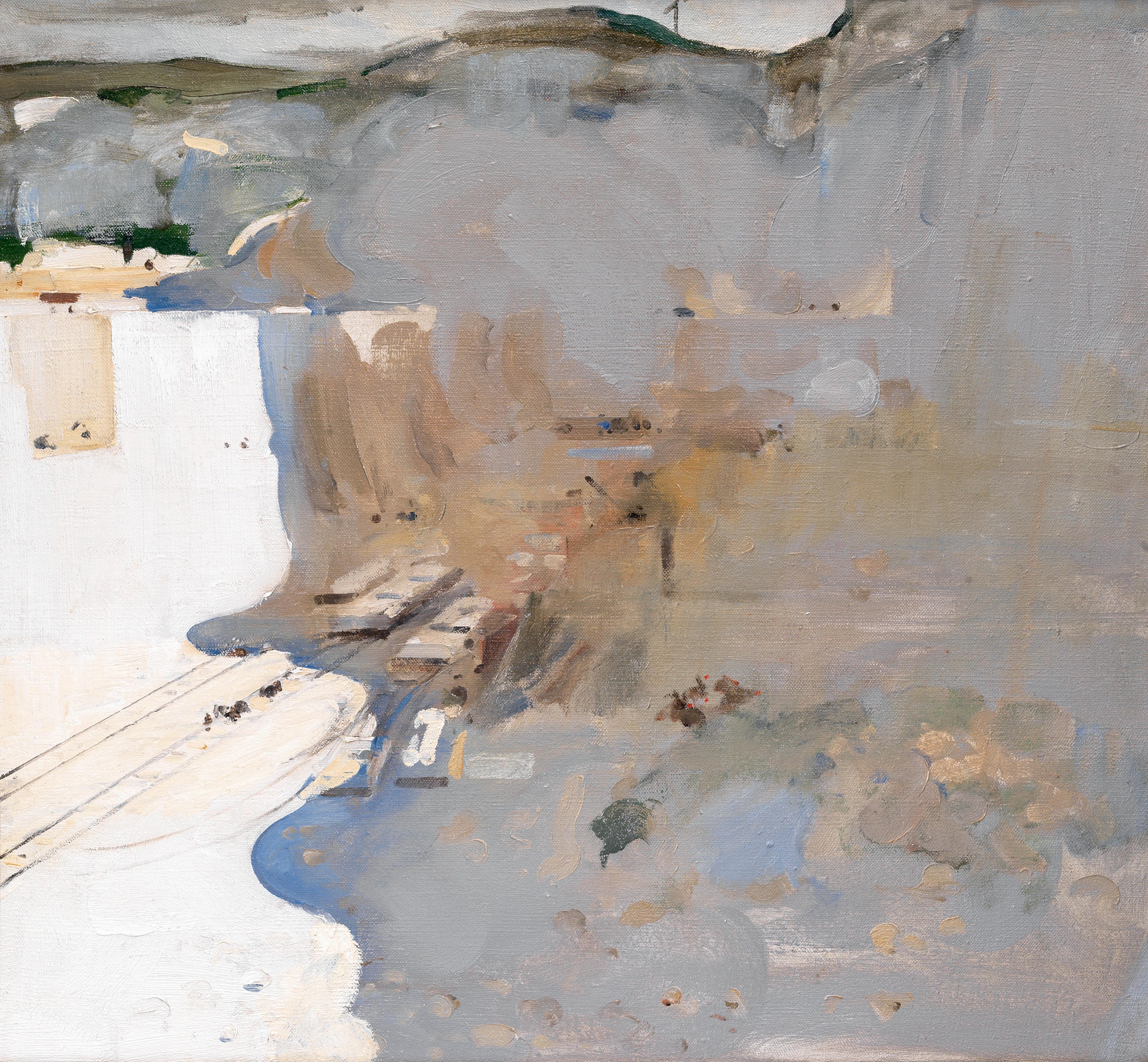
School painter to survive in the ranks of the NEAC and there is every reason to assume that Melville would have been familiar with his recent work. However, beyond subject matter and format, there is little resemblance between his light lyricism and the rather leaden tones of MacGregor’s brooding landscape.
We have therefore to confront the startling originality of The Chalk Cutting in which limpid pools of blue-grey shade snake across the terrain masking cliffs and crevices; they, as T. Martin Wood observed, ‘hid mysteries’.2 This central void is penetrated only by a narrow gauge railway, its trucks loaded with blocks of stone, and around its periphery amid smudges and spots are fragments of landscape that merely frame the painting of a shadow.