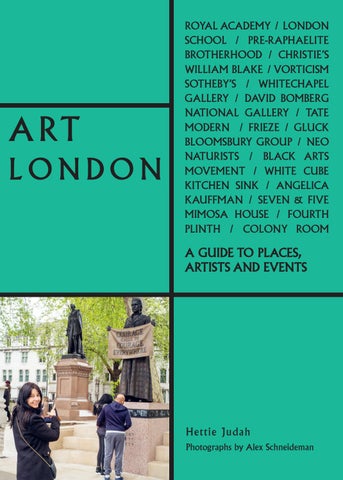
A RT LONDON
ROYAL ACADEMY / LONDON SCHOOL / PRE-RAPHAELITE BROTHERHOOD / CHRISTIE’S WILLIAM BLAKE / VORTICISM SOTHEBY’S / WHITECHAPEL GALLERY / DAVID BOMBERG NATIONAL GALLERY / TATE MODERN / FRIEZE / GLUCK BLOOMSBURY GROUP / NEO NATURISTS / BLACK ARTS MOVEMENT / WHITE CUBE KITCHEN SINK / ANGELICA KAUFFMAN / SEVEN & FIVE MIMOSA HOUSE / FOURTH PLINTH / COLONY ROOM
A GUIDE TO PLACES, ARTISTS AND EVENTS
Hettie Judah Photographs by Alex Schneideman
I N T RO D U C T I O N London today is a booming art city. Its colleges
Nevertheless, the city has proved a magnet for
are cosmopolitan, its blockbuster exhibitions
talent: surprisingly few of London’s great artists
booked up months in advance, and its major fairs
were born here.
and auctions comfortably lodged in collectors’ calendars. In this city, art can be discovered in
There is no single art history of London. It is a suite
every setting; from artist-run spaces in Deptford
of parallel stories rather than a grand overarching
to the slickest galleries in Mayfair; from scrappy
narrative. The piecemeal, neighbourhood-by-
student pop-ups to crowning retrospectives at the
neighbourhood structure of this book reflects a
Royal Academy.
patchwork of activity: Flemish artists at the Tudor court; connoisseurs of Covent Garden’s taverns
It was not always thus: had this book been written
and brothels in the eighteenth century; the Pre-
forty years earlier, it would have been a far slimmer
Raphaelite Brotherhood; the Whitechapel Boys
volume. In 1978, the ICA held a conference on
(and girls) from Jewish immigrant communities
‘The State of British Art’, in which crisis was the
in the East End; the Black Arts Movement of the
dominant mood. The venerable art magazine
1980s. Here, too, are isolated figures, among
Studio International suspended publishing. For
them artist-visionary William Blake and living
European collectors London was not even an
sculptures Gilbert & George.
intriguing stopover en route to New York. In the British press, works of contemporary art were
In 1998 London’s great artworld diarist Louisa Buck
approached as if an endless series of bad jokes.
published the primer Moving Targets. Over twenty
The idea that some two decades on, Tate Modern
years on, her choice of title is more apposite than
would draw five million visitors in its first year – and
ever: London’s artworld was and is impossible
would continue expanding to accommodate ever
to pin down. Galleries open and close overnight,
growing crowds – was unthinkable.
districts heat up and cool down again as fast as opportunistic landlords rocket the rent. Whole
That was not the city’s first creative crisis. Its art
ecosystems are wiped out as studio complexes are
scene has ebbed and flowed like the waters of
sold for development. Ironically, nostalgia often flares
the Thames. Like the Thames, too, it has borne
for the crisis years of the 1970s, when London’s
abundant love and conflict, junk, folly and sewage.
abandoned buildings offered space to live, work and
Today home to some of the world’s greatest
show, safely hidden from the international market.
museums, London for centuries operated in the shadow of Florence, Venice and Genoa, Antwerp
London can be fast-paced, brutal and demanding:
and Amsterdam, Paris, Berlin and New York.
many artists have moved to Berlin, Lisbon, Athens,
6
and England’s South East. Yet the city lacks neither
book, ‘institution’ indicates a venue not funded
artists nor galleries; if anything, the sheer volume
primarily by sales, be that an artist-run space,
of art can feel overwhelming. Perhaps some kind
private foundation or major museum. As with the
of guide to art in London, past and present, might
boundaries of London’s neighbourhoods, these
come in handy?
designations are approximate.
A NOTE ON STRUCTURE
The information on venues is interspersed with
Art London is organised by loosely defined districts.
narrative texts on places, movements and artists
Within them, sites are designated ‘institutions’ or
through the ages, along with profiles of some of
‘commercial galleries’. For the purposes of this
London’s leading contemporary practitioners.
BUYING ART However coy they may appear, all the commercial galleries listed in Art London do actually sell work, though to whom and at what price are closely guarded secrets. Let the gallery’s location and ambiance be your guide; if you love something, and think it might be within range, there’s no harm in asking the gallerist about it. Works in artistrun and studio spaces may well also be for sale; again, no harm in asking. London has a packed schedule of fairs selling art, high-end craft and design; some deliberately positioned at the affordable end, others very much not (see overleaf for a list of London’s art fairs). If you have lofty tastes not met by your limited budget, editions (often prints, photographic or otherwise) are a more accessible entry point. Camden Arts Centre, Chisenhale, ICA, South London Gallery, Studio Voltaire, Serpentine and Whitechapel all invite their exhibiting artists to create editions to help raise funds for the gallery; be warned, prices go up as the edition progressively sells out. Studio Voltaire’s House of Voltaire features wildly fashionable artist collabs ranging from tea towels and t-shirts to ceramics and knitwear. Look out, too, for fund-raising initiatives like Drawing Room’s biannual auction of works on paper donated by some of Britain’s most prominent artists. 7
S T JA M E S ’ S INSTITUTIONS ICA
The Mall, SW1Y 5AH ica.art
It is a delightful quirk of London that one of its most subversive institutions shares a street with the Queen. Fiercely contemporary, with an eye to the margins rather than the mainstream, the ICA is a site for talks, events, music and cinema as well as art, much of it at the progressive, and often controversial, cutting edge. Free entry Tuesdays. Outstanding restaurant and bookstore.
MALL GALLERIES The Mall, SW1 mallgalleries.org.uk
THE NATIONAL GALLERY Trafalgar Square, WC2N 5DN nationalgallery.org.uk
Exhibition venue and home to the Federation of British Artist Societies, the Mall Galleries host a program of shows and competitions largely dedicated to representational art. National collection of European paintings, with works dating from the thirteenth to early twentieth centuries. Star turns include Jan van Eyck’s Arnolfini Portrait (1434), Diego Velazquez’s The Toilet of Venus (aka the ‘Rokeby Venus’, 1647-51), The Ambassadors (1533) by Hans Holbein the Younger, and works by Leonardo, Rembrandt, Rubens and van Gogh. A recently acquired self-portrait by Artemisia Gentileschi was only the twentieth work by a female artist in a collection of 2,300 paintings. Collection free, exhibitions ticketed.
THE NATIONAL PORTRAIT GALLERY
St Martin’s Place, WC2H 0HE npg.org.uk
Founded as a collection of portraits of ‘men and women who have made and are making British history and culture,’ the collection now extends to over 200,000 portraits, including painted, photographic and even moving image. In the summer and winter months, the gallery hosts exhibitions of works shortlisted for painted and photographic portrait awards. Collection free, exhibitions ticketed.
32
ST JAMES’S
The National Gallery, Trafalgar Square
The National Portrait Gallery, St Martin’s Place
33
HOLBORN INSTITUTIONS BRITISH MUSEUM
Great Russell Street, WC1B 3DG britishmuseum.org
Vast and exquisite collection of artefacts of international (and, in some instances, controversial) origin. Temporary shows range from surveys of world cultures, to displays themed around ideas of faith or dissent, to handsome art exhibitions. The museum today occupies a vast and tangled
site,
including
state-of-the-art
subterranean
facilities for treating and caring for their extraordinary collection. Displays free, exhibitions ticketed.
THE FOUNDLING MUSEUM 40 Brunswick Square, WC1N 1AZ foundlingmuseum.org.uk
Founded by Thomas Coram in 1739, the Foundling Hospital looked after children at risk of abandonment. William Hogarth and composer George Frideric Handel helped turn it into a fashionable cause; Hogarth encouraged his contemporaries to donate works, creating in the process London’s first public art gallery. The Foundling Hospital closed in 1954, and the Museum tells the story of the hospital and its public museum. It still has artist ‘Fellows’, and commissions and shows contemporary art.
THE SOANE MUSEUM
13 Lincoln’s Inn Fields, WC2A 3BP soane.org
Architect Sir John Soane is survived by his designs for the Bank of England and Dulwich Picture Gallery, as well as his home at Lincoln’s Inn Fields, for which he knocked down three existing buildings. He had the house and his collection preserved for the nation by an act of parliament in 1833. Highlights include Hogarth’s A Rake’s Progress (1733), works by Turner and Canaletto, and fabulous classical statuary, but the building is better considered as a total work of art, with Soane’s use of mirrors and coloured glass adding to the atmospherics.
74
HOLBORN
COMMERCIAL GALLERIES HERALD STREET
43 Museum Street, WC1A 1LY heraldst.com
A central off-shoot for Bethnal Green’s Herald Street, occupying a pretty Georgian townhouse; fitting for a gallery representing Pablo Bronstein, an artist fascinated by the legacy of Georgian architecture and its ersatz manifestations on the British high street. Gallery bedfellows include Michael Dean, Matthew Darbyshire, Amalia Pica, Alexandra Bircken and Lesley Vance.
ISAAC JULIEN AND VAGABONDIA Julien can summon up breathtaking images. Whether it’s embracing lovers licked by the morning light in his homage to the Harlem Renaissance, Looking for Langston (1989), or Maggie Cheung as the airborne goddess Mazu in Ten Thousand Waves (2014), he can seduce viewers with sublime beauty, but that’s only ever the surface. This artist’s poetic vision serves his exploration of capital: the movement of money, and the movement of people and things in pursuit of it, from historic wealth built on enslaved labour, to contemporary migrant workers drowned picking cockles off the English coast. Many of Julien’s works are projected on multiple screens, surrounding you in image and sound, so that impressions flood faster than you can process them. His two-screen work Vagabondia (2000) is set in The Soane Museum, bringing to life an overlooked character – a Black vagabond – from Hogarth’s A Rake’s Progress. Filmed at night, the house is repopulated by figures in historic dress, who perform against a voice-over in Saint Lucian Creole French provided by the artist’s mother. The film is shot to reflect Soane’s interest in mirrors, doubling and perspectival tricks in his architecture, but also suggests the origins of the wealth the house was built with. 75
CHELSEA INSTITUTIONS S A AT C H I G A L L E RY
Duke of York’s HQ, King’s Road, SW3 4RY saatchigallery.com
In the 1980s, the Saatchi Gallery was where you went to see the best contemporary art in London, amassed and displayed by the country’s most significant collector. Those days have passed: artists have become wary of a collector who might dump their work on the market en masse, or refuse to lend to significant museums, and London is now rich in collectors and private foundations. The Saatchi in its Chelsea incarnation is a different beast: there are still collection shows, along more or less inflammatory themes, but also commercial tie-ins, hosted events and art fairs.
COMMERCIAL GALLERIES MICHAEL HOPPEN 3 Jubilee Place, SW3 3TD michaelhoppengallery.com
Eminent photographic gallery staging diverse exhibitions, from Fergus Greer’s portraits of Leigh Bowery to Gerry Cranham’s sports photography, Daido Moriyama’s Tokyo to the surreal fashion photography of Guy Bourdin.
VIGO
Saatchi Gallery, Duke of York’s HQ, King’s Road, SW3 4RY vigogallery.com
Somewhat nomadic gallery currently housed on the Saatchi premises. Vigo are particularly interested in artists of the African diaspora – notably the great modernist painter Ibrahim el-Salahi, and photographer Hassan Hajjaj’s eyecatching works exploring consumerism, cultural clichés and Moroccan youth culture.
124
CHELSEA
DANTE GABRIEL ROSSETTI Rossetti was torn between passions for poetry and art (and, notoriously, beautiful women). The son of an Italian writer and scholar, he grew up on Charlotte Street in Fitzrovia. Dante was a middle name, but he favoured its association with the great poet, whose work he translated, and whose Divine Comedy inspired his paintings. Medieval romance is where Rossetti found his principle inspiration: knights and maidens, fallen women, tragic love. In 1844, aged 16, he enrolled in the Royal Academy Schools. Encountering William Holman Hunt’s The Eve of St Agnes (1848) – its subject drawn from a poem by Keats – he sensed kinship. He sought him out and, together with John Everett Millais, formulated the principles of the Pre-Raphaelite Brotherhood. Rejecting the mannered Grand Style of the Royal Academy, the PRB favoured close observation from nature, powerful emotion and intense colour reminiscent of fifteenth-century Italian art. Rossetti indiscreetly let slip the existence of the PRB (intended as a secret society) to a journalist on The Times. The revelation coincided with a deluge of mocking hostility, a spectacle that put Rossetti off public exhibition of his work. Championed and supported by John Ruskin, it was often through the great critic that Rossetti found a market. In the early 1850s, the artist and poet Elizabeth Siddal became his lover and favourite model, often cast as characters from Dante. Rossetti delayed marrying Siddal until 1860, when she was already gravely ill. When Siddal died in 1862, Rossetti buried the only complete manuscript of his poems with her (he had them exhumed seven years later). A flamboyant and recognisable figure – the archetypal bohemian – Rossetti was sought out by younger artists, among them Edward Burne-Jones and William Morris, with whom he formed a second generation of the PRB. After Siddal’s death, Rossetti moved to 16 Cheyne Walk, which he shared with a menagerie including deer, exotic birds and his beloved wombat, Top, whose own death inspired the improbable verse tribute: ‘Neither from owl nor from bat/ Can peace be gained until I clasp my wombat.’
125
BERMONDSEY
Robin Klassnik, Matt’s Gallery
White Cube, Bermondsey; Tracey Emin, A Fortnight of Tears (2019)
177
VAU XHALL A N D LAMBETH INSTITUTIONS BEACONSFIELD
Beaconsfield Gallery Vauxhall 22 Newport Street, SE11 6AY beaconsfield.ltd.uk
An artist-run space occupying a former ‘Ragged School’, Beaconsfield hosts exhibitions, residencies and events: think of it as a grass-roots, socially engaged counterbalance to the slickness of nearby Newport Street (an artist-run space of a rather different kind).
GARDEN MUSEUM
Lambeth Palace Road, SE1 7LB gardenmuseum.org.uk
Founded near the site of the great botanical gardens created by the Tradescant family in the early seventeenth century, the Garden Museum has recently reopened after extensive renovation. Exhibitions of art on botanical themes, both trad and rad.
GASWORKS
155 Vauxhall Street, SE11 5RH gasworks.org.uk
Arts non-profit: the gallery being only the most visible manifestation of a long-respected residency and studio program drawing on Gasworks’s formidable international network.
IMPERIAL WAR MUSEUM, LONDON Lambeth Road, SE1 6HZ iwm.org.uk
Alongside
more
traditional
conflict-related
historical
exhibitions, IWM has a dynamic track record for commissioning new works by contemporary artists. They’re often REALLY good: Rosalind Nashashibi’s Electrical Gaza saw her nominated for the 2017 Turner Prize; John Akomfrah’s Mimesis: African Soldier was a highlight of 2018.
MORLEY GALLERY
61 Westminster Bridge Road South Bank, SE1 7HT morleycollege.ac.uk
The gallery of Morley College hosts exhibitions by students and recent graduates, as well as emerging and established artists and designers. The college has a good art collection, including works by Edward Bawden, John Piper, Bridget Riley, Maggi Hambling and Denzil Forrester.
178
PRODIGIES, REVOLUTIONARIES, DEFIERS OF THE PATRIARCHY; DRUNKS, REBELS AND IMPASSIONED IMMIGRANTS; QUEER PIONEERS AND PROTO FEMINISTS: THERE HAVE ALWAYS BEEN ARTISTS IN LONDON. SOME WERE CELEBRATED IN THEIR LIFETIME, OTHERS WERE TOO RADICAL, TOO SUBVERSIVE, TOO MODEST, TOO FEMALE, TOO FOREIGN FOR THEIR TIME. ART LONDON GUIDES YOU TO THEIR WORK, CELEBRATING THE EXTRAORDINARY BREADTH AND DIVERSITY OF THE CITY’S ARTISTIC LIFE.
ISBN: 978-1-78884-038-5
ËxHSLHSIy840385zv&:,:*:^:& £15.00/$19.95
www.accartbooks.com