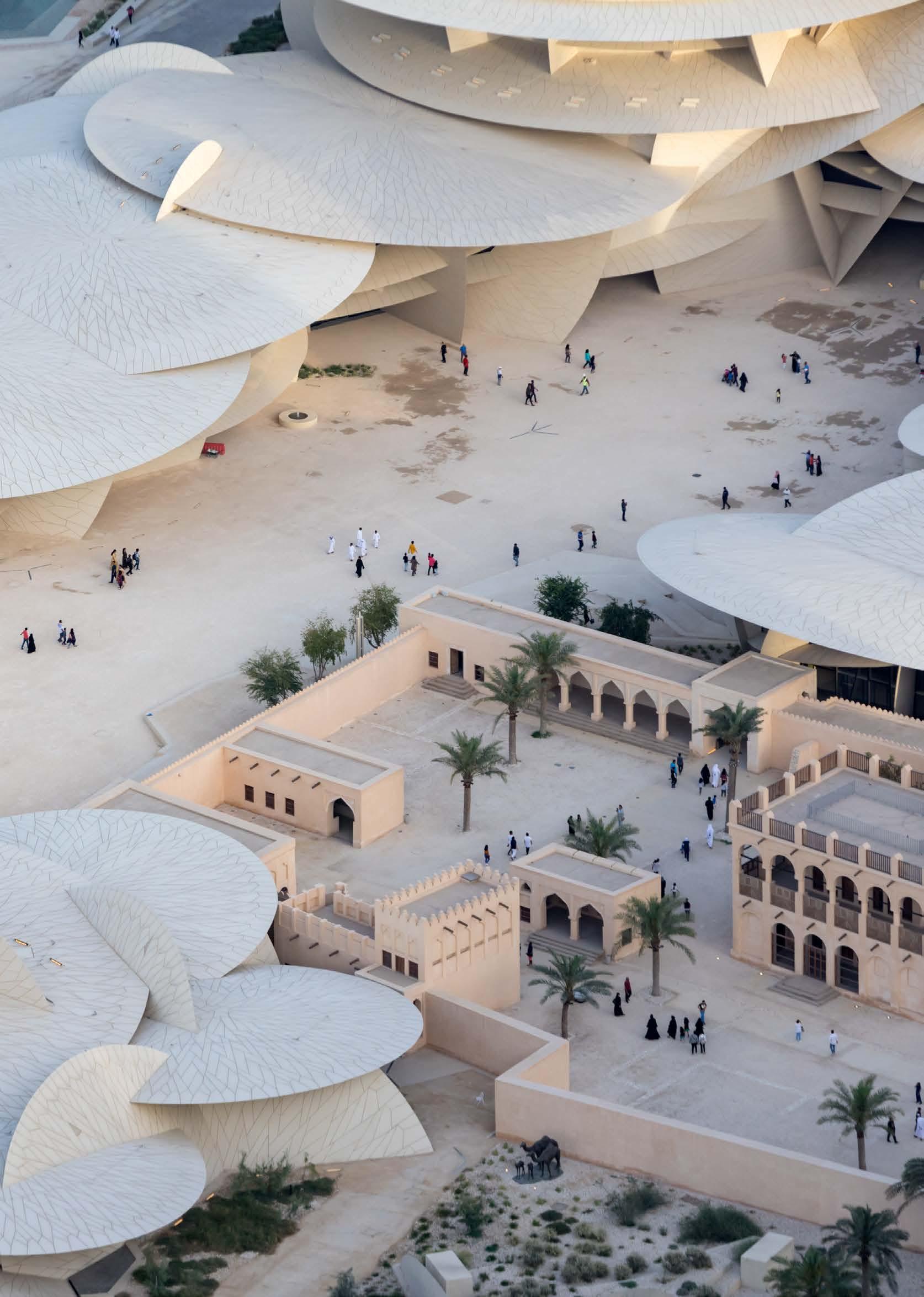
NATIONAL MUSEUM OF QATAR, DOHA
cultural property seriously, and they failed dismally to do that. It was an appalling neglect of responsibility: 99% of the damage that was done in Iraq to cultural property was either done by the Coalition or enabled by the Coalition because of their lack of proactive activity.”
He brought up examples of Coalition helicopters that had been instructed to land on a particular spot, because it wouldn’t create as much of a sandstorm and was much easier and quicker. That spot turned out to be the former courtyard of a World Heritage site in the ancient Sumerian city of Babylon. “Every time a Chinook took off or landed on that,” he said, “they compacted and destroyed the archaeology underneath. They compacted and destroyed the millennia-old paving.”
His co-panellist Martin Roth, the late director of the Victoria & Albert Museum, urged international cooperation between museums and the culture sector to fight the problem.
“We need something that we can do tomorrow – and tomorrow means that museums have to work together, that we need more intelligence. We just don’t talk to each other,” said Roth. “There’s a kind of progress, but it’s very slow.”
The German-born museum director noted that iconoclasm was “part of our own history”, pointing out that the area where he had long worked, the German region of Saxony, was where Martin Luther’s Protestant Reformation – the religious ideology behind cultural destruction in northern Europe during the 16th century – had originally started.
A group of participants in the 2016 Art for Tomorrow conference was fortunate enough to be taken by the Pritzker Prize-winning architect Jean Nouvel on a hard hat tour of the National Museum of Qatar, the construction of which was nearing completion. The museum opened in 2019, and quickly became one of Qatar’s top cultural draws, welcoming an estimated 600,000 visitors in its first year.
The National Museum of Qatar (NMoQ) first opened in 1975 to document Qatari heritage. Decades later, Qatar Museums chairperson Sheikha al-Mayassa bint Hamad bin Khalifa Al Thani commissioned Nouvel to design a new building for the museum.
Nouvel’s design for NMoQ is one of the most ambitious pieces of contemporary architecture in the Middle East. It is inspired by the desert rose: a crystal formation, found in the arid salt flats of Qatar, with a complex geometry of interlaced discs. The museum’s interlocking discs emulate the crystal’s overlapping petals, giving the structure its iconic, sculptural form. Nouvel’s building encircles the restored Old Amiri Palace – the original seat of government and the previous national museum –like a protective flower around its core.
The new building is composed of 539 disks of varying diameters and curvatures, which intersect to form complex shapes. They are made of reinforced concrete and clad in glass-fibre-reinforced concrete panels in a sandy beige that blends harmoniously with Qatar’s desert landscape.
NMoQ’s permanent display is organised as a sequence of 11 immersive galleries – a chronological journey through Qatar’s history. Key highlights include the Pearl Carpet of Baroda – a spectacular 19th-century textile embroidered with more than 1.5 million Gulf pearls and precious stones; the Al Zubarah Qur’an manuscript; and the maritime pearling and dhow material culture.
He said he was now working as a director of the Victoria & Albert Museum, where “there are still shrapnel impacts from the Blitz”, and had previously led the museum of Dresden, “so I know quite a lot about reconstruction of museums after the damage”.
“Let’s think about our own history, our own experience before we talk about others,” he said.
The Dubai-based writer Sultan Sooud Al Qassemi – founder of the Barjeel Art Foundation in Sharjah, whose aim is to promote Arab artists – said that the cultures of the Middle East, whether in the past or in the present, were endangered and needed to be protected.
“It’s great to see east Asian art and European and North American art, but the truth is, none of these cultures are under threat,” he explained. “If you just draw a three-hour radius around us, almost every culture is either under threat through negligence or war or development.” Doha has the opportunity to be “a place where all these regions and cultures are not only documented and archived, but also highlighted and shared with the rest of the world”.
Meanwhile, construction continued apace on major museum projects in the Gulf region – chiefly two buildings designed by the French Pritzker Prize-winning architect Jean Nouvel: the Louvre
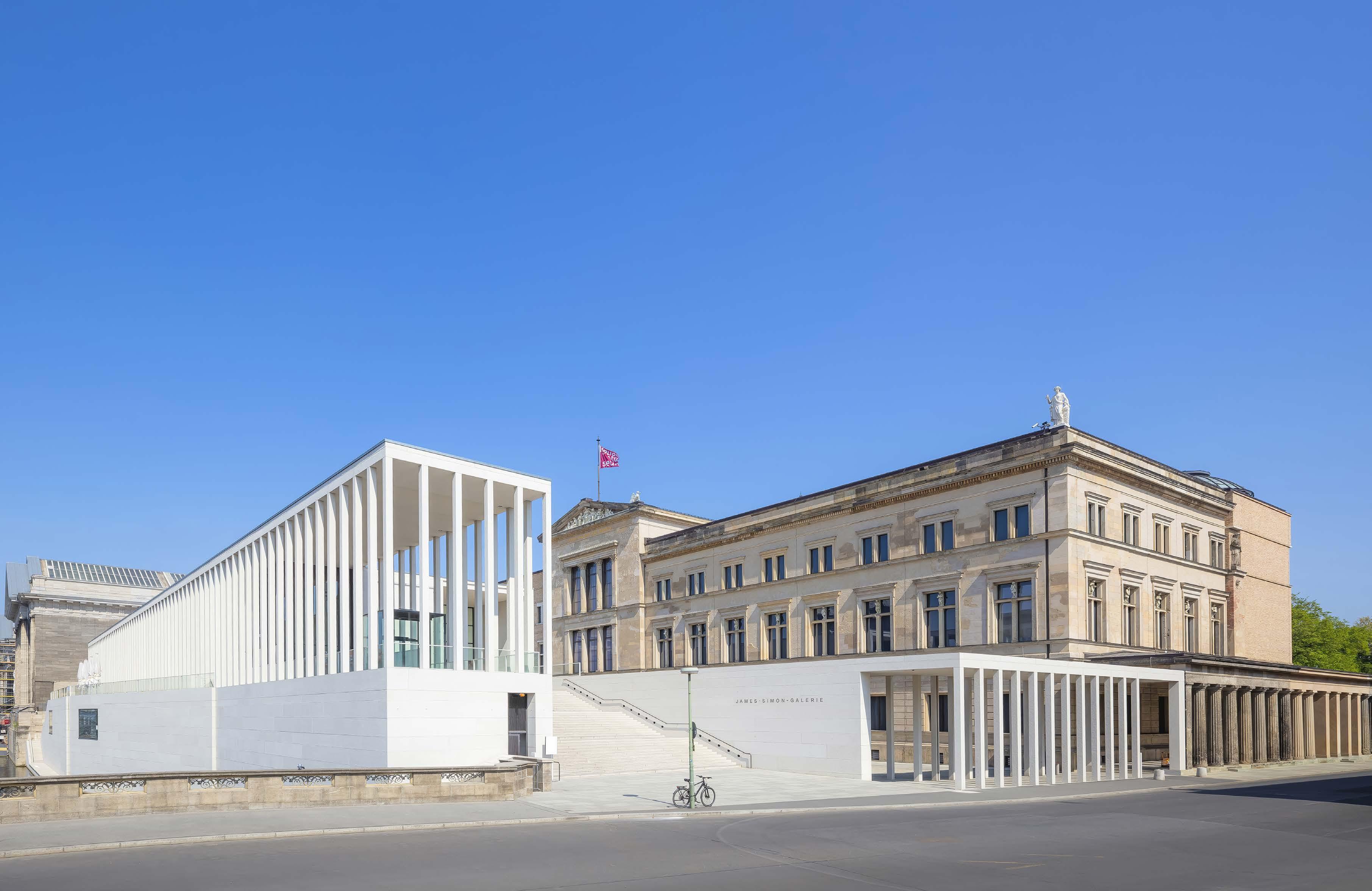
THE NEUES MUSEUM, BERLIN
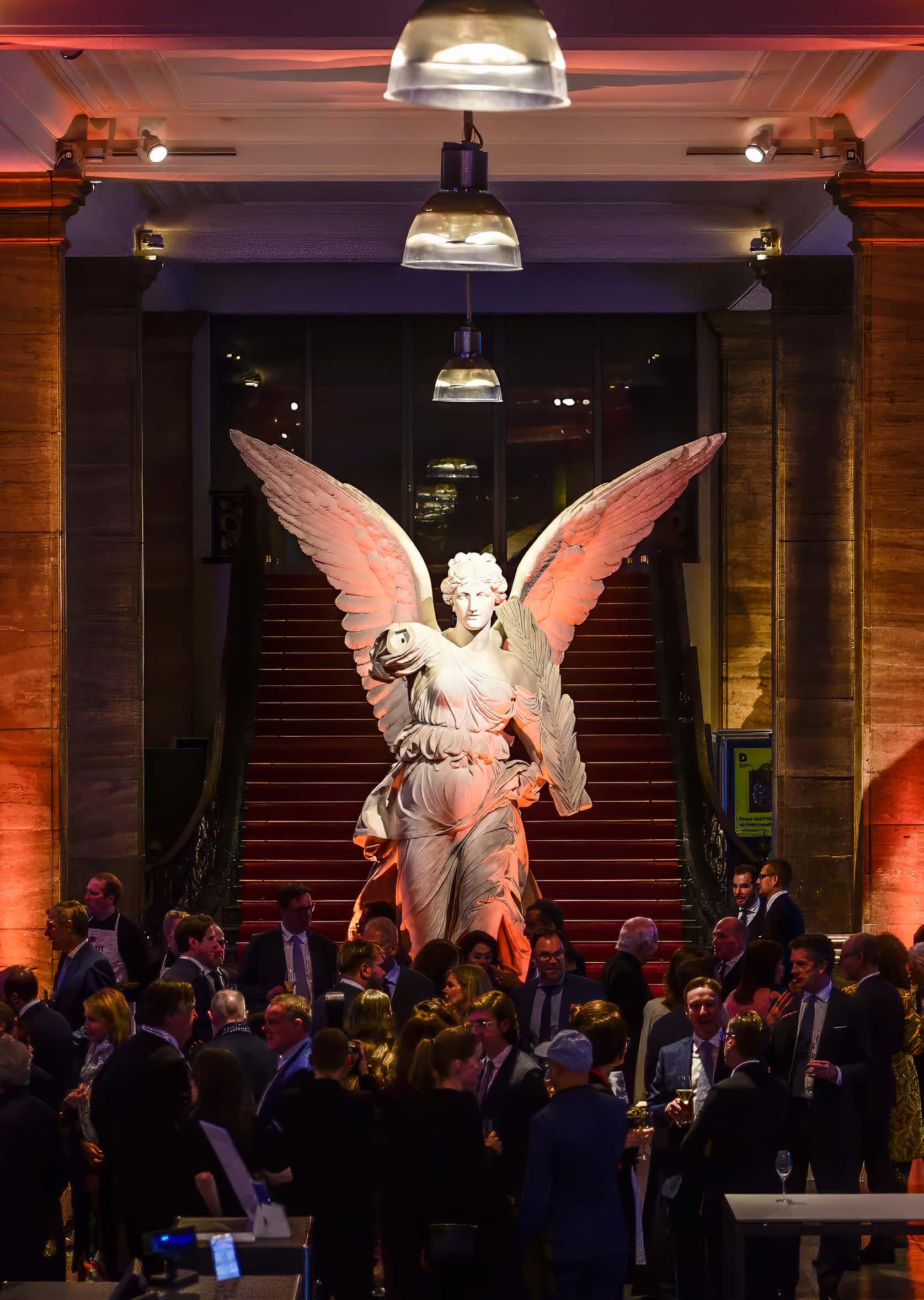
The Neues Museum in Berlin was a highlight of the cultural tours organised for participants in the Art Leaders Network in Berlin in 2018. An extension of the Altes Museum, it was constructed between 1841 and 1859 to house those parts of the rapidly growing royal collections of art, antiquities and ethnographic objects which no longer fitted in the original museum. An early example of neoclassicist architecture realised with Industrial Age techniques, the museum was conceived as part of Berlin’s Museum Island, later recognised by Unesco as a World Heritage Site.
The building was heavily bombed by the Allies between 1943 and 1945, with the roof and large parts of the structure destroyed and the interiors gutted by fire. It remained a haunting ruin in the heart of Berlin for decades until the British architect David Chipperfield began its restoration in 2003.
Chipperfield’s design philosophy and approach was “conservation, not reconstruction”. Instead of restoring the museum to its original 19th-century appearance, he preserved and stabilised what survived, reconstructiing missing parts in contemporary materials, and leaving visible the traces of time and destruction. Fresco fragments, bullet holes and war-scarred masonry remained in evidence as integral parts of the building’s history, while modern brick, concrete and glass were added to tonally match the old. The grand staircase hall and sequence of galleries were also restored.
The museum, which reopened in 2009, became a model for postwar heritage reconstruction, and Chipperfield was awarded the Pritzker Architecture Prize in 2023 for his works. The jury cited his “commitment to the permanence and humanity of the built environment”, highlighting the Neues Museum as a defining achievement.
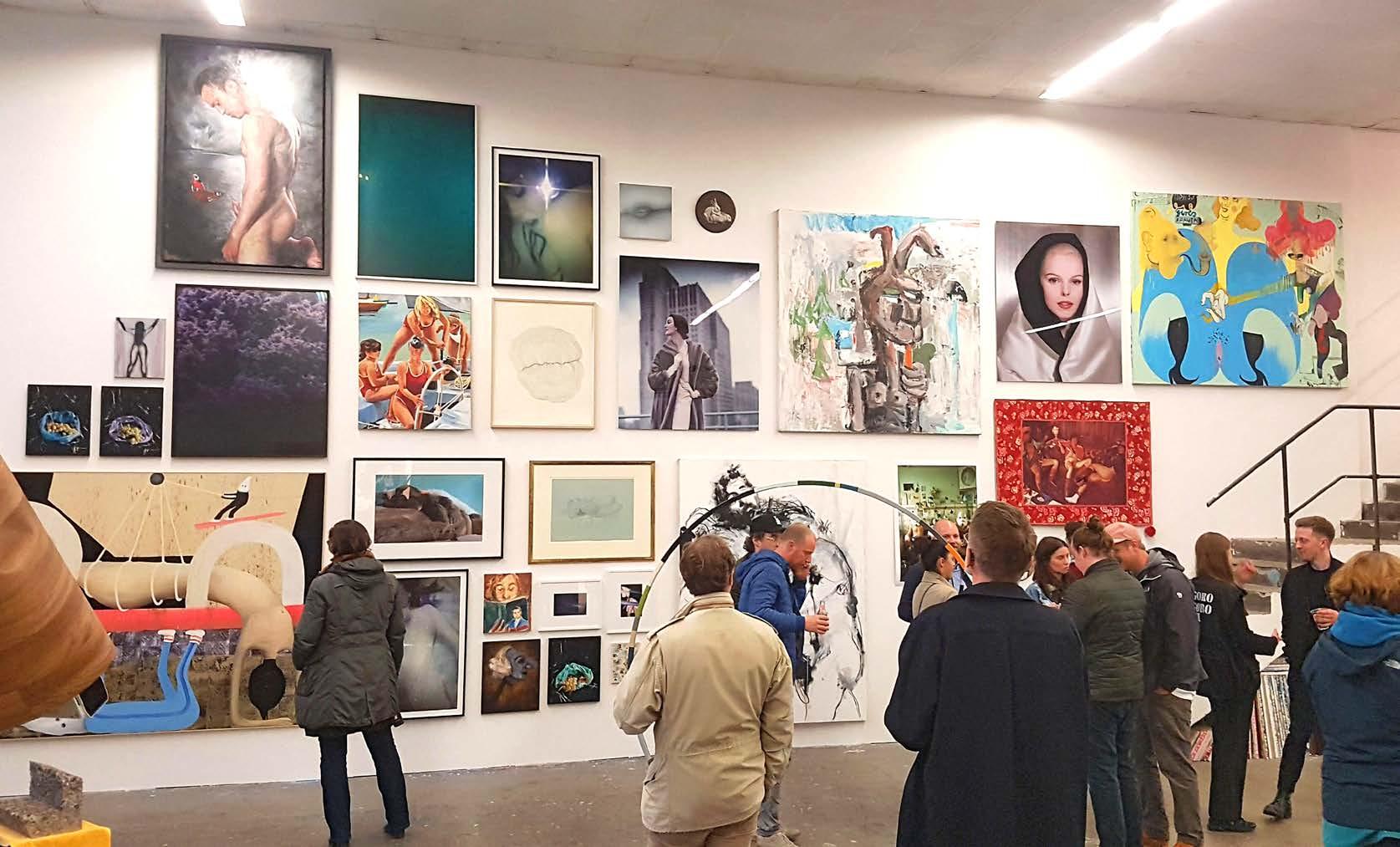
The Berlin Art Leaders Network coincided with the 14th edition of Berlin Gallery Weekend. Forty-seven galleries, including four newcomers, put on exhibitions enjoyed by Berliners and by the many international visitors, collectors, curators and art professionals who had travelled over for the weekend. Berlin demonstrated its continued appeal as a creativity hub, with at least 8,000 artists still living and working there, lured by the history and culture, but also by more affordable rents compared to other major European capitals.
Among the highlights of Berlin Gallery Weekend was a fourday exhibition titled Ngorongoro II, held in a former East German ceramics factory. Artists invited other artists to exhibit their work. The show had no curators, no labels, and no sales. Elsewhere in Berlin, inside a 1960s brutalist building that had originally been a church, the Kӧnig Galerie showed Swiss artist Claudia Comte’s installation When Dinosaurs Ruled the Earth, featuring a forest of monumental log sculptures.
One prominent artist with a longstanding Berlin presence – the Danish-Icelandic artist Olafur Eliasson – gave a presentation about how technology had transformed his art practice. He noted that everyone in his studio now worked with a computer, and that 40% of visitors to his exhibitions had been alerted to them by social media.
He said that social media and artists whose work was “Instagrammable” were part of a general trend: “the democratisation of art”. He added: “Insta-friendly doesn’t mean quality, but social media is an opportunity.” ■
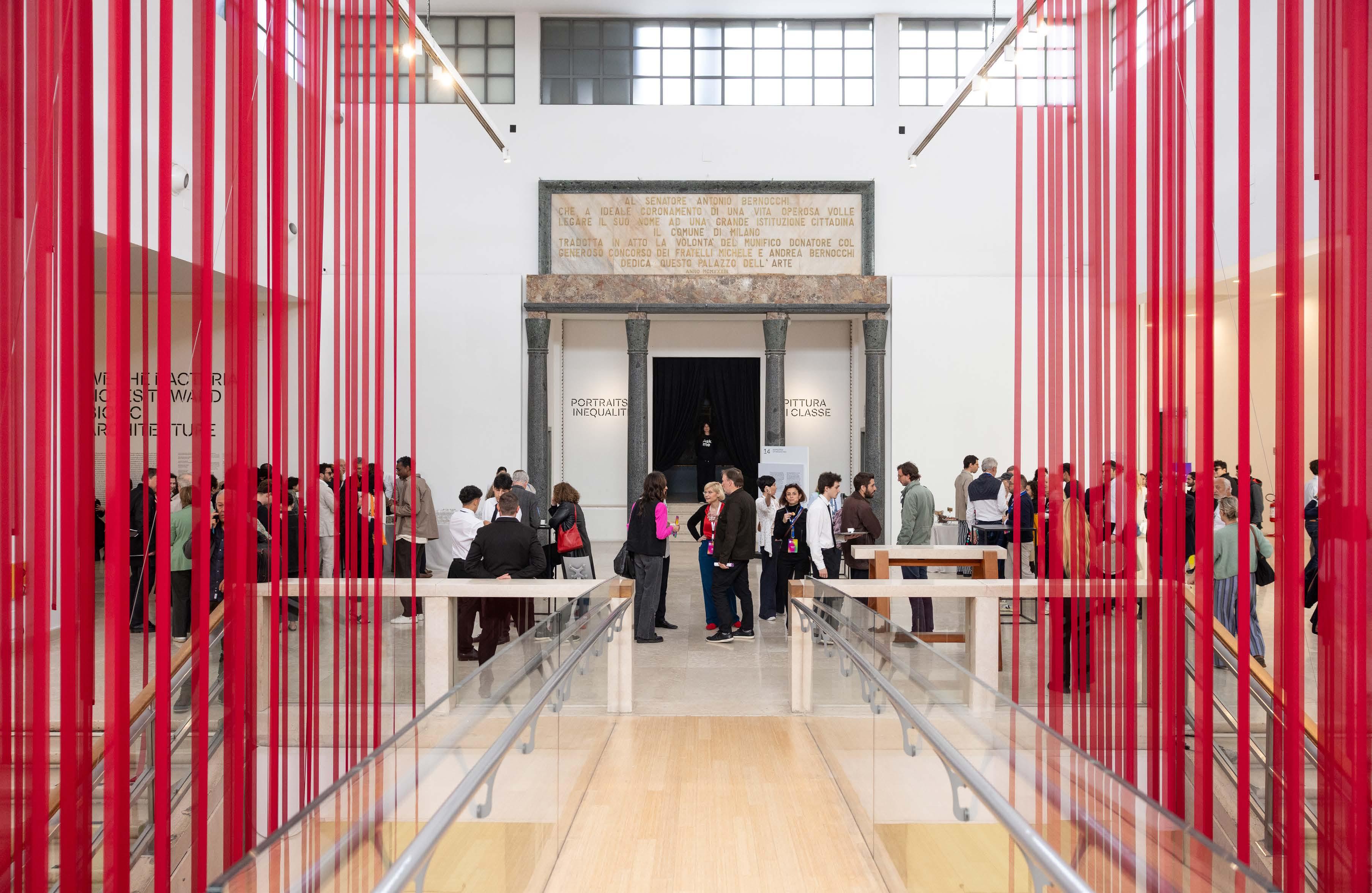
Above An exhibition during Berlin Gallery Weekend in 2018
Right The opening-night reception at the Bode-Museum in Berlin
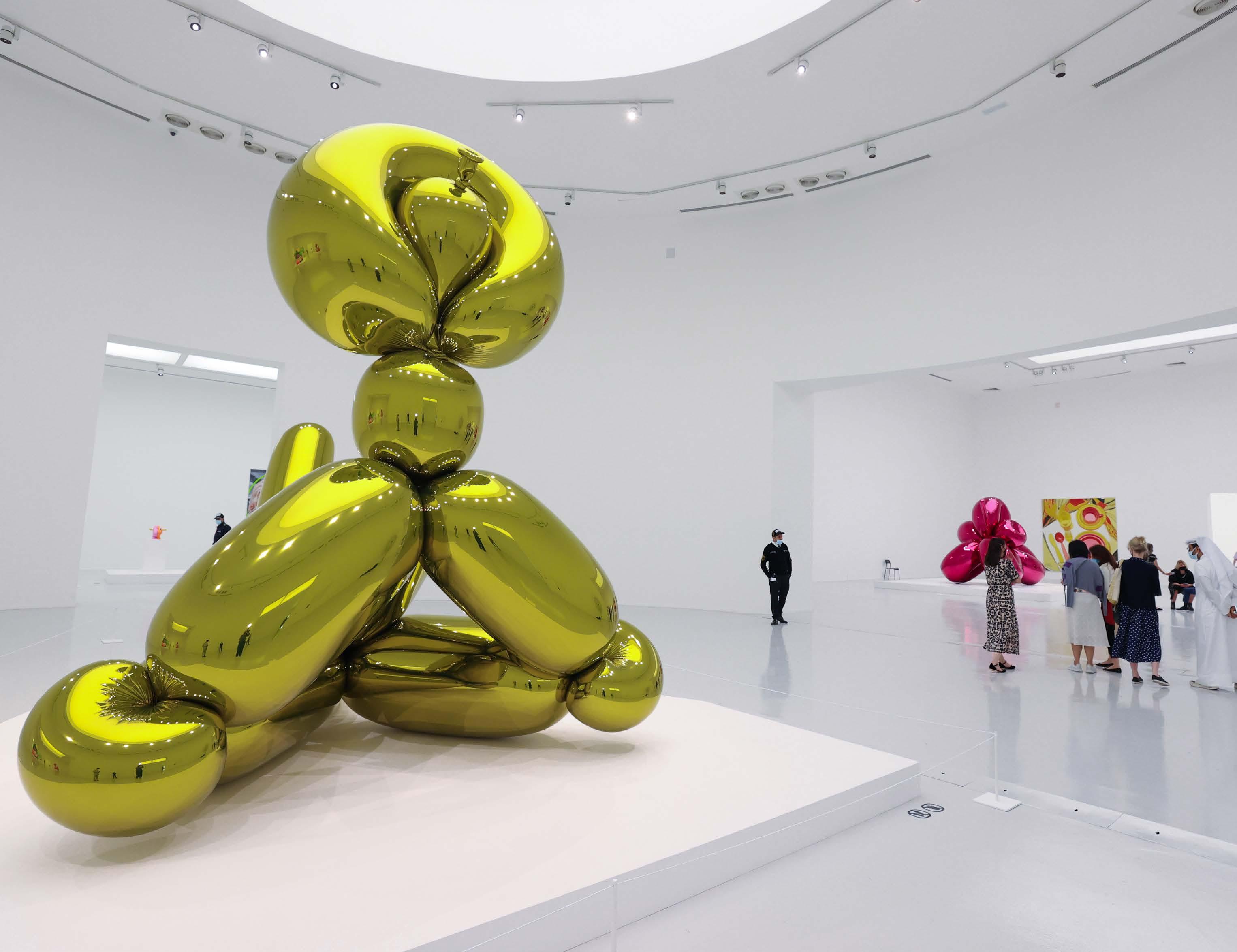
JEFF KOONS EXHIBITION AT AL RIWAQ
Jeff Koons’s first major survey exhibition in the Middle East – Jeff Koons: Lost in America – coincided with the Art for Tomorrow talks in Doha in 2021. Guests attended the exhibition’s evening opening, in the presence of the artist. The exhibition at Qatar Museum’s Al Riwaq Gallery in Doha in the fall of 2021 featured more than 60 works from the artist’s four-decadeslong career. Koons described it as “almost a hallucinogenic autobiography of growing up in the United States” in a Qatar Museum video. “I love everyday culture, and so my work embraces the everyday,” he said. “It celebrates colour, and it celebrates life’s energy.”
Koons is one of the most prominent and controversial figures in contemporary art, known for his glossy, monumental sculptures. Embracing pop culture, advertising and commercial imagery, he rose to prominence in the 1980s and became known for transforming banal, everyday objects into seamless sculptures produced with immaculate precision, whose trademark mirror-polished surface invites viewers to see themselves reflected in the art.
Koon’s iconic, monumental works include Rabbit, 1986, Balloon Dog, 1994-2000, Michael Jackson and Bubbles, 1988, and Puppy, 1992. His Rabbit, 1986 – a stainless-steel sculpture of an inflatable toy bunny, rendered at about 3ft tall – is perhaps his most iconic sculpture. One edition of Rabbit sold at Christie’s in 2019 for US$91.1 million – the highest auction price for a living artist at the time.