Contents INTRODUCTION 6
The 1960s EXTRAORDINARY TIMES 124
The Menus The 1870s
The 1970s ONE HUNDRED YEARS ON 138
WATCHING THE WHARVES 8
The 1880s
The 1980s THE NIGHT’S AMBROSIA 152
AN INTELLECTUAL KALEIDOSCOPE 12
The 1890s
The 1990s SOMETHING OLD, SOMETHING NEW 164
YOU’RE A PEACH! 18
The 1900s
The 2000s THE KINSTLER YEARS 178
THE SINDELAR YEARS 34
The 1910s
The 2010s THE TRADITION CONTINUES 188
THE GREAT WAR 58
The 1920s
A NOTE ABOUT THE MENUS 202
THE GREAT DROUGHT 76 STATE DINNERS OF THE LOTOS CLUB 204
The 1930s RED INK 94
The 1940s
ACKNOWLEDGMENTS 212
INDEX OF STATE DINNER HONOREES 214
ON THE MOVE 102 PICTURE CREDITS 215
The 1950s THE BIRTH OF THE LOTOS STATE DINNER 110
The new Lotos Club, once it was up and running in a rented brownstone at No. 2 Irving Place, quickly acquired a reputation for good fellowship and hospitality. Its entertainment committee reportedly watched the wharves for the arrival of possible dinner guests, including British writer Charles Kingsley, who was met on the deck of his steamer. “But, gentlemen,” he protested, “I am trying to view the approaches to New York. I cannot make any engagements now.” Four days later, however, he found his way to Irving Place and was welcomed by the Club.
the 1870s WATCHING THE WHARVES
Guests during this first decade were many and varied. Three hundred gentlemen crowded the parlors to hear Henry Stanley talk about finding Dr. David Livingstone in the heart of Africa. A shivering King Kalākaua of Hawaii was treated to lobster salad on a frigid December night. And in 1877, Lotos started a tradition that continues today: welcoming New York City mayors to its table. By the time Gilbert & Sullivan were entertained in November 1879, the Club had moved to a larger house at Fifth Avenue and Twenty-first Street. There, in more elegant quarters, the simple receptions of the early 1870s gave way to full-blown banquets, followed by a long procession of speakers. But the idea of creating a souvenir menu card was just beginning to catch on.
Henry M. Stanley and his gun bearer, Kalulu, from an 1872 carte-de-visite; the Lotos clubhouse at 149 Fifth Avenue; David Kalākaua, King of Hawaii.
U THANT
JAMES A. MICHENER N OVE L I S T, N ON FI C T I ON W R I T E R DE C E M BE R 16, 1975
Storyteller to the Nation
ON T THE HE M HE MENU ENU ENU EN
The menu courses offer a culinary expression of states and nations united, with shrimp remoulade, a traditional New Orleans favorite; Long Island duck Montmorency, made with cherries from Michigan; Italian gnocchi; and French desserts.
“S
TORYTELLING CAME NATURALLY TO ME,” JAMES MICHENER
The lithographed menu for this State Dinner was the work of Martin Schreiber, a designer for Ampco Printing-Advertisers Offset, owned by Lotos member Seymour Udell. The cover (left) carries a photograph of U Thant, the United Nations logo and a picture of U.N. headquarters in New York. Inside (previous page) is a photo of Secretary-General Thant at the podium in the General Assembly Hall. The menu’s back cover (above left) features a photo of the Security Council below a list of Lotos leaders. On the menu page (above right) Thant is seen at the U.N. microphone and congratulating his successor as secretary-general, Kurt Waldheim. 146
once said. His long career was certainly a testament to that statement. The author began his first book, Tales of the South Pacific, while in the Navy Reserve during World War II. Although it won a Pulitzer Prize in 1948, it was not a bestseller until Richard Rodgers and Oscar Hammerstein II turned the book into an enormously popular stage musical the following year. With Hawaii in 1959, Michener found a successful formula: the epic, multi-generational saga set in an intriguing place. His books, often weighing in at eight hundred pages or more, combined well-researched history, travelogue, and fiction. Nine of his forty books, including Chesapeake, Texas, and Alaska, topped The New York Times bestseller list, and many were made into popular movies and television miniseries. His work made him rich, and Michener gave away more than $100 million to charity, $37 million to the University of Texas, and millions in artworks to various institutions. Speaking at Michener’s State Dinner, humorist Art Buchwald brought down the house with a parody of his friend’s exhaustive histories, as he traced the geography of Michener’s birthplace back “three billion, six hundred million years.” Ned Butterfield’s menu design, borrowing liberally from the visual vocabulary of early twentieth-century Lotos menu illustrator Thomas Sindelar, uses lotus flowers, an entwined ribbon bearing book titles, flags, and vignettes from the writer’s works. On the left are illustrations inspired by Hawaii and also by The Bridges at Toko-Ri, a novel about the Korean War whose title is misspelled on the menu.
R O N CH ER N OW
STATE DINNER IN HONOR OF
B I O G R A P H ER
Ron Chernow
J A N U A RY 3 1 , 2 0 1 9
America’s Biographer G
ENERAL DAVID PETRAEUS TOLD THE LOTOS CROWD THAT RON
Chernow was, above all, “a brilliant storyteller.” His books were informed by exceptional research and thoughtful treatment of his subjects, Petraeus said, and were also “exceedingly readable.” His most recent, Grant, a biography of the Civil War hero and U.S. president, was a particular favorite of Petraeus, who said Chernow “restored America’s Ulysses to his rightful place in history.” There was a murmur of excitement when Chernow said he would speak about how he “got mixed up with a certain musical about the founding fathers and founding mothers.” In 2008, a mutual friend introduced the author to Broadway musical creator Lin-Manuel Miranda, who was “obsessed” with Chernow’s 2004 biography of statesman Alexander Hamilton. Miranda told him that as he read Hamilton, “hip-hop songs started rising off the page.” Chernow was puzzled. “This was not a typical reaction to one of my books,” he confessed to great laughter. Chernow admitted to being a “world-class ignoramus” about hip-hop, but said that changed when he heard Miranda’s first song for the new musical. “You’ve taken the first forty pages of my book and you’ve accurately condensed them into a four-minute song!” he remembered telling Miranda. To the great Ron Chernow and Zenos Frudakis at the writer’s Brooklyn home.
Thursday, January 31, 2019
delight of the audience, Chernow recited the lyrics to that song. Miranda’s work, he said, carried us back to the Greeks and Elizabethans, teaching us “the charm of verse drama.” Despite initial misgivings about Miranda’s mixed-race cast, Chernow concluded it was a “stroke of genius.” The actors had a “special feel for the passion, energy, and idealism of the American Revolution.” Hamilton was a blockbuster from the moment it opened in 2015. At the end of the evening, artist Zenos Frudakis gave Chernow the painting he had created for the souvenir menu. “It actually looks like me,” the author told the artist, who included portraits of the subjects of Chernow’s last book, Ulysses S. Grant, and of his work-in-progress, Mark Twain. Mary Kornblum designed the menu around the portrait.
ABOUT THE ARTIST
Primarily a sculptor, Zenos Frudakis has created public monuments, portrait statues, busts, and figurative sculpture, including Freedom, his 2000 work on the streets of Philadelphia. Frudakis studied sculpture and painting at the Pennsylvania Academy of the Fine Arts, and is known for his ability to capture the likeness, character, and vitality of his subjects in both two and three dimensions. A Lotos member since 1991, Frudakis created a bust of Mark Twain for the Club for its one hundred twenty-fifth anniversary in 1995.
R
ON CHERNOW’S BESTSELLING BOOKS include The House of Morgan, winner
of the National Book Award; The Warburgs; The Death of the Banker; Titan: The Life of John D. Rockefeller, Sr.; Washington: A Life, which received the Pulitzer Prize for Biography; and most recently, Grant, named one of the Ten Best Books of 2017 by The New York Times. His 2004 book Alexander Hamilton was adapted into a ground-breaking Broadway musical. Mr. Chernow is a former president of PEN America and was awarded the 2015 National Humanities Medal. He is currently at work on a biography of Mark Twain. THE LOTOS CLUB • FIVE EAST SIXTY-SIXTH STREET • NEW YORK, NEW YORK
200
THE MENU
Dungeness Crab Parfait Salmon Caviar, Celery Root, Wild Arugula Pickled Radish Pistachio-Crusted Roasted Veal Loin Porcini Mushrooms, Winter Vegetable Bouchée Artichoke Mousseline, Sauternes Sauce Roasted Fig Tartlet Mascarpone Cheese Panna Cotta Chocolate Dome, Caramel Sauce
Book, text, photography and artwork copyright © 2019 The Lotos Club First published in 2019 by Scala Arts Publishers, Inc. 1301 Avenue of the Americas New York, NY 10019 www.scalapublishers.com Published in association with The Lotos Club 5 East 66th Street New York, NY 10065 www.lotosclub.org Distributed by ACC Art Books 6 West 18th Street New York, NY 10011 ISBN: 978-1-78551-232-2 Cataloging-in-Publication Data is available from the Library of Congress. All rights reserved. No part of the contents of this book may be reproduced, stored in a retrieval system, or transmitted in any form or by any means, electronic, mechanical, photocopying, or otherwise, without the written permission of The Lotos Club and Scala Arts Publishers, Inc. Designed by Mary Kornblum Production Associate: Jeffrey Stern
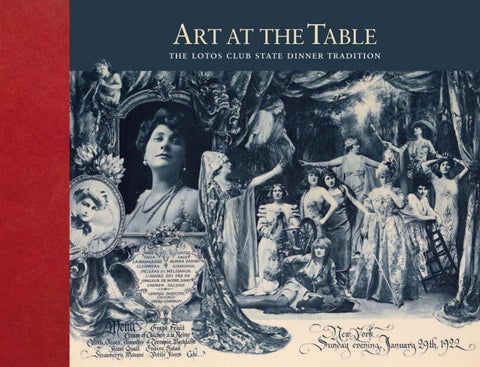
Front cover: Detail of the menu for the 1922 Mary Garden dinner. Back cover: Cover of the 1899 menu for Chauncey M. Depew. Frontispiece: The first Lotos State Dinner for James Anthony Froude, published in Frank Leslie’s Illustrated Newspaper, November 2, 1872. Pages 4-5: Details inside the Lotos clubhouse at 5 East 66th Street. Page 212: Drawing of a Lotos dinner by Edward Moran, published in the Club’s “Souvenir of the Twentieth Anniversary of the Lotos,” 1890. Left: Adapted from the cover of “Souvenir of the Twentieth Anniversary of the Lotos,” 1890.