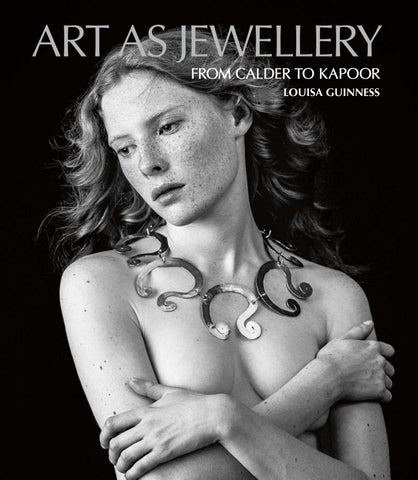
ART AS JEWELLERY FROM CALDER TO KAPOOR LOUISA GUINNESS
“ONE SHOULD EITHER BE A WORK OF ART OR WEAR A WORK OF ART” OSCAR WILDE
“ONE SHOULD EITHER BE A WORK OF ART OR WEAR A WORK OF ART” OSCAR WILDE
VERY LITTLE WAS WRITTEN ABOUT GIANCARLO MONTEBELLO DURING THE GEM YEARS. THERE WERE A FEW INTERVIEWS BUT THE SURFACE WAS BARELY SCRATCHED. HOWEVER, IN THE BOOK ‘JEWELRY BY ARTISTS IN ITALY 1945 -1995’, PUBLISHED IN 1995, GIANCARLO BROKE HIS SILENCE AND TOLD HIS STORY IN PRINT. WHAT FOLLOWS IS THE EDITED AND UPDATED VERSION OF THE TEXT THAT APPEARED IN THE EPONYMOUS BOOK OF THE EXHIBITION, BY LUISA SOMAINI AND CLAUDIO CERRITELLI: 66
67
136
137
136
137
158
159
158
159
POWERFUL, IRREVERENT, SUBVERSIVE AND HUMOROUS – THE DEFINING QUALITIES OF TIM NOBLE AND SUE WEBSTER’S ART HAVE NOT BEEN LOST IN TRANSLATION AS RINGS, NECKLACES, BRACELETS AND CUFFLINKS. The infamous British double act were already familiar with the medium when they were approached by Louisa Guinness about the possibility of making jewellery in 2004. Before he met Sue, Tim modelled and wore a silver skull ring, cast in silver at Tim’s request by his mother, a goldsmith. Soon after Tim met Sue, he gave her a ring, cast from his own but in gold, marking the beginning of a long-lasting relationship. Standing outside the then very new and fashionable White Cube Gallery in London’s Hoxton Square, Sue Webster and Louisa Guinness got talking. ‘I didn’t know who Louisa was but I was attracted to the necklace she was wearing at the time which said “CUNT”, spelled in bejewelled gothic writing.’ recalls Sue. ‘I immediately wanted one.’ Noticing Sue’s ring, Louisa enquired if she had ever considered making jewellery. They took a mould from the ring and were planning on making a version, but at the last minute Sue decided she did not want anyone else wearing ‘her’ ring and the design in this form was cancelled. However, the ring did go on to inspire a series of cufflinks designed by the artists in 2004. Other works in Tim Noble and Sue Webster’s 2004 series of jewellery were based on their iconic light sculptures. These early works explored the artists’ interest in the abstraction of single word images and the trappings of popular culture. At once art and anti-art, high culture and popular culture,
Page 215: Fucking Beautiful, Large, 2014 Necklace 18 ct rose gold polished 44.7 x 2.7 cm, edition of 10 Right: Fucking Beautiful, 2002 8 neon sections, transformers 148 x 6.5 x 168 cm
216
217
224
225
224
225
SIR PETER BLAKE IS OFTEN REFERRED TO AS THE GODFATHER OF BRITISH POP ART… His painting skill is extraordinary but he makes few works. Many famous people have sat for Blake, and a recent exhibition by the artist was comprised solely of portraits. His work has long been inspired by a love affair with icons and the ephemera of popular culture. He is also well known for his limited edition prints, books and the sleeve design for The Beatles’ Sgt. Pepper’s Lonely Hearts Club Band.
When Blake was approached by the Louisa Guinness Gallery, the ambition was to encapsulate a piece of his art, literally, in an item of jewellery. Ideas were discussed extensively in Blake’s remarkable studio, but despite hours of deliberation nothing concrete emerged. The spark eventually came courtesy of Peter’s old ‘Elvis’ cufflinks. Blake is an Elvis Presley fan of the highest order; he collects memorabilia of all kinds but Elvis is a particular passion, and the artist has made several sculptures in celebration of the singer. Blake’s battered silver cufflinks were inexpensive souvenirs from Graceland, shaped to the classic design that any man who dons a cufflink early in the morning will instantly recognise. The design works and the cuff chasing is limited. Blake agreed to revamp the cufflinks and make them his own. Working with the Louisa Guinness Gallery, the smallest ready-made glass watch face available was found. Circles this size were drawn out on a piece of paper and given to the artist. Blake painted hearts, targets and stars inside, and created a few tiny collages that were then set behind the glass face. A cufflink matching the design of the Elvis piece was made, although the battered sliver was replaced with 18ct gold. The swivelling bar at the back of the cufflink was replaced with a tiny gold spoon inspired by a large-scale piece Blake was working on at the time. Each watercolour was signed, and each was unique.
Page 225: Collage Necklace, Crosses, 2010 Silver, chain: 28.2 cm, largest cross: 4.5 x 5.2 cm, unique Above: Red Star Cufflinks, 2008 18 ct gold and watercolour on paper Diameter: 2.2 cm, spoon: 3 cm, a unique watercolour Right: Watercolours painted by Peter Blake for his cufflinks
226
227
QUINN CONNECTS FREQUENTLY AND MEANINGFULLY WITH ART HISTORY, FROM MODERN MASTERS RIGHT BACK TO ANTIQUITY. so pave-set diamonds. In total, more than 560 diamonds were individually set, amounting to more than six carats. Not only is the intrinsic value of the gold unusually high for a jewellery piece of this type, but the hours spent setting the diamonds were also numerous. The result is a perfectly beautiful fruit suspended on a rotating chain that sits nestled on the wearer’s front. ‘I like the form of the strawberry for a number of reasons, mostly because it’s like a heart,’ says Quinn. ‘The strawberry is a refreezing of one of my frozen sculptures, only in another medium.’ Inspired by working in precious metal for his jewellery collaboration with Louisa Guinness Gallery, Quinn continued to work with the same goldsmith on another of his larger-scale sculptures, Siren, a solid-gold sculpture of Kate Moss practising yoga, completed in 2008. Quinn’s 2008 flower sculpture series ‘The Nurseries of El Dorado’ consisted of an exotic array of plants cast in bronze, which bore the flowers, fruits and vegetables from far off climates and ecosystems, hybridising them into one magical species. It’s a concept he has subsequently applied to jewellery, creating orchid rings in solid gold. The artist followed a detailed process to create the flower jewellery, as explained by his goldsmith:
240
Orchid blooms are chosen by Marc for his rings, which he then sends for casting. The blooms are very delicately attached to wax rods which will act as feeders for the gold to pass down. The whole structure of wax rods and natural petals is painted with a refractory mix of plaster, brick dust and fine silica in water; this creamy mix sets over a period of a few minutes, trapping the flower and wax rods in a block of the solidified plaster mix. The resulting block mould is then baked in a kiln at 700C in order to burn out the flower, melt the wax rods and dehydrate the mould. In the meantime, gold is melted in a furnace and, once molten, poured into the space in the block mould left behind by the burnt-out flower. Once cold, the metal is broken out of the mould, cleaned and polished before being attached to a ring made from a beaten gold band. The process is simple in theory but tricky in practice due to the extreme thinness of the petals. However, enough examples cast perfectly to make the rings possible. 241
YINKA SHONIBARE’S SCULPTURE EXPLORES THEMES OF CULTURAL IDENTITY, COLONIALISM AND POST-COLONIALISM. A British-Nigerian artist living in London, Shonibare mbe often incorporates African batik fabric into his work. When invited to make jewellery in 2010 by Louisa Guinness Gallery, he had just completed the sculpture for the ‘fourth plinth’ on Trafalgar Square, London. Shonibare was the first artist chosen to reflect specifically on the historical symbolism of Trafalgar Square, which commemorates the Battle of Trafalgar, and to link his work directly to Nelson’s Column. His large-scale sculpture, Nelson’s Ship in a Bottle, featured a scale replica of HMS Victory in a giant bottle. The next challenge came when Shonibare decided to reduce this even further to make a pendant. The sails, on both sculpture and pendant, were made from African batik material, its rich pattern symbolic of African identity and independence. The challenge of enclosing the ship inside the bottle was overcome, and a mini pedestal was created for the bottle and ship to rest on while not being worn. A silver chain was attached and – with a nod to the ocean – a clasp in the form of an anchor completed the circle. Shonibare is also interested in the Victorian age, and made two Toy Painting necklaces. These are similar to his wall art, but where his large-scale work attaches full-size toys to the circumference of a batik-clad disc, for the equivalent jewellery he used Victorian charms from a vintage charm bracelet. The charms served the same purpose as the toys and created a star-like effect around a disc.
Page 261: Ship in a Bottle Pendant, 2011 Hand painted resin, glass, wood and silver Bottle: 3.5 x 6.9 x 3.5 cm, plinth: 5.0 x 5.1 x 2.5 cm, edition of 10 Left: Toy Painting, 2010 Pendant Silver, found charms, batik fabric with chain Inner circle: 6.8 cm, chain: 38 cm, unique within a series of 25
262
“IT WAS GREAT TO WORK WITH LOUISA ON CREATING AN ACCESSIBLE FORM OF MY SHIP IN A BOTTLE PROJECT IN TRAFALGAR SQUARE. IT WAS VERY EXCITING TO SEE THE RELATIONSHIP BETWEEN ART AND THE ART OF JEWELLERY MAKING.” YINKA SHONIBARE mbe
A V
280
281
A V
280
281
“I TREAT JEWELLERY AS WEARABLE SCULPTURE, WHICH FITS TO THE BODY WITH THE BODY BEING IN CONTROL OF THE SCULPTURE” CONRAD SHAWCROSS
Because of the title, each piece in Seven Days inevitably becomes associated with the chronology of the weeks, and further exploits the artist’s use of the sequence to create a control. As Shawcross explains, working at a reduced scale helps guide the design of his jewellery: ‘The constraints give me ideas; so making pieces to fit the body gives me constraints, which I enjoyed responding to.’
Loop System, 2013 Bracelets Displayed in dedicated oak box, lined with a series of seven pendulum-driven drawings signed and inscribed by the artist Silver Diameter: 14.0 cm, Pencil on Paper: 14.0 x 14.0 cm, External Box: 21.1 x 131.5 x 7.5 cm, edition of 10
316
317
EMILY YOUNG’S PRACTICE UNDERSCORES HER DEEP PREOCCUPATION WITH OUR RELATIONSHIP WITH THE PLANET. Working with large blocks of stone – granite, marble, alabaster, chalcedony, malachite, lapis lazuli or quartz – Young creates torsos, heads or abstracted forms, with a combination of traditional carving skills and technology.
She had been drawn to jewellery making for some time. Taking the offcuts from her monumental lapis work, she began to shape and polish talismans. ‘Often, they already had beautiful accidental shapes: little torsos, or heads,’ she says. ‘And I thought, if I just tidy these little shapes up a bit, refine them, they could be tiny portable sculptures, full of the natural beauty both of the material and also the accidental nature of their forms.’ Young would carry scaled-down sculptures with her or give them as gifts. Following discussion with Louisa Guinness Gallery, these tactile forms were delivered to a London goldsmith who, with great skill, applied gold mounts and traces to the stones. The artist explains: ‘The large pieces that I make, some of them weighing over twenty tonnes, and these small pieces all come from the same place – from the detritus of the natural world, the unwanted stones, the broken pieces, often formed hundreds of millions – if not billions – of years ago. When worked by a human hand with a careful kind of consciousness, a kind of devotion to the planet, beauty can appear from these simplest of places. And to wear one of these pieces on your body seems a particularly easy way of being in touch with the beauty of the earth, its geology, its delicacy, its strength. The notion that we can connect more profoundly with our wounded planet is all important to me.’
Page 329: Little Lapis Goddess, 2016 Pendant 18 ct gold and lapis lazuli 3.7 x 1.1 x 0.7 cm, unique Opposite Left: Little Goddess VI, 2016 Pendant on Plinth 18 ct gold and chrysomelanite 6.4 x 2.0 x 2.8 cm, unique Opposite Right: Little Lapis Goddess II, 2016 Pendant 18 ct gold and lapis on Plinth 12.5 x 4.5 x 0.4 cm, unique
330
“I HAVE AN INSTINCT THAT EVERY PART OF OUR PLANET, EVERY GRAIN OF SAND, EVERY DROP OF WATER, EVERY CREATURE, EVERY BLADE OF GRASS, IS PRECIOUS AND DESERVING OF CARE. SO MY OFFCUTS, WHICH COULD BE USED FOR JEWELLERY, WERE PRECIOUS TOO, AS WERE THE ORIGINAL PIECES OF STONE FROM WHICH THEY CAME.” EMILY YOUNG 331
ART AS JEWELLERY FROM CALDER TO KAPOOR LOUISA GUINNESS ALEXANDER CALDER • SALVADOR DALÍ • PABLO PICASSO MAN RAY • LUCIO FONTANA • MERET OPPENHEIM HARRY BERTOIA • MIMMO ROTELLA • NIKI DE SAINT PHALLE ALBERTO GIACOMETTI • POL BURY • WILLIAM COPLEY PIETRO CONSAGRA • LOUISE NEVELSON • ROBERT RAUSCHENBERG LEONOR FINI • GEORGE RICKEY • ARNALDO AND GIÒ POMODORO CÉSAR • MAX ERNST • JESÚS RAFAEL SOTO • ARMAN EDUARDO CHILLIDA • GÜNTHER UECKER • YAYOI KUSAMA ANTHONY CARO • BEATRIZ MILHAZES • ROBERT INDIANA CLAUDE LALANNE • SOPHIA VARI • ANISH KAPOOR ANTONY GORMLEY • GAVIN TURK • TIM NOBLE AND SUE WEBSTER MICHAEL CRAIG-MARTIN • PETER BLAKE • HEINZ MACK GIULIO PAOLINI • GIUSEPPE PENONE • BERNAR VENET LOUISE BOURGEOIS • KENNY SCHARF • SAM TAYLOR-JOHNSON MARC QUINN •CORNELIA PARKER • MARIKO MORI • ED RUSCHA RON ARAD •YINKA SHONIBARE • BILL WOODROW • KEITH HARING GRAYSON PERRY • JOANA VASCONCELOS • ROSS LOVEGROVE NOT VITAL • JASON MARTIN • ROB WYNNE • PARVIZ TANAVOLI FRANK STELLA • JANNIS KOUNELLIS • ILYA AND EMILIA KABAKOV AI WEIWEI • ERWIN WURM • BLANCA MUÑOZ • DAMIEN HIRST UGO RONDINONE • KENDELL GEERS • DINOS CHAPMAN REBECCA HORN • MIKE CHAVEZ DAWSON • CHRISTOPHER THOMPSON ROYDS • JEFF KOONS • WILLIAM TURNBULL CONRAD SHAWCROSS • STEPHEN COX • NIC FIDDIAN GREEN ENRICO CASTELLANI • ALLEN JONES • EMILY YOUNG
ISBN: 978-1-85149-870-3
ËxHSLIPBy498703zv;:(:&:!:+
£45.00/$75.00
www.accartbooks.com