Table of Contents
A Note from the Translator
A Short Preface
Introduction
Life
Architecture of Life
Sharing
Why is this Soup Delicious?
Architecture
The Price of Architecture
Architectural Theory and Classical Chinese
About Light
Primal Scenes of Architecture
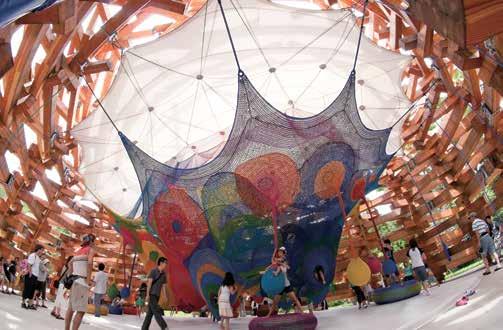
Fuji Kindergarten
Is this a Donut Shop?
Architecture for Children
Meeting Kashiwa Sato
Married Couple Architects
How to Build a Kindergarten
Ensō
No Walls
Noise
Children and Background Noise
Fuji Kindergarten is a Flea Market
School Buildings and Education
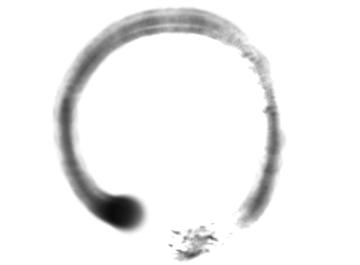
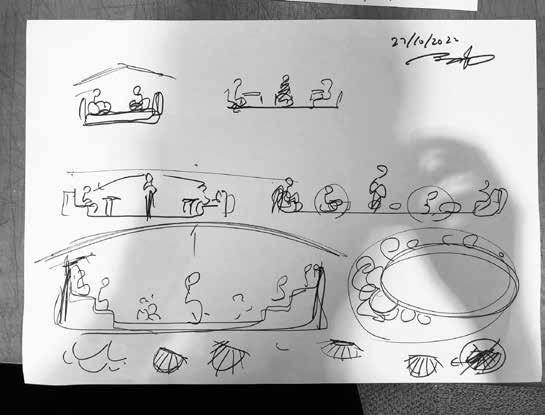
Ensō sketch
There is no center. The placement of the columns was decided by drawing a ring around the existing trees and gatherings of children. The architecture does not determine life, but rather life determines the architecture.
Fuji Kindergarten does not have a principal’s office. Instead, the principal’s desk is located in a corner near the entrance. In a conventional school, this would be the place for the security guard’s office. The principal is not a security guard. The door is open to welcome the children. Crayfish, loaches, and other mysterious items are lined up in front of the desk. It’s just like a night market at a temple festival. From here, all the rooms are visible. But this is not the center. It is part of the ring, like the kindergarten pupils. With everyone seeing and being seen, hearing and being heard, endless equal and cheerful events unfold.
074 Fuji Kindergarten
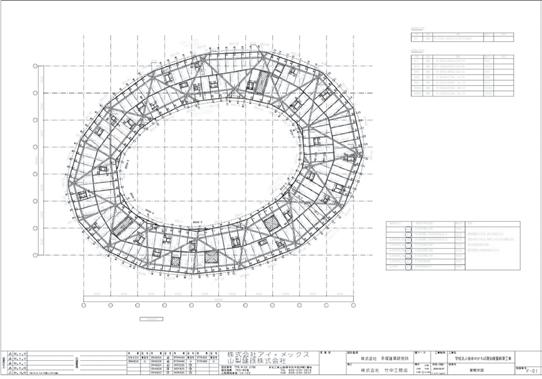
Fuji Kindergarten structural drawing
When I give lectures, I’m sometimes asked, “Are you aware of Jeremy Bentham’s panopticon architecture?” Fuji Kindergarten is the polar opposite of that concept. The panopticon is a concept for a prototypical prison conceived by Jeremy Bentham, who also created the term “international.” He is the thinker who invented the concept of the “greatest happiness of the greatest number.” At a glance, this may seem similar to modern democracy, but it is not. It is an idea that predates the concept of democracy. His idea has a center. A single leader will decide what is the greatest happiness of the greatest number. This is tied to Thomas Carlyle’s “Great Man” theory. It is also tied to Karl Marx’s later spinoff, socialism. In short, the idea is that a wise person sitting in the center will think about everyone’s happiness. It is a monotheistic, unitary concept. The panopticon has a center. It is the concept of prison guards thinking about the wellbeing of prisoners. Needless to say, a pris-
Jewels are buried in the garden of Fuji Kindergarten. I call them jewels, but most of them are fake. Occasionally a real jewel is mixed in. It’s a prank by the kindergarten principal. Hearing that there are some real ones, the parents tell their children, “Try your best and find them.” When a child brings one back, their parents praise them. There is no acting or flattery. It’s real. Even so, it is just junk jewelry and nothing that could be sold. But it’s good. The kindergarten principal is like an old guy running a food stall who well understands the psychology of his customers.
Principal’s office at Fuji Kindergarten
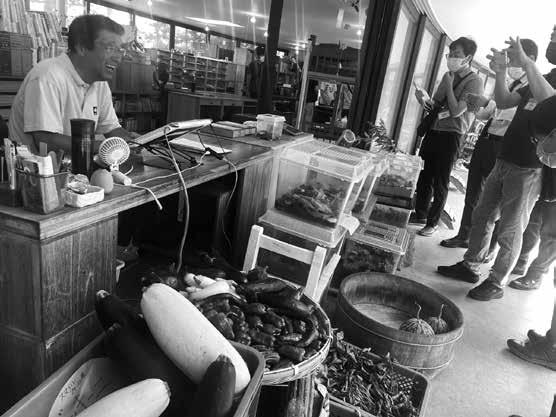
Fuji Kindergarten has no principal’s office. Instead, he sits behind a row of rhinoceros beetles and crayfish lined up near the entrance. When I was a child, if the nearby Kuzuya Goryo Shrine had a festival, a market would be held for a few days. Thinking back on it now, it seemed like it was run by muscular people, tattooed Monmon men who treated me kindly and allowing me to tend the stalls. At a strategic point along the approach to the shrine sat the boss with a hakka pipe, scowling over the entire business. He was the ringleader. That’s what Mr Kato’s principal’s office is like. Everyone knows the principal is the most important person. He sees and knows everything that’s going on in the kindergarten. Every child who arrives at the kindergarten says, “Good morning.” The kindergarten principal says, “Good morning.” It’s a beautiful daily life that seems so obvious, yet so unprecedented.
Fuji Kindergarten isn’t an especially fancy building. Of course, as an architect, I am very particular about details, but by now, it doesn’t really matter. The magic of the flea market still hangs over the kindergarten today.
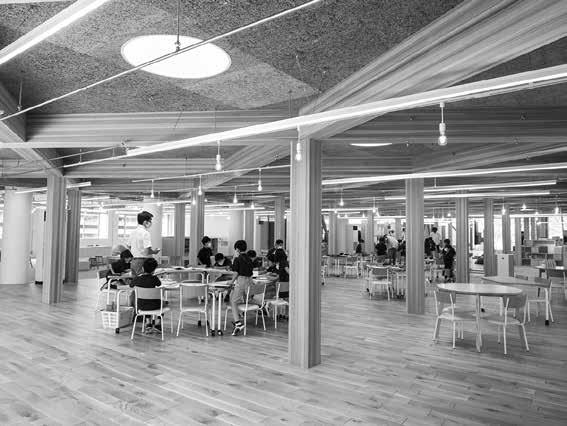
sounds and voices can be distracting, making teaching difficult. This is because each sound carries information. However, when multiple classrooms are mixed while echoes are suppressed, the moderate overlap of information becomes background noise. Background noise does not interfere with teaching. In real society, there are almost no places without background noise. While we often have intimate conversations with friends in coffee shops or bars, such places are not silent. Rather, silent spaces make it difficult to have deep conversations. No one would rent a quiet conference room for a deep, personal talk. Thinking about it in this way, it becomes clear how exceptional a quiet classroom is in real society.
Humans are creatures that require background noise. We are not accustomed to silence. More than ten years ago, I was invited to a Kecak dance performance in Bali. The venue was a clearing within a jungle. It was accompanied by wonderful chanting and gamelan music. I recorded the performance on my iPhone, but something mysterious happened. When I played it back in Tokyo, it was overwhelmed by a reverberating “beep” noise, making it almost impossible to hear the chanting. There was no such noise at the venue. When I mentioned this phenomenon to Professor Chikara Ohashi, who had invited us to speak, he immediately gave me a clear answer. “That’s the background noise of the jungle.” In short, it wasn’t a malfunction of the iPhone, it was a real noise. Humans are creatures that were raised in jungles. So, when in a jungle, human beings have the ability to cancel out the signal of that background noise. My brain was unconsciously erasing the jungle’s background noise. This noise-canceling system only works in the jungle. So, when the recording was played back in Tokyo, my brain was unable to cancel out the noise. In fact, our bodies are always canceling out noise, such as our heartbeats and breathing. Though internal body noises are actually quite loud, we are able to have ordinary conversations due to our noise-canceling mechanisms. When we are underwater, these noise-canceling mechanisms stop, and we can hear our heartbeats and breathing. This is because water separates our body from our normal environment. A normal environment is one with a healthy range of background noise. An anechoic chamber is a completely silent, echo-less space. The phenomenon that occurs inside one is the same as that underwater. It is said that within minutes of entering an anechoic chamber, people begin to hear their heartbeats and breathing, and after about 40 minutes, they begin to develop mental abnormalities. Research on newborns has shown the harmful effects of silent rooms on people. Newborns placed in special silent rooms suffer from mental disorders. Soundproofing technology is constantly improving, making it easier to create si-
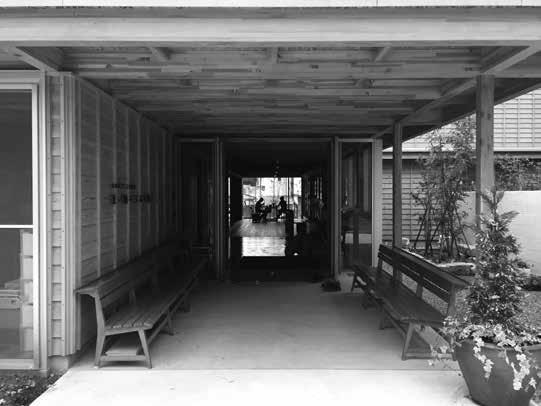
Higashiyahata Christ Church, four benches under the eaves
church. Pastor Okuda himself certainly has a keen aesthetic sense. He undoubtedly noticed the problem from the outset, but was unable to prevent it, which was troubling him. After the first baptism, he came to me and asked apologetically, “What do you think of these?” I suspect he intended to elicit from me the words, “They don’t suit the architecture,” so he could immediately remove them on the grounds that “Tezuka-sensei told me they were no good.” Knowing this, I cruelly replied, “Don’t ask me.” In fact, rather than being obstacles, I found the benches endearing. I heard they were used as a place for parishioners to gather after services. This is one blessing of a church with eaves. These eaves were installed for people to gather. The space under the eaves is not sacred. It should be an area in which people can do as they please, free from reprimands and time pressure. Of course, I hope that one
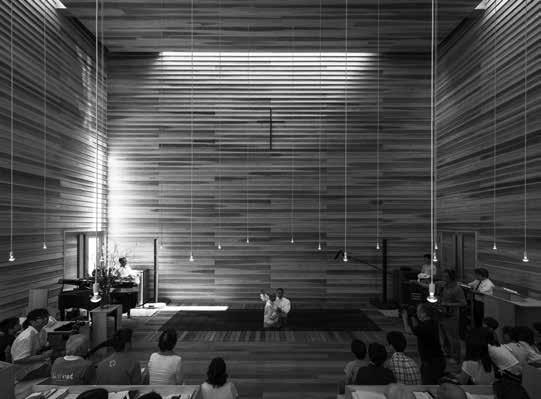
day they will be replaced with chairs that fit the style of the building and are comfortable to sit in, but as an outsider, it would be wrong for me to ask them to throw away chairs that have been polished and cherished for so many years. I wanted Higashiyahata Christ Church to have large eaves. It’s quite a scene when a greatly diverse group of people from many different households are jostling under one roof. “Lend your eaves and you will lose your house.” Because there is no discrimination under the eaves, naturally the people who gather there are a mixed bunch. The charm of Higashiyahata Christ Church lies in the diversity produced by this mixture. Boards are affixed to both sides of the benches in the church hall. While these boards are also there for structural reasons, I also thought that, without boards on both sides, high-spirited parishioners might uncontrollably spill out. I think that a style
about the Meiji Restoration. Experts in history often criticize him for “telling lies.” This is only natural. He is a novelist, not a historian. Takamori Saigo’s conversations were not recorded anywhere. Yet they have captivated the public and created a generation of innumerable fans of the Meiji Restoration. Another great figure from the same era is Shotaro Ikenami. He weaves vivid descriptions of food into his historical novels. The aromas waft and juices shine from between his words. He has published something like a cookbook. However, even if you read this book, you won’t learn about the seasonings or the temperatures, because it is written as a cuisine-related event. This lighthearted writing, like an essay about a hobby, has produced far more gourmets in Japan than have serious cookbooks.
Architecture is not an object, but an event. Why do we build architecture? “To be, or not to be.” To build, or not build. To people who build architecture. To people who study architecture. To people who use architecture. I want to convey these thoughts.

This is a forty-minute video. It won an Emmy Award. It’s wonderful, so please watch it.
Children
Jhamtse Gatsal
We are in a wonderful world. We are deep in the Indian Himalayas, on the border with Bhutan. Here lies Jhamtse Gatsal. The name means “garden of love and compassion.” Unfortunately, there is no equivalent in Japanese. If you look up “compassion” in a dictionary, you’ll find it means charity and sympathy, but “Jhamtse” is neither of those things. It means uniting one’s feelings with others, sharing in their sorrows and joys. The words charity or sympathy have condescending tone, suggesting that “those already in a safe zone will help those now suffering.”
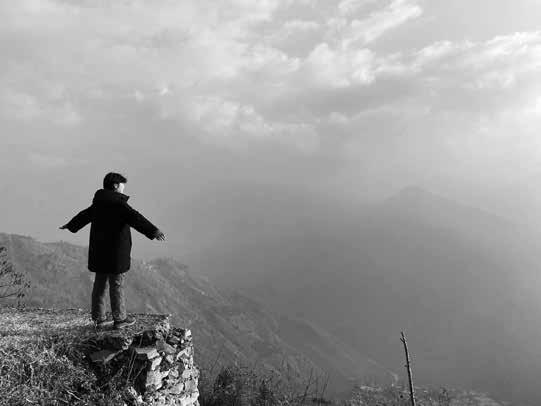
Yui Tezuka spreads her arms on a Himalayan ridge
important to raise doubts and recognize differences in opinion. Zen dialogues in Tibetan Buddhism will start with two people, but may then increase to three, five, seven, or thirteen people. How on earth can there be a Zen dialogue with such a large group of people?
People can only converse in their normal speaking voices up to seven meters apart. When people can see each other, they come to respect each other. Having no abrasiveness is important. Many things become visible.
Children
When dealing with the phenomenon of so-called poverty by putting the best architecture in the poorest regions, we often collide with criticisms such as, “Such people don’t need splendid architecture” or “Such people shouldn’t be given delicious food.” These are not just in online comment sections. They may be heard in places that are actually involved in welfare. Behind such criticisms lies a condescending attitude: “These people now in distress are a different breed, and that’s why we’re helping them.”
Jhamtse Gatsal is an orphanage. Particularly in Indian society, the lives of orphans are highly perilous. They barely scrape by, skimming just above the ground. Saving them is a virtuous act. However, Jhamtse Gatsal is more than just a facility to save lives. It’s a family. As a family, it’s natural to strive to bring even a small smile to the faces of every member. That’s why we serve delicious, nutritious meals to the children. There are many restaurants along the 500-kilometer road to the nearest airport. By Japanese standards some of these places might not be considered restaurants, but to the local community they are splendid restaurants. But the meals at Jhamtse Gatsal are the best. They employ good chefs who are constantly innovating.
Despite being in the middle of nowhere, Jhamtse Gatsal offers the best education in the region. Ninety percent of the children go on to university, and the orphanage produces nine of the top ten students in the region. This is not to say that cultivating an elite is admirable. The orphanage also offers a wide range of workshops to train carpenters and farmers. What’s important is choice. Orphans here can become anything they want if they strive. To become anything, they need to know about good things.
are drawn downward, showing the beauty of the rocks that have been sculpted by the Aki River since time immemorial. The valley is deep, and sunlight enters only briefly. Reflections on the river surface capture those brief moments. Direct sunlight cannot enter. Groundwater is drawn under the eaves. It is not called a cold spring. It is water from the Aki River, a clear stream that extends deep underground, filtered by rocks and leaves. This water fills the bathtub, the rim of which is invisible. The bath has an indigo color, painstakingly polished by artisans over several months. Indigo is the shade of black visible just before sunrise. It is also the black of Kurochaya, the parent of this annex. When filled with water, the bath basin becomes a single stone, reflecting the trees of the valley and weaving infinite illusions.
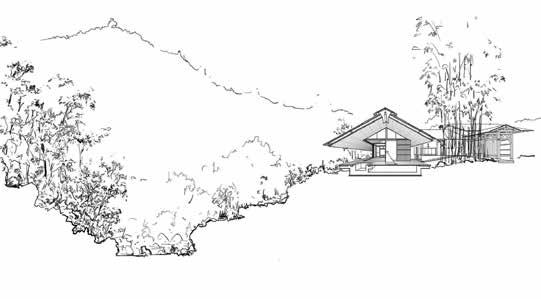
Most of this building is exterior. In Noh, it would be a stage. There are paths with eaves, and a real bamboo garden corresponding to a kagami-ita (painted backdrop). There are no posts defining
Japan
the place. The thirteen-bay-wide eaves are floating. Taking a seat on the stage, with the bamboo grove in the courtyard garden behind you, manifests a timeless emaki (picture scroll) that could never be depicted by a human intellect. Here, one can eat and drink in the rain and the snow. On fine days, the glorious sunshine reflects even more brilliantly on the underside of the eaves. The more magnificent a modern Noh stage is, the more it is protectively enveloped within the theater, transforming it into an installation like a kagami-ita (painted backdrop). However, Noh originally involved setting a stage in nature and chanting about an empty world on the boundary between this life and the afterlife. Finally, the essence of Japanese architecture is the roof. Humans are surprisingly strong. While it’s indeed difficult to survive exposed to the wind and rain, as long as there’s a roof, we not only have the ability to survive but to find pleasure in it. There’s a charm to this moderate tailoring of nature.
The roof is made of corrugated slate. Though it’s slightly dyed with the color of Kurochaya, it’s the same material as an ordinary factory roof. If we had wanted to, we could have used ceramic tiles. Even so, we chose corrugated slate because, out of all the modern options, it is the material that is best suited to the design. There are no gutters at the ends of the eaves. When rain falls into the ravine, the corrugated slate splits the water, creating a natural screen from streams of droplets equal to the number of grooves.
The wall finishes are woven. We cut 20,000 thin panels and glued them together, leaving tiny, hair-width gaps. On the interior, they are affixed horizontally. On the exterior, they are affixed vertically. The interior follows the water that moves left and right, while the exterior keeps out the vertically falling rain. The undersides of the eaves are fixed with thin wood blocks, stained black. They are held down with wooden battens. The porous ceiling reduces echoes. Steel panels would be too thick to appreciate the sound of
“Gathering” with crescent-shaped cushions
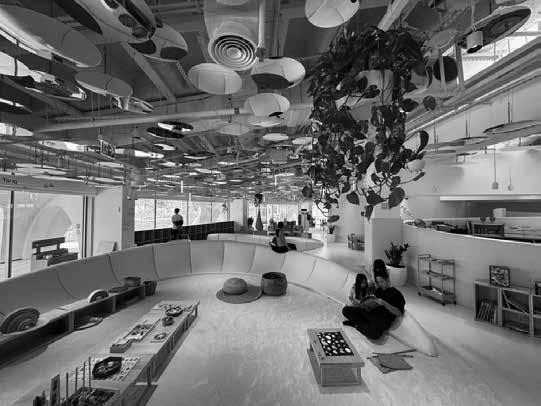
the C, a sense of connection is born. There are no chairs in the classroom. It is a carpet culture. They use cushions like tangerines, which are called poufs. These may be sat upon directly. The desks recall Japanese low tables with foldable legs. There are no classrooms that separate the children. This is a place where people gather. “Gathering” is not the same as “assembling.” Walls are a hindrance when gathering. There are round, dish-shaped cushions in the center of the building. It is inappropriate to give instructions to children. Children know what is fun. Rules are not needed. Children grow. Gradually, they will come to need spaces for small groups. They will also need personal spaces. We must continue to think about this. But there is no going back to the old-fashioned square classrooms.
Architecture is the Last Piece of the Puzzle
Society is full of excellent activists. I’m not sure if expression “activist” is appropriate, but I can’t find any other word to describe them. These people could be called revolutionaries. They fight every day to create concepts that don’t exist in society. It isn’t a battle of life or death, They aren’t fighting for their lives, but they’re similar to the loyalist samurai who brought about the Meiji Restoration (1868). They burn and run, driven by an earnest sense of patriotism. Principal Kato of Fuji Kindergarten is trying to create a new type of early childhood education. Pastor Okuda has taken on the challenge of helping the vulnerable in society. Taro and Akiko Tamura are tackling the problem of family breakdowns caused by childhood cancer. Dr. Yoshimitsu Tokunaga of Sora no Mori Clinic is addressing the problem of infertility caused by bacterial imbalances. The monk Lobsang Phuntsok founded an orphanage in the world’s poorest and most remote place and created the world’s most advanced educational system. Throughout our lives as architects, we have been fortunate to meet and work with many great people.
No matter how excellent the architecture we build, we cannot find families for the people sleeping under the Shinjuku railway tracks. Architecture itself does not create new education. Architecture cannot prevent tsunamis. On the other hand, when designing hospitals, we’re often told, “What is important is the love from the nurses.” I agree. But “love from the nurses” alone won’t improve the future situation. Even if we shout, “More love from the nurses!” the love from the nurses is not inexhaustible. Nurses are also people.
Architecture is the last piece of the puzzle. Working as an architect, there are moments when the events in society seem like puz-