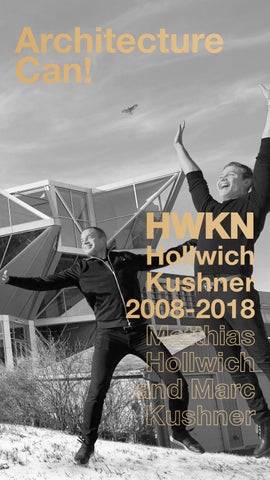
Architecture Can!
HWKN
Hollwich Kushner 2008-2018
Architizer People want to be social—so do buildings. We founded Architizer in 2008 because in the early days of social media publishing our work in architecture magazines was beginning to seem out of touch with how we were sharing information online. The platform we built hosts architectural portfolios. What we learned from the metrics—click-through rates and time-on-site—was that the public craved innovative, wildly unusual buildings. This discovery—a surprise to us—is one way social media has changed the relationship among 40
architects, buildings, and the audience, exposing the deepseated public preference for uniqueness of place and giving architects the ultimate communications tool to speak to a global audience.
Animalation For forty years the Black Party in New York City has brought together thousands of gay men for a night of bacchanalia. The salacious scenes that take place around the perimeter of the giant dance floor—the organizers refer to them as “curious acts”—had become so captivating that they dissipated the essential energy of the party. We wanted to see what would happen if we introduced a new focus to the space, one that would shift attention from the perimeter to the center. Since the architecture would have to compete with some very compelling content, we used mystery to draw the attention of the crowd. Our giant animated light object produced an effect similar to that of an ambiguous natural event, something like observers reading various forms into the same cloud formation. Different perceptions of the object—spider, harness, threat, refuge—created a personalized experience for each partygoer. The individual experiences, in turn, transformed passive onlookers into active participants.
42
Sasha Bruce House
43
Architecture is communal—it is one of the only experiences shared by all people of all cultures—but bringing people together to help one another is still a rarity. Nevertheless, architecture’s universality can bind the most diverse crowd. That was our experience at the Sasha Bruce House, a Washington, D.C., shelter for homeless youth. Then PresidentElect Barack Obama asked us—and offered to help us—to spruce up the interiors of this noble institution. The project kicked off his national call for volunteerism; even without this unique circumstance, the convergence of public-spirited individuals would have been significant.
The project involved friends, neighbors, and volunteers in a construction project that turned into a meaningful social experience for all involved. Architects have the power to include all sorts of stakeholders during the creation of a project. As we plan and construct each one, we continually ask ourselves how to build a sense of community one building at a time.
Wharf Marina The Wharf Marina floats along the Washington Channel on the edge of the new District Wharf community in Washington, D.C. At a time when most developers focus on building amenities, this building is an amenity for the entire neighborhood and the city at large, welcoming foot traffic by the water and boat traffic in the water. The building is a visual extension of a bench that edges the Washington Channel waterfront. Here the bench turns into a truss that zigzags between deck and ceiling. Housed inside of the truss is a simply detailed glass box with open interior spaces that provide uninterrupted views over the water and toward Washington’s historic fabric.
New(er) York Architecture’s vibrant longevity differentiates it from the other design disciplines. Unlike painting or sculpture architecture is not preserved in a museum—it is the museum. We have often wondered why the most popular buildings in New York City were built before World War II. Beauty is fleeting, but character is enduring, it turns out. We try to imbue our buildings with unique personalities so that they will stay vital for many years after they are built. New(er) York applies contemporary construction techniques and design methodologies to timeless New York City landmarks. We aspired to retain the visual liveliness of these buildings without directly copying their ornamentation; period details and flourishes instead inform new construction. Different cities and eras present an endless amount of inspiration—it is one of our favorite things about architecture.
$30.00 [USA] £19.95 [GB]