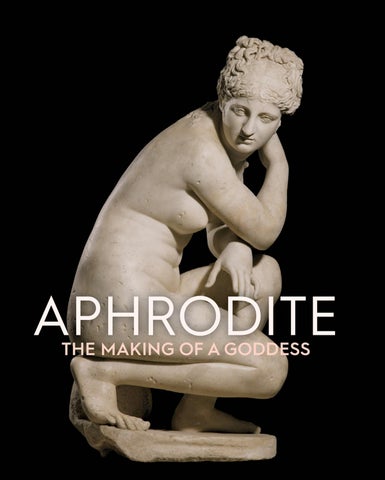
Contents aphrodite: the making of a goddess 8 October 2026 to 11 April 2027
Lead supporter of the exhibition:
Foreword
6
The A.G. Leventis Foundation
Acknowledgements
8
Chronology of the Mediterranean World
10
Summaries of principal Greek myths involving Aphrodite
17
Copyright © Ashmolean Museum, University of Oxford, 2026 Anja Ulbrich, Liam McNamara, Peter A. Thompson and Jennifer Sliwka have asserted their moral rights to be identified as the authors of this work. British Library Cataloguing in Publications Data A catalogue record for this book is available from the British Library ISBN: 978-1-910807-75-0 All rights reserved. No part of this publication may be transmitted in any form or by any means, electronic or mechanical, including photocopy, recording or any storage and retrieval system, without the prior permission in writing of the publisher. Catalogue designed by Stephen Hebron Printed and bound in Italy by OGM For further details of Ashmolean titles please visit: www.ashmolean.org/shop
Dimensions of objects are listed, when known at the time of going to press. For a full list of the objects shown in the exhibition, please visit the following weblink: https://www.ashmolean.org/exhibition/ aphrodite-the-making-of-a-goddess
Exhibition also supported by: The Huo Family Foundation
Kaplanis Charitable Trust Patrons of the Ashmolean Museum High Commission of the Republic of Cyprus in the United Kingdom of Great Britain and Northern Ireland The Panayotis & Effie Michelis Foundation We are most grateful to all our lenders, who are supporting our exhibition: Department of Antiquities, Republic of Cyprus Paris, Musée du Louvre, Département des antiquités orientales Paris, Musée du Louvre, Département des antiquités grecques, étrusques et romaines The British Museum The Metropolitan Museum of Art, New York The Royal Collection/ His Majesty King Charles III Rijksmuseum, Amsterdam Staatliche Museen zu Berlin, Gemäldegalerie Gallerie degli Uffizi Museo Gypsotheca Antonio Canova, Possagno, Treviso Private Collection Loewe Blenheim Palace Heritage Foundation National Museums Liverpool, World Museum North East Museums (Tyne & Wear Archives & Museums) Tate
Introduction Aphrodite – The Making of a Goddess Liam McNamara
23
Chapter 1 The Myths of Aphrodite Anja Ulbrich
27
Chapter 2 Aphrodite’s Island: Cyprus and its Almighty Goddess Anja Ulbrich
65
Chapter 3 Beauty and Beyond: Aphrodite/Venus in the Greek and Roman Worlds Peter A. Thompson
129
Chapter 4 Unearthing the Past: The Rediscovery of Aphrodite/Venus and her Transformation over Time Jennifer Sliwka
159
Chapter 5 ‘She’s got it!’ Aphrodite/Venus in Popular Culture Peter A. Thompson
193
Notes
200
Bibliography
203
Picture Credits
208
Map of the Mediterranean and the Middle East
Ostia
Rome
Pithekoussai
Eryx
Mt Olympus
Troy Athens
Locri
Aphrodisias
Mycenae Carthage
Kamarina
Knidos Lapethos Paphos
Kition
Byblos Tyre
Ascalon Naukratis
0
200 Miles Data: Natural Earth, NOAA
Opposite: detail of fig.1.36
20 aphrodite – the making of a goddess
Map of the Mediterranean and the Middle East 21
Aphrodite – The Making of a Goddess Liam McNamara Keeper of the Department of Antiquities
Fig.0.1 Ancient Roman marble statue of Aphrodite/Venus, replicating an image of the goddess made by the Athenian sculptor Praxiteles in the fourth century BCE. Metropolitan Museum, New York, 52.11.5
22 aphrodite – the making of a goddess
From ancient times to the present day, the Greek goddess Aphrodite and her Roman counterpart Venus have captured the imagination of artists, writers, scholars and audiences around the world (figs 0.1, 0.2). No other Greek goddess appears so often in myths, poems, plays, artworks, films, or even video games. Few figures from antiquity have inspired such lasting fascination or left such a strong mark on European art and culture. Ancient Greek and Roman stories about Aphrodite/Venus, together with famous sculptures of the goddess – many rediscovered in Italy from the Renaissance onwards – have shaped artistic creativity for centuries. These images not only inspired painters and sculptors, but also influenced ideas of female beauty and idealised femininity that still resonate today. Today, Aphrodite is best known as the goddess of love and beauty. Ancient stories repeatedly emphasise her extraordinary, almost supernatural beauty, as well as her charm, elegance and playful nature. These qualities led to many love affairs with gods and a few lucky mortals. Her power to awaken desire has strongly shaped how she has been imagined and represented, from ancient Greek and Roman art to Renaissance masterpieces and modern interpretations. Aphrodite is unique among Greek and Roman goddesses in being shown by artists – especially sculptors – as partially or fully nude, embodying divine beauty and attraction. She is often accompanied by Eros (known to the Romans as Cupid), the winged god of erotic love. Usually shown as a small naked boy with bow and arrows, Eros was believed to strike gods and humans alike, filling them with love and desire. Yet Aphrodite’s influence went far beyond romance and sexuality. Her myths, symbols and places of worship reveal a goddess with power over nature, society and human life itself. Aphrodite – The Making of a Goddess follows the goddess’s journey from her mythical birth and early worship on the island of Cyprus, through the Greek and Roman worlds, and into European art and culture up to the present day. The Myths of Aphrodite presents the best-known ancient stories about the goddess. These include her dramatic birth from sea and sky, her arrival on Cyprus, her triumph in a famous beauty contest against other goddesses, and her many
aphrodite – the making of a goddess 23
Fig.0.2 Blue Venus (The Venus of Alexandria), (S 41), by Yves Klein. A painted plaster sculpture replicating an ancient image of the goddess. Original work 1962, posthumous edition 1982. Private collection
relationships. Among them are her marriage to Hephaistos, the god of metalworking; her passionate affair with Ares, the god of war; and her encounters with mortals. Together, these myths reveal a complex goddess whose power extended across nature, human emotions and social order. Aphrodite’s Island: Cyprus and its Almighty Goddess explores the worship of a powerful female deity on Cyprus between about 1200 and 300 BCE. As people from different cultures settled on the island, the goddess absorbed traits from earlier Middle Eastern and Egyptian deities, including Ishtar, Astarte and Hathor. Sanctuaries dedicated to her existed in every city, where people gathered to worship, offer sacrifices and leave gifts. These objects give us vivid insight into ancient religious life. As her cult spread to mainland Greece, she acquired a new name: Aphrodite. Beauty and Beyond: Aphrodite/Venus in the Greek and Roman Worlds traces the goddess’s expansion across the Mediterranean and Europe. From ports in Egypt to Roman forts in northern Britain, her worship travelled widely. Her most recognisable images appeared in sculpture, on coins and on gems. Although best known as a goddess of love and pleasure, she was also associated with the sea, protection, and even warfare. In Roman times, she became Venus, a central figure in the imperial pantheon, whose image was adapted to local traditions throughout the empire. Unearthing the Past: The Rediscovery of Aphrodite/Venus and her Trans formation over Time focuses on the Renaissance rediscovery of ancient statues and the intense admiration they inspired. One of the most influential was the Venus de’ Medici, celebrated for centuries as the ideal of beauty, and endlessly copied and studied by artists. Today, contemporary artists continue to question and reinterpret these ideals, offering new perspectives on Aphrodite’s enduring legacy. ‘She’s got it!’: Aphrodite/Venus in Popular Culture explores the enduring and adaptable presence of Aphrodite/Venus in modern popular culture. It traces how the ancient goddess has been repeatedly reimagined in commercial, artistic and political contexts. Although she is often reduced to a symbol of beauty, desire and sexual attraction – especially in advertising, fashion, music and film – these modern uses reveal changing and sometimes contested ideals, rather than a single, fixed meaning. Beyond entertainment and commerce, Aphrodite/Venus has played a role in political and social activism, particularly in feminist and environmental movements. Taken together, these examples show the goddess’s ongoing cultural power and her remarkable ability to absorb, reflect, and express changing social values – confirming that Aphrodite’s story is far from over.
24 aphrodite – the making of a goddess
aphrodite – the making of a goddess 25
Fig.1.3 This terracotta figurine shows Aphrodite kneeling in a shell, holding a jewellery box, with Eros holding up a bath towel. It was found in Corinth and dates to the fourth to third century BCE. Berlin, Antikensammlung, TC 8351
Fig.1.4 Terracotta figurine of Aphrodite rising from the sea symbolised by the large shell as a backdrop and a smaller one in front, c.30 BCE to 30 CE, produced and found in Kerch on the Black Sea coast (Crimea). Paris, Musée du Louvre, Département des antiquités grecques, étrusques et romaines, CA 2288
34 aphrodite – the making of a goddess
Fig.1.5 Terracotta figurine of Aphrodite rising from the water, wearing a diadem or Stephane and wringing out her wet hair. This Greek-style figurine, dated to the first century BCE, was discovered in Cheikh Ibada, Antinoé (Antinoupolis) near Minya in Egypt and possibly made in a workshop in Alexandria. It demonstrates the wide distribution of Hellenistic and Graeco-Roman image types of Aphrodite across the Greek world and later the Roman empire. Paris, Musée du Louvre, Département des antiquités grecques, étrusques et romaines, AM1676
Fig.1.6 Silver coin of 1 drachm, minted in the city of Knidos with the head of a male roaring lion on the front side (obverse) and the head of Aphrodite with long hair and a diadem or fillet on the reverse, c.449–411 BCE. Diameter: 1.7 cm, weight 6.2 grams. British Museum, London, BM 1926,0203.8
with a lion’s head on the other side (fig.1.6). It is possible that the sanctuary has been discovered, but the identification is doubtful and the original sculpture of the goddess is lost. However, the full, standing form of the cult image is depicted on Roman coins of Knidos minted at the time of emperor Caracalla (r. 198–217 CE), whose bust is depicted on the obverse alongside his wife Plautilla’s. The reverse of such coins show the nude goddess standing beside a tall jar used to carry bath water (loutrophoros), holding a bundled-up garment or towel, and modestly covering her pubic area with her right hand. This gave her the name Pudica, a Latin term meaning ‘chaste’ or ‘modest’ (fig.1.7). All variations of the Pudica type in Roman sculpture depict the goddess covering her pubic area with one hand, while only some of them also show her covering her bust with her other arm. In some sculptures, the loutrophoros (bathwater jar) is replaced by a dolphin – referring to her birth from the sea – and/ or a figure of Eros. Many of the sculptures of this type were found without arms and/or a head, as those parts tend to break off if a sculpture topples over or is discarded. However, the appearance of the head, especially the hairstyle, and the positions of the arms can often be reconstructed from other sculptures of this type, where they are preserved, or from images on coins, which show either the head or the complete form of the statue (figs 1.8, 3.20). the myths of aphrodite 35
Opposite: Fig.1.9 Marble statue of a crouching Aphrodite or Venus, late second century CE. Roman variation of a Greek original, created by the sculptor Doidalsas c.200 BCE. Found in Italy. Royal Collections Trust, RCIN 69746. Displayed in the British Museum
Fig.1.10 Attic red-figure vase showing Aphrodite with sceptre riding a swan, attributed to the Achilles painter (460– 430 BCE), found in Polis tis Chrysochous, ancient Marion, Cyprus. Ashmolean Museum, Oxford, AN1891.451.a
Fig.1.11 Terracotta figurine of Aphrodite sitting sideways on a goose, her feet trailing in the water, third or second century BCE, from ancient Salamis, Cyprus. British Museum, London, BM 1881,0824.102
38 aphrodite – the making of a goddess
the myths of aphrodite 39
Opposite: Fig.1.16 Marble statue of Aphrodite with her foot on a tortoise/ turtle, second or third century CE, found in a temple of Artemis in Dura Europos, Syria. Paris, Musée du Louvre, Département des Antiquités orientales, AO 20126
Fig.1.17 Votive figurine of a turtle or tortoise, c.400–200 BCE, from KoukliaPalaepaphos, Cyprus. Ashmolean Museum, Oxford, AN1888.1268
42 aphrodite – the making of a goddess
upon a bronze he-goat. It is a work of Skopas, and the Aphrodite is named Pandemos (Common). The meaning of the tortoise and of the he-goat I leave to those who care to guess.11 One of the best-preserved examples of a statue fitting the description of Aphrodite with her foot on a tortoise, or possibly a turtle with its flatter shell (the ancient and modern Greek word for both is the same: chelóna), has been found in the Roman Middle East near Beirut/Sidon, albeit headless (fig.1.16). Pausanias’s bewilderment about the meaning of the tortoise has continued in scholarship to the present day, although various interpretations have been offered. These include suggestions that this animal – always carrying its shell and home with it, and having numerous offspring every year – symbolises the domestic sphere, including marriage, female sexuality, fertility and children, all of which were associated with the goddess. This interpretation is based on an episode of the Trojan War narrated in Homer’s Iliad: after being wounded fighting on the side of the Trojans (rather than the Greeks) and complaining to Zeus, Aphrodite is sent off the battlefield by Zeus with the order to focus on marriage, children and the household.12 Another possibility is that the tortoise or turtle also alludes to her stepping from the sea onto land, not only claiming dominion over it, but triggering a burst in the fertility of the earth, its vegetation, and animals. Both the tortoise (which lives exclusively on land) and the turtle (which, like Aphrodite, connects and moves between the sea and land, to lay her eggs in the sand) are very fertile animals, having numerous offspring per reproductive cycle. This also applies to the different birds associated with the goddess, including the aforementioned dove, swan and goose. Dedications of tortoise or turtle figurines are known from some Aphrodite sanctuaries in Cyprus and elsewhere in the Greek world (fig.1.17). The other cult image of Aphrodite Pandemos in Olympia, described by Pausanias, showed the goddess riding a male goat, clearly referring to the more earthly and carnal love and mating instinct the goddess inspired in both male and female humans and animals alike. This power of the goddess
the myths of aphrodite 43
Fig.1.18 Bronze mirror cover depicting Aphrodite Pandemos riding backwards on a galloping goat, c.375–350 BCE, from Palestrina, Italy. Musée du Louvre, Département des antiquités grecques, étrusques et romaines, NIII 3536; Br 1707.1; Br 1707.2
over animals might be symbolised by depictions of her riding various creatures, including birds, goats, sheep and possibly also bulls (figs 1.10–11 and 1.18–1.19). The response of the earth to Aphrodite’s arrival and landfall was to bring forth grass, greenery and blossoms. This means that the goddess triggered a boost in the fertility of the land, its soil, and all manner of vegetation. Aphrodite’s power over the fertility of the earth might be referred to by those Cypriot and Greek images of the goddess which show her holding a flower or fruit in her hand. In her homeland, Cyprus, she was sometimes depicted wearing a high crown composed of flowers and foliage, and occasionally of fruit or ears of wheat (figs 1.20–1.21). The presence of both fruit and grain suggests that Aphrodite’s power over the fertility of the soil extended beyond naturally occurring vegetation, including grasses and shrubs important for animal feed, to horticulture and agriculture. These activities are usually considered the remit of the Greek goddess Demeter (or her Roman counterpart, Ceres) – who is also depicted wearing a vegetal crown, or holding wheat or fruit such as the pomegranate – as well as of her daughter, Persephone (fig.1.22). Thus, in addition to being Aphrodite Pandemos, beloved of the common people, the goddess was also worshipped as Aphrodite Chthonia (‘Aphrodite of the Earth’), an epithet that connects her to the underworld, where the god Hades ruled and where vegetation seemed to emerge from every springtime, before retreating there every autumn or winter. In Greek and Roman art, only a few representations of two goddesses side-byside survive, and some can be identified as twin representations of Aphrodite. One example is a Roman double statuette from Paphos in Cyprus, which shows Aphrodite Ourania, the celestial goddess, clad in a gown covered in stars, and her earthly counterpart, Aphrodite Pandemos or Chthonia, fully wrapped in a simple, undecorated cloak covering her head (fig.1.15). 44 aphrodite – the making of a goddess
Fig.1.19 Terracotta figurine of Aphrodite Pandemos sitting on a ram, from Myrina on Lemnos, Greece, c.100 BCE to 100 CE, Musée du Louvre, Département des antiquités grecques, étrusques et romaines, Myrina 191, Myr 93
Fig.1.21 Terracotta figurine of enthroned Cypriot Aphrodite wearing a vegetal crown and holding a flower in front of her chest, c.mid-fourth century BCE, from ancient Kition (Larnaca), Cyprus. H; 26.7 cm × 10.2 × 8.7 cm. Musée du Louvre, Département des Antiquités orientales, AM 112
Fig.1.20 Cypriot limestone sculpture probably representing Aphrodite with a crown of ears and flowers in her hand, c.550 BCE, from Trikomo, Cyprus. Musée du Louvre, Département des antiquités grecques, étrusques et romaines, N III 3497
the myths of aphrodite 45
Left: Fig.1.26 Silver tondo applique, showing Aphrodite sitting on a rock in one of her rural open-air and garden sanctuaries, symbolised by the column and a statue of the shepherd god Pan. She offers a bunch of ears to a goose at her feet. Third century BCE. Staatliche Museen zu Berlin, Antikensammlung, No.1967.2 Below: Fig.1.27 Statuette of Aphrodite leaning on a column, Greek or Roman, Eastern Mediterranean, Hellenistic or Imperial Period, 100 BCE–100 CE. Museum of Fine Arts Boston, Museum purchase with funds donated anonymously, 1979.304. Photograph © 2026 Museum of Fine Arts, Boston
Below: Fig.1.28 Apulian Red-figure krater of the fourth century BCE showing Hermes sitting between the goddesses Hera, Athena and a seated Aphrodite holding up a mirror. This scene possibly depicts a rehearsal of the imminent actual beauty contest, Ashmolean Museum, Oxford, AN1944.15
During the Trojan War, Hera and Athena – both scorned losers in the beauty contest – fought on the side of the Greeks, while Aphrodite was naturally an ally of Paris, and therefore schemed and fought on behalf of the Trojans. After she complained to Zeus about being wounded in battle, he ordered her to leave the fighting to the gods of war, Athena and Ares, and to confine her activities instead to the domestic matters of love, marriage and beauty/beautification (see above).15 Convincingly, some scholars suggest that this myth reflects the integration of the Cypriot goddess (or Kypris, as she is called by Homer and other Greek poets) into the Olympian Greek pantheon.16 Zeus, the leader and father of many of the Olympian gods, did so by stripping Cypriot Aphrodite of those powers that were already assigned to other Olympian goddesses. These included politics and warfare, already the remit of Athena. Thereby, Aphrodite’s authority became increasingly (although not exclusively) focused on love, beauty and the domestic sphere, which included marriage, sex and procreation, all fundamental aspects of human life and society.
love and desire. Zeus appointed a judge, the Trojan prince Paris, who was grazing his flocks near Troy. The messenger god Hermes brought the goddesses before him, each of whom proceeded to offer a bribe to win the contest. Paris rejected both Hera’s offer of power over all of Asia, and Athena’s offer of wisdom and luck in battle in favour of Aphrodite’s promise to grant him the most beautiful woman in the world, Helen, who was already married to King Menelaus of Sparta. Aphrodite thus won the golden apple. She is often depicted with this fruit in Greek and Roman art, and in later European art (figs 1.27, 4.25). Paris abducted or rather eloped with Helen, convincing her to leave her husband and sail with him back to Troy. This instigated the Trojan War between the Greeks, led by Agamemnon, and the Trojans, so masterfully described in Homer’s Iliad. There are several depictions of the story of the ‘Judgement of Paris’ with the three goddesses on Athenian and South Italian red-figure vases; one of the finest of them is in the Ashmolean Museum (fig.1.28). This krater, a large, two-handled vase used for mixing wine with water, which was often a centrepiece at symposia (drinking parties) or wedding ceremonies, was produced by a south Italian potter in red-figure technique in the fourth century BCE. The image adds an intriguing episode into the famous story about the divine beauty contest. Paris has yet to appear, and the God Hermes is apparently running a rehearsal. Hera, at the left of the scene, tweaks the shoulder of her tunic. Hermes, wearing his distinctive wide-brimmed hat, gestures towards Aphrodite, who is seated at the same level and holds her trademark mirror. An armed and helmeted Athena stands close by. Perhaps Hermes is giving the goddesses their instructions and practising their lines – or, as he was one of Aphrodite’s many lovers, he might be coaching her to win. 48 aphrodite – the making of a goddess
the myths of aphrodite 49
jewellery boxes, as well as jewellery itself, are regularly adorned with images of the goddess or her associated animals (doves, dolphins), flowers or Eros (figs 1.30–1.34). As Aphrodite was not only patron goddess of brides, but of wives in their domestic sphere, women could be depicted with attributes of and animals sacred to the goddess, such as the mirror or the goose (fig.1.38).
Fig.1.40 Vulcan (Hephaistos) catching his wife Venus (Aphrodite) cheating on him with Mars (Ares), with the gods looking on, created in 1549 by printmaker Cornelis Massijis. Ashmolean Museum, Oxford, WA1863.8303
Aphrodite’s Love Affairs and children
Fig.1.38 Attic red-figure vase decorated with a domestic scene. Two women stand in conversation, one holding a mirror, with a goose between them; both items were attributes of Aphrodite, c.480–470 BCE. Ashmolean Museum, Oxford, AN1885.663
Aphrodite and Hephaistos’s incompatible personalities led to her committing adultery with a string of other Olympian gods and even some humans. Several of those affairs resulted in children, while her marriage to her lawful husband, Hephaistos, remained childless. Thus, a dalliance with love-struck Poseidon, with whom she regularly joined forces as goddess of seafaring, resulted in the birth of two daughters, Rhodos, the goddess of the island of Rhodes (situated on one of the major maritime trade routes of ancient Greece), and a sybil or prophetess called Herophile (literally ‘friend of Heroes’). Together with Hermes, with whom she shared and possibly bonded over frequent air travel (the goddess was constantly commuting for work between her home island, Cyprus, the mountain Olympus, and other ‘workplaces’ across the Greek world, including Troy), she had only one child: the intersex god Hermaphroditus. This figure, whose body combined both female and male characteristics, representing androgyny, fertility and the union of opposites, appeared in art and literature as a dual-sexed deity and gave rise to the term ‘hermaphrodite’ (fig.1.39).
Ares
Fig.1.39 Small marble statuette of nude Hermaphroditos with clearly indicated female and male features, possibly a copy of a larger sized Hermaphrodite statue type, made in a Roman workshop, 70–100 ce. National Museums Liverpool, Lady Lever gallery, LL13
54 aphrodite – the making of a goddess
Aphrodite’s most significant and enduring extra-marital love affair, however, was with Ares (whose Roman counterpart was Mars), the impulsively violent god of strife and warfare. She was caught cheating with him in her marital home and bed by her husband Hephaistos, who exposed the intertwined couple in flagrante delicto to the horrified (but also gleeful) assembly of gods.19 This story was also never depicted in Greek or Roman art, but amusingly portrayed in later European art, particularly prints (fig.1.40). The enduring and long-term mutual the myths of aphrodite 55
66 aphrodite – the making of a goddess
aphrodite’s island 67
From Greek myth to history and archaeology
A
Previous pages: Fig.2.1 The coastline and landscape of Cyprus around the rock formation Petra tou Romiou (background). Cypriot folklore has it that the goddess Aphrodite stepped onto land here, about 8 km east of ancient Paphos (modern village of Kouklia) and her famous temple, mentioned by Homer. Opposite: detail of fig.2.91
68 aphrodite – the making of a goddess
phrodite’s birth story, as explored in the previous chapter, firmly connects Aphrodite to the Eastern Mediterranean island of Cyprus. The goddess either returns to, or sets off from, her home sanctuary of Paphos in several other tales, including repeatedly during the Trojan War, and in the Homeric Hymns. The myth of Adonis and other stories about Aphrodite either mention or are wholly or partially set in Cyprus, or feature mythical figures connected with the island, such as King Kinyras of Paphos, the father of Adonis. Many stories about Aphrodite are associated with the Trojan War of Homer’s Iliad, such as the Judgement of Paris, which was the catalyst for the whole conflict. We have to rely almost exclusively on literary evidence from ancient Greek and Roman authors for information about Aphrodite and her cult and worship on her birth island of Cyprus. Although ancient Cypriot literature has not survived, its existence is attested in Greek and Roman sources. Authors of the Late Roman and Byzantine periods record some of the content of an epic poem called Kypria, composed by the Cypriot author Stasinos, probably in the seventh century BCE, who was as semi-legendary as Homer. The Kypria belonged to the so-called ‘Epic Cycle’ of five epic poems telling stories related to the Trojan War, expanding on and supplementing Homer’s Iliad and Odyssey.1 Given the title, the Kypria might have recorded further genuinely Cypriot myths and events concerning the Trojan War, possibly also featuring Aphrodite. The goddess was so closely connected with Cyprus that Homer, Hesiod and other early Greek poets called her Kypris or Kypria (the Cypriot goddess) as often as they used her new Greek name, Aphrodite (meaning ‘[One] given from the foam of the sea’), possibly referring to her birth myth (see chapter 3). The epic poem Kypria might also have provided more information on Kinyras, the most famous mythical king of Cyprus, who was considered founder and first king of Paphos and its famous sanctuary of Aphrodite, built ‘near where she emerged from the sea’, and where he also served as her first chief priest (fig.2.1). After him all subsequent historical high priests of Aphrodite in Paphos called themselves Kinyradai (Greek), as attested by Greek Hellenistic and Roman dedicatory inscriptions found in the sanctuary (fig.2.27).2 Kinyras’s intimate connection with Aphrodite in Paphos is also reflected in the story of his son Adonis, who was passionately loved by the goddess, and Kinyras is also associated with the Trojan War. Upon hearing about the planned Greek expedition to Troy, he sent an elaborate breastplate or cuirass to its leader, King Agamemnon of Mycenae.3 This gift, mentioned in The Iliad, perhaps echoes a relationship between the Greek mainland and Cyprus in the Late Bronze Age aphrodite’s island 69
Mediterranean at the time (fig.2.24). Both through the image-type of the nude goddess, associated with Astarte, and the oxhide ingot-shaped base, this figurine represents the Cypriot goddess not only as love, sex, war and fertility goddess (like Astarte), but also as patron-goddess of Cyprus’s rich copper resources, copper mining and metalworking. This unique aspect of the Cypriot goddess was observed by the Mycenaean Greeks who traded with and emigrated to Cyprus around 1200 BCE, precisely when this figurine was made. Her association with copper would later be reflected in Aphrodite’s marriage to Hephaistos, the Greek god of metallurgy (see Chapter 1).
The Cypriot Goddess and Greek Migrants to Cyprus When the Mycenaean Greeks first traded with and then emigrated to Cyprus in large numbers from around 1200 BCE onwards, they found that the local Cypriot population, the Eteo-Cypriots, worshipped just one all-powerful multifaceted goddess over the entire island. At home, they had worshipped several Greek goddesses, with names familiar to us from the Olympian gods; Linear B tablets from Mycenaean palaces mention Athena, Hera, Potnia Theron (Artemis), Persephone and Eilytheia. None of those appear in the dedicatory inscriptions found in Cyprus before the fifth or even third century BCE. Thus, it appears that the Greek immigrants started to worship this Cypriot Great Goddess as their main goddess alongside the local Eteo-Cypriots in the same sanctuaries in order to integrate with the Cypriot population. Both Greek settlers and Eteo-Cypriots used very generic titles rather than a specific name for the Cypriot goddess until the late fourth century BCE. In dedicatory inscriptions that record the Greek language in a Syllabic Cypriot script – a format known as Greek Cypro-Syllabic – she is simply addressed as ‘thea’ (the goddess, as there was only one), ‘wanassa’ (the queen, echoing the Mycenaean term for the king, ‘wanax’), or ‘Paphia’ (the goddess of Paphos) after her main island sanctuary in Paphos. Dedications to Paphia were found in other Cypriot city-kingdoms, including Chytroi and Ledrai (modern Nicosia), which underlines the prominence of her main sanctuary in Paphos (figs 2.25, 2.26). A late fourth-century BCE royal dedication to the goddess, from her main sanctuary on the acropolis of the city-kingdom of Amathous, is written in both Greek CyproSyllabic and Greek alphabetic scripts. While the Cypro-Syllabic text calls her just ‘Kypria’ (the Cypriot goddess), the Greek alphabetic text calls her ‘Kypria Aphrodite’.17 As well as being one of the earliest Greek alphabetic inscriptions found on Cyprus, this is the first time the name Aphrodite appears on the island, combined with her local name, Kypria (figs 2.25). From the third century BCE onwards, Greek alphabetic dedications replaced the Greek Cypro-Syllabic ones, and the name Aphrodite was often combined with her old local names. Thus, she is regularly called ‘Aphrodite Paphia’, particularly in her home sanctuary at ancient Paphos, which was the most important sanctuary of the goddess not only in Cyprus, but in the entire Hellenistic and Roman world. One of those
80 aphrodite – the making of a goddess
Fig.2.24 Copper oxhide ingot from the Uluburun shipwreck with signs of corrosion, 1450–1050 BCE, 28.6 kg. Metropolitan Museum of Art, New York, inv.no. 11.140.7
Lapethos
Kyrenia
Bellapais Vounous Chytroi Pomos Soloi Tamassos
Marion
Salamis
Ledroi Idalion
Kotsiatis Kition
Lemba (Nea) Paphos
Souskiou Paphos
0
Kourion
Amathous
15 Miles Data: Natural Earth, NASA, OpenTopography
Fig.2.25 Map of Cyprus during the Archaic and Classical period (750–310 BCE), when the island had fourteen politically autonomous city-states, each ruled by a king, which are commonly called city-kingdoms (their names are underlined). They had surrounding territories (with further towns and villages), the borders of which fluctuated over time and can only be tentatively reconstructed. The map shows other sites mentioned in the text
aphrodite’s island 81
Right: Fig.2.69 Lifesize limestone head of a goddess or her priestess with vegetal crown adorned with sphinxes, rosettes, topped by either stylised doves or leaves, from the sanctuary of the goddess at Arsos. Cyprus Museum, Nicosia, 1935/D 285 Far right: Fig.2.70 Limestone statue of the goddess or priestess with vegetal crown in full Cypriot female dress, earcaps and rich jewellery, 500–475 BCE. Paris, Musée du Louvre, Département des Antiquités orientales, AM1514
Fig.2.68 Colossal limestone head of the goddess or her priestess with vegetal crown, decorated with branches, flowers, sphinxes and doves perching on top, ear-caps (a specifically Cypriot ear-ornament made of fabric), and multiple earrings, c.500–450 BCE, from the sanctuary of the goddess at Arsos. Cyprus Museum, Nicosia 1939/IX-7/1
100 aphrodite – the making of a goddess
Fig.2.71 Terracotta figurine of the goddess with vegetal crown, seated on a throne flanked by sphinxes while holding a round perfume bottle (aryballos) in her right hand, c.400–300 BCE. British Museum, London, BM 1866,0101.1
the earth and vegetation, an aspect reflected in Hesiod’s birth myth of Aphrodite as well as in the Adonis myth (see Chapter 1). The goddess with a vegetal crown introduces a whole new scale of sculpture to the sanctuaries of the Cypriot goddess. While previous image types are generally on a small scale, there are colossal versions with a vegetal crown as well as life-size and half-life-sized examples. The type seems to have been a genuinely Cypriot creation, having originated in the fertile Mesaoria plain, most notably around Golgoi and Idalion, Arsos and Achna. From there it spread towards the coastal areas in the eastern half of the island around Salamis and Kition (fig.2.25). Numerous smaller mould-made terracottas of this type, some depicting the goddess seated on a throne, occasionally flanked by sphinxes, were dedicated in various sanctuaries in the eastern half of the island during the fifth and fourth centuries (fig.2.71). There are several indications that this image type depicts the goddess herself. Firstly, a female head with such a crown is depicted on fifth- and fourth-century BCE Cypriot coins of various city-kingdoms (fig.2.42), and coins only ever depict deities or their symbols. Secondly, the crowns are often embellished with sphinxes, doves and even Astarte figurines, all associated with the goddess, or the goddess is seated on a sphinx-flanked throne. Thirdly, the most iconic statue with a vegetal crown, created in the fourth century BCE and dedicated in the sanctuary of Apollo and Aphrodite at Golgoi-Agios Photios, is clearly identifiable as Aphrodite, as she carries a winged Eros on her left arm like a mother would her infant. Furthermore, her crown not only consists of twigs and foliage, but features two nude females, one on each side (figs 2.72–2.73). Thus, this sculpture combines all of the aforementioned iconographic references to love, sexuality, aphrodite’s island 101
Fig.2.137 Head of a bronze statue of Apollo with his characteristic semi-long hairdo. Chatsworth Apollo, from a riverside sanctuary just outside of the city of Tamassos, c.470–460 BCE, British Museum, London, 1958,0418.1
Fig.2.135 Silver coin of Kition, minted during the reign of King Azbaal, c.430 BCE. Obverse: Herakles-Melqart with lionskin and bow in striking pose; reverse: lion attacking a stag. Ashmolean, HCR6322
of ancient Cyprus. All sanctuaries in the capital cities of the city-kingdoms (for example at Amathous, Paphos, Idalion etc.) are dedicated to the goddess, while the Cypriot god was always worshipped in sanctuaries outside the cities and their walls. This includes major sanctuaries like the one of Apollo Hylates (of the forests) near Kourion, situated 2 km west of the city, and others even bordering the city-wall, like the Apollo sanctuary in Idalion. The only exceptions are the urban sanctuaries of the Phoenician counterpart couple, Astarte and Melqart, in the Phoenician city-kingdom of Kition (modern Larnaca), reflecting the more Middle Eastern religious traditions practised by its largely Phoenician inhabitants. Fig.2.136 Limestone statue of Apollo carrying a lyre at his left side, from a sanctuary at Golgoi-Malloura, c.440 BCE, Louvre, Paris, AM 2973
126 aphrodite – the making of a goddess
aphrodite’s island 127
Becoming Aphrodite: A Goddess in the Greek World
D
Opposite: detail of fig.3.16
130 aphrodite – the making of a goddess
espite the various similarities and connections between Bronze Age Cypriot deities and Greek gods outlined in the previous chapters, the question of precisely how and when the Greek-speaking peoples of the Mediterranean adopted the quintessential deity of Cyprus and transformed her into a member of their own pantheon is a contentious issue. Faced with a tantalisingly incomplete record of the ancient past, scholars do not agree on the character and chronology of the process through which Aphrodite emerged as a Greek goddess.1 What is clear, as shown in Chapter 2, is that there was largescale Greek settlement and cultural presence in Cyprus from around 1200 BCE onwards, and the island was certainly integrated within a busy network of economic and social exchange across the Aegean during that period, so we can be confident that some Greeks of the time would have encountered the important and powerful Cypriot goddess.2 By the eighth and seventh centuries BCE, we find the Greeks enthusiastically worshipping a new divine figure called Aphrodite, whom the epic poet Homer addressed as ‘the one from Cyprus, who arouses sweet desire for gods and who subdues the races of mortal humans, and birds as well, who fly in the sky, as well as all beasts – all those that grow on both dry land and in the sea’.3 Although Homer’s Aphrodite seems all-powerful, the Greek goddess was not a universal deity like her Cypriot predecessor. Instead, Aphrodite had to share the stage with other, older goddesses who already commanded responsibility over areas of life such as marriage (Hera), agriculture (Demeter), craft (Athena) and so on. As a result, greater emphasis came to be placed upon Aphrodite’s role as a goddess of desire, sex and beauty, and she gained a companion in Eros, a young god of love and sex who in some traditions was Aphrodite’s son. These facets of Aphrodite’s character have tended to dominate understandings of her significance from the Medieval and Early Modern periods onwards (see Chapters 4 and 5). But her significance in ancient Greece was not limited to those realms, and her authority extended to several other important aspects of life. As we have already seen, through Aphrodite’s place in various mythological and artistic traditions (Chapters 1 and 2), she retained the Cypriot goddess’s importance for seafaring, trade and war, with different inflections of the goddess’s powers serving the religious needs of the Greeks in a range of settings, some of which will be explored below. Just as the precise origins of the new goddess are obscure, the root of her Greek name, Aphrodite, is also contested. Although the Greek poet Hesiod connected it linguistically with the sea foam from which the goddess was born, Classical philologists now regard this as an unreliable folk etymology.4 Rather, the ancient beauty and beyond 131
Fig.3.4 Map of Athens showing the locations of Aphrodite’s sanctuaries in the city Orchomenos Naupaktos Boura Patras
Oropos
Mt Kyllini Psophis
Ourania
Sikyon
Megara
Corinth
Athens
Aegina
AGORA
Mantineia Argos Epiadauros Troezen Tegea
Elis/Olympia
with Eros
Bassai
Megalopolis
ACROPOLIS
en Kepois (exact location unknown)
Thebes
Thespiae
Aegion
Pandemos
Hermione
Sparta
Messene
Gytheio
0
20 Miles
Kainepolis Kythira
Greeks as a coherent ethnic group (Herodotus 8.144). But Aphrodite, as a patron of seafarers in a world that depended upon maritime mobility and trade, had a particular capacity to bring Greeks together. Indeed, other finds from Naukratis have indicated that Aphrodite was worshipped there with the epithet Pandemos, meaning ‘of all the people’, indicating her ability to unify Greek-speaking migrants and merchants from various home cities.13
Aphrodite for everyone? Cities, Politics, Warfare and Sex Aphrodite Pandemos appears again in Athens, a city where the variety of the goddess’s cults gives an illuminating view into the range of her powers and responsibilities (fig.3.4). As Pandemos she was worshipped at a shrine on the south-western slopes of the Acropolis hill, near the entrance to the citadel, and the Athenians claimed that this sanctuary had been established by the mythical king Theseus when he founded their city.14 Although in later centuries Aphrodite was worshipped as a protector of political magistrates in other cities of the Greek world, the notion of uniting and representing ‘all the people’, the entire demos, had special significance in Athens with the advent of democracy in the late sixth century BCE.15 In this political system, popular participation and broad support 134 aphrodite – the making of a goddess
Fig.3.5 Map of Greece showing the locations of sanctuaries, temples and altars of Aphrodite mentioned by the second-century CE traveller Pausanias
Data: Natural Earth, NASA, OpenTopography
were essential to decision-making – the divine favour of Aphrodite Pandemos could be instrumental in achieving this, especially as her companion at this shrine was Peitho, the spirit of persuasion. But in the democracy, Aphrodite was by no means restricted to this function. Only a few minutes’ walk away from the Pandemos shrine, on the north slope of the Acropolis, another sanctuary served Aphrodite and Eros, emphasising the goddess’s importance for love and sex, and a few hundred yards further north, in the agora (the marketplace and political heart of the city), she was worshipped as Aphrodite Ourania (‘heavenly’).16 Drawing upon textual and archaeological sources, the list goes on: elsewhere in Athens, near the Ilissos river, there was a shrine to Aphrodite en Kepois (‘in the Gardens’), and she also had major sanctuaries at the Piraeus, the port of Athens, both as Ourania and as Aphrodite Euploia (‘of fair voyages’) – clearly of great importance for a city that boasted (and relied upon) a powerful navy.17 The number and character of Aphrodite’s cults in Athens is typical of her presence across the Greek world, where her shrines were abundant and her epithets were various. The ancient writer Pausanias, in his guide to the sites of historical and religious interest that he encountered in Greece during the Roman period, mentions seventy sanctuaries of Aphrodite, and he also records many of the goddess’s names (fig.3.5). From these we get a clear sense of Aphrodite’s strong connection with seafaring, and she was worshipped by maritime traders and by beauty and beyond 135
Opposite: Fig.3.37 Byzantine wood, bone and horn casket showing the story of the hero Paris from Greek mythology. Made in Venice c.1400–1430 CE. Ashmolean Museum, Oxford, WA1947.191.228 Right: Fig.3.38 Detail of the Pris Casket showing Aphrodite, Hera and Athena in the Judgement scene, c.1400– 1430 CE. Ashmolean Museum, Oxford, WA1947.191.228
Aphrodite/Venus raising her foot to remove her sandal, their decision to reproduce that pose here makes no clear narrative sense, and in this context it seems that the goddess simply serves as a marker of the scene’s antique and amorous character. Later, on a fifteenth-century CE casket in the Ashmolean Museum (fig.3.37), Aphrodite is depicted in a scene of the Judgement of Paris, but there the goddess was presented identically to her competitors Hera and Athena, rather than being individualised, with all three deities lacking any of the features or attributes that defined their Classical image types (fig.3.38).70 Rather than a goddess to be revered and feared, the post-Roman version of Aphrodite/Venus lost her spiritual authority and became a more straightforward symbol of love and beauty, often deployed as a signifier of the antique past.71 Of course, the antique past can command great authority and importance in the modern world. Aphrodite/Venus, as a multifaceted divine figure whose worship had been extremely widespread across the ancient Mediterranean, held enormous potential as an emblem of the sophistication and artistic achievements of Greco-Roman antiquity. In time, these themes would return to widespread cultural prominence within the socio-political framework of Early Modern Christian Europe. Although stripped of her divinity, with her celebrated statues buried under proud monuments of a new age, Aphrodite/Venus would rise again.
156 aphrodite – the making of a goddess
beauty and beyond 157
Fig.4.1 The Medici Venus, late second century BCE–early first century BCE, marble sculpture, 153cm (h). Galleria degli Uffizi, Florence, 1914 no. 224
Right: Fig.4.2 Study of the Venus de’ Medici by Maarten van Heemskerck (1498–1574), c.1532– 1536, red chalk on paper, 13.4 × 21.1 cm. Staatliche Museen zu Berlin, Inv. no.: 79 D 2, fol. 63 verso Below left: Fig.4.3 Drawing attributed to the circle of Raphael (1483–1520), Two Figures of Aphrodite, c.1508–1525, pen and brown ink on laid paper, 32.2 × 21.7 cm. Ashmolean Museum, Oxford, WA1846.261 Below right: Fig.4.4 Drawing attributed to the circle of Raphael (1483–1520), Aphrodite, c.1500– 1550, pen and brown ink on paper, 26.2 × 15.1 cm. Ashmolean Museum, Oxford, WA1846.263
162 aphrodite – the making of a goddess
unearthing the past 163
of course, in the making of casts which are produced section-by-section before being reassembled. By drawing attention to the way this statue has been held up as a singular ideal of beauty for centuries, Man Ray questioned its status for contemporary artists and essentially liberated them from tradition, inviting them to consider alternative models for emulation and invention. This sculpture forms part of an edition of ten plasters made in 1971 by Arturo Schwarz which recreate the ‘original’ object – a hollow plaster cast – from 1936. Although the ‘original’ was dismantled shortly after its execution and the plaster cast reused by Man Ray in further artistic experimentations, it was immortalised in a photograph by the artist. In 1971, Man Ray instructed Schwarz to find more casts after the ancient torso, each of which he then bound with rope. The sculptures were clearly meant to be provocative, to challenge perceptions and traditional values. The artist deliberately chose the erotic female body of the goddess, knowing full well its power to seduce and excite as well as its potential to outrage and offend. This series of bound Venuses encourages us to view the ancient sculpture through a different lens, and draws attention not only to the early ‘restorations’ or additions that were appended to the antique sculpture, but also how it has been replicated, adapted, and varied in different iterations over the centuries in ways that have transformed or altered the original meaning or function of the piece. 186 aphrodite – the making of a goddess
Fig.4.24 Michelangelo Pistoletto (b. 1933), Venus of the Rags, 1967, 1974, marble and textiles, 212 × 340 × 110 cm. Tate Britain, London, T12200
The Venus Pudica type also features in the work of Italian artist Michelangelo Pistoletto (b. 1933) whose Venus of the Rags is an icon of the Arte Povera (literally ‘poor art’) movement that emerged in Italy in the 1960s–1970s (fig.4.24). This movement embraced a wide range of materials, including those commonly discarded, such as soil, rags and twigs as a means of challenging and disrupting the values of commercialised galleries. Pistoletto made his first version of the Venus installation in 1967 using a mica-covered concrete sculpture from a garden centre that had a glittering white surface which he combined with a heap of brightly coloured rags. The sculpture is inspired by an ancient statue by Praxiteles known as the Aphrodite of Knidos dated about 360 BCE in which the goddess was depicted nude, reaching for a bath towel while covering her pubis, leaving her breasts exposed. Although the original Greek sculpture no longer survives, many Roman copies were made after it and, like the Venus de’ Medici, subsequent artists produced variations on the theme such as Bertel Thorvaldsen’s Venus with the Apple of 1813–1816, in which the naked goddess not only reaches for her bath towel, but also holds up the golden prize awarded to her by Paris, who judged her to be the fairest goddess in the mythical beauty contest with Juno and Minerva (fig.4.25). Pistoletto’s Venus is an inexpensive imitation of Thorvaldsen’s statue, which in turn is a derivation from the antique Pudica type. In repurposing the statue here, Pistoletto draws attention to the ways this seemingly infinite replication and imitation can – depending on the viewer’s perception – either devalue the power and beauty of the ‘original’, or render it more familiar and accessible to a wider audience. In combining sculpture and rags, Pistoletto also introduces a series of contrasts that invite consideration such as hard/soft, formed/unformed, white/coloured, fixed/movable, ‘precious’/disregarded, historical/contemporary and unique/common. Pistoletto has made several versions of the Venus of the Rags, using a range of materials and scales for the goddess and different arrangements of the rags, creating a new incarnation of the original concept that evolves and responds to changing ideas about beauty, consumerism, loss and waste. In this version from 1974, Pistoletto commissioned Tuscan stone masons to recreate the sculpture using a mica-containing marble, creating a deliberate and more costly replication of an imitation. The fact that the pile of rags in front of the naked Venus is largely composed of old clothes is also ironic: while these objects may have once held meaning or performed a specific function for the owner, they were subsequently lost or discarded. In Pistoletto’s installation, however, they are given new potential for meaning or beauty. Accordingly, while the many versions of the Venus of the Rags demonstrate the continued importance of the Venus Pudica in the canon of western art, they also reveal how the artist drew on the power and recognisability of this type to argue for a set of new aims and ambitions. In other words, the Venus of the Rags encourages us to reflect on the ways ancient statues of the goddess have dominated narratives around female beauty, artistic skill and economic value. Indeed, by positioning the goddess of beauty with her back to the viewer, Pistoletto subverts our expectations, deliberately rejecting historical presentations of the goddess. In juxtaposing her with objects that have been discarded or forgotten, Pistoletto’s installation deliberately leaves space for interpretation, unearthing the past 187